❌

Normal view

Could quantum protocols make electronic voting more secure?

9 September 2026 at 14:40
Electronic voting, the use of electronic systems to cast, record or count votes, could potentially simplify the process of electing new political leaders or other representatives. While some countries have already started using internet-connected devices or electronic voting machines at polling stations, the trustworthiness, security and anonymity of electronic voting systems are still widely debated.

Physicists Find Useful Energy Hiding in Quantum “Waste Heat”

8 September 2026 at 18:23
Heat Engine in Driven Dissipative Quantum SystemA new theoretical approach helps connect quantum physics with classical thermodynamics by clarifying what counts as heat and useful work in tiny quantum machines. When a machine is reduced to a single atom and particles of light, even basic concepts such as heat and useful work become difficult to define. This problem sits at the [...]

'There is no conflict between quantum physics and gravity': Physicists prove Einstein's 'happiest thought' holds true at quantum scales

For the first time, physicists have measured the tiny quantum shift an object acquires by falling through Earth's gravity — an effect of Einstein's relativity that was predicted almost a century ago but never observed.

Researchers placed ultracold rubidium atoms into a superposition, a quantum state in which a single particle takes two paths at once. In this experiment, one path put the atom in free fall while the other kept it motionless. Recombining the atoms revealed an almost imperceptible difference between the two paths.

The measurement, published Sept. 2 in the journal Science Advances, shows that Einstein's equivalence principle — the idea at the heart of general relativity — still holds when it is pushed into the quantum world, creating a small but tantalizing link between relativity and quantum mechanics.

"The principle says that acceleration and gravity cannot be distinguished locally," Vlatko Vedral, a physicist at the University of Oxford and a co-author of the new study, told Live Science via email.

Einstein's happiest thought

The classic illustration of the equivalence principle is a thought experiment known as Einstein's elevator. A person sealed in a windowless elevator cannot tell whether the floor is pressing against their feet because the elevator is parked motionless on Earth or because it is being accelerated through empty space. Einstein called that realization the "happiest thought" of his life and built general relativity around it.

For heavy, everyday objects, the equivalence principle has been tested to extraordinary precision. Quantum objects are a different matter. They behave like waves, and each wave carries a quantity called phase — essentially, where its crests and troughs sit. Phase cannot be seen directly, but when two versions of the same particle are recombined, any mismatch between their phases shows up as an interference pattern. The two waves reinforce each other in some places and cancel each other out in others, thereby changing the odds of where the particle turns up.

Theory says that a wave in free fall should build up phase relative to an identical wave held still and that this phase should grow with the cube of the falling time. Therefore, doubling the fall time multiplies the effect eightfold. Charles Galton Darwin, a grandson of the famous naturalist, and Earle Kennard both documented this prediction in 1927 ‪—‬ but no one had measured it until now.

An atom that falls and stays still at once

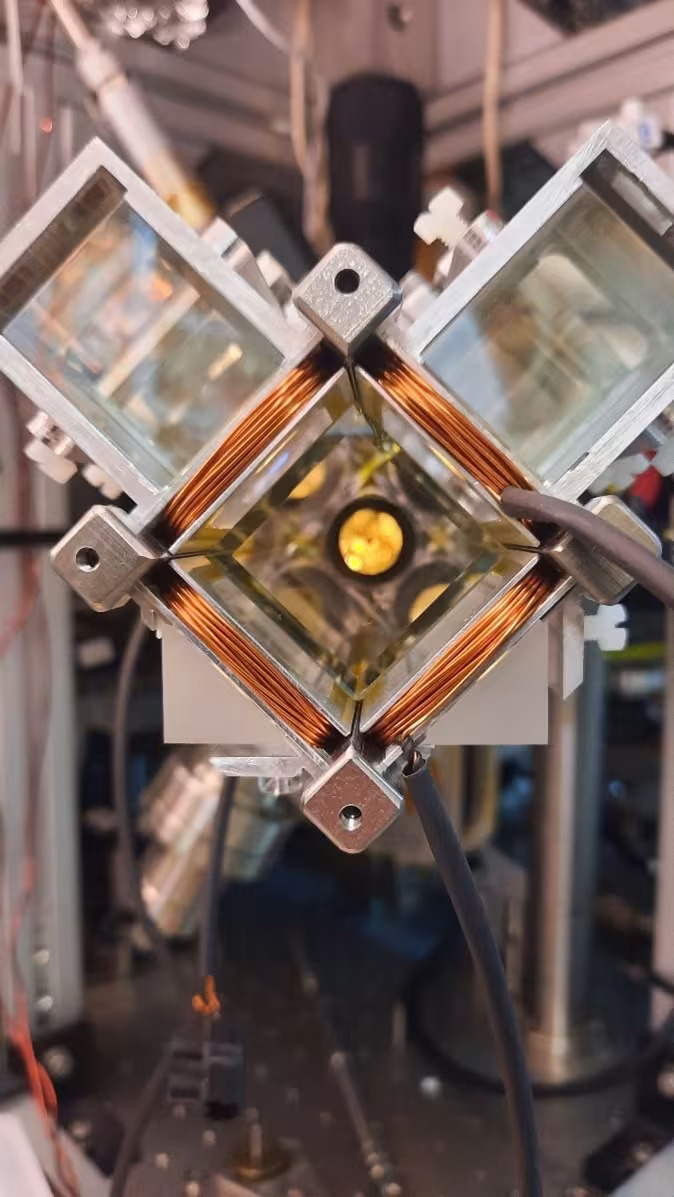
A square of copper coil held up by a series of metal bolts.

This apparatus, called 2D MOT, feeds the science chamber with cold atoms. (Image credit: Or Dobkowski)

Catching the effect required an instrument with one arm genuinely at rest with respect to Earth and the other in genuine free fall ‪—‬ something no previous experiment could supply. Matter-wave experiments going back to the neutron interferometry of the 1970s had measured gravity in other ways, but never with that pair of trajectories.

The team behind the new study, led by physicist Ron Folman at Ben-Gurion University of the Negev in Israel, chilled roughly 20,000 rubidium atoms into an exotic state of matter called a Bose-Einstein condensate, released them from their magnetic trap and ran the interferometer about 113 micrometers beneath an "atom chip" patterned with gold wires only 2 micrometers thick.

Radio and microwave pulses put each atom into a superposition of two magnetic states. A magnetic kick launched one of them upward, and a fraction of a millisecond later, a second pulse made that half insensitive to magnetic fields so that it rose and fell under gravity alone. The other half remained magnetically sensitive and felt a force tuned to cancel gravity exactly, leaving it suspended in place.

At the top of the arc, the two halves of a single atom stood about 7.5 micrometers apart ‪—‬ about seven times the width of the atomic wave itself — before the sequence was reversed to bring them back together. The team named the device the quantum Galileo interferometer, after the scientist who first argued that all objects fall at the same rate.

"Two different accelerations can be superposed, zero [acceleration] and the Earth's gravitational acceleration, and the resulting quantum interference measured," Vedral said.

A phase predicted almost 100 years ago

The researchers tracked the interference signal as they stretched the free-fall time to about 2.4 milliseconds. Across 633 runs over 5.3 hours, they recorded 13 complete oscillations, each one a full cycle of phase built up between the two halves of the atom. The growth followed the cube of the falling time, matching the theoretical model to within about 2.5%.

"The phase between the two elements of the superposition, which grows as the cube of the duration of the experiment and which was predicted a long time ago, in 1927, has now finally been observed for the first time," Vedral said.

The result matters because the same phase can be derived in two completely different ways: One treats gravity as a force acting on a quantum wave; the other moves into the falling frame, where gravity vanishes, and invokes the equivalence principle. Both give the same answer, and that agreement is what allows quantum mechanics and general relativity to coexist.

"They tell us that, at this level of accuracy, there is no conflict between quantum physics and gravity," Vedral said. "In other words, the equivalence principle is perfectly compliant with quantum mechanics."

The difficulty of bringing the two halves back together

The hardest part of the experiment was the recombination. Because the two halves of the atom end up moving at very different speeds, returning them to overlap in both position and motion is extremely demanding. Physicists Marlan Scully, Berthold-Georg Englert and Julian Schwinger named the problem the "Humpty-Dumpty effect." The magnetic fields also curve across the atom cloud, distorting the two halves in different ways.

The contrast of the interference fringes started at 80% for short runs and faded to 20% for the longest run, setting a practical ceiling on how long the experiment can run. The authors also cautioned that their measurement does not rule out every theory in which the equivalence principle breaks down, because some of those theories predict the same phase.

What comes next

The team now wants to test the equivalence principle under more general conditions, such as the "same experiment in a rotating frame," Vedral said. "Even more interestingly, performing an experiment in which two such systems are superposed and can gravitationally affect one another" would further test the results, he added.

That last idea points toward one of the field's central open questions. Scaling up the technique from atoms to far heavier objects, such as nanodiamonds, would let physicists ask whether gravity itself follows quantum rules and would open a route to testing the conjecture — championed by study co-author and Nobel laureate Roger Penrose — that gravity is what destroys quantum superpositions in the first place.

See how much you know about Albert Einstein with our Albert Einstein quiz!

“Magic-Angle” Graphene Uses Faint Light to Transform an Insulator Into a Metal, Revealing a New Way to Make the Unseen Visible

11 August 2026 at 12:56

A material that normally blocks the flow of electricity can suddenly begin behaving like a metal when exposed to remarkably weak light, according to a new experiment involving one of the strangest forms of graphene ever created. The breakthrough reveals that an unusual quantum effect could eventually provide a new way to detect some of the faintest radiation around us.

Researchers working with “magic-angle” twisted bilayer graphene found that faint, long-wavelength radiation can effectively melt the material’s fragile correlated insulating state, causing its electrical resistance to plummet. Remarkably, the experiments showed that even relatively weak radiation could trigger a dramatic transition from an insulator to a metal.

Beyond revealing an unusual way that light can manipulate matter, the discovery could provide the foundation for extremely sensitive detectors capable of spotting faint terahertz and far-infrared radiation.

With further development, detectors operating at these wavelengths could have applications ranging from security imaging and material inspection to astronomy and environmental sensing.

The study, published in Nature Communications, centers on magic-angle twisted bilayer graphene, or MATBG—a material produced by stacking two sheets of graphene and rotating them relative to one another at a carefully controlled angle.

Under the right conditions, interactions between electrons can cause magic-angle graphene to enter exotic collective states, including superconducting and insulating phases.

“Here we show that this expectation does not apply to magic-angle twisted bilayer graphene (MATBG) and demonstrate giant photoresponse of MATBG to low-intensity long-wavelength photons when it is tuned to half filling of the moiré band,” researchers write. “Far-infrared photons selectively overheat the low-heat-capacity electronic subsystem, driving a collapse of the correlated order and producing a giant photoresistive response.”

Ordinarily, changing an insulator into a conductor with light requires supplying enough energy to alter how electrons can move through the material fundamentally. Previous experiments involving light-induced insulator-to-metal transitions have frequently depended on intense, ultrafast excitation.

Magic-angle graphene offers another route.

Twisting graphene sheets at carefully controlled angles creates a larger repeating structure known as a moiré superlattice, dramatically changing how electrons within the material interact. Those interactions have already produced some remarkable results.

As The Debrief reported last year, researchers studying magic-angle twisted trilayer graphene uncovered new evidence of unconventional superconductivity, including unusually tightly bound electron pairs and a distinctive superconducting energy gap.

That work was part of a greater effort to understand whether these exotic materials could eventually help scientists design superconductors capable of operating at much higher temperatures.

In the new study, researchers exploited another unusual state that can emerge in magic-angle graphene. At certain electron densities, interactions between electrons become unusually important, allowing them to organize into what physicists call a “correlated insulator.”

That collective state is extremely fragile. The correlated insulating gap exists at an energy scale of only a few millielectronvolts. Previous measurements cited by the researchers indicate that a gap of approximately 1 millielectronvolt at very low temperatures gradually closes as the material warms and disappears around 10 kelvin.

The researchers realized that weakness could become an advantage.

Their experimental device consisted of magic-angle graphene sandwiched between layers of hexagonal boron nitride and configured as a field-effect transistor. A graphite back gate allowed them to precisely control the number of charge carriers and tune the graphene into its correlated insulating state.

They then exposed it to millimeter-wave and far-infrared radiation.

Instead of needing to inject large numbers of charge carriers, the incoming photons heated the graphene’s low-heat-capacity electronic system. That relatively small temperature increase was enough to destabilize the cooperative electronic order, retaining the insulating state.

The gap collapsed, resistance dropped dramatically, and the material became metallic.

Measurements in darkness and under illumination reinforced that interpretation. Without radiation, the graphene displayed the temperature-sensitive resistance expected from an insulator. Under millimeter-wave illumination, it instead exhibited behavior representative of a metal.

Researchers compare the mechanism to superconducting bolometers, highly sensitive radiation detectors in which incoming energy interrupts a superconducting state. But their graphene device essentially operates in reverse: instead of destroying a zero-resistance state, approaching photons destroy a high-resistance correlated insulating state and turn it metallic.

That makes the insulator-to-metal transition more than an unusual demonstration of quantum physics. It becomes the detector’s signal.

The team found that the device responded across wavelengths ranging from 85 to 2,140 micrometers, encompassing far-infrared and millimeter-wave radiation.

That portion of the electromagnetic spectrum is particularly interesting because it can reveal things ordinary cameras cannot. Terahertz radiation can penetrate some materials opaque to visible light, while interactions between this radiation and matter can provide information about a material’s composition.

More capable detectors could therefore eventually contribute to technologies such as security scanners looking for concealed objects, systems inspecting manufactured components without cutting them open, or sensors identifying substances using characteristic spectral markers.

Astronomy offers another potential application. Cold dust, star-forming regions, and other objects that may be faint or obscured at visible wavelengths emit radiation in the far-infrared. Detecting those extremely weak signals requires exceptionally sensitive instruments, making improved detector technology valuable for future astronomical observatories.

The experimental graphene detector exhibited considerable intrinsic sensitivity. The researchers measured an internal voltage responsivity of approximately 17 million volts per watt of absorbed power. They note that its internal responsivity exceeds that of many commercial bolometers operating in the same spectral region.

However, researchers caution that practical external performance is presently limited partly by how efficiently radiation is absorbed, meaning the experimental device is not equivalent to a finished commercial detector. Better antennas, cavities, metamaterials, or other structures designed to funnel radiation into the graphene could potentially improve its performance considerably.

There are other hurdles. The effect currently requires ultra-low temperatures, and the unusually strong response depends upon generating high-quality magic-angle graphene structures. Those requirements mean practical security scanners or telescope cameras based on the technology remain prospective rather than imminent.

Still, there are encouraging characteristics. The photoresponse persisted at temperatures around 6 to 7 kelvin and remained robust in magnetic fields of several tesla, with substantial reduction appearing only above roughly 4 tesla. That magnetic-field tolerance could make the technology attractive for specialized scientific instruments where superconducting detectors may meet limitations.

The current device also has an estimated practical response time of roughly 50 nanoseconds, largely because of its electrical design. The underlying electron cooling occurs much faster, and researchers estimate that smaller devices could reduce that practical limit by at least an order of magnitude. They also envision twisted multilayer materials, wafer-scale growth, and large-format detector arrays as potential directions for future development.

For now, the experiment demonstrates that in certain quantum materials, changing electrical behavior does not necessarily require pumping large amounts of energy into individual electrons. Sometimes, a small amount of light only needs to destabilize the collective state that those electrons have constructed together.

For physicists, the discovery offers a new way to investigate how fragile collective states of matter collapse and recover. For engineers, that same fragility could become useful precisely because extraordinarily weak radiation can trigger an extraordinarily large electrical response.

“Our experiments can be further generalized for time-domain interrogation of the CI state itself,” researchers write. “Radiation-driven excitation confined within the flat band, combined with time-resolved monitoring of the CI photoresistance, would allow direct access to the intrinsic timescale of correlated-order suppression and recovery, thereby probing the collective dynamics within the ground state.”

Study: Elesin, L., Shilov, A. L., Kravtsov, M. et al. “Correlated Insulator Moiré Bolometer.” Nature Communications (2026).

Tim McMillan is a retired law enforcement executive, investigative reporter and co-founder of The Debrief. His writing typically focuses on defense, national security, the Intelligence Community and topics related to psychology. You can follow Tim on Twitter: @LtTimMcMillan.  Tim can be reached by email: tim@thedebrief.org or through encrypted email: LtTimMcMillan@protonmail.com 

A Bizarre Dead Star’s Magnetic Field Has Revealed a Strange Surprise, Potentially Confirming a 90-Year-Old Theory

10 August 2026 at 15:19

An unusual dead star displaying one of the strongest magnetic fields astronomers have ever seen may offer the clearest evidence yet that regions of space appearing to be void of matter are anything but empty.

An international team of astronomers has revealed that the magnetar 1E 1547-5408 displays behavior consistent with vacuum birefringence, a phenomenon first predicted almost a century ago, but never directly observed—until now.

The findings, detailed in a new study published in the journal Nature, were the product of more than 140 hours of observations in 2025 using NASA’s Imaging X-ray Polarimetry Explorer (IXPE), the Neutron Star Interior Composition Explorer (NICER), and Australia’s Murriyang radio telescope.

NASA IXPE
Artist’s concept of NASA’s Imaging X-ray Polarimetry Explorer (IXPE), one of the platforms that made the recent magnetar discoveries possible (Image Credit: NASA)

Spying on the Universe’s Most Extreme Objects

Ranking among the most extreme objects known to astronomers, magnetars are a variety of neutron stars that display unusually strong magnetic fields.

These extreme celestial objects pack more mass than our Sun into a region of space spanning only a few miles; yet they also manage to generate magnetic fields that are sometimes as much as trillions of times that of our planet.

For the recent study, scientists focused on 1E 1547-5408, a magnetar that spins once every two seconds. This magnetar is atypical since it also emits both intense X-rays and bright radio waves. Measuring the polarization of light it produces, researchers were able to discern that X-ray polarization was almost three times stronger than expected, based on current models that characterize the star’s surface, as well as the geometry of its magnetic field.

An Unusual Signal Emerges

The observed characteristics were unexpected, and to explain this, the researchers looked to the concept of vacuum birefringence, a phenomenon originally predicted in 1936. This predicts that magnetic fields possessing enough power could potentially alter the vacuum of space.

According to quantum theory, the vacuum of space isn’t truly empty—it is filled with fleeting “virtual” particles, and when subjected to the influence of such a strong magnetic field, the quantum vacuum is predicted to behave like an extremely large optical filter, whereby light that passes through it is subtly changed, with its polarization increasing.

Based on computer simulations, the researchers found that the proposed vacuum birefringence phenomenon produced results that appeared to be consistent with both the X-ray and radio observations.

Hoa Dinh Thi, a researcher at Rice University and the recent study’s co-lead author, said the team’s model “suggests that reproducing the observed X-ray polarization signatures, while also satisfying the constraints set by radio observations, requires the presence of vacuum birefringence in the neutron star’s environment.”

“This finding exemplifies how neutron stars enable us to test fundamental physics in environments not replicable in labs on Earth,” Thi added.

Although the team says further observations will be required to confirm their findings, their current results offer the strongest evidence to date for one of the longest-standing predictions in quantum physics.

If confirmed through future observations of magnetars, such findings could reveal the presence of other exotic phenomena that may provide astronomers with a unique opportunity to explore the fundamental nature of space itself—and potentially even more surprises in regions of the cosmos that were long assumed to be “empty.”

The recent study, “Vacuum birefringence and the polarized X-ray emission from a radio magnetar,” appeared in the journal Nature. 

Micah Hanks is the Editor-in-Chief and Co-Founder of The Debrief. A longtime reporter on science, defense, and technology with a focus on space and astronomy, he can be reached at micah@thedebrief.org. Follow him on X @MicahHanks, and at micahhanks.com.

Scientists Catch a Hidden Electronic State Forming Almost Instantly

9 August 2026 at 20:13
Photoinduced Hidden State Formation IllustrationResearchers observed a hidden state triggered by light forming within 30 femtoseconds. A pulse of light sent a metal-organic framework into a hidden electronic state in just 30 femtoseconds. By watching the transformation almost as it happened, researchers uncovered a fleeting intermediate stage that appears to guide the material into its new state. The work [...]

Researchers Map the Hidden 3D Geometry of a Quantum Wavefunction

8 August 2026 at 13:16
Artistic Illustration of Electron Orbital ImagingPhysicists at Göttingen University imaged three-dimensional wave functions using a tabletop soft X-ray laser. An electron inside a molecule does not occupy one fixed point. Quantum mechanics instead describes it through a “wavefunction,” a mathematical map that gives the probabilities of properties such as position and momentum. Within molecules, these electron wavefunctions are known as [...]

Quantum Computing’s “Dark Horse” Just Cleared a Major Hurdle

Quantum Computer Processor Superconducting CircuitsResearchers demonstrated that braiding and fusing particles known as non-Abelian anyons can perform every operation required by a quantum computer. A quantum computer becomes broadly useful only when it can perform any computation rather than a limited set of specialized tasks. Physicists have now demonstrated that unusual quantum objects called non-Abelian anyons can provide that [...]

Quantum computer completes verified task beyond practical reach of classical simulations

1 August 2026 at 13:00
IBM and researchers from the University of Chicago announced a demonstration in quantum computing that meets the fundamental criteria for "quantum advantage"—the point where quantum computers can be confirmed to have outperformed classical computers on trusted computations.

Substrate dynamics could power brain-inspired chips

28 July 2026 at 14:00

Many of today’s electronic devices — from the semiconductors in your cell phone to the photovoltaic cells in your solar panels — are built on thin-film substrates. The thin film is an electronically conductive material while the substrate is an inert material. Or is it?

Physicists and materials scientists have long assumed substrates do not react to electrical stimulus, but new research from the University of California San Diego Alex Frañó’s lab and a team of collaborators has shown that substrates are not inert after all. The discovery 1 has the potential to help engineers build the dense, three-dimensional, brain-inspired computer chips needed for more energy-efficient computing.

substrate
Source: Unsplash

In a human brain, a vast network of neurons works across different regions, enabling every thought and action we take. Yet thoughts that are quick and simple for humans — recognizing faces, differentiating a cat from a dog or solving a captcha — can be devilishly hard and energy-intensive for computers. Quantum materials may provide a solution.

It was this quest to develop new materials that led Frañó’s lab to study vanadium dioxide thin-film devices. When a voltage is applied to the thin film, an electric filament forms — something similar happens when the Earth and atmosphere create a voltage strong enough to result in lightning. The filament in the thin film drives the device’s electrical spiking, much like the signals in our neurons.

This reaction has been studied countless times in labs around the world, but Frañó’s lab was implementing a new technique, developed by graduate student Elliot Kisiel, called dark-field X-ray microscopy. Kisiel, who spent most of his graduate studies at Argonne National Laboratory and is now a Mayer Postdoctoral Fellow there, developed the tool to combine the best of two worlds: electron microscopy and X-ray diffraction.

“Dark-field X-ray microscopy gives us the ability to look at an entire device in one image, which not only greatly improves how fast we can perform these measurements, but also allows us to study the areas surrounding the devices with high fidelity,” he stated.

A changing substrate

Since the lenses for X-rays are often thick and, therefore, absorb most of the X-rays that pass through them, the team needed to look at something that provided more signal, which is why they decided to look at the substrate during some of their preliminary testing with this new technique.

What they saw was completely unexpected: not only was there a change in the thin film, but there was also a change in the substrate, showing for the first time that the two parts were sharing energy or “coupled.” This discovery went against everything scientists had assumed about substrates for decades.

 Materials for a new age of computing

Thin films are so called because they are vanishingly thin — around 100 nanometers — while the substrates they sit on can be 10,000 times thicker. Despite their lopsided sizes, in this experiment, the thin film was able to push and pull on the substrate. Frañó likened the discovery to a tree on a mountaintop being able to move the entire mountain. Furthermore, the substrate also acted on the thin film, each pushing and pulling on the other.

They spent the next four years making sure what they saw wasn’t a fluke. They not only reproduced the results doing the research exactly as they had done it the first time, but they also reproduced the results when they changed certain aspects of the sample, such as the thickness and material of the substrate. They also tested their results using different instrumentation. Much of that work was done at Argonne, which has a synchrotron facility that produces high brilliance X-rays, and at Brookhaven National Laboratory, home to the world’s only all-electric ultrafast electron microscope, which is able to capture exactly how a working device behaves under realistic operating conditions.

It wasn’t a fluke.

“The assumption that substrates are inert needs to be rethought,” Frañó stated. “Going forward, we have to assume that the substrate is undergoing changes when the film is. This is a transformational notion that counters decades of previous supposition.”

This paper is a companion to a paper that was published last year in ACS Nano 2. In that paper, they used dark-field X-ray microscopy to study the thin film, while this paper focuses on the substrate. Together they illustrate how one research result leads to the next research inquiry.

In Frañó’s case, the question he now asks himself is, “What can we do with this new substrate discovery? If a tree is moving the whole mountain, let’s find a way to capitalize on that.”

One idea is that the substrate can act as a medium that can couple materials on either end of the substrate. Currently, thin film devices are connected two-dimensionally, but if researchers could build on both sides of a substrate, it would allow for three-dimensionality, opening up the possibility of denser, more interconnected computer chips, and bringing us one step closer to the next generation of computing.


References

  1.   Elliot Kisiel et al. (2026) Dynamic asymmetric strain imprinted into substrates by an oxide thin film doi:10.1126/science.adt9347 ↩
  2. Elliot Kisiel et al. (2025) High-Resolution Full-Field Structural Microscopy of the Voltage-Induced Filament Formation in VO2-Based Neuromorphic Devices. ACS Nano doi: 10.1021/acsnano.4c14696 ↩

The post Substrate dynamics could power brain-inspired chips appeared first on Mapping Ignorance.

World’s First Room-Temperature Quantum Material Sorts Light in an Unprecedented Way

25 July 2026 at 01:46
Quantum Materials Engineering Concept IllustrationQuantum materials could transform technologies ranging from powerful computers and highly secure communications to advanced energy systems, but one major obstacle has long stood in the way. Most quantum materials reveal their unusual properties only when chilled to temperatures near absolute zero. At room temperature, continual atomic vibrations caused by heat can overpower the fragile [...]

Quantum Zeno effect could freeze computations as qubit systems scale up

24 July 2026 at 17:40
The promise of quantum computing is to solve complex problems faster and more energy-efficiently than today's supercomputers—from optimizing logistics to simulating molecules. This goal is coming within reach as the number of qubits—the computational units of quantum computing—increases.

World's first 'zinc oxide spin qubit' could advance scalable quantum devices

24 July 2026 at 14:20
A research team led by SKKU professor Hosung Seo of the Department of Quantum Information Engineering and the SKKU Advanced Institute of Nanotechnology, working with the University of Wisconsin–Madison and the University of Washington, has identified—for the first time—an atomic defect structure in the zinc oxide (ZnO) semiconductor with outstanding properties for use as a "spin qubit," a core building block of future quantum computers, quantum communications and quantum sensors.

20 Years in the Making: Physicists Confirm Long-Standing Quantum Prediction

Quantum Bath Chip for EntanglementISTA physicists have confirmed a theory proposed 20 years ago that could advance quantum technology. A future quantum computer may need separate modules to behave as one machine, even when they are physically apart. That requires distributed entanglement, a quantum connection between distant components that has typically depended on active control and repeated measurements. Physicists [...]

Scientists achieve all-electrical control of single-molecule quantum states

16 July 2026 at 14:30
Quantum technologies promise revolutionary advances in computing, sensing and information processing. However, controlling individual quantum bits (qubits) at the atomic scale remains a major challenge because conventional approaches rely on magnetic fields, which are difficult to confine to a single molecule.

Braided, exotic particles could build reliable, universal quantum computers

16 July 2026 at 13:50
A truly useful quantum computer must be able to run any algorithm, with the same versatility an ordinary laptop offers. Physicists have now shown a new way to give a quantum computer exactly that flexibility, harnessing the capabilities of exotic quantum particles called non-Abelian anyons.

'Smaller than the tiniest scale in nature': Physicists made a black hole out of light and used it to test Stephen Hawking's elusive radiation theory

Physicists have coaxed a black hole's most famous glow out of a strand of optical fiber and, for the first time, watched that light react back on the simulated black hole that produced it.

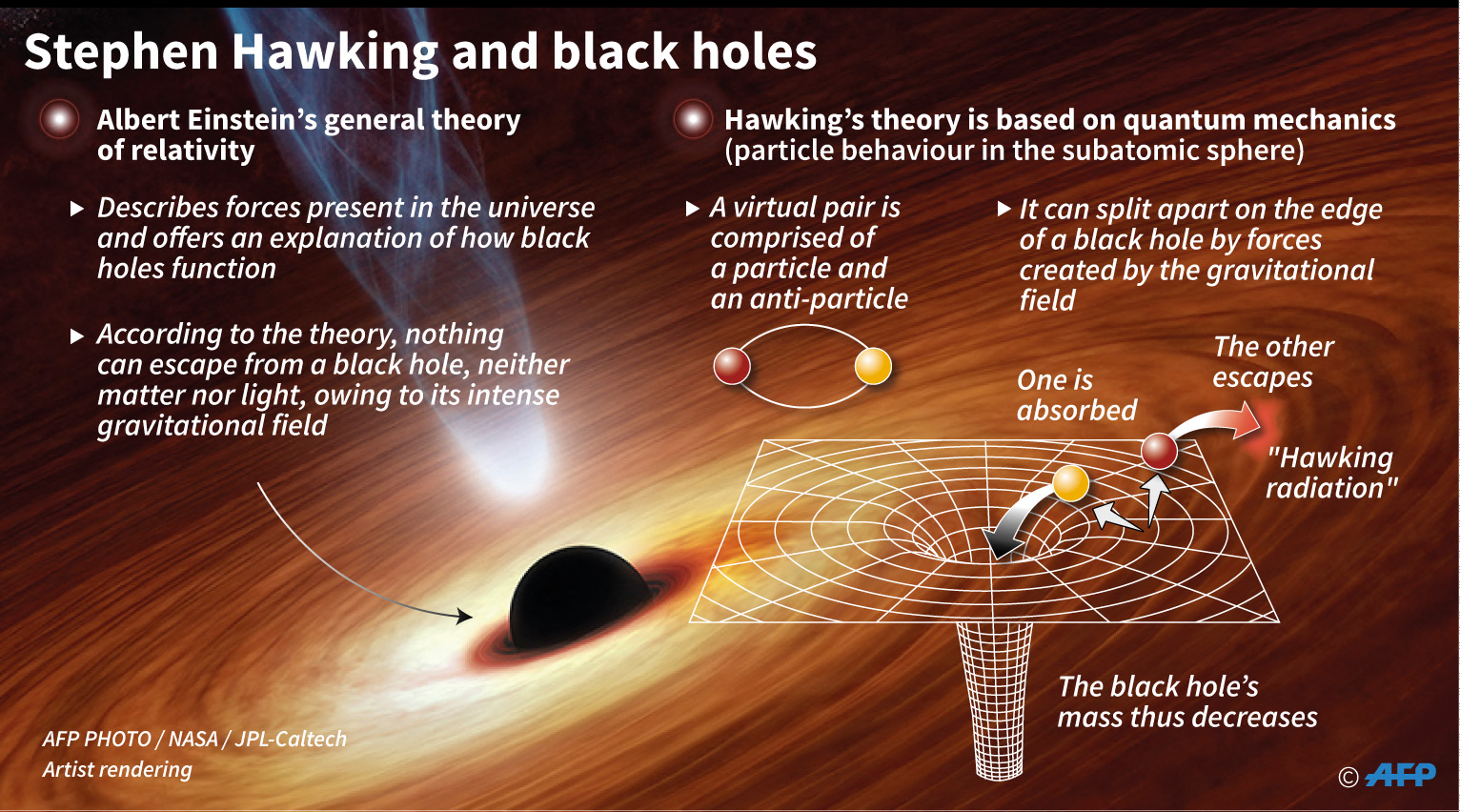
The result gives researchers a rare, hands-on look at Hawking radiation ‪—‬ the faint thermal emission that Stephen Hawking predicted should leak out of black holes ‪—‬ and offers a first clue about the tiny push that could, in principle, make a real black hole slowly evaporate, the research team said in a new study.

Working with a tabletop experiment in optical fibers, the international team detected both the radiation and its long-sought "back reaction" — the way the radiation feeds energy back and reshapes the object that created it.

According to the new study, published July 1 in the journal Nature, the light behaved exactly as Hawking predicted it should: like the glow of a warm object, with a definite temperature and a spectrum that fades away steadily toward higher frequencies. It did so even in a regime where the usual textbook description of a black hole should break down.

Illustration of two theories by Einstein and Hawking regarding black holes (Graphic by AFP)

An infographic explaining how Hawking radiation works, contrary to the predictions of general relativity. (Image credit: ALAIN BOMMENEL,VALENTINA BRESCHI,WILLIAM ICKES via Getty Images)

Where three great theories collide

Hawking radiation is famous because it sits at the crossroads of physics' biggest ideas.

"Jacob Bekenstein predicted that black holes have an entropy and a temperature, and Hawking calculated the thermal radiation of the black hole," study co-author Ulf Leonhardt, a physicist at the Weizmann Institute of Science in Israel, told Live Science via email. "In Hawking-Bekenstein radiation, quantum physics, general relativity and thermodynamics come together — subjects that are normally in conflict with each other."

The conflict runs deep: General relativity pictures space and time as smooth and continuous, while quantum mechanics describes a world of discrete, unpredictable jumps ‪—‬ and no one has managed to fully reconcile the two.

That combination is exactly what makes Hawking radiation so hard to study. Astronomers have never seen Hawking radiation from a real black hole and probably never will; the glow is far too faint to pick out across the cosmos. So physicists have turned to laboratory stand-ins that obey the same equations, building black hole analogues out of flowing water, ultracold atoms and, as in this study, light.

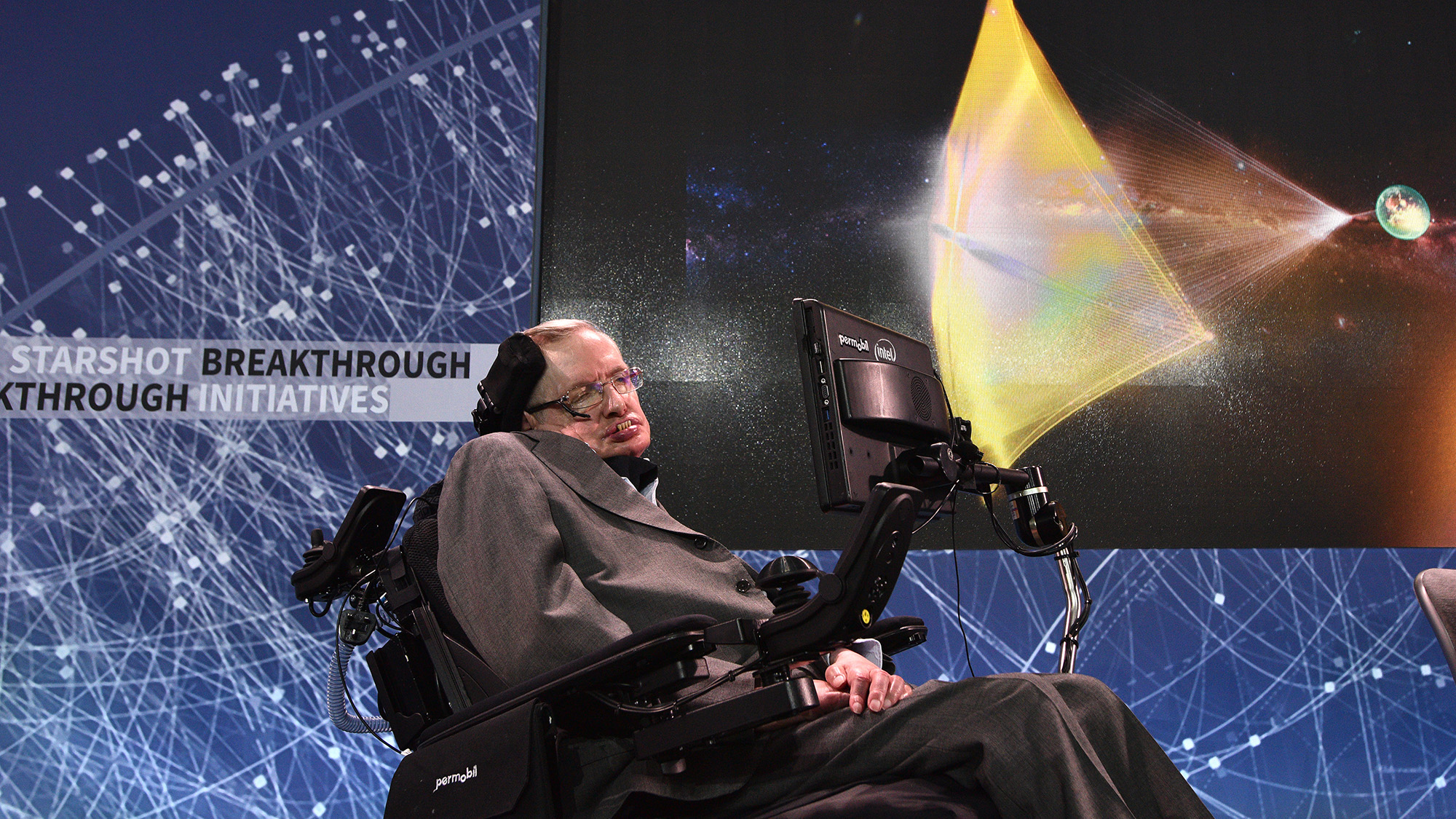
A man in an electronic wheelchair stands in front of a projector screen with various space images on it

Physicist Stephen Hawking that black holes should be able to lose information through an elusive type of radiation. New research zooms in on the mechanism that makes it possible. (Image credit: Bryan Bedder / Stringer via Getty Images)

Building a black hole from light

The trick behind every black hole analogue is a moving medium. "Imagine a swimmer in the sea with a current faster than he can swim," Leonhardt explained. "He is swept away. This is what happens beyond the [event] horizon, and this is why normally nothing can escape the black hole."

A black hole's event horizon is the boundary where that current — space itself, in real life — starts moving faster than anything can travel. To recreate it, the team needed a material that appears to rush along at the speed of light. Their solution was elegant: use light to make the "material."

"In optics we need a material that appears to move at the speed of light," Leonhardt said. "For this we use light itself — in nonlinear optics, light acts like a material."

In practice, the researchers fired an intense, ultrashort "pump" pulse into a thin photonic-crystal fiber — a strand of glass threaded with a pattern of tiny air channels running along its length, which lets researchers fine-tune how light moves through it. As it traveled, the pulse slightly changed how the glass bent light, creating a moving speed bump that raced along with it. A second, much weaker "probe" pulse then ran into this moving front. Where the probe could no longer keep up, an artificial horizon formed — and the black hole analogue was born.

Catching the glow and its pushback

The payoff came in the ultraviolet. According to theory, Hawking radiation is created in pairs: One partner escapes, while the other, carrying "negative" energy, is the mirror image that would fall into a real black hole. In the fiber, that partner showed up as ultraviolet light.

"We counted photons in the ultraviolet that correspond to the Hawking partners beyond the horizon," Leonhardt explained. "They have a wavelength around 233 nanometers. This was our signal."

Just as important as seeing the glow was understanding how it was made. For years, researchers assumed the fiber built up its Hawking radiation through a cascade — a chain of separate steps in which the light is converted first into one intermediate form, and then another, each feeding the next before the radiation finally emerges. The team found that, instead, a single, direct interaction does the job, with the pump and probe light producing the Hawking pair in one clean step. It is a much simpler picture that the researchers said may carry over to other analogues and perhaps even to real black holes.

Because energy has to come from somewhere, making Hawking radiation should nudge the source that created it. For a real black hole, that nudge is how it loses mass and, over unimaginable timescales, evaporates entirely — the process Hawking described in his landmark 1974 paper. No experiment had ever captured that recoil.

Here, the team saw it. Producing the radiation shifted a small fraction of the pump pulse's own light to a slightly different color, leaving a telltale lopsided pattern in the spectrum. That asymmetry, absent in earlier experiments, is the fingerprint of the back reaction, or recoil — the black hole analogue quietly paying the energetic price for its own glow.

The road to a quantum experiment

The result also speaks to one of the thorniest puzzles in black hole physics: the trans-Planckian problem. Trace Hawking's radiation back to where it was born and the calculation runs into territory no physicist can vouch for — the Planck scale, the vanishingly small size at which space and time are thought to lose their familiar meaning and all known physics gives out. Hawking's prediction, in other words, appears to rest on a foundation that may not exist.

"Any light getting away from the horizon is stretched out enormously," Leonhardt said. "So it must come from waves smaller than the tiniest scale in nature, where the physics is unknown. Would that still give Hawking radiation? That was the question, and we have answered it in our experiment." Remarkably, the glow stayed perfectly thermal even in this extreme regime.

The team's next step is concrete. So far, they have used ordinary laser light, which reproduces the spectrum of Hawking radiation but not its deepest quantum weirdness. Next, the team plans to "go quantum," Leonhardt said. "We will explore how to get into the quantum regime and observe quantum features such as entanglement" — the ghostly link that should tie each escaping Hawking particle to its lost partner.

See how much you know about black holes with our black hole quiz!

NASA is creating a fifth state of matter on the ISS, thanks to an upgrade to a mini-fridge-sized quantum lab

10 July 2026 at 17:37

A new upgrade to the International Space Station's (ISS) quantum laboratory is enabling NASA to probe the behavior of atoms further than ever before, the space agency has announced.

Combining the ISS's newly upgraded "Cold Atom Laboratory" with the near zero-gravity of low Earth orbit, scientists are attempting to understand the properties of so-called "ultracold" atoms in an environment impossible to replicate on Earth. The aim of the mission is to study how clouds of atoms behave at temperatures close to absolute zero (minus 459.67 degrees Fahrenheit or minus 273.15 degrees Celsius) — the coldest possible temperature in the universe, where atoms lose all their energy of motion.

"At the coldest temperatures, matter behaves drastically different from anything we have experienced," Jason Williams, project scientist for the Cold Atom Lab at NASA’s Jet Propulsion Laboratory in Southern California, which built the facility, said in a statement. "The wavelike nature of matter dominates, and ultracold matter can behave in ways that are not only unexpected, but that also enable extremely precise measurements of time, gravity, and motion. The lab has lots of tools — especially with this latest upgrade — to let us probe the nature of the universe."

Rule-breaking particles

Atoms and their subatomic particles are quantum mechanical objects whose behavior is fundamentally different from that of the large-scale world. For example, the laws of quantum mechanics predict that particles can be in more than one place at the same time (quantum superposition); can be mysteriously linked with each other over great distances (quantum entanglement); and move through spacetime as waves as well as moving like fixed, solid objects.

But observing these behaviors is notoriously difficult. Firstly, atoms are so tiny that if an atom were the size of a golf ball, then a human teeing one off would stand roughly as tall as the distance from Earth to the moon. Secondly, it’s impossible to isolate measurements of these behaviors for atoms in "normal" environments (like on Earth), as the desired quantum behavior is disturbed by energy from heat and gravity.

To overcome these challenges, the ISS's Cold Atom Laboratory — which is the size of a mini-fridge — uses lasers to cool gases of rubidium and potassium to just above absolute zero. At these temperatures, atoms form a state of matter known as a Bose-Einstein condensate, in which many atoms behave like a single wave of quantum matter.

Not only does this setup allow scientists to observe quantum behaviors on a much larger scale than that of single atoms, but the reduced gravity enables the condensate matter waves to expand and evolve undisturbed for much longer periods than would be possible on Earth.

This is the fourth major upgrade to NASA’s Cold Atom Laboratory since it arrived aboard the ISS in 2018. According to NASA, the significant improvements in this most recent upgrade include a redesigned magnetic trap to contain the cloud of atoms, improved atom sources, and better measurement capabilities.

Scientists launched these upgrades to the ISS in April 2026, and they have since been installed, switched on, and started making state-of-the-art measurements. As well as enabling novel tests of fundamental physics, measurements of these effects are critical in demonstrating future, space-based, highly precise quantum technologies related to positioning, navigation, timing, and gravity sensing. These technologies could one day enable astronauts to navigate on the moon without GPS and produce high-precision maps of Earth’s gravity.

"In the previous century, there was a quantum revolution that led to lasers, cellphones, and MRIs for medical imaging," Ethan Elliott, deputy project scientist at NASA’s Jet Propulsion Laboratory in California said in the statement. "We’re performing Quantum 2.0 – direct manipulation of large quantum states – and we hope for similar gains in quantum technology by advancing this science in orbit."

Scientists Used Water to Uncover a Strange, ‘Invisible’ Quantum Phenomenon That Remained Elusive for Decades

30 June 2026 at 13:17

A team of physicists set out to recreate a 60-year-old quantum mystery using a large water tank. While their experiment produced the expected results, it also revealed an unexpected behavior in the water.

The experiment centered on the Aharonov–Bohm effect, a strange quantum phenomenon where electrons respond to a magnetic field even when they never actually pass through it. First predicted back in 1959, this effect has been notoriously difficult to confirm because the changes it causes in electron waves are incredibly subtle.

Instead of using electrons and a particle accelerator, researchers from the Okinawa Institute of Science and Technology (OIST), along with collaborators in Oslo and Chile, recreated the effect using water waves, making an otherwise invisible quantum effect visible in a tabletop experiment. The team reported their findings in Communications Physics.

A 1980 Idea Gets a Modern Upgrade

In 1980, physicist Michael Berry showed that classical systems could model the Aharonov–Bohm effect. In this analogy, a vortex at the center of a water tank replaces the solenoid that creates a magnetic field in the quantum experiment. Water waves take the place of electrons. When these waves travel around the vortex, rather than through it, they acquire a measurable distortion. This appears as a pitchfork-shaped pattern in the wave fronts, showing that the vortex changes the phase of the waves without direct contact. The OIST team extended the approach by testing a new scenario.

“With waves traveling the opposite direction, you see a mirror image pattern,” says Jonas Rønning, co- author and former postdoc in the OIST unit. “The question for us was, what happens if you send waves from both directions at the same time? We thought that the patterns might cancel each other out, or both pitchfork-like patterns would be visible, but our intuition was completely wrong.”

Two Waves Walk Into a Vortex

The researchers constructed a custom tank, created a vortex at its center, and sent waves from opposite sides to meet in the middle. They used a high-speed camera to observe how the waves interacted on the water’s surface.

Without a vortex, the peaks and troughs remain in place. When the vortex is there, the standing wave breaks down. The vortex shifts the phase of the waves as they travel around it, altering the standing-wave interference pattern and creating rotating nodal lines. These are lines of momentarily flat water that spiral outward and turn in the opposite direction of the vortex.

“This was something new and unexpected,” says Aditya Singh, a PhD student in the Nonlinear and Non-equilibrium Physics Unit and co-first author of the study. “That’s what makes this fluid analogue system so valuable. It reveals topological effects — wave behaviors that occur across the whole system — that can’t be seen in quantum experiments.”

At first, the team suspected their equipment was causing the rotating lines. However, the same pattern also appeared in their computer simulations.

“When we first saw these lines, we thought they were an experimental artifact,” Singh says. “But when we also saw them in our simulations, we dropped everything and quickly worked out the mathematics underlying how they arise.”

More Speed, More Lines

As the strength of the vortex increased, more rotating nodal lines appeared, always moving in the direction opposite to the vortex. The study showed that the number of lines is quantized, meaning it is fixed to whole-number values determined by the vortex’s circulation. In other words, the topology of the vortex determines how many rotating nodal lines appear. This effect was observed across the entire wave field, not just near the vortex core as earlier models suggested.

This finding differs from Berry’s original experiment, which observed changes only near the vortex. In this case, the researchers discovered a non-local effect, a pattern that covers the entire system and depends on the overall setup. Instead of being limited to the area near the vortex, the rotating nodal lines appeared throughout the whole standing-wave pattern.

Although the practical uses of these newly discovered nodal patterns are not yet clear, the study shows that simple classical systems can reveal behaviors that are challenging to observe in quantum experiments. By making these effects visible, the researchers plan to explore more complex wave systems that could offer new insights into superconductivity and other quantum phenomena.

“One direction is to make the system more complex by introducing multiple vortices and arranging them into a lattice,” senior author Mahesh Bandi says. “That setup would mirror conditions in some superconducting materials, with the water waves behaving like a supercurrent. We don’t yet know what we’ll see — and that’s exactly what makes it worth doing.”

Austin Burgess is a writer and researcher with a background in sales, marketing, and data analytics. He holds an MBA, a Bachelor of Science in Business Administration, and a data analytics certification. His work focuses on breaking scientific developments, with an emphasis on emerging biology, cognitive neuroscience, and archaeological discoveries.

Can Time Flow in Reverse? A Quantum Breakthrough Challenges Our Assumptions

Physics Time Flow IllustrationResearchers investigate how quantum time flow can be stretched, blurred, or even reversed. What if the direction of time isn’t as fixed as it seems? While our everyday experience tells us that time moves relentlessly forward, the microscopic laws governing quantum systems are far less restrictive. In fact, many of the equations of quantum mechanics [...]
❌