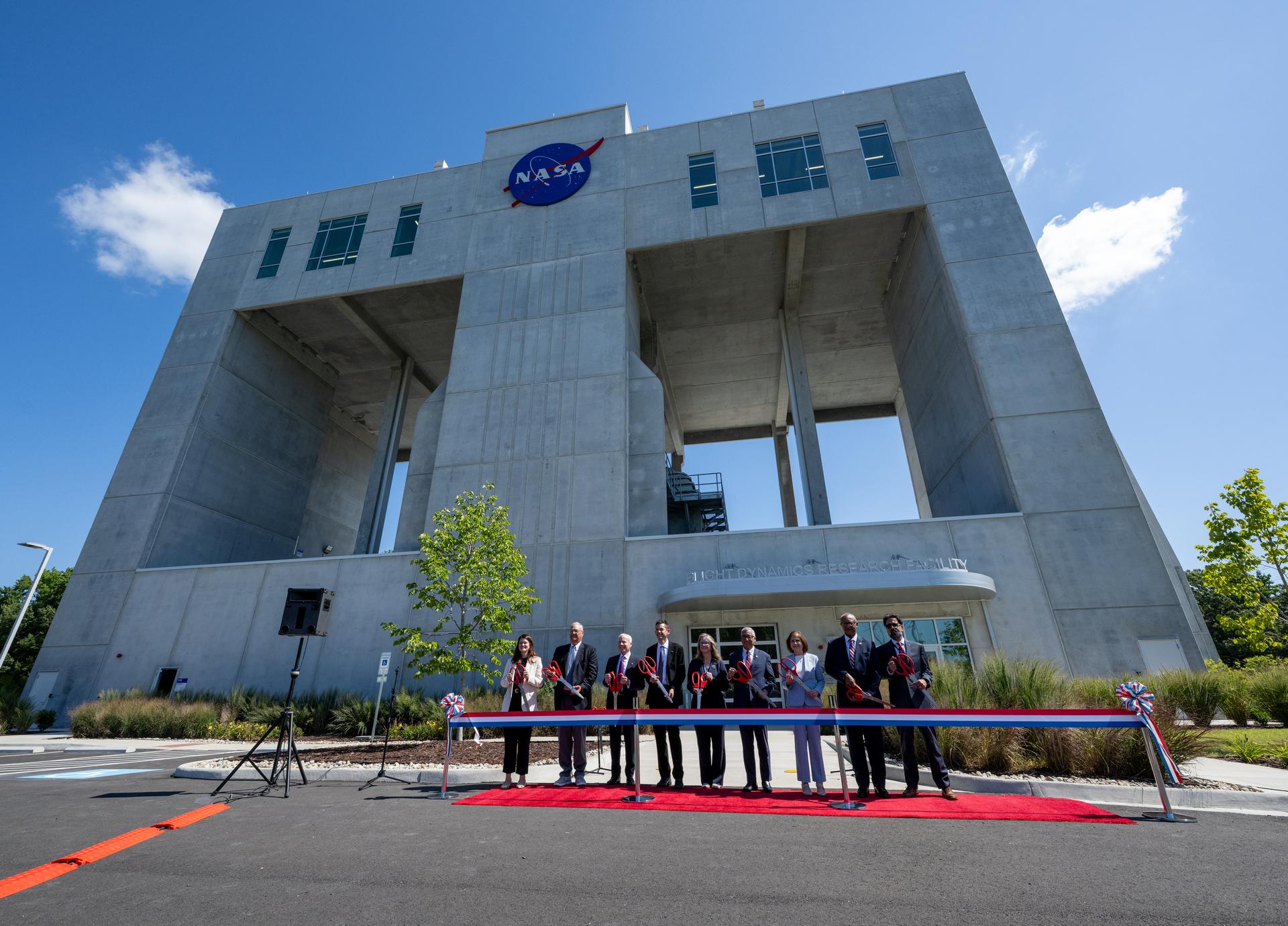
From left to right: Casey Swails, NASA deputy associate administrator; Mike Waller, vice president of BL Harbert International Federal Division; Edward C. Forst, administrator of the U.S. General Services Administration; NASA Administrator Jared Isaacman; Dr. Trina Dyal, director of NASA’s Langley Research Center; Rep. Robert “Bobby” Scott (D-Va.); Virginia Lt. Gov. Ghazala F. Hashmi; Jimmy Gray, mayor, City of Hampton; and Amit Kshatriya, NASA associate administrator, pose for a photo before cutting the ribbon to open the Flight Dynamics Research Facility, NASA’s newest wind tunnel, Friday, July 31, 2026, at NASA’s Langley Research Center in Hampton, Virginia.
Credit: NASA/Keegan Barber
NASA opened its newest wind tunnel, the Flight Dynamics Research Facility, Friday, providing a critical resource for the agency and its partners to test the safety and performance of future generations of aircraft, rockets, and space exploration vehicles.
Located at NASA’s Langley Research Center in Hampton, Virginia, the Flight Dynamics Research Facility will support advances in aircraft safety, X‑plane development, drone research, and spacecraft technology. The facility will enable both free‑flight and mounted testing of a wide range of scale-model vehicles designed to travel through an atmosphere, from airplanes to space capsules returning to Earth.
“The Flight Dynamics Research Facility is NASA’s first major new wind tunnel in more than 40 years and gives us a powerful new platform to test the ideas and technologies that will shape the future of aviation and exploration,” said NASA Administrator Jared Isaacman. “America has led in air and space because we were willing to take on hard problems, challenge assumptions, and build what didn’t exist before. This facility gives the talented team at Langley, and our partners across government, industry, and universities, the tools to keep pushing the boundaries of what’s possible and ensure America remains the world leader in air and space.”
A ribbon-cutting ceremony at NASA Langley marked the start of a new chapter in flight research. Agency leaders, partners, and Virginia officials emphasized how the Flight Dynamics Research Facility’s state-of-the-art capabilities will shape the future of flight and exploration.
“The opening of the Flight Dynamics Research Facility represents a significant advancement for NASA and for the nation,” said Dr. Trina Dyal, NASA Langley center director. “By bringing modernized testing capabilities under one roof, we are enabling transformative research that will ensure the United States remains at the forefront of aeronautics and exploration.”
Built through a partnership with the U.S. General Services Administration (GSA), the facility replaces aging infrastructure with an energy-efficient facility that reduces maintenance costs and provides the flexibility needed for future research. The Flight Dynamics Research Facility is part of a broader, long-term collaboration between the agencies, representing the fourth new building GSA has delivered to NASA under Langley’s 20-year campus revitalization plan.
“GSA is proud to partner with NASA in delivering the Flight Dynamics Research Facility, a state-of-the-art asset that will power the next generation of American dominance in aeronautics and space exploration,” said Edward C. Forst, GSA administrator. “This facility reflects what we do best: provide the advanced, expertly designed installations that federal agencies need to carry out their missions. With these new capabilities, NASA will be better equipped to test bold ideas, validate new designs, and advance technologies that will serve the nation for decades to come.”
The Flight Dynamics Research Facility combines and improves upon the capabilities of two historic NASA Langley wind tunnels – the 20-Foot Vertical Spin Tunnel and the 12-Foot Low-Speed Tunnel. The 25,000-square-foot building features a vertical wind tunnel with improved airflow, modern digital systems, and flexible testing capabilities that will allow researchers to study how aircraft, spacecraft, parachutes, and other vehicles behave during flight.
The facility’s 20-foot diameter test chamber is much larger than those of its NASA Langley predecessors, allowing for more air to pass around test models and improving data accuracy. Its increased size also allows for the use of larger, more detailed models during testing.
The Flight Dynamics Research Facility’s top airspeed of 117 miles per hour is twice as fast as the old facilities, enabling free-flight tests of heavier scale models. This will allow simulations of full-scale vehicles flying at higher altitudes – a critical capability for operations such as studying the stability of aircraft or reentry capsules coming back from space.
The facility’s wind power comes from four 750-horsepower motors, each with an integrated, 14-foot diameter, eight-bladed fan. The fan blades are made of lightweight carbon fiber, enabling rapid, precise airspeed adjustments during free‑flight tests.
The Flight Dynamics Research Facility illustrates the powerful synergy between NASA’s aeronautics and space exploration efforts, with each driving innovation in the other. The facility will drive experimental research across a wide range of flight systems, advancing the development of autonomous flight vehicles, drones, commercial and military aircraft, and X‑planes.
As NASA prepares for a sustained human presence on the lunar surface through the Artemis program and the development of a Moon Base, the facility will play a key role in testing vehicle designs for entry, descent, and landing that will help reduce mission risk and support the safe return of crews to Earth. NASA also will be able to use the wind tunnel to help design aircraft for Mars and other destinations in our solar system where atmospheric flight is possible.
With the Flight Dynamics Research Facility now open, NASA is entering a new era in flight research – one that will shape the aircraft and spacecraft of tomorrow, strengthen industry partnerships, and extend the agency’s legacy of pioneering aerospace leadership.
The facility is managed under the Aerosciences Evaluation and Test Capabilities portfolio in the Aeronautics Division of NASA’s Research and Technology Mission Directorate.
Learn more about the Flight Dynamics Research Facility at:
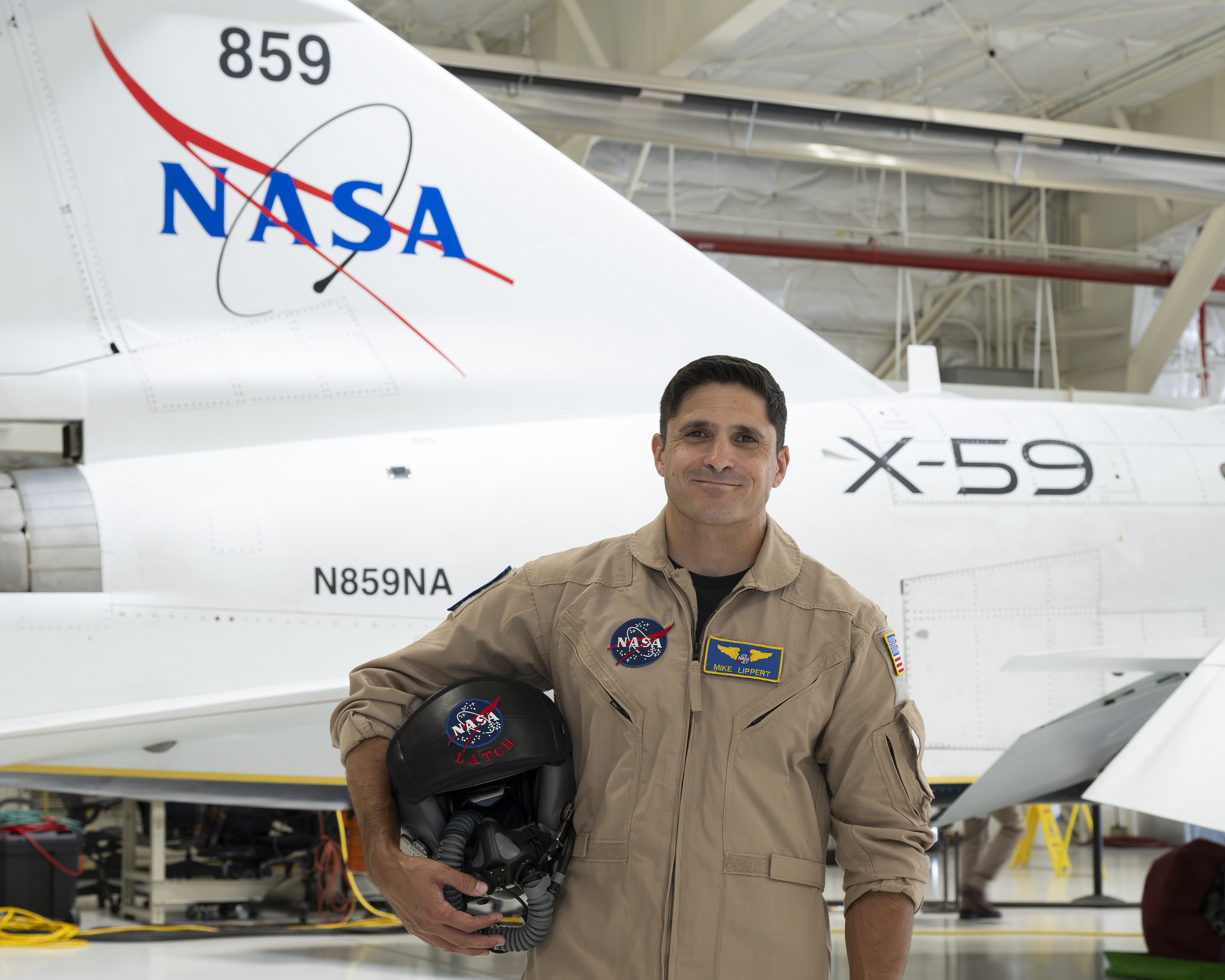
NASA’s X-59 test pilot Mike Lippert stands in front of the agency’s X-59 quiet supersonic research aircraft at NASA’s Armstrong Flight Research Center in Edwards, California, on Wednesday, June 24, 2026.
NASA/Carla Escamilla
NASA added a new X-59 test pilot to support the agency’s Quesst mission: Mike Lippert, a research test pilot based at NASA’s Armstrong Flight Research Center in Edwards, California.
“This fulfills a lifelong dream of conducting airborne research and experimental flight test for NASA in the high desert — contributing to humankind’s understanding of the science of flight and the nature of the world around us,” Lippert said.
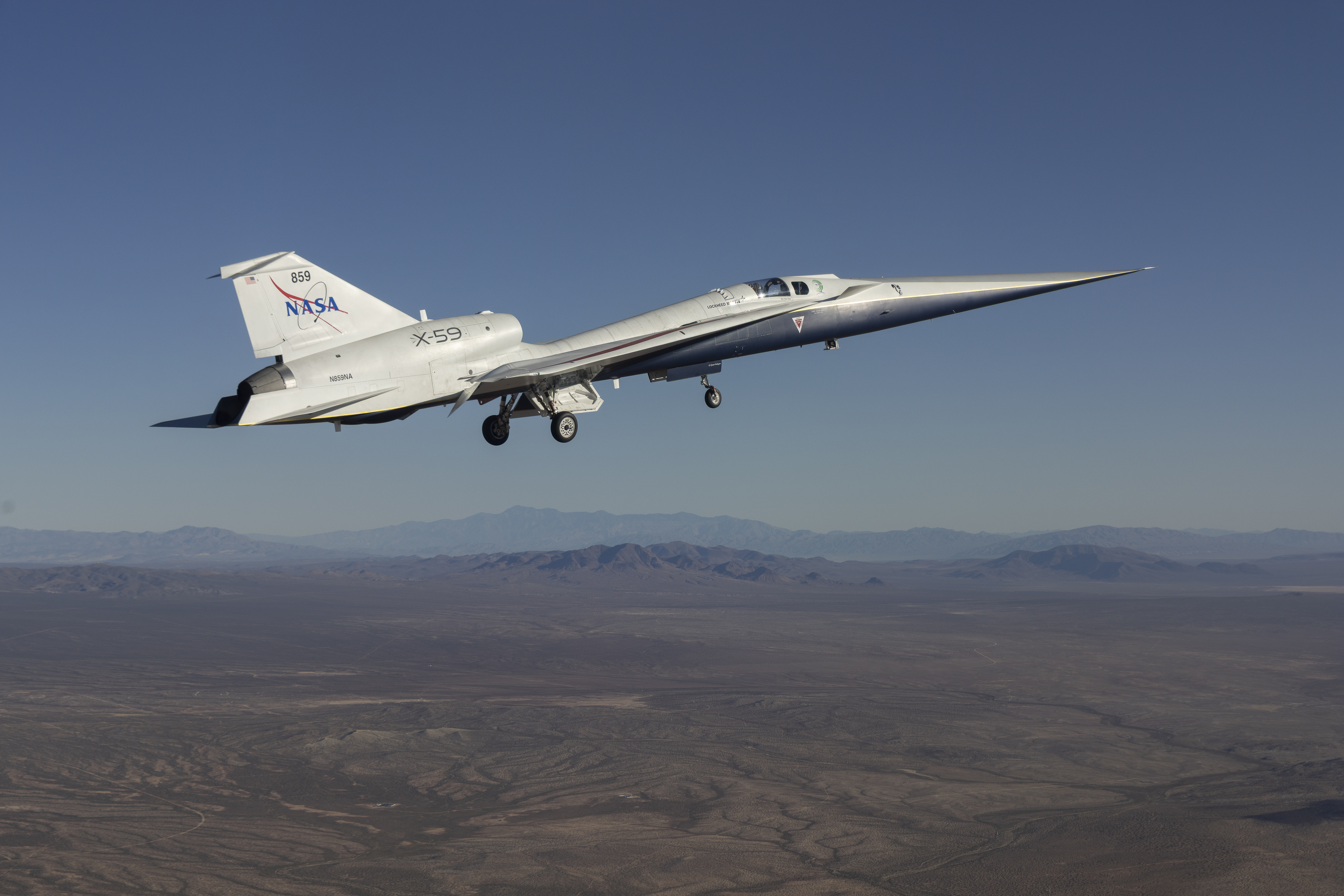
Lippert will fly the X-59, along with the F-15 and F-18 support aircraft to monitor the quiet supersonic X-plane when it’s in the air. He joins Nils Larson and Jim “Clue” Less, who have been flying the X-59 since its first flight in October 2025.
A South Carolina native, Lippert served 20 years with the U.S. Marine Corps before retiring last year as a lieutenant colonel. Like his fellow test pilots, he boasts an impressive flight resume, including logging more than 2,600 hours of flight time in 60 different types of aircraft.
Lippert said he finds test pilot work especially rewarding.
“For me, the joy of taking part in experimental flight test and airborne research is the experience of discovery and learning something new every day,” he said. “It is incredibly rewarding to be part of a team solving complex problems and venturing into the unknown, together.”
Lippert spent the majority of his career flying the AV-8B Harrier operationally and serving as a test pilot in the F-35 program. He is also an aerospace engineer, earning a bachelor’s degree from the United States Naval Academy in Annapolis, Maryland, and a Master of Science in flight test engineering from the U.S. Air Force Test Pilot School at Edwards Air Force Base in California. Additionally, he earned a Master of Science in systems engineering from the Naval Postgraduate School in Monterey, California.
Lippert is currently pursuing a doctoral degree in aerospace engineering at the University of Alabama Graduate School in Tuscaloosa, where his research focuses on high-speed gas dynamics, including supersonic and hypersonic fluid mechanics — complementing his work on the Quesst mission.
Lippert is busy preparing for his role at NASA by flying training flights on support aircraft and spending time in the X-59 simulator. He is expected to begin flying the X-59 later this summer.
NASA Announces New Spacecraft Technology Demonstration Mission at Moon
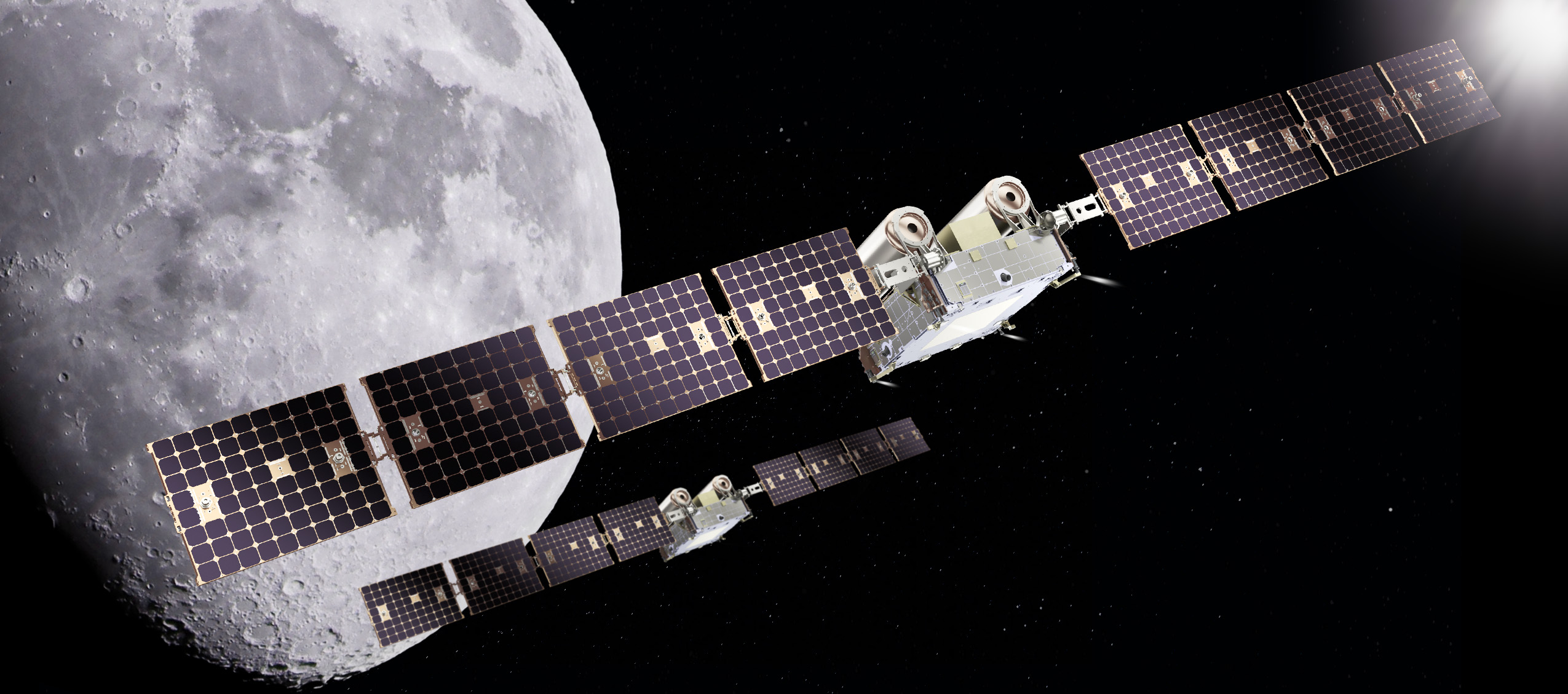
An artist’s rendering of NASA’s CAPSTONE 02 spacecraft in lunar orbit. The mission features two identical small spacecraft that will further mature technologies to support Artemis, Moon Base, and deep space exploration.
Terran Orbital
NASA is working with industry to advance the next phase of cislunar infrastructure for the agency’s Artemis program and Moon Base, including orbital assets and demonstrations. Under a contract awarded to Advanced Space, the agency’s CAPSTONE 02 mission will demonstrate rendezvous and proximity operations, autonomous navigation, and cislunar communication capabilities while continuing to characterize the radiation environment at the Moon.
The CAPSTONE 02 mission, targeted for launch in 2027, will use two small spacecraft in lunar orbit to facilitate these demonstrations to support future NASA lunar and deep space missions.
NASA’s original CAPSTONE demonstration, short for Cislunar Autonomous Positioning System Technology Operations and Navigation Experiment, became the first U.S. commercial mission to the Moon and the first spacecraft to operate in a near rectilinear halo orbit around the Moon. This is a nearly stable orbit, thanks to the interactive pull of gravity from both the Earth and the Moon.
The mission successfully validated communications, networking, and autonomous navigation capabilities while gathering operational experience in cislunar space. The second CAPSTONE mission expands upon these accomplishments by transitioning from orbit validation to demonstrations that will inform future lunar exploration and infrastructure development.
Achieving our most ambitious space exploration goals requires iterative, risk-tolerant demonstrations in partnership with industry. Technology development through flight testing is how we convert hard problems into the lasting capabilities needed for a permanent presence at the Moon.
Christopher Baker
Lead of the In‑Space Infrastructure portfolio within the Research and Technology Mission Directorate at NASA Headquarters in Washington, DC.
NASA’s CAPSTONE 02 mission will demonstrate advanced relative navigation technologies for rendezvous and proximity operations in cislunar space. These techniques are more sophisticated than those used in low Earth orbit and are designed to support NASA astronauts as they dock with Moon landers in cislunar orbit, enabling safe crew transfers to and from the lunar surface.
The demonstration will fly two identical spacecraft of approximately 400 kilograms (882 pounds) from Terran Orbital Systems, Inc. Mission operators will conduct a series of rendezvous and proximity operations and loitering – or formation flying – techniques in lunar orbit with each spacecraft to better understand the trajectories of the spacecraft under the simultaneous influence of Earth and Moon gravities, otherwise known as three-body orbits.
The CAPSTONE 02 mission will use ground tracking measurements, optical sensors, and celestial bodies to help one spacecraft locate and rendezvous with another. The mission will apply navigation strategies similar to those planned for Orion’s approach to a lunar lander in deep space, helping NASA build confidence in these techniques for future exploration.
Each CAPSTONE 02 spacecraft will have the ability to switch between ‘chaser’ and ‘target’ roles, testing a broad range of operational scenarios under a variety of environmental conditions in cislunar space. Transporting crew to the lunar surface from cislunar orbit depends on knowing how well navigation systems will perform during these operations. Since these conditions can’t be fully recreated on Earth, they must be tested in space.
The CAPSTONE 02 mission also will serve as an operational testbed, enabling testing of three NASA-developed navigation software suites. Each software application will collect data during CAPSTONE 02’s low energy transfer trajectory, which will take it from the Earth to beyond the Moon before settling into a lunar orbit. The spacecraft will carry an optical imaging payload from Lawrence Livermore National Laboratory to support the navigation demonstration as well as capture imagery of the Moon. In addition, the mission will further mature the Cislunar Autonomous Positioning System navigation software that was first demonstrated on CAPSTONE as a method of determining spacecraft position relative to other spacecraft without relying on Earth-based tracking.
The suite of technologies on CAPSTONE 02 are designed to automate routine navigation tasks, reduce reliance on traditional space-to-ground data, and enable new mission concepts that may be derived from increased inter-satellite coordination. Additionally, the CAPSTONE 02 spacecraft are designed for cost-effective, rapid deployment, demonstrating a scalable and repeatable mission model.
“This mission represents an important step in the maturation of cislunar capabilities,” said Sean Fuller, Moon Base CAPSTONE manager. “By expanding on the lessons learned from CAPSTONE to demonstrate increasingly sophisticated operational concepts, CAPSTONE 02 lays the foundation for lunar infrastructure and commercial services that support Artemis, Moon Base, and future missions to deep space.”
The CAPSTONE 02 mission is funded by NASA’s Human Spaceflight Mission Directorate with support from the Research and Technology Mission Directorate. The mission is managed by Small Spacecraft & Distributed Systems, based at NASA’s Ames Research Center in California’s Silicon Valley, within the Research and Technology Mission Directorate. NASA used a Small Business Innovation Research Phase III contract to fund the mission.
To learn more about NASA’s CAPSTONE mission, visit:
Preparations for Next Moonwalk Simulations Underway (and Underwater)
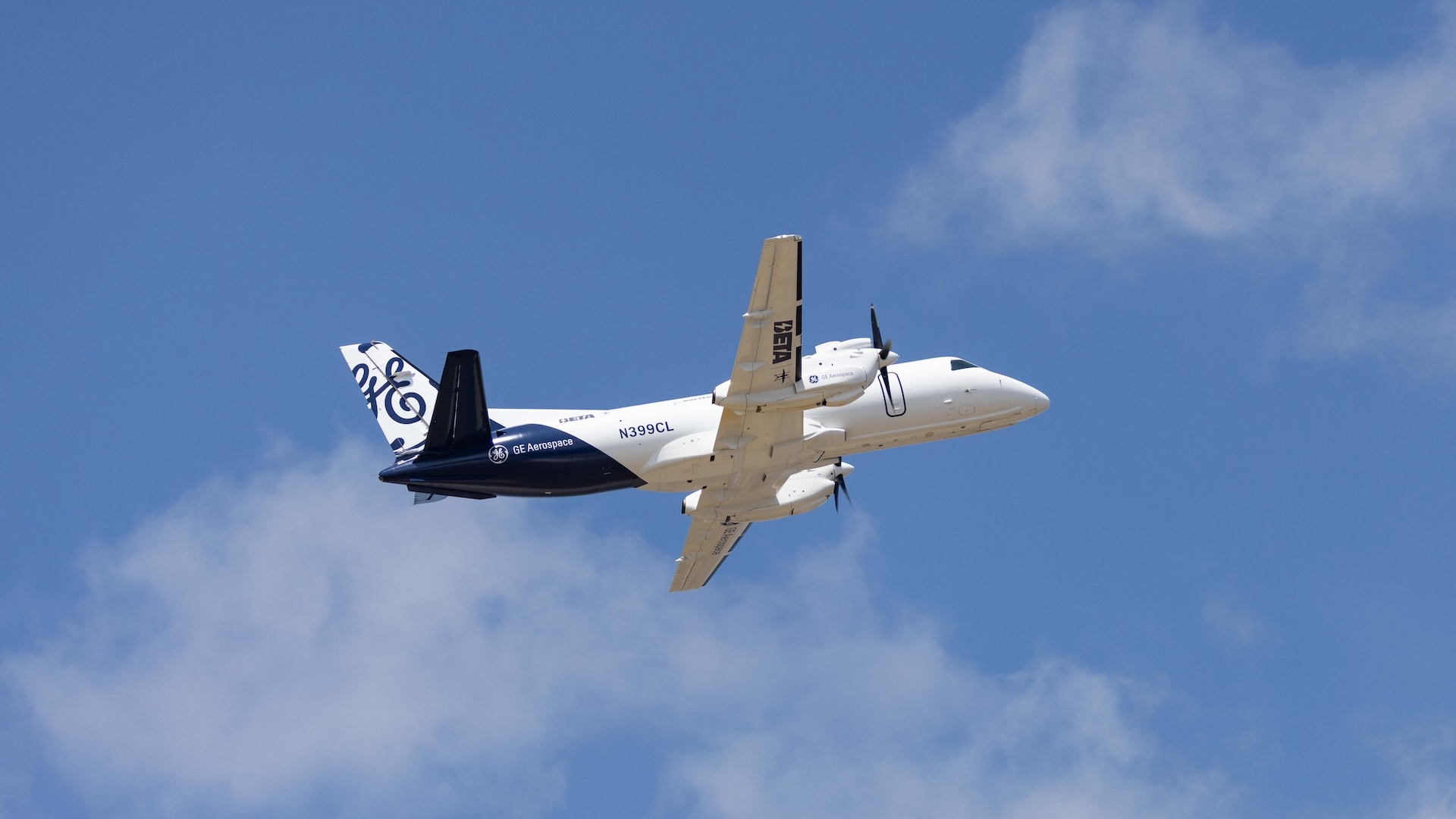
A modified Saab 340B aircraft in flight powered in part by a hybrid electric system built by GE Aerospace, along with NASA, BETA Technologies, and Boeing.
GE Aerospace
An aircraft powered by a megawatt-class hybrid-electric engine developed in collaboration with NASA and built by GE Aerospace, demonstrated flight of an innovation that can inform new generations of fuel-saving aircraft power systems.
Mounted to a Saab 340B aircraft, the engine flew at Farnborough International Air Show in the United Kingdom. It was the public debut of a system that has in recent months made historic test flights, becoming the first hybrid electric-powered aircraft to fly above 30,000 feet.
“This achievement reflects what NASA does best in aeronautics: we explore bold possibilities, validate them through rigorous research and testing, and work with industry to turn breakthrough ideas into technologies that bring real value for the American people,” said Laurie Grindle, director of the Aeronautics Division within the agency’s Research and Technology Mission Directorate at NASA Headquarters in Washington.
The testing leveraged work done through NASA’s former Electrified Powertrain Flight Demonstration project and the agency’s ongoing Subsonic Vehicle Technologies and Tools project – years of collaborative research that included key testing at NASA test facilities.
The engine integrates electric motors, a gas turbine, and energy storage capabilities. It was designed to demonstrate the capacity to power an aircraft around the size of a regional-class jet, reducing fuel burn and costs without sacrificing performance. The unit’s technology and designs are expected to be used to help develop future hybrid systems that could lower airline operating costs.
The demonstration flight came after years of rapid development for the technology. For NASA, it also validates work that stretches back to a time when hybrid aviation propulsion seemed almost beyond the horizon of possibility.
This achievement reflects what NASA does best in aeronautics: we explore bold possibilities, validate them through rigorous research and testing, and work with industry to turn breakthrough ideas into technologies that bring real value for the American people.
LAURIE A. GRINDLE
Director of the Aeronautics Division within the agency's Research and Technology Mission Directorate
“This is the culmination of more than 15 years of work, and we did that because it’s going to have an impact for aircraft that will help reduce energy use and help U.S. companies and the public,” said Ralph Jansen, aerospace engineer at NASA’s Glenn Research Center in Cleveland. “It’s about having a vision that no one believes can happen and then doing the work to define and execute the research and development needed to make it happen.”
This accomplishment was possible because of the collaborative effort of hundreds of people working on Electrified Powertrain Flight Demonstration and Subsonic Vehicle Technologies and Tools projects across NASA centers, in conjunction with GE Aerospace and its partner companies.
Hybird-Electric Evolves
In recent years, aviation has seen a boom in small aircraft and drones powered by electrical systems drawing from batteries. But large passenger and cargo planes require complex engines capable of supplying massive amounts of power. So more than a decade ago when NASA began contemplating hybrid systems, just the possibility of using electric motors to supplement some energy was a daunting engineering challenge.
NASA spent about seven years performing preliminary research, working with small businesses and other partners to consider technological obstacles and the potential commercial viability of hybrid systems. During that time, the agency addressed several barriers to implementation including the power, thermal, and battery technology, and the integration of the power system, engine, and aircraft.
Through the agency’s Electrified Powertrain Flight Demonstration award, GE Aerospace and NASA worked with researchers to develop lighter and more efficient power systems and shrink key components – sometimes dramatically.
NASA and GE Aerospace also leveraged agency facilities and resources to further their research. In 2022, GE Aerospace tested an integrated version of its propulsion system at NASA’s Electric Aircraft Testbed at the agency’s Neil A. Armstrong Test Facility in Sandusky, Ohio. Testing allowed the system to operate in conditions simulating 45,000 feet in altitude, the range in which commercial single-aisle aircraft fly.
The team added components, including electric motors, power converters, propellers, and a GE Aerospace commercial engine, followed by more ground tests and eventual flight tests. For the researchers who’d spent years on the concept, seeing the engine powering an aircraft in flight was a major step in a long journey.
“I’ve got to say, I was pretty touched seeing it fly. It was just awesome,” Jansen said. “It’s just like a regular plane, which is probably the best thing of all.”
NASA’s current support for this research is through the Aeronautics Division of its Research and Technology Mission Directorate.
Preparations for Next Moonwalk Simulations Underway (and Underwater)
NASA / Lillian Gipson/Getty Images
THIS PAGE WAS UPDATED ON JUNE 23, 2026
This Aeronautics Research Mission Directorate (ARMD) solicitations page compiles the opportunities to collaborate with NASA’s aeronautical innovators and/or contribute to their research to enable new and improved air transportation systems.
Most opportunities to participate in research are officially announced through the Web-based NASA Solicitation and Proposal Integrated Review and Evaluation System, better known as NSPIRES. You are encouraged to visit the NSPIRES web site, create an account, and sign up for automated email announcements.
Other types of collaborative opportunities, such as those involving Requests for Information or academic research contests, also are included on this page.
This ARMD Solicitations page has four major sections:
Quick list of open solicitations with key dates listed.
August 3, 2026 Deadline for proposals on Open Fan Flight Demonstrations NRA
Currently Open Solicitations
NASA Research Announcement – Development Plan for Open Fan Flight Demonstration – OPEN
As part of NASA’s Advanced Air Vehicles Program, the Subsonic Vehicle Technologies and Tools project endeavors to advance knowledge, technologies, and concepts that enable accelerated introduction of radical aircraft and engine technologies across a range of vehicle classes.
This is achieved through partnerships with industry to ensure that these technologies are applicable to planned products to increase the chances of inclusion in future aircraft systems.
This research announcement solicits proposals for providing an open fan flight demonstration plan with optional accompanying risk reduction activities. The flight demonstration plan will inform the project of the scope of a possible future flight demonstration and provide insight into the roadmap, risk reduction areas, and areas of potential investment.
The Project F.I.R.E. team receives their “Future Game-Changer” award during the 2024 Gateways to Blue Skies forum held at NASA’s Ames Research Center in California. Gateways to Blue Skies is one of several Aeronautics Innovation Challenges open to the academic community.
NASA / Brandon Torres
Aeronautics Innovation Challenges – OPEN
NASA’s nationwide team of aeronautical innovators are committed to giving students of all ages opportunities to solve some of the biggest technical challenges facing the aviation community today. Through NASA-sponsored challenges and competitions, students representing multiple disciplines will put their skills to work by designing and building solutions to real-world problems.
NASA’s X-59 quiet supersonic research aircraft lifts off for its first flight Tuesday, Oct. 28, 2025, from U.S. Air Force Plant 42 in Palmdale, California. The aircraft’s first flight marks the start of flight testing for NASA’s Quesst mission, the result of years of design, integration, and ground testing and begins a new chapter in NASA’s aeronautics research legacy.
NASA/Lori Losey
NASA ARMD Aeronautics Flight Accelerator – CLOSED
NASA’s Aeronautics Research Mission Directorate is seeking information from U.S. industry, academia, and government organizations regarding potential partnerships for research, development, and flight testing under the Aeronautics Flight Accelerator initiative. NASA is requesting input on technologies, concepts, and flight test campaigns suitable for cost shared maturation leading to flight within the next three years. Areas of interest span subsonic (including vertical lift), supersonic, and hypersonic flight technologies.
THIS IS NOT A REQUEST FOR PROPOSAL. NO PROPOSALS SHOULD BE SUBMITTED.
RFI Release Date: April 7, 2026 Responses Were Due: May 7, 2026, 1:00PM Pacific Daylight Time (PDT)
High school students visit the Glenn Research Center Manufacturing Facility and learn about careers in the STEM manufacturing field.
NASA/Marvin Smith
FY26 NASA Aerospace Skilled Technical Workforce Hubs (NAS_Hub) – CLOSED
This opportunity seeks proposals to establish state or regionally focused Skilled Technical Workforce Hubs (NAS_Hubs) that will serve as strategic centers for developing and sustaining a skilled technical workforce aligned with aerospace industry and NASA mission needs. The NAS_Hub Notice of Funding Opportunity has been released and may be found in NASA’s Solicitation and Proposal Integrated Review and Evaluation System (NSPIRES) on the NAS_Hub landing page.
Key Dates
Pre-Proposal Webinar: February 18, 2026, 2:00 to 3:00 p.m. ET
Office Hours Session: March 3, 2026, 2:00 to 3:00 p.m. ET
Proposal Deadline: March 23, 2026, at 11:59 p.m. ET
Anticipated Award Notification: June 2026
About the Opportunity
The rapid expansion of the space economy and renewed national priorities in human space exploration have created an urgent demand for a robust skilled technical workforce—individuals in critical science- and engineering-based roles who do not require a bachelor’s degree. To address nationwide shortages and ensure U.S. competitiveness in aerospace and defense, NASA’s Office of STEM Engagement is launching the NASA Aerospace Skilled Technical Workforce Hubs (NAS_Hub) initiative.
Through this notice NASA seeks lead organizations to establish hubs that:
Collaborate with aerospace employers to align education and training with industry-defined workforce needs.
Partner with community colleges and high school Career and Technical Education programs to deliver hands-on, industry-aligned learning experiences.
Coordinate with state or regional workforce development system.
Build clear and sustainable employment pathways into high-demand aerospace technical careers.
NAS_Hubs will serve as focal points for aligning education, workforce, industry, and government partners to accelerate workforce readiness over a three-year period of performance.
Eligibility
Eligible applicants include:
State, county, city, township, special district, and tribal governments
Public and private institutions of higher education
Nonprofit organizations
For-profit organizations and small businesses
Proposals must include partnerships with, at a minimum:
Three aerospace industry collaborators supporting NASA’s work
Community college career and technical education program
High school career and technical education program
State or regional workforce development system
NASA Center or other NASA facility
Award Information
Maximum Annual Award: $500,000
Maximum Total Award: $1,500,000 over three years
Cost Sharing: Not required
How to Apply
Proposals must be submitted electronically via NSPIRES. Registration in NSPIRES and an active SAM.gov registration are required.
Pre-Proposal Webinar and Technical Assistance
NASA will host an interactive pre-proposal webinar for the NAS_Hub opportunity on Feb. 18, 2026, from 2:00 to 3:00 p.m. ET. This session will provide an in-depth overview of this funding opportunity, including program goals, eligibility requirements, proposal preparation guidance, and submission tips. Proposers will also have the opportunity to receive technical assistance and clarification from NASA staff. Prior to attending a webinar, proposers are strongly encouraged to review the full NAS_Hub notice and to check the NAS_Hub landing page in NSPIRES regularly for updates and additional guidance.
Please note that registration is requiredfor the webinar. Connection details will be provided upon completion of registration. Webinar dates, times, registration links, and connection information will be posted on the NAS_Hub landing page in NSPIRES, which also will feature recordings and presentation materials from the webinar after the event for those unable to attend.
NASA’s Advanced Capabilities for Emergency Response Operations (ACERO) project used this request for information to identify technologies that addressed current challenges facing the wildland firefighting community. NASA was seeking information on data collection, airborne connectivity and communications solutions, unmanned aircraft systems traffic management, aircraft operations and autonomy, and more. This would support development of a partnership strategy for future collaborative demonstrations.
Interested parties were requested to respond to this notice with an information package submitted via https://nari.arc.nasa.gov/acero-rfi no later than 4 pm ET, October 15, 2023. Submissions were accepted only from U.S. companies.
This request for information is being used to gather market research for NASA to make informed decisions regarding potential partnership strategies and future research to enable Advanced Air Mobility (AAM). NASA is seeking information from public, private, and academic organizations to determine technical needs and community interests that may lead to future solicitations regarding AAM research and development.
This particular RFI is just one avenue of multiple planned opportunities for formal feedback on or participation in NASA’s AAM Mission-related efforts to develop these requirements and help enable AAM.
The respond by date for this RFI closed on Feb. 1, 2025, at 6 p.m. EST.
ROA-2025 NRA Amendment 1 – CLOSED
Advanced Air Vehicles Program Fellowship Opportunities
This announcement solicits proposals from accredited U.S. institutions for research training grants to begin the academic year. This Notice of Funding Opportunity is designed to support independently conceived research projects by highly qualified graduate students in disciplines needed to help advance NASA’s mission, thus affording these students the opportunity to directly contribute to advancements in STEM-related areas of study. These opportunities are focused on innovation and the generation of measurable research results that contribute to NASA’s current and future science and technology goals.
Research proposals are sought to address the key challenges summarized in the Elements section at the end of the Amendment 1 document, and which reference NASA’s Hypersonic Technology project.
Reflecting the Fiscal Year 2026 budget changes, the Transformational Tools & Technologies project opportunities originally described in this announcement were cancelled. Proposals citing this project will not be evaluated.
Notices of Intent are not required.
A budget breakdown for each proposal is required, detailing the allocation of the award funds by year. The budget document may adhere to any format or template provided by the applicant’s institution. Two pre-proposal teleconferences for potential proposers will be held and meeting links will be posted on NSPIRES.
Proposals were due by 5 p.m. EDT on June 11, 2025.
NASA Research Opportunities in Aeronautics
Competition for NRA awards is open to both academia and industry.
The current open solicitations for ARMD Research Opportunities are ROA-2024 and ROA-2025.
Here is some general information to know about the NRA process.
NRA solicitations are released by NASA Headquarters through the Web-based NASA Solicitation and Proposal Integrated Review and Evaluation System (NSPIRES).
Participation is open to all categories of organizations, including educational institutions, industry, and nonprofits.
Any updates or amendments to an NRA is posted on the appropriate NSPIRES web pages as noted in the Amendments detailed below.
ARMD sends notifications of NRA updates through the NSPIRES email system. In order to receive these email notifications, you must be a Registered User of NSPIRES. However, note that NASA is not responsible for inadvertently failing to provide notification of a future NRA. Parties are responsible for regularly checking the NSPIRES website for updated NRAs.

 Login