❌

Normal view

MacVoices #26229: Macstock – Using Blockchain to Protect and Preserve Creator Content with Alessandra White

By: Chuck
10 August 2026 at 18:40
At Macstock, Alessandra White explains how blockchain can give creators greater control and permanence over their digital content. She discusses Hive, decentralized publishing, digital sovereignty, and ways creators can preserve posts and videos beyond centralized platforms. The conversation also examines blockchain’s permanence, including the trade-off that published material cannot simply be deleted…ever.  http://traffic.libsyn.com/maclevelten/MV26229.mp3 This MacVoices […]

💾

MacVoices #26227: Live! – Apple at $5 Trillion, Earnings Call and Upgrade Program Analysis

By: Chuck
6 August 2026 at 18:59
The MacVoices Panel tests a new live-production platform while discussing Apple’s reported $5 trillion valuation, and the end of Tim Cook’s earnings-call era. The pros and cons of Apple’s new device upgrade and leasing program is the subject of intense debate over factors such as balloon payments, ownership, carrier lock-ins, AppleCare costs, convenience, and flexibility. […]

💾

MacVoices #26220: Live! – New Ways To Pay For Your Apple Gear

By: Chuck
29 July 2026 at 21:47
The MacVoices Live! panel examines Apple’s move from the iPhone Upgrade Program to a Klarna-backed leasing model, including the possibility of restricting leased devices after missed payments. The discussion explores how financing could soften the impact of rising iPhone prices, especially for premium and foldable models. They share personal experiences while debating ownership versus leasing, AppleCare implications, trade-in strategies, and changing consumer expectations around smartphone upgrades.

💾

MacVoices #26219: Toby Schmitz, The Youngest Macstock Attendee, On Creativity and Entrepreneurship

By: Chuck
28 July 2026 at 21:25
Toby Schmitz was the youngest attendee at Macstock X, so his perspective on how the conference and the accompanying Ecamm Creator Camp gave him the confidence and practical guidance to begin his own YouTube channel, podcast, and livestream. He reflects on learning from a wide variety of sessions, the influence of his family of creators, […]

💾

MacVoices #26216: Live! – Who Should Profit From The AI Revolution?

By: Chuck
23 July 2026 at 22:04
A spirited panel debates whether AI companies should surrender part of their ownership to a public wealth fund. The conversation examines distrust of AI, job displacement, data-center energy and water use, income versus wealth taxation, billionaire resentment, corporate political influence, and the dangers of government owning stakes in companies it also regulates.

💾

MacVoices #26185: TV+ Talk – How Apple Connects Entertainment, Sports, and Corporate Identity

By: Chuck
19 June 2026 at 14:06
Charlotte Henry and Chuck Joiner explore how Apple TV connects sports, entertainment, and corporate strategy, from World Cup coverage and the After the Whistle podcast to Slow Horses and global storytelling. They debate Tim Cook’s visible Hollywood presence, his role in the service’s growth, and how future leadership could shape Apple’s streaming ambitions. 

💾

MacVoices #26178: Flip The Script – Tymofii Bezverkhyi’s Journey from Student Developer to MacPaw Engineer

By: Chuck
15 June 2026 at 20:25
At MacPaw’s Flip the Script event in San Francisco, Junior iOS Engineer Tymofii Bezverkhyi shares how his path from Ukraine’s Kyiv School of Economics to studying in Ireland, winning Apple’s Swift Student Challenge, and attending WWDC led to a role at MacPaw. Tim discusses his passion for Apple development, his work on MacPaw’s AI Eney, and why he appreciate’s the company’s responsibility and growth objectives. 

💾

MacVoices #26143: Live! – Apple Earnings, Services Growth, and Why Vision Pro Isn’t Done

By: Chuck
13 May 2026 at 15:55
The MacVoices Live! panel examine Apple’s quarterly earnings, the continuing importance of Services revenue, and what John Ternus’ presence on Apple’s earnings call may indicate about Apple’s future leadership transition. Chuck Joiner, David Ginsburg, Eric Bolden, Brian Flanigan-Arthurs, Marty Jencius, and Jeff Gamet discuss the Apple Vision Pro and the newest wave of “Vision Pro is doomed” commentary. They argue that Vision Pro should be viewed as an early-stage platform product that still needs more time, more content, more developer support, and a larger installed base before its long-term value can be fairly judged. 

💾

In Minnesota, Words Matter More Than Rape

21 August 2026 at 15:00

Shiloh Hendrix got a $1,000 fine and 200 hours of community service for using a racial slur. The Somali man who filmed her had rape charges dropped "in the interest of justice". Only in Minnesota, says Steven Tucker.

The post In Minnesota, Words Matter More Than Rape appeared first on The Daily Sceptic.

Meta’s local AI model prompts enterprises to rethink hardware-software cost trade-off

11 August 2026 at 02:38

Meta rolled out a new 30-billion-parameter AI model optimized to run on a PC or Mac with a single GPU on Monday, offering a way to run always-on agentic workflows locally rather than relying on the cloud.

The company has dubbed it Muse Glimmer. However, its hardware demands, including a GPU with a minimum of 24GB of VRAM, could make it difficult to justify for deployment at scale.

Although analysts and consultants agree that there is a tremendous enterprise appetite for running models locally, determining whether switching more systems from cloud to local makes fiscal sense is much more complex. 

The hardware costs are tricky to calculate even today, with the VRAM needed depending on the particular applications to be run. But the far bigger consideration is that there is no way to determine what RAM costs will look like over the next 12-18 months, and there is an identical lack of visibility into how cloud prices might increase during the same timeframe. 

That makes determining the better financial choice impossible.

Agents become capex, not opex

Noah Kenney, principal consultant at Digital 520, noted that since RAM costs have increased “exponentially” over the last 12 months, cloud AI providers are also going to have to increase their prices. Beyond that, IT needs to anticipate logistical issues; key questions to ask are, “How quickly can you scale? Can you even get the hardware?”

“Meta just made agents a capital expense instead of an operating one,” Kenney said. “For two years, enterprises have been trained to rent intelligence by the token from someone else’s data center. Muse Glimmer runs the agent on a GPU you own, on the desk, with the meter switched off. That is a direct shot at the business model that cloud AI vendors are built on, and it comes from the one player with no cloud API revenue to protect.”

In its post announcing the new model, Meta pointed out that it has aggressively slimmed it down to try to make it efficient and cost-effective. 

“At full precision, a 30-billion parameter model would require over 55 GB of memory — far more than any consumer GPU offers,” Meta said. “We use quantization techniques to compress the model’s weights to approximately 4-bit precision, shrinking the language model to under 20 GB. This leaves enough headroom for the model’s working memory, its KV cache, the perception encoder for image understanding, and the speculative decoding drafter to run simultaneously within a 24 GB or 32 GB envelope. We validated that this compression introduces minimal to no degradation on agentic tasks.”

More options for enterprises

Mike Wilkes, enterprise CISO at Aikido Security, said that Meta’s move is significant in that it starts to give enterprises more options. 

“The most important thing about Muse Glimmer is not that Meta has produced another capable model, it is that the economics and architecture of AI are beginning to move back toward the edge,” he said. “The financial comparison therefore becomes capital expenditure that can be amortized over several years versus an effectively perpetual per-token or per-request cloud operating expense.”

That means, he said, that an enterprise may rationally pay somewhat more for hardware if doing so gives it predictable AI costs, offline availability, control over model versions, freedom from sudden API pricing or access changes.

Independent cybersecurity and risk advisor Steven Eric Fisher also noted that the specs published by Meta don’t tell the full story.

The problem is that running locally versus in the cloud can generate a lengthy list of related expenses. 

“Agentic workloads [in the cloud] can amplify consumption through reasoning, retries, tool calls, context growth, and evaluation, while local deployment [also] introduces hardware, power, lifecycle, support, and utilization costs,” he said, adding that even the RAM requirements need a lot of context.

“Meta’s stated 24GB and 32GB memory targets demonstrate that Glimmer can be loaded and executed on comparatively accessible hardware, but that is not the same as having sufficient capacity for meaningful agentic workloads,” Fisher said, pointing out that once other factors are considered, practical memory requirements can move beyond the 32 GB available on an Nvidia RTX 5090 GPU.

“In enterprise terms, this still places Glimmer primarily in high-end developer, data science, or dedicated AI workstations rather than the standard corporate desktop or laptop,” he said.

Better ROI not guaranteed

Justin Greis, CEO of consulting firm Acceligence, agreed. 

“I wouldn’t assume that moving inference from the cloud to the endpoint automatically produces a lower total cost of ownership,” he said, noting that variable cloud costs would be traded for the price of  deployment, endpoint management, support, security, model updates, and potentially accelerated hardware refresh cycles for the local devices.

“Muse Glimmer is an important milestone because it makes local agentic AI technically viable. But technical viability and enterprise ROI are two different milestones,” Greis said. “I think Meta has crossed the first one. I do not think they have fully crossed the second one yet.”

However, Kenney argued that there are also other elements of the Meta rollout that make meaningful comparisons difficult. 

“It is worth remembering that the local model is quantized, compressed to roughly 4-bit precision, while the cloud APIs you are comparing against typically serve full-precision models, so this is not a pure apples-to-apples cost comparison,” he said. “The ROI question is not local versus cloud on price alone. It is also a question of whether a company is willing to use a quantized model for the specific task. A cheaper agent that needs more retries or human correction can erase its savings fast.”

In addition, a local model often neglects to include every service that a cloud provider typically delivers. 

“The cloud vendor was quietly handling updates, scaling, reliability, and security patching across your whole footprint. Bring the model in-house and every one of those becomes your problem, multiplied by every machine running it,” Kenney noted. “Most enterprises that consume AI as a service have no muscle for operating a fleet of local models, and that cost rarely gets adequate consideration in ROI conversations. The GPU is cheap. Patching a thousand of them is not.”

Sanchit Vir Gogia, chief analyst at Greyhound Research, also stressed that it can be difficult for IT to comprehensively anticipate the different cost variables. 

“Finance leaders are right to feel skeptical. An engine bought for one employee burns capital whether or not it runs. Meta has shown that a thirty-billion-parameter agent can run on a single machine, and that is a real engineering result. What it has not shown is that such an agent works reliably at enterprise scale, or that a fleet of them can be operated safely. Model fit and production fit are different claims. A laptop must still run the employee’s actual job,” Gogia said. “The economics turn on the incremental hardware premium, refresh timing and actual utilization, measured against the price of the remote inference being displaced.”

On the other hand, Arun Chandrasekaran, a distinguished VP analyst with Gartner, said that he found it “very interesting that they have decided to release a smaller model that operates on the edge” and especially liked Meta’s use of the popular Apache license. But he would have preferred that they had released more than just a model.

“Enterprise customers are asking for a car and Meta is delivering an engine,” Chandrasekaran said. “They should have built something more like a platform solution.”

Why I Founded Free Speech Press

9 August 2026 at 13:13

Self-censorship is rising and traditional publishers steer clear of controversial topics. Mike Fairclough explains why he has launched a new publishing venture – and why it matters now.

The post Why I Founded Free Speech Press appeared first on The Daily Sceptic.

Driver Denied Car Insurance Over “Jesus Loves You” Stickers

8 August 2026 at 17:00

A driver has been denied car insurance because he put 'Jesus loves you' stickers on his car, and is now planning legal action against his insurer, GoSkippy.

The post Driver Denied Car Insurance Over “Jesus Loves You” Stickers appeared first on The Daily Sceptic.

SpaceX Now Faces a Terrible Peril

6 August 2026 at 15:34

Investors were not impressed by SpaceX’s first-ever earnings report earlier this week. Shares dropped by more than ten percent, even after the company reported higher than expected revenue — comforting financial news which, unfortunately for CEO Elon Musk, was overshadowed by the venture’s massive AI spending.

The same day, SpaceX insiders, including employees and executives, got their first real opportunity to turn their holdings into cash after the total shares available for trading grew from around 639 million to 1.55 billion, a chunk of the stock valued at just over $100 billion being unlocked.

As Reuters put it, investors now faces an “irresistible opportunity to cash out.”

“This has to be the most talked-about lockup in the history of IPO lockups,” institutional ​brokerage firm R.F. Lafferty & Co CEO Robert Hackel told the agency. “You are going to see a lot of exits.”

It’s no wonder Musk’s rocket company is facing massive pressure this week. Shares are down more than 28 percent over the past month, currently hovering around $114, which is miles below its mid-June record high of $225.

SpaceX’s massive volatility briefly made Musk the world’s first trillionaire — only for him to lose that title once his rocket company’s stock came crashing back to Earth.

Its current share price is also low enough to keep an additional 455 million shares locked up, since it’s still south of its $135 IPO price, setting the stage for even more volatility if it were to claw itself back to that point.

Musk remaind steadfast in his ambitious vision for the company, from orbital data centers to a fleet of humanoid robots that would enable large scale manufacturing on the surface of the Moon.

During Tuesday’s earnings call, he admitted that his plans sound “totally nuts” and “super sci-fi right now,” but maintained that “it’s going to happen.”

Whether investors continue to buy into his vision, though, is anything but guaranteed. SpaceX’s success so far this year has largely been built on hype surrounding AI. The company was merged with Musk’s AI startup, xAI, bringing in plenty of new investors — but saddling it with billions of dollars in additional debt.

Its space ambitions hinge almost entirely on the success of Starship, a super-heavy launch platform that has yet to complete a single successful flight and landing.

SpaceX’s revenues, meanwhile, are heavily dependent on its Starlink satellite internet service. There’s certainly good news there, but the program also saw its average revenue per user drop over the last quarter, rattling investors.

In short, SpaceX’s path to profitability is inextricably linked to the belief that Musk’s sci-fi dreams can be turned into reality in a short enough time period that the dream won’t collapse in on itself.

“SpaceX wants to tell the story they’re the market leader,” The Westly Group founder Steve Westly told CNBC. “But people still have these questions: how quickly can they grow? How big are the costs going to be before this thing gets to profitability?”

More on SpaceX: SpaceX Achieves Its First Moon Landing by Accidentally Crashing Into It at 5,400 Miles Per Hour, Causing Huge Explosion and 60-Foot Crater

The post SpaceX Now Faces a Terrible Peril appeared first on Futurism.

SpaceX is set to acquire 130,000 acres of marshland in southern Louisiana

3 August 2026 at 15:41

SpaceX and the state of Louisiana are close to finalizing a deal for the launch company to acquire about 130,000 acres along the northern coast of the Gulf of Mexico.

There have been persistent rumors about such an agreement for months, but now The Times-Picayune | The New Orleans Advocate reports that Louisiana Gov. Jeff Landry is expected to announce the agreement later this month.

The deal would give SpaceX control of an 18-mile stretch of marshland southwest of Lafayette. The site, known as Pecan Island, became available as part of a legal settlement that resolves dozens of lawsuits that blame ExxonMobil for pollution and coastal land loss, the newspaper reports.

Read full article

Comments

© SpaceX

NASA to Host Florida Event Celebrating American Air, Space Leadership

31 July 2026 at 22:08
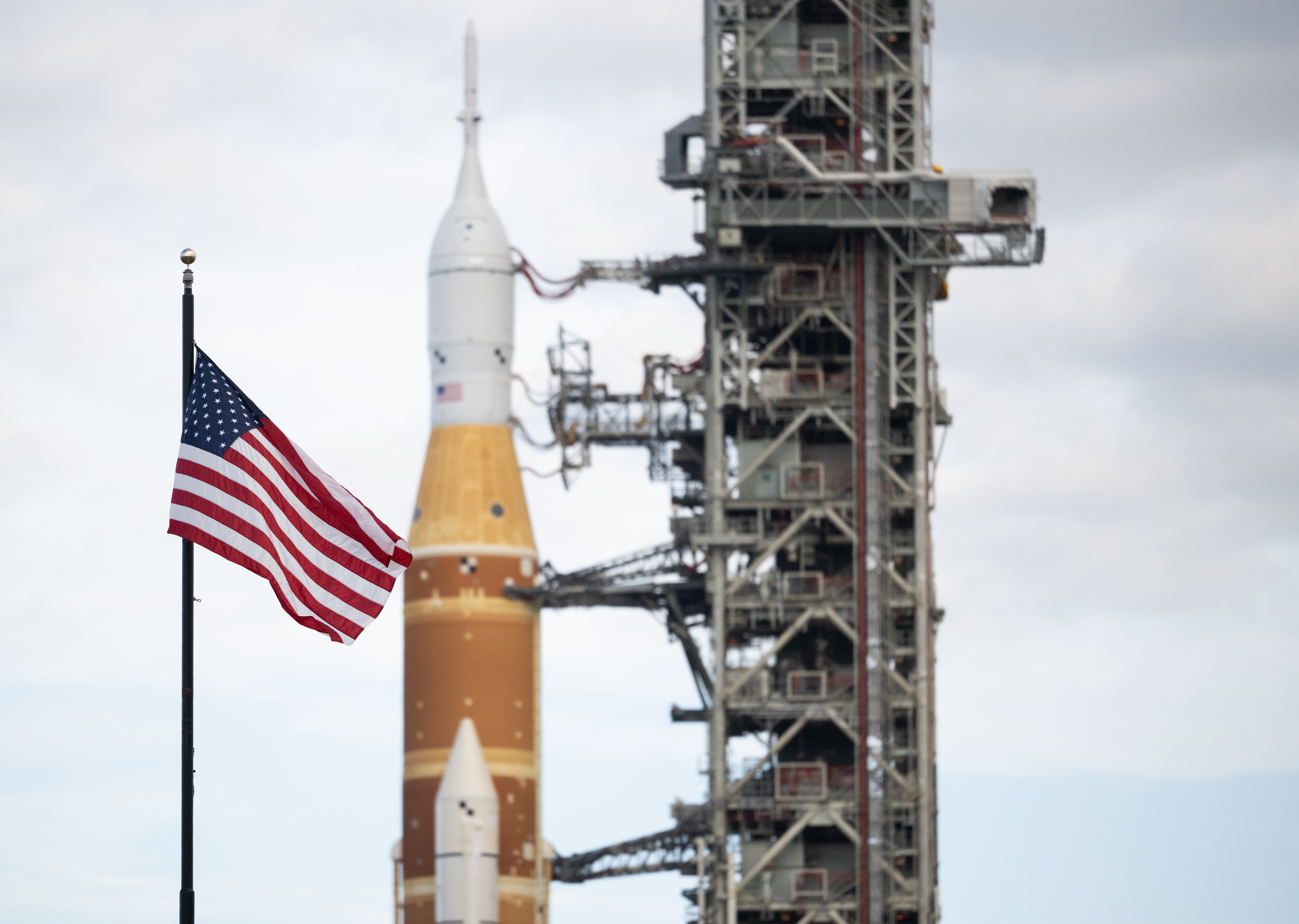
An American flag is seen in front of NASA’s SLS (Space Launch System) rocket and Orion spacecraft at NASA’s Kennedy Space Center in Florida on Jan. 17, 2026, ahead of the historic Artemis II test flight. NASA will host a news conference at NASA Kennedy on Friday, Aug. 14, to highlight American leadership in space and aviation.
Credit: NASA/Joel Kowsky

NASA will hold a news conference at 2:30 p.m. EDT, Friday, Aug. 14, live from the agency’s Kennedy Space Center in Florida, and media and digital creators are invited to attend in person.

The announcement, held in the XLV Hangar at the Shuttle Landing Facility, will preview a new event at NASA Kennedy later this year tied to America’s 250th anniversary, showcasing American leadership in aviation, space exploration, and emerging technologies while bringing together the public, industry leaders, innovators, and the next generation of explorers.

Participants include:

  • NASA Administrator Jared Isaacman
  • NASA leadership
  • Members of Congress

The agency will stream this news conference live through a variety of platforms:

https://www.nasa.gov/live

This event is open to U.S. media and digital creators. The request to attend must be received no later than 12 p.m. on Thursday, Aug. 6, to the Kennedy newsroom at: https://media.ksc.nasa.gov. NASA’s media accreditation policy is available online.

For more information about NASA’s missions, visit:

https://www.nasa.gov

-end-

George Alderman / Cheryl Warner
Headquarters, Washington
202-358-1600
george.a.alderman@nasa.gov / cheryl.m.warner@nasa.gov

Danielle Sempsrott
Kennedy Space Center, Fla.
321-298-8990
danielle.c.sempsrott@nasa.gov

Share

Details

Last Updated
Jul 31, 2026

The post NASA to Host Florida Event Celebrating American Air, Space Leadership appeared first on NASA Science.

NASA to Host Florida Event Celebrating American Air, Space Leadership

31 July 2026 at 22:08
An American flag is seen in front of NASA’s SLS (Space Launch System) rocket and Orion spacecraft at NASA’s Kennedy Space Center in Florida on Jan. 17, 2026, ahead of the historic Artemis II test flight. NASA will host a news conference at NASA Kennedy on Friday, Aug. 14, to highlight American leadership in space and aviation.
Credit: NASA/Joel Kowsky

NASA will hold a news conference at 2:30 p.m. EDT, Friday, Aug. 14, live from the agency’s Kennedy Space Center in Florida, and media and digital creators are invited to attend in person.

The announcement, held in the XLV Hangar at the Shuttle Landing Facility, will preview a new event at NASA Kennedy later this year tied to America’s 250th anniversary, showcasing American leadership in aviation, space exploration, and emerging technologies while bringing together the public, industry leaders, innovators, and the next generation of explorers.

Participants include:

  • NASA Administrator Jared Isaacman
  • NASA leadership
  • Members of Congress

The agency will stream this news conference live through a variety of platforms:

https://www.nasa.gov/live

This event is open to U.S. media and digital creators. The request to attend must be received no later than 12 p.m. on Thursday, Aug. 6, to the Kennedy newsroom at: https://media.ksc.nasa.gov. NASA’s media accreditation policy is available online.

For more information about NASA’s missions, visit:

https://www.nasa.gov

-end-

George Alderman / Cheryl Warner
Headquarters, Washington
202-358-1600
george.a.alderman@nasa.gov / cheryl.m.warner@nasa.gov

Danielle Sempsrott
Kennedy Space Center, Fla.
321-298-8990
danielle.c.sempsrott@nasa.gov

Share

Details

Last Updated
Jul 31, 2026

Rocket Report: New launch rule may limit environmental regulations, Falcon 9 to hit Moon

31 July 2026 at 11:30

Welcome to Edition 9.05 of the Rocket Report! It was a big week for launch contracts, with both Rocket Lab and SpaceX scoring sizable deals from the US military for their respective Electron and Falcon 9 rockets. The vehicles have been the workhorses for small and medium lift for the United States over the past decade and may remain so for some time. Also, there will be no Rocket Report next week, as I am traveling on assignment, and Stephen is taking a week off.

As always, we welcome reader submissions, and if you don't want to miss an issue, please subscribe using the box below (the form will not appear on AMP-enabled versions of the site). Each report will include information on small-, medium-, and heavy-lift rockets as well as a quick look ahead at the next three launches on the calendar.

Rocket Lab wins large Electron deal. Rocket Lab Corporation announced this week that it has been awarded its largest launch contract to date, a $266 million multi-launch contract with the US Space Force. Under the contract awarded by the US Space Force Space Systems Command, Rocket Lab will execute 12 suborbital launches, with up to six additional launches. The first launch of this contract is expected no earlier than the end of 2026.

Read full article

Comments

© Stoke Space

UK says the cloud is financial infrastructure

31 July 2026 at 10:00

Every cloud architect, every financial services executive, and frankly every enterprise CTO should be paying attention to what is going on in the United Kingdom right now. Britain has formally designated Microsoft, Google, Amazon Web Services, and Oracle as “critical third parties” to the financial sector, meaning they are now subject to direct oversight by UK financial regulators rather than being treated as distant infrastructure suppliers outside the regulatory perimeter.

The designations took effect on July 13, 2026, and the oversight will be carried out by the Bank of England, the Prudential Regulation Authority, and the Financial Conduct Authority. The point is straightforward. If these platforms underpin critical banking and financial operations, then their resilience is no longer just a procurement issue. It is now a matter of financial stability.

This is a bigger deal than many people understand. For years, enterprises have treated cloud platforms as outsourced technology providers. Regulators are now making a different argument. They are saying that when enough banks, insurers, payment firms, and market infrastructures depend on the same small group of cloud providers, those providers become systemic infrastructure whether they like the label or not. Reuters reported that the UK’s framework will bring requirements such as resilience testing, self-assessments, and incident reporting directly to these providers. In other words, this is not just more policy language. It is operational oversight aimed at the platforms themselves.

The first thing to understand is that this move is not anti-cloud. It is the opposite. It is an acknowledgment that cloud has become too important to remain lightly touched when it comes to systemic risk. Regulators are not trying to unwind cloud adoption in financial services. They are accepting the reality that core financial operations now depend on a concentrated set of external platforms. When that happens, the conversation changes from vendor management to infrastructure resilience.

Systemic cloud concentration

The market has spent years talking about cloud concentration risk as if it were some vague future concern. It is no longer abstract. The UK is acting because concentration at this level means that a disruption at one major provider can ripple across multiple institutions simultaneously. That is the core issue. It is not whether Microsoft, Google, Amazon, or Oracle are competent operators. In many cases, they are exceptionally good at what they do. The problem is that too much critical activity depends on too few shared platforms.

This is a concept many business and technology leaders still struggle to internalize. A single bank can do a fine job managing its own vendor exposure and still be part of a broader systemic vulnerability if every other bank is relying on the same provider, the same region, the same identity layer, or the same operational dependencies. Regulators are stepping in because the risk is collective, not just institutional. That is why this matters well beyond the UK. It provides a framework for thinking about cloud not as outsourced capacity, but as part of the plumbing of the financial system itself.

Regulators expand their reach

Traditionally, regulators focused on the bank, insurer, or market institution and expected that entity to manage the risks created by outside suppliers. That approach still exists, and financial institutions remain accountable for their own resilience. However, the UK now says that, in some cases, this indirect model is not enough. If a third party becomes critical enough, regulators want direct line of sight into that provider’s resilience posture as well. This is probably the most important architectural and policy signal in the entire move.

That changes the relationship between the financial sector and the cloud providers in a meaningful way. Direct oversight means cloud providers are increasingly being treated less like optional technology partners and more like essential utilities that support national economic confidence. Once that happens, architecture decisions start to carry a different weight. Decisions about control planes, failover models, identity dependencies, regional design, observability, and incident response are no longer just internal engineering choices. They become part of a broader resilience conversation that may now include regulators.

A lot of enterprises have been behind the curve. They built architectures under the assumption that the cloud was simply a faster and cheaper hosting model. It is not. At scale, cloud is shared critical infrastructure. The UK has now made that point explicit.

More scrutiny isn’t more safety

It’s tempting to read this and assume the problem has now been solved. It has not. Direct oversight of hyperscalers does not remove the responsibility of banks or other enterprises to architect well. In fact, it should push them to architect better. A regulated provider can still be a concentration point. A resilient platform can still be used in a fragile way. And a well-run cloud service can still become part of a badly designed dependency chain.

If you are in a regulated or highly sensitive industry, you should take this as a warning that resilience can no longer be treated as a side topic. You need to know exactly which services are business-critical, which control planes are shared, which identity systems create cross-platform dependencies, and how your recovery assumptions actually work in the real world. Most organizations are much weaker here than they believe.

The UK’s move should also force a hard conversation about operational transparency. If regulators are requiring incident reporting and resilience evidence from major providers, enterprises should be demanding clearer dependency mapping and better architectural visibility inside their own environments. You cannot build true resilience on top of assumptions and vendor slide decks.

The start of a much larger shift

The deeper message is that cloud is crossing a line from enterprise technology choice into national and sector-level infrastructure policy. Once a few governments and central regulators start treating cloud this way, the rest of the world tends to follow in some form. We have already seen comparable concern in Europe, and now the UK has made its own move with direct designations and direct oversight.

Architects, CIOs, and boards need to mature their thinking quickly. The conversation is no longer limited to feature depth, discounts, migration speed, or which provider has the best AI story this quarter. The conversation is now about resilience, concentration, transparency, control, and systemic dependency. Those are bigger issues, and they are not going away.

The UK is telling the market something very clearly. Microsoft, Google, Amazon, and Oracle are not just selling cloud services into the financial sector. They are becoming part of the infrastructure on which that sector depends. Once you understand that, everything changes, including how we architect for the future.

❌