Mars could have carried liquid water more recently than we thought
The economist John Maynard Keynes once remarked, “In the long run we are all dead.” From an astronomical standpoint, this is true for the Earth itself. In roughly 5 billion years, the Sun will exhaust the hydrogen at its core and enter the next phase of its life as a Red Giant, where it will swell up large enough to engulf and destroy the Earth.
Currently, the Sun is still in its main-sequence phase, where it fuses hydrogen into helium in its core. Although it remains relatively stable during this phase, it will gradually grow brighter with time. As the Sun shines brighter, the increased heat and radiation will raise Earth’s surface temperature, potentially pushing it past the threshold for life to survive.
One of Earth’s geological processes that helps regulate its surface temperature is the carbon cycle. Over millions of years, carbon moves from the Earth’s interior into the atmosphere as carbon dioxide or CO2, where it functions as a greenhouse gas that traps heat. Plants take in this CO2 through photosynthesis and move carbon through the biosphere.
Meanwhile, rain and rock weathering draw carbon into the oceans and rocks. By pulling CO2 out of the atmosphere, the carbon cycle could mitigate Earth’s warming as the Sun brightens over time. Today, human activities are increasing atmospheric CO2 and warming the planet. However, over billions of years, the carbon cycle could gradually remove enough CO2 from the atmosphere that eventually too little would remain to support photosynthesis.
With these challenges to life on Earth in mind, the researchers Jacob Haqq‐Misra and Eric Wolf investigated how long Earth’s biosphere could last in the distant future. The team used computer models to calculate the balance of energy that Earth would receive and emit over time, accounting for the effects of increasing sunlight and changing atmospheric CO2 concentrations. They followed this up with calculations using the ExoCAM model to determine the temperature and atmospheric conditions of future Earth across different latitudes. They related these conditions to a habitability metric to determine their impact on the biosphere.
To estimate the biosphere’s maximum possible lifespan, the team conducted 29 simulations representing the planet’s conditions over the next 2 billion years. In one set of simulations, the Earth’s carbon cycle contributed little to regulating surface temperature, with the atmosphere’s CO2 concentration fixed at approximately modern levels of 400 parts per million (ppm) and surface temperatures continuing to increase. In another, the carbon cycle worked to keep Earth’s average surface temperature fixed at the modern average of approximately 59℉ (15℃), no matter how much it had to reduce CO2 in the atmosphere.
In the scenario with a fixed CO2 concentration, the team found that in 1.7 billion years, Earth’s surface reached an average of 122°F (50°C), which is too hot for most land plants. After 1.9 billion years, it reached 149°F (65°), becoming too hot for all land plants to survive as temperatures continued to rise.
They also found that in the fixed average surface temperature scenario, atmospheric CO2 dropped below the 150 ppm level that most plants require for photosynthesis within 500 million years. After 1.4 billion years, CO2 levels fell below 10 ppm, leaving only a few land photosynthesizers and aquatic plants alive. After about 1.8 billion years, atmospheric CO2 dropped to 1 ppm, leaving only microbes capable of photosynthesis.
The researchers’ findings generally extend the estimated lifetime of Earth’s future biosphere compared with earlier, simpler models that suggested maximum lifespans of 100 million to 1.5 billion years. However, they clarified that other scientists should verify their results by running tests with other models, especially under extreme conditions of high incoming solar radiation and low atmospheric CO2.
Lastly, Haqq‐Misra and Wolf noted that their model did not account for major evolutionary changes that could help life adapt to future conditions. Over time, plants could evolve to tolerate higher temperatures or lower atmospheric CO2 levels. Future humans or another intelligent species might also engage in large-scale geoengineering projects to prevent the end of life on Earth. If life on Earth proves adaptable enough, the biosphere may endure until a Red Giant fills the daytime sky.
The post The long-term fate of Earth’s biosphere appeared first on Sciworthy.
University of California, Riverside’s Professor Eric Schwitzgebel and University of Lisbon postdoctoral researcher Jeremy Pober argue that consciousness is substrate flexible, meaning it can arise not just in the biological tissue we find on Earth, but potentially in radically different physical materials found elsewhere in the cosmos.
The post Consciousness is Not Exclusive to Earth’s Biology, Philosophers Argue appeared first on Sci.News: Breaking Science News.
It’s a bit worrying when a scientific paper begins, “How long will life on Earth survive?” But in this case—a study by Jacob Haqq‐Misra of Blue Marble Space and Eric Wolf at the University of Colorado Boulder—the billion-plus-year timeline under consideration shouldn’t cause you too much existential panic.
The context for this question is that we understand the Sun will brighten as it eventually matures into a red giant that swallows the Earth in a solar furnace. So, where along that 5 billion-year path will life on Earth, in fact, be cooked?
This isn’t just a question of incoming radiation. Among the thermostat-like stabilizing feedback loops in Earth’s climate, the cycling of CO2 through the solid Earth is a major factor over timescales this long. The weathering of silicate rocks at the surface converts atmospheric CO2 into carbonate that ends up on the seafloor, where it can be subducted into the mantle with tectonic plates. (And eventually, it can cycle back out to the atmosphere through volcanoes.)


© NASA/GSFC/SDO
![]()
Editor’s Note: Astrobites is a graduate-student-run organization that digests astrophysical literature for undergraduate students. As part of the partnership between the AAS and astrobites, we occasionally repost astrobites content here at AAS Nova. We hope you enjoy this post from astrobites; the original can be viewed at astrobites.org.
Title: Retrieving the Red Edge on Earth-Like Planets with Heterogeneous Clouds and Surfaces
Authors: Zachary Burr et al.
First Author’s Institution: Jet Propulsion Laboratory; ETH Zurich
Status: Published in ApJ
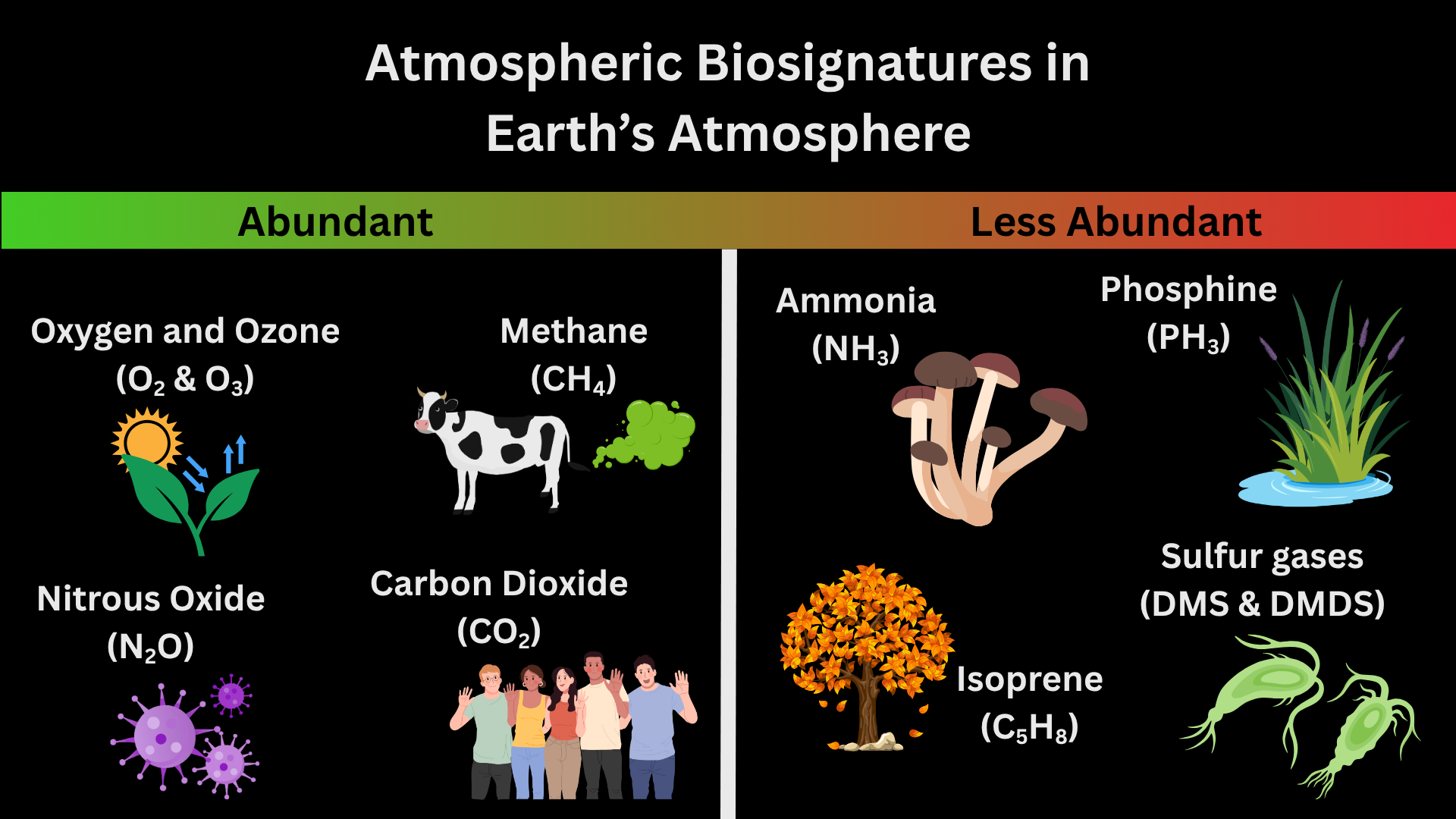
In the next 25 years, astronomers could find signs of life on other planets with the launch of the Habitable Worlds Observatory. Atmospheric signs of life, known as atmospheric biosignatures, are how astronomers currently search for life on other planets. Figure 1 shows examples of atmospheric biosignatures with pictures of each chemical’s origin on Earth. Before E.T. can phone home, though, we have to understand what chemicals make up a planet’s atmosphere. To do this, astronomers can use spectroscopy to observe a planet’s atmosphere in different wavelengths and measure the types and quantities of chemicals present.
Figure 1: Atmospheric biosignatures present in Earth’s atmosphere. More abundant biosignatures include oxygen and ozone (byproducts of photosynthesis in plants and bacteria) and nitrous oxide (byproduct of bacteria that don’t need oxygen to survive). Less abundant biosignatures include isoprene (released from the breakdown of leaves that have fallen from trees) and sulfur gases (byproducts of cyanobacteria). [Kaz Gary]
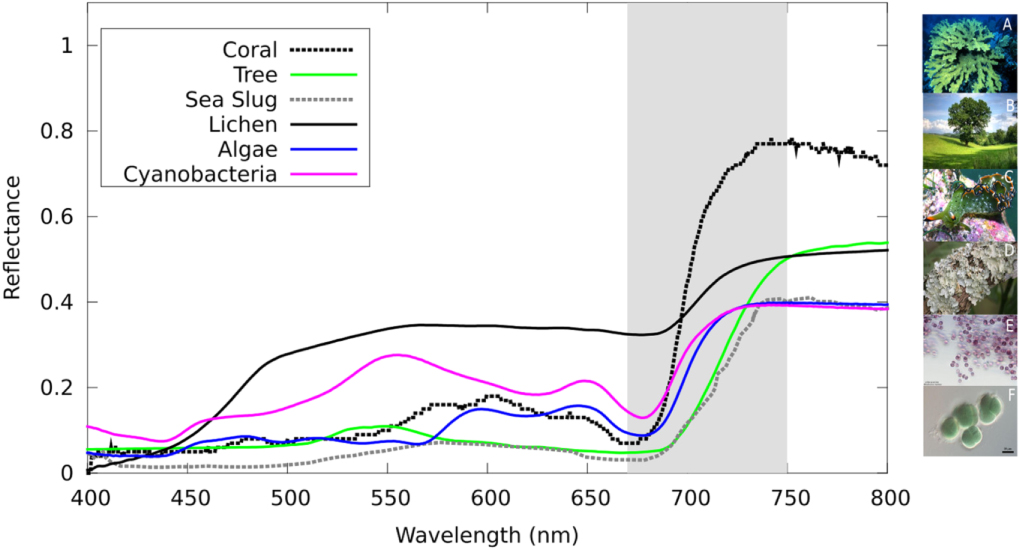
But are atmospheric biosignatures the only way to tell if life exists on other planets? Short answer: absolutely not. Let’s take Earth as an example. If we imagine Earth as a directly imaged exoplanet and take spectra of the light it reflects, you’ll find that around near-infrared wavelengths (~700 nanometers or just past the red part of the visible light spectrum), the light reflected off of Earth increases sharply. This sharp increase is called the vegetation red edge and is caused by plant and ocean life on Earth’s surface as shown in Figure 2. This is made possible because chlorophyll (the thing that makes plants green) absorbs nearly all visible light but reflects near-infrared light. The vegetation red edge is an example of a surface biosignature. In today’s article, the authors determine if the vegetation red edge will be visible in spectra of Earth-like exoplanets!
Figure 2: Spectra of different sources of the vegetation red edge on Earth. The vegetation red edge is highlighted in gray where the spectra rapidly increase and then level off beyond the visible light part of the spectrum. Each color represents a different source with pictures of each source on the right-hand side of the plot. [O’Malley-James and Kaltenegger 2019]
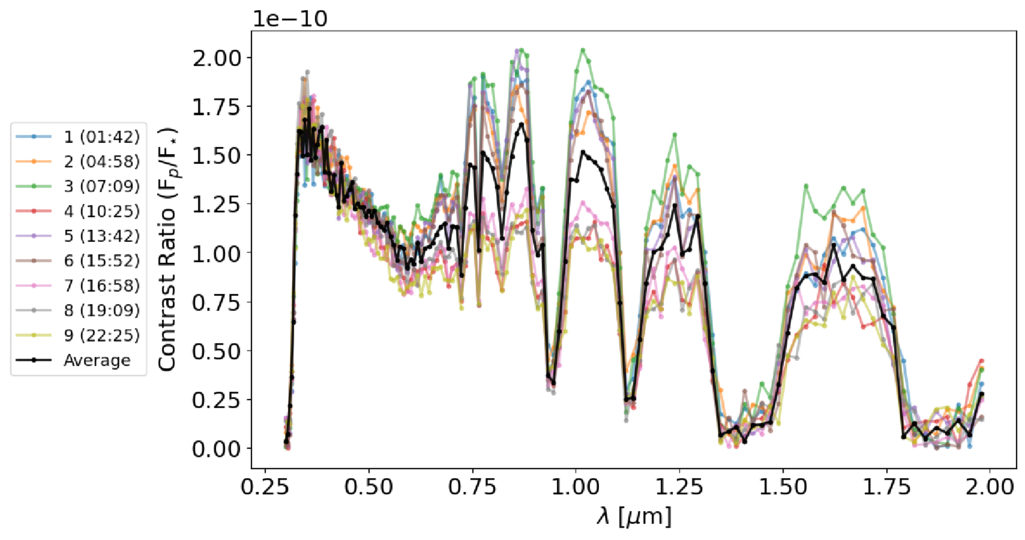
Planets rotate; that’s how we have morning, noon, and night in 24 hours guaranteed. This means that different parts of the surface will be visible at different times when we take spectra. Sometimes, we may see more ocean than land, other times not. To determine if the vegetation red edge would be visible at all points in Earth’s day, the authors simulated nine different spectra of modern-day Earth representing nine snapshots of Earth’s rotation. Additionally, they also simulated a time-averaged spectrum that shows an entire Earth day in one snapshot without the time variability. These spectra are shown in Figure 3.
Figure 3: Spectra of a directly imaged modern-day Earth at nine different times in its rotation. The y-axis is the ratio of the planet’s signal to the star’s signal and the x-axis is wavelength in microns. Each color represents a time in UTC and the black curve represents the time-averaged spectrum. [Burr et al. 2026]
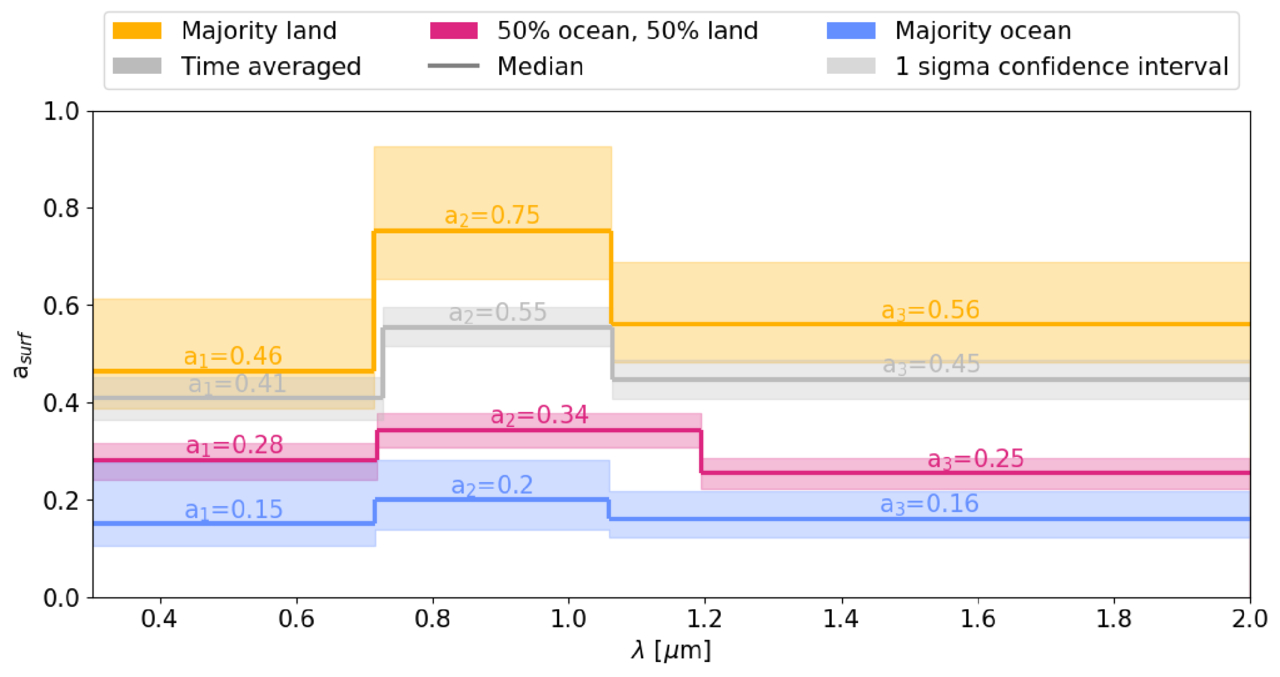
After running the models, the authors were able to detect a sharp increase in the surface albedo value in every spectrum, including the time-averaged one. This result is shown in Figure 4. The authors take this result one step further in order to validate that the vegetation red edge is actually a result of surface variation of vegetation. They re-run models on each of their spectra but instead include a constant surface albedo instead of a time-varying one. This resulted in incorrectly measured radii, chemicals, and surface gravity in nearly all of the models. Without the vegetation red edge and surface features, the models could not accurately determine if life was present on Earth.
Figure 4: Retrieved surface albedos for the nine time-varying spectra. The surface albedo is broken down into three different values (a₁, a₂, a₃). Each of these values represents a change in the surface albedo at different wavelengths (i.e., how reflective the surface is at three different wavelengths). The nine spectra were broken down by the amount of surface that was visible at that time and color-coded for each category. The time-averaged spectrum is shown in gray. Each category of spectra was able to retrieve an increase in reflected light from the surface at vegetation red edge wavelengths. The spectra that had the majority land visible have the biggest increase in the surface albedo. This makes sense since the amount of visible vegetation is the largest with majority-land planets. [Burr et al. 2026]
Original astrobite edited by Madison VanWyngarden.
About the author, Kaz Gary:
I am a fourth-year PhD candidate at The Ohio State University with a passion for planets. My current work focuses on modeling exoplanet observations for the Habitable Worlds Observatory and understanding planetary atmospheres. Outside of research, I help develop planetarium shows and love all forms of science communication. In my free time, I enjoy playing tabletop RPGs, painting, watching terrible reality TV, and hanging out with my pet hedgehog.
The post Life on the (Red) Edge appeared first on AAS Nova.
![]()
Editor’s Note: Astrobites is a graduate-student-run organization that digests astrophysical literature for undergraduate students. As part of the partnership between the AAS and astrobites, we occasionally repost astrobites content here at AAS Nova. We hope you enjoy this post from astrobites; the original can be viewed at astrobites.org.
Title: Clouds Can Enhance Direct-Imaging Detection of O2 and O3 on Terrestrial Exoplanets
Authors: Huanzhou Yang, Michelle Hu, and Dorian S. Abbot
First Author’s Institution: University of Chicago
Status: Published in ApJ
In the hunt for life beyond Earth, studying exoplanet atmospheres is one of our most powerful tools. The atmosphere of an exoplanet acts as a window into its environment and allows astronomers to take a guess at what processes are shaping the planet’s climate, chemistry, and thus, its potential for habitability. The gases present in the planet’s atmosphere impart a unique spectral fingerprint on the light that passes through the atmosphere and allows us to identify what gases might be present and look for possible signs of life.
JWST is already hard at work looking at distant worlds and gathering spectroscopic data for us to analyse. It has already observed several exoplanets and recorded the light that passed through their atmospheres. This has not only sparked a debate over what could be interpreted as the first possible signs of biological activity, but has also given us a glimpse of worlds that are remarkably different from our own.
However, JWST is mostly limited to observing the atmospheres of transiting exoplanets. That means planets that orbit close to their host star and are more or less directly edge-on, as viewed from us, so that they transit across the face of the star. The only planets that the telescope is able to observe directly are big, young, and hot planets farther from their host star, at distances more resembling those of the outer planets in our solar system, like Saturn or Uranus. If only we had a telescope powerful enough to image a potentially habitable planet directly and analyse the light reflected from it.
This is where the Habitable Worlds Observatory (HWO) will come in. Now, I know what you are thinking. Why must astronomers always look towards greener pastures bigger telescopes when we already have perfectly functional space telescopes in orbit or practically on the launch pad? Well, it is true that the next flagship space telescope from NASA, the Nancy Grace Roman Space Telescope, is designed to directly image exoplanets and analyse their atmospheres. But space telescopes can take decades to plan and are often built on lessons learned from previous missions. Roman, with its 2.4-meter primary mirror and coronagraph, will be able to observe planets similar in size and orbital distance to Jupiter and will get us some of the way, for sure, but not all the way. At three times the mirror size, HWO, NASA’s proposed successor to Roman that is planned for the 2040s, will carry the torch even further and be able to directly image Earth-like planets in the habitable zone, where liquid water can exist on the planet’s surface.
This brings us to today’s article. If the HWO is going to potentially observe Earth analogues, we might expect it to run into the same issue that plagues everyone living in the UK for most of the year — clouds. Clouds in the atmosphere of an exoplanet can sometimes cause trouble when trying to analyse the light. Cloud particles scatter different wavelengths of light differently, and cloud variability creates dynamic changes in the observed brightness that can make it hard to know what exactly you are looking at. Clouds can also mean varying levels of opacity to look through depending on cloud composition, and they can hide underlying atmospheric properties such as water content beneath a thick cloud layer. For transmission spectroscopy, even a thin layer of clouds can disrupt the measurements as the light has to travel a long distance through the atmosphere. However, for direct imaging, the effect of clouds is perhaps more nuanced. While a thick cloud deck will block the signal from whatever gas lies beneath it, it will also increase the overall albedo of the planet and make it easier to detect the gas above. This means that cloud height and type are both critical variables in understanding atmospheric properties of exoplanets, which is what the authors of today’s article set out to investigate.
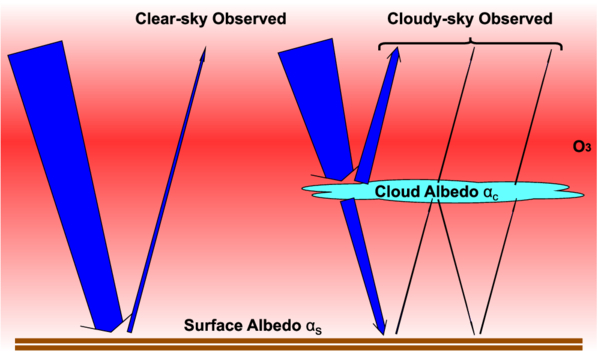
To understand how clouds affect the ability to detect signs of life on distant Earth-like planets, the authors used computer simulations. They focused on two gases, molecular oxygen (O2) and ozone (O3). Both gases are often regarded as biosignatures, although their astrobiological significance has been debated. The authors first used a tool that simulates how a telescope like the HWO might observe an Earth-like planet around a star 15 parsecs away. This tool predicts how light bounces off a planet’s surface and atmosphere, and whether the two gases would show up clearly in the reflected light. Next, they created realistic cloud conditions using a cloud microphysics model. This model calculates how clouds might form and behave depending on factors like surface pressure or how much sunlight the planet gets. With this they were able to change things like cloud height and particle size. They then combined the two tools by adding the simulated clouds into the observations model and building a mathematical model to help explain what they saw in the simulations. The sketch for their model can be seen in Figure 1.
Figure 1: Clouds can affect the amount of reflected light (albedo) from the imaged planet. Depending on the cloud height and particle size, this can have a big impact on the observability of different species of gas in the atmosphere. Here the blue arrows indicate the amount of light entering the atmosphere and being reflected. The arrows get thinner from tail to head, representing absorption in the atmosphere. Depending on the presence of clouds, a varying amount is reflected back. The red colour indicates the assumed distribution of ozone, O3, which is concentrated at a high altitude. [Yang et al. 2025]
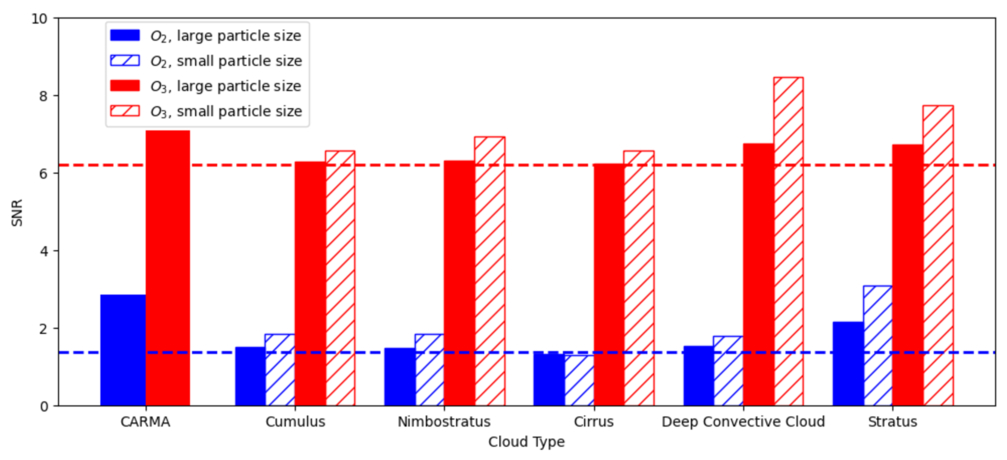
The researchers discovered that low clouds can actually make gases like oxygen and ozone easier to detect, because these clouds reflect more light without blocking the gases above them. On the other hand, high clouds can make it harder since they can hide the gases from view. They tested different cloud types using real data from Earth as seen in Figure 2. They looked at five common cloud types, like stratus (flat and low), cirrus (high and wispy), and deep convective clouds (tall, thunderstorm-like), and compared them to their model clouds (labelled as CARMA in the figure).
Figure 2: The figure shows how different types of clouds affect our ability to detect oxygen (blue) and ozone (red) on an Earth-like planet. The dashed lines show the results without clouds, while the bars show what happens when clouds are present. Solid bars represent larger cloud droplets, and striped bars represent smaller ones, which reflect more light. The figure shows that most cloud types — especially low clouds like stratus and thick storm clouds — actually make it easier to detect these gases, particularly when droplets are small. Only high, thin clouds (cirrus) slightly reduce oxygen detection, and even then, the effect is small. This is the article’s main finding: while clouds can block light in some observation methods, for direct imaging of reflected light, they often help us see signs of life better. The cloud types are based on real Earth data while the authors’ simulated cloud model is labelled as CARMA. [Yang et al. 2025]
Original astrobite edited by Maria Vincent.
About the author, Kasper Zoellner:
I have a Master of Science in astronomy and I am currently working towards a PhD in physics and educational science. My greatest passion is the search for exoplanets and how stellar variability may influence the possibility of life. I am also interested in science outreach, education, and discussing what sci-fi novel to read next!
The post Weather Forecast for the Habitable Worlds Observatory: Cloudy with a Chance of Biosignatures appeared first on AAS Nova.

![]()
Editor’s Note: Astrobites is a graduate-student-run organization that digests astrophysical literature for undergraduate students. As part of the partnership between the AAS and astrobites, we occasionally repost astrobites content here at AAS Nova. We hope you enjoy this post from astrobites; the original can be viewed at astrobites.org.
Title: Impacts on Ocean Worlds Are Sufficiently Frequent and Energetic to Be of Astrobiological Importance
Authors: Shannon M. MacKenzie et al.
First Author’s Institution: Johns Hopkins University Applied Physics Laboratory
Status: Published in PSJ
Asteroids and meteorites are usually associated with doom and destruction (rest easy, dinosaurs), but they may have also been essential for the emergence of life on Earth. It is popularly theorized that some of the base building blocks of life, like volatiles and organics, were delivered here by meteorites and that the energy of these impacts synthesized even more, like HCN and amino acids. Expectedly, the same should be true for other planets. Today’s article explores this possibility using nearby analogies for potentially habitable exoplanets: our solar system’s ocean worlds.
The solar system formed from one massive cloud of gas and dust, so the composition everywhere is approximately the same. However, early Earth was an extremely hot ball of magma that destroyed its organic matter. Luckily, organics were able to survive in objects like meteorites in the cold outskirts of the solar system.
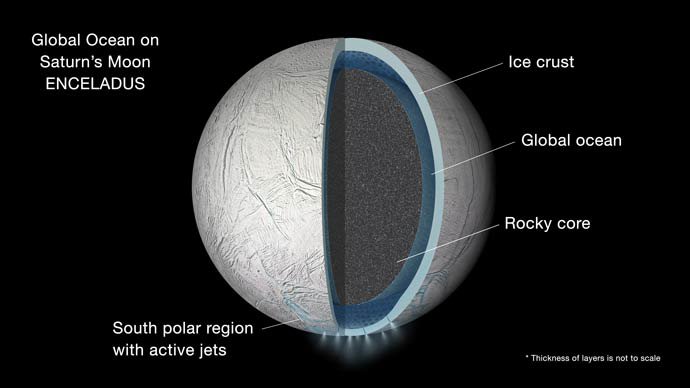
In the search for extraterrestrial life, we start by looking for the basic necessities — and water is a big one. Though Earth is the only planet in our solar system with liquid water, several moons of Jupiter and Saturn have it as well. These moons are beyond the balmy habitable zone, so their surfaces are covered in icy crusts, but beneath those crusts are subsurface oceans of liquid water, making these moons “ocean worlds” (see Figure 1). On their own, the presence of water makes these moons astrobiologically interesting, and they will also elucidate ocean worlds that are further away.
Figure 1: Saturn’s moon Enceladus with a liquid water ocean beneath the icy crust. Jets on the surface are strong indicators of hydrothermal vents on the ocean floor. [JPL]
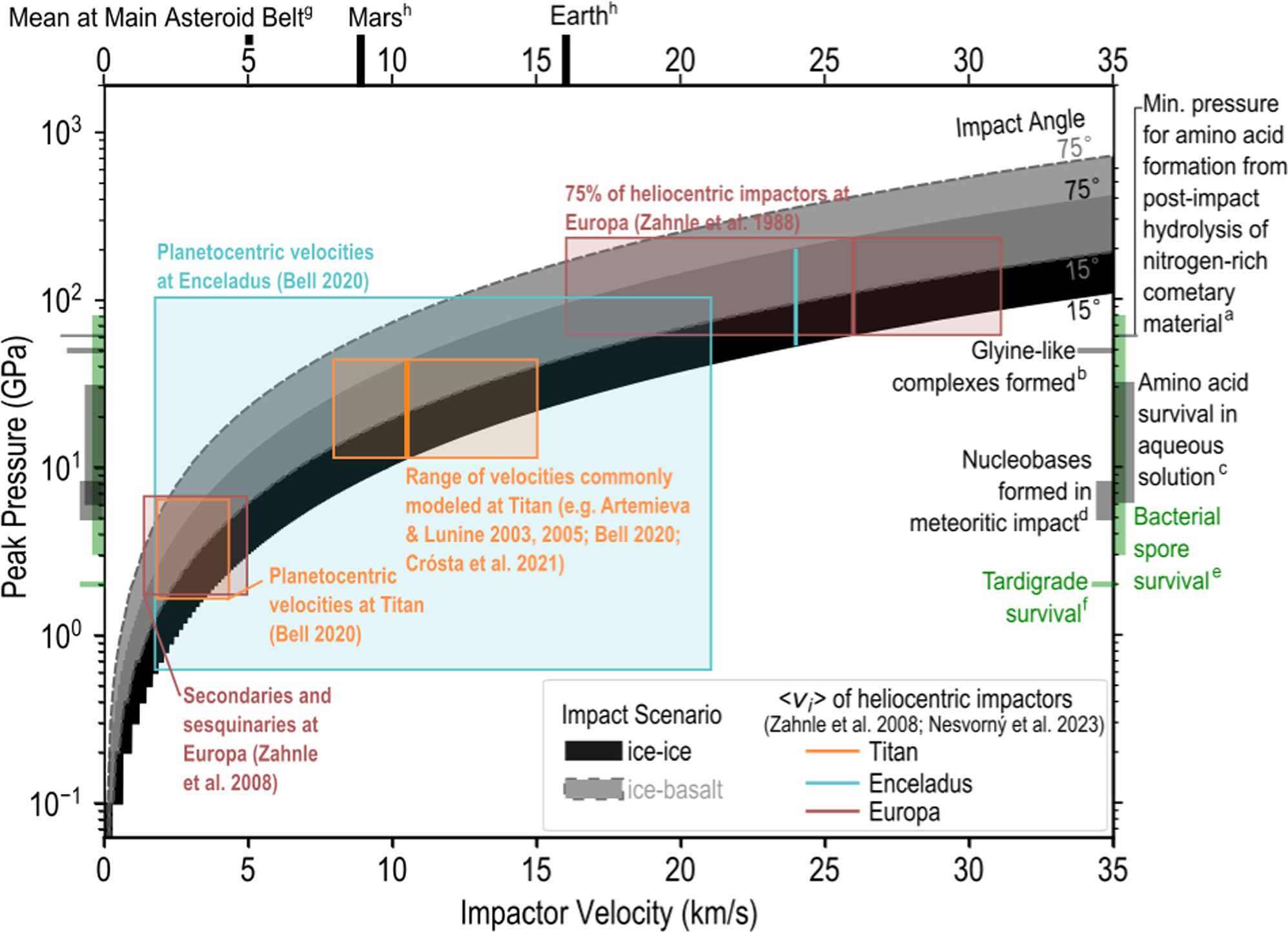
To evaluate survivability, the authors modeled the maximum pressure of an impact on an ocean world’s ice crust for a range of impact velocities and angles. Around Jupiter and Saturn, most impactors are either icy or rocky objects that originate from the Kuiper Belt or Oort cloud, so the authors modeled both types of impactors. Rocky impactors create higher pressures (shown in gray in Figure 2) than icy impactors (shown in black in Figure 2). From the sizes of observed craters on the ocean world moons, previous works determined the velocities and pressures of impacts, which are shown by the colored boxes in Figure 2. Finally, a number of other works have estimated the ranges of survivable pressures for biota and biologically important molecules, which are shown by the green and black bars on the right of Figure 2. Impressively, the survivable pressure ranges are within the observed and modeled pressures of impacts! So these life building blocks can be, and likely have been, deposited on the ocean world moons.
Figure 2: The modeled impact velocities and maximum pressures for icy (black) and rocky (gray) impactors. Survivable pressures of various organics (green and gray colored bars on the y-axis) are within the range of observed velocities and pressures from craters on each ocean world moon (colored boxes). [MacKenzie et al. 2024]
When an impactor hits the icy crust, some of the ice will melt. The deposited organics will end up in a pool of liquid water in the crater, which is an ample environment for prebiotic chemistry until the pool freezes. From the observed crater sizes and modeled velocities, the authors estimated how much liquid water could remain in a crater and how long it would take to freeze. Freeze times ranged from a few Earth years for the smallest craters (<4 kilometers in diameter) to thousands of years for the largest craters (hundreds of kilometers). In labs on Earth mimicking the crater conditions, amino acids have been synthesized in as short as a few months to a few years, so synthesis is possible in the melt pools.
The pools eventually freeze, trapping any deposited or synthesized material on the icy surface. Other processes, like future impacts, are required to break through the icy crust and transport material to the subsurface oceans where theorized hydrothermal vents could allow more complex development.
In summary, survivable impacts on the ocean world moons are common, and each provides an opportunity for prebiotic chemistry to arise. Unlike most objects astronomers study, the proximity of these ocean worlds means that we can thoroughly understand them through physical samples. NASA’s Cassini detected organic compounds in the plumes that burst off the surface of Enceladus, and the Dragonfly mission is set to head for Titan in 2028 to collect and analyze samples once it arrives in 2034. In the coming decades, we may witness the discovery of more precursors to life or microbial life itself in the subsurface oceans of moons in our solar system, and gain radical insight into the ocean worlds beyond.
Original astrobite edited by Sonja Panjkov.
About the author, Annelia Anderson:
I’m an Astrophysics PhD candidate at the University of Alabama, using simulations to study the circumgalactic medium. Beyond research, I’m interested in historical astronomy, and hope to someday write astronomy children’s books. Beyond astronomy, I enjoy making music, cooking, and my cat.
The post Seeding Life in the Oceans of Moons appeared first on AAS Nova.


New observatories and spacecraft missions are probing environments in our solar system that could potentially host life but have long remained hidden. Icy moons like Saturn’s Enceladus and Jupiter’s Europa likely contain oceans beneath frozen outer shells. But a layer of ice prohibits space probes from sampling them directly. Exploring these icy moons is almost forensic: Their surfaces keep aContinue reading "Scientists used a method from ecology to identify whether icy moons could hold conditions for life"
The post Scientists used a method from ecology to identify whether icy moons could hold conditions for life appeared first on Astronomy Magazine.
Earth has many unique features for a planet, such as a magnetic field, a large moon, and plate tectonics. It’s also the only planet we know of that harbors life. These facts form the basis of the Rare Earth hypothesis, which posits that we haven’t found aliens because other planets in the Galaxy probably don’t have all the right conditions for life.
Another characteristic of Earth is that about 30% of its surface is land and about 70% is ocean. Recently, Columbia University Assistant Professor David Kipping investigated whether the proportion of Earth’s surface covered by dry land versus ocean, or its land fraction, is another reason Earth is habitable not only for simple single-celled organisms, but also for intelligent species like humans.
To test this hypothesis, Kipping created 4 statistical models of planets with different land fractions that intelligent aliens could potentially evolve on. First, he created an equation to describe the likelihood that a planet in its star’s habitable zone has a particular land fraction, known as a probability distribution. Kipping weighted this probability distribution toward the extreme ends, making it more likely that a planet would be covered by a single huge landmass or a single vast ocean than by a mix of both, as on Earth.
Kipping then incorporated this land fraction probability distribution into his statistical models to calculate the probability that a random planet will have that land fraction and host intelligent life. The 4 scenarios Kipping tested were: 1) that intelligent life is more likely to emerge on land-dominated planets, 2) that it’s more likely to emerge on ocean-dominated planets, 3) that it’s more likely to emerge on planets with roughly equal amounts of land and ocean, and 4) that its emergence is independent of a planet’s land fraction.
As a first step in determining the kinds of planets intelligent aliens would tend to emerge on, Kipping used each model to predict the probability that intelligent life would emerge on a planet with the same land fraction as Earth. He then compared these probabilities by calculating the ratios between each value. Because Earth is the only known planet with intelligent life, a model that predicted a greater probability for humanity’s existence on Earth would be more likely to reflect reality.
Kipping considered it strong evidence that a given model was more realistic than another if the ratio between 2 of them was greater than 10, meaning one model was 10 times more likely to predict the existence of Earth and humanity. Kipping found that no comparison of any 2 models passed this threshold. However, the models assuming that intelligent life prefers ocean-dominated planets or planets with a land-ocean balance were 2.5 and 3 times more likely to predict the existence of humanity than the model assuming that intelligent life prefers land-dominated planets. Additionally, the model assuming that intelligent life prefers a land-ocean balance was always more likely to predict humanity than any other model, though marginally.
Kipping also addressed whether finding more planets with intelligent life would affect which model was deemed most realistic, for example, if scientists discovered conclusive evidence of life on Mars in its distant past. Here, Kipping identified 2 complications. First, it’s uncertain how much of Mars’s surface was once covered by water – some estimate it had a land fraction as high as 81%, while others estimate it was as low as 25%. Second, proving that Mars once had life would not prove it once had intelligent life.
Regardless, Kipping reran the models assuming that ancient Mars had a land fraction comparable to Earth’s. Adding this second data point produced ratios similar to those in the earlier Earth-only calculations, meaning it still didn’t make any single model 10 times more likely to predict the existence of humans and Martians, respectively.
Kipping then took the 10-times threshold and reversed the calculations to find what conditions would exceed it. In doing so, he calculated that astronomers would need to find 14 other planets with intelligent life and known land fractions to robustly determine whether intelligent life is more likely to occur on desert planets, ocean planets, balanced planets, or without bias.
Kipping concluded that he can’t yet definitively state whether there is something special about Earth’s land fraction when it comes to producing intelligent species. However, Earth’s existence would suggest that intelligent life is unlikely to favor extreme desert planets, so the Milky Way probably isn’t filled with Tatooines and Jakkus. And while his analysis doesn’t debunk the Rare Earth hypothesis, it does undermine the argument that Earth’s ocean size explains why Earth is rare.
The post Is Earth’s water why intelligent life evolved here? appeared first on Sciworthy.