
❌

Normal view

Apple Lawsuit: OpenAI Seeks Dismissal of Trade Secrets Case

By: Hannah
6 August 2026 at 19:02

Apple lawsuit against OpenAI has reached its first major procedural challenge, with the ChatGPT developer asking a US federal judge to dismiss allegations that it acquired or used trade secrets taken by former Apple employees.

OpenAI submitted its 31-page dismissal motion on Wednesday in the US District Court for the Northern District of California. The filing argues that Apple has not adequately identified protectable trade secrets or alleged facts showing that OpenAI misappropriated confidential information.

Apple filed the case on July 10 against OpenAI, its io Products hardware operation, former Apple Vice President Tang Yew Tan, and former electrical engineer Chang Liu. The complaint accuses the defendants of obtaining information connected to Apple’s product development, manufacturing, components, testing, and supply chain operations.

The allegations have not been proven, and OpenAI denies possessing or seeking Apple’s trade secrets. US District Judge Edward Davila must now decide whether Apple’s complaint contains enough factual detail for the litigation to continue.

OpenAI Challenges the Apple Lawsuit

OpenAI’s motion focuses initially on how Apple described the information it claims was stolen. According to OpenAI, the complaint relies on generalized product-development categories without identifying the protected information with enough precision.

Trade secret plaintiffs face a difficult balance at the beginning of litigation. Apple must describe the protected material sufficiently to establish a plausible legal claim, but revealing the material publicly could expose the same information it is trying to protect.

Sensitive details can later be handled under seal or through a protective order. At the dismissal stage, however, Apple must still provide enough information for the court to distinguish genuine trade secrets from general engineering knowledge, employee experience, or skills acquired through years of work.

OpenAI argues that Apple has not crossed that threshold. Its motion says the complaint fails to establish ownership of a protectable trade secret and does not plausibly allege that OpenAI acquired, disclosed, or used such information.

The filing also disputes the commercial premise behind Apple’s accusations. OpenAI says it is developing products that are different from Apple’s hardware and has no need or desire to use the iPhone maker’s confidential material.

That position does not settle whether information was taken. A company can potentially misappropriate trade secrets even when its eventual product has a different design. The court’s immediate task is narrower: determining whether Apple has alleged facts that could support its claims if those facts are later proven.

The image shows a large, circular modern building surrounded by trees, with the sun rising or setting in the background. The sleek, white architecture resembles Apple’s campus—an icon often seen in discussions about their Q2 earnings.
Apple Park | Image Source: Google

Disputed Access to Apple Information

Apple’s complaint centers partly on Chang Liu, who spent eight years working as a senior system electrical engineer at the company before joining OpenAI in January 2026.

Apple alleges that Liu retained an Apple-issued computer and accessed confidential technical information after leaving. It claims he exploited residual authentication access on multiple occasions to obtain internal documents while already working for OpenAI.

OpenAI presents a different explanation. It says Apple employees contacted Liu after his departure and asked him to help locate files needed for ongoing Apple work. The company published redacted messages that it says support this account.

OpenAI argues that Apple’s systems and policies allowed personal and corporate information to become intermingled through iCloud accounts. Former employees, it says, could retain access to Apple files without requesting it or realizing that access remained active.

The motion maintains that Apple cannot treat the foreseeable effects of its own access-management practices as proof that former employees intentionally stole data. Apple, in contrast, alleges that its records document repeated access to restricted information rather than an accidental discovery of lingering permissions.

These competing accounts are likely to become central if the case enters discovery. Authentication logs, downloaded files, device records, internal communications, and employment timelines could establish whether access was deliberate, what information was obtained, and whether it reached anyone working on OpenAI products.

A dismissal motion normally tests whether the complaint states a legally sufficient claim. It is not a trial, and the judge is not expected to resolve every factual disagreement using competing evidence at this point.

Tang Tan and OpenAI’s Hardware Team

Apple separately accuses Tang Tan, OpenAI’s chief hardware officer, of seeking confidential information from Apple employees during recruiting conversations.

Tan spent more than 24 years at Apple and worked on products including the iPhone, Apple Watch, AirPods, and iPod. He later helped establish io Products with former Apple design chief Jony Ive and other collaborators. OpenAI acquired the hardware company as part of its effort to create a family of devices built around artificial intelligence.

Apple alleges that Tan used confidential project names, retained internal materials, and encouraged job candidates to discuss unreleased components or bring physical parts to interviews. OpenAI rejects the claim that these interactions formed a coordinated effort to collect Apple secrets.

OpenAI says Tan repeatedly instructed employees that confidential information from previous employers could not be brought into its organization. It also offers an alternative explanation for an Apple offboarding document found in his possession, arguing that Tan retained it to help incoming employees comply with Apple’s departure procedures.

Apple’s position is that the document and recruiting communications must be examined alongside the other alleged conduct. It describes the events as part of a connected campaign rather than isolated employment or administrative issues.

The dispute comes during intense competition for engineers capable of developing consumer AI hardware. Apple alleges that more than 400 former employees have moved to OpenAI, although hiring people from a competitor does not by itself establish trade secret misappropriation.

A company must generally connect recruitment to the acquisition, disclosure, or use of protected information. OpenAI is relying heavily on that distinction, presenting Apple’s lawsuit as an attempt to respond to employee departures and its difficulties competing for AI talent.

A man with light skin, short brown hair with some gray, and blue eyes—resembling Sam Altman of rocket company fame—wears a black suit, white shirt, and black polka dot tie while posing against a dark gray background.
Image Credit: Getty Images

Apple Seeks Immediate Restrictions

OpenAI’s dismissal request arrives shortly after Apple asked the court for a preliminary injunction. Apple wants restrictions imposed while the lawsuit proceeds, arguing that it could suffer harm if its confidential information is used during OpenAI’s hardware development.

The requested relief would prevent OpenAI and the individual defendants from acquiring, accessing, using, or disclosing the alleged trade secrets. Apple has also requested expedited discovery and forensic examination of relevant devices and accounts.

OpenAI says those restrictions are unnecessary because it does not possess or want Apple’s protected information. It has described Apple’s request as based on false information and has offered to cooperate in addressing specific concerns.

The two companies also disagree over their communications before the lawsuit. Apple initially said its concerns had been raised with OpenAI months earlier. OpenAI responded that Apple’s outside lawyers contacted the wrong person after confusing names and incorrectly described a conversation with OpenAI’s general counsel.

OpenAI says Apple did not present the specific accusations before filing the case and that the companies had previously discussed resolving any access issues. Apple has since provided additional information in support of its injunction request, including allegations involving other former employees.

These disputes have moved beyond ordinary court filings. OpenAI published messages and emails on its website to support its version of events, calling Apple’s lawsuit aggressive and poorly investigated. Apple has primarily presented its account through formal legal submissions.

Judge Davila could dismiss some or all of Apple’s claims, deny the motion, or allow Apple to amend its complaint with more specific allegations. Even a dismissal would not necessarily end the case if permission to revise the complaint is granted.

The next scheduled public test is an October 1 hearing covering Apple’s preliminary injunction and request for early discovery. That proceeding may determine whether OpenAI faces immediate limits on its hardware work before the underlying trade secret claims receive a full evidentiary review.

The post Apple Lawsuit: OpenAI Seeks Dismissal of Trade Secrets Case appeared first on AppleMagazine.

Apple seeks court order to block OpenAI from using alleged trade secrets in hardware ambitions

4 August 2026 at 16:00

OpenAI

Apple has asked a federal judge for a preliminary injunction that would stop OpenAI and two of its former employees from accessing, using, or disclosing what the iPhone maker claims are its confidential trade secrets, escalating a high-stakes legal battle over artificial intelligence and future consumer devices.

In a filing Monday in the U.S. District Court for the Northern District of California, Apple argued it faces “irreparable harm” without the order. The motion comes weeks after the company sued OpenAI, the two ex-employees now working for the ChatGPT maker, and OpenAI’s commercial arm io Products. Apple alleges the defendants misappropriated proprietary information to advance OpenAI’s push into consumer hardware.

The two former Apple staffers named are Chang Liu, previously a senior system electrical engineer, and Tang Yew Tan, who served as vice president of product design for the iPhone and Apple Watch. Apple is also seeking expedited discovery, including documents related to alleged access of its trade secrets, and depositions of Liu, Tan, OpenAI employee Yu-Ting Peng, an unnamed OpenAI worker who previously worked at Apple, and corporate representatives from OpenAI and io Products.

The lawsuit highlights growing rivalry between the two tech giants. Analysts have suggested OpenAI is developing its own phone or other AI-powered device that could operate without traditional apps or operating systems, potentially drawing users away from Apple’s dominant iPhone ecosystem. The legal action follows OpenAI’s successful defense against a separate challenge from Elon Musk’s xAI.

The case underscores intensifying competition in AI hardware, where control over key technical knowledge could shape the next generation of consumer gadgets. A ruling on the injunction request is pending.

MacDailyNews Take: OpenAI, the company behind ChatGPT, the AI for newbies who don’t know better alternatives exist, seems to be filled with traitors.


‎
Please help support MacDailyNews — and enjoy subscriber-only articles, comments, chat, and more — by subscribing to our Substack: macdailynews.substack.com. Thank you!

Support MacDailyNews at no extra cost to you by using this link to shop at Amazon.

The post Apple seeks court order to block OpenAI from using alleged trade secrets in hardware ambitions appeared first on MacDailyNews.

OpenAI classifica processo da Apple como “podre desde a raiz” e pede arquivamento

6 August 2026 at 12:45

A briga entre a OpenAI e a Apple teve um novo capítulo na Justiça. Depois de rebater as acusações publicamente em carta aberta no início da semana, a dona do ChatGPT protocolou ontem (5/8) uma petição pedindo a um juiz federal americano que arquive o processo movido pela Apple, classificando as alegações da fabricante como sem fundamento.

Segundo a Bloomberg, os advogados da OpenAI argumentam que o processo distorce a conduta de seus funcionários e que um dos acusados de furto de dados, na verdade, tentava ajudar um ex-colega que continuava na Apple. Na petição, a empresa chega a dizer que a ação da Apple é “sem fundamento e forjada”, usada para compensar suas dificuldades em reter talentos e sua demora em integrar IA aos produtos.

Redigido sem investigação adequada e construído sobre comunicações seletivamente recortadas e condutas comuns tiradas de contexto, a reclamação da Apple é — tomando emprestada sua própria expressão — “podre desde a raiz”.

A defesa se concentra em dois nomes já conhecidos do processo. Tang Tan, chefe de hardware da OpenAI e ex-vice-presidente de design de produto da Apple por 24 anos, teria seguido práticas normais de recrutamento do setor ao entrevistar funcionários da Maçã. Já Chang Liu, engenheiro acusado de acessar arquivos confidenciais de hardware por semanas após identificar uma falha de autenticação, estaria apenas atendendo a um pedido de ex-colegas da Apple que precisavam localizar informações para o próprio trabalho — a OpenAI publicou trechos de mensagens de texto que, segundo ela, comprovam a versão.

A petição também questiona a base jurídica do processo: para a OpenAI, a Apple nunca chegou a identificar de forma específica quais informações configurariam, de fato, segredos industriais protegidos, nem demonstrou uso indevido por parte de qualquer um dos réus. Como reforço, a empresa de Sam Altman afirma não ter qualquer interesse nos segredos da rival, já que estaria “construindo algo inteiramente novo e diferente de tudo o que existe na Apple”.

OpenAI is asking a federal judge to dismiss a lawsuit filed by Apple accusing the artificial intelligence company of stealing trade secrets, saying that the iPhone maker’s allegations are meritless. https://t.co/9u2OTVWMlw https://t.co/ZmugpwLCWy

— Mark Gurman (@markgurman) August 6, 2026

Outro ponto de defesa recai sobre as próprias práticas internas da Apple: segundo a OpenAI, a fabricante permitia que funcionários usassem contas pessoais do iCloud para trabalho e, posteriormente, revisou mensagens pessoais deixadas em dispositivos corporativos — o que teria gerado o acesso residual alegado no processo, e não um esquema coordenado de furto.

Chama atenção também a defesa específica de Tan quanto à posse de um documento interno sobre desligamento de funcionários: enquanto a Apple alega que o material serviria para burlar verificações de segurança, a OpenAI sustenta o oposto — que Tan teria guardado a informação justamente para garantir que novos contratados vindos da Apple seguissem à risca os procedimentos de desligamento da própria Apple, sem reter dados confidenciais.

Segundo o Axios, a petição tem 31 páginas e variações da palavra “fail” (“falhar”/”fracassar”, em referência às falhas da Apple) aparecem quase 50 vezes ao longo do texto — um indicativo do tom escolhido pelos advogados da OpenAI.

Injunção e próximos passos

O caso corre como Apple vs. Liu (processo 5:26-cv-07078) na Justiça Federal do Distrito Norte da Califórnia, sob o juiz Edward Davila — o mesmo que presidiu o julgamento criminal de Elizabeth Holmes, ex-CEO 1Chief executive officer, ou diretor executivo. da Theranos.

Paralelamente ao pedido de arquivamento, a OpenAI ainda precisa responder, até 17 de agosto, ao pedido de liminar feito pela Apple para suspender o uso de qualquer suposto segredo industrial enquanto o processo tramita. A audiência sobre essa liminar está marcada para 1º de outubro.

Até a publicação desta matéria, a Apple não havia se pronunciado sobre a nova petição da OpenAI.

Notas de rodapé

  • 1
    Chief executive officer, ou diretor executivo.

OpenAI rebate Apple publicamente sobre processo por roubo de segredos industriais

4 August 2026 at 14:17

A briga entre a OpenAI e a Apple continua. Agora, a dona do ChatGPT publicou uma resposta às alegações feitas contra ela no processo em seu blog oficial.

Na carta aberta, intitulada “Apple is getting this wrong” (“A Apple está entendendo isso errado”, em tradução direta), a empresa de Sam Altman tenta demonstrar inconsistências na narrativa apresentada pela Apple aos tribunais, classificada por ela como “descuidada, agressiva e estranhamente pessoal”. A OpenAI também diz que a prática não faz jus à grandeza histórica da Maçã.

Quanto às questões endereçadas na carta, a acusação principal — de que Tang Tan, líder de hardware da OpenAI e ex-designer da Apple, utilizou seu conhecimento sobre os procedimentos internos da Apple para repassar informações confidenciais sobre os seus produtos — foi contestada, com a versão oficial da OpenAI alegando que Tang sempre foi enfático quanto à falta de intenção em fazer uso de segredos industriais de outras empresas. A confusão sobre a revogação de acesso já havia sido mencionada em uma reportagem do The Information.

Sobre Chang Liu, cuja acusação envolvia a retenção de dispositivos e acessos para baixar arquivos internos, a réplica à Maçã, caso verdadeira, é um tanto reveladora: na carta, foi mencionado que funcionários da Apple entraram em contato com Liu mesmo após a sua saída para localizar os arquivos de projetos internos, revelando uma fragilidade no processo de revogação do acesso a arquivos internos. As mensagens trocadas entre Chang e um funcionário da Maçã via iMessage foram divulgadas junto da carta.

Já tratando sobre a alegada ciência da OpenAI quanto aos temas do processo, a dona do ChatGPT expôs emails de advogados externos que representavam a Maçã admitindo um erro no envio das mensagens, ocasionado por uma confusão entre os sobrenomes de Che Chang (conselheiro geral da OpenAI) e de um funcionário de sobrenome Wang — a quem, alegadamente, se referia a mencionada conversa por telefone, que nunca aconteceu, de acordo com a carta e com uma confissão feita em um dos emails divulgados.

A carta não cobriu, no entanto, as acusações de que a OpenAI vinha incentivando funcionários da Apple a realizar entrevistas para os seus cargos e fornecer detalhes sobre dispositivos ainda não lançados, e nem o suposto contato feito por parte da OpenAI com fornecedores da Apple sob o apoio de dados internos importantes.

Solicitação de liminar

Ontem, a Apple solicitou, de maneira preliminar, uma liminar para impedir que Liu e Tan possam acessar, obter, utilizar ou divulgar informações confidenciais. O pedido foi rebatido na carta:

O pedido da Apple por uma liminar preliminar é baseado em informações falsas e é completamente desnecessário, porque não temos, nem queremos ter, nenhum de seus segredos comerciais. Estamos muito mais interessados em construir produtos e tecnologias inovadores que ampliem as fronteiras do que é possível.

Até o momento, a Maçã não se pronunciou sobre a resposta da OpenAI.

via Reuters

Apple evitou citar Jony Ive em processo contra a OpenAI

20 July 2026 at 13:36

Desde que a Apple levou a OpenAI aos tribunais por uma suposta violação de segredos industriais e propriedade intelectual, a ausência do nome de Jony Ive no processo tem sido motivo de especulações, considerando que o ex-executivo da Maçã e braço direito de Steve Jobs é uma peça relevante para o desenvolvimento de hardwares da dona do ChatGPT.

No ano passado, a startup de Ive, a io Products, foi adquirida pela OpenAI por US$6,5 bilhões. Desde então, o estúdio de design independente LoveFrom (também comandado pelo ex-Apple) passou a ser o espaço da gigante de inteligência artificial (IA) para a supervisão do design da sua linha de hardware. Nesse processo, mais de 400 funcionários trocaram a Maçã pela empresa de Sam Altman — entre eles, Tang Tan e Chang Liu, acusados de instruírem a revelação de protótipos da Maçã para quem estivesse em entrevista com a empresa de IA.

Para Mark Gurman, jornalista da Bloomberg, existem duas explicações lógicas para Ive ter ficado de fora das acusações: a ausência de provas que comprovem seu vínculo com o esquema e a sua relação de proximidade com a viúva de Jobs, Laurene Powell Jobs.

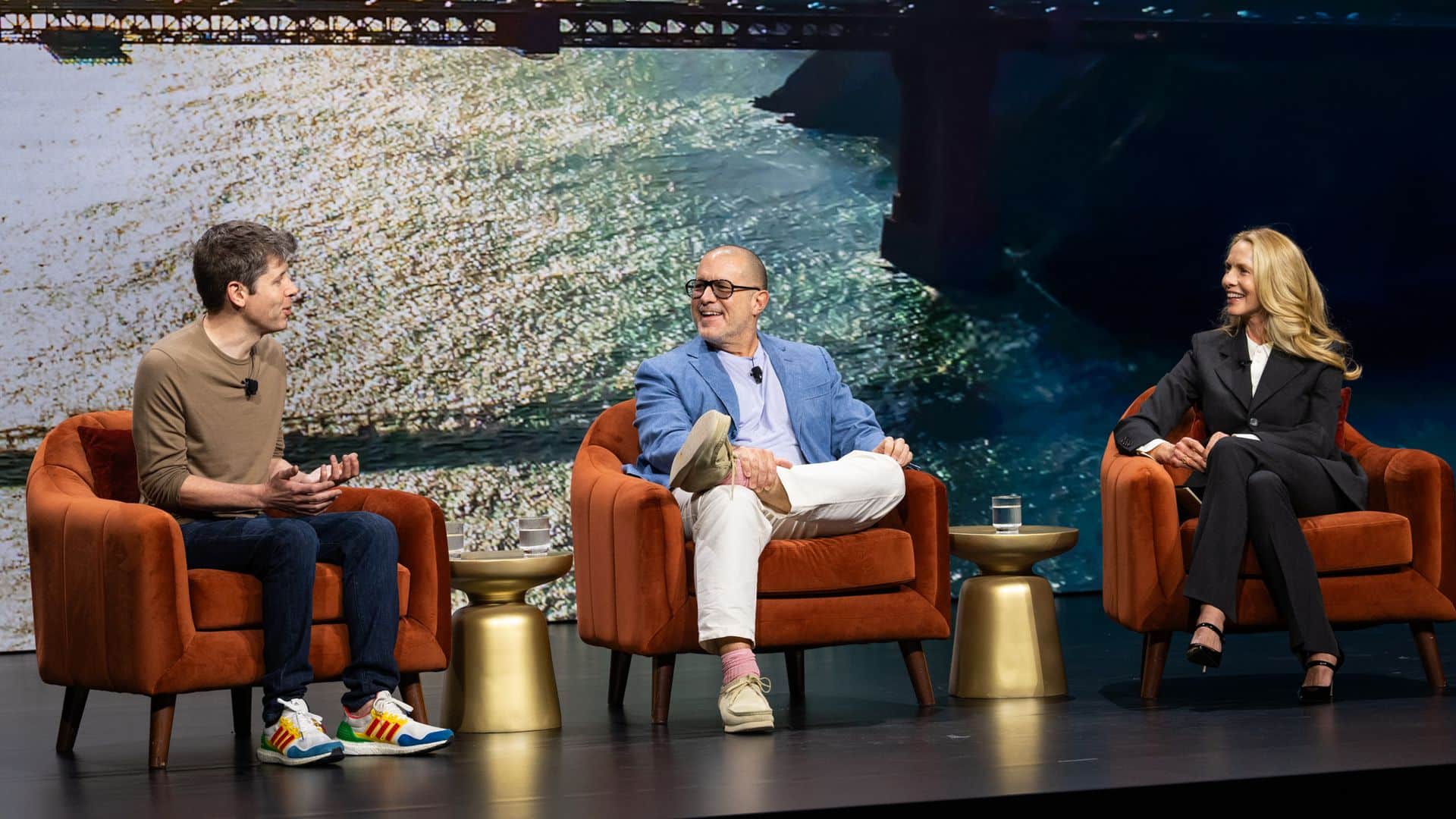
Jony Ive, Sam Altman e Laurene Powell Jobs

Próxima de Tim Cook e de outros executivos da empresa — além de manter uma relação de longa data com Ive —, ela continua circulando com naturalidade entre ambos os lados, tendo inclusive participado da última WWDC como convidada.

Laurene também é uma das principais investidoras dos projetos de Ive e esteve ao lado dele e de Altman quando os dois revelaram que o primeiro dispositivo de IA da OpenAI já estava em desenvolvimento. Para Gurman, esse conjunto de relações pode ter contribuído para evitar que o nome do ex-chefe de design da Apple fosse envolvido diretamente na disputa judicial, especialmente na ausência de evidências que o ligassem ao suposto vazamento de informações.

Apple sends legal preservation letters to dozens of former employees now at OpenAI

17 July 2026 at 14:00

Apple logo

Apple has intensified its high-stakes legal fight against OpenAI by sending formal preservation letters to approximately 40 former employees who now work at the AI company, according to reports from the Financial Times and corroborated by tech outlets.

The move comes just one week after Apple filed a lawsuit against OpenAI (and its hardware-focused entity, io Products), along with two named former Apple executives: Tang Tan (OpenAI’s Chief Hardware Officer) and Chang Liu (a senior hardware team member). In the complaint, Apple accuses OpenAI of orchestrating a coordinated effort to poach talent and misappropriate confidential information related to hardware engineering, product development, manufacturing processes, and other proprietary designs.

Preservation Letters: What They Mean

These letters are not lawsuits themselves, but formal legal notices requiring recipients to preserve all potentially relevant documents, communications, emails, files, and other evidence. They serve as an early step in litigation to prevent the destruction or alteration of materials that could be critical to the case. Apple appears to believe the alleged misconduct extends beyond the individuals explicitly named in the original filing, viewing the evidence uncovered so far as potentially just the “tip of the iceberg.”

Apple’s lawsuit highlights that more than 400 former Apple employees have joined OpenAI. While hiring talent from competitors is common in Silicon Valley (especially in California, where non-compete agreements are limited), Apple alleges specific breaches involving the theft of trade secrets, violation of employment contracts, and improper use of proprietary information to accelerate OpenAI’s hardware ambitions, particularly its reported AI device development.

Background on the Dispute

• Key Defendants: OpenAI, io Products, Tang Tan (24-year Apple veteran who led product design), and Chang Liu (former senior system electrical engineer).

• Apple’s Demands: An injunction to stop OpenAI from using any Apple-derived information, plus monetary damages.

• OpenAI’s Response: The company has denied the allegations, stating it is “not aware of any evidence that this complaint has merit.”

The escalation underscores growing tensions between the two tech giants. Apple, a leader in consumer hardware, is protective of its tightly controlled supply chain and engineering secrets, while OpenAI is pushing aggressively into hardware to leverage its chatbot.

This development is likely to fuel further scrutiny of talent poaching in the AI sector, where companies compete fiercely for top engineers. Legal experts note that preservation letters are standard in complex intellectual property cases and signal Apple’s intention to build a broader case through discovery.

As the lawsuit progresses, both sides will be watching closely, especially as OpenAI continues its hardware timeline reportedly unchanged despite the legal pressure. The case could set important precedents regarding employee mobility, trade secret protection, and the blurry lines between accumulated expertise and stolen proprietary information in the fast-moving tech industry.

MacDailyNews Take: OpenAI, the company behind ChatGPT, the AI for newbies who don’t know better alternatives exist, seems to be filled with traitors.


‎
Please help support MacDailyNews — and enjoy subscriber-only articles, comments, chat, and more — by subscribing to our Substack: macdailynews.substack.com. Thank you!

Support MacDailyNews at no extra cost to you by using this link to shop at Amazon.

The post Apple sends legal preservation letters to dozens of former employees now at OpenAI appeared first on MacDailyNews.

Apple’s lawsuit against OpenAI could derail the AI giant’s hardware ambitions to challenge the iPhone

13 July 2026 at 14:13
Jony Ive
Jony Ive

According to Bloomberg News‘ Mark Gurman, Apple’s aggressive lawsuit accusing OpenAI of systematically stealing its intellectual property poses a significant threat to the AI company’s efforts to develop consumer hardware devices that could rival the iPhone — potentially disrupting those plans long before any courtroom resolution.

The Core Allegations

Apple filed the blockbuster suit last week, claiming OpenAI orchestrated a coordinated effort to misappropriate trade secrets. Key details include:

• OpenAI allegedly encouraged former and prospective Apple employees to bring unreleased product information, prototypes, CAD designs, and supplier details to interviews and new roles.

• OpenAI instructed hires on evading Apple’s security protocols, reportedly using a checklist tied to its former iPhone design leadership.

• Specific individuals named include OpenAI’s Chief Hardware Officer Tang Tan (a 24-year Apple veteran who led iPhone and Apple Watch design) and engineer Chang Liu, who allegedly retained access to Apple systems post-departure to download confidential files on unreleased products.

Apple claims it has uncovered a “pattern of theft” involving more than 400 former employees now at OpenAI. The suit also implicates io Products (Jony Ive’s hardware startup, acquired by OpenAI for $6.5 billion), describing OpenAI’s emerging hardware efforts as “rotten to its core” due to reliance on misappropriated secrets.

Why This Matters for OpenAI’s iPhone Rival Plans

OpenAI has been aggressively building a hardware division to create AI-powered consumer devices — potentially including a smartphone or agent-based hardware that could bypass traditional app ecosystems and compete directly with Apple’s ecosystem dominance. This push gained momentum with the io Products acquisition and talent poaching from Cupertino.

Gurman’s reporting highlights how the lawsuit creates immediate headwinds:

• Talent and Reputation Risks: Even without a final verdict, the public accusations could slow recruiting, damage partnerships, and invite scrutiny from suppliers wary of legal entanglement.

• Injunctive Relief: Apple is seeking court orders to bar OpenAI from using the alleged secrets, return materials, and preserve evidence—moves that could force redesigns or delays in OpenAI’s device timeline.

• Broader Competitive Tension: The clash comes amid a strained partnership (Apple integrates ChatGPT into Siri and Apple Intelligence), with both sides eyeing greater independence in AI hardware. OpenAI’s ambitions to reduce reliance on the iPhone now face a major legal and PR obstacle.

OpenAI’s Response and Context

OpenAI has denied the claims, stating it has “no interest in other companies’ trade secrets” and remains focused on innovative technology.

The suit escalates existing frictions, including reports of OpenAI previously considering legal action against Apple over their integration deal.
‎
MacDailyNews Take: OpenAI has always been skeevy, from eschewing its open source roots to Sam Altman to desperately overpaying for a washed Jony Ive. Just plain skeevy.

If ever a Skynet would arise, we expect it would spring from the diseased loins of OpenAI.

This isn’t just a legal spat, it’s a flashpoint in the intensifying battle for the future of AI devices. Apple is fiercely protecting the decades of innovation behind its hardware supremacy, while OpenAI bets big on disrupting it with AI-first experiences. As Gurman notes, the disruption to OpenAI’s plans could be swift and substantial, regardless of how the case ultimately resolves in court.


‎
Please help support MacDailyNews — and enjoy subscriber-only articles, comments, chat, and more — by subscribing to our Substack: macdailynews.substack.com. Thank you!

Support MacDailyNews at no extra cost to you by using this link to shop at Amazon.

The post Apple’s lawsuit against OpenAI could derail the AI giant’s hardware ambitions to challenge the iPhone appeared first on MacDailyNews.

Apple sues OpenAI, alleging theft of trade secrets to fuel hardware ambitions

10 July 2026 at 22:29

OpenAI

In a sharp escalation of tensions between two of the tech industry’s biggest players, Apple has filed a civil lawsuit against OpenAI, accusing the AI powerhouse of stealing confidential information from former Apple employees to advance its own efforts in building competing hardware devices.

The complaint, filed Friday in the U.S. District Court for the Northern District of California, targets OpenAI along with two of its executives: chief hardware officer Tang Tan and technical staff member Chang Liu, both former Apple employees. Apple claims they improperly took proprietary data to help OpenAI accelerate development of AI-powered devices that could rival Apple’s ecosystem.

Key Allegations

According to the suit, Tan and Liu used various methods to extract Apple’s confidential information, including trade secrets related to product design, engineering, and hardware development. The goal, Apple alleges, was to bolster OpenAI’s push into consumer devices—potentially including screen-free or AI-centric hardware initiatives that overlap with Apple’s ambitions in areas like Siri enhancements and Apple Intelligence.

“Former Apple employees took confidential information to OpenAI to advance the AI company’s device efforts,” the complaint states. Apple emphasizes that such actions breach the trust and legal obligations these individuals owed their former employer.

This lawsuit comes amid a complex web of partnerships and rivalries in the AI sector. Apple and OpenAI have a high-profile collaboration, with OpenAI’s ChatGPT integrated into Apple’s iOS, iPadOS, and macOS platforms. However, the suit highlights underlying friction as both companies vie for dominance in AI hardware and software.

Broader Context in Tech Turf Wars

The filing underscores the intense talent wars and intellectual property battles defining the AI boom. Tech giants routinely poach top engineers, but accusations of trade secret misappropriation have become more common as companies race to lead in generative AI, on-device processing, and next-generation consumer gadgets.

Apple, known for its tight control over its supply chain and design secrets, has a history of aggressively protecting its intellectual property through litigation. OpenAI, valued at hundreds of billions and backed by major investors, is rapidly expanding beyond software into hardware explorations, often in partnership with figures like former Apple chief designer Jony Ive.

Such suits often lead to countersuits or settlements as companies seek to avoid prolonged public scrutiny of internal practices.

Potential Implications

• For Apple: Reinforces its reputation as a defender of innovation secrets while potentially straining its partnership with OpenAI on AI features for iPhones and Macs.

• For OpenAI: Could slow hardware momentum and invite closer scrutiny of its hiring and integration practices.

• Industry-Wide: May prompt other firms to tighten employee agreements and non-compete enforcement in the high-stakes AI talent market.

MacDailyNews Take: The case is expected to draw significant attention as it unfolds, potentially revealing more details about the secretive race to build the next generation of AI devices. Apple is seeking injunctive relief, damages, and the return or destruction of any misappropriated materials.


‎
Please help support MacDailyNews — and enjoy subscriber-only articles, comments, chat, and more — by subscribing to our Substack: macdailynews.substack.com. Thank you!

Support MacDailyNews at no extra cost to you by using this link to shop at Amazon.

The post Apple sues OpenAI, alleging theft of trade secrets to fuel hardware ambitions appeared first on MacDailyNews.

❌