❌

Normal view

'It's incredibly rare to see a moment like this in the ocean': Camera drone captures moment humpback whale gives birth off Australian coast

A camera drone operator captured footage of a humpback whale giving birth off the north coast of New South Wales in what is thought to be a world first.

Alexander Forrest, a commercial drone pilot for the Organisation for the Rescue and Research of Cetaceans in Australia (ORRCA), was conducting aerial observations of migrating humpback whales (Megaptera novaeangliae) on July 28. ORRCA is a nonprofit organization focused on the rescue, conservation and welfare of marine mammals.

During the survey, Forrest noticed a whale swimming slightly behind her pod and going unusually slowly. Then, he saw her give birth.

"It's incredibly rare to see a moment like this in the ocean. It's a very rarely documented encounter," Forrest told Live Science. "It's the first drone video as far as we know of a full humpback whale live birth. It gives critical inside moments in the first moments of a calf's life, and also discovers the behaviour of a new humpback whale mother and her freshly newborn calf."

An ORRCA spokesperson said that this is only the fourth time the phenomenon of a humpback whale giving birth had been filmed, in general. Scientists also have footage of other whale births, including a gray whale (Eschrichtius robustus) birth filmed off the coast of California and a sperm whale (Physeter macrocephalus) recorded giving birth in the Caribbean.

Large whales swim in the blue ocean

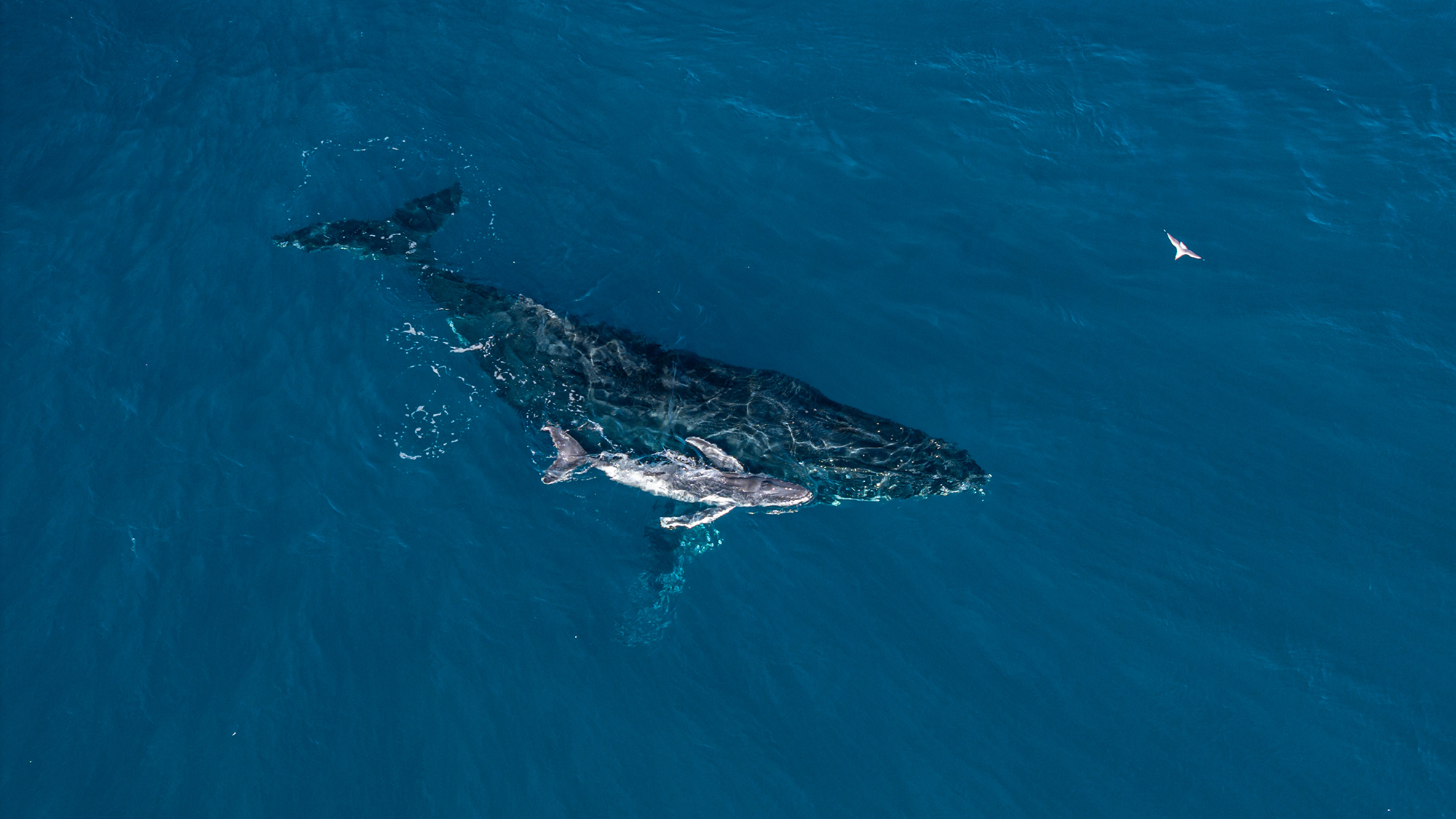
The expectant humpback whale mother swam behind her pod, eventually giving birth by herself. (Image credit: Alexander Forrest/ORRCA (@forrestfov))

The drone video shows the newborn whale surface from blood-reddened water for its first breath. The mother then turns back to reunite with it. The scene was filmed around 0.4 miles (700 meters) from the shore at Kingscliff in northeastern New South Wales.

The birth is "a symbol of one of the strongest conservation efforts in history, returning humpback whales from near extinction to nearly 50,000 on the New South Wales coast," Forrest said. Gathering data on this humpback whale population is critical to "discovering more about where they birth, what happens when they birth, and what those early moments look like."

Large whales swim in the blue ocean

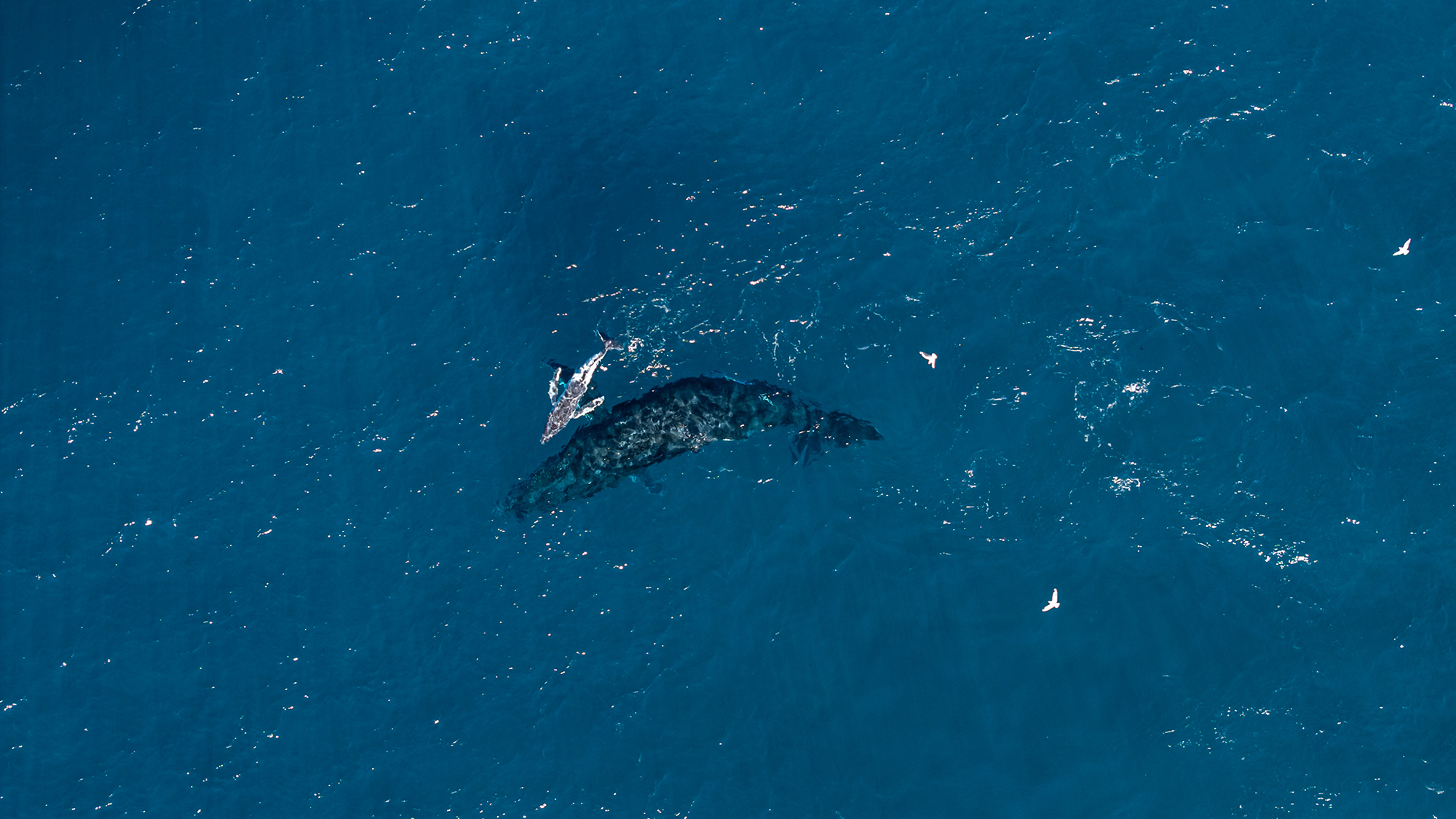
Humpback whale calves stay with their mothers for their first 11 months. (Image credit: Alexander Forrest/ORRCA (@forrestfov))

The footage will now be analyzed so that a report on the observation can be peer-reviewed and published in a scientific journal. Notably, the mother whale was trailing behind her pod when she gave birth, a detail biologists will compare with observations of other birthing whales that were accompanied by members of their pod. For instance, the 2023 drone footage of the sperm whale giving birth showed that she had 10 adult females near her that formed a protective circle and took turns lifting the calf up so it could breathe at the water's surface.

Throughout their first weeks, calves stay close to their mothers and learn critical behaviors, such as breathing at the surface.

"Humpback whales seem to have an incredible maternal bond with their offspring," Forrest said. "There is an 11-month period where this calf will be raised and feeding on very nutrient-rich milk until it is a yearling and can fend for itself."

A newborn humpback whale calf weighs 1 to 1.5 tons (900 to 1,360 kilograms) and measures roughly 10 to 16 feet (3 to 5 meters) in length. While feeding on its mother's milk, the calf will gain 100 pounds (45 kg) a day and develop the strength and food storage it needs for its first migration. Humpback whales undertake one of the longest migrations of any mammal, travelling up to 5,000 miles (8,000 kilometers) each way between the cold waters of the poles to warm tropical breeding grounds.

Killer whales sink another boat off the coast of Spain — why are they still doing this after 6 years?

A pod of killer whales has sunk another yacht off northwestern Spain, reinforcing a bizarre pattern of vessel encounters that has stretched on for more than six years along the Iberian coast.

In the incident, reported Friday (July 24), the whales destroyed the rudder of a 46-foot-long (14 meters) Swedish-flagged yacht off Galicia in northwestern Spain, forcing the two people aboard to send a mayday call. A Spanish coastguard vessel towed them to safety, Spain-based news outlet Sur in English reported.

The incident came after several other encounters in the same waters earlier that week, including one in which a pleasure craft called the Idem sank near Estaca de Bares, the northernmost point of the Iberian Peninsula. The ship sank after the killer whales, also known as orcas (Orcinus orca), destroyed its rudder. Both occupants were rescued.

That makes the Idem at least the eighth boat lost to these encounters since they began, according to groups that track the incidents. More than 700 interactions between orcas and vessels have been logged since 2020, ranging from a brief nudge to a multihour rudder-ramming session, according to the Atlantic Orca Working Group, the Spanish-Portuguese research collective that has coordinated data collection on the phenomenon from the start.

Researchers have identified roughly 15 individual killer whales involved in these incidents, out of an Iberian subpopulation of fewer than 50. The group is so small that the International Union for Conservation of Nature lists it as critically endangered, as it is dependent mainly on Atlantic bluefin tuna for its food.

The family-like cluster is thought to be led by a female known as White Gladis. That name comes from an early theory researchers themselves once floated: that White Gladis suffered some kind of traumatic run-in with a boat and that the encounter flipped a behavioral switch, with her being the first in the group to start ramming rudders.

Alfredo López Fernandez, a biologist with the Atlantic Orca Working Group, told Live Science in 2023 that this kind of defensive, trauma-driven origin was gaining traction among researchers at the time. But "defensive" isn't "vengeful" — and the idea has since curdled online into a punchier revenge story most scientists studying the population don't endorse.

So why do orcas go after the boats? Nobody knows for certain, but the leading explanation is simple: Orcas are some of the most social animals on the planet, and social animals pick up habits from one another the way trends spread through a friend group. Researchers describe the behavior as socially learned — young orcas appear to watch adults ram a rudder and then try it themselves, and the habit has spread through the group over time.

A 2022 study in the journal Marine Mammal Science found that the killer whales usually targeted sailing boats and often lost interest after striking the rudder and causing the boat to stop.

None of that makes the encounters any less disruptive for the people living through them. The standard guidance from authorities like the Maritime Safety and Rescue Society and the Atlantic Orca Working Group, refined over repeated encounters, is to cut the engine, drop the sails if possible, disengage the autopilot, and let go of the wheel entirely, giving the orcas nothing to push against. Boats that follow this protocol tend to sustain less damage than those that don’t.

Sailors are asked to report every encounter. Each one adds to the data scientists are using to try to solve a years-long mystery.

'It was unlike anything I'd witnessed before': Orcas seen headbutting a sunfish so hard that it exploded

23 July 2026 at 05:00

One of the ocean's most intelligent and aggressive predators has once again surprised scientists with a curious new behavior. In the Gulf of California, researchers witnessed orcas working together to smash dead sunfish into bits — a suspected food processing technique that makes it easier for younger whales to feed on the enormous bony fish that weigh up to 4,400 pounds (2,000 kilograms).

In two separate encounters, one orca gripped a sharp-tail sunfish (Masturus lanceolatus) while another orca charged toward the fish. The first whale released the carcass just before impact, allowing its companion to slam into the fish at high speed and scatter fragments of fish flesh throughout the water.

"It was unlike anything I'd witnessed before," Kathryn Ayres, a scientist at the conservation nonprofit Beneath the Waves told Live Science in an email. "As a scientist, moments like this are incredibly exciting because you realize you're observing something that may never have been documented in detail before — as you can tell in the video!"

Ayres and her colleagues dubbed the behavior "ram-to-fragment." Their observations, published July 23 in the journal Frontiers in Ethology, suggest the killer whales were not trying to kill the sunfish, which were already dead and appeared to have been disembowelled. Instead, the orcas may have been breaking down the bulky carcasses so members of the group, particularly younger animals, could feed more easily.

Hunting in action

The first encounter Ayres observed took place in July 2024 near an offshore seamount off Baja California Sur, Mexico. An adult female orca held a sharp-tail sunfish by its tail-like clavus, or rudder, while an adult male orca accelerated toward it, belly-up. The female released the fish an instant before the male struck.

The collision produced a loud noise and caused the sunfish's tissue to disintegrate. In the video, Ayres' shock is evident as she can be heard exclaiming, "Oh my god!"

A juvenile orca then swam into the cloud of suspended flesh and ate the smaller pieces, while the adults fed on what remained of the main carcass.

A second encounter, which the researchers credited diver Héctor Franz for filming in September 2025, followed much of the same sequence. One adult orca stabilized the sunfish, another rammed it and a calf later pulled tissue from the broken carcass.

Ayres had previously watched orcas hunt ocean sunfish (Mola mola), but this was different.

"I had also seen orcas ram their prey previously, but I had never witnessed an impact powerful enough to completely fragment the tissue like this," Ayres said. "That was what made this observation so remarkable."

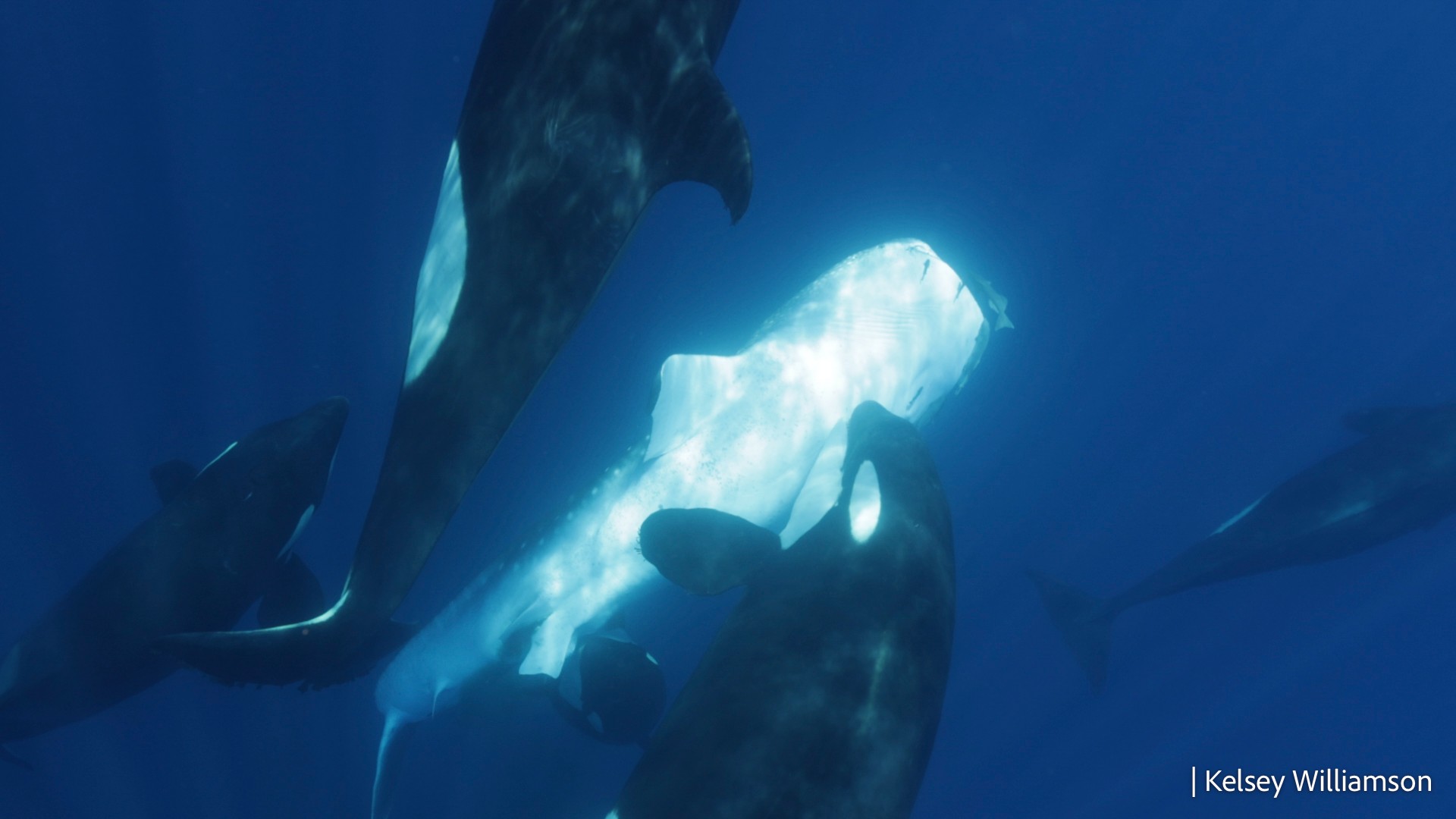
The maneuver resembled coordinated attacks Ayres and her team had previously documented, in which orcas confronted whale sharks (Rhincodon typus) — the largest living fish — in the Gulf of California. In those hunts, some orcas took turns ramming it.

An orca hits the under side of a small whale shark, which has been flipped upside down for easier predation

Previous footage from diver Kelsey Williamson shows orcas flipping a whale shark upside down to have an easier time preying on it. (Image credit: Kelsey Williamson)

Why make fish confetti?

Ramming is not a new killer whale hunting technique, said Matt Hansen, a postdoctoral researcher at the Leibniz Institute of Freshwater Ecology and Inland Fisheries who was not involved in the study. However, the hold-and-release sequences and shattering of carcasses may be new, Hansen told Live Science in an email.

The researchers proposed several possible explanations for the behavior. The predominant assumption is that the adults were processing food for younger whales. Orcas frequently tear apart prey and share portions with calves and juveniles, and in both newly described encounters, young killer whales were present.

But two observations are not enough to show that the adults were deliberately feeding or teaching the youngsters, Heather Hill, a professor and chair of psychology at St. Mary's University in Texas who was not involved in the research, told Live Science in an email.

"Whether or not it represents parental investment, observational learning, or distribution of resources remains circumstantial in my opinion," she said.

The researchers also suggested that the behavior could have been playful. Orcas are highly intelligent and social, and they sometimes manipulate, toss or strike prey without immediately eating it. However, Hill said that the two encounters appeared more practical than playful.

"If it was for fun, I would have expected multiple attempts made with variations in speed, point of contact, force of impact, and initiators because the point of playing is to try different things and not destroy the toy too soon," she said. "Since it appears that these events were 'one and done' so to speak, probably less playful and more functional — to eat the fish and maybe to model a foraging technique and possibly to share resources with the younger animal."

The study authors also raise a more speculative possibility that dispersing the sunfish's microbe-rich skin and gelatinous tissue could somehow affect the surrounding water or expose the orcas to potentially beneficial microbes. But what that benefit might be is unclear.

"I don't see how dispersing the skin into the water column would have a different effect from eating it," Hansen said. "Unless the authors are suggesting [the orcas] are using it like a lotion on their own skin? Who knows, the world is weird and wonderful."

Orca quiz: Will you sink or swim?

'Weirdos of the sperm whale world' appear to be evolving 2 different dialects, audio recordings suggest

24 June 2026 at 15:01

An isolated population of sperm whales in the Mediterranean Sea are splitting into two distinct groups with different dialects, a new study reveals. This shift has likely been happening for thousands of years, as two groups split from an initial single population.

The findings, published Tuesday (June 23) in the journal Proceedings of the Royal Society B: Biological Sciences, are providing a rare insight into the process of different dialects emerging among non-human species.

The sperm whales (Physeter macrocephalus) live in small social units of females and young, and they associate with other groups in the same area. They use social vocalizations called codas ‪—‬ shortpatterns of clicks ‪—‬ to communicate. The particular codas they use identify them as being part of the same cultural group.

Taylor Hersh, a researcher in the School of Biological Sciences at the University of Bristol in the U.K. and first author of the research, and her colleagues have analyzed codas recorded over almost 20 years in the Mediterranean, where there is a unique population of a few thousand sperm whales, to see if they all use the same dialect.

Sperm whales entered the Mediterranean via the Strait of Gibraltar about 20,000 years ago, and they have spread throughout the area. The whales rarely leave the sea ‪—‬ even males, which normally migrate. Other sperm whales don't seem to enter often, either, so the Mediterranean ones are effectively isolated from other populations and are considered an endangered subpopulation.

"The sperm whales in the Mediterranean are really cool," Hersh told Live Science. "I've always thought of them as the weirdos of the sperm whale world in that they don't leave through the Strait of Gibraltar even though they could. They are unique, and for a long time, they were also thought to be acoustically unique."

The thinking was that all the sperm whales in the Mediterranean belonged to the same clan, identified by their use of a single coda 90% of the time. This coda consists of three clicks and then a pause before the fourth and final click ‪—‬ a pattern called the three-plus-one type.

But the analysis by Hersh's team of 5,291 codas recorded between 2003 and 2021 revealed that sperm whales living in the eastern Mediterranean around the Hellenic Trench, off Greece, have a slightly different dialect from that used by animals in the western basin around Spain's Balearic Islands.

The eastern whales produce a distinct form of the three-plus-one coda. "It's a very similar pattern of clicks, but it's much, much faster," Hersh said.

four sperm whales in the sea

Researchers found distinct dialects between the two populations, with the eastern population producing slower codas. (Image credit: Asociación Tursiops)

In some recordings, whales in the eastern Mediterranean produced the slower coda, showing they were familiar with both dialects.

"The western sperm whales religiously stick to their dialect, but there were four instances of eastern whales using the western dialect," Hersh said. "The question of why is still an open one. Their dialect seems to be a lot more diverse than we expected. They do occasionally make those slow three-plus-one codas, but they make a lot of other coda types, too."

Hersh hopes further recordings alongside records that tie individual whales to sounds and events might help elucidate why the whales switch between dialects.

"It's exciting to see this study showing different populations behaving closely, but also differently," said Gašper Beguš, linguistics lead at Project CETI, a nonprofit organization that aims to translate the communication of sperm whales.

The study paints a picture of sperm whales progressively occupying the Mediterranean from west to east, with the dialect of one group gradually changing. "The groups in the east clearly remember the western dialect because they have these 'throwback' days," Hersh said.

It's still a mystery how and why these dialects evolved.

"Every speech is a dialect; the question is how did they arise and why?" said Beguš, who wasn't involved in the new study. He said the historical change in habitat does help to show which dialect came first. "In the Mediterranean, maybe they're forming different groups, so that's why they're trying to distinguish themselves," he told Live Science, giving the parallel of young people who distinguish themselves from previous generations by coming up with new slang.

"It's possible that these two groups with repertoires that are very similar but still distinctive could represent a sort of midway phase,” Ellen Jacobs, a marine biologist at Aarhus University in Denmark who wasn't involved in the research, told Live Science via email.

"Changes in the rhythm might be a very feasible and meaningful way for coda signals to start to diverge," she said, like the way the English words "How do you do?" got mashed together until they morphed into "howdy."

The timescale on which a sperm whale dialect develops is uncertain, but it's likely a slow process, according to Hersh. "It's probably happening on the scale of hundreds and thousands of years, because sperm whales can live into their 60s and 70s. And this study is looking over 19 years of data, and that's just a snapshot of one animal's life," Hersh said.

This means the eastern whale dialect was conceivably emerging in the Mediterranean Sea as famous human civilizations were speaking different languages on the surrounding lands, including when the ancient Greeks and Romans were rising and then falling.

"Maybe if we could leave them for another 10,000 years, we would come back to find the completely separated dialects of clans," Jacobs said.

Why Are So Many Whales in Vancouver Waters? A Guide to Legally Spotting Them

17 June 2026 at 21:12

In recent years, the coastal waters of Vancouver have witnessed an unprecedented resurgence of whale activity, captivating marine biologists and local observers alike. This renewed presence, not merely anecdotal, stems from a culmination of seasonal patterns, thriving ecosystems, and impactful conservation measures. A comprehensive study led by researchers at the University of British Columbia’s Institute for the Oceans and Fisheries (IOF) has quantitatively confirmed that transient killer whales now inhabit the Salish Sea for more than two-thirds of the year. Alongside these apex predators, humpback and grey whales are increasingly frequenting these waters, signaling a dynamic shift in regional marine biodiversity.

Transient killer whales, known for their elusive nature and specialized diet of marine mammals, particularly seals and sea lions, are now commonly sighted along Vancouver’s shoreline and within the surrounding straits and harbors. Data collected from 2016 to 2023 underscores not only their presence but also their routine exploitation of these rich feeding grounds. This expanded usage correlates strongly with the rebound of pinniped populations, themselves benefiting from decades-old protections that halted their severe culling. The recovery has thus created a robust trophic cascade, enabling transient killer whales to establish a near year-round residency within the inside waters of Vancouver Island.

Humpback whales represent another remarkable comeback story in this region. Historically decimated by intense commercial whaling in the early 20th century, these baleen giants were completely extirpated from British Columbia waters by 1910. Without older generations to transmit migratory and feeding knowledge, their return to ancestral feeding grounds was lost for nearly a century. However, conservation efforts since the 1960s, including international bans on whaling and improved fisheries management, have facilitated a population recovery that now sees substantial numbers of humpbacks returning each summer to feast on abundant krill, herring, and other prey.

The presence of grey whales in areas around Vancouver is comparatively anomalous but increasingly documented. These whales typically forage offshore near Alaska, subsisting on amphipods—small crustaceans dependent on nutrient-rich algae associated with Arctic sea ice. The drastic loss of sea ice due to climate change directly undermines this fundamental food source, causing nutritional stress especially among pregnant and lactating females who must meet extraordinarily high energetic demands during migration and calf-rearing periods. Consequently, some grey whales are observed making unscheduled stops in the Salish Sea, an adaptation that reflects their deteriorating foraging options rather than traditional migratory behavior.

Studies estimate that pregnant grey whales require a daily intake of approximately 1,600 to 1,900 kilograms of prey to sustain both fetal development and energy reserves critical for postnatal care during their long migrations. Following calving, lactating females continue to consume between 1,300 and 1,600 kilograms of prey daily to nourish their calves for several months. Disruptions in prey availability, driven by climate-induced changes in sea ice and associated ecosystem dynamics, are thus placing immense physiological strain on these populations. The unfortunate consequence has been an observed increase in mortality rates, with malnourished grey whales occasionally stranding along the coastline.

This resurgence of whale activity near Vancouver not only highlights the success of targeted conservation policies but also underscores emerging challenges. Increased interactions between humans and whales necessitate rigorous adherence to safe viewing practices. Researchers advocate for maintaining substantial distances from whales—minimum thresholds are typically 200 meters for most killer whales and extend to 1,000 meters for the endangered southern resident killer whales. The regulations also stipulate 100 meters for other cetaceans, increasing to 200 meters when whales are resting or accompanied by calves. These guidelines are critical in minimizing disturbances and preventing collisions, which pose significant risks to these vulnerable animals.

Furthermore, the role of public awareness and responsible recreational boating cannot be overstated. Boaters, kayakers, and paddleboarders are urged to stay vigilant and reduce speeds when whale blowholes are sighted. The unpredictability of whale movements demands a precautionary approach to navigation within whale habitats. Educational initiatives, such as free online whale-safe boating courses offered by organizations like the Marine Education & Research Society (MERS), have proven effective tools in promoting safer human-wildlife coexistence in marine environments.

The broader implications of these findings extend into the realm of ecosystem health and global climate resilience. Whales function as keystone species, their feeding and migratory behaviors facilitating nutrient transport and productivity within marine systems. The return of diverse whale populations to coastal waters symbolizes not just ecological recovery but offers hope for restoring complex marine food webs fractured by human exploitation. Yet, the acute vulnerability of species such as grey whales to climate-driven habitat changes serves as a stark reminder of ongoing environmental threats.

Simultaneously, the study’s revelations about transient killer whales reveal a nuanced predator-prey dynamic finely attuned to regional ecosystem changes over recent decades. The resurgence of pinniped populations has provided these cetaceans with ample sustenance, allowing for sustained presence in traditionally seasonal zones. This trophic realignment invites further studies into the long-term evolutionary and behavioral adaptations of marine mammals in a rapidly changing oceanic milieu.

Whale conservation is, thus, at a critical juncture. While success stories abound, exemplified by humpback recovery, emerging stressors including climate change, ship traffic, and underwater noise pollution complicate the ecological narrative. The scientific community and policymakers must continue fostering adaptive management strategies that address these multifaceted challenges while engaging public participation for effective stewardship.

In conclusion, the intensifying presence of transient killer whales, humpbacks, and grey whales in Vancouver’s coastal waters offers a vivid testament to both nature’s resilience and the pressing need for sustained conservation vigilance. These marine mammals, emblematic of wider ocean health, depend on intact habitats, thoughtful human behaviors, and responsive environmental policies. As our understanding deepens through ongoing research, so too must our commitment to coexistence with these ocean giants, ensuring their survival amidst an era of rapid ecological transformation.


Subject of Research: Marine mammal population dynamics and conservation in Pacific Northwest coastal waters.

Article Title: Rebounding Giants: The Return of Whales to Vancouver’s Coastal Waters

News Publication Date: Not specified in the provided content.

Web References:

References:

  • Taryn Scarff et al., “Transient killer whales in the Salish Sea,” Marine Mammal Science
  • Grey whale energetics and climate impact study, Marine Mammal Science

Image Credits: Julia Adelsheim

Keywords: Whales, Cetaceans, Marine mammals, Transient killer whales, Humpback whales, Grey whales, Conservation, Climate change effects, Salish Sea, Marine ecology, Pinnipeds, Fisheries management

❌