Megaliths —those enormous stone blocks that have stood for millennia— continue to fascinate archaeologists and the general public. A recent compilation of books published between 2025 and 2026 shows that, although research has advanced by leaps and bounds thanks to new technologies, some fundamental questions remain without definitive answers. Who built these monuments? Why did […]
What lies beneath one of the most important fortified settlements of Hellenistic Calabria? A study combining archaeology and geophysics has begun to answer this question. Thanks to the application of sophisticated subsurface exploration techniques, an interdisciplinary team from the University of Catania has succeeded in identifying anomalies compatible with buried structures at the Castiglione di […]
The death, which radiocarbon dating places between 3932 and 3653 B.C., surprised an individual at approximately forty weeks of gestation in the rock shelter of Ripari Altí, at 1,100 meters above sea level, within the current Dolomiti Bellunesi National Park. The archaeological context points to the final phases of the Neolithic, a period in which […]
Excavations carried out as part of the National Recovery and Resilience Plan (PNRR) have brought to light an architectural complex of incalculable value in the heart of Villa Celimontana. Under the supervision of the Special Superintendency of Rome of the Ministry of Culture, the work has uncovered eight rooms belonging to an Imperial-era building whose […]
Excavations by the University of Catania at the Tava Tepe site, located in western Azerbaijan, have uncovered an archaeological complex that upends established notions about Late Bronze Age communities in the Caucasus region. What was initially interpreted as an isolated domestic structure, dated to around 1300–1000 BCE, has turned out to be the last link […]
The Turkish Minister of Culture and Tourism, Mehmet Nuri Ersoy, has announced the completion of the excavation and restoration works of an ancient pool located in the frigidarium of the monumental complex known as the Hamam Gymnasium, within the ancient city of Tralleis, in the province of Aydın. The newly restored structure has remarkable dimensions: […]
The archaeological excavations currently being carried out at Kapellenberg, near Hofheim am Taunus in Germany, have provided new evidence during this summer campaign regarding the possible location of the central tomb of a large burial mound dating back approximately 6,000 years, as confirmed by the leaders of the research project directed by Professor Detlef Gronenborn […]
The Minister of Culture and Tourism of Turkey, Mehmet Nuri Ersoy, has announced the discovery in the ancient city of Sardis, in the province of Manisa, of a male marble sculpture approximately 2,500 years old, a piece that, due to its monumental dimensions and unusual state of preservation, stands out as an exceptional find for […]
In the summer of 15 BC, Emperor Augustus’ two stepsons, Tiberius and Drusus, brought the Central Alps and the Swiss Plateau under Roman control. That campaign concluded decades of efforts to link the Gallic provinces with Illyricum and secure the routes between northern Italy and the Danube. However, while the western and eastern routes of […]
A native Australian millet may carry the genetic fingerprints of thousands of years of Aboriginal harvesting, storage, and plant management. Seen from the air, Channel Country resembles a vibrant and vast tapestry, with a network of waterways crisscrossing the land. Spread across more than 280,000 square kilometers in outback Australia, it is one of the [...]
More than 1,000 years ago, two babies were tucked away in an abandoned Roman toilet channel. Yet, despite what the location suggests, they were cherished, not discarded.
More than 1,000 years ago, two babies were tucked away in an abandoned Roman toilet channel. Yet, despite what the location suggests, they were cherished, not discarded.
Scientists have uncovered new evidence that modern humans inherited DNA from two previously unknown ancient human relatives, revealing another surprising chapter in our evolutionary history. The discovery was made using a new genetic analysis method that can identify traces of long-extinct human groups even when no ancient DNA from them has ever been found. The […]
In the heart of the granite massif of the Landes de Lanvaux, in the French department of Morbihan, lies the Neolithic cemetery of Coëby, discovered in 1986. This site, preserved for centuries by the dense forest cover that shielded it from intensive agriculture, contains around 95 megalithic monuments from different periods, from the Neolithic to […]
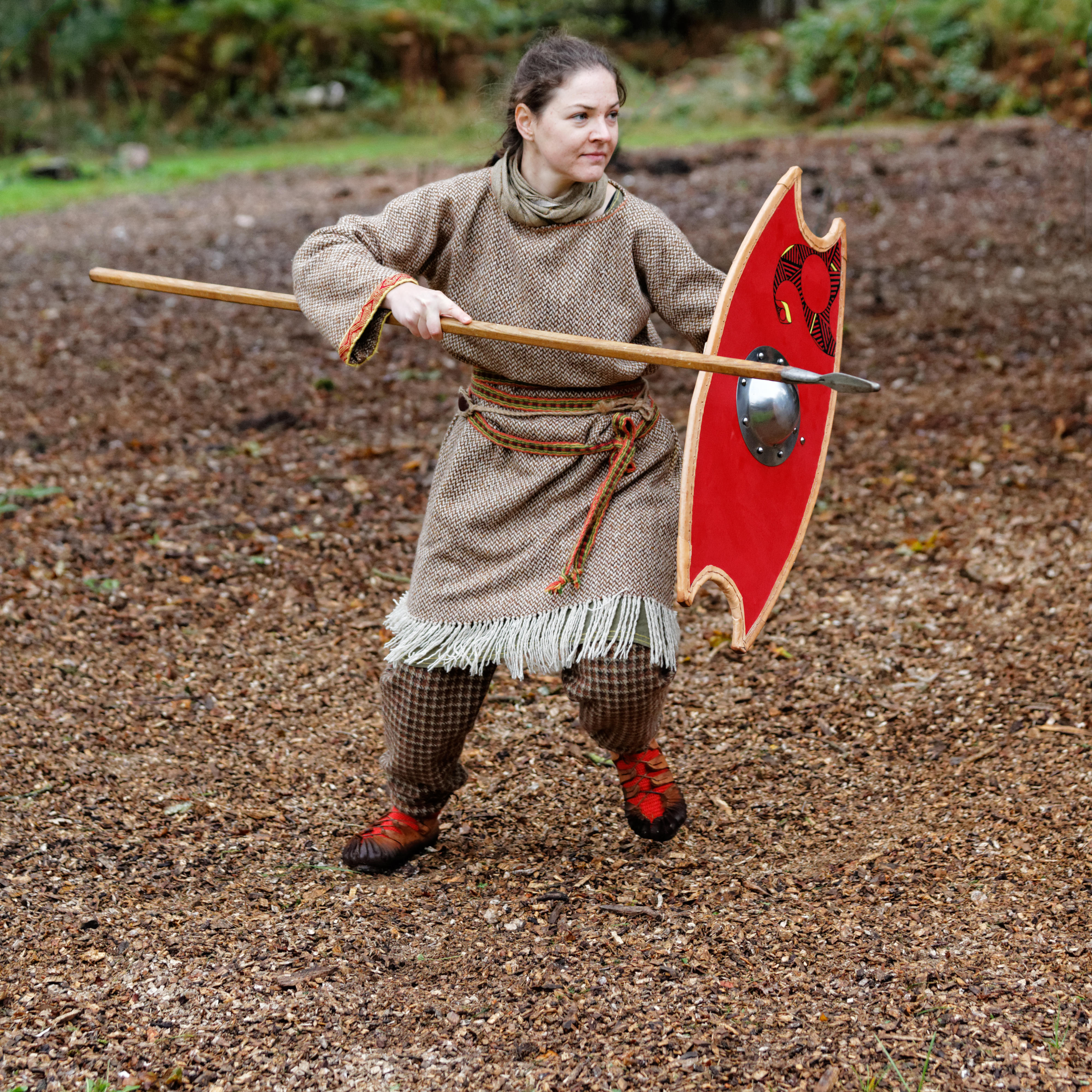
A modern-day re-creation of how a woman in Britain may have fought around the first century A.D. (Image credit: Alamy)
The ancientCelts thrived in Europe, earning a reputation as fierce warriors. They sacked Rome around 390 B.C. and, decades later, were received by Alexander the Great while he was conquering his empire.
It's no surprise, then, that archaeologists find many weapons in Celtic graves. However, over the decades, some of those weapons have been found in burials of women, hinting that they may have used these weapons. What's more, recent genetic studies suggest that elite Celts inherited power through maternal lines.
The Celts lived throughout Europe, from what is now Spain to Turkey. They shared a similar language and culture, and clues of female power have been found throughout their old lands and hinted at in ancient texts. This raises an interesting question: Did the Celts have women who fought in battle?
Opinions vary, but some experts Live Science interviewed thought it was possible that Celtic women could have fought in battle, although perhaps not regularly. One problem is that there is an ongoing debate among scholars as to whether the inhabitants of the British Isles around 2,000 years ago were, in fact, Celtic.
Genetic hints
Although it's not directly related to answering the question about Celtic women warriors, a few recent genetic studies have found that elite Celtic women held powerful roles. A 2024 study in the journal Nature Human Behaviour that looked at ancient DNA in several Celtic burials from Germany found a matrilineal inheritance of power, and a 2025 study of burials from Iron Age England revealed that men married into local, powerful female lineages.
This supports textual evidence that Celtic women had more power than many of their female counterparts across Europe. Women "of the Celts did generally enjoy more freedom and opportunity than their counterparts in the Greek and Roman world," Philip Freeman, a humanities professor at Pepperdine University, wrote in his book "War, Women and Druids: Eyewitness Reports and Early Accounts of the Celts" (University of Texas Press, 2002). "It is hard to imagine a Greek wife joining her husband on the battlefield or even leading an army, as did the British queen Boudicca."
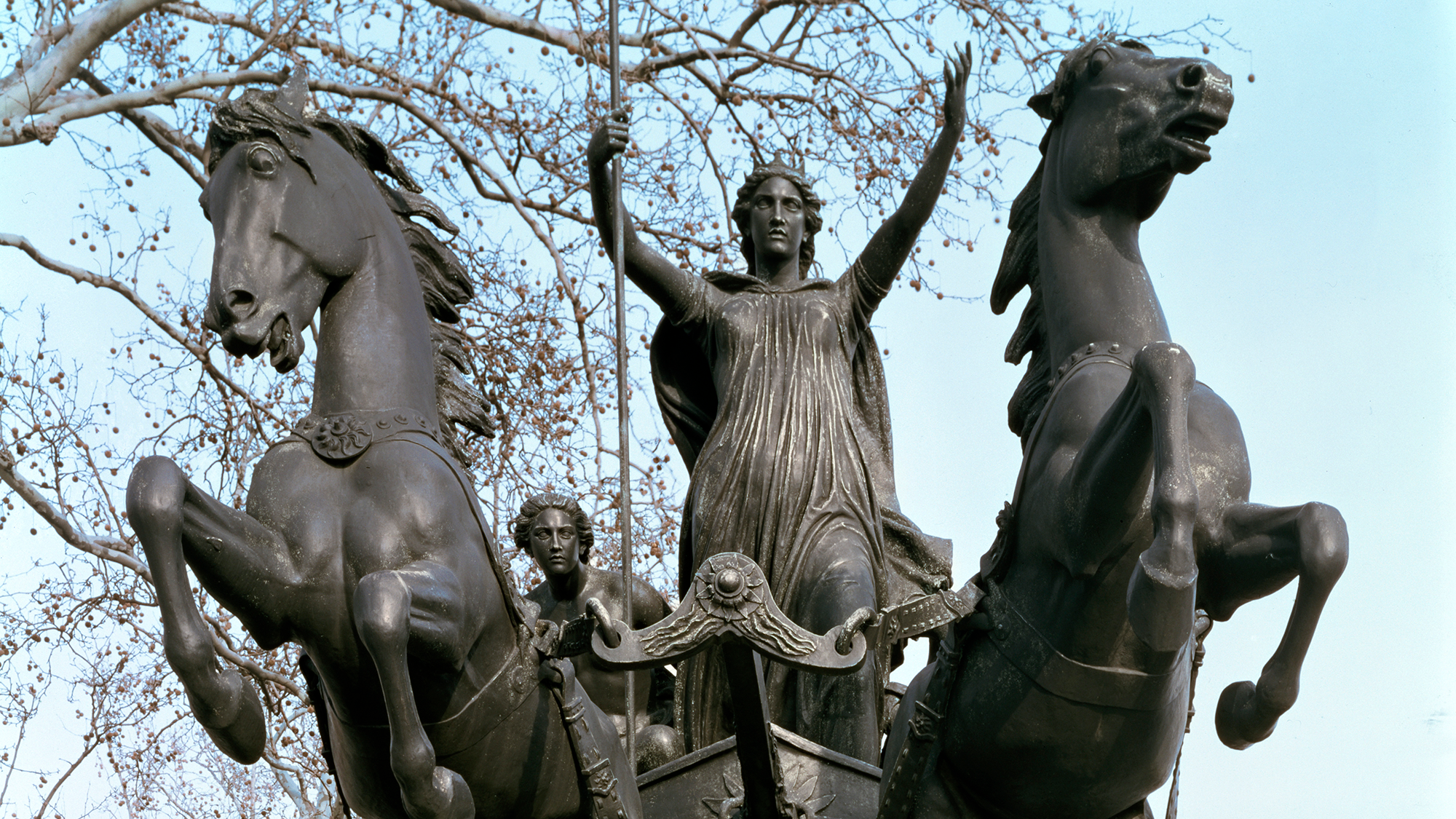
A statue depicting Queen Boudica, who led a revolt against Rome around A.D. 60. Whether she and her people can be considered Celtic is a matter of debate. (Image credit: Heritage Images via Getty Images)
"Flashing-eyed" women
Another piece of possible evidence is a particularly colorful ancient quote about the Gauls, a Celtic group that lived in what is now France.
The Roman soldier and historian Ammianus Marcellinus (who lived circa A.D. 330 to 395) wrote in his book "Res Gestae" ("Achievements") that "a whole group of foreigners cannot stand against one of them in a quarrel if he involves his wife, stronger than him by far and flashing-eyed — least of all when she swells her neck and gnashes her teeth and, swinging her vast, white arms, proceeds to rain down punches mixed with kicks, like shots discharged from the twisted cords of a catapult" (translation by Gavin Kelly).
In other words, don't mess with a Gallic wife.
But we have to be careful with the Ammianus quote as it refers to brawling rather than warfare, said Gavin Kelly, a professor of Latin literature and Roman history at the University of Edinburgh. We shouldn't take the quote to mean that Celtic women fought in battle, Kelly said. He doesn't know if Celtic women fought in battle but, if they did, Kelly suspects it was rare.
Rachel Pope, an archaeology professor at the University of Liverpool who has studied the Celts extensively, told Live Science in an email that "we have good evidence now across Europe that a small number of women were buried with weapons." In a 2021 Journal of Archaeological Research study, she mentioned cases in which women were buried with daggers or spears, including a 2,500-year-old cemetery in eastern France where some women were buried with daggers.
Some of the best evidence is from Britain, where "we have osteological evidence from three hillforts now that [some] women took part in combat," Pope said, noting that there "is evidence too for women fighters in northern Britain, where women are buried with chariots."
Simon Mays, a senior human skeletal biologist at Historic England who has studied a woman buried with weapons on the Isles of Scilly, off the southwest coast of Britain, said women in the region were probably involved in battle. There "is little doubt that violence was a routine part of Iron Age life, and [thus] female involvement is likely," Mays told Live Science in an email.
However, just because someone fought in battle doesn't make them a "warrior," Emmet Taylor, a lecturer at the School of Irish Learning at University College Cork, told Live Science in an email. Taylor noted that it "is important for us to think about martial identities complexly," and in ancient and early medieval Ireland, there is little evidence that women were allowed to join social groups that could be considered warriors.
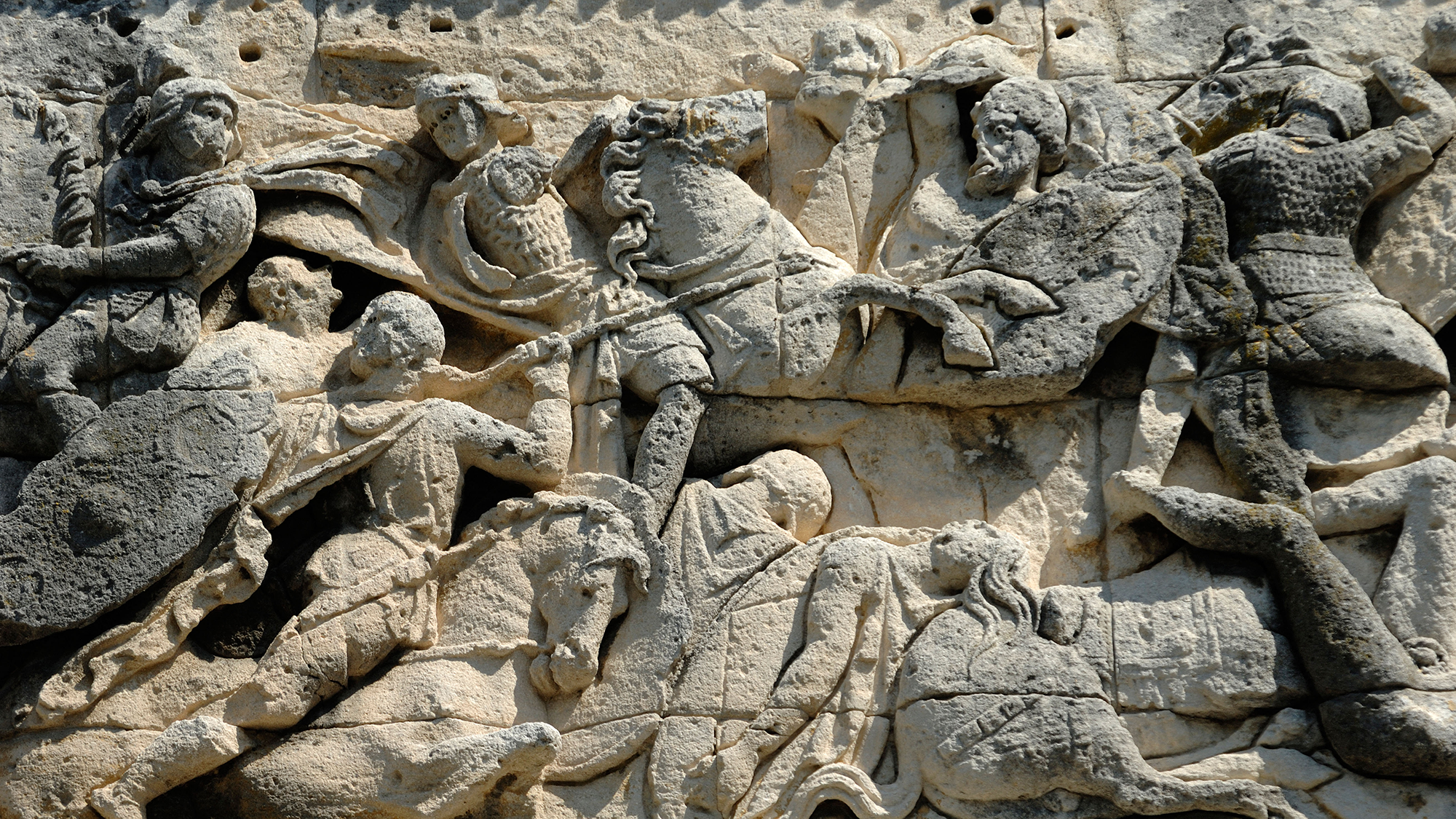
Roman and Gallic soldiers fight in a battle scene depicted on a Roman archway in France. It's debated whether Gallic women also fought in battle. (Image credit: Alamy)
Can ancient Britons be considered Celts?
Most famously, there isBoudica (sometimes spelled Boudicca), a queen of the Iceni (a people in England) who led a revolt against the Roman Empire around A.D. 60. She led her forces to several victories against the Romans before being defeated at the Battle of Watling Street in A.D. 61, after which she died — either by illness or by taking poison to avoid being captured by the Romans.
However, whether the Iceni or other ancient groups in Britain were Celtic is a matter of debate among scholars. The ancient geographer Strabo (who lived circa 64 B.C. to A.D. 24) actually "distinguished Britons from Celts," John Collis, a professor emeritus of archaeology at the University of Sheffield, wrote in his book "The Celts: Origins, Myths and Inventions" (Tempus, 2003).
Terms such as "Celt" and "Gaul" were "never used for the inhabitants of the British Isles except in the most general way for all the inhabitants of western Europe including non Indo-European speakers such as Basques," Collis wrote.
However, although ancient writers didn't refer to people in Britain as Celts, they did note their cultural and linguistic similarities, Freeman wrote. Following this line of thought, it's not too far-fetched to call Boudica a Celt.
Miranda Aldhouse-Green, a professor emeritus of archaeology at Cardiff University in the U.K., told Live Science in an email that she prefers "to refer to Boudica as British rather than Celtic" but noted that Boudica's rebellion is part of substantial evidence for warrior women in Britain.
"There is archaeological evidence for war-women in Britain in the form of Iron Age chariot [burials]," she said. For example, she noted the story of Cartimandua of the Brigantes in Yorkshire, who allied herself with Rome and fought against anti-Roman groups in the region.
"So yes, women did fight particularly in Britain," Aldhouse-Green said. But there is "less evidence" on the European continent for women fighting in battle, she noted.
In Britain the evidence for women in battle is very strong. "In the texts, we have Boudica, raising an army and razing three cities, and [the ancient writer] Tacitus tells us women commanding combat was not unusual," Pope said.
See how much you know about the celts with our Celtic quiz!
For archaeologists, the Coëby cemetery in Brittany, France, is a gold mine for research. It contains several prehistoric stone monuments and earth mounds. In a new study of two unusually large mounds, scientists may have stumbled upon a rare style of funerary monument.
For archaeologists, the Coëby cemetery in Brittany, France, is a gold mine for research. It contains several prehistoric stone monuments and earth mounds. In a new study of two unusually large mounds, scientists may have stumbled upon a rare style of funerary monument.
The ancient Egyptian god of the moon had two very different faces: a crescent-beaked white bird and a silver-coated baboon. Now, researchers think they may have found the common thread connecting them all.
The ancient Egyptian god of the moon had two very different faces: a crescent-beaked white bird and a silver-coated baboon. Now, researchers think they may have found the common thread connecting them all.
Koç University researchers have developed a conservation method that combines photogrammetry, digital modeling, 3D printing and embedded sensors to replace missing sections of archaeological amphorae. The customized fills can also monitor environmental and physical changes affecting the artifacts, offering a systematic approach to their conservation and long-term preservation.

 Login