❌

Normal view

The Growing Crescent of Mars as NASA’s Psyche Mission Approaches

17 July 2026 at 23:32
1 Min Read

The Growing Crescent of Mars as NASA’s Psyche Mission Approaches

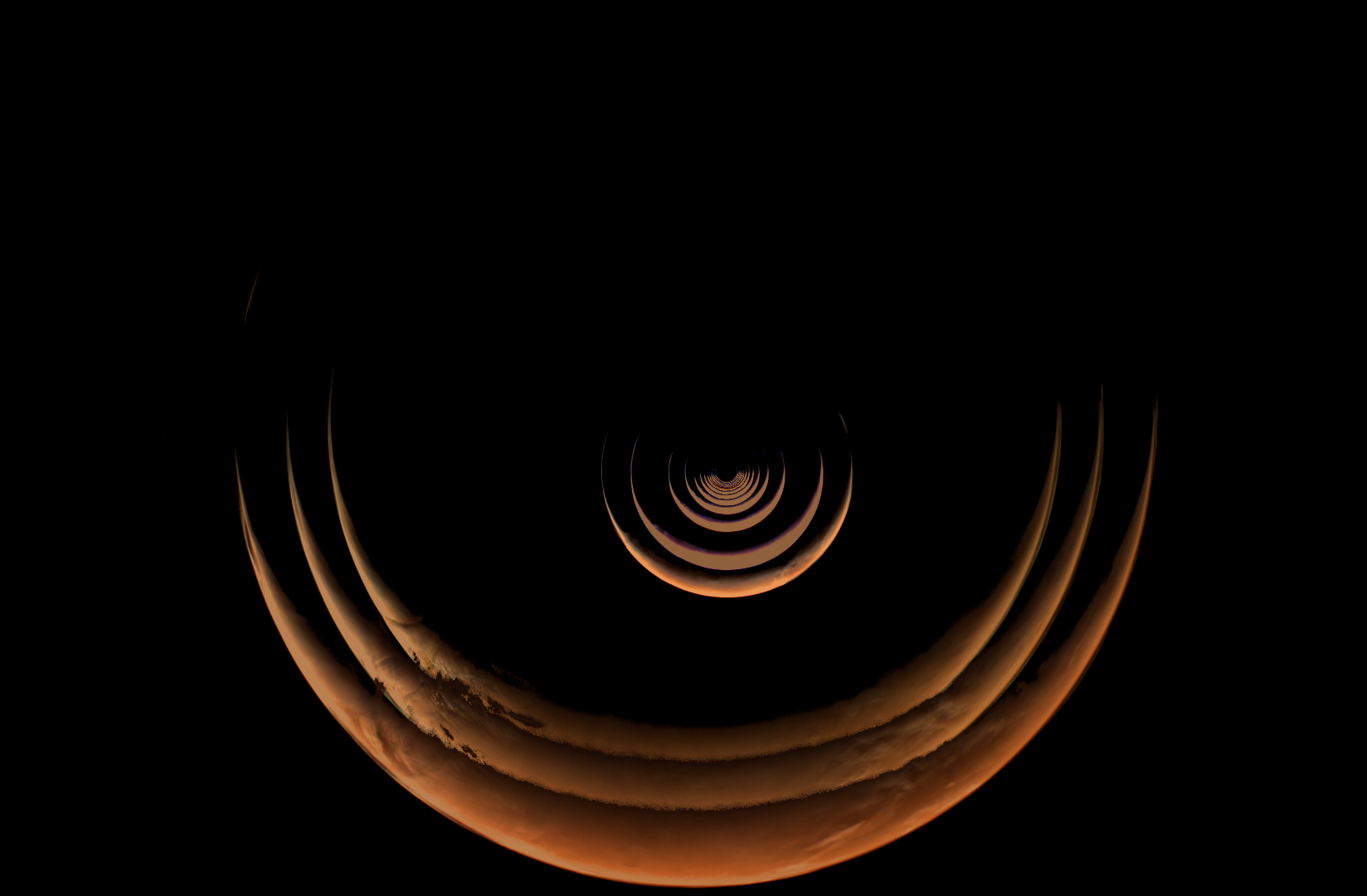
A time-lapse composite against a black background shows a series of concentric, glowing orange crescent planetary horizons that expand outward from a small central point, illustrating a spacecraft's approach during a Mars flyby.
PIA26586
Credits: NASA/JPL-Caltech/ASU

Downloads

The Growing Crescent of Mars as NASA’s Psyche Mission Approaches

PNG (3.48 MB)

Description

This composite of images taken by NASA’s Psyche mission shows the crescent of Mars grow as the spacecraft approached the planet for a gravity assist from May 2 to May 15, 2026. The series begins with the smallest crescent at the center of the of the image as Mars is farthest from the spacecraft, and progressively grows as the spacecraft gets closer. After these views were captured by the spacecraft’s multispectral imager instrument, Mars began to overfill the field of view as Psyche made close approach with the planet and captured a series of high-resolution images of the surface.

Because Psyche approached Mars from a high phase angle, the planet appeared as a thin crescent in the days running up to the close approach, lit by sunlight reflecting off its surface. Using these views of the approach, close approach, and departure from Mars, the Psyche team compiled a stunning time-lapse of its entire Mars encounter.

For more information about NASA’s Psyche mission, visit:

https://science.nasa.gov/mission/psyche/

The post The Growing Crescent of Mars as NASA’s Psyche Mission Approaches appeared first on NASA Science.
Curiosity Finds Evidence of an Ancient Sandstorm

15 July 2026 at 19:16
1 Min Read

Curiosity Finds Evidence of an Ancient Sandstorm

Beige, elongated rocks are scattered in a pile on Mars. The rocks are made from many rippled layers stacked on top of one another.
PIA26728
Credits: NASA/JPL-Caltech/MSSS

Downloads

Curiosity Finds Evidence of an Ancient Sandstorm

PNG (7.32 MB)

Description

Billions of years ago, an hours-long Martian sandstorm blew so intensely that sand ripples began to climb upon one another as they moved across the surface. These layers of sediment eventually hardened into the multilayered rocks seen in this image, which was taken by NASA’s Curiosity rover on Dec. 12, 2024, the 4,391st Martian day, or sol, of the mission. 

Scientists believe this is the first evidence of climbing wind ripple strata on the Red Planet. Spotted at a location nicknamed “Jawbone Canyon,” these rocks are a rare time capsule preserving a dramatic wind event early in Martian history. A paper detailing the discovery was featured on the cover of the journal Geology on July 1, 2026.

Perseverance’s Trip to ‘Broom Point’

15 July 2026 at 18:27
2 Min Read

Perseverance’s Trip to ‘Broom Point’

A reddish rocky Martian landscape superimposed with a white line zig-zagging from top right to bottom left of the image. Annotations indicate the landing site, the crater floor, delta, Neretva Vallis, the crater rim, and “Broom Point.”
PIA26754
Credits: NASA/JPL-Caltech/MRO/HIRISE/UA/ICL

Downloads

Perseverance’s Trip to ‘Broom Point’

PNG (16.62 MB)

Description

This orbital map shows the path NASA’s Perseverance Mars rover took to get to a location the science team has dubbed the “Broom Point member,” a sequence of layered bedrock likely more than 3.9 billion years old. As planned, the rover landed inside Jezero Crater on Feb. 18, 2021. It investigated the crater’s western delta and inlet river valley, Neretva Vallis, before summiting the crater rim in December 2024 following a rim-to-crest climb of 2,620 feet (800 meters).

The Broom Point region is situated on the outer edge of the crater rim and was visited by the rover in mid-2025. The yellow dot indicates location where the rover took a selfie.

NASA’s Jet Propulsion Laboratory, which is managed for the agency by Caltech in Pasadena, California, built and manages operations of the Perseverance rover. Arizona State University leads the operations of the Mastcam-Z instrument, working in collaboration with Malin Space Science Systems in San Diego, on the design, fabrication, testing, and operation of the cameras, and in collaboration with the Niels Bohr Institute of the University of Copenhagen on the design, fabrication, and testing of the calibration targets.

For more about Perseverance: science.nasa.gov/mission/mars-2020-perseverance/

JPL manages the Mars Reconnaissance Orbiter for NASA’s Science Mission Directorate in Washington as part of NASA’s Mars Exploration Program portfolio. Lockheed Martin Space in Denver built MRO and supports its operations. The University of Arizona, in Tucson, operates HiRISE, which was built by Ball Aerospace & Technologies Corp., in Boulder, Colorado.

For more information, visit:

science.nasa.gov/mission/mars-reconnaissance-orbiter

Desert Field Test With NASA Advanced Rover Prototype

18 June 2026 at 19:29
2 Min Read

Desert Field Test With NASA Advanced Rover Prototype

A prototype four-wheel rover developed at NASA’s Jet Propulsion Laboratory with advanced mobility and robotic autonomy capabilities trundled across the Colorado Desert near Plaster City, California, during a field test in March 2026.
PIA26701
Credits: NASA/JPL-Caltech

Downloads

Desert Field Test With NASA Advanced Rover Prototype

PNG (27.94 MB)

PIA26701 Figure A

JPEG (26.03 MB)

PIA26701 Figure B

JPEG (951.75 KB)

PIA26701 Figure C

JPEG (16.03 MB)

PIA26701 Figure D

JPEG (16.46 MB)

Description

A prototype four-wheel rover developed at NASA’s Jet Propulsion Laboratory with advanced mobility and robotic autonomy capabilities trundled across the Colorado Desert near Plaster City, California, during a field test in March 2026. Called ERNEST (Exploration Rover for Navigating Extreme Sloped Terrain), the rover served here as a testbed for autonomy software developed for a potential lunar mission requiring higher speeds and much greater mileage than can be achieved with current planetary rovers.

ERNEST was trailed by engineers as it traveled about 16 miles over the course of 37 hours of drive time. That’s more than 10 times the speed at which NASA’s Perseverance rover can navigate on Mars. The team also tested how well the rover traveled at dusk, dawn, and nighttime to simulate the experience of large terrain shadows in polar regions on the Moon.

A prototype four-wheel rover developed at NASA’s Jet Propulsion Laboratory with advanced mobility and robotic autonomy capabilities trundled across the Colorado Desert near Plaster City, California, during a field test in March 2026.
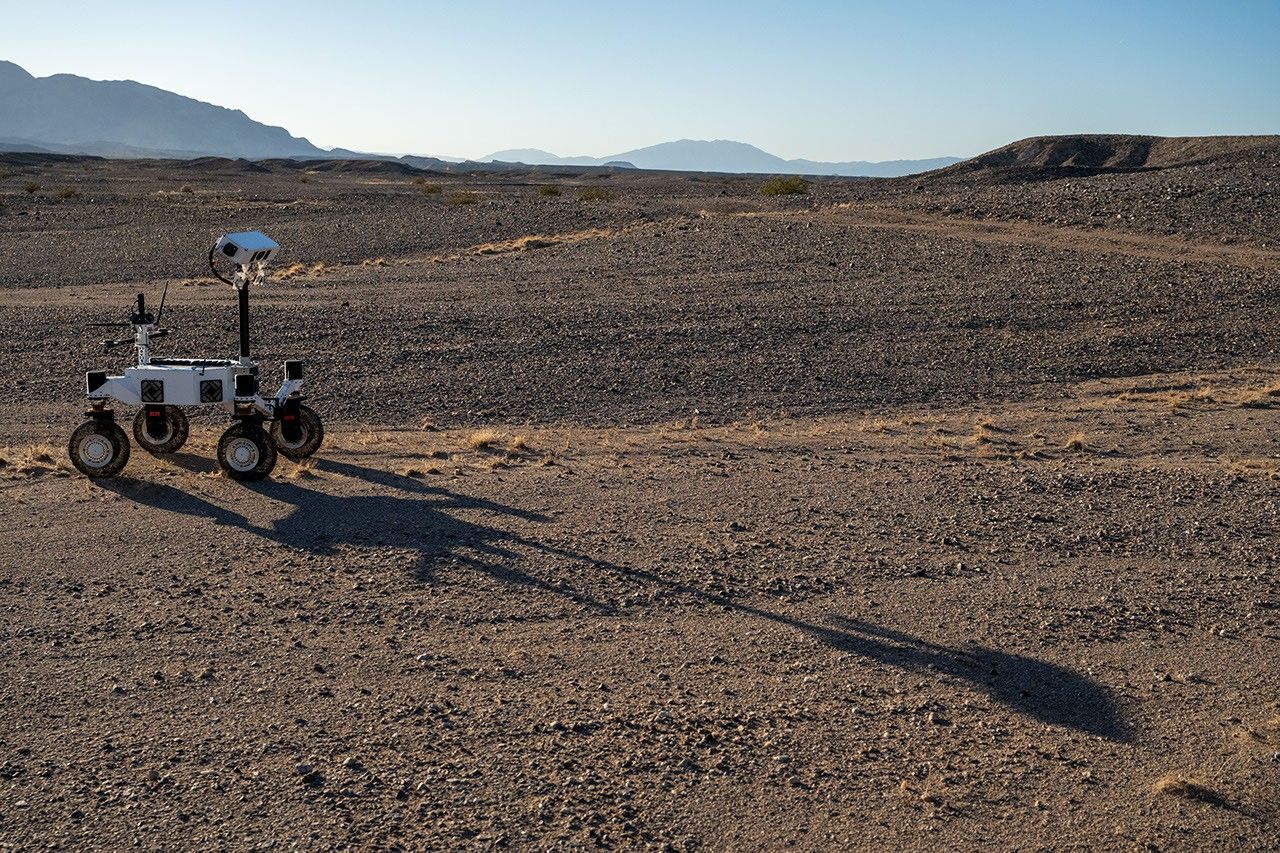
Figure A

Figure A shows the rover traveling toward its shadow.

A prototype four-wheel rover developed at NASA’s Jet Propulsion Laboratory with advanced mobility and robotic autonomy capabilities trundled across the Colorado Desert near Plaster City, California, during a field test in March 2026.
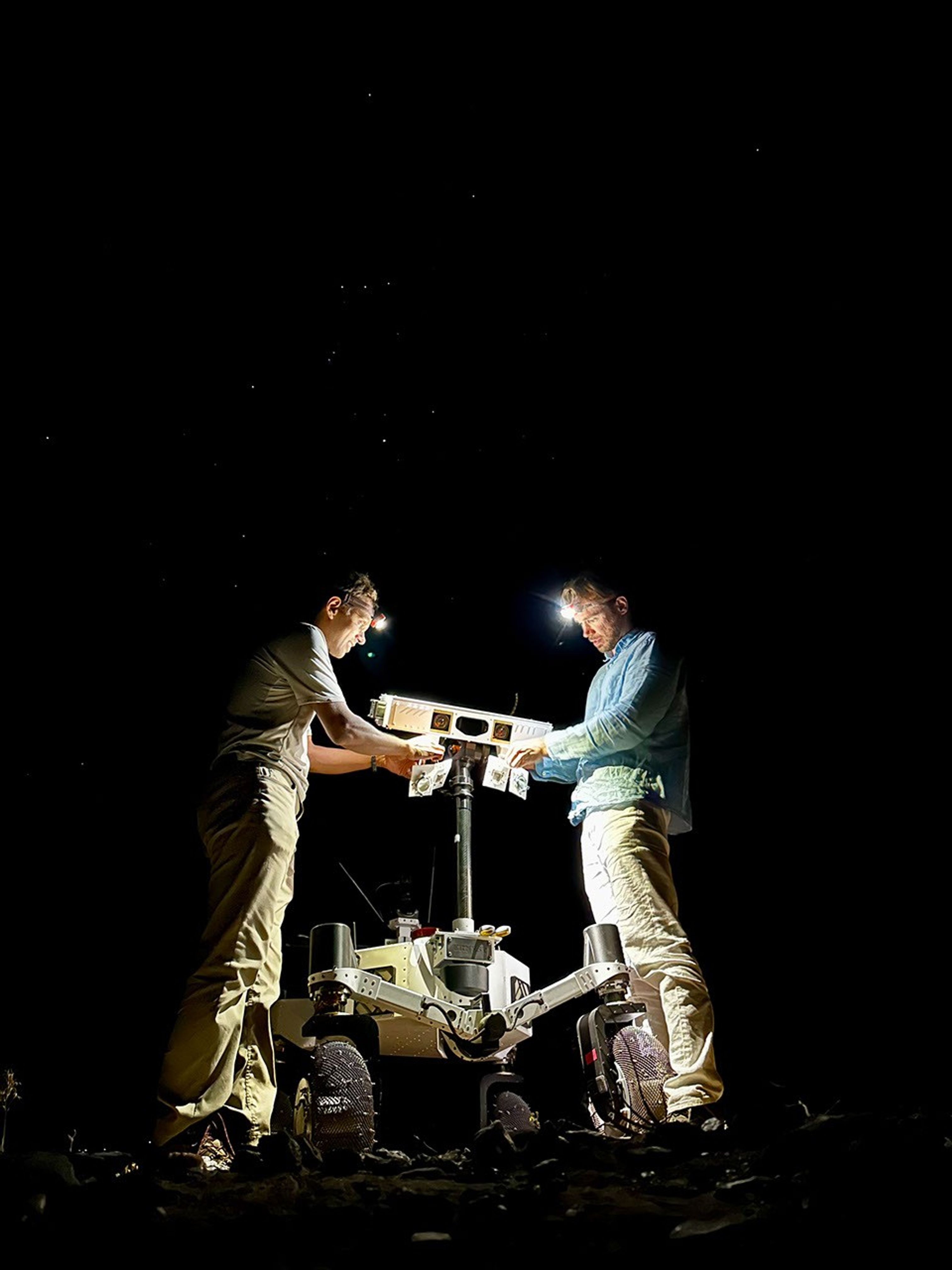
Figure B

Figure B shows two team members setting up illuminators on the rover at night.

A prototype four-wheel rover developed at NASA’s Jet Propulsion Laboratory with advanced mobility and robotic autonomy capabilities trundled across the Colorado Desert near Plaster City, California, during a field test in March 2026.
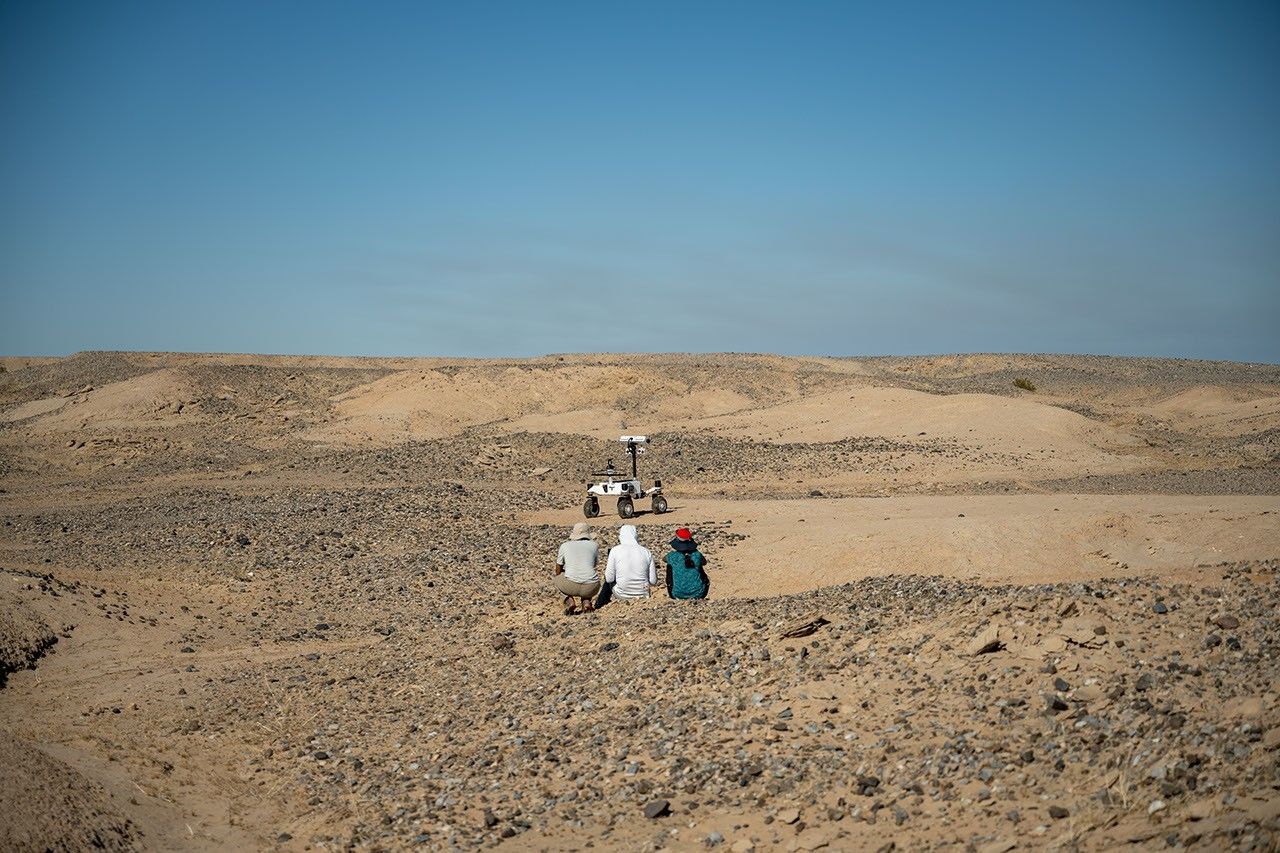
Figure C

Figure C shows three team members observing the rover during its long-range traverse.

A prototype four-wheel rover developed at NASA’s Jet Propulsion Laboratory with advanced mobility and robotic autonomy capabilities trundled across the Colorado Desert near Plaster City, California, during a field test in March 2026.
Figure D

Figure D shows the rover with one wheel up on a rock.

Work on ERNEST began in 2022 and was initially supported by JPL internal research and development funds. It is currently funded by NASA’s Mars Exploration Program and the agency’s Exploration Science Strategy Integration Office under its Science Mission Directorate in Washington. Caltech in Pasadena, California, manages JPL for NASA.

The post Desert Field Test With NASA Advanced Rover Prototype appeared first on NASA Science.

Astronaut Jessica Meir Assists With Hardware Updates for NASA’s Cold Atom Lab

16 June 2026 at 21:41
2 Min Read

Astronaut Jessica Meir Assists With Hardware Updates for NASA’s Cold Atom Lab

A woman in a black T-shirt with a headlamp affixed to her head and her hair floating up above her wears latex gloves to handle cabling that she’s working on. Wires, a laptop computer, and other equipment surround her.
PIA26725
Credits: NASA

Downloads

Astronaut Jessica Meir Assists With Hardware Updates for NASA’s Cold Atom Lab

JPEG (4.91 MB)

Description

NASA astronaut Jessica Meir inspects optical fibers while installing hardware updates to the agency’s Cold Atom Lab, or CAL, aboard the International Space Station on May 8, 2026.

About the size of a minifridge and operated from Earth, CAL chills atoms to temperatures below minus 459 degrees Fahrenheit (minus 273.15 degrees Celsius), so close to absolute zero that they form a large quantum object called a Bose-Einstein condensate (BEC) — a fifth state of matter distinct from solids, liquids, gases, and plasma. In a BEC, scientists can observe the quantum properties of atoms at a scale visible to the naked eye. For instance, atoms and particles sometimes behave like solid objects and sometimes behave like waves, a quantum property called “wave-particle duality.”

Managed by Caltech in Pasadena, NASA’s Jet Propulsion Laboratory designed, built, and operates Cold Atom Lab, which is sponsored by the Biological and Physical Sciences (BPS) division of NASA’s Science Mission Directorate at the agency’s headquarters in Washington. The BPS division pioneers scientific discovery and enables exploration by using space environments to conduct investigations that are not possible on Earth. Studying biological and physical phenomena under extreme conditions allows researchers to advance the fundamental scientific knowledge required to go farther and stay longer in space, while also benefiting life on Earth. 

To learn more about Cold Atom Lab, visit:

https://coldatomlab.jpl.nasa.gov/

The post Astronaut Jessica Meir Assists With Hardware Updates for NASA’s Cold Atom Lab appeared first on NASA Science.

Astronaut Jessica Meir Assists With Hardware Updates for NASA’s Cold Atom Lab

16 June 2026 at 21:41
2 Min Read

Astronaut Jessica Meir Assists With Hardware Updates for NASA’s Cold Atom Lab

A woman in a black T-shirt with a headlamp affixed to her head and her hair floating up above her wears latex gloves to handle cabling that she’s working on. Wires, a laptop computer, and other equipment surround her.
PIA26725
Credits:
NASA

Downloads

Astronaut Jessica Meir Assists With Hardware Updates for NASA’s Cold Atom Lab

JPEG (4.91 MB)

Description

NASA astronaut Jessica Meir inspects optical fibers while installing hardware updates to the agency’s Cold Atom Lab, or CAL, aboard the International Space Station on May 8, 2026.

About the size of a minifridge and operated from Earth, CAL chills atoms to temperatures below minus 459 degrees Fahrenheit (minus 273.15 degrees Celsius), so close to absolute zero that they form a large quantum object called a Bose-Einstein condensate (BEC) — a fifth state of matter distinct from solids, liquids, gases, and plasma. In a BEC, scientists can observe the quantum properties of atoms at a scale visible to the naked eye. For instance, atoms and particles sometimes behave like solid objects and sometimes behave like waves, a quantum property called “wave-particle duality.”

Managed by Caltech in Pasadena, NASA’s Jet Propulsion Laboratory designed, built, and operates Cold Atom Lab, which is sponsored by the Biological and Physical Sciences (BPS) division of NASA’s Science Mission Directorate at the agency’s headquarters in Washington. The BPS division pioneers scientific discovery and enables exploration by using space environments to conduct investigations that are not possible on Earth. Studying biological and physical phenomena under extreme conditions allows researchers to advance the fundamental scientific knowledge required to go farther and stay longer in space, while also benefiting life on Earth. 

To learn more about Cold Atom Lab, visit:

https://coldatomlab.jpl.nasa.gov/

NASA’s INCUS Satellites Progress Toward Launch

8 June 2026 at 16:22
2 Min Read

NASA’s INCUS Satellites Progress Toward Launch

A complex spacecraft partially wrapped in gold-colored foil and featuring a large rectangular solar panel stands on a metallic support structure against a solid blue background.
PIA26614
Credits: Blue Canyon Technologies

Downloads

NASA’s INCUS Satellites Progress Toward Launch

JPEG (10.32 MB)

Description

One of the three satellites that make up NASA’s INCUS (Investigation of Convective Updrafts) mission sits on a fixture at the facilities of Blue Canyon Technologies in Lafayette, Colorado. The satellite completed testing in preparation for launch in late May 2026. The mission will make the first space-based survey of the dynamics of tropical convective storms.

The three nearly identical satellites will fly in tight coordination in low Earth orbit, with the first and second satellites separated by 30 seconds, and the second and third satellite separated by 90 seconds. 

Each satellites carries a radar designed to observe the vertical motion of air and water — known as convective mass flux — as storms develop and evolve. The middle satellite will also carry a microwave radiometer.

The INCUS mission is set to launch in 2027 from NASA’s Wallops Flight Facility in Virginia.

Funded through the Earth Venture Mission-3 acquisition under NASA’s Earth System Science Pathfinder Program and led by principal investigator Sue van den Heever at Colorado State University in Fort Collins, INCUS is one of several missions fulfilling the clouds, convection, and precipitation requirements of NASA’s Earth System Observatory, a set of interconnected missions set to study our home planet’s dynamic natural systems and how they interact. The mission is also part of FALCON (Fleet for the Atmosphere Linking Commercial Observations with NASA), a fleet of atmosphere-observing satellites that will combine hardware contributions from NASA centers, universities, and commercial partners.

The post NASA’s INCUS Satellites Progress Toward Launch appeared first on NASA Science.

NASA’s INCUS Satellites Progress Toward Launch

8 June 2026 at 16:22
2 Min Read

NASA’s INCUS Satellites Progress Toward Launch

A complex spacecraft partially wrapped in gold-colored foil and featuring a large rectangular solar panel stands on a metallic support structure against a solid blue background.
PIA26614
Credits:
Blue Canyon Technologies

Downloads

NASA’s INCUS Satellites Progress Toward Launch

JPEG (10.32 MB)

Description

One of the three satellites that make up NASA’s INCUS (Investigation of Convective Updrafts) mission sits on a fixture at the facilities of Blue Canyon Technologies in Lafayette, Colorado. The satellite completed testing in preparation for launch in late May 2026. The mission will make the first space-based survey of the dynamics of tropical convective storms.

The three nearly identical satellites will fly in tight coordination in low Earth orbit, with the first and second satellites separated by 30 seconds, and the second and third satellite separated by 90 seconds. 

Each satellites carries a radar designed to observe the vertical motion of air and water — known as convective mass flux — as storms develop and evolve. The middle satellite will also carry a microwave radiometer.

The INCUS mission is set to launch in 2027 from NASA’s Wallops Flight Facility in Virginia.

Funded through the Earth Venture Mission-3 acquisition under NASA’s Earth System Science Pathfinder Program and led by principal investigator Sue van den Heever at Colorado State University in Fort Collins, INCUS is one of several missions fulfilling the clouds, convection, and precipitation requirements of NASA’s Earth System Observatory, a set of interconnected missions set to study our home planet’s dynamic natural systems and how they interact. The mission is also part of FALCON (Fleet for the Atmosphere Linking Commercial Observations with NASA), a fleet of atmosphere-observing satellites that will combine hardware contributions from NASA centers, universities, and commercial partners.

❌