Using the James Webb Space Telescope (JWST), astronomers obtained high-contrast coronagraphic images of the protoplanetary disk around the young, nearby star TW Hydrae. Results of the observational campaign, published July 27 on the preprint server arXiv, shed more light on the nature of this disk.
Visible in Scotland, the total solar eclipse of Aug. 2, 1133, featured nearly 4½ minutes of totality. This eclipse provides just one of many historical examples of people wrongly associating a celestial spectacle with an earthly event: In his Historia Novella, written between 1140 and 1143, English historian William of Malmesbury linked the eclipse withContinue reading "Aug. 2, 1133: A total eclipse is misremembered"
Using spectral data from the Dark Energy Spectroscopic Instrument (DESI), astronomers have gained some of the clearest evidence yet that white dwarf stars are accreting debris from disintegrating exoplanets. Captured while DESI was unable to study its primary targets: distant galaxies, the results provide unprecedented insights into the chemical makeup of rocky exoplanets, revealing compositions remarkably similar to the planets and asteroids of our own inner solar system.
Where it is: 2.5 million light-years away, in the constellation Andromeda
When it was shared: July 27, 2026
Andromeda is the only major galaxy in the universe that is speeding closer to the Milky Way as all the others rush away. Now, a new analysis of Hubble Space Telescope data hints that our galactic next-door neighbor may be winding down from a big burst of activity as it draws toward a possible collision with our galaxy.
The new study found that the Andromeda galaxy (M31) has been steadily slowing its production of new stars over the past 500 million years. The findings suggest that the galaxy is naturally winding down after a more active period, offering astronomers valuable clues about how large spiral galaxies evolve.
Andromeda is a giant spiral galaxy similar to the Milky Way, but with around twice its mass. As the nearest large spiral galaxy to Earth, it provides an ideal laboratory for studying galaxy formation and evolution. An understanding of when and where stars form is essential for explaining how galaxies develop and change over time.
The new research, published July 27 in The Astrophysical Journal, combines two major Hubble surveys that mapped roughly two-thirds of Andromeda's disk, including around 200 million stars. It's already known that Andromeda experienced a dramatic burst of star formation about 2 billion years ago, which is thought to have formed about a fifth of all the stars in the galaxy. That starburst is thought to be the result of a merger with another galaxy, probably the compact elliptical galaxy M32, which now orbits Andromeda.
The new study found that Andromeda formed stars at a rate of around one solar mass per year 500 million years ago. By 40 million years ago, that rate had halved, while today the rate has fallen to just one-fifth of a solar mass each year. Researchers found that most recent star formation in Andromeda has been concentrated within a ring about 32,000 light-years from the galaxy's center and that the decreasing activity within this region is largely responsible for the overall decline. That suggests the galaxy is gradually winding down from its previous burst of star formation rather than suddenly running out of material.
Scientists also investigated whether M32 may have contributed to the slowdown. Regions closest to M32 show a more recent decline in star formation, making the companion galaxy a possible influence, although the evidence remains inconclusive.
"We need to measure the individual stars because they are the fossil record of the galaxy's formation," study co-author Ben Williams, an astronomer at the University of Washington, said in a NASA statement. "Hubble is the only telescope that can give you high enough spatial resolution over a large enough area to be able to do that in Andromeda."Although the team will continue studying Hubble's archive, they will also target observations from NASA's Nancy Grace Roman Space Telescope, which will launch on a SpaceX Falcon Heavy rocket as soon as Aug. 30. With a field of view at least 100 times larger than Hubble's, Roman will survey the entire Andromeda galaxy and its surrounding halo in unprecedented detail.
Andromeda is best observed in November and is visible to the naked eye, even from locations with moderate light pollution. The galaxy may collide with the Milky Way about 5 billion years from now, though its ultimate trajectory is still uncertain.
A Jupiter-mass object orbiting a brown dwarf could become the first confirmed moon beyond our Solar System. A massive object appears to be circling a brown dwarf in the CD-35 2722 system, but calling it a moon is not straightforward. Unlike moons in our Solar System, it does not orbit a planet. Instead, it travels [...]
Scientists once suspected that a brutal, years-long winter starved the dinosaurs following an asteroid impact 66 million years ago. New evidence suggests a more violent end: widespread firestorms that may have burned even thick-skinned dinosaurs to a crisp within hours.
The roughly six-mile-wide (10-kilometer-wide) asteroid struck Mexico's Yucatán Peninsula, excavating the Chicxulub crater and vaporizing enormous quantities of rock. Some of that material condensed into tiny droplets called spherules, which spread around the planet before falling back through Earth's atmosphere at several miles per second.
As the spherules slowed, their kinetic energy became heat, producing an intense pulse of thermal radiation. Earlier models suggested the effect would have resembled a worldwide broiler that was potentially deadly to exposed, thin-skinned animals, but not powerful enough to ignite vegetation across the globe.
A new study argues that those calculations overlooked a crucial ingredient: a thick layer of fine silicate dust formed from rock vapor that did not initially condense into spherules. Evidence for that dust emerged in 2023 from the Tanis fossil site in North Dakota, where researchers identified a layer of extremely fine, impact-derived material deposited above the spherules. A similar dust layer has since been documented at the K–Pg boundary (which divides the "age of reptiles" and the "age of mammals") in Raton Basin across the Colorado–New Mexico border.
"It reinvigorated my interest in what happened to the leftover vapor — that's where this work started," lead author Brandon Johnson, a planetary scientist at Purdue University, said in a statement.
The dust would have acted like an insulating blanket, preventing thermal radiation from escaping into space and redirecting more heat toward Earth’s surface. The researchers estimated that the surface heat pulse could have been about 3.5 times more intense than what was suggested by models considering the falling spherules alone. "We're in the realm where we might be essentially killing off everything within that first hour or two," Johnson said.
The radiation may not have directly ignited thick pieces of wood, but it exceeded ignition thresholds for grass, lichen, and pine needles, which could have fueled larger fires. The study also found that exposed terrestrial animals may have received about 17 times the thermal dose considered lethal to humans.
Animals sheltering underground or in water would have had a better chance of surviving the initial heat pulse. Afterward, the same dust may have blocked sunlight for years, triggering the prolonged "impact winter" more typically blamed for the dinosaurs' extinction.
There is, however, a missing element: the wildfire evidence that supports this dust-caused inferno theory has only been found in North America. "It could be that we will eventually find the record of completely global wildfires," said Alfio Alessandro Chiarenza, a paleontologist at University College London who was not involved in the study. "We just don't have it so far."
The study was published on July 28 in the journal JGR Biogeosciences.
Not all meteorites are created equal, and one that crashed through the roof of a New Jersey home is giving scientists a rare glimpse into the chemistry of an ancient asteroid while offering new clues to the puzzle of how life began on Earth.
On July 16, 2024, a daytime meteor streaked across the sky and produced a sonic boom as it passed south of the Statue of Liberty.
“A forensic study of the fragments revealed that they contained preserved bits from near the surface of a primitive asteroid where it experienced concentrated salty fluids—a process not previously known from this type of proto-planet world,” said lead author and meteor astronomer Peter Jenniskens of the SETI Institute and NASA’s Ames Research Center in California’s Silicon Valley in a statement.
Two years later, after analyzing fragments from the event, researchers found that the meteorite contained evidence of ancient salty fluids, complex organic chemistry, and processes that occurred on a primitive asteroid billions of years ago.
Daytime meteor (left), impact site, and a fragment of the Hillsborough meteorite (Image Credit: (A) M. Kirschner and M. Hankey, American Meteor Society; [(B) to (D)] A. Gordon/SETI Institute).The findings, published in the journal Science Advances, come from an international team led by meteor astronomer Peter Jenniskens of the SETI Institute and NASA Ames Research Center.
“Our cameras in Northford, Connecticut, and Douglassville, Pennsylvania, as well as a doorbell camera in Wayne, New Jersey, captured the meteor, and from that we measured its trajectory,” said American Meteor Society operations manager Mike Hankey.
Traveling at approximately 32,000 miles per hour (14.4 kilometers per second), witnesses from the surrounding areas, including New York, New Jersey, Connecticut, Rhode Island, and Pennsylvania, reported seeing a bright fireball that broke apart while a part of it broke through the roof of a New Jersey residence.
“The path traced back to low in the asteroid belt,” Hankey adds.
Using footage from meteor cameras, including systems in Connecticut and Pennsylvania, researchers reconstructed the meteor’s path. The trajectory traced back to a region of the asteroid belt between Mars and Jupiter. The space rock disappeared from view about 22 miles above the surface. Shortly afterward, weather radar at Newark Airport detected a cloud of falling debris stretching from Staten Island into New Jersey.
The homeowner acted quickly, handling the space rock with gloves and aluminum foil before placing it in a glass container to protect the material from contamination.
The meteorite was classified as a CM1/2 carbonaceous chondrite, a rare type of primitive meteorite known for containing organic compounds and evidence of water weathering.
According to researchers, the Hillsborough meteorite is only the second witnessed fall of a CM1/2 carbonaceous chondrite ever recorded. Most known CM meteorites belong to the less-altered CM2 category, while no CM1-type meteorite fall has ever been observed.
A fragment of the Hillsborough meteorite (Image Credit: SETI Institute).
“A high fraction of compounds were the product of organic chemistry with minerals,” said organic mass spectrometry specialist Phil Schmitt-Kopplin of Technical University Munich. “We do not know if these magnesium organic compounds were contributed by brine chemistry or were simply left over from earlier impact shock processes.”
The final analysis showed tiny salt-rich pockets inside the meteorite, pointing to a formation where water once evaporated on its parent asteroid, leaving behind highly saline fluids. Scientists are comparing these minerals with samples from the asteroids Ryugu and Bennu to better understand early solar system chemistry.
These ancient salty waters may have helped protect and change the molecules needed for life before life first began. The meteorite contained carbon, nitrogen, amino acids, and other organic compounds, many of which appear to have formed through interactions between water, minerals, and carbon-rich chemistry.
“We are thrilled that nature delivered such a precious asteroid sample on our doorstep,” said curator Denton Ebel from the Department of Earth and Planetary Sciences at the American Museum of Natural History.
Chrissy Newton is a PR professional and the founder of VOCAB Communications. She currently appears on The Discovery Channel and Max and hosts the Rebelliously Curious podcast, which can be found on YouTube and on all audio podcast streaming platforms. Follow her on X: @ChrissyNewton, Instagram: @BeingChrissyNewton, and chrissynewton.com. To contact Chrissy with a story, please email chrissy @ thedebrief.org.
As new observations reveal the outer edges of IC 1101 for the first time, scientists have confirmed it is the largest known galaxy. The galaxy’s statistics are staggering, containing an estimated 3.4 trillion solar masses of stars and spanning roughly 1.7 million light-years, eclipsing every other known galaxy.
IC 1101 belongs to a class known as brightest cluster galaxies (BCGs), which form as massive galaxies spend billions of years absorbing smaller neighboring galaxies.
The new images are the deepest ever taken of the galaxy, and were revealed in a recent paper accepted for publication in a future issue of Astronomy and Astrophysics, but available now in preprint form on the arXiv server.
Blending into the Cosmic Background
Despite their enormous sizes, BCGs are notoriously difficult for astronomers to study. Because they are built through the gradual merger of many smaller galaxies, their outer regions are extremely faint, containing diffuse stellar halos and tidal tails left behind by ancient collisions. These wispy edges often blend into the free-floating gas and stars that fill galaxy clusters, making it difficult to determine precisely where the galaxy ends and the surrounding cluster begins.
Carlos Marrero-de la Rosa of the Astrophysical Institute of the Canary Islands led the new study, focusing on IC 1101, the dominant galaxy at the center of the Abell 2029 galaxy cluster.
The research relied on ultra-deep images captured with the Wide Field Camera at the Isaac Newton Telescope, allowing astronomers to resolve the galaxy’s diffuse outer boundary in unprecedented detail.
Applying a star subtraction algorithm to the composite image of the IC 1101 galaxy provides a new level of detail and contrast. Credit: Carlos Marrero-de la Rosa et al. (2026)
Battling Light Pollution
With the number of satellites orbiting Earth increasing dramatically in recent years, astronomers have raised concerns about artificial light pollution. In this case, however, the researchers faced interference from a far more distant source: foreground stars within our own galaxy.
These stars, located between Earth and IC 1101, scatter light across telescope images, washing out the extremely faint structures astronomers are attempting to detect. Since the galaxy’s outermost regions are already difficult to distinguish, any additional scattered light significantly reduces image contrast.
To overcome this problem, the researchers constructed a detailed model of how the telescope spreads light using dozens of calibration stars. The model allowed the team to accurately subtract scattered light from more than 250 foreground stars, bringing IC 1101’s faintest structures into much sharper contrast and enabling a more precise measurement of its true extent.
The Largest Known Galaxy
IC 1101’s immense scale becomes even more striking when compared with our own Milky Way. The astronomers measured IC 1101 at roughly 520 kiloparsecs across—about 17 times wider than the Milky Way’s approximately 30-kiloparsec diameter. Even after accounting for all forms of mass, including elusive dark matter, scientists estimate that the Milky Way contains only about 1 to 1.5 trillion solar masses of material, compared with the 3.4 trillion solar masses contained in the stars of IC 1101 alone.
Researchers also found evidence that the giant galaxy continues to grow. They identified eight structures beyond its main edge, two of which align with previously observed X-ray disturbances that suggest ongoing accretion. According to the team, IC 1101 likely collided with another galaxy group between two and three billion years ago, producing a merger that continues to shape the galaxy today.
Ryan Whalen covers science and technology for The Debrief. He holds an MA in History and a Master of Library and Information Science with a certificate in Data Science. He can be contacted at ryan@thedebrief.org.
Born Aug. 1, 1818, Maria Mitchell was raised in the Quaker tradition, which allowed equal education for boys and girls. This, plus lessons from her father, afforded her the opportunity to become skilled in astronomy, mathematics, and navigation. After a brief stint as a teacher, she became the first librarian of the Nantucket Antheneum. SheContinue reading "Aug 1, 1818: The birth of Maria Mitchell"
Skywatchers across North America and Europe should mark Wednesday, Aug. 12 on their calendars. From a daytime solar eclipse to the peak of the Perseid meteor shower beneath a moonless sky, the date offers an exceptionally rare combination of celestial events within a 24-hour period. Add brilliant Venus and the glowing band of the Milky Way after sunset, and the result is a full day of astronomy that could become one of the standout skywatching opportunities of the year.
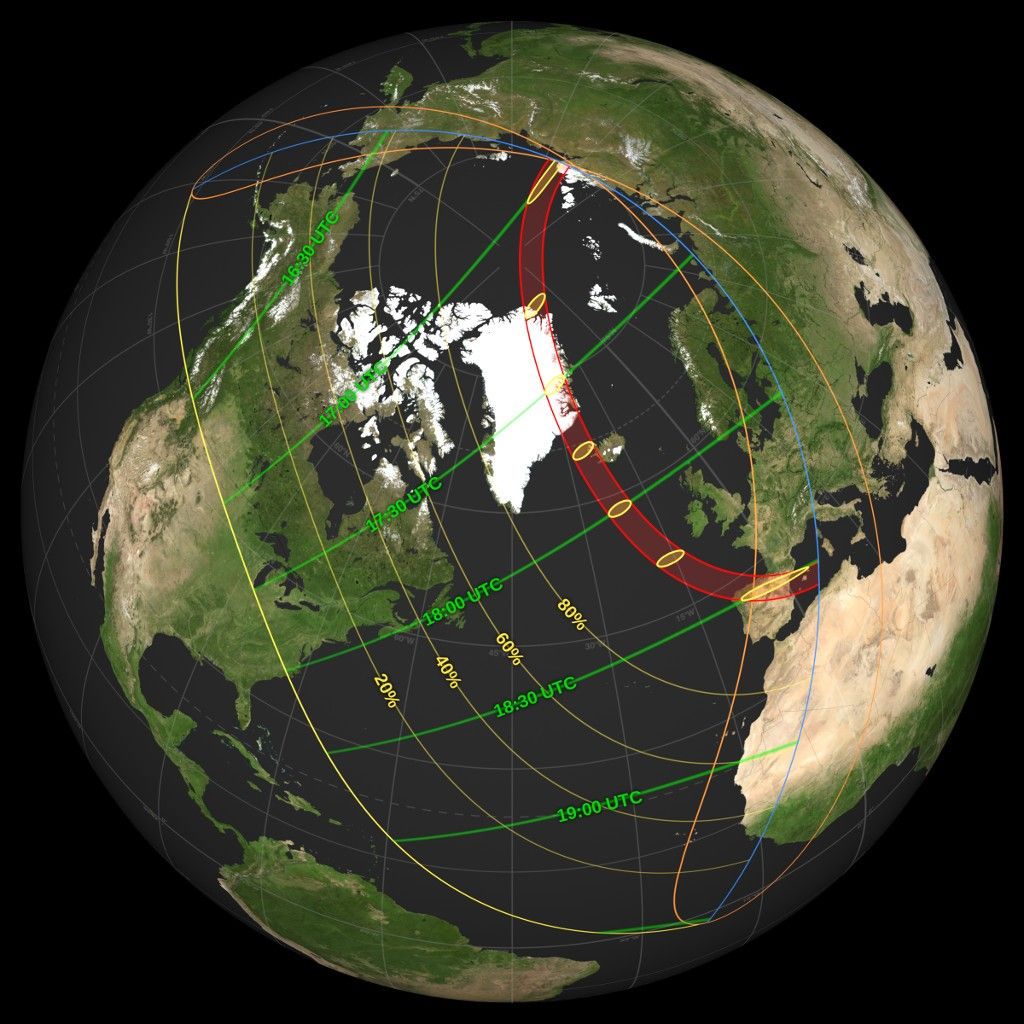
The first spectacle arrives during daylight as the moon partially covers the sun across Alaska, eastern Canada and parts of the northeastern U.S. A dramatic total solar eclipse will be visible along a narrow path stretching across eastern Greenland, western Iceland and northern Spain — and that's where eclipse chasers will be. However, about 779 million people in North America, Europe and North Africa will see at least a 10% partial eclipse, according to Time and Date.
Northern Canada will experience North America's deepest partial eclipse, with parts of Nunavut in the Canadian Arctic seeing up to 93% of the sun covered, according to Time And Date; large eastern cities like Toronto, Ottawa and Quebec will see between 8% and 24% coverage. The best views in the U.S. will be from Alaska and the Northeast, with Fairbanks, Alaska, seeing 37% of the sun covered, and Boston seeing 16%.
This NASA map shows who will see a total solar eclipse (red line) and who will see a partial eclipse (yellow lines) on Aug. 12. (Image credit: NASA)
In Europe, London will see a 91% eclipse and Paris will get 92%. No matter your viewing location, it's important to use ISO 12312-2 certified solar eclipse glasses throughout the entire partial eclipse. Also remember to fit binoculars, telescopes and cameras with solar filters before pointing them at the sun. (Here’s a great selection of gear that will help you safely watch the eclipse from anywhere).
After sunset, the day's second major event begins. Brilliant Venus will be easy to spot as it reaches dichotomy, the point at which the planet appears half illuminated. Through a small telescope or large stargazing binoculars, skywatchers should see Venus resembling a tiny half-moon as it moves closer to Earth.
Once darkness falls, the day's third and fourth major events will begin. The annual Perseid meteor shower will peak during the overnight hours of Aug. 12-13, and this year's display benefits from one crucial advantage: a new moon. With no moonlight washing out faint meteors, observers under truly dark skies could see between 50 and 75 meteors per hour, while even suburban locations should enjoy frequent "shooting stars," according to The Planetary Society.
The best time to look is from midnight to 2 a.m. local time, when the sky is darkest and the constellation Perseus is highest in the sky. As a final bonus, those under dark, rural skies will see the Milky Way arch overhead, providing one of the finest views of our home galaxy all year.
A daytime solar eclipse, a moon-free Perseid meteor shower, a dazzling Venus and spectacular views of the Milky Way make Aug. 12 a great opportunity for anyone with an interest in the night sky. If skies are clear, it could be the single greatest day and night for skywatching in years.
See how much you know about the sun with our sun quiz!
A £3 million investment could help secure a leading UK role in NASA’s future search for life on nearby planets. An Earth-like planet orbiting a nearby star would appear as little more than a dim point beside a light source 10 billion times brighter. British astronomers are preparing technology that could help NASA separate that [...]
Some of the brightest objects in the universe may also hold the key to understanding how galaxies evolve — especially when gravity transforms them into giant cosmic magnifying glasses.
Using artificial intelligence to search through data from the Dark Energy Spectroscopic Instrument (DESI), astronomers have identified seven promising candidates for quasars acting as gravitational lenses — natural cosmic magnifying glasses created when a massive object's gravity bends and magnifies light from a more distant object.
These unusual systems could help researchers better understand how actively growing supermassive black holes evolve, according to a statement from Ohio State University.
"Quasars are like the baby pictures of a supermassive black hole," Everett McArthur, lead author of the study and a graduate student in astronomy at The Ohio State University, said in the statement. "So exploring how we get from quasars to those black holes is really important."
Quasars are the intensely bright centers of galaxies powered by actively feeding supermassive black holes. Studying these objects can help researchers understand how black holes evolve into the enormous ones found throughout the modern universe. But as these black holes pull in gas and dust, they release so much energy that they can outshine their entire host galaxies, making those galaxies difficult to study.
Rare cases where a quasar acts as a gravitational lens offer a way around that problem, giving astronomers a unique opportunity to observe both the quasar and the distant galaxy whose light is magnified by its gravity.
Gravitational lensing can be seen in this cosmic deep field. Notice how some glowing spots are dots while others are lines. (Image credit: Image: NASA, ESA, CSA, STScI, Jose Diego (IFCA), Jordan D'Silva (UWA), Anton Koekemoer (STScI), Jake Summers (ASU), Rogier Windhorst (ASU), Haojing Yan (University of Missouri); Image Processing: Joseph DePasquale (STScI))
However, finding these rare alignments can be exceptionally challenging. To uncover them, the research team began with a catalog of roughly 800,000 quasars identified by DESI and used a machine-learning model to search for subtle signatures of gravitational lensing.
Because so few quasars acting as gravitational lenses are known, researchers had little real-world data to train their AI model. Instead, they generated simulated examples of these cosmic alignments, allowing the algorithm to learn what to look for before searching the DESI catalog. The algorithm narrowed the search to about 200 candidates, which researchers then reviewed manually. That process resulted in seven new quasar lens candidates.
Two "fans" representing DESI observations above and below the plane of the Milky Way. (Image credit: DESI Collaboration/DOE/KPNO/NOIRLab/NSF/AURA/R. Proctor/ Robert Lea (created with Canva))
The discoveries roughly double the number of known systems found through similar survey searches, according to the statement.
While artificial intelligence played a key role in finding the candidates, the discoveries highlight the scientific potential hidden within the massive datasets produced by modern astronomy. DESI is mapping millions of galaxies and quasars, creating an enormous archive that would be nearly impossible to search by hand.
Follow-up observations will be needed to confirm the newly identified quasar lenses and study their properties in greater detail. If verified, they could offer astronomers a powerful new way to investigate how supermassive black holes shaped the galaxies around them while demonstrating how AI can uncover rare cosmic phenomena hidden within the enormous datasets produced by modern sky surveys.
The German eROSITA consortium (eROSITA-DE), which includes the University of Bonn and is led by the Max Planck Institute for Extraterrestrial Physics (MPE), has released its second major public data set, the "eROSITA Data Release 2" (DR2).
Astronomers have made a surprising discovery about one of the brightest space rocks in the main asteroid belt.
With help from some of the astronomy world’s most powerful ground-based telescopes, astronomers now report new evidence that the asteroid (44) Nysa is vastly unlike most asteroids in appearance, possessing an unusual three-lobed structure.
However, that’s not all the team behind the new research says they have discovered: the object also appears to be accompanied by a previously unknown object.
A Three-Lobed Asteroid with a Mysterious Companion
According to the international team behind the discovery, the roughly 47-mile-wide asteroid Nysa is a rare variety of space object, whose uneven appearance could offer new insights into the violent collisions that played a significant role in shaping the early solar system. Belonging to a rare class of asteroids, the object may also help scientists better understand how such objects preserve material from early in the universe.
While the Nysa’s unusual shape and accompanying object, which astronomers have characterized as a small moon, are all newly-discovered features, knowledge of the asteroid’s existence goes back more than a century, and astronomers have long studied the object due to its unusually bright surface, which is believed to be rich in a translucent crystalline mineral called enstatite.
Based on past observations, astronomers suspected that the object might possess an elongated shape, composed of two connected lobes, although the object’s exact shape remained unknown.
That all changed after astronomers turned the SHARK-VIS instrument on the Large Binocular Telescope in Arizona, and the SPHERE/ZIMPOL instrument on the European Southern Observatory’s Very Large Telescope in Chile, toward the object. Doing so allowed researchers to capture the sharpest images of Nysa ever seen from Earth.
Based on those observations, astronomers have now revealed an asteroid unlike any previously seen.
“A Remarkably Unusual Object”
Kate Minker, a Lowell Observatory astronomer and the lead author of a new paper detailing the discoveries, says the new images reveal a truly unique asteroid, in addition to offering potential clues about its formation.
Above: A maximum pixel stack of Nysa and its moon (indicated with pink arrows) imaged on Feb. 15, 2026 (Image Credit: Kate Minker et al.).
“The images reveal a remarkably unusual object,” Minker said in a statement. “The most likely explanation is that Nysa is either a contact trinary, consisting of three connected components, or an extremely irregular coherent body unlike anything we’ve previously observed.”
To determine the reasons for its odd shape, the team combined the new imagery made possible with the Large Binocular Telescope’s SHARK-VIS instrument and the SPHERE/ZIMPOL with existing photometric observations obtained by other observatories around the world. The resulting data set offered Minker and her team a detailed three-dimensional model of the asteroid.
Now, the team reports that their reconstruction of Nysa points to strong evidence that it consists of three distinctive lobes, each of which is connected by more narrow regions.
Nysa’s Not Alone
Another intriguing finding from the new data is the identification of the small satellite orbiting Nysa, which the researchers have given the temporary designation of S/2026 (44) 1.
Observed during two separate campaigns, this tiny moon is believed to be only a little more than a half mile across and orbiting at least 106 miles from its host asteroid.
“We borrowed a specialized technique from another field of astronomy, known as ‘high-contrast imaging,’ to detect the small moon whose faint light was overwhelmed by the intense brightness of the primary asteroid,” said Gianluca Li Causi of the Italian National Institute for Astrophysics in a statement.
Further Questions
Right now, scientists believe Nysa’s unusual shape was likely the result of an ancient collision, in which fragments expelled from larger bodies were gradually reassembled over time into a single body.
There are other possibilities, too. One theory holds that Nysa could be a victim of a cosmic hit-and-run incident, resulting from a collision with a much larger asteroid at some point in the very distant past—possibly billions of years ago.
Minker and her team hope that future observations of the asteroid and its newly discovered moon will provide further insights and eventually allow astronomers to calculate Nysa’s mass and density more accurately.
Doing so could ultimately bring to light which of the competing scenarios about its formation is most likely to be accurate, and ultimately, it could elevate Nysa to a small—but quickly growing—class of unusual asteroids that may preserve a record of the catastrophic conditions in our solar system, which helped shape it during its very earliest periods.
Micah Hanks is the Editor-in-Chief and Co-Founder of The Debrief. A longtime reporter on science, defense, and technology with a focus on space and astronomy, he can be reached atmicah@thedebrief.org. Follow him on X @MicahHanks, and at micahhanks.com.
With the Space Race heating up, the Ranger program was developed as an answer to Sputnik: The U.S. would land spacecraft on the Moon. When President John F. Kennedy vowed in 1961 to put a man on the lunar surface, the project evolved. Instead of being purely scientific or exploratory, Ranger spacecraft would also beContinue reading "July 31, 1964: Ranger 7 returns the first close pictures of the Moon"
Astronomers searching for extraterrestrial intelligence have traditionally focused on a specific, narrow band of the radio spectrum. However, a new survey presented at the Royal Astronomical Society‘s National Astronomy Meeting (NAM2026) in Birmingham suggests that this approach may overlook a significant portion of the available frequencies.
The frequencies most often investigated by SETI (Search for Extraterrestrial Intelligence) programs are those between 1.42 and 1.66 GHz. This range, known as the ‘water hole’, is situated between the natural radio emissions of hydrogen and hydroxyl, the two molecules that make up water. Astronomers have regarded this quiet section of the spectrum as a reasonable place for interstellar communication, because any civilization acquainted with these molecules would probably also decide to send and receive signals in search of in that specific region.
Louisa Mason, who is carrying out research as a PhD student at the University of Manchester, focused on investigating frequencies outside the water hole range. To carry out the first SETI survey with that telescope, she used archived data from the Atacama Large Millimeter/submillimeter Array (ALMA) in Chile. She analyzed data originally collected for other astronomical studies instead of requesting new observation time.
Hunting for Signals in Unclaimed Territory
Mason focused on two narrow frequency bands in the ALMA Band 3 data, looking for narrowband signals that might be the result of technology rather than natural astrophysical origins. In the four observations that she examined, she did not discover any candidates for technosignatures above her detection threshold.
“For decades, SETI searches have concentrated on a relatively small part of the radio spectrum. We wanted to ask what might happen if we looked somewhere very different,” Mason said. “The millimetre and submillimetre radio bands remain almost completely unexplored for SETI, so this is really about opening up a new area of parameter space to search.”
A lack of results does not rule out the possibility of alien transmitters. It only means that none appeared in this specific region of the sky and frequency range. Mason describes the survey as a proof of concept, showing that high-frequency telescopes like ALMA could play a much larger role in future SETI efforts.
A Much Bigger Haystack Than Anyone Realized
The research also revealed a gap in how astronomers count the stars they have actually examined. Each time a telescope observes a single target, it also collects light from many other stars in the same field of view. Researchers refer to this as “stellar bycatch.”
Previous SETI surveys have made this bycatch estimate based on the Gaia catalog, which is the European Space Agency‘s survey of the stars. However, Gaia has certain limitations such as its magnitude cutoffs, uncertainties when measuring distant stars, and difficulties in crowded areas. To overcome these limitations, Mason used the Besançon Galactic Model, a simulation of the Milky Way’s stellar population that includes stars that are too faint or too far away for Gaia to detect.
When Mason applied the model to a previous survey of 1,327 telescope observations, the estimated number of stars observed increased from about 288,000 with Gaia to over 6.1 million with the galactic simulation.
“One of the most exciting things about this work is realizing that we’ve surveyed many more stars than initially thought,” Mason said. “Even a very small observation can contain a huge number and diversity of stars that we might never have intended to study. By combining high-frequency observations with galactic simulations, we can better understand exactly what we’ve searched and where we should look next.”
Recommendations for SETI
Mason carried out this research in collaboration with Professor Michael Garrett, Dr. Andrew Siemion, and Dr. Kelvin Wandia. The team argues that expanding both the radio frequencies searched and the number of stars included could reduce the influence of human assumptions on SETI strategies. Whether these broader searches will detect technosignatures missed by traditional water-hole surveys remains unknown.
Austin Burgess is a writer and researcher with a background in sales, marketing, and data analytics. He holds an MBA, a Bachelor of Science in Business Administration, and a data analytics certification. His work focuses on breaking scientific developments, with an emphasis on emerging biology, cognitive neuroscience, and archaeological discoveries.
A spacecraft meant to push NASA’s Swift Observatory to a higher orbit malfunctioned and started tumbling several days ago. Engineers think it can still succeed.

 Login