Researchers demonstrated that braiding and fusing particles known as non-Abelian anyons can perform every operation required by a quantum computer. A quantum computer becomes broadly useful only when it can perform any computation rather than a limited set of specialized tasks. Physicists have now demonstrated that unusual quantum objects called non-Abelian anyons can provide that [...]
Research on nuclear explosion residues continues to bring surprises to the scientific community. A research group led by Luca Bindi, from the Department of Earth Sciences at the University of Florence, has identified a multicomponent metallic alloy previously unknown, which formed during the Hiroshima atomic bombing on August 6, 1945, and that has remained hidden […]
There are many algorithms for which it has been mathematically proven that a quantum computer can generate results that would take a classical computer an unreasonable amount of time to generate. Unfortunately, today's quantum computers either can't run those algorithms or can only run simplified versions that classical computers can also handle. This has left the field facing a challenging question: Can we demonstrate the promise of quantum computers on today's noisy, limited hardware?
That's a more difficult question than it may first appear. If you generate a result that's out of reach of today's regular computers, it may not be possible to verify that you got the right result. And given that today's quantum computers are somewhat error-prone, getting the wrong result is a distinct possibility. Further, in the absence of a mathematical proof of the capabilities of quantum hardware, it's possible that a better classical algorithm could outperform the quantum hardware.
These issues inspired IBM to launch a quantum advantage tracker. On Thursday, the company announced three new entries that it says clearly show a quantum advantage, each using a different approach to overcoming errors and validating quantum results. "Trusted computing when you can do classical simulations is irrelevant," IBM's Jay Gambetta told Ars. "Trusted computing when you can't do classical simulations is a big deal."
If you follow quantum computing news for long enough, it can start to seem like any quantum system that can alternate between two well-separated energy states can be used as a qubit. Atoms, ions, photons, electrons, and manufactured devices all have their backers. One of the key things that attracts backers is the tech's ability to scale. We'll need a lot of high-quality qubits to start doing any complex computations, and the ability of any technology to get us there is the subject of debate.
So even as some technologies can now support thousands of qubits, some competitors are still working on a small handful of qubits—the companies behind them are convinced that they have the potential to scale more effectively.
One of those technologies involves quantum dots that hold a single electron. Their advantage is that we can manufacture them using the same tech we use to build traditional processors, an approach that has proven to be scalable. This week saw two new papers describing different ways of using quantum dots, one of which was appealing enough that IBM bought the company that developed it. Separately, another company has released a processor showing 100 individual electrons being held in diamond defects, technology that wasn't obvious could scale.
Correlation explanation: Quantum entanglement between electrons in strange metals appears to account for some of their unusual behaviour. (Courtesy: Harald Ritsch / TU Wien)
“Strange” metals owe at least some of their peculiar properties to the quantum entanglement of their electrons. This finding comes from physicists at the Vienna University of Technology in Austria, who used a concept from quantum information science to guide their experiments. A similar approach, they say, could also yield a better understanding of certain high-temperature superconductors and other correlated quantum materials.
Electrons travel relatively unimpeded through most metals, but in the 1980s, scientists identified puzzling exceptions in certain cuprate high-temperature superconductors. Further examples of this “strange” metal behaviour subsequently turned up in other classes of materials, including heavy-fermion materials, pnictides and organic compounds. This resistive behaviour cannot be explained by theories that treat electrons as independent, non-interacting particles, nor by theories that include interactions while treating electrons as quasiparticles. And although multiple recenttheoretical works suggested a possible role for entanglement, experimental evidence was lacking.
A novel statistical tool
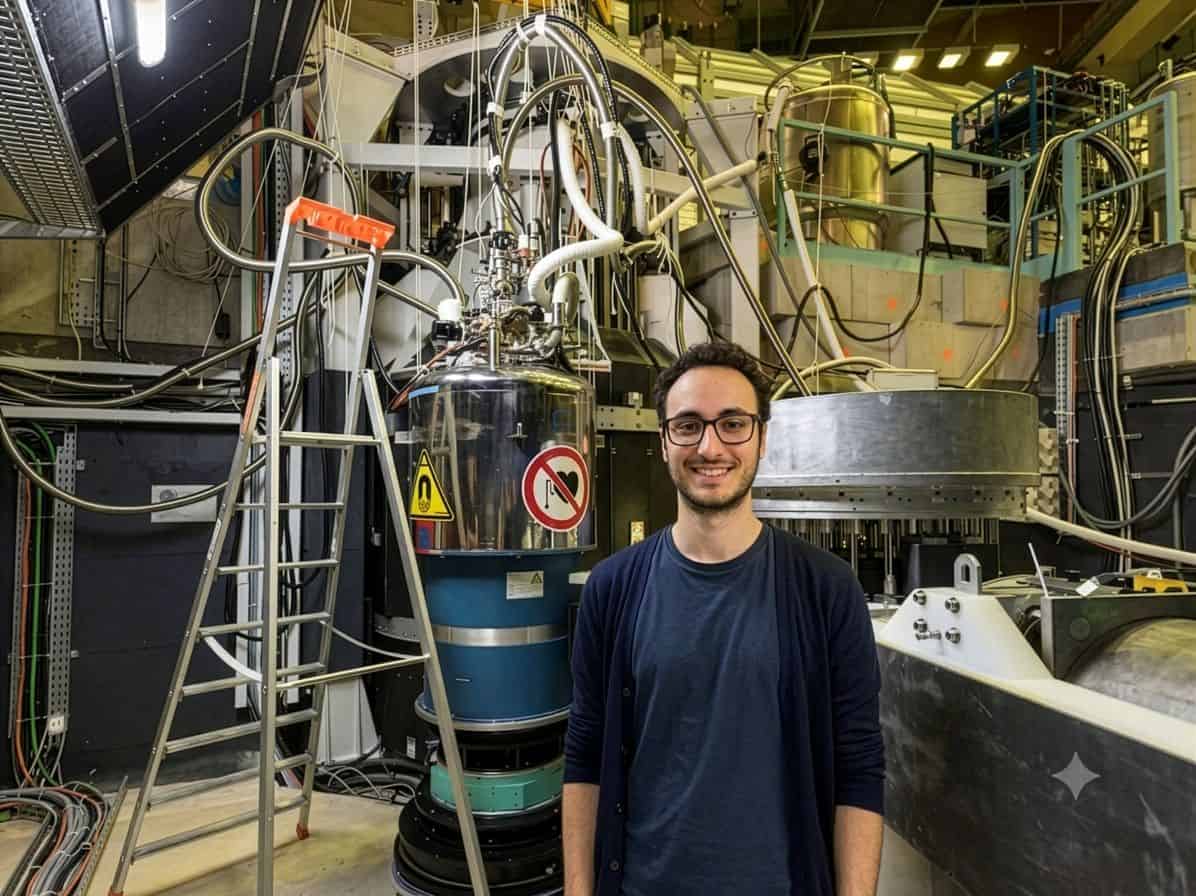
To investigate further, a team led by solid-state physicist Silke Bühler-Paschen used facilities at the Institut Laue-Langevin (ILL) in Grenoble, France to perform inelastic neutron scattering measurements on a heavy-fermion metal with the chemical formula Ce3Pd20Si6. According to team member Federico Mazza, who conducted this part of the study, the scattered neutrons would normally each transfer their energy to individual particles.
However, when the researchers analysed their data using a concept called quantum Fisher information – roughly, a measure of how sensitively a quantum state depends on a given parameter – they found that they could not explain what they were seeing in terms of particles behaving independently. Instead, the data indicated that groups of at least nine quantum-entangled entities were acting collectively. Mazza says this provides direct evidence of highly multipartite quantum entanglement in the material – and, in turn, a new way of understanding why strange metals are so strange.
The parent state of high-temperature superconductivity
The strange metal state is of great interest because physicists consider it the “parent” state of high-temperature superconductivity, though it also occurs across other materials platforms. “We had suspected that some of the intriguing properties of this state might be related to entanglement but were not able to pin it down until now,” Bühler-Paschen explains. “The results are a great success for us. They confirm that our unusual approach of using methods from quantum information science for solid-state physics studies of novel materials can reveal fundamentally new insight.”
Neutron scattering: Federico Mazza at the Institut Laue Langevin. (Courtesy: ILL Grenoble)
The experiments, which are detailed in Nature Physics, were not without challenges. For starters, the researchers needed to identify an ideal material to study the effect they were looking for and then grow it as a large, high-quality single crystal. Once they secured inelastic neutron scattering beamtime at the ILL’s powerful high-resolution triple-axis spectrometer – a difficult feat in itself – Bühler-Paschen notes that they had to obtain and analyse the data at the highest standards and support it with simulations. “Last but not least, [we had to] communicate with our peers that multipartite entanglement contains valuable information beyond correlation functions and scaling analyses,” Bühler-Paschen recalls.
Rather than being a “detail” of one particular material, Bühler-Paschen says the team’s result suggests that enhanced multipartite entanglement might be an integral part of the strange metal state. Verifying this, however, will require studies on other strange metals across materials classes, she says.
“Looking further ahead, we can envision that this aspect of strange metals finds application in quantum devices,” she tells Physics World. “It could also help us better understand high-temperature superconductors and other materials in which electrons are so strongly correlated that they lose their (quasi)particle nature.”
In the event of a nuclear holocaust, the only life remaining on Earth may be cockroaches, Keith Richards and physicists arguing about philosophical interpretations of quantum mechanics. One especially rich source of arguments is a deterministic alternative to the standard Copenhagen interpretation that dates back to the American (and later British, after Princeton University fired him for alleged communist sympathies) theoretical physicist David Bohm. According to Bohm, the position of a quantum particle is well defined everywhere and guided by a “pilot wave” which, alas, cannot be measured directly.
Despite these philosophical differences, Bohmian mechanics makes the same predictions as the Copenhagen interpretation. Except maybe it doesn’t. Occasionally, a bright theorist hypothesizes that, under very specific circumstances, one could distinguish them. Very occasionally, a bright experimentalist conducts an experiment that claims to actually do so.
This is what happened last year when Jan Klärs and colleagues at the University of Twente in the Netherlands sent photons from a laser down one of two coupled waveguides towards a potential step. When the photons reached the step, they could pass through it by quantum tunnelling. They could also pass into the other waveguide. The researchers interpreted the distance the photons travelled through the barrier before tunnelling into the other waveguide as a measurement of their speed.
The key result was that, when the wave functions on both sides of the barrier were the same, the photons still tunnelled at, ahem, light speed – matching the Copenhagen notion that tunnelling occurred equally in both directions. However, the Twente team calculated that Bohmian mechanics predicted that photons inside the step – where the guiding equation didn’t have a real-valued frequency – would be at rest and get stuck. Interferometric measurements showed that wasn’t happening.
Not so fast
Game, set and match to Copenhagen? Er, no. Proponents of Bohmian mechanics immediately disputed the team’s definition of velocity. “It’s just an operational definition,” says Aurélien Drezet of the CNRS University of Grenoble-Alps in France. “It has the units of velocity…but that doesn’t mean that Bohmian mechanics can interpret the result.”
In a “Matters Arising” article in Nature, Drezet and two colleagues at the Technion–Israel Institute of Technology in Haifa now add an experimental qualm. The fact that the Twente team was able to produce an image shows that radiation must be leaking out of the cavity, Drezet claims: “If you go to higher approximations and include cavity losses, you explain the experiment completely using Bohmian mechanics,” he says.
Klärs, who is preparing a formal response, is unconvinced. On the first point, he sees no reason “why the same speed measurement, which correctly captures the Bohmian velocity in the propagating regime, should cease to be a speed measurement in the evanescent regime”. On the second, he says his group did not ignore radiative leakage from the cavity: they measured it and found it “does not have a significant impact on the scattering physics we investigate or on the interpretation of our results”.
This could go on for some time – regardless of how many seconds it is to midnight.
ISTA physicists have confirmed a theory proposed 20 years ago that could advance quantum technology. A future quantum computer may need separate modules to behave as one machine, even when they are physically apart. That requires distributed entanglement, a quantum connection between distant components that has typically depended on active control and repeated measurements. Physicists [...]
A photon is a single particle of light, and under normal circumstances, it can't be divided. But a photon is also not a particle, in the sense that it does not have a specific location. Instead, it is an extended object.
So if a photon is only partway through the process of reflecting from a perfect mirror and you yank the mirror away, what happens? The answer, from a trio of Norwegian physicists, turns out (arxiv.org link) to be more complex than I expected.
A photon divided?
Let’s first talk briefly about dividing and combining photons. If this were a common experience in our lives, then shining a single color of light through a piece of glass or reflecting it from a surface might cause photons to divide or combine. This would lead to an amazing array of colors: Our universe would be the most fantastic and legal LSD trip you could imagine. But this doesn't generally happen, hence LSD.
There are some obvious big picture issues that stand between us and useful quantum computing. Issues like whether we can make enough high-quality hardware qubits to connect into the error-corrected logical qubits we need, and how we generate the states needed to perform universal computation on those logical qubits. But there are also many less prominent challenges that will need to be solved before we can perform calculations.
One of those challenges, which only affects some types of hardware, is calibration. For devices we manufacture, like superconducting qubits, there are always subtle variations among individual qubits. (This is not true when we use something like an atom to hold the qubit, but the lasers that control them can drift.) As a result, this hardware is put through a process called calibration, where we test different frequencies and amplitudes of the microwave pulses that control them to find the combination that produces the lowest error rates, and then save those settings for use in calculations.
However, you can't perform the typical calibration process while you're doing calculations, which means drift becomes an issue for long and complicated algorithms. Google, though, has figured out that it's possible to do calibration using the same data that's used for error correction.
Researchers investigate how quantum time flow can be stretched, blurred, or even reversed. What if the direction of time isn’t as fixed as it seems? While our everyday experience tells us that time moves relentlessly forward, the microscopic laws governing quantum systems are far less restrictive. In fact, many of the equations of quantum mechanics [...]
A quantum “mini universe” made from ultracold atoms revealed that time can emerge from entropy changes inside a system, offering experimental insight into one of physics’ deepest mysteries. A scientist at the University of Birmingham has created a “mini universe” that could help answer one of science’s most fundamental questions: What is time? In a [...]
Quantum computing news usually picks up near the end of the year, as companies try to provide evidence that they are hitting benchmarks on time. However, there have been interesting announcements as the summer starts this year, from incremental progress to attention-grabbing promises. As we did earlier this month, Ars has a rundown of some of the most significant announcements.
These include a promise of useful, error-corrected quantum computing as soon as 2028, details on an updated trapped ion processor, and a case in which claims of quantum supremacy have been cut back a bit thanks to advances in more traditional algorithms.
2028 is remarkably soon
Many people in the field expect that useful quantum computers are still about five to 10 years away. While there may be a few useful algorithms that can be run on existing error-prone hardware, almost all of the interesting problems that quantum computing can be applied to will require some form of error correction enabled by linking a small collection of hardware qubits together into what's called a logical qubit. Logical qubits include the redundant storage of information along with neighboring qubits that can be measured to determine when errors occur and how to fix them.
Bird flocks, bacterial swarms, and even crowds move according to interaction rules that appear to break one of physics’ most fundamental principles: Newton’s law of action and reaction. Birds can see much of what is happening around them, but when flying in a flock, they respond only to birds beside them or ahead of them. [...]
Oxford physicists have created an unconventional class of quantum superpositions from highly nonclassical states. Researchers at the University of Oxford have created a new class of quantum superpositions, including Schrödinger’s cat-like states, using building blocks that are themselves strongly nonclassical. The advance could support future quantum computing architectures based on more complex systems than conventional [...]
With dozens of companies, from small startups to tech giants, pursuing quantum computing, there's a steady flow of results as they try to find a path to utility. We typically focus on new technologies and major landmarks, which can obscure the fact that any big success will inevitably have been built on a lot of incremental progress.
The past few weeks have seen two companies release progress reports on how they're trying to get the technologies closer to general use. None of these represents a major breakthrough, but all are absolutely necessary for the technology to advance. The idea here is to convey the hard work required to move us closer to something useful.
Microsoft does material science
Microsoft is one of the few companies working on topological qubits, based on the distinct physics that occurs when particles are confined. Microsoft's system relies on a thin superconducting wire placed on top of a semiconductor. In superconductors, groups of two electrons form Cooper pairs. But if the wire contains an odd number of conducting electrons—meaning there's a single unpaired electron—it will end up delocalized to both ends of the wire. (Because quantum mechanics is weird.)
The big bang has causality issues, particularly the "horizon problem." I critique suggested solutions like cosmic inflation and negentropy, arguing that they require unproven concepts. The Creator, as described in the Bible, provides a coherent explanation without causality violations, in contrast with those scientific storytelling fairy tales for adults.
A new theoretical study suggests that black holes may never completely disappear, potentially offering a way to resolve the long-standing black hole information paradox. One of the biggest unsolved problems in modern physics, known as the “black hole information paradox,” may finally have a compelling solution. The proposed answer could also help explain where the [...]

 Login

 Researchers demonstrated that braiding and fusing particles known as non-Abelian anyons can perform every operation required by a quantum computer. A quantum computer becomes broadly useful only when it can perform any computation rather than a limited set of specialized tasks. Physicists have now demonstrated that unusual quantum objects called non-Abelian anyons can provide that [...]