Private fusion companies have raised almost $4.5bn in funding over the past year – a 70% increase year-on-year. That is according to a report on the state of the fusion industry, which was published yesterday by the Fusion Industry Association (FIA). The report – The Global Fusion Industry in 2026 – also finds that private fusion endeavours now employ over 16,000 people worldwide.
Magnetic confinement, in which magnetic fields are used to contain a high-temperature plasma, is the most popular fusion technique, being used by 48% of firms according to the report. Inertial confinement, which uses rapid compression, usually by lasers, to create a confined plasma for a short period of time, is employed by 21% of firms – with other techniques such as magneto-inertial making up the remainder.
While electricity generation is a main target for private fusion companies, many also see the technology being applied to space propulsion, with other markets including marine propulsion, hydrogen fuel and industrial heat.
The funding boost for this year’s figures has come from major funding rounds, with CFS raising $863m in August 2025 while Inertia Enterprises, Helion Energy and Proxima Fusion have raised about $1.5bn in total this year.
Ambitious goals
The first FIA report on the fusion industry was published in 2021, where it found that private fusion endeavours had received over $1.8bn of funding since the 1990s.
The 2021 report discovered that over two-thirds of the 35 companies surveyed thought that electricity generated from fusion would enter the grid in the 2030s, with a further 20% thinking it would more likely come in later decades.
That confidence, however, has grown – with this year’s report finding that 71% expect the first fusion plant to deliver commercial electricity by the 2030s.
Indeed, FIA chief executive Andrew Holland says he is “confident” that commercial fusion will be delivered in the 2030s.
“Alongside private investment, fusion companies still need the support of governments to address common challenges including the availability of resilient materials and the fusion fuel cycle,” he says. “The governments that update their programmes and funding priorities to meet the sector’s needs today will be the ones to capitalize on this vital emerging industry.”
The report comes as General Fusion has become the first fusion company to be publicly listed. It joined the Nasdaq exchange with $150m in fresh funding, which is expected to go towards the firm’s Lawson tokamak programme that is expected to be complete in 2028.
Telltale patterns of antineutrino emissions could reveal whether fusion reactors have been reconfigured to produce material for nuclear weapons, say physicists in the US. Although commercial fusion power plants are still some years away, members of the team at Virginia Tech and Princeton University argue that it is nevertheless useful to develop robust ways of monitoring their output now, to ensure the technology is not misused.
“Neutrinos cannot be shielded, their signatures cannot be spoofed and they can be detected from a distance, either onsite or offsite, allowing for nonintrusive monitoring of reactor operation,” says team member Patrick Huber, a physicist at Virginia Tech’s Center for Neutrino Physics. Better still, the team’s calculations show that existing antineutrino detectors such as Virginia Tech’s mobile MiniCHANDLER are sensitive enough to spot these signatures.
The DT process and nuclear proliferation
Most fusion technologies rely on the deuterium-tritium (DT) fusion process, which occurs when a deuterium nucleus (a proton bound to a neutron) and a tritium nucleus (one proton and two neutrons) fuse to produce helium-4, a free neutron and large amounts of energy. Because fissile materials are not directly involved in this reaction, the nuclear proliferation risk of fusion reactors is widely regarded as being much lower than that of fission power plants.
That said, if neutrons released in the DT process were combined with small amounts of material such as uranium-238 or thorium-232 in the “blanket” that surrounds the DT fuel in the fusion reactor, it would, in principle, be possible to use the reactor to produce plutonium-239 or uranium-233. Both materials are used in nuclear weapons, and a gigawatt-scale fusion reactor operating in this mode could produce tens of kilograms per week – enough for several first-generation bombs.
Checking for nuclear fingerprints
Crucially, though, this clandestine production would not necessarily go unnoticed. Whenever radioisotopes in the blanket absorb neutrons during the fusion process, they give off a distinctive pattern of antineutrinos. And according to the Princeton-Virginia Tech team’s simulations, the current generation of antineutrino detectors is already capable of distinguishing this pattern from the one produced during normal reactor operations.
In the current study, which appears in Phys. Rev. Applied, the researchers focused on the plutonium antineutrino signal. Using a Monte Carlo particle transport code called MCNP6, they modelled the output of a simplified toroidal fusion reactor with an outer radius of 6.2 m and an inner radius of 2.0 m. This reference reactor would operate at a typical power density, and Huber explains that it would produce a total of 1500 MW of power through plasma fusion via the DT reaction. The team also analysed two designs for the “blanket”: one featuring a molten salt (LiF-BeF2 or FLiBe) and one that relied on dual-coolant lead-lithium (DCLL).
Next, the two Princeton members of the team, Alexander Glaser and Robert James Goldston, defined and evaluated a reference fissile material production scenario. As part of this, they estimated both the plutonium production rate and the energy release that occurs as some of the covertly introduced nuclear material undergoes fission. Huber explains that this evaluation provided the first part of the antineutrino background signal.
Glaser and Goldston then analysed the neutron activation and antineutrino signatures driven by neutrons emanating from the fusion plasma. These provided the second part of the background. Finally, the team used these signatures to assess the detectability of covert fissile material production against the combined background from neutron activation and cosmogenic antineutrinos.
Based on these simulations, the team concluded that a detector like MiniCHANDLER could pick up on the production of a few kg of plutonium over 30 days – a result that Huber says should be applicable to any fusion power system that relies on DT fusion. Importantly, he points out that unlike some alternatives, antineutrino-based monitoring does not require inspectors to have access to reactor buildings and could allow plants to be monitored around the clock.
Practical advantages
The idea of using antineutrinos to detect illicit nuclear material production is not new. It dates back to the 1970s, and the two Princeton team members have previously worked on nuclear monitoring and verification for a variety of nuclear reactors and nuclear fuel-cycle facilities (including some in Iran). Given the rapid development of fusion energy systems, Hubner tells Physics World it was “a natural next step” to consider non-intrusive, antineutrino-based monitoring options for them, too. He adds that the group has been studying possible safeguards for fusion reactors since the early 2010s and was part of an IAEA consultancy on the topic in 2013.
As well as optimizing the design of detector systems, Huber says he and his colleagues are also interested in studying thorium as an alternative “fertile” material. “Even though the fission signature would be weaker compared with the uranium reference case analysed in this study, the results we have reported on already suggest that such an effort is well justified,” he says.
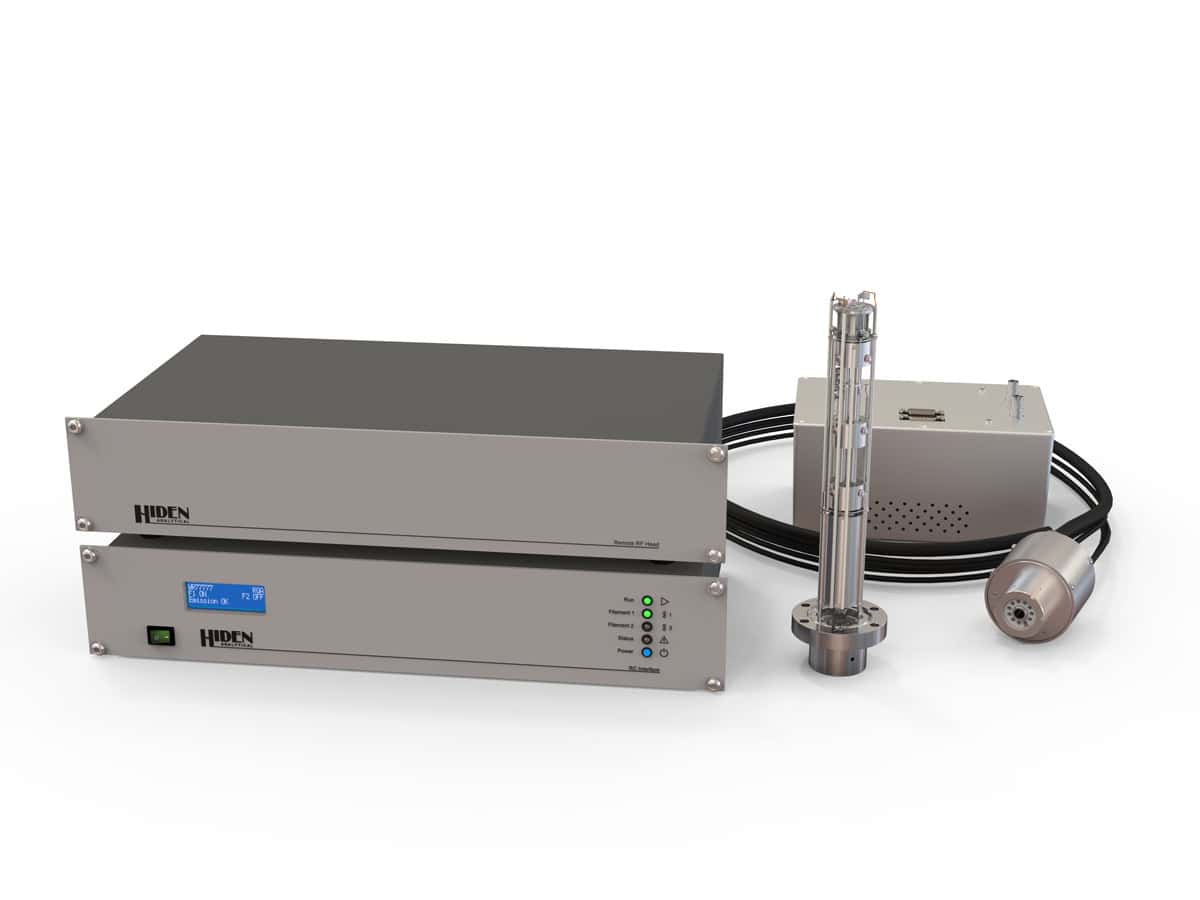
Hiden Analytical has designed a quadrupole mass analyser that can resolve the isotopes of hydrogen and helium that are involved in nuclear fusion (Credit: shutterstock/Mesh Cube)
Nuclear fusion promises to deliver an abundant, safe and sustainable source of energy, but replicating the reactions that power the Sun remains a scientific and engineering challenge. Experimental reactors, such as the ITER facility now being built in France, are designed to heat and confine a plasma containing deuterium and tritium to extreme temperatures, with the aim that the two hydrogen isotopes fuse together to form helium along with a neutron and a huge amount of energy. Crucial to success is understanding what is happening inside the reactor, allowing the plasma composition and properties to be adjusted in real time to initiate and sustain the reaction.
The extreme conditions inside the reactor preclude the use of direct probes, but a combination of external diagnostics can be used to monitor the plasma conditions and the progress of the reaction. To push the capabilities of these techniques, Chris Marcus and colleagues at Oak Ridge National Laboratory (ORNL) in the US have been developing a system that will exploit both mass spectrometry and optical spectroscopy to analyse the complex mixtures of light gases that are released from the tokamak while the reaction is taking place. “Each of these techniques provides complementary information that will help to isolate the hydrogen and helium isotopes we are interested in,” he says.
Complementary diagnostics
As part of this project, Marcus has been working with Hiden Analytical in the UK to develop a mass spectrometer that offers unique capabilities for fusion research. A key part of the brief was to achieve a higher resolving power for hydrogen and helium isotopes than can be achieved with standard instruments. “Our main objective was to detect small concentrations of helium-4, the main product from the nuclear reaction,” says Marcus. “But commercial instruments are unable to resolve helium-4 from deuterium when it is present at concentrations below about 10%.”
The spectrometer developed by the Hiden team exploits a quadrupole design, which is favoured for its rapid scanning speeds, compact footprint, and the ability to provide real-time analysis of atoms and molecules over a broad mass range. These quadrupole sensors work by ionizing the gas species, and then sending the ions through four cylindrical rods impressed with a composite DC and radio-frequency voltage. The resulting electric field separates the ions according to their mass-to-charge ratio, isolating the species of interest and preventing any other ions from reaching the sensor. The ion current produced at the output can then be related to the relative abundance of each species in the gas mixture.
However, conventional quadrupole analysers can only distinguish between atoms and molecules with a difference in mass of 1 amu. That makes it difficult to isolate helium-4 from deuterium, the species of particular interest for fusion research, since their masses differ by just 0.026 amu. “Although large-rod mass spectrometers are able to separate helium and deuterium, they are not suitable for deploying close to the outlet of a fusion reactor,” says Bob Mellor of Hiden Analytical. “We needed to develop a compact instrument that also delivers the extra resolving power.”
Improving resolution
Fortunately, quadrupole devices offer stable operation in several different zones. Standard instruments exploit a region of stability that can be accessed at lower voltages, but the Hiden team designed a spectrometer that can operate in a different stability zone that can separate helium and deuterium, albeit at significantly higher voltages. “This zone, which we call Zone H, achieves the detection limits that Oak Ridge required, but still enabled the use of a small quadrupole sensor,” says Mellor. The operational mode of the spectrometer can easily be switched between Zone H and the more usual Zone 1, which means that the instrument can also be used for conventional vacuum diagnostics.
Once a prototype instrument had demonstrated the feasibility of this solution, the next challenge for Hiden was to engineer a system that would be immune to the strong magnetic fields and high levels of radiation close to the tokamak. That posed a particular problem for the power and control electronics, since solid-state devices are prone to radiation damage and must be installed behind a radiation shield. As a result, the connecting cable between the power unit and the sensor can be up to 140 m long, which presents problems in connecting the RF voltage that is impressed on the quadrupole sensor rods.
A coaxial cable can be used, but simply connecting the RF voltage over long distances results in significant power loss in the generator. This means that the operating frequency of the sensor must be reduced to keep within the available power budget. “If you go much longer than 10 m, the frequency becomes so low that you don’t have any useful resolving power,” says Mellor.
The solution is to transmit RF power down the long coaxial cable to a set of intermediary electronics, or matching unit, that contains radiation-hard passive components and thermionic valves. “In the matching unit there is a power to-voltage convertor that generates the high-voltage RF to be impressed on the rods,” explains Mellor. “Independent testing at a fusion facility has confirmed that this solution is immune to radiation, magnetic fields, and ground vibrations.”
The resolving power of the mass spectrometer has also been evaluated at ORNL. “We have demonstrated that the quadrupole analyser can detect helium-4 at a concentration of 3% in a mixture containing 97% of deuterium,” says Marcus. “It also provides a fast response time, providing an analysis in less than a second, which is another key requirement for fusion diagnostics.
Experimental validation
In the meantime, Hiden has developed a series of commercial instruments to make the technology available to other fusion developers, as well as for other applications that require similar levels of performance. Both the DLS-2 and DLS-2X offer switchable dual-zone operation, combining high resolving power for light species along with high-performance residual gas analysis for vacuum diagnostics. They are available in two possible configurations: one with a Zone H that achieves an ultrahigh mass resolution of 0.0065 amu for species with masses of up to 10 amu, and the other providing a separation of 0.02 amu over a mass range extending to 22.5 amu. While the resolving power and sensitivity are the same for both instruments, the DLS-2X also features remote electronic control for use in harsh environments.
The HAL 101X combines dual-zone operation with radiation-hard electronics (Credit: Hiden Analytical)
Meanwhile, the HAL 101X includes all the features that were developed for the gas analyser system being developed and tested at ORNL. That includes dual-zone operation and radiation-hard electronics, as well as an additional analysis mode in Zone 1 – called Threshold Ionization Mass Spectrometry (TIMS) – that can help to distinguish between species with similar mass-to-charge ratios when they are present in sufficiently high concentrations.
The Hiden team is now working with Marcus to investigate the capabilities of the HAL 101X to distinguish between other light gases that are important for fusion research. “We have established that we can isolate neon, which can be used as a catalyst for the fusion reaction,” says Mellor. “The usual difficulty with neon is that its mass-to-charge ratio is overlapped by argon ions, but Zone H can be used to separate neon-20 from doubly charged argon.” More challenging will be to resolve tritium from hydrogen deuteride, which are separated by just 0.006 amu. “It may be possible by using the TIMS method in Zone 1, or by further increasing the applied DC and RF voltages to achieve a higher mass resolution in Zone H,” says Marcus.
While those investigations continue, Marcus is continuing to evaluate the HAL 101X on a diagnostic test stand at ORNL. “The next steps for the mass analyser will be to advance it into the production phase for the full diagnostic suite,” says Marcus. “That will yield a complete system that has been validated for operational use.”
Fusion is usually performed via two types of plasma confinement. Magnetic involves using magnetic fields to hold stable a hydrogen plasma, while inertial confinement uses rapid compression, usually by lasers, to create a confined plasma for a short period of time.
In the late 1990s, scientists working on the TCV tokamak found that a certain plasma shape — dubbed negative triangularity – can help to keep the hot plasma stable and better contained.
The award-winning work build on the progress made in the decades since to show that such a configuration can lead to enhanced plasma confinement.
Indeed, the findings highlight how negative‑triangularity plasmas are no longer a niche idea but can work reliably, at high performance, and in reactor‑relevant conditions making them promising for real fusion power.
Stefano Coda from the Swiss Federal Technology Institute of Lausanne
Awarded each year, the PPCF prize aims to highlight work of the highest quality and impact published in the journal. The award was judged on originality, scientific quality and impact as well as being based on community nominations and publication metrics.
The journal is now seeking nominations for next year’s prize, which will focus on papers in the following areas: foundational and discovery plasma physics; astrophysical, space and ionospheric plasmas; laboratory astrophysics, high energy density physics; low temperature, dusty and industrial plasmas, and inertial fusion.
Below, Coda talks to Physics World about prize, the importance of recognition and what advice he has for early-career researchers.
What does winning the 2026 PPCF Outstanding Paper Prize mean to you?
This prize is especially meaningful as it recognizes a line of research that has long been associated with our facility TCV but has taken decades to enter the mainstream. Negative triangularity is now considered a realistic option for a fusion power plant. The success of this paper confirms our group’s longstanding and continuing leadership in this effort.
How important is it that researchers receive recognition for their work?
Recognition takes several different forms. It begins with the simple act of acceptance of a publication through the peer-review process. The broader recognition that comes from downloads, citations, and ultimately the propagation of a scientific idea – the replication of an experiment, the application of a theory, a practical implementation of a conceptual notion – is the engine that keeps propelling science forward by giving it visibility and credibility. Researchers are driven primarily by curiosity and the desire to contribute new knowledge, so recognition is most meaningful when it reflects genuine scientific impact. Prizes and awards are then the cherry on the cake!
What advice would you give to early-career researchers looking to pursue a career in plasma physics?
Do not lose sight of the beauty of the science. Plasma physics is enormously complex, full of unsolved mysteries, and yet still rooted largely in classical physics. It is an exceptionally exciting time for the field with applications ranging from manufacturing to biology, and above all nuclear fusion, whose tantalising promise of abundant clean energy is driving tremendous momentum in both the public and private sectors. But whatever direction you choose, it will be rewarding if you keep your eye on the beauty of the science.
As government agencies go, the US Nuclear Regulatory Commission has left a lot to be desired, often operating less like a government watchdog and more as an industry partner. There’s fee recovery, for example, which effectively mandates the industry pay its own regulators’ salary, as well as the NRC’s habit of trusting voluntary leak reports from reactor operators, not to mention its history of hiding internal safety data to protect its reputation.
As if those deficiencies weren’t bad enough, president Donald Trump is now stripping what’s left of the commission’s mandate down to the bone. Last week, the NRC proposed a bold amendment to its long-standing nuclear safety principles: deleting a line requiring nuclear plant operators to keep radiation exposure “as low as is reasonably achievable.”
According to the Hill, the NRC justifies the move by saying it will remove “unnecessary ambiguity.” But critics say this rule is the whole reason energy companies bother keeping radiation levels as low as possible in the first place.
“Facility owners felt like… ALARA [as low as reasonably achievable] was forcing them to go well below the allowable radiation limits and spend a lot of money to do that,” director of nuclear power safety at the Union of Concerned Scientists Edwin Lyman told the Hill. “This is opening the door for sloppier practices,” Lyman continued, and “worse management.”
It gets worse. Also per the Hill, the NRC likewise announced plans to significantly weaken its approach to the National Environmental Policy Act, a foundational piece of legislation dating back to 1970. On Wednesday, the NRC said it wants to gut draft environmental reviews entirely — which, in practice, means kneecapping the public’s chance to weigh in before a reactor gets the green light.
If that weren’t enough, the commission also wants to wash its hands of its mandate to review basic environmental nuisances like noise, dust, and air pollution associated with nuclear facilities. That’s if they even do a review in the first place, as the proposed changes would exempt certain existing reactors, and even new reactors from regular inspection altogether, the Hill reports.
The proposed changes come just a few months after the US Department of Energy began stripping safety regulations that limited nuclear workers’ exposure to radiation. In effect, these changes allow energy companies to speed up productivity, unlocking higher profits at their workers’ expense.
The timing of it all is hard to overstate: with several new nuclear reactors gearing up for operations throughout the US, it’s clear the Trump administration is doing all it can to fast-track incoming nuclear facilities, consequences be damned.
Fortunately, a team of physicists at Virginia Tech has a plan for preventing that before it happens, which utilizes an existing variety of particle detection to spot and track down such illicit nuclear development before it becomes a major concern.
The team, led by Virginia Tech researcher Patrick Huber, says that antineutrino detectors could hold the key to preventing misuse of nuclear fusion, as described in new research published in Physical Review Applied.
Antineutrino Detection
Fusion reactors generate large quantities of energy by fusing hydrogen nuclei, which results in powerful neutron emissions. This makes such systems ideal for energy production, since they aren’t reliant on the same kinds of materials used in weapons production.
Still, there are potential concerns, since the neutrons produced by fusion reactors could potentially be used to convert uranium-238—the most common isotope of uranium found in nature—into plutonium-239. The latter isotope is the primary fissile component used in the production of nuclear weapons (along with another variety of uranium isotope: uranium-235).
Given the abundance of uranium-238, scientists warn of the potential for seemingly innocuous fusion reactors being used for the generation of plutonium-239. The only way to prevent this from happening is the use of monitoring systems that could detect such activity.
Fortunately, such detection systems already exist.
The Hunt for Illicit Plutonium Production
According to Huber and his team, antineutrino detectors could hold the key to overcoming this problem.
As one of the byproducts of nuclear reactions, antineutrinos—the very low-mass, chargeless neutrino variants (essentially the antimatter counterparts of neutrinos) can neither be blocked using shielding, nor can they be produced by any known non-nuclear processes.
Because of this, they offer a perfect source for detecting nuclear power generation, including those being operated covertly by any potential bad actors.
The Footprints of Antineutrinos
Given the antineutrino “footprint” produced by the fusion process, Huber and his colleagues used simulations to determine if the signal produced by uranium-238’s absorption of neutrons, which releases antineutrinos as they become split into smaller nuclei, compared with normal nuclear reactor operation. They also used their simulations to make comparisons to another known source of antineutrinos: emanations coming from space.
“We find that even a relatively small detector should be able to confirm production rates of a few kilograms of plutonium over 30 days, despite the cosmogenic background and the antineutrino emissions associated with neutron activation of reactor components,” Huber and the team write in their new paper.
Any such detector could also be operated at a considerable distance from the source reactor, which would make such detection systems practical for use at various facilities.
Fundamentally, the team believes the method their work describes could greatly promote efforts to curb the proliferation of illicit nuclear systems for use in making weapons.
Micah Hanks is the Editor-in-Chief and Co-Founder of The Debrief. A longtime reporter on science, defense, and technology with a focus on space and astronomy, he can be reached atmicah@thedebrief.org. Follow him on X @MicahHanks, and at micahhanks.com.
Researchers from the private nuclear fusion energy company Commonwealth Fusion Systems have published a series of papers that they claim confirm that their flagship ARC reactor will produce more usable energy than it consumes if built as designed.
Although the company projects it will deliver the first commercial fusion plants by the early 2030s, other researchers say there are remaining challenges to overcome, and won’t declare the ARC reactor successful until an operational version is constructed to validate the research team’s theoretical predictions.
ARC Fusion Reactor ‘Will Work’ When Built
Scientists have long dreamed of capturing the nuclear fusion reaction that fuels our Sun and using it to generate clean, renewable power. Private fusion firms like CFS have received nearly $10 billion in funding over the last decade alone.
The first laboratory “net-energy” controlled fusion reaction, which fusion scientists call “ignition,” didn’t occur until 2022, when physicists at the US National Ignition Facility in Livermore, California, successfully produced more energy than was used to generate the reaction. Although brief, that moment has fueled speculation that practical fusion energy generation may be right around the corner.
Now, the Commonwealth team, which includes 58 researchers from the company and partner institutes, has published scientific papers outlining the physics of their ARC reactor, including new models that they say account for the “expected behavior” of the superhot plasma at the heart of the design.
Brandon Sorbom, the company’s chief science officer, said that the published works “confirm that when we build the ARC fusion power plant, it will work”.
Company Claims ARC Will Produce 400 Megawatts of Net Electricity
After nearly a decade of research, CFS, founded in 2018, is currently preparing its prototype for a 2027 demonstration it calls ‘SPARC.’ The company said they expect that trial run, which will demonstrate their technology’s ability to generate more energy than it needs to heat the plasma, will help them fine-tune ARC’s final design.
A peek inside the Commonwealth Fusion Systems magnet production facility. Image Credit: CFS.
According to the Commonwealth-led team, ARC will generate more energy than is required to operate the entire facility, including plasma heating, resulting in a true net-positive power-generation facility. This includes producing approximately 400 megawatts of net electricity, which the team noted is enough to power 280,000 average US homes. For comparison, recent census data indicates that Boston, Massachusetts, near the company’s headquarters in Cambridge, has around 271,000 U.S. homes.
Like SPARC, the ARC reactor uses high-temperature superconducting magnets to compress the plasma, which remains suspended by the magnetic fields, preventing it from damaging the chamber walls and terminating any potential fusion reaction. Under this extreme pressure, the nuclei of heavy hydrogen trapped inside the chamber fuse to form helium, the same reaction that takes place inside the Sun.
This fusion reaction results in the release of energy, primarily high-speed neutrons. At its hottest, the donut-shaped ring of plasma reaches seven times the temperature of the Sun.
Critics Applaud Publication While Highlighting Unproven Concepts and Systems
Tony Roulstone, a nuclear engineer at the University of Cambridge, UK, conceded that the CFS team and its collaborating authors are “some of the best in the fusion business” and noted the company’s ARC reactor concept is the result of “good work over many years.” However, Roulstone also warned of the pressure on researchers in privately funded companies to “claim things before the evidence is fully in place.”
David Hammer, a nuclear engineer at Cornell University in Ithaca, New York, said it is a good sign that the team is publishing at a high volume, but also warned that published papers will not guarantee that the built device will work as intended.
Their modeling “has to be proven correct by a fusion reactor that works as designed”, he adds. If the firm can get SPARC operating successfully next year, “it will be an important step forward”, he says.
Hamner also noted that several of the design’s subsystems require further development before it can be declared complete. This includes addressing how plasma will behave in the real world when it becomes unstable versus its modeled behavior, proving out the process for extracting usable energy from the generated heat, and demonstrating that the reactor is robust enough to operate for long periods.
The scientists also noted the challenges in sourcing tritium, the isotopic fuel the reactor requires to operate. Although CFS has outlined its tritium generation process, Hamner noted that the series of published papers neither details the process nor demonstrates its viability.
“There are candidate blanket materials and blanket designs, but there are many engineering person-years needed” to bring a functional ARC-style plant to fruition, he explained.
“We certainly have to build more on top of that foundation laid out in these papers,” a company spokesperson said, adding that they will “be able to produce tritium for operations and for future power plants.”
Editor’s Note: This article was updated to correct a previous version that described neutrinos, rather than fast-neutrons, in the context of the reporting, and to clarify that the first achievement of a “net-energy” controlled fusion reaction (ignition) occurred in 2022.
Christopher Plain is a Science Fiction and Fantasy novelist and Head Science Writer at The Debrief. Follow and connect with him on X, learn about his books at plainfiction.com, or email him directly at christopher@thedebrief.org.

 Login