❌

Normal view

Citizen Scientists Helped Reveal How Fatherhood Evolved in Spider Relatives

20 July 2026 at 12:25

Paternal care is uncommon among several wild animal species, even among arthropods—the invertebrates that include insects, arachnids, and crustaceans.

Now, in a recent study in the Zoological Journal of the Linnean Society, harvestmen—also known as daddy longlegs—account for more than half of all independently evolved cases of paternal care currently documented among arthropods.

The news insights were made possible by a recent citizen science effort that significantly increased the available data about these paternal behaviors in arthropods, all within days.

Built for Fatherhood

Harvestmen are one of the most diverse arachnid groups, with more than 6,900 described species. Despite making up just 0.6% of arthropod diversity, they show more independent origins of paternal care or egg guarding than any other arthropod lineage. This concentration of paternal care makes harvestmen a key group for studying the evolution of this behavior.

Led by Glauco Machado at the University of São Paulo, the research team combined almost thirty years of fieldwork with a review of iNaturalist, a public website for sharing nature sightings. From 1936 to 2025, published studies had found parental guarding in only 80 harvestman species. However, the iNaturalist search added 85 new records: 78 showing parental care and seven showing no care, more than doubling the number of harvestman species with available behavioral data.

Machado was surprised by how quickly the platform produced results. “It’s a tremendous source of information that can improve the velocity with which we accumulate biological information,” he said. “I would never be able to do this by visiting museums around the world. It would be very expensive, very time-consuming, but here we conducted the search in only one week.”

The Evolution of Fatherhood

With the expanded dataset, the researchers were able to map parental behaviors onto a newly constructed evolutionary tree encompassing 165 species across nine families. This represented the first reconstruction of how both maternal and paternal care evolved within the superfamily Gonyleptoidea. The findings challenge the assumption that caregiving behaviors follow a single evolutionary pathway.

The analysis found that maternal care evolved only from ancestors that did not provide care, a pattern also seen in insects. Paternal care, however, appeared in two ways: once from ancestors with no care, and once from species where females already guarded eggs. This difference suggests that separate evolutionary pressures shaped the development of parental care in harvestmen.

Machado suggests that sexual selection may have driven the evolution of paternal care from maternal care. In this scenario, which the researchers describe as enhanced fecundity, females favor males that are already tending eggs.

“It’s very rare in nature, paternal care, and this behavior evolved many times independently,” Machado said. “In many species where males care for the offspring alone, the caring activity is a sexually selected behavior, which means that females prefer males that are caring for the eggs.”

The evolutionary tree also showed that parental care does not always persist across lineages. Several groups appear to have lost caregiving behavior over evolutionary time. Some harvestmen now use easier methods, like hiding their eggs or burying them under debris, to protect them without having to stay and guard them.

Limitations of Citizen Science

Machado emphasizes that experts remain essential to this process. It takes specialized knowledge to correctly identify species, tell the sex of the guarding animal, and tell real parental care apart from similar behaviors such as mate-guarding. “I think taxonomists’ role in modern science is more important than ever,” he said. “We cannot preserve a species that doesn’t have a name. And names are provided by taxonomists.”

Additionally, animals that are actively guarding eggs are more likely to be photographed than those not showing any behavior, which could make active parental care seem more common than it really is.

What Comes Next

Machado views this approach as a model for future research. More than half of the new records came from individuals without formal training in arachnology, and he anticipates similar results as researchers apply iNaturalist to other animal groups for which parental care remains poorly documented.

“I think it’s a very broad contribution for people that are working with insects, frogs, and all kinds of groups, animal groups, in which we have both maternal care and paternal care,” he said. The next mystery solved through citizen science may not involve arachnids at all.

Austin Burgess is a writer and researcher with a background in sales, marketing, and data analytics. He holds an MBA, a Bachelor of Science in Business Administration, and a data analytics certification. His work focuses on breaking scientific developments, with an emphasis on emerging biology, cognitive neuroscience, and archaeological discoveries.
Volunteer Measures Record Louisiana Rainfall 

15 July 2026 at 13:32

“I didn’t sign up to try to measure a new record or anything”, said Matt Carnicle, a volunteer for the NASA-sponsored Community Collaborative Rain, Hail, and Snow Network, or CoCoRaHS, project. Carnicle measured a whopping 29.06 inches of rainfall on June 18th, 2026, breaking an all-time 24-hour record for the state of Louisiana of 22.00 inches. “I’m just a regular guy who likes to track the weather, and I report what I get in my gauge whether it’s zero, two hundredths, or whatever is in there when I read it.” 

CoCoRaHS  (pronounced KO-ko-rozz) is a network of volunteer weather observers of all ages working together to measure and map rain, hail, and snow by measuring precipitation in their backyards. Together, these thousands of daily precipitation reports – openly available on the project website – are used by scientists and citizens for a wide variety of purposes, to include improving weather forecasting, informing water and land management, driving atmospheric models, and triggering flash flood and severe weather warnings. 

Matt joined through a storm-spotter class where he learned how CoCoRaHS is part of a NASA hail research project focused on Gulf States in the Southeast United States. CoCoRaHS reports (and photos) of hail are used for researching the “melt rate” between when the satellite estimates the stone sizes in the clouds and what volunteers measure on the ground. Matt took it a step further and purchased a standardized rain gauge in order to participate with CoCoRaHS by measuring rainfall.

Matt’s June 18, 2026 rain measurement shatters Louisiana’s 1962 state record of 22.00 inches of rain in 24-hours (Hawaii holds the national record with 49.69 inches in 24-hours). Even more remarkably, the 29.06 inches he measured fell in less than 12 hours! According to Louisiana State Climatologist Jay Grymes, who validated Matt’s measurement along with National Weather Service representatives, an event of this magnitude in this area is expected to happen less than once in a thousand years. A National Oceanic and Atmospheric Administration (NOAA) committee will convene in the coming months to verify and document the new record.

You can join Matt and other CoCoRaHS volunteers and submit official rainfall reports to the National Weather Service. They’re also on the lookout for hail in the southeast, where CoCoRaHS and NASA are doing research on how hail melts as it moves from the clouds to the ground. The only requirement for participation is that volunteers use the correct manual gauge, which is precise to the nearest 1/100th of an inch and is approved by the National Weather Service (measurements from automated rain gauges are not accepted). Sign up here, and you might measure the next record precipitation event: https://science.nasa.gov/citizen-science/community-collaborative-rain-hail-and-snow-network/

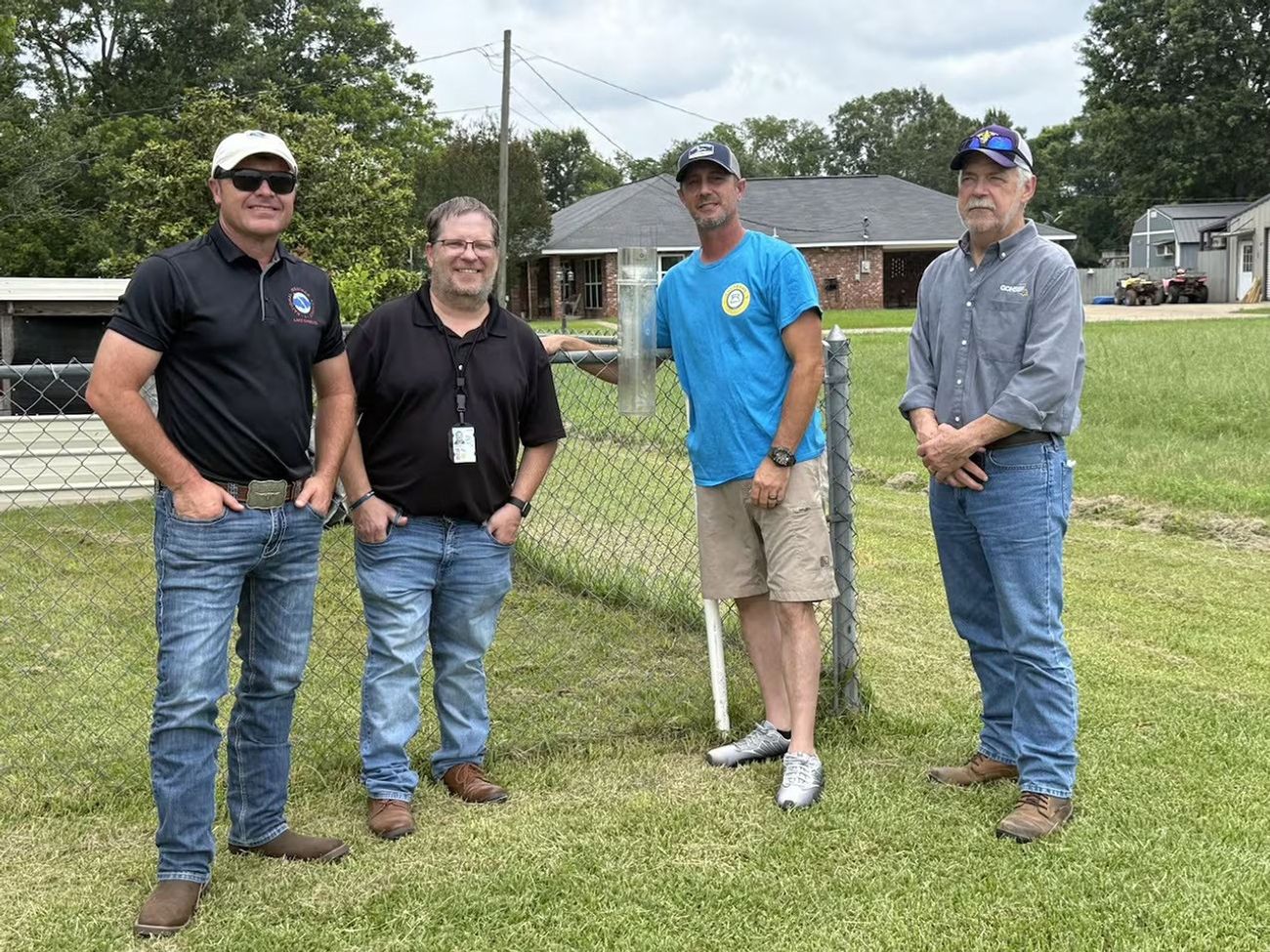
Four men standing outdoors on a grassy lawn in front of a chain-link fence. The man in the bright blue t-shirt is touching a clear, cylindrical tube—likely a rain gauge—mounted near the fence. The other three men are dressed in casual work attire, including jeans, polo shirts, and a button-down shirt. Residential houses and trees are visible in the background.
From left to right: National Weather Service Lake Charles Warning Coordination Meteorologist Doug Cramer, National Weather Service Lake Charles meteorologist Jonathan Brazzell, rain gauge owner/observer Matt Carnicle, and Louisiana State Climatologist Jay Grymes. Carnicle’s arm is around the CoCoRaHS rain gauge. https://www.cocorahs.org/
Image credit: Matt Carnicle.

Learn More and Get Involved

White CoCoRaHS logo on dark blue background

Community Collaborative Rain, Hail, and Snow Network (CoCoRaHS)

Join a national community of precipitation reporters providing critical data to improve scientific understanding and forecasts.

Search for Hidden Cosmic Companions in Sun’s Backyard

17 June 2026 at 20:40

Some stars have planets. Others are orbited by brown dwarfs, balls of gas too massive to be planets, but too low-mass to be stars. Astronomers love these brown dwarf-star pairs because being paired with a star helps reveal a brown dwarf’s age. Ages of astronomical objects are often hard to measure, but essential for understanding how they form. 

Now, you can join NASA’s new Backyard Worlds: Binaries project and help astronomers discover these rare and interesting pairs. As a volunteer, you’ll inspect images from NASA’s Wide-field Infrared Survey Explorer (WISE) space telescope. Brown dwarfs may appear as small dots moving across a field of otherwise static stars. 

“We need your help to gain critical insights into these enigmatic cosmic objects,” said project lead Aaron Meisner.

Brown dwarfs are common but mysterious because they are so faint. There’s one for every three or four stars in our corner of the Milky Way galaxy. They are important laboratories for understanding giant planets like Jupiter.

Join the Backyard Worlds: Binaries project today and help astronomers understand where and when brown dwarfs form! You can also try one of our other brown dwarf-related projects: Backyard Worlds: Cool Neighbors! Anyone with a laptop or cell phone can participate. Participation does not require citizenship in any particular country.

Share

Details

Last Updated
Jun 18, 2026
Editor
NASA Science Editorial Team

The post Search for Hidden Cosmic Companions in Sun’s Backyard appeared first on NASA Science.

Search for Hidden Cosmic Companions in Sun’s Backyard

17 June 2026 at 20:40

Some stars have planets. Others are orbited by brown dwarfs, balls of gas too massive to be planets, but too low-mass to be stars. Astronomers love these brown dwarf-star pairs because being paired with a star helps reveal a brown dwarf’s age. Ages of astronomical objects are often hard to measure, but essential for understanding how they form. 

Now, you can join NASA’s new Backyard Worlds: Binaries project and help astronomers discover these rare and interesting pairs. As a volunteer, you’ll inspect images from NASA’s Wide-field Infrared Survey Explorer (WISE) space telescope. Brown dwarfs may appear as small dots moving across a field of otherwise static stars. 

“We need your help to gain critical insights into these enigmatic cosmic objects,” said project lead Aaron Meisner.

Brown dwarfs are common but mysterious because they are so faint. There’s one for every three or four stars in our corner of the Milky Way galaxy. They are important laboratories for understanding giant planets like Jupiter.

Join the Backyard Worlds: Binaries project today and help astronomers understand where and when brown dwarfs form! You can also try one of our other brown dwarf-related projects: Backyard Worlds: Cool Neighbors! Anyone with a laptop or cell phone can participate. Participation does not require citizenship in any particular country.

Share

Details

Last Updated
Jun 18, 2026
Editor
NASA Science Editorial Team

Backyard Worlds: Binaries

16 June 2026 at 14:00

Backyard Worlds: Binaries

Most stars in our Milky Way galaxy exist in groups, including pairs or “binaries,” in which two stars orbit each other. Some binaries are stars paired with brown dwarfs, balls of gas more massive than planets without enough mass to sustain nuclear fusion. Finding brown dwarfs in pairs helps scientists deduce their ages and origin stories! Backyard Worlds: Binaries invites you to search images made by NASA’s Wide-field Infrared Survey Explorer (WISE) space telescope to find these vital brown dwarfs in binary systems. Your discoveries will teach us about brown dwarf formation and identify objects that resemble giant planets like Jupiter.

Go to Project Website about Backyard Worlds: Binaries

project task

Examining Images

division

Astrophysics

where

Online

launched

2026

Illustration showing a large, dark red gas‑giant–like world in orbit with a white dwarf shown as a bright white dot. The bright band of the Milky Way stretching across the star‑filled background.
Artist’s rendition of a brown dwarf orbiting a white dwarf (the bright white circle) with the Milky Way in the background.
 NOIRLab/NSF/AURA/P. Marenfeld

What you’ll do

  • Learn how to recognize binary systems and brown dwarfs in images made by NASA’s WISE space telescope. 
  • Click buttons to indicate whether or not they contain binaries. If you see a binary, click a button to indicate whether or not it includes a brown dwarf. Review as many image sets as you like, 
  • If you want to, you can discuss what you have found with other volunteers and scientists in the Talk forum.

Requirements

  • Time: 5-15 minutes to complete the tutorial
  • Equipment: Web-connected device.
  • Knowledge: None. In project tutorial provides all instruction needed.

Get started!

  1. Visit the project website.  
  2. Complete the in-project tutorial to learn how to spot binary systems in short animations of WISE data.
  3. Start identifying candidate binary systems containing a brown dwarf, using a Field Guide reference as necessary.

Learn More

The Backyard Worlds: Binaries Research page gives an overview of the research being pursued and its value towards expanding what we know about how star and planetary systems form. Links throughout this page take the reader to additional sources of information. The Frequently Asked Questions (FAQs) page has additional information relevant to the work of the project. 

You might also like to try Backyard Worlds: Cool Neighbors and Backyard Worlds: Planet 9!

A vibrant logo set against a starry space background. In the center is a colorful, striped planet featuring shades of blue, green, and pink, surrounded by a glowing orange-red ring. A white silhouette of a telescope on a tripod points up toward the planet. Arcing above the planet is the text "BACKYARD WORLDS:" in white, blue-outlined letters. Arcing below is the word "BINARIES" in large, stylized red bubble letters on a white, cloud-like background.

Looping side‑by‑side animation showing two sky images: the original WISE sky view on the left and processed images on the right. Pixelated points labeled as M‑dwarf stars shift position between frames, illustrating how subtracting sequential images reveals moving objects.
Animated images from the Backyard Worlds: Binaries project showing two distinct “dipoles” – single objects moving through space – that appear to be moving together. These dipoles “flip” together, indicating that they are moving in the same direction.
Backyard Worlds: Binaries WISE data.

Get to know the people of Backyard Worlds: Binaries!

Mei Lin

Intern, undergraduate student
Harvard University

Portrait photo of a man wearing a blue shirt and blazer

Aaron Meisner

Staff Astronomer
NSF’s NOIRLab and Harvard University

Zachary Hartman

NASA Postdoctoral Fellow
NASA Ames Research Center

Austin Rothermich

Graduate Student
City University of New York and American Museum of Natural History

Portrait photo of a woman with long curly hair

Jackie Faherty

Astrophysicist / Scientist at American Museum of Natural History

Adam Schneider

United States Naval Observatory

Portrait photo of a smiling man

J. Davy Kirkpatrick

Astronomer, Infrared Processing and Analysis Center (IPAC) at the California Institute of Technology 

Portrait photo of a bearded young man

Dan Caseldon

Citizen scientist and Research Associate, American Museum of Natural History

Arjun Dey

Astronomer, NSF’s NOIRLab 

John Gizis

Observational Astronomer, University of Delaware

The post Backyard Worlds: Binaries appeared first on NASA Science.

Citizen Science Born in the Pandemic: The Hubble Image Similarity Project

2 July 2025 at 17:00

images from the Hubble Image Similarity Project

Motivated by a desire to support community members financially during the coronavirus pandemic, researchers employed 30 local citizen scientists in the Hubble Image Similarity Project. This project quantified the similarities between astronomical images, providing a way to test the results of image-search algorithms.

Seeking Similarities

Eagle Nebula

The Eagle Nebula, pictured here in an image from Kitt Peak National Observatory, is a star-forming region in the Milky Way. [T.A.Rector (NRAO/AUI/NSF and NOIRLab/NSF/AURA) and B.A.Wolpa (NOIRLab/NSF/AURA); CC BY 4.0]

Say you have an image of a star-forming region, featuring eye-catching gas clouds, dense and dusty knots, and newborn stars. How would you go about finding other images that resemble yours?

You might start your search with an astronomical image database, using filters for object type or instrument to sift through thousands and thousands of options. But even filtering out everything but star-forming regions might yield vastly different results, given the widely varying shapes, colors, and sizes of these regions.

Or maybe you’ll feed your image into a neural network that has been trained to spot similar images. The results may seem promising, but how can you tell whether the algorithm has found the images that are the most similar? Would another algorithm do better?

The Hubble Image Similarity Project

Astronomical image collections rarely contain information about similarities between images in their metadata, and while neural networks appear to excel at gathering similar images, the results of these models are generally unverified. The Hubble Image Similarity Project, led by Richard White (Space Telescope Science Institute) and Josh Peek (Space Telescope Science Institute and Johns Hopkins University), addressed these issues with a team of citizen scientists who generated similarity information for astronomical images, providing a quantitative means to test the results of neural networks.

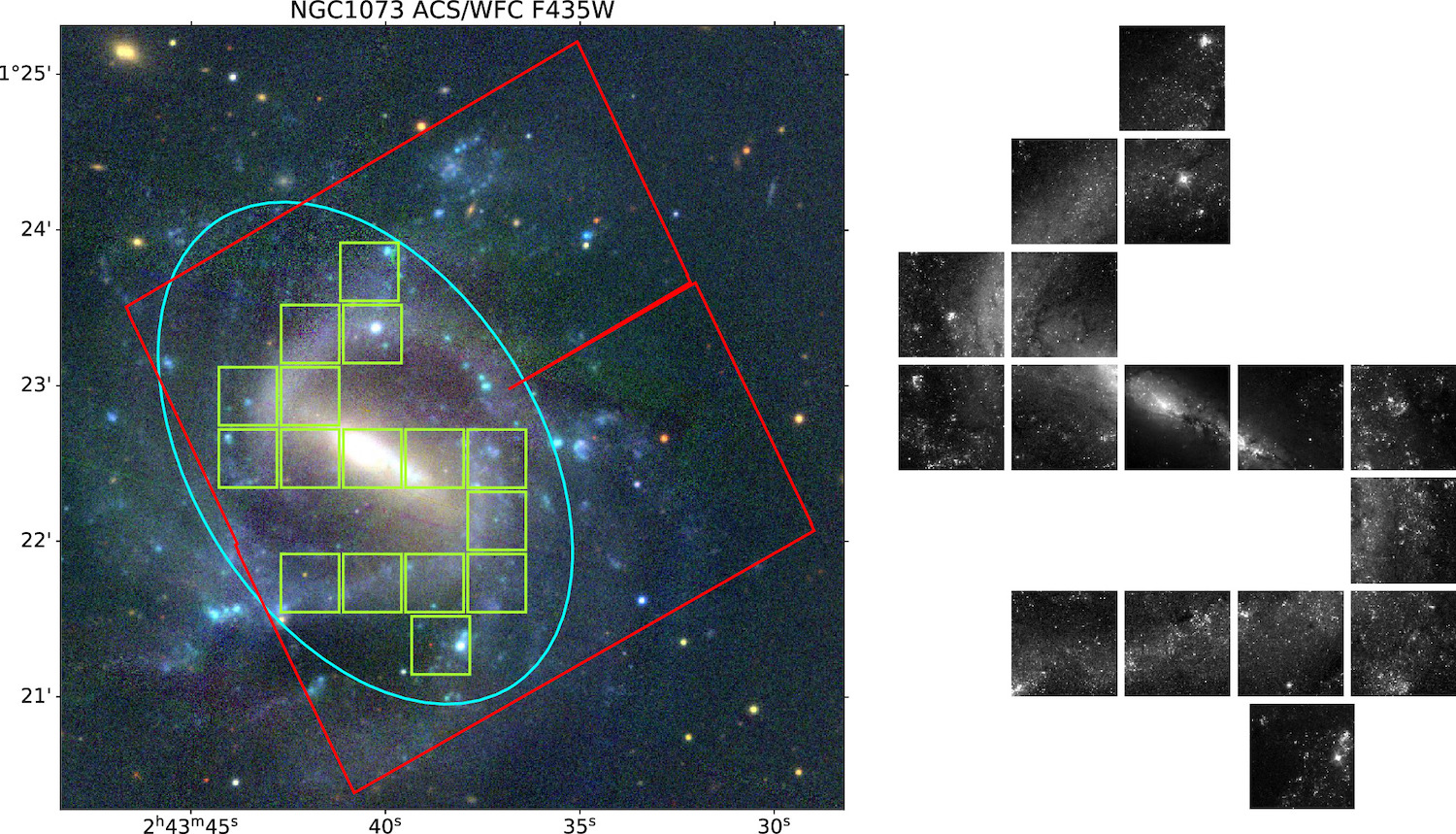
example of how the Hubble Image Similarity Project selects image cutouts for study

An example of individual test images (green squares) extracted from a Hubble Legacy Archive image (red square). Low-contrast areas have been excluded, leaving the galaxy’s spiral arms for analysis. Click to enlarge. [White & Peek 2025]

White and Peek began by amassing a sample of images from the Hubble Legacy Archive. This sample included many different object types, such as galaxies, planetary nebulae, star-forming regions, and star clusters. After trimming and binning the images, converting them to 8-bit grayscale, filtering out low-contrast images, and eliminating satellite trails, image artifacts, and repeated observations of the same patch of sky, 2,098 images of 666 objects remained.

Citizen Scientists, Assemble

White and Peek recruited 30 members of the community within walking distance of the Space Telescope Science Institute to identify similar astronomical images, and the reviewers were paid for their work. In the three phases of the project, reviewers considered test images one at a time and 1) selected all similar images from a set of 15 comparison images, 2) selected the most similar image from a narrowed-down set of 6 comparison images, and finally 3) selected the most similar image from a set of 3 comparison images.

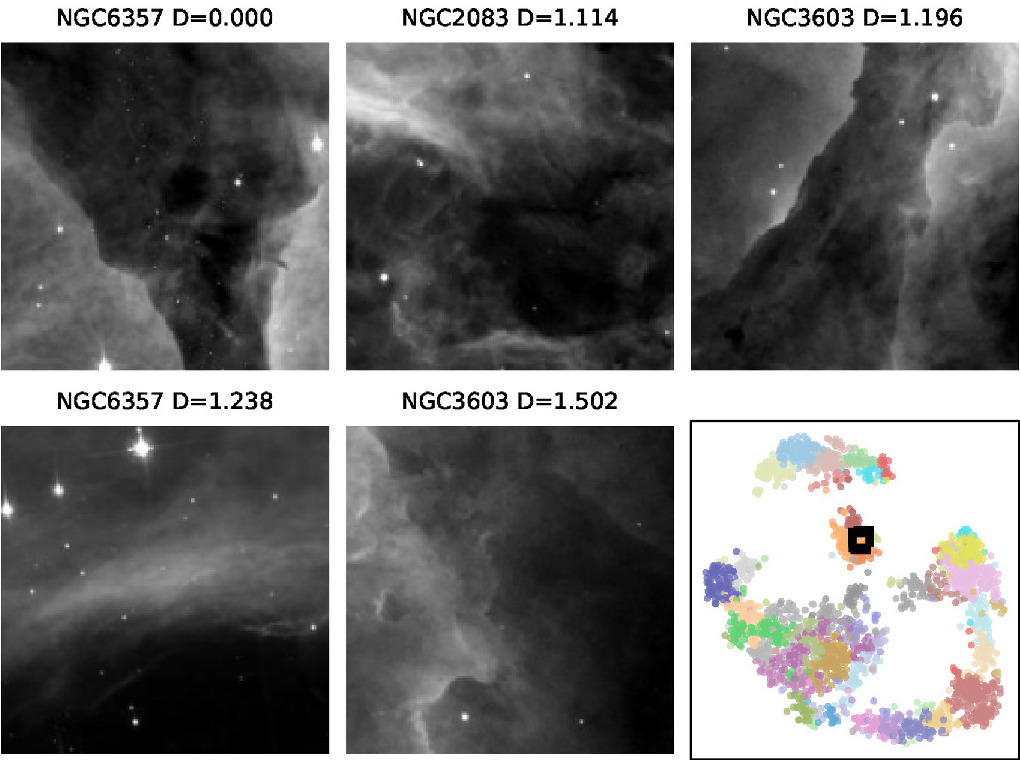
similar images from the Hubble Image Similarity Project and a visualization of the data

Examples of similar images according to the image similarity matrix. In the lower-right corner is a visualization of the similarity data. The semicircle of data points in the bottom half of this visualization represents galaxies, while star clusters occupy the small arc near the top and nebulae sit in the island in the center of the plot. Click to enlarge. [Adapted from White & Peek 2025]

The citizen science team ultimately compared 5.4 million pairs of images, and White and Peek used these comparisons to produce an image similarity matrix. The matrix describes the metaphorical “distance” between the images, with the most similar images being the smallest distance apart.

Similar images resemble one another in terms of structure, texture, and other factors that White and Peek say are “difficult even to describe in words” — for example, the diffuse glow of a galaxy interrupted by a bright star with diffraction spikes, or a nebula speckled with stars and dense dusty clumps. The similarity data from this study are available online and can be used to test the performance of image-search algorithms. In future work, the authors plan to carry out a similar project using images of the Martian landscape.

Citation

“The Hubble Image Similarity Project,” Richard L. White and J. E. G. Peek 2025 AJ 169 306. doi:10.3847/1538-3881/adcb43

The post Citizen Science Born in the Pandemic: The Hubble Image Similarity Project appeared first on AAS Nova.

❌