Certaines des caractéristiques du Système solaire, à commencer par l'origine de la Lune, s'expliquent par des événements et des scénarios violents. Que faut-il en penser dans le cas de certaines des lunes de Neptune depuis que le télescope James-Webb a pris le relais de Hubble ?
A Jupiter-mass object orbiting a brown dwarf could become the first confirmed moon beyond our Solar System. A massive object appears to be circling a brown dwarf in the CD-35 2722 system, but calling it a moon is not straightforward. Unlike moons in our Solar System, it does not orbit a planet. Instead, it travels [...]
New research led by the University of California, Berkeley reveals that beyond Neanderthals and Denisovans, humans interbred with two mysterious ‘ghost’ lineages: one in Africa more than 50,000 years ago, another in Eurasia over 1.7 million years ago.
As new observations reveal the outer edges of IC 1101 for the first time, scientists have confirmed it is the largest known galaxy. The galaxy’s statistics are staggering, containing an estimated 3.4 trillion solar masses of stars and spanning roughly 1.7 million light-years, eclipsing every other known galaxy.
IC 1101 belongs to a class known as brightest cluster galaxies (BCGs), which form as massive galaxies spend billions of years absorbing smaller neighboring galaxies.
The new images are the deepest ever taken of the galaxy, and were revealed in a recent paper accepted for publication in a future issue of Astronomy and Astrophysics, but available now in preprint form on the arXiv server.
Blending into the Cosmic Background
Despite their enormous sizes, BCGs are notoriously difficult for astronomers to study. Because they are built through the gradual merger of many smaller galaxies, their outer regions are extremely faint, containing diffuse stellar halos and tidal tails left behind by ancient collisions. These wispy edges often blend into the free-floating gas and stars that fill galaxy clusters, making it difficult to determine precisely where the galaxy ends and the surrounding cluster begins.
Carlos Marrero-de la Rosa of the Astrophysical Institute of the Canary Islands led the new study, focusing on IC 1101, the dominant galaxy at the center of the Abell 2029 galaxy cluster.
The research relied on ultra-deep images captured with the Wide Field Camera at the Isaac Newton Telescope, allowing astronomers to resolve the galaxy’s diffuse outer boundary in unprecedented detail.
Applying a star subtraction algorithm to the composite image of the IC 1101 galaxy provides a new level of detail and contrast. Credit: Carlos Marrero-de la Rosa et al. (2026)
Battling Light Pollution
With the number of satellites orbiting Earth increasing dramatically in recent years, astronomers have raised concerns about artificial light pollution. In this case, however, the researchers faced interference from a far more distant source: foreground stars within our own galaxy.
These stars, located between Earth and IC 1101, scatter light across telescope images, washing out the extremely faint structures astronomers are attempting to detect. Since the galaxy’s outermost regions are already difficult to distinguish, any additional scattered light significantly reduces image contrast.
To overcome this problem, the researchers constructed a detailed model of how the telescope spreads light using dozens of calibration stars. The model allowed the team to accurately subtract scattered light from more than 250 foreground stars, bringing IC 1101’s faintest structures into much sharper contrast and enabling a more precise measurement of its true extent.
The Largest Known Galaxy
IC 1101’s immense scale becomes even more striking when compared with our own Milky Way. The astronomers measured IC 1101 at roughly 520 kiloparsecs across—about 17 times wider than the Milky Way’s approximately 30-kiloparsec diameter. Even after accounting for all forms of mass, including elusive dark matter, scientists estimate that the Milky Way contains only about 1 to 1.5 trillion solar masses of material, compared with the 3.4 trillion solar masses contained in the stars of IC 1101 alone.
Researchers also found evidence that the giant galaxy continues to grow. They identified eight structures beyond its main edge, two of which align with previously observed X-ray disturbances that suggest ongoing accretion. According to the team, IC 1101 likely collided with another galaxy group between two and three billion years ago, producing a merger that continues to shape the galaxy today.
Ryan Whalen covers science and technology for The Debrief. He holds an MA in History and a Master of Library and Information Science with a certificate in Data Science. He can be contacted at ryan@thedebrief.org.
A £3 million investment could help secure a leading UK role in NASA’s future search for life on nearby planets. An Earth-like planet orbiting a nearby star would appear as little more than a dim point beside a light source 10 billion times brighter. British astronomers are preparing technology that could help NASA separate that [...]
A giant planet spent more than a decade concealed inside one of astronomy’s most closely watched star systems. Astronomers have discovered a planet named Beta Pictoris d orbiting a young star just 63 light-years from Earth. The gas giant is about 100 times fainter than Beta Pictoris b, the first planet found in the system, [...]
Una señal diminuta, oculta al lado de uno de los astros más deslumbrantes del cielo, puede resolver un enigma de décadas y abrir otra vía para estudiar cómo viven y mueren las estrellas gigantes.
WARSAW, Poland — The Spanish government announced it will allocate between 1.6 billion and 2 billion euros ($1.8 to $2.3 billion) to develop a national military satellite communications constellation that […]
Airbus Defence and Space won prime contractor status for the development of the next SpainSat NG bird, a secure communications satellite for mission-critical government and defence uses.
Thales Alenia Space separately detailed its selection as a co-contractor for the SpainSat NG-III project, explaining 10 Spanish companies are also on board to provide various technologies.
The contracts were awarded by Spanish satellite operator Hisdesat and the latest bird rounds out the SpainSat NG geosynchronous Earth orbit constellation, which already provides coverage of two-thirds of the planet.
Each company explained current SpainSat NG satellites play a key role in European security and defence, with the European Union, NATO and numerous allied governments employing them.
Airbus Defence and Space’s prime position means it is responsible for design, integration and testing of the satellite. It suggested the work would be an evolution of previous SpainSat NG birds, a fact Thales Alenia Space elaborated on by explaining the latest item would add “several improvements” to the existing model.
The project is to be handled at Airbus Defence and Space facilities in Spain. It explained the satellite would use X-band receivers and transmitters which “provide the capability of 16 traditional antennas” and can rejig coverage “up to 1,000-times per second while detecting and mitigating electronic interference”.
Thales Alenia Space is to provide UHF and military Ka-band payloads.
Airbus Defence and Space stated the SpainSat NG-III would be resilient to “high-altitude nuclear events and electromagnetic pulses”.
Development is expected to take 48-months and the satellite is scheduled to launch in Q3 2030 before coming online early in 2031.
Thales Alenia Space asserted the development keeps Hisdesat at the forefront of domestic and allied defence capabilities, along with delivering a boost for the Spanish space industry.
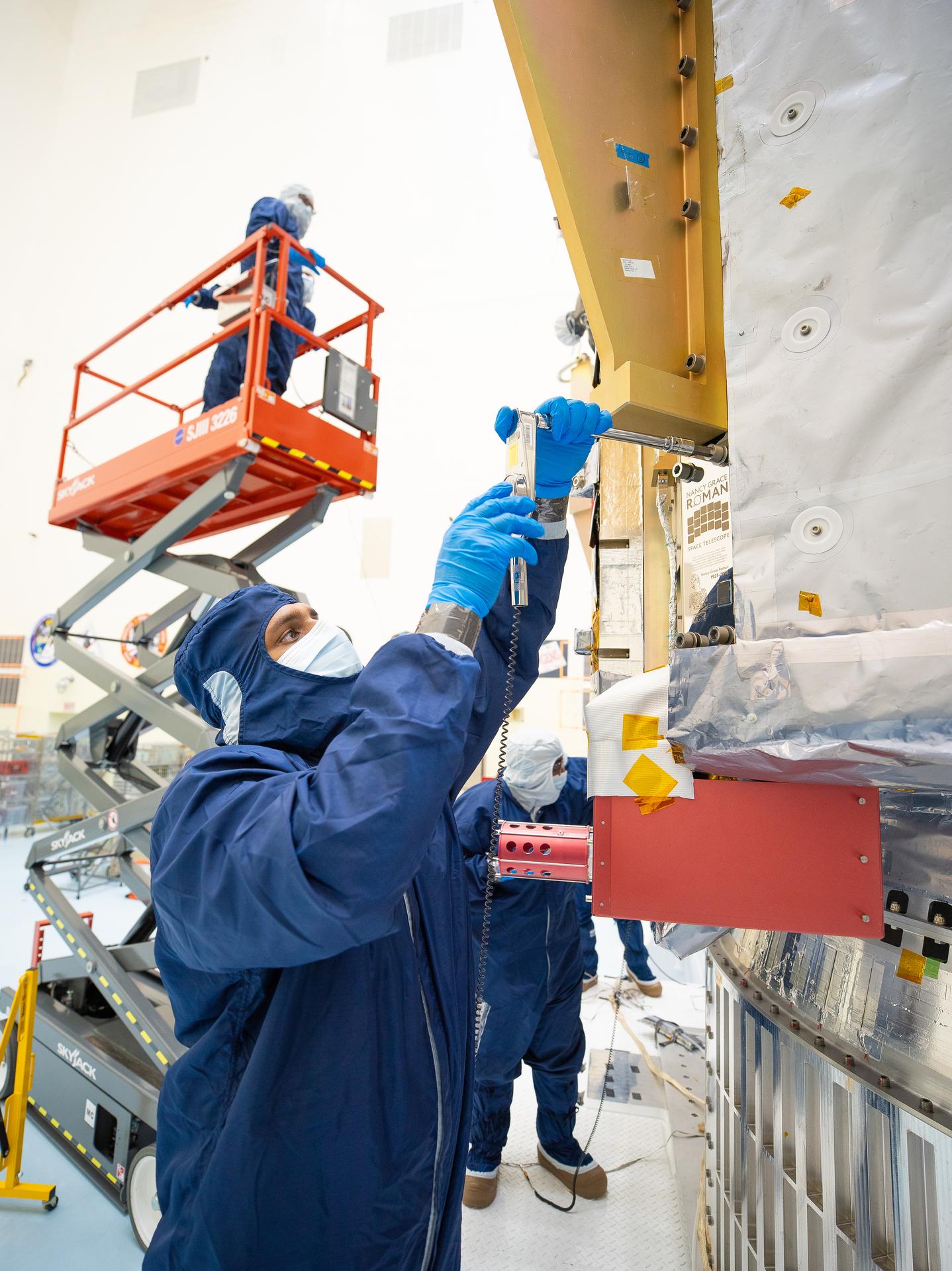
On July 27, technicians at NASA’s Kennedy Space Center in Florida installed a memory card containing 1,350,144 names as part of a commemorative plaque on the Nancy Grace Roman Space Telescope. The names were submitted by people globally, including astronauts from Artemis II and Artemis III. The memory card will travel with the Roman observatory to the Sun-Earth Lagrange point 2, or L2, about one million miles from Earth, where the Sun’s and Earth’s gravity balance out.
Roman is named after Dr. Nancy Grace Roman, NASA’s first chief astronomer and one of the architects of the agency’s modern science program. Roman championed space-based observatories that could study the universe from above Earth’s hazy atmosphere while making their data broadly available to the scientific community.
NASA and SpaceX are targeting launch for no earlier than 7:26 a.m. EDT Sunday, Aug. 30 aboard a SpaceX Falcon Heavy from Launch Complex 39A at Kennedy.
Companies must ensure people know when they are interacting with artificially generated images, audio and text designed to look real
From apparently conspiring to steal elections to abusing staff or performing embarrassing dance moves, the last few years have seen plenty of fake content made about politicians intended to malign its targets and mislead the public.
Now EU rules aim to stem the flood of this deceptive content: starting from Sunday, artificially generated images, audio and text designed to look authentic must be labelled.
A fossilized skull fragment of Homo sp. unearthed in central Spain offers paleoanthropologists a fresh window into the story of ancient humans who lived in Europe hundreds of thousands of years ago.
Apple’s outgoing CEO Tim Cook expressed solidarity with communities hit by the ongoing wildfires across southern Europe and confirmed the company will donate to on-the-ground relief efforts.
In a post on X late Wednesday, Cook wrote: “Our hearts go out to everyone affected by the devastating wildfires in southern Europe. Thank you to the first responders, and to everyone still in harm’s way, please stay safe. Apple will be donating to relief efforts on the ground.”
Our hearts go out to everyone affected by the devastating wildfires in southern Europe. Thank you to the first responders, and to everyone still in harm's way, please stay safe. Apple will be donating to relief efforts on the ground.
The statement comes amid one of Europe’s most severe wildfire seasons in recent years. Intense heatwaves, dry vegetation, and strong winds have fueled major blazes in France, Spain, Greece, and other areas, burning hundreds of thousands of hectares, forcing hundreds of thousands of people to evacuate, and claiming lives including multiple firefighters.
In southwestern France, a large fire near Bordeaux has scorched around 42,000 hectares of pine forest, prompting the evacuation of roughly 220,000 residents and vacationers at its peak (with many later allowed to return as conditions eased somewhat). France has already recorded its highest wildfire-burned area in years, surpassing previous full-year totals with summer still underway.
Spain has faced its largest wildfire on record west of Madrid (in the Ávila region and surroundings), with total burned area across the country exceeding 200,000 hectares according to European data. Evacuations affected tens of thousands, and new outbreaks continued in provinces including Zamora, León, and Castellón.
In Greece, fires on Crete and elsewhere killed three firefighters and forced tourists and residents to flee, some by boat. Broader European Forest Fire Information System figures show far-above-average burned area and number of fires so far in 2026, driven by successive heatwaves that have left vegetation highly flammable.
Cook’s message follows Apple’s established pattern of offering financial support after major disasters without publicly disclosing exact donation amounts. Similar statements and aid have been issued after other recent crises.
MacDailyNews Note: As temperatures remain elevated and fire weather risks persist (particularly shifting eastward toward Italy and Greece in coming weeks) emergency crews continue battling the blazes while residents and responders face ongoing threats. Apple’s planned contribution aims to assist those recovery and relief operations already underway.
Please help support MacDailyNews — and enjoy subscriber-only articles, comments, chat, and more — by subscribing to our Substack: macdailynews.substack.com. Thank you!
Vodafone Group completed the purchase of CK Hutchison’s 49% stake in UK joint venture VodafoneThree, less than 14 months after the formation of the operator from their respective mobile operations in the country.
In a brief statement on the completion of the £4.3 billion deal, Vodafone asserted having full ownership would allow it to “move at an even faster pace and capture the significant benefits” of its £11 billion network investment plan and “targeted synergies”.
Within the latter it aims to save £700 million across annual costs and capital expenditure by its FY30 (which runs to end-March 2030).
Vodafone CEO Margherita Della Valle added she expects the upgraded infrastructure to “deliver better connectivity for our customers up and down the country, help drive the UK’s digital economy, and deliver long-term value for our shareholders.”
Announcing completion of the sale, CK Hutchison deputy chair Canning Fok said the company was “proud of the role it has played in the history of [the] UK telecommunications industry”, pointing to the pioneering launch of 3G in the market under its 3 brand in 2003 and creation of the JV with Vodafone in 2025.
“This transaction realises our investment in VodafoneThree and returns value to the Group and our shareholders, while further strengthening our balance sheet and creating additional opportunities for the future,” Fok added.
The European Union (EU) outlined plans to provide €10 billion in funding to build seven AI gigafactories in addition to unlocking €20 billion in private investment for the project.
In its latest push to accelerate Europe’s technological sovereignty and close the gap to the US and China, the EU stated the initiative would expand AI compute capacity and give start-ups, SMEs, industry and others access to infrastructure for training, inference and tuning of advanced frontier AI models.
It explained the gigafactories would be used to combine advanced AI processors, software and cloud technology stacks, high-speed connectivity and energy-efficient data centres.
They will add to Europe’s network of 19 AI gigafactories with the aim of ensuring the continent can develop advanced AI on its own infrastructure in line with EU rules, following standards on data protection, security and ethics.
The first step is a call for tenders, with the EU inviting consortiums or special purpose vehicles bringing companies, public entities, investors and other partners to apply.
It explained the facilities can be established in a single member state, either on one site or across several locations.
They may also include cross-border developments in several member states through distributed AI computing facilities.
Applications will undergo a competitive valuation to select successful projects. The application process closes on 12 November, with successful bidders to be announced in 2027.
Facilities will need to become operational within 18-months of contracts being signed.
Henna Virkkunen, EVP for Tech Sovereignty, Security and Democracy at the European Commission, said “access to the raw scale of computing power within AI gigafactories is a strategic necessity for Europe as AI development accelerates”.
Summer is normally thought of as the time for pacy potboilers and brain-soothing page-turners – airport reads that wind up sandy and sunscreen-stained. Not so for Friedrich Merz’s holiday reading list.
Germany’s embattled chancellor, who has faced one rough patch after another since taking office 14 months ago, seems to be seeking spiritual guidance this year while putting his feet up.

 Login