❌

Normal view

The quest to keep organs alive outside the body

24 July 2026 at 18:03

This week, I covered a fascinating effort to preserve organs outside the body. There’s a huge shortage of donor organs, and one of the main reasons is time—they survive only a matter of hours outside the body, even when they’re kept on ice.

Doctors dream of organ banks—stores of human organs that can be preserved for days, weeks, months, or even longer. That would allow them to run tests on organs, find the best matches for them, and transport the organs to those recipients.

In new research, one team has been able to supercool the kidneys of pigs—animals whose organs are of a similar size to human ones—and preserve them for days. The kidneys survived being stored at −4 °C (25 °F) and eventually reimplanted back into pigs. And that’s just the latest development in a field that is positively buzzing.

It has proved super difficult to freeze organs. Once ice forms in them, they’re done. The ice crystals create all kinds of damage and render the organs unusable. That hasn’t stopped many researchers from trying.

Some have focused on cryopreservation—rapid extreme cooling that essentially leaves cells in a glasslike state. This process is now routine for eggs, sperm, and embryos, which are cooled to −196 °C in less than two seconds and can be used even after decades in storage.

No one has managed to cryopreserve and thaw human organs for transplantation. But plenty of human bodies and brains have been stored at ultra-low temperatures in the hope that they might one day be rewarmed and brought back to life. (You can read more about why some people opt for cryonics here.)

In March, I wrote about Stephen L. Coles, a gerontologist who had opted to cryopreserve his own brain. After the scientist died in 2014, his body was taken to Alcor, a cryonics facility in Arizona. A team at the facility removed Coles’s head, perfused his brain with cryoprotective chemicals (which work like antifreeze), removed the brain from the skull, and cooled it to −146 °C.

When Coles’s friend Greg Fahy, a cryobiologist, studied pieces of his brain years later, he found that the brain cells, which had shrunk, “bounced back” once they were rewarmed. But that doesn’t mean the cells are alive, or that it might one day be possible to reanimate the brain. As Matthew Powell Palm of Texas A&M told me at the time: “There are so many ways those neurons could be toast.”

Powell Palm is working on other ways to preserve organs. It was he, along with his colleagues, who managed to store supercooled pig kidneys and successfully transplant them, in a study described as “a landmark achievement.” Those organs did better than kidneys stored on ice, he says.

His approach didn’t require cryoprotectants. But other teams are exploring potential chemical cocktails that might allow them to store organs at lower temperatures, potentially for longer periods of time. (More on this in The Checkup soon!)

Another way to prolong the lifespan of an organ is to use a machine that perfuses it with nutrients, mimicking what happens inside the body. Machine perfusion devices have become more commonly used over the last decade or so and are typically used to maintain livers and kidneys for up to about 24 hours.

Researchers are now adapting this protocol for a growing list of organs, even eyeballs—a recent feat that might enable whole-eye transplants. In March, I went to visit scientists in Valencia who had developed a perfusion system for uteruses. They had used their device—which they nicknamed “Mother”—to keep a human uterus alive for a day.

It’s an exciting time for organ preservation. Keep an eye out for more coverage from MIT Technology Review in the coming weeks.

This article first appeared in The Checkup, MIT Technology Review’s weekly biotech newsletter. To receive it in your inbox every Thursday, and read articles like this first, sign up here.

Supercooled kidneys have been transplanted into pigs in a “landmark achievement”

23 July 2026 at 17:58

When it comes to organ donation, time is everything. As soon as an organ has been carefully removed from a donor’s body, it starts to deteriorate. Surgeons have a matter of hours to get it into a recipient. Leave it too long and the organ will become unusable.

In most cases, organs will be kept on ice during that time, at around 4 °C (39 °F). They cannot be frozen—in previous attempts, ice has formed, causing all kinds of damage.

Matthew Powell Palm at Texas A&M University and his colleagues have an alternative solution—a device that allows organs to be cooled to -4 °C (25 °F) without forming any ice.

Now, in new research with pig organs, his team has shown that kidneys, at least, can be supercooled and preserved in the device for days. Once rewarmed, the organs have been successfully transplanted into animals, and they seem to do better than organs kept on ice.

The work represents “a landmark achievement,” says Kevin Myer, president and CEO of LifeGift, an organ procurement organization based in Texas, who was not involved in the research.

Cooling organs

Powell Palm hopes this approach could ultimately help ease the organ shortage crisis. Today, there are more than 104,000 people waiting for a kidney transplant in the US alone. It is estimated that 17 people die every day in the US while waiting for a transplant. That’s partly due to a lack of donated kidneys, but it’s also because many of those that are available never make it to a recipient. In some years, around one in three donated kidneys end up being discarded, often because they end up too degraded to use by the time they reach a recipient. Kidneys can be stored on ice for around 24 hours or placed in devices that aim to mimic the conditions of the body, also for up to around 24 hours. That’s not always long enough to find a suitable recipient and transport the organ, says Myer.

Scientists around the world have been working on ways to store organs for longer by cooling them to even chillier temperatures. Cooling an organ slows its metabolism—the colder you go, the greater the effect, and the longer you can store it.

We’ve long been able to successfully cryopreserve eggs, sperm, and embryos, but it’s much harder to freeze large organs. Teams have been exploring various temperatures and cryoprotectants (chemicals that essentially work like antifreeze), but so far no one has been able to freeze human organs for transplantation.  

As a thermodynamicist, Powell Palm explored another approach. By keeping an organ submerged at a constant pressure, it should be possible to prevent the formation of ice at temperatures a little below 0 °C, without the need for cryoprotectants (which might have side effects and would need to be approved before being used in human transplants). 

To test this theory, Powell Palm and his colleagues have created a device that does just that. The device itself is essentially a hermetically sealed chamber with a transparent lid. At its base is a device that monitors the organ’s temperature and checks for the formation of ice. Organs are submerged in a solution that is already commonly used to preserve them for transplant. “I always describe this as low-tech high science,” says Powell Palm. “A lot of work has gone into understanding the … kinetics at play in this system, but ultimately … it’s quite simple.”

Supercooled kidneys

To test their device, Powell Palm and his colleagues first removed single kidneys from pigs. The organs were flushed with the same commonly used solution to remove the blood, just as transplant organs are. The team then kept some kidneys on ice for either two hours or 24 hours, to mimic standard conditions used in human transplantation. They also put some of the removed kidneys in their device for 24, 48, or 72 hours.

The stored kidneys were then each transplanted back into the original donor pigs. Each pig’s second kidney was removed in the same procedure, leaving each animal with only the kidney that had been stored, and reimplanted.

Once the 24-hour supercooled kidneys were transplanted, they immediately began producing urine—a key indication that they were working. The team members also measured other markers of kidney function and found that the organs appeared to be working normally within about 10 days of being transplanted.

Kidney supercooled for 72 hours reperfuses homogeneously upon transplantation, and proceeds to recover baseline renal function over the 30 day survival period studied.
A kidney that was supercooled for 72 hours recovers once it is transplanted back into a pig.
COURTESY RONALD SELLERS, POWELL-PALM LAB, TEXAS A&M UNIVERSITY

That’s slower than kidneys stored on ice for two hours but much quicker than kidneys kept on ice for 24 hours, says Powell Palm.

The organs that were kept supercooled for 48 and 72 hours performed similarly, he says. “Even at three days—triple the clinical standard—we’re getting recovery that is faster than … [what has been] the gold standard for the last three decades,” he says. “So we’re really, really pumped about this.”

“It is impressive,” says Heidi Yeh, a transplant surgeon at Mass General Brigham for Children, who also researches organ preservation technologies. “Often kidneys that have been stored for 48 hours [in other studies] take a week or two before they start working again.”

Organs that grow

The supercooled organs seem to work well in the long term, too. Over a 30-day period, the pigs grew by around 30%—and the kidneys grew with them, almost doubling in size to compensate for both the pigs’ growth and the lack of a second kidney. The team monitored one of the pigs for 200 days before removing and analyzing its kidney. Even at that point the organ looked healthy, says Powell Palm. He and his colleagues presented the findings at the American Transplant Congress in Boston last month.

Earlier this year, researchers in Canada showed they could also cool pig kidneys to below-zero temperatures and transplant them into pigs. The team’s protocol included the use of a cryoprotectant, and organs were stored for up to 48 hours before being transplanted into pigs. Those organs survived for a week.

In supercooling organs for 72 hours and showing that they do well for 30 days or more, Powell Palm and his colleagues have broken new ground. “It’s the first time this has ever been reported in history,” he says.

Those extra hours could make all the difference, says Myer of LifeGift. The advance could give doctors more time to evaluate the kidneys, match them to the most suitable donors, and physically get the organs to their intended recipients in time. It could enable international donations and open up cheaper transport options, he adds. “Right now, with kidney transplantation the assumed limit is 18 to 24 hours,” he says. “If we can get up to 72 hours … that would change everything.”

Powell Palm and his colleagues think they may even be able to go beyond 72 hours. In preliminary studies, organs that had been stored for up to 120 hours appeared healthy, although those organs have not yet been transplanted.

And because the process doesn’t require any cryoprotective chemicals, the team members are hoping for an accelerated approval from the US Food and Drug Administration, which would allow them to test the device in human transplantations.

The storage device is simple and compact, so Powell Palm thinks it will be easy to transport. It hasn’t been tested for air travel yet, but it has been used to take supercooled kidneys across the US in the back of a Kia Sorento, he says: “From a stability perspective, we view this as an even higher bar.”

Powell Palm and his colleague Sebastian Giwa plan to launch a company dedicated to developing the technology, along with other protocols that “stop biological time,” in the coming months, he says.

The power line that could reshape New York’s grid is hitting snags

23 July 2026 at 10:00

On July 3, as a heat wave swept the region, New York State’s grid imported 52 gigawatt-hours of electricity from Canada—enough to meet about 9% of its total electricity demand that day.

Some of that power shuttled in on a 339-mile power line stretching from Quebec to Queens called the Champlain Hudson Power Express (CHPE). It opened in May and is officially the longest underground transmission line in North America.

An underground power line might not sound all that exciting, but this could be a big deal for the state’s grid planning, and for emissions. It could provide up to 20% of New York City’s electricity demand, largely with abundant hydropower from Quebec.

One wrinkle: The line has been down for most of this month, and some experts are concerned about how drought will affect the power supply feeding it. Let’s look at how the CHPE transmission line could help shape the future of our grid, and what barriers it needs to overcome to make a difference.

Planning for the CHPE (which is charmingly pronounced “chippy”) started 15 years ago, with the permitting process formally beginning in March 2010. The vision was to build infrastructure to better connect Quebec and southern New York.

Map showing the route of CHPE project over land and underwater,  south from Canada to NYC.
The Champlain Hudson Power Express stretches 339 miles from Quebec to Queens. It is officially the longest underground transmission line in North America.

Over 99% of Quebec’s electricity comes from renewable sources; most demand is met with hydropower, though the province’s wind capacity is growing quickly. New York has some hydropower of its own, as well as nuclear and wind, but the state still relies on fossil fuels for most of its energy generation.

Transmission Developers, a company owned by the alternative asset management firm Blackstone, and Hydro-Québec, the province’s manager of generation and transmission, partnered to build CHPE. Construction began in late 2022 and wrapped up earlier this year. The total cost for the privately funded project turned out to be  $6 billion.

The construction of this line was a feat. It’s made up of a bundle of two high-voltage direct-current power cables, each measuring roughly five inches across. Developers buried the bundle underground or underwater across the length of New York State. Much of the line was laid at the bottom of the Hudson River, requiring special boats that shot water jets deep into the sediment to create trenches for the cable.

Connecting grids together can help accelerate the transition away from fossil fuels. The ability to move electricity to where it’s needed could also help limit the amount of new capacity we need to build. Research has shown that interconnection can help cut emissions and lower system costs.

But CHPE is off to a slow start and has seen two outages so far. The first, on July 1, was reportedly caused by a trip at a converter on the Canadian side of the border. The second outage began on July 4, and the power line is still down as of the morning of July 22.

Some experts say this isn’t unusual for a new infrastructure project. Other power lines have seen similar startup challenges, and the equipment hasn’t really been fully tested until it’s in operation, Normand Mousseau, a physics professor at Université de Montréal, told the Gazette.

Officials traced the issue to a damaged section of cable on the US side of the border, and the company that manufactured the line sent experts to investigate the cause, according to reporting from RTO Insider, a trade publication. 

The damaged portion of the cable has been removed and replaced, says Lynn St-Laurent, a spokesperson for Hydro-Québec. “It is currently estimated that the remaining work, including necessary post-repair testing, will be completed by the weekend.”

Similar woes have afflicted the New England Clean Energy Connect line, which opened in January, stretching 145 miles from Quebec to Maine. That project has also seen outages, and very little additional energy has flowed into the Northeast.

The good news for New York is that the grid wasn’t relying on CHPE yet. “Our planning studies did not assume CHPE would be available this summer, and that was one reason the grid performed reliably during the heat wave earlier this month,” Kevin Lanahan, a spokesperson for the New York Independent System Operator, the state’s grid management company, said in a statement. “A core principle of reliability planning is not relying on any single project.” 

The idea is that eventually, states and regions will be able to rely—at least in part—on these projects, so there is pressure to get them working smoothly: Building massive transmission lines is a major long-term investment. In future years, as the equipment gets stress-tested and utilities begin to feel more confident in the projects’ reliability, they could play a bigger role on the grid.

One thing to keep an eye on moving forward is the condition of Quebec’s hydropower fleet: The region has seen intense drought for the past three years, eating into the water reserves used to generate electricity. That could mean there won’t always be abundant hydropower to ship across the border—even if the transmission lines are able to carry it. 

This article is from The Spark, MIT Technology Review’s weekly climate newsletter. To receive it in your inbox every Wednesday, sign up here. 

Shape-shifting mirrors on NASA’s new space telescope could unveil Jupiters like our own

22 July 2026 at 10:00

When NASA’s Nancy Grace Roman Space Telescope launches, as early as the end of next month, it will attempt one of astronomy’s most precise disappearing acts to date. The telescope will carry the first space-bound “active” coronagraph, an instrument that effectively erases most of the light from a star during photography.

It will allow astronomers to take the first pictures of planets orbiting other stars that are similar to those in our solar system. Ultimately, it could pave the way for a future mission that could snap the first photos of Earth-like worlds.

“I hope it’s remembered for it being that critical stepping stone for … finding Earth 2.0,” says Brandon Creager, the instrument’s lead mechanical engineer at NASA’s Jet Propulsion Laboratory (JPL).

Named after Nancy Grace Roman, NASA’s first chief of astronomy, this new telescope will carry a roughly 300-megapixel wide-field camera that will enable it to capture images about 100 times larger than the Hubble Space Telescope’s widest exposures at a similar resolution.

These capabilities will help astronomers unpack the mysterious identities of dark matter and dark energy—and to detect around 100,000 new exoplanets, planets outside our solar system, whose presence can be inferred from the way they distort the starlight of more distant stars. Javier Viaña, a research scientist at Harvard who has had two projects selected for Roman’s highly competitive first year of observing, compares the leap to moving from “interviewing a handful of people” to “conducting a global census.”

Another camera will use the coronagraph, blocking out a star’s light as it observes one stellar system at a time. The instrument will allow astronomers an unprecedented look at the space around stars, enabling them to see smaller, dimmer, and more close-in exoplanets. “It’s giving us the ability to see planets that we haven’t been able to physically see before,” says Creager.

The anatomy of a vanishing trick

Coronagraphs in space aren’t new. But earlier incarnations, such as those currently aboard Hubble and the James Webb Space Telescope, use a stationary system to block a star’s blinding light. The approach does help, but it’s a bit like putting your thumb over a flashlight while searching a dark room for a firefly. Though the bulb vanishes, stray glare can still escape and overwhelm the light of the insect. Inside a telescope, that glare can come from light leaking around the edges of machinery or from minuscule imperfections in mirrors and coatings that can scatter starlight into speckles. All this can hide, or even impersonate, a planet.

Roman’s coronagraph, however, will attempt something completely unseen in space telescopes until this year: Before each observation, it will measure that leftover light and try to suppress it, a technique known as active wavefront control.

The telescope is able to do this because it contains two deformable mirrors. Each has a 48-by-48 checkerboard of actuators (tiny pistons) beneath a thin, deformable sheet of glass. Applying a small amount of voltage makes the actuators contract and tug their patches of mirror slightly backward, like thousands of microscopic fingers delicately sculpting a surface.

The effect is very subtle: Each patch of mirror can deform by up to 0.5 micrometers, or about one-fourth the size of an E. coli bacterium, and in increments as small as approximately 10 picometers. That’s about a tenth the diameter of a hydrogen atom, says Ilya Poberezhskiy, the instrument’s project systems engineer at JPL.

The actuators allow the mirrors to create an “active wavefront,” where each component is moved to the perfect position to cancel out incoming waves of unwanted light—a bit like a pair of noise-canceling headphones, but for light instead of sound. The “canceled-out” light creates a “doughnut-shaped region around the star where we suppress starlight and where we’re hoping to see exoplanets,” says Poberezhskiy.

Compared with current space-based coronagraphs, the system is expected to improve sensitivity to exoplanets against the glare of their host stars by a factor of up to 1,000, revealing planets that would have been far too faint to detect before.

Like Hubble and JWST, Roman also uses masks, patterned plates placed in the path of the light that are designed to block the photons that run into them. One tool in Roman’s mask arsenal is “silicon grass,” a thicket of microscopic spikes on some masks that can be used in certain configurations to absorb photons so they don’t bounce around the telescope and accidentally reach a detector.

Light entering the forest bounces deeper and deeper between the blades and gets trapped instead of reflecting back toward the camera. “Once the light gets into there, it never gets out,” Poberezhskiy says. The mirrors and masks form a succession of gates and hedges to guide as much of the preserved planetary light as possible toward the final detector.

Alien Jupiters

This elaborate setup could open a new chapter in the direct imaging of exoplanets. Nearly all exoplanets photographed so far are oversize youngsters that are nothing like the residents of our solar system: several times the mass of Jupiter, still glowing with the heat left over from their birth, and orbiting tens or hundreds of times farther from their star than the Earth is from the sun. This is because they are relatively easy to see. Their size, warmth, and distance from their parent star makes them shine brightly in infrared light, far away from the worst of the stellar glare.

Roman, however, could directly image a true Jupiter analogue—a planet similar to Jupiter in mass and circling a sunlike star a few times farther out than Earth is from our sun. Unlike the hot Jupiters we can see now, this one would be a much more mature gas giant like ours, primarily reflecting its parent star’s light after billions of years of cooling instead of heavily emitting its own.

Astronomers have been able to infer the existence of such planets from the gravitational wobble they impart to the star. Roman instead will collect starlight reflected from the planet itself. “We’re not looking at the star. We’re not looking at the effect of the planet on the star,” says Meredith MacGregor, a professor of astronomy at Johns Hopkins who has also secured an observing program. “We are actually looking at the planet, and that is super powerful.”

Once this instrument becomes available, it will become the scientists’ turn to do their jobs. “I’m honestly a little terrified about how we’re all going to deal with it, because I think it’s just so much data,” MacGregor says. “I think people will legitimately still be working on Roman data for decades.”

But don’t expect to see a 4K photo of an alien Jupiter in the coming months. Roman will not be able to resolve such a planet into a solid globe—at best, it will likely resemble a smattering of pixels. Still, that will be enough, MacGregor says, as Roman can then use the coronagraph to get information on the various wavelengths of light from the planet, which can tell astronomers about its atmospheric chemistry.

“You’re taking something that’s a point of light and turning it into an actual world,” she says, “because if you know that about its atmosphere, now you know something about the surface of the planet and the possibility of life being on that planet, right? So that’s a big step.”

During its first observations, scientists and engineers will see whether they can hold a star at the very center of the coronagraph’s masks, shape the mirrors, “dig” the dark doughnut (as Poberezhskiy describes it), and then maintain everything as the spacecraft moves through space and actively changes temperature.

The results will inform NASA’s proposed Habitable Worlds Observatory, the daydream of many an exoplanet astronomer, which will in theory be able to separate the light of an Earthlike planet from that of a sunlike star, over 10 billion times brighter.

Creager, who has worked on the instrument since 2018, is proud of the achievement: “Not too many people get to say, ‘I built something and it’s taking a picture of a planet that’s at a star that’s 50 light-years away or 100 light-years away.’” He imagines the moment he and his team will be able to look at the first image as it arrives: “Yes, we did that.” While the planet may show up only as a tiny dot, Roman’s achievement will be the darkness engineered around it.

The P5 Report & The Future of Particle Physics (Part 1)

3 January 2024 at 20:21

Particle physics is the epitome of ‘big science’. To answer our most fundamental questions out about physics requires world class experiments that push the limits of whats technologically possible. Such incredible sophisticated experiments, like those at the LHC, require big facilities to make them possible,  big collaborations to run them, big project planning to make dreams of new facilities a reality, and committees with big acronyms to decide what to build.

Enter the Particle Physics Project Prioritization Panel (aka P5) which is tasked with assessing the landscape of future projects and laying out a roadmap for the future of the field in the US. And because these large projects are inevitably an international endeavor, the report they released last week has a large impact on the global direction of the field. The report lays out a vision for the next decade of neutrino physics, cosmology, dark matter searches and future colliders. 

P5 follows the community-wide brainstorming effort known as the Snowmass Process in which researchers from all areas of particle physics laid out a vision for the future. The Snowmass process led to a particle physics ‘wish list’, consisting of all the projects and research particle physicists would be excited to work on. The P5 process is the hard part, when this incredibly exciting and diverse research program has to be made to fit within realistic budget scenarios. Advocates for different projects and research areas had to make a case of what science their project could achieve and a detailed estimate of the costs. The panel then takes in all this input and makes a set of recommendations of how the budget should be allocated, what should projects be realized and what hopes are dashed. Though the panel only produces a set of recommendations, they are used quite extensively by the Department of Energy which actually allocates funding. If your favorite project is not endorsed by the report, its very unlikely to be funded. 

An computer generate graphic showing two sprays of particles being injected from a single center point
The P5 report also created an awesome graphic that contains symbolism for the different aspects of the plan. The left  side depicts oscillating neutrinos and the shape of the Higgs potential. The right side depicts dark matter and the large scale structure of the universe. The central ball of light is supposed to represent discoveries of the unknown. Source

Particle physics is an incredibly diverse field, covering sub-atomic to cosmic scales, so recommendations are divided up into several different areas. In this post I’ll cover the panel’s recommendations for neutrino physics and the cosmic frontier. Future colliders, perhaps the spiciest topic, will be covered in a follow up post.

The Future of Neutrino Physics

For those in the neutrino physics community all eyes were on the panels recommendations regarding the Deep Underground Neutrino Experiment (DUNE). DUNE is the US’s flagship particle physics experiment for the coming decade and aims to be the definitive worldwide neutrino experiment in the years to come. A high powered beam of neutrinos will be produced at Fermilab and sent 800 miles through the earth’s crust towards several large detectors placed in a mine in South Dakota. Its a much bigger project than previous neutrino experiments, unifying essentially the entire US community into a single collaboration.

DUNE is setup to produce world leading measurements of neutrino oscillations, the property by which neutrinos produced in one ‘flavor state’, (eg an electron-neutrino) gradually changes its state with sinusoidal probability (eg into a muon neutrino) as it propagates through space. This oscillation is made possible by a simple quantum mechanical weirdness: neutrino’s flavor state, whether it couples to electrons muons or taus, is not the same as its mass state. Neutrinos of a definite mass are therefore a mixture of the different flavors and visa versa.

Detailed measurements of this oscillation are the best way we know to determine several key neutrino properties. DUNE aims to finally pin down two crucial neutrino properties: their ‘mass ordering’, which will solidify how the different neutrino flavors and measured mass differences all fit together, and their ‘CP-violation’ which specifies whether neutrinos and their anti-matter counterparts behave the same or not. DUNE’s main competitor is the Hyper-Kamiokande experiment in Japan, another next-generation neutrino experiment with similar goals.

A depiction of the DUNE experiment. A high intensity proton beam at Fermilab is used to create a concentrated beam of neutrinos which are then sent through 800 miles of the Earth’s crust towards detectors placed deep underground South Dakota. Source

Construction of the DUNE experiment has been ongoing for several years and unfortunately has not been going quite as well as hoped. It has faced significant schedule delays and cost overruns. DUNE is now not expected to start taking data until 2031, significantly behind Hyper-Kamiokande’s projected 2027 start. These delays may lead to Hyper-K making these definitive neutrino measurements years before DUNE, which would be a significant blow to the experiment’s impact. This left many DUNE collaborators worried about its broad support from the community.

It came as a relief then when P5 report re-affirmed the strong science case for DUNE, calling it the “ultimate long baseline” neutrino experiment. The report strongly endorsed the completion of the first phase of DUNE. However, it recommended a pared-down version of its upgrade, advocating for an earlier beam upgrade in lieu of additional detectors. This re-imagined upgrade will still achieve the core physics goals of the original proposal with a significant cost savings. With this report, and news that the beleaguered underground cavern construction in South Dakota is now 90% complete, was certainly welcome holiday news to the neutrino community. This is also sets up a decade-long race between DUNE and Hyper-K to be the first to measure these key neutrino properties.

Cosmic Implications

While we normally think of particle physics as focused on the behavior of sub-atomic particles, its really about the study of fundamental forces and laws, no matter the method. This means that telescopes to study the oldest light in the universe, the Cosmic Microwave Background (CMB), fall into the same budget category as giant accelerators studying sub-atomic particles. Though the experiments in these two areas look very different, the questions they seek to answer are cross-cutting. Understanding how particles interact at very high energies helps us understand the earliest moments of the universe, when such particles were all interacting in a hot dense plasma. Likewise, by studying the these early moments of the universe and its large-scale evolution can tell us about what kinds of particles and forces are influencing its dynamics. When asking fundamental questions about the universe, one needs both the sharpest microscopes and the grandest panoramas possible.

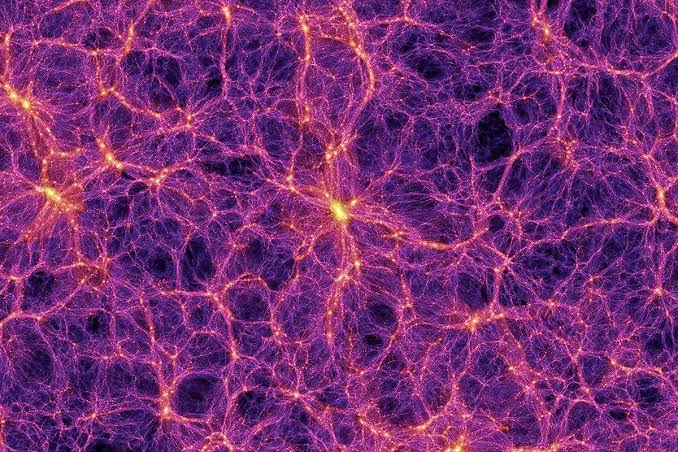
The most prominent example of this blending of the smallest and largest scales in particle physics is dark matter. Some of our best evidence for dark matter comes analyzing the cosmic microwave background to determine how the primordial plasma behaved. These studies showed that some type of ‘cold’, matter that doesn’t interact with light, aka dark matter, was necessary to form the first clumps that eventually seeded the formation of galaxies. Without it, the universe would be much more soup-y and structureless than what we see to today.

The “cosmic web” galaxy clusters from the Millenium simulation. Measuring and understanding this web can tell us a lot about the fundamental constituents of the universe. Source

To determine what dark matter is then requires an attack from two fronts: design experiments here on earth attempting directly detect it, and further study its cosmic implications to look for more clues as to its properties.

The panel recommended next generation telescopes to study the CMB as a top priority. The so called ‘Stage 4’ CMB experiment would deploy telescopes in both the south pole and Chile’s Atacama desert to better characterize sources of atmospheric noise. The CMB has been studied extensively before, but the increased precision of CMS-S4 could shed light on mysteries like dark energy, dark matter, inflation, and the recent Hubble Tension. Given the past fruitfulness of these efforts, I think few doubted the science case for such a next generation experiment.

A mockup of one of the CMS-S4 telescopes which will be based in the Chilean desert. Note the person for scale on the right (source)

The P5 report recommended a suite of new dark matter experiments in the next decade, including the ‘ultimate’ liquid Xenon based dark matter search. Such an experiment would follow in the footsteps of massive noble gas experiments like LZ and XENONnT which have been hunting for a favored type of dark matter called WIMP’s for the last few decades. These experiments essentially build giant vats of liquid Xenon, carefully shield from any sources of external radiation, and look for signs of dark matter particles bumping into any of the Xenon atoms. The larger the vat of Xenon, the higher chance a dark matter particle will bump into something. Current generation experiments have ~7 tons of Xenon, and the next generation experiment would be even larger. The next generation aims to reach the so called ‘neutrino floor’, the point as which the experiments would be sensitive enough to observe astrophysical neutrinos bumping into the Xenon. Such neutrino interactions would look extremely similar to those of dark matter, and thus represent an unavoidable background which would signal the ultimate sensitivity of this type of experiment. WIMP’s could still be hiding in a basement below this neutrino floor, but finding them would be exceedingly difficult.

A photo of the current XENONnT experiment. This pristine cavity is then filled with liquid Xenon and closely monitored for signs of dark matter particles bumping into one of the Xenon atoms. Credit: XENON Collaboration

WIMP’s are not the only dark matter candidates in town, and recent years have also seen an explosion of interest in the broad range of dark matter possibilities, with axions being a prominent example. Other kinds of dark matter could have very different properties than WIMPs and have had much fewer dedicated experiments to search for them. There is ‘low hanging fruit’ to pluck in the way of relatively cheap experiments which can achieve world-leading sensitivity. Previously, these ‘table top’ sized experiments had a notoriously difficult time obtaining funding, as they were often crowded out of the budgets by the massive flagship projects. However, small experiments can be crucial to ensuring our best chance of dark matter discovery, as they fill in the blinds pots missed by the big projects.

The panel therefore recommended creating a new pool of funding set aside for these smaller scale projects. Allowing these smaller scale projects to flourish is important for the vibrancy and scientific diversity of the field, as the centralization of ‘big science’ projects can sometimes lead to unhealthy side effects. This specific recommendation also mirrors a broader trend of the report: to attempt to rebalance the budget portfolio to be spread more evenly and less dominated by the large projects.

A pie chart comparing the budget porfolio in 2023 (left) versus the projected budget in 2033 (right). Currently most of the budget is being taken up by the accelerator upgrades and cavern construction of DUNE, with some amount for the LHC upgrades. But by 2033 the panel recommends a much more equitable balance between different research area.

What Didn’t Make It

Any report like this comes with some tough choices. Budget realities mean not all projects can be funded. Besides the pairing down of some of DUNE’s upgrades, one of the biggest areas that was recommended against were ‘accessory experiments at the LHC’. In particular, MATHUSULA and the Forward Physics Facility were two experiments that proposed to build additional detectors near already existing LHC collision points to look for particles that may be missed by the current experiments. By building new detectors hundreds of meters away from the collision point, shielded by concrete and the earth, they can obtained unique sensitivity to ‘long lived’ particles capable of traversing such distances. These experiments would follow in the footsteps of the current FASER experiment, which is already producing impressive results.

While FASER found success as a relatively ‘cheap’ experiment, reusing detector components from and situating itself in a beam tunnel, these new proposals were asking for quite a bit more. The scale of these detectors would have required new caverns to be built, significantly increasing the cost. Given the cost and specialized purpose of these detectors, the panel recommended against their construction. These collaborations may now try to find ways to pare down their proposal so they can apply to the new small project portfolio.

Another major decision by the panel was to recommend against hosting a new Higgs factor collider in the US. But that will discussed more in a future post.

Conclusions

The P5 panel was faced with a difficult task, the total cost of all projects they were presented with was three times the budget. But they were able to craft a plan that continues the work of the previous decade, addresses current shortcomings and lays out an inspiring vision for the future. So far the community seems to be strongly rallying behind it. At time of writing, over 2700 community members from undergraduates to senior researchers have signed a petition endorsing the panels recommendations. This strong show of support will be key for turning these recommendations into actual funding, and hopefully lobbying congress to even increase funding so that more of this vision can be realized.

For those interested the full report as well as executive summaries of different areas can be found on the P5 website. Members of the US particle physics community are also encouraged to sign the petition endorsing the recommendations here.

And stayed tuned for part 2 of our coverage which will discuss the implications of the report on future colliders!

Moriond 2023 Recap

17 April 2023 at 16:16

Every year since 1966,  particle physicists have gathered in the Alps to unveil and discuss their most important results of the year (and to ski). This year I had the privilege to attend the Moriond QCD session so I thought I would post a recap here. It was a packed agenda spanning 6 days of talks, and featured a lot of great results over many different areas of particle physics, so I’ll have to stick to the highlights here.

FASER Observes First Collider Neutrinos

Perhaps the most exciting result of Moriond came from the FASER experiment, a small detector recently installed in the LHC tunnel downstream from the ATLAS collision point. They announced the first ever observation of neutrinos produced in a collider. Neutrinos are produced all the time in LHC collisions, but because they very rarely interact, and current experiments were not designed to look for them, no one had ever actually observed them in a detector until now. Based on data collected during collisions from last year, FASER observed 153 candidate neutrino events, with a negligible amount of predicted backgrounds; an unmistakable observation.

Black image showing colorful tracks left by particles produced in a neutrino interaction
A neutrino candidate in the FASER emulsion detector. Source

This first observation opens the door for studying the copious high energy neutrinos produced in colliders, which sit in an energy range currently unprobed by other neutrino experiments. The FASER experiment is still very new, so expect more exciting results from them as they continue to analyze their data. A first search for dark photons was also released which should continue to improve with more luminosity. On the neutrino side, they have yet to release full results based on data from their emulsion detector which will allow them to study electron and tau neutrinos in addition to the muon neutrinos this first result is based on.

New ATLAS and CMS Results

The biggest result from the general purpose LHC experiments was ATLAS and CMS both announcing that they have observed the simultaneous production of 4 top quarks. This is one of the rarest Standard Model processes ever observed, occurring a thousand times less frequently than a Higgs being produced. Now that it has been observed the two experiments will use Run-3 data to study the process in more detail in order to look for signs of new physics.

Event displays from ATLAS and CMS showing the signature of 4 top events in their respective detectors
Candidate 4 top events from ATLAS (left) and CMS (right).

ATLAS also unveiled an updated measurement of the mass of the W boson. Since CDF announced its measurement last year, and found a value in tension with the Standard Model at ~7-sigma, further W mass measurements have become very important. This ATLAS result was actually a reanalysis of their previous measurement, with improved PDF’s and statistical methods. Though still not as precise as the CDF measurement, these improvements shrunk their errors slightly (from 19 to 16 MeV).  The ATLAS measurement reports a value of the W mass in very good agreement with the Standard Model, and approximately 4-sigma in tension with the CDF value. These measurements are very complex, and work is going to be needed to clarify the situation.

CMS had an intriguing excess (2.8-sigma global) in a search for a Higgs-like particle decaying into an electron and muon. This kind of ‘flavor violating’ decay would be a clear indication of physics beyond the Standard Model. Unfortunately it does not seem like ATLAS has any similar excess in their data.

Status of Flavor Anomalies

At the end of 2022, LHCb announced that the golden channel of the flavor anomalies, the R(K) anomaly, had gone away upon further analysis. Many of the flavor physics talks at Moriond seemed to be dealing with this aftermath.

Of the remaining flavor anomalies, R(D), a ratio describing the decay rates of B mesons in final states with D mesons and taus versus D mesons plus muons or electrons, has still been attracting interest. LHCb unveiled a new measurement that focused on hadronically taus and found a value that agreed with the Standard Model prediction. However this new measurement had larger error bars than others so it only brought down the world average slightly. The deviation currently sits at around 3-sigma.

A summary plot showing all the measurements of R(D) and R(D*). The newest LHCb measurement is shown in the red band / error bar on the left. The world average still shows a 3-sigma deviation to the SM prediction

An interesting theory talk pointed out that essentially any new physics which would produce a deviation in R(D) should also produce a deviation in another lepton flavor ratio, R(Λc), because it features the same b->clv transition. However LHCb’s recent measurement of R(Λc) actually found a small deviation in the opposite direction as R(D). The two results are only incompatible at the ~1.5-sigma level for now, but it’s something to continue to keep an eye on if you are following the flavor anomaly saga.

It was nice to see that the newish Belle II experiment is now producing some very nice physics results. The highlight of which was a world-best measurement of the mass of the tau lepton. Look out for more nice Belle II results as they ramp up their luminosity, and hopefully they can weigh in on the R(D) anomaly soon.

A fit to the invariant mass the visible decay products of the tau lepton, used to determine its intrinsic mass. An impressive show of precision from Belle II

Theory Pushes for Precision

The focus of much of the theory talks was about trying to advance our precision in predictions of standard model physics. This ‘bread and butter’ physics is sometimes overlooked in scientific press, but is an absolutely crucial part of the particle physics ecosystem. As experiments reach better and better precision, improved theory calculations are required to accurately model backgrounds, predict signals, and have precise standard model predictions to compare to so that deviations can be spotted. Nice results in this area included evidence for an intrinsic amount of charm quarks inside the proton from the NNPDF collaboration, very precise extraction of CKM matrix elements by using lattice QCD, and two different proposals for dealing with tricky aspects regarding the ‘flavor’ of QCD jets.

Final Thoughts

Those were all the results that stuck out to me. But this is of course a very biased sampling! I am not qualified enough to point out the highlights of the heavy ion sessions or much of the theory presentations. For a more comprehensive overview, I recommend checking out the slides for the excellent experimental and theoretical summary talks. Additionally there was the Moriond Electroweak conference that happened the week before the QCD one, which covers many of the same topics but includes neutrino physics results and dark matter direct detection. Overall it was a very enjoyable conference and really showcased the vibrancy of the field!

❌