
❌

Normal view

Structured light could deliver a new method for diagnosing eye disease

20 July 2026 at 15:00

By controlling a type of polarized light widely used in quantum optics, researchers have transformed subtle optical patterns in our peripheral vision into vibrant, easily perceptible shapes. Led by Dusan Sarenac at the University of Waterloo, Canada, the team showed for the first time that the “Boehm’s brushes” perceived by participants can be altered by adjusting the topology of spin-orbit coupled light. Their results, reported in Proceedings of the National Academy of Sciences, could lead to promising new techniques for checking our eye health.

For the most part, human eyes are incapable of detecting polarization in visible light. But in some rare cases, structures inside the eye itself can scatter light in different ways depending on its polarization, creating subtle yet perceivable “entoptic” patterns. Perhaps the best-known examples of these are “Haidinger’s brushes”: hourglass-shaped patterns that can form in our central vision, but only when viewing linearly polarized light at blue wavelengths.

In 1940, Swiss biophysicist Gundo Boehm discovered another example: a two-lobed, bowtie-shaped entoptic pattern that forms when viewing linearly polarized light in the peripheral vision as it scatters from subcellular structures in the inner retina. Unlike Haidinger’s brushes, this lesser-known effect is driven by angular variations in scattering strength relative to the polarization direction.

But as Sarenac explains, these ethereal shapes are more than just a curiosity. “Because retinal disease may alter a person’s ability to perceive the pattern, researchers have long considered whether Boehm’s brushes could serve as a biomarker of retinal health,” he says. “However, their weak visibility has limited practical use.”

Whereas previous studies simply asked participants to passively observe the effect, Sarenac’s team considered what would happen if the light’s polarization was constantly varied. To explore this possibility, the researchers created a beam of spin-orbit coupled light, in which polarization is linked to the light’s orbital angular momentum – a property describing how the wavefront twists as the beam travels – so that the polarization direction rotates steadily across the beam.

In quantum optics, these structured waveforms are already being widely explored for their possibilities in imaging, communication and information processing. But for the first time, Sarenac’s team considered how our eyes could actually perceive this light. “We engineered the spatial polarization of the light to match the symmetry of the retinal scattering response,” Sarenac describes. “This allowed many weak local contributions to reinforce one another.”

The researchers then projected this structured light through a ring-shaped aperture, targeting specific regions in the periphery of participants’ retinas, which could also be adjusted to target varying distances from the centre of vision. Using an automated test, they measured how much contrast participants needed to reliably distinguish a Boehm’s brush from the background at these varying distances.

Based on the subject’s responses, Sarenac’s team determined that the use of spin-orbit coupled light not only made Boehm’s brushes appear far more vivid to the participants, it also transformed the bowtie shape into a multi-lobed pattern, with the number of lobes varying depending on the topology of the light’s twisting polarization.

“Across 11 participants, detection thresholds improved exponentially away from the centre of vision, and the pattern became robustly visible at approximately one degree of retinal angular distance,” Sarenac describes. These results reveal a fascinating link between human vision and quantum mechanics, which the team hope could be harnessed in practical healthcare. With further studies involving patients with retinal disease, they now envisage eye tests where retinal conditions could be diagnosed in people who can’t clearly perceive vibrant, multi-lobed Boehm’s brushes in their peripheral vision.

“In the longer term, these patterns may provide a non-invasive functional probe of retinal integrity because their shape and visibility can be measured across different retinal locations,” Sarenac says.

The post Structured light could deliver a new method for diagnosing eye disease appeared first on Physics World.
Wearable pacemaker uses ultrasound to control heart rhythm

2 July 2026 at 09:00
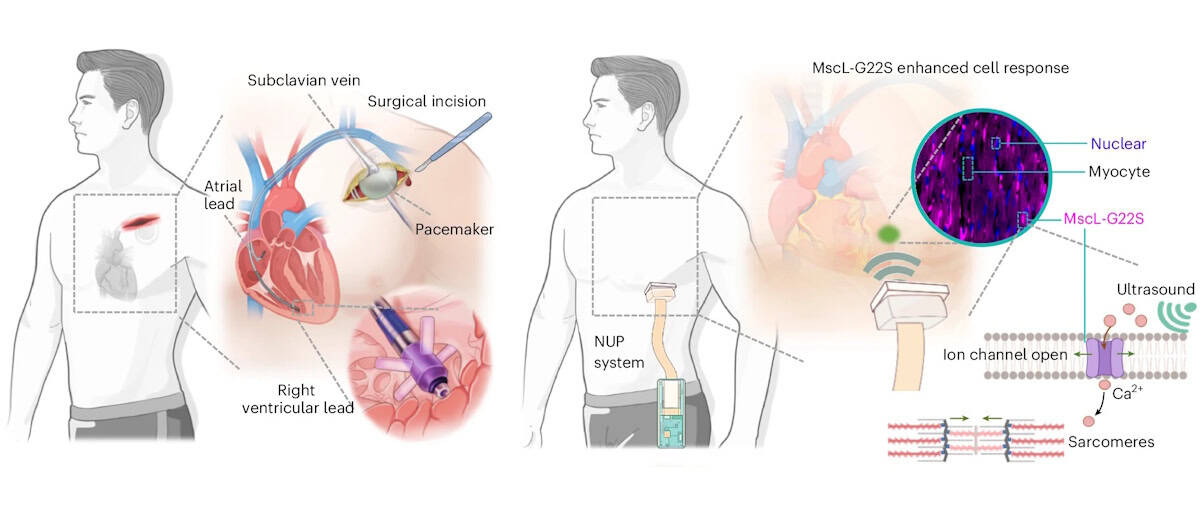
Illustrations showing traditional and sonogenetic cardiac pacing
Traditional versus sonogenetic pacing Left: schematic illustration of the steps for traditional surgical implantation of a cardiac pacemaker. Right: operational workflow of the non-invasive ultrasound pacemaker with sonogenetics. Created in BioRender. (Courtesy: C Gong et al. Nat. Biomed. Eng. 10.1038/s41551-026-01673-z 2026, Springer Nature)

Cardiac arrhythmia – a disorder in which the heart beats too fast, too slowly or irregularly – affects millions of people worldwide. Currently, arrhythmias are treated using pacemakers to regulate the heart’s rhythm, but traditional pacemakers require invasive surgical implantation and intracardiac leads that risk infection and tissue injury. As an alternative, a research collaboration headed up at Massachusetts Institute of Technology (MIT) and the University of Southern California (USC) has developed a non-invasive pacemaker that’s worn like a sticker on the chest and stimulates the heart using ultrasound.

“Ultrasound offers a unique combination of deep tissue penetration, spatial focusing and non-invasive delivery,” explains first author Chen Gong from USC. Previous approaches for ultrasound-based cardiac pacing, however, lacked reliability or required the use of microbubbles. In this new study, Gong and collaborators employed a technique called sonogenetics, in which cardiac cells are genetically altered to increase their sensitivity to ultrasound. Once exposed to ultrasound waves, the engineered cells trigger the opening of ion channels that let in calcium, which signals the cells to squeeze and beat.

“Our central motivation was to address the limitations of conventional pacemakers, while preserving precise control of cardiac rhythm,” says Gong.

The team first examined whether ultrasound could modulate cardiac cells in vitro, using sonogenetically engineered human heart muscle cells. Ultrasound stimulation caused almost three-quarters of the engineered cells to beat in synchrony with the ultrasound waves. In contrast, unaltered cells did not exhibit such behaviour. Importantly, ultrasound exposure did not impact the cells’ expression of biomarkers for inflammation, myocardial injury or oxidative stress, demonstrating the safety of this approach.

The non-invasive ultrasound pacemaker

The researchers designed a sonogenetics-based non-invasive ultrasound pacemaker (NUP) capable of real-time imaging and steerable stimulation, describing the device in Nature Biomedical Engineering. The postage stamp-sized device, which sticks to the skin via a bioadhesive interface, incorporates a 64-channel phased-array transducer, as well as data acquisition, wireless transmission and power modules.

To assess whether this prototype NUP could achieve non-invasive cardiac pacing in sonogenetically engineered rats, they attached the device onto the rats’ chests and applied ultrasound stimulation through the chest wall to the heart.

At an acoustic pressure of 2 MPa and a 40 ms pulse duration, the NUP increased the rats’ heart rates from 240 to 360–540 bpm, with a higher pulse repetition frequency leading to increased heart rate. Upon stopping the ultrasound stimulation, the heart returned to its natural rhythm. In control rats without the genetic modification, NUP could not control the heart rate effectively.

The team demonstrated that the NUP could electrically steer the ultrasound beam focus with a spatial precision of less than 1 mm, enabling targeting of different regions of the heart to induce chamber-specific pacing. NUP also successfully treated cardiac arrhythmias induced in the engineered rats, returning their heart rates to normal levels. In contrast, ultrasound stimulation of control rats did not effectively treat their arrythmias.

“A major objective of this work was to move beyond proof-of-concept stimulation and demonstrate a wearable system that could realistically support daily use,” explains Qifa Zhou, group leader at USC.  “The current prototype integrates imaging, stimulation, wireless communication and battery-powered operation into a wearable format.”

Clinical potential

For future clinical use, the NUP device needs to automatically detect the wearer’s heart rate, locate heart chambers and deliver stimuli. To achieve this, the researchers used a cloud-based, artificial intelligence (AI)-powered imaging feedback loop that determines the heart rate and stimulation coordinates, and steers the ultrasound beam to target sites.

To test its feasibility for human-scale applications, they assessed the acoustic energy penetration of the device. Using simulations and experiments on a pig heart beneath layers of tissue, they confirmed that, even after tissue attenuation, NUP could deliver sufficient ultrasound pressure (approximately 2 MPa) to a human heart to enable stimulation at clinically relevant pacemaker sites.

The team also assessed the biosafety of the NUP approach, finding that the delivered ultrasound energy remained below approved safety limits and generated minimal thermal effects during and after stimulation. They also confirmed that the sonogenetic engineering induced no off-target effects, immune responses or pathological changes in the rats.

“In the long term, we are optimistic about applying sonogenetics in humans,” explains co-author Gengxi Lu from MIT. “Sonogenetics is different from gene editing – it does not aim to rewrite a patient’s DNA sequence, but instead enables target cells to temporarily or controllably express ultrasound-responsive proteins. At the same time, extensive clinical validation will still be needed to establish safety and long-term effectiveness.”

The team is now focusing on clinical translation and validation of the NUP technology, which includes improving gene delivery strategies, validating the system in larger animal models, and developing closed-loop control approaches that combine real-time physiological sensing with adaptive stimulation. There’s also much engineering work to be done, such as device miniaturization, and improving battery life, skin coupling and motion robustness.

“For cardiac pacing, we envisage that the final goal of NUP technology is to be a permanent alternative to a long-term implanted pacemaker,” Xuanhe Zhao from MIT tells Physics World. “More broadly, we are interested in expanding ultrasound-enabled bioelectronic medicine beyond cardiac pacing toward other organs and therapeutic applications where non-invasive, spatially precise modulation could have clinical impact.”

The post Wearable pacemaker uses ultrasound to control heart rhythm appeared first on Physics World.

Laser-based rotation of floating samples enables high-resolution 3D microscopy

18 June 2026 at 10:00

A new contact-free way of rotating delicate samples, such as biological cells, undergoing three-dimensional (3D) optical microscopy increases the image resolution and could reveal more details about microscale structures and processes.

Current optical microscopes provide extremely good image resolution in a single plane, but since depth information is often lacking, samples are routinely rotated and imaged at multiple different angles to create a 3D picture. Because rotating via mechanical microtools such as tiny grippers, needles or pipettes can damage samples, contact-free approaches such as optical tweezers, magnetic manipulation or optothermal forces are often used instead. However, these methods rely on the sample being birefringent, magnetic, light-absorbing or specially shaped.

By contrast, the laser-based technique developed by a team led by Moritz Kreysing and Fan Nan from the Institute of Biological and Chemical Systems at the Karlsruher Institut für Technologie (KIT) in Germany can rotate and spin floating microscopic objects no matter what their shape or material properties.

Their method involves focusing a 1455 nm infrared laser beam on a small region of a highly viscous liquid – initially at 25°C – in which the sample will be suspended. This gently heats that region of the liquid by a few degrees. But rather than focusing on one spot, an acousto-optic deflector steers the beam rapidly along a carefully designed two-dimensional (2D) pattern.

“Because the viscosity of the liquid changes with temperature, this moving heat pattern generates tiny fluid flows, known as thermoviscous flows. By choosing the scan geometry and timing correctly, these flows become three-dimensional and helical, like microscopic corkscrew-shaped currents,” explain Kreysing and Nan. Once a small object is floated freely in these 3D helical flows, it can be rotated, spun, transported or stabilized solely via software-defined scan patterns, with different symmetries controlling the movement of the surrounding liquid.

The KIT technique allows stacks of high-resolution images focused at different depths to be acquired along multiple different angles by re-orienting the sample, a feature that “can help overcome the anisotropic resolution of conventional 3D microscopy”, explain the researchers. Using a high-viscosity liquid to suspend the samples not only enables kinematic stop-and-go actuation, it also suppresses Brownian motion (the jiggling around of tiny particles in fluids), which otherwise decreases image resolution and makes the study of cellular transport processes tricky.

Since previous methods of laser-driving fluid flows could only create motion in one plane, the researchers found it “particularly exciting” when they first observed their laser scanning in a 2D plane generating 3D flow fields. “Another key moment was the observation of opto-hydrodynamic focusing. The particles did not just rotate; their spiral motion converged toward a stable height and position. This was significant because it meant that the optofluid could stabilize the sample, rather than requiring mechanical confinement or complex feedback control.”

As detailed in their recent Light: Science & Applications paper, the KIT team demonstrated rotation and spinning of various samples including stained biological cells, nano-printed micro-tiles and perfectly spherical beads. “We see immediate potential in advanced optical microscopy, especially multi-view imaging of suspended cells, cell clusters, organelles, microstructures or soft materials,” Kreysing and Nan tell Physics World.

Since the basic hardware components of their system will be familiar to many optics and microscopy labs, they are hoping for early adoption by specialized research groups. But to optimize the technique for biological applications, they will now investigate the use of different liquids and operating conditions “that better preserve the viability of live mammalian cells while still providing sufficient stability for precise rotation and imaging”.

The researchers suggest that future areas of application could include microfluidics, microrobotics, colloidal assembly, materials science and 3D microfabrication. As such, they also want to develop more advanced scan patterns that can generate curved, programmable or multi-axis helical flows. “This could allow more complex 3D manipulation, such as controlled orientation of irregular objects, coordinated actuation of multiple particles, or integration with microfabrication workflows,” they explain.

The post Laser-based rotation of floating samples enables high-resolution 3D microscopy appeared first on Physics World.

Abnormal snoring sounds help diagnose common sleep disorder

8 June 2026 at 16:00

Obstructive sleep apnoea (OSA) is a sleep disorder in which the throat muscles relax and block the airway during sleep, causing pauses in breathing. If left untreated, OSA can lead to serious health problems. A research team led by Mingjiang Wang at the Harbin Institute of Technology, Shenzhen in China, in collaboration with Huizhou University, has now come up with a new method for detecting OSA – based on recordings of the subject snoring.

“OSA is a common yet underdiagnosed sleep disorder,” explains first author Heng Li. “The clinical standard for diagnosis is polysomnography [PSG], which is expensive, time-consuming and unsuitable for large-scale or home-based screening.”

PSG collects multiple physiological signals via various sensors that patients wear while asleep, potentially disrupting their sleep patterns. “Therefore, we aim to develop a non-contact detection method using snoring, which is a typical symptom of OSA and can be recorded contactlessly using a microphone,” says Li.

The acoustic patterns of snoring, produced by the vibrations of upper airway, contain markers that reflect airway narrowing and collapse. However, developing a reliable snoring-based detection model is challenging, as labelled snoring datasets are scarce and snoring sounds vary greatly between individuals.

In this study, published in Physiological Measurement, the research team uses a pretrained audio model called Wav2vec 2.0 to address these challenges. By transferring acoustic knowledge learned from large-scale unlabelled speech and audio data, the model removes the need for labelled snoring datasets.

Wav2vec 2.0 was originally designed for speech recognition and is computationally intensive, making it unsuitable for routine OSA monitoring. Thus the team adapted it for snoring sounds, removing layers more relevant to speech recognition while retaining acoustic features relevant to snoring pathology, aiming to lower the computational cost.

“We do not use the pretrained model directly,” Li explains. “Instead, we prune higher speech-related Transformer layers and fuse low- and mid-level representations, so that the model emphasizes snoring-related acoustic information.”

Constructing a snoring dataset

In collaboration with the Shenzhen People’s Hospital, the team collected sleep recordings from 100 individuals with apnoea-hypopnea indices (AHI) ranging from 2.4 to 68.3 events/hour. AHI – defined as the average number of apnoea (where breathing stops completely) and hypopnoea (shallow breathing) events per hour of sleep – is used to classify OSA from normal (AHI of below 5) through to severe (30 or above).

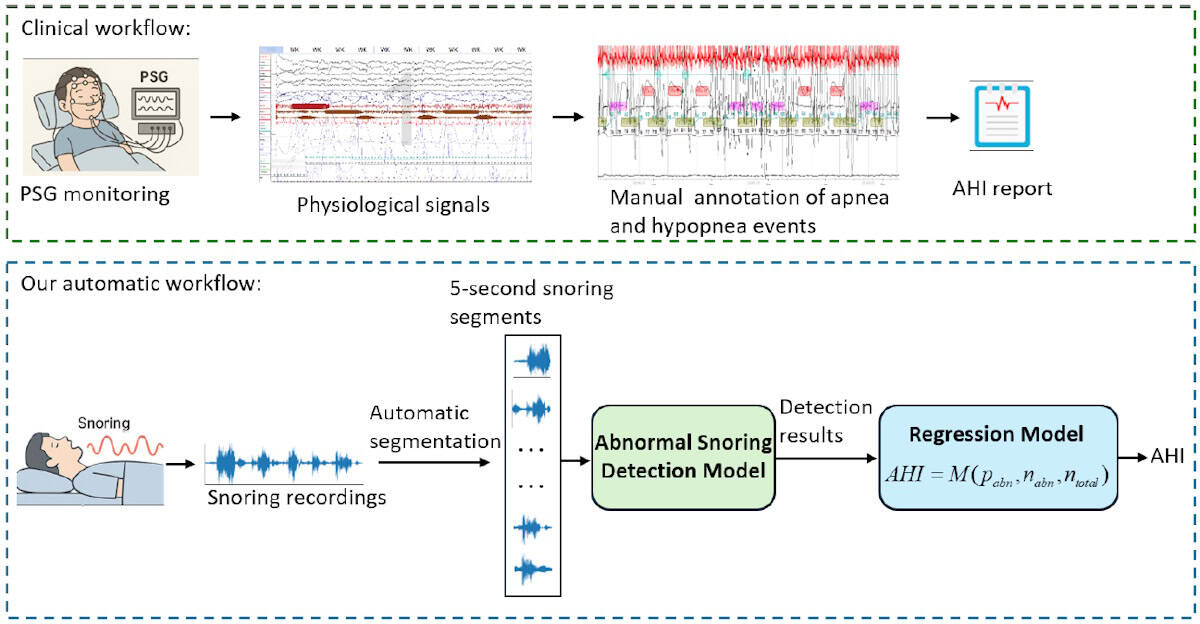
All subjects slept in hospital wards and were also monitored with a PSG device during sleeping. Sleep physicians then used the PSG data to annotate the audio recordings with apnoea and hypopnea events. Each recording was divided into 5-s audio segments and assigned as either abnormal, if they included apnoea/hypopnoea events, or normal.

Illustration of methods for detecting abnormal snoring
Abnormal snoring detection Upper panel: the clinical workflow using PSG and physiological signals to determine AHI. Lower panel: the proposed automatic workflow, which estimates AHI directly from snoring recordings using segment-level abnormal snoring detection and regression models. (Courtesy: Physiol. Meas. 10.1088/1361-6579/ae6f6a)

To evaluate their framework’s ability to detect abnormal snoring, the researchers compared it against five other pretrained audio models. They first ran a subject-dependent evaluation, in which random audio segments from all subjects were used for training, validation and testing. All models performed well – as expected when the training and test data come from the same subjects – but the adapted Wav2vec 2.0 model achieved the highest accuracy and sensitivity.

The team then performed a subject-independent evaluation, which better reflects a real-world scenario, with each subject’s data randomly assigned to the training, validation or test set. Here, the existing methods exhibited a reduced accuracy of between 65% and 71%, while the new model retained an accuracy of 73.95%.

“In subject-independent testing, this adapted model achieved better performance than the compared baseline models, suggesting improved generalization to unseen subjects,” says Li. The team’s model was also significantly more computationally efficient, an important factor for OSA screening in home-based or resource-limited scenarios.

AHI estimation

Finally, the researchers designed a snoring-based AHI estimation framework, using their detection model to identify abnormal snoring segments and calculating a ratio-based statistic – the number of abnormal segments divided by the total number of segments – to quantify OSA severity. They then used four common linear regression models to estimate AHI for individual subjects.

All models demonstrated reasonable accuracy and good correlation between predicted and PSG-derived AHI values. The mean absolute error was roughly 11 events/h, which means that the estimated AHI may deviate from the true value by 11 events per hour of sleep and could (if near a threshold between categories) result in an incorrect severity diagnosis. However, while the current model is not yet precise enough for clinical diagnosis, it could prove ideal as a potential tool for home-based OSA screening or pre-screening.

The researchers are now investigating how to more effectively apply pretrained audio models to clinical snoring analysis. “We are focused on making these models lighter and more suitable for home-based screening, while validating their effectiveness across large, multicentre datasets,” Yun Lu, one of the corresponding authors from Huizhou University, tells Physics World. “Additionally, we plan to improve the accuracy of AHI estimation by integrating snoring-based predictions with additional non-contact physiological information.”

The post Abnormal snoring sounds help diagnose common sleep disorder appeared first on Physics World.

Molecular spin sensor takes the temperature of cancer cells

29 May 2026 at 16:45

Researchers in Japan have succeeded in measuring the temperature inside living cells with high precision using a new class of biocompatible quantum nanosensor – something that has been difficult to do until now even. If improved, the nanosensor could be used to characterize a wide range of biological phenomena and so help in disease diagnosis, they say.

Recent years have seen the advent of a new generation of nanoscale quantum sensors that can detect the tiny magnetic fields of biological systems. Some of these sensors rely on photons and others on electrons or spin defects – typically diamond specially engineered with nitrogen–vacancy (NV) defects. This material is made by removing two carbon atoms from the diamond lattice and replacing one with a nitrogen atom. The other “hole” is left empty, thereby creating a vacancy or defect. The spin state of the defect is influenced by the local magnetic field that can be “read out” from the way it fluoresces.

While a powerful tool, and biocompatible, this type of quantum sensor does suffer from certain limits. For one, it can be structurally inhomogeneous, which affects how it detects temperature and other physical or chemical parameters inside biological cells.

A more homogenous structure

Even though the new molecular quantum nanosensor (MoQN) works in the same way as these conventional devices, it does not suffer from this problem, explain Nobuhiro Yanai of the University of Tokyo and Hitoshi Ishiwata of the National Institutes for Quantum Science and Technology (QST), who led this research effort. This is because it has a more homogenous structure and does not contain any defects. Instead, it is made by embedding molecular spin qubits, in this case fabricated from pentacene, in nanocrystals of para-terphenyl. This design makes the structure uniform on a molecular scale and preserves the quantum coherence of the spin qubits. It is then coated with Pluronic F127, which is a biocompatible surfactant.

By detecting the spin direction of the “excited triplet state” of the pentacene qubits using a technique known as optically detected magnetic resonance (OMDR), the researchers can precisely determine the temperature of the qubits’ surroundings from the OMDR peak position. When they tested their method inside the cytoplasm of cancer cells in vivo, they found that the intracellular temperature was consistently higher than the surrounding medium.

Yanai says he embarked on this study after reading about the work of Sam Bayliss’ group at the UK’s University of Glasgow, and Ashok Ajoy’s group at the University of California, Berkeley in the US on OMDR in pentacene-doped para-terphenyl crystals. He says he immediately got the idea that nanocrystals of this material could be used for quantum sensing inside cells. This was because his group had already developed such nanocrystals for a different purpose in previous research.

Ensuring biocompatibility

“I then spoke with Hitoshi Ishiwata, who is an expert in quantum sensing using NV centres,” he recalls. “While many molecular qubits have been developed to date, there had been no examples demonstrating their sensing ability within living cells.”

The project required materials science expertise, he tells Physics World, and in particular, finding out how to reduce the material to the nanoscale and ensuring it was biocompatible.

“We already knew that nanodiamonds are good quantum sensors for temperature measurements, but I had noticed a practical limitation: their ODMR spectra often vary significantly from particle to particle,” he says. “This spectral dispersion can introduce errors, especially when trying to perform precise measurements at the single-particle level.”

Replacing hydrogen with deuterium

The researchers thought they had overcome this problem during the first run of their experiments because they found that different particles showed identical OMDR spectra. However, their joy quickly waned when they observed that the spectra were still broadened by hyperfine interactions between the pentacene-doped para-terphenyl molecules’ electron spins and hydrogen nuclear spins.

To improve the spectral resolution, Ishiwata says he suggested chemically modifying the molecule by replacing the hydrogen in it with deuterium. And the technique worked: “the hyperfine broadening was strongly suppressed, allowing us to determine the OMDR spectra much more precisely.”

These findings, which are detailed in Science Advances, show that MoQNs are a chemically versatile platform for quantum sensing in living cells and that they can operate directly inside them while maintaining the precision needed for absolute thermometry, he says. Their appeal also lies in in the fact that their structures can be easily modified.

It will not all be plain sailing, however, adds Yanai. MoQNs cannot yet target specific organelles within cells, so endowing them with this targeting capability is an important future challenge. “What is more, their size has been limited to around 200 nm so far, so creating smaller MoQN particles will be crucial,” he says.

The post Molecular spin sensor takes the temperature of cancer cells appeared first on Physics World.

Google upgrades iPhone switching tool

23 July 2026 at 09:24

Google upgraded iPhone migration options with a service built directly into Android 17 aimed at simplifying the switch, a release timed to coincide with the unveiling of Samsung’s Z Series at its Galaxy Unpacked event.

The search giant expanded the range of data which can be wirelessly transferred from an iPhone without downloading a separate migration app.

In addition to “photos, videos, contacts, messages and calendar”, the latest method covers a user’s “Google Account, passwords, Wi-Fi credentials” and eSIM profile.

By simplifying onboarding and broadening the compatible data types, Google aims to lower the barriers to switching smartphone ecosystems to attract more iPhone users to Android.

Google commenced deployment of the feature on select Pixel devices and it is also available on the Samsung Galaxy Z Flip8 and Z Fold8 ranges unveiled at Galaxy Unpacked.

The company plans to expand the migration method to more Android devices in future.

The post Google upgrades iPhone switching tool appeared first on Mobile World Live.

Samsung unveils 3 new foldables packed with AI

22 July 2026 at 17:12

Samsung Electronics expanded its foldables lineup with a trio of smartphones at its Galaxy Unpacked event in London, including the first Ultra-branded foldable as it pushed upgraded form factors and AI-powered features.

Leading the charge was the Galaxy Z Fold8 Ultra, the first device to carry Samsung’s Ultra branding on a foldable. Measuring 4.1mm when unfolded, Samsung said the device is its thinnest Galaxy Fold model to date.

Powered by Qualcomm’s Snapdragon 8 Elite Gen 5 Mobile Platform for Galaxy, the handset features an 8-inch main display, 5,000mAh battery and a 200MP main camera. It also introduced new Galaxy AI tools including Gemini Notebook, capable of summarising documents and generating content from uploaded files, and Now Nudge, a contextual Galaxy AI feature designed to proactively prompt actions based on user activity.

Samsung also refreshed the Galaxy Z Fold8 with a redesigned display format and adjustable aspect ratios aimed at improving content consumption across video, gaming and reading. The device weighs 201 grams, making it the company’s lightest Fold model, and includes a 4,800mAh battery rated for more than 26 hours of video playback. The Fold8 also introduced an AI-powered editing tool to automatically track and reframe a subject in a video.

In the clamshell segment, Samsung updated the Galaxy Z Flip8 with expanded functionality on its FlexWindow cover display, enabling users to access apps, messages and personalised AI information without opening the handset. The latest Flip model also adds a 50MP main camera and dual recording mode for capturing both subject and creator simultaneously.

Pricing starts at $2,099 for the Galaxy Z Fold8 Ultra, $1,899 for the Galaxy Z Fold8 and $1,199 for the Galaxy Z Flip8. All three models will be available from 7 August.

At the event, TM Roh, CEO, president and head of Samsung Electronics’ Device eXperience division, emphasised the importance of foldables in the AI era.

“The question is: if AI is becoming more personal, more proactive, and more multidimensional, what is the optimal device to bring that experience to life? We believe the answer is foldables.”

Wearables
Samsung also refreshed its wearables portfolio with the Galaxy Watch Ultra2 and Galaxy Watch9, its first watches built on Qualcomm’s Snapdragon Wear Elite platform.

The smartwatches introduce new AI-powered health features, with the vendor claiming both models received an FDA-cleared sleep apnea detection update. The Galaxy Watch9 starts at $379, while the Watch Ultra2 is priced from $699.

In addition, Samsung unveiled intelligent eyewear, although pricing and a release date were not disclosed.

Doubling down
Ben Wood, chief analyst at CCS Insight, said Samsung is “doubling down on foldables at exactly the moment the category is about to get its biggest credibility boost with the much-rumoured arrival of a folding iPhone later in the year.”

He said Apple’s expected entry “could also be the moment that turns foldables from a niche premium category into a mainstream flagship battleground.”

Wood added “Qualcomm is one of the quiet winners from Samsung’s latest launch, securing important design wins across phones, watches and glasses.”

The post Samsung unveils 3 new foldables packed with AI appeared first on Mobile World Live.

iOS 27 Beta 1: Impressions on Build 24A5355q after 1 week

17 June 2026 at 18:23

iOS 27 Developer Beta 1 has been out since WWDC 2026, with the second beta slated to be released soon. There are a number of changes and performance improvements to be appreciated in this very first developer beta, along with oddities to be expected with prerelease software. Just like last year, I decided to take […]

The post iOS 27 Beta 1: Impressions on Build 24A5355q after 1 week appeared first on Low End Mac.

iOS 27

17 June 2026 at 07:58

On June 8th 2026 at WWDC 2026, Apple announced the iOS 27 Developer Beta, which is set for consumer release in September 2026. iOS 27 was announced alongside macOS Golden Gate, iPadOS 27, visionOS 27, watchOS 27, and tvOS 27. Aimed to be a like a “Snow Leopard” sort of release, this new version brings […]

The post iOS 27 appeared first on Low End Mac.

OpenAI’s new hardware is a $230, 13-switch keyboard for Codex

17 July 2026 at 18:07

OpenAI is selling its first hardware — without any help from Jony Ive. It describes the Codex Micro as a “command center for agentic work” but it’s really a 13-switch wireless keyboard customized to help developers keep tabs on what their Codex agents are doing. It costs $230.

The keyboard has 13 mechanical switches (one keycap covers two of them by default), a rotary encoder, joystick, and RGB backlighting around the whole keypad and individual keys. It comes with 32 customizable icon keycaps.

OpenAI claims that the Codex Micro is a serious business tool: The command keys enable Codex users accept changes, reject outputs, push-to-talk, start new chats, and trigger custom actions. The rotary encoder can be used to dial up the “brainpower” allocated to tasks — or in more conventional terms, how many tokens to allocate to reasoning on a task. And the RGB lighting can provide feedback on how various tasks are progressing. And the RGB lighting under the “agent” keys can provide feedback on how various tasks are progressing.

The Codex Micro’s manufacturer, Work Louder, already has a similar device on the market, the Creator Micro, which offers similar functionality, but without the colorful keys. It costs $56 less than the Codex Micro, however.

The Codex Micro will fit in snugly with OpenAI’s other merchandise, where using Codex is as much about a fashion statement as a technological choice.

This article first appeared on InfoWorld.

Aina scores $5.5M for AI interface work

16 July 2026 at 16:50

Consumer hardware company Aina raised millions of dollars in seed funding to finance development of an interface it argues is required to fully unlock the potential of AI on smartphones and PCs.

The company believes current device hardware lags the progress of software and AI, resulting in a disconnect between expectation and reality in terms of the interface with apps and services.

It raised $5.5 million in the recent funding round to advance development of experimental interfaces which adapt to the app being used.

Aina stated it already shipped hundreds of experimental keypads called Dune to early adopters, a product for Mac computers it describes as “context-aware” which primarily focuses on work tools.

It is using the feedback from Dune to develop a general-purpose interface for smartphones and computers.

Aina founder and CEO Apoorv Shankar (pictured) said current smartphones and PCs “are still primarily designed for browsing” and use manual inputs requiring users to “figure out what you need”.

He argued this is laborious when users are “doing hundreds of tasks” per day.

The company believes there is room within the broader AI assistant space for a contextualisation system which makes it easier for people to interact with the technology. Shankar explained the general-purpose interface on the drawing board is being designed to “capture human approval”.

Shankar was previously VP of hardware at smart ring company Ultrahuman.

The seed funding round was led by Redstart Labs (Infoedge) and 360 ONE Asset, with two other investment companies and a host of angel investors.

Along with launching its interface, Aina intends to use the backing to grow its team in the US and India.

The post Aina scores $5.5M for AI interface work appeared first on Mobile World Live.

OnePlus calls it a day in Europe, North America

16 July 2026 at 16:44

Smartphone brand OnePlus announced an end to new product releases in Europe and North America, a move reportedly part of a bigger brand revamp by parent company Oppo.

OnePlus revealed the move in a statement posted on its user forum, confirming media speculation earlier this week.

It told users in Europe software updates already committed to would be fulfilled and “backed by Oppo”.

The decision was attributed to a “proactive global strategy adjustment”. Its latest flagship smartphone OnePlus 15 launched in the markets late in 2025.

Bloomberg reported the move is part of a wider restructure at Oppo, noting it is pulling another of its smartphone brands, Realme, from the Chinese market.

The news outlet claimed although OnePlus would remain active in China, it is set to be wound down in other countries during 2027.

South China Morning Post linked the brand’s demise in Western markets to ongoing industry woes involving the price and availability of memory components.

Flagship killer
Its retreat marks the decline of global ambitions for a brand once seen as a plucky challenger in the Android segment with somewhat of a cult following in its early days.

OnePlus was founded in 2013 by former Oppo employees Pete Lau and Carl Pei: the former is now back at Oppo while Pei heads device venture Nothing.

The company promoted early handsets as “flagship killers” and had several well reviewed devices over the years. In 2020, its OnePlus 7T Pro won the coveted Global Mobile Award (Glomo) for best handset.

Having had close links since its foundation and shared owners in the form of BBK Electronics, OnePlus was made an official Oppo sub-brand in January.

The post OnePlus calls it a day in Europe, North America appeared first on Mobile World Live.

Rings tipped to be lord of the wearables

16 July 2026 at 11:34

FDM CCS Insight pointed to one area of the devices market which is showing signs of promise against a mostly gloomy backdrop, as it noted smartphones are not the only form-factor affected by rising component costs.

Analysts believe the smart ring sector is nailed on to book a rise in shipments in 2026, bucking an anticipated 3% drop in the overall wearables market.

FDM CCS Insight stated wearables’ woes would mostly stem from an anticipated drop in smartwatch shipments, the dominant form-factor in 2025.

The company predicts smartwatch shipments to fall 4% due to “replacement fatigue” and a general lack of innovation.

It also highlighted “supply side” issues involving memory and component costs as hindrances, indicating problems which have affected the smartphone market for some time are beginning to spread.

FDM CCS Insight acknowledged a forecast smart ring shipments would grow 53% this year comes “from a small base” in previous years, but argued the rise points to a greater “interest in health and wellness tracking” among buyers, along with broader retail availability.

It ranked Oura at the top of the shipments table for the first half of the year and noted Ultrahuman recovered from a ban on shipments in the US during the final quarter of 2025.

A recent “easing of regulations” by the US Food and Drug Administration is also tipped to fuel future shipments.

Senior analyst Ekta Mittal said the company’s research showed “75% of smart ring owners also own a smartwatch”, suggesting there could be a knock-on effect for the latter form-factor.

The post Rings tipped to be lord of the wearables appeared first on Mobile World Live.

Huawei sharpens imaging focus with Pura 90s Series

15 July 2026 at 16:48

Huawei unveiled its Pura 90s Series smartphone lineup at a launch event in Kuala Lumpur, Malaysia, placing design and photography upgrades at the centre.

Huawei emphasised the series aims to allow users to move efficiently “from capture to refinement” across long-range, macro and low-light photography. The smartphones are fitted with a 200MP ultra large sensor telephoto camera system, alongside a 50MP main sensor and a 40MP ultra-wide lens.

The telephoto setup supports 4x optical zoom and up to 100x digital zoom. AI-powered composition and image optimisation tools are also built in to speed up editing.

The top-end Pura 90s Pro Max variant features a 6.9-inch LTPO OLED display with 1-120Hz adaptive refresh. The device runs on the Chinese vendor’s proprietary EMUI 16.0 operating system and is available in 12GB RAM configurations paired with 256GB or 512GB storage options.

The series comes equipped with a 6,000mAh battery in non-EU markets and support for up to 100W wired and 80W wireless super charging. Handsets are available in four colour gradients.

Alongside the smartphone launch, Huawei unveiled its MatePad Air tablet featuring an OLED PaperMatte display and a bundle of AI tools aimed at supporting document and content workflows. The vendor also refreshed its wearables portfolio with the FreeClip 2 S earbuds, introducing two new colour options, a redesigned charging case and improved user comfort.

Huawei added its latest launches underscore its ambition to building a “connected and cohesive user experience” aimed at supporting “diverse user needs”.

The vendor first launched its Pura 90 series earlier this year, alongside its wide-screen Pura X Max foldable smartphone.

The post Huawei sharpens imaging focus with Pura 90s Series appeared first on Mobile World Live.

China clears Apple Intelligence for launch

15 July 2026 at 15:57

Apple’s on-device generative AI system reportedly received the green light from Chinese regulators, clearing the way for its long-delayed debut in the world’s largest smartphone market.

Reuters reported China’s cyberspace regulator stated Apple’s on-device generative AI service, Apple Intelligence, has been registered for use on iPhones in China.

The news outlet stated Apple Intelligence will tap into capabilities from AI models developed by Baidu and Alibaba, citing a source familiar with the matter.

Alibaba confirmed to Reuters its Qwen model will be integrated into Apple Intelligence across iPhone, iPad, Mac and Vision Pro in China.

A Baidu representative confirmed the company is also working with Apple on AI features for Chinese iPhone users.

Bloomberg reported the Cyberspace Administration of China included Apple’s generative AI services on a list of newly approved providers, alongside offerings from local companies like Huawei and Xiaomi.

Neither the regulator nor Apple has given a launch date.

The approval gives Apple greater access into a Chinese population eager to experiment with new AI tools, potentially boosting the company’s recent recovery in the market as it attempts to narrow the gap with domestic AI leader Huawei.

Reuters also reported ZTE’s Nubia-Doubao phone, built using ByteDance’s Doubao AI, was registered by the regulator in the same batch.

The post China clears Apple Intelligence for launch appeared first on Mobile World Live.

OpenAI plots AI speaker launch in hardware push

15 July 2026 at 11:49

OpenAI is reportedly preparing to enter the consumer hardware market with a portable, screen-free smart speaker designed to serve as an AI companion in the home.

Sources told Bloomberg the device will access ChatGPT’s AI capabilities to control smart home appliances, play media, answer questions and respond to messages. It will utilise OpenAI’s GPT-Live voice technology to listen and adaptively respond at the same time to support more natural conversations and incorporate AI models beyond those used in existing smart speakers.

In addition, the hardware will apparently feature a camera and sensors to enable the AI to read its surroundings. Unlike conventional smart speakers, the rechargeable device will be portable and feature moving mechanical elements.

It will also draw on user data such as emails to become increasingly personalised over time. OpenAI envisions the speaker developing a humanlike personality, proactively surfacing information, anticipating users’ needs and acting as a physical embodiment of ChatGPT.

OpenAI’s hardware unit is reportedly developing around five products in total, with the speaker set to be the first to market.

Last year, the company splashed $6.5 billion to acquire io Products, the device startup co-founded by former Apple design chief Jony Ive. Ive’s creative design studio LoveFrom is also working on the hardware line.

A hardware launch would put the ChatGPT-maker in direct competition with Apple, Amazon and Google in consumer devices.

Trade secrets
Last week, Apple filed a lawsuit against OpenAI and io Products, alleging “theft of trade secrets” obtained through former employees during hiring to accelerate the development of its AI devices. According to its lawsuit, more than 400 former Apple employees have joined OpenAI’s hardware effort.

Drew Pusateri, a spokesman for OpenAI, told the BBC OpenAI has “no interest in other companies’ trade secrets” and is “focused on building innovative technology that empowers people everywhere”.

Apple is seeking an injunction that could delay the AI giant’s device sales. According to Bloomberg, OpenAI is aiming to unveil the speaker later this year, with release targeted for 2027, subject to the lawsuit.

Meanwhile, Apple is reportedly developing its own AI-focused home devices including a smart home hub with a 7-inch display and facial recognition tied to the upcoming AI-powered Siri revamp in iOS 27.

The post OpenAI plots AI speaker launch in hardware push appeared first on Mobile World Live.

Samsung flexes foldable tech ahead of latest launch

15 July 2026 at 11:37

Samsung hyped-up redesigned screen technology intended to cut crease visibility and improve durability of foldable smartphones, in its latest announcement eking out details of new devices set to be launched at Galaxy Unpacked next week.

The company explained its Flex Titanium display technology uses structural and material advances on components used in its previous generations of foldables.

Alongside improvements in the robustness of the screen, Samsung claimed the new tech provided a “more refined viewing experience”.

It noted the development was shaped by a “deep understanding” of what users want from foldable smartphones, namely larger immersive viewing experiences and a less visible crease.

The Flex Titanium technology is set to make its debut in devices unveiled at Galaxy Unpacked in London on 22 July.

In recent years Samsung’s mobile product events held in July have been where it unveils its new generation of foldables and various other product updates. Its flagship Galaxy S smartphones are generally launched at Galaxy Unpacked events held in Q1 each year.

In the run up to the upcoming event, it has released a steady stream of information hyping what’s to come and lauding progress in developing foldables since the launch of its first iteration in 2019, a device it now describes as a “bold experiment”.

In comments released by the company last week, Samsung CEO and president TM Roh hinted at the possibility a new foldable form factor device could be revealed at Galaxy Unpacked, while also pushing the idea the vendor would deliver “more personal, natural AI experiences”.

Alongside fresh additions to its foldable line, the company announced it will present the “next evolution” of its Galaxy Watch at the upcoming event.

The post Samsung flexes foldable tech ahead of latest launch appeared first on Mobile World Live.

❌