Login
The Largest Intact Meteorite on Earth Is Still Exactly Where It Landed. But Why No Crater?
24 July 2026 at 16:42
 The Hoba meteorite smashed into the Earth, but look around it, and you won't see any crater.

 The Hoba meteorite smashed into the Earth, but look around it, and you won't see any crater.
A near-Earth object that astronomers believed was an asteroid for nearly three decades has been unmasked as a faint, active comet, revealing a case of cosmic mistaken identity that could help improve planetary defense.
The object, known since its discovery in 1998 as 1998 SH2, appeared to be an ordinary asteroid. It follows a 4.5-year orbit around the sun and showed no obvious signs of cometary activity, such as the glowing coma or tail produced when sunlight vaporizes surface ice.
However, during a close pass about 2 million miles (3 million kilometers) from Earth in August 2025, researchers using NASA's Deep Space Network planetary radar system noticed something unexpected: The object wasn't where orbital predictions said it should be, according to a statement from the space agency. That discrepancy prompted scientists to take a closer look, and what they found surprised them.
Using decades of precision optical astrometry — measurements of the object's position against background stars — researchers found that gravity alone couldn't explain its irregular motion. Instead, they detected tiny nongravitational forces consistent with jets of gas escaping from the object's surface as hidden ice warmed in sunlight.
"After we measured the nongravitational perturbations affecting the motion of 1998 SH2 and recognized they weren't compatible with the object being an asteroid, we suspected the object could be an active comet," Davide Farnocchia, lead author of the study and navigation engineer with NASA's Center for Near-Earth Object Studies at the Jet Propulsion Laboratory, said in the statement.
To test the idea, the team observed the object with the European Southern Observatory's Very Large Telescope in Chile and the Canada-France-Hawaii Telescope atop Mauna Kea. The observations revealed a faint but unmistakable comet tail, confirming the object's true identity.
The discovery earned 1998 SH2 a second designation: P/1998 SH2, officially recognizing it as a comet. Beyond solving the mystery, the finding has important implications for planetary defense.
Unlike rocky asteroids, comets can subtly change course as gas escaping from their surfaces acts like tiny thrusters. Identifying those nongravitational forces allows scientists to more accurately predict an object's future orbit and assess any potential impact risk.
"This work shows the importance of continuously tracking near-Earth objects," Farnocchia said in the statement. "Because of outgassing, the motion of comets is more significantly perturbed than that of asteroids.
"Detecting these perturbations can be an important diagnostic tool for planetary defense that will help understand which objects may be comets rather than asteroids, how their orbits evolve, and how that influences their Earth impact risks."
The study also suggests that 1998 SH2 may not be unique. The researchers noted that analyzing the motions of near-Earth objects with increasingly precise astrometry could reveal more hidden comets that have long been classified as asteroids because they lack obvious tails or glowing comas.
As astronomers continue to monitor the growing population of near-Earth objects, subtle orbital changes may prove just as revealing as spectacular comet tails, uncovering more examples of cosmic mistaken identity while helping scientists better understand which objects pose potential threats to Earth.
Their findings were published July 10 in the journal Nature Astronomy.
This periodic visitor is now bright enough to see in binoculars from a dark sky. We also report on a bright supernova in Ursa Major.
The post Comet 10P/Tempel Brightens, Sets Sail South appeared first on Sky & Telescope.
NASA's James Webb Space Telescope is finding clues that are leading scientists closer to understanding the origins of the interstellar comet 3I/ATLAS.
Comet 3I/ATLAS captured the world's attention when it was discovered nearly a year ago on July 1, 2025. The comet was first spotted by the Asteroid Terrestrial-impact Last Alert System (ATLAS), and is only the third interstellar object every discovered.
The comet swooped through our solar system, passing by Earth at a far (and safe) distance on its tour of our cosmic neighborhood. It is on a long trajectory that will take it out of our solar system, never to return.
In observations from the James Webb Space Telescope, scientists were able to look in the direction the comet as it began moving away from the sun in December of last year. While in close proximity to our star, the sun's heat warmed the comet, making it extra bright and easy to observe.
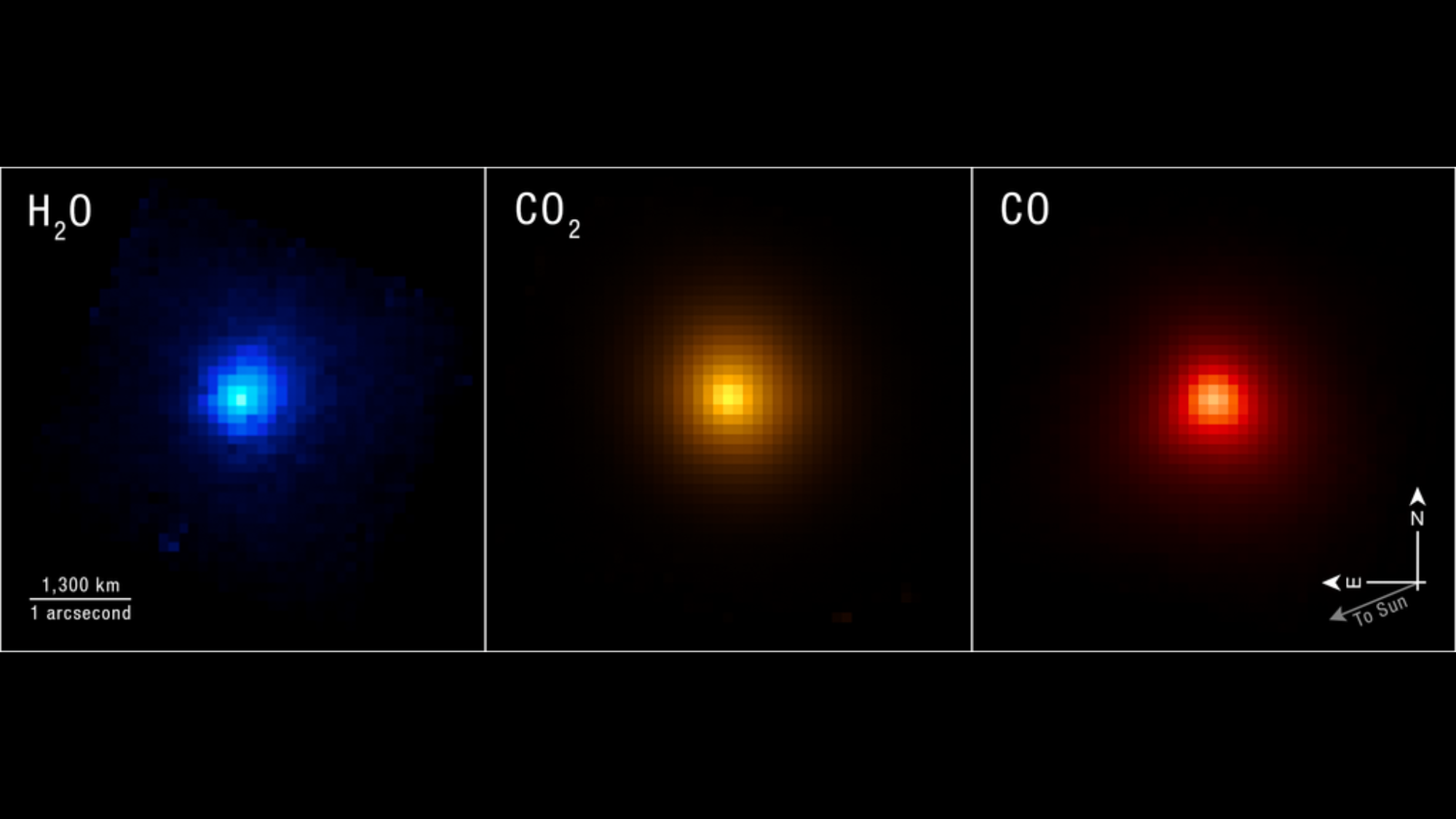
With this view, astronomers were able to calculate some of the ratios of the chemicals present in the comet. This further highlighted that the object is from out of our solar system, as they found ratios of carbon and heavy hydrogen not found in comets in our solar system.
Researchers described their results in a new paper published June 22 in the journal Nature.
Being only the third interstellar object ever found, people were excited about 3I/ATLAS. They were so excited, in fact, that conspiracies about the object sprouted up quickly. Due to it being from outside of our solar system, some claimed that the comet could be some sort of alien spaceship, similar to the initial suspicions about the interstellar object 'Oumuamua found years earlier.
But with new information coming in from space telescopes, and astronomers eager to understand this object better, these clues are leading us closer and closer to the true origins of this strange comet.
On the evening of June 24, 1881, Sir William Huggins directed his reflector, equipped with spectroscopic and photographic tools and located in his private observatory in London, to the head of Comet 1881 III. He captured the first photographic spectrum of a comet, and later analysis of the imagery revealed cyanogen emissions at certain wavelengths.Continue reading "June 24, 1881: First photographic spectrum of a comet"
The post June 24, 1881: First photographic spectrum of a comet appeared first on Astronomy Magazine.
The NSF–DOE Vera C. Rubin Observatory has yet to begin its 10-year Legacy Survey of Space and Time, but it’s already keeping an eye on the sky. Astronomers recently described Rubin’s serendipitous spotting of 3I/ATLAS days before the interstellar object’s discovery.
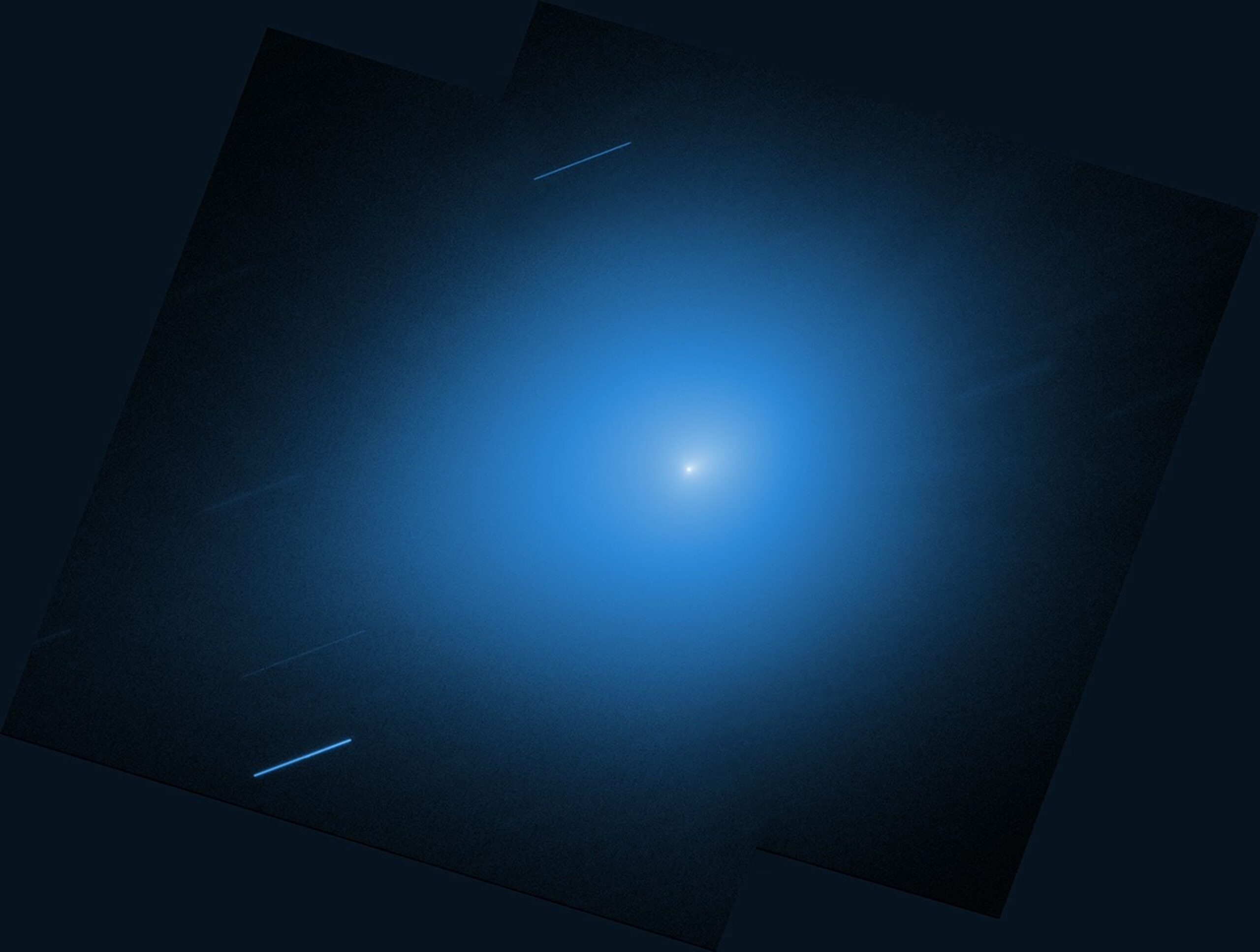
Interstellar comet 3I/ATLAS as seen by the Hubble Space Telescope on 30 November 2025. [NASA, ESA, STScI, D. Jewitt (UCLA), M.-T. Hui (Shanghai Astronomical Observatory). Image Processing: J. DePasquale (STScI)]
Our solar system has been playing host to a rare interstellar tourist: 3I/ATLAS. Just the third known interstellar object to have passed through our star system, 3I/ATLAS was discovered on 1 July 2025 by the robotic telescope network of the Asteroid Terrestrial-impact Last Alert System (ATLAS). After making its closest approach to the Sun in October 2025, 3I/ATLAS is now journeying out of the solar system and is currently located beyond the orbit of Jupiter.
While astronomers would likely grumble about hosting a human guest for nearly a year, they’ve been thrilled with 3I/ATLAS’s lengthy visit and have turned countless telescopes toward the rare interstellar object. They’ve also turned to the archives, searching for pre-discovery sightings of the object — and finding them in the commissioning data from one of the most highly anticipated observatories on the planet: Rubin Observatory.
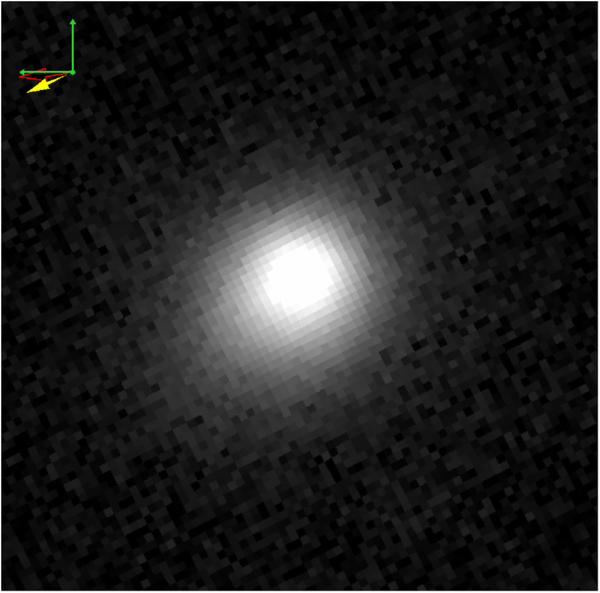
3I/ATLAS as seen by Rubin Observatory on 3 July 2025. [Chandler et al. 2026]
For most of 2025, Rubin was in its commissioning phase, carrying out science validation observations — a critical period during which instruments, procedures, and pipelines are fine tuned, and the quality and quantity of data collection can vary. On 20 June 2025, the very first night of its science validation survey, Rubin happened to turn toward the small patch of sky containing the as-yet undiscovered 3I/ATLAS.
In a recent article, Colin Orion Chandler (LSST Interdisciplinary Network for Collaboration and Computing Frameworks; University of Washington) and collaborators described how they tracked down 3I/ATLAS in Rubin’s commissioning data after the object’s discovery was announced. In total, the observatory serendipitously spotted 3I/ATLAS nine times between 21 June and 2 July, then several more times — some on purpose, some by chance — between 3 and 20 July.
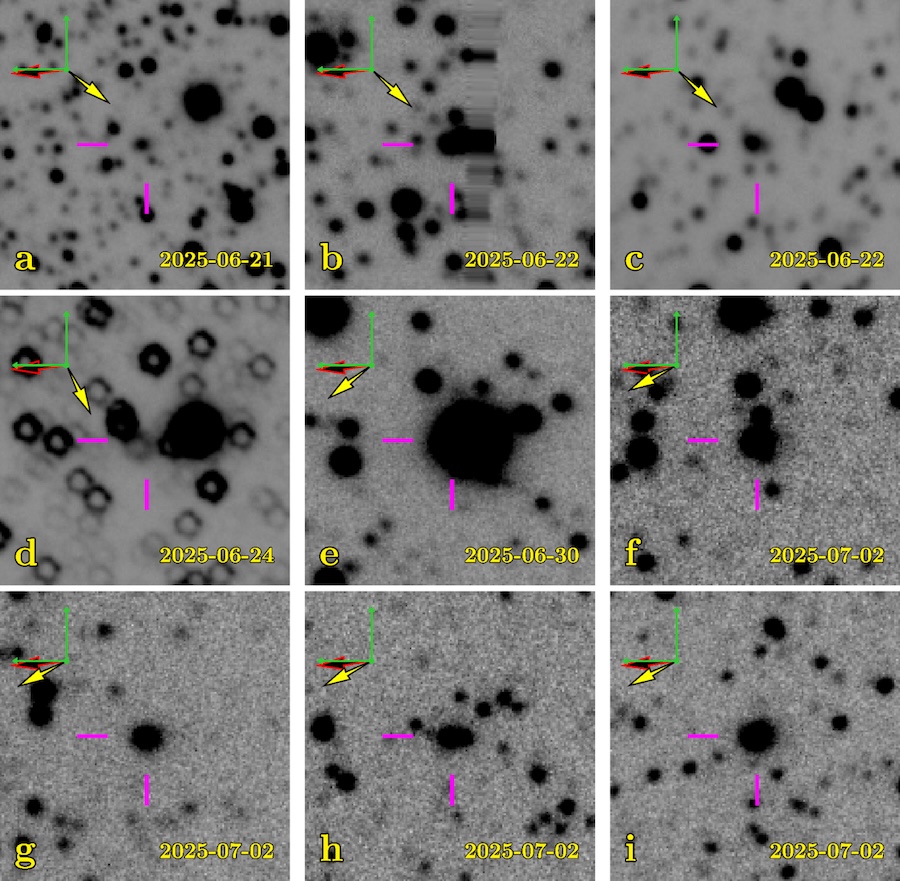
Serendipitous observations of 3I/ATLAS by Rubin. [Chandler et al. 2026]
In their analysis of Rubin’s observations of 3I/ATLAS, Chandler and collaborators found that had the science validation survey started sooner, and had the analysis pipelines been operational, Rubin might have been the first to welcome humanity’s third interstellar visitor. Findings like these heighten the anticipation for the start of the Legacy Survey of Space and Time, during which Rubin will surely build upon its already impressive record of interstellar object observations.
“NSF-DOE Vera C. Rubin Observatory Observations of Interstellar Comet 3I/ATLAS (C/2025 N1),” Colin Orion Chandler et al 2026 ApJL 1001 L35. doi:10.3847/2041-8213/ae4b3a
The post Interstellar Comet 3I/ATLAS Through the Eyes of Rubin Observatory appeared first on AAS Nova.
Researchers tracked the tail of comet C/2023 P1 (Nishimura) as it interacted with a string of coronal mass ejections, leading to the first-ever quantitative analysis of a cometary tail detachment event.
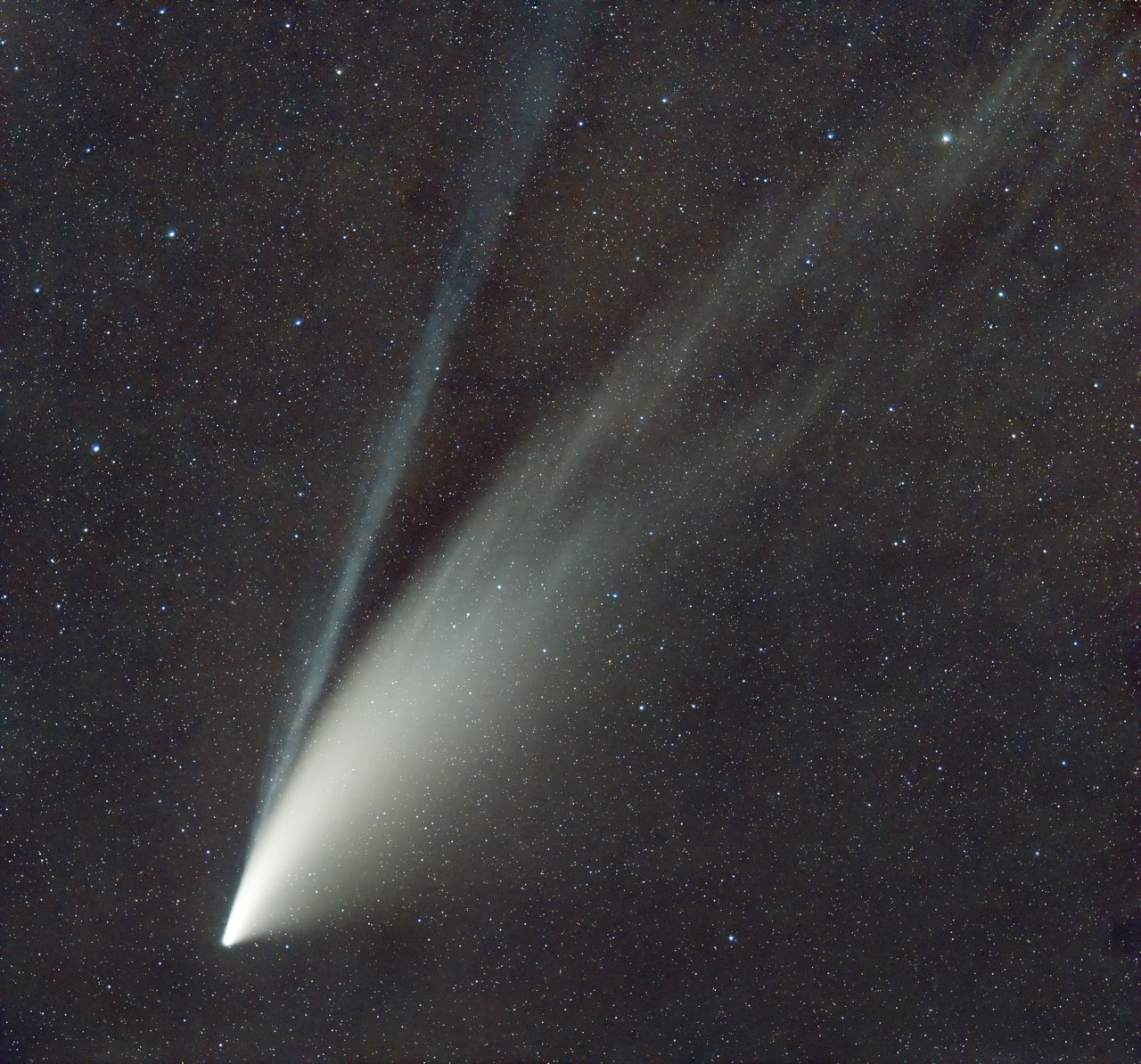
A photo of comet C/2020 F3 (NEOWISE) showing its narrow bluish ion tail and broader white dust tail. [Juan lacruz; CC BY-SA 4.0]
When comets journey into the inner solar system, they tend to do so sporting two tails: a dust tail that sweeps back from the comet along its curved trajectory and an ion tail that points away from the Sun, in the direction of the interplanetary magnetic field.
The ion tail, which forms when ultraviolet light from the Sun ionizes gas in a comet’s fuzzy coma, interacts with structures in the solar wind, causing it to shift, sputter, and sometimes even disconnect entirely. Now, for the first time, researchers have quantified the timescales involved when a comet loses — and regrows — its tail.
Shaheda Begum Shaik (George Mason University; US Naval Research Laboratory) and collaborators studied this phenomenon in observations of the comet C/2023 P1 (Nishimura) from 1 to 14 September 2023. In high-resolution images from the Solar Orbiter Heliospheric Imager, Shaik’s team analyzed the dynamics of C/2023 P1’s tail as the comet braved blustery solar wind conditions in the inner solar system.
In a two-week period, the comet underwent four separate tail disconnection events, in which the connection between the ion tail and the comet was severed. Each of these events coincided with the passage of a coronal mass ejection: a tangled mass of solar plasma and magnetic fields ejected from the Sun’s outer atmosphere.
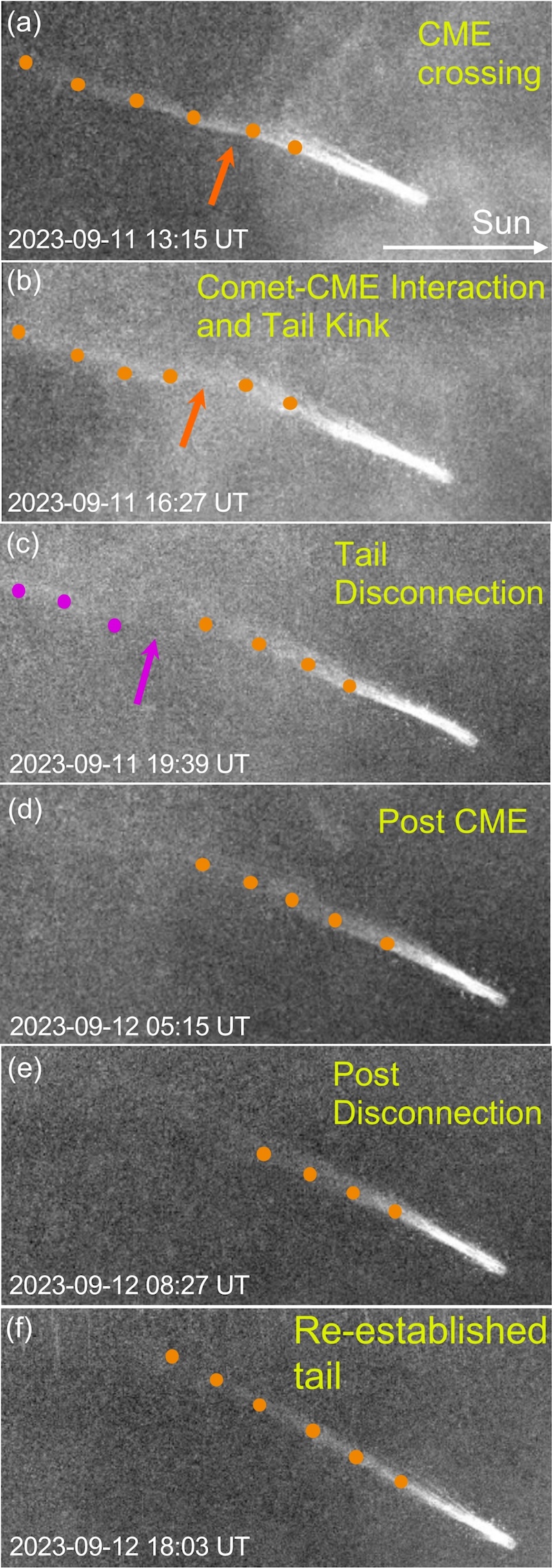
Solar Orbiter Heliospheric Imager observations of the 11 September 2023 tail disconnection event, which was driven by a passing coronal mass ejection (CME). [Shaik et al. 2026]
Focusing on the tail disconnection event with the highest-resolution and highest-cadence data, Shaik’s team observed constant small-scale fluttering of the ion tail, reflecting the buffeting of the tail by the solar wind. The tail then developed a kink, which the team speculated is due to compressed solar wind plasma piling up in front of an oncoming coronal mass ejection. The wide-field images show the coronal mass ejection advancing upon the comet and the comet’s tail seemingly being sliced in two.
The free-floating tail segment sped away from the comet at roughly 295 km/s, likely indicating that the tail became caught up in and was transported by the flank of the coronal mass ejection as it barreled past the comet. The timescale and geometry of the event suggest that the interaction of the coronal mass ejection’s magnetic field with the comet’s tail was responsible for the disconnection.
Over the following 24 hours, the comet’s tail slowly regrew at a rate of 86 km/s to its original length of 1.9 million kilometers. The rate of regrowth is likely determined by several factors, such as the rate at which the comet produces ions and the local magnetic field configuration. This work represents a first look at the quantitative behavior of a tail disconnection event, paving the way for future investigations of cometary behavior and a greater understanding of the complex magnetic and plasma environment of the inner solar system.
“The First Quantitative Study of Cometary Tail Regrowth Following a Coronal Mass Ejection-Driven Disconnection Event,” Shaheda Begum Shaik et al 2026 ApJ 999 60. doi:10.3847/1538-4357/ae3bdb
The post Comets Are Lizards: Watching C/2023 P1 Regrow Its Tail appeared first on AAS Nova.
Editor’s Note: After a short hiatus, the Monthly Roundup is back! This series of articles, which began in 2023, examines multiple perspectives or findings on a single topic.
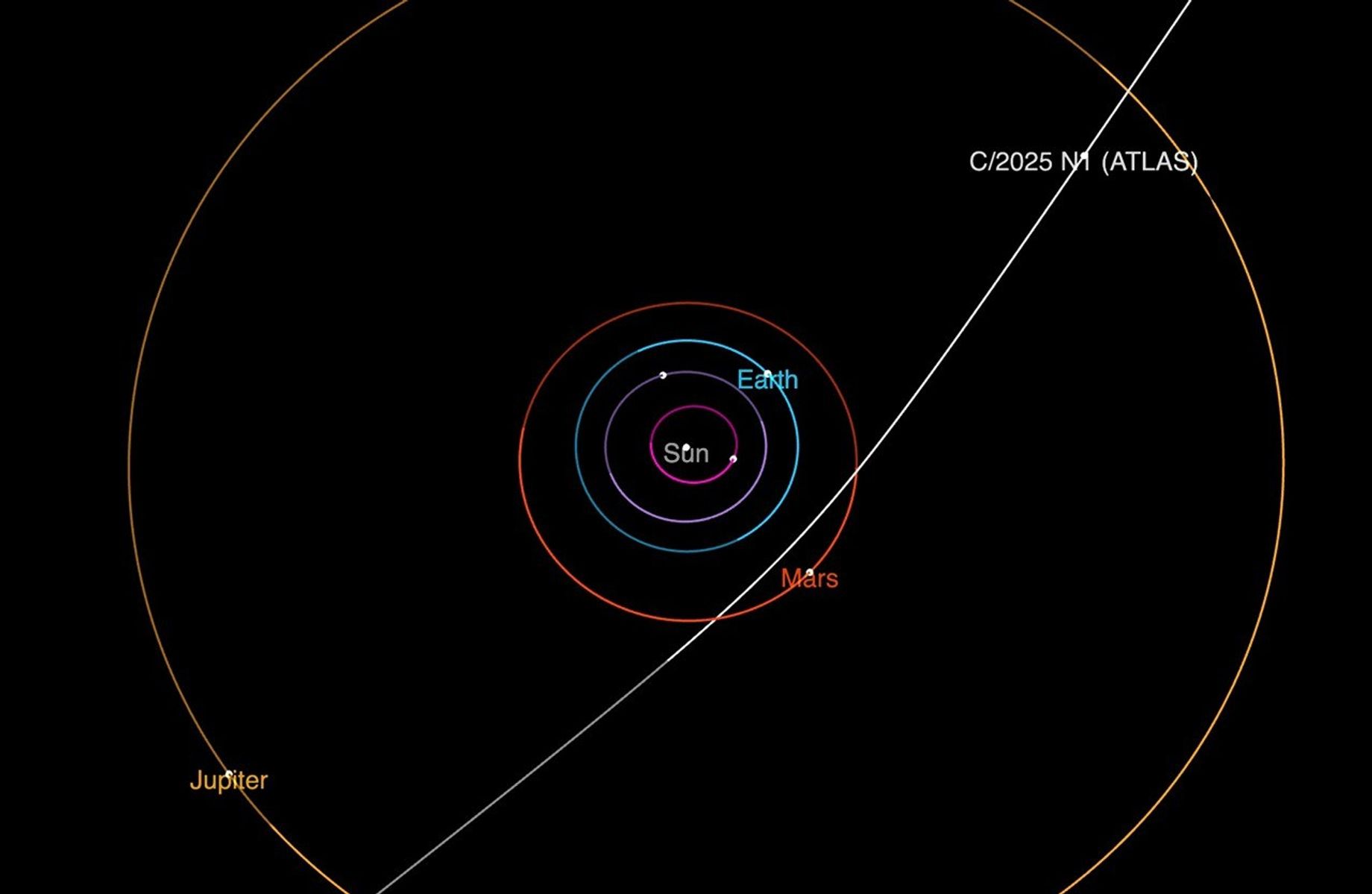
Interstellar object 3I/ATLAS’s trajectory through the solar system. Click to enlarge. [NASA/JPL-Caltech]
Last summer, professional and amateur astronomers worldwide rolled out the red carpet in 3I/ATLAS’s honor, enlisting a pack of ground-based and spacefaring paparazzi to capture its every move. Observations in the first few months after 3I/ATLAS’s discovery revealed cometary features, including a fuzzy coma of gas and dust, a tail that trailed behind the object, and a plume of dust on the side facing the Sun.
With 3I/ATLAS having now made its closest approach to the Sun, venturing within 1.36 au of our star on 29 October 2025, the comet is wrapping up its tour of the solar system and heading back out to interstellar space — but the research continues. Today, we’re taking a look at five of the more than three dozen research articles published in the AAS journals that have examined 3I/ATLAS and its journey through our solar system. As always, this Monthly Roundup contains only a short summary of each article, so be sure to check out the full research articles linked at the bottom of this post!
Bin Yang (Diego Portales University and the Planetary Science Institute) and collaborators obtained spectra of 3I/ATLAS less than two weeks after it was discovered, when it was 4.0–4.4 au from the Sun. Using the Gemini South telescope and the Infrared Telescope Facility (IRTF), Yang’s team sought to characterize its coma, the dusty envelope of gas that puffs out from the icy nucleus as the comet warms up.
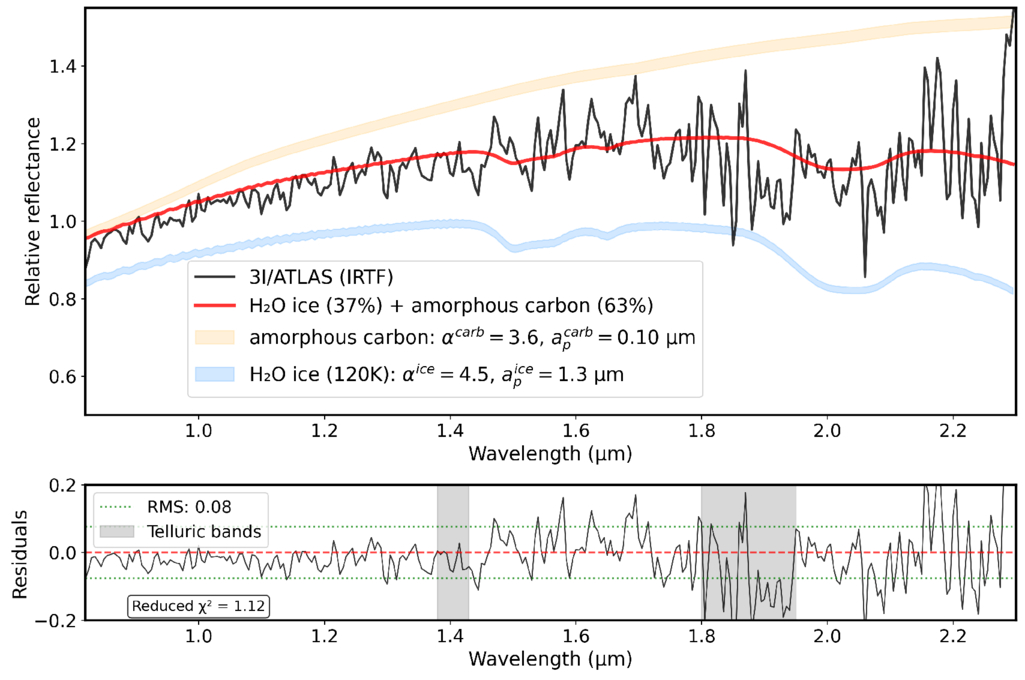
IRTF spectrum of 3I/ATLAS (black line) with the best-fitting model (red line). Click to enlarge. [Yang et al. 2025]
Yang and coauthors found that the near-infrared spectrum was well fit by a model including a blend of amorphous carbon and water ice (63% carbon and 37% water ice by volume) at a temperature of 120K. 3I/ATLAS’s spectrum bears certain similarities to well-studied solar system comets like C/2006 W3 and 6P/d’Arrest, which suggests that the particles in these objects’ comae are similar in size or composition. Ultimately, the discovery of abundant water ice in 3I/ATLAS’s coma, along with the carbon dioxide spotted in other studies, suggests that the comet formed in the cold, volatile-rich outer regions of its home system.
3I/ATLAS is the second interstellar object for which astronomers have obtained polarization information. The first, 2I/Borisov, showed a high degree of positive polarization, comparable to the exceptional solar system comet Hale–Bopp.
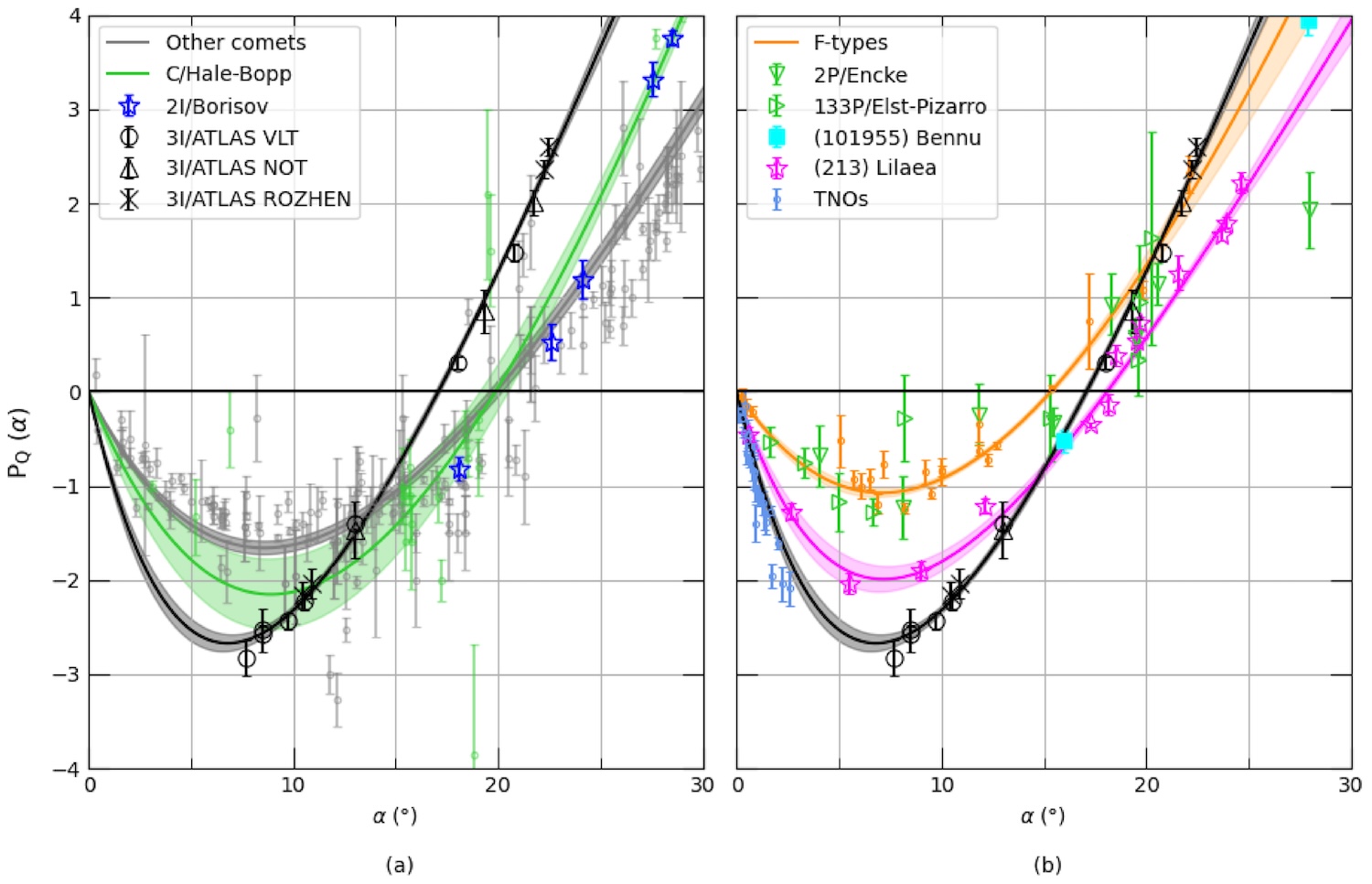
Comparison of 3I/ATLAS’s polarization (black) to measurements of 2I/Borisov (blue) as well as solar system comets and asteroids. Click to enlarge. [Gray et al. 2025]
Gray’s team suggested that 3I/ATLAS’s extreme polarization behavior could be evidence for a mixture of large icy and dark particles in its coma. It’s also possible that it’s the first identified member of a new class of comets, distinct from both solar system comets and interstellar comet 2I/Borisov.
Interstellar objects like 3I/ATLAS have been hailed as pristine beacons that grant us a rare glimpse into the conditions of other star systems. But as new work by Romain Maggiolo (Royal Belgian Institute for Space Aeronomy) and collaborators shows, 3I/ATLAS was likely greatly altered by its journey through interstellar space.
Spectroscopic measurements from JWST suggest that 3I/ATLAS has extremely high abundance of carbon dioxide and carbon monoxide compared to water. A comet’s chemical abundance ratios can be either inherited from the material from which the comet formed, or they can be due to processing after its formation. The team finds that comet 3I/ATLAS’s extreme abundance ratios can be attributed to the comet being pummeled by galactic cosmic rays — high-energy charged particles — as it cruised through interstellar space.
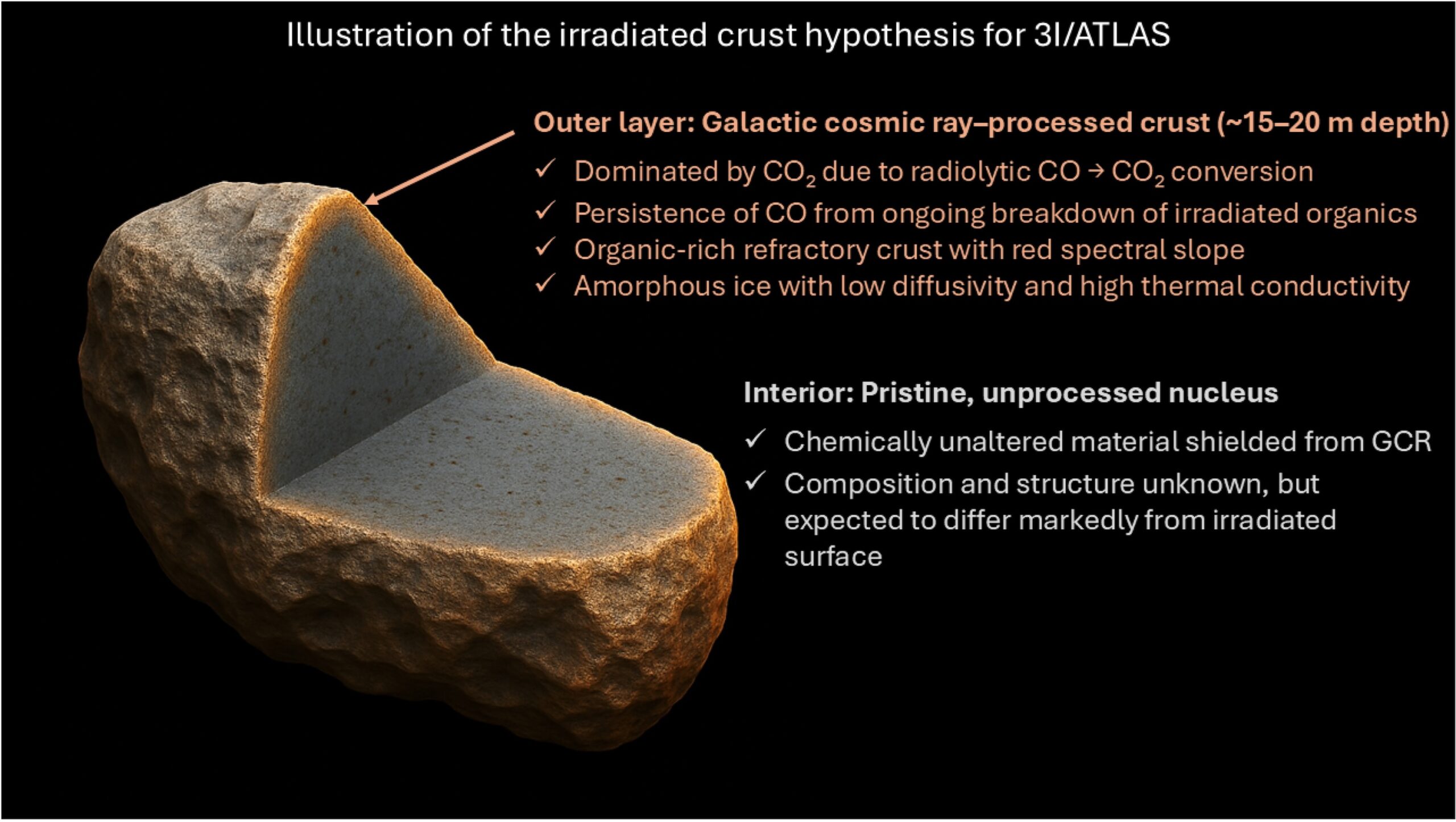
Illustration of the nucleus of 3I/ATLAS, featuring a pristine core encased in a crust that has been irradiated by cosmic rays. Click to enlarge. [Maggiolo et al. 2026]
It’s only a matter of time before the next interstellar object pays our solar system a visit, and researchers are already thinking about how they’ll study the next visitor. One of the best ways to learn about an interstellar interloper would be to send a spacecraft to rendezvous with it and collect data from up close.
To plan for possible future rendezvous, Atsuhiro Yaginuma (Michigan State University) and collaborators considered what it would have taken for an existing spacecraft to meet up with 3I/ATLAS shortly after it was discovered. The team considered ready-to-launch spacecraft on Earth as well as operational spacecraft currently orbiting Mars.
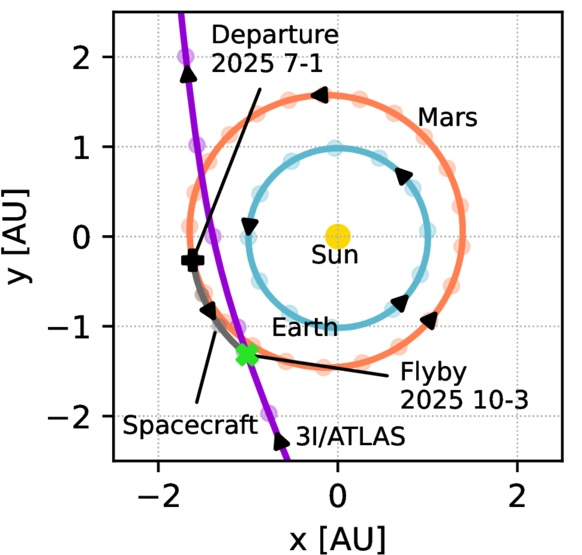
Illustration of the trajectory for the minimum-energy rendezvous with 3I/ATLAS launched from Mars on the day the comet was discovered. [Adapted from Yaginuma et al. 2025]
This highlights the importance of detecting interstellar objects as early as possible, as well as the advantage of stationing well-fueled spacecraft at key locations around the solar system; these spacecraft could be deployed rapidly after an interstellar object is discovered, enabling the collection of valuable data. (This is similar to the premise of the European Space Agency’s Comet Interceptor mission, which will wait at one of the Sun–Earth Lagrange points for the arrival of a long-period comet; such a mission could be repurposed to track down an interstellar comet.)
Like its predecessor 1I/ʻOumuamua, 3I/ATLAS prompted speculation that it’s not a natural object, though there’s no compelling evidence that it’s anything but a comet. If 3I/ATLAS were an interstellar probe, we might be able to unmask it as such by intercepting its radio communications. In a recent Research Note, Ben Jacobson-Bell (University of California, Berkeley) and coauthors described their search for narrow-band radio signals — the communication medium for all spacecraft in our solar system — from 3I/ATLAS.
The Breakthrough Listen project pointed the 100-meter Green Bank Telescope in 3I/ATLAS’s direction, just one day before the object made its closest approach to Earth at a distance of 1.8 au. The team identified nine possible “events” in their data, all of which were ruled to be radio-frequency interference. Based on this non-detection, Jacobson-Bell and collaborators ruled out the presence of isotropic, continuously outputting radio transmitters with power greater than 0.1 watt. (For comparison, a cellphone puts out approximately 1 watt, and spacecraft radios tend to put out a few dozen watts.) Other searches for radio transmissions from 3I/ATLAS have similarly detected no signals.
“Spectroscopic Characterization of Interstellar Object 3I/ATLAS: Water Ice in the Coma,” Bin Yang et al 2025 ApJL 992 L9. doi:10.3847/2041-8213/ae08a7
“Extreme Negative Polarization of New Interstellar Comet 3I/ATLAS,” Zuri Gray et al 2025 ApJL 992 L29. doi:10.3847/2041-8213/ae0c08
“Interstellar Comet 3I/ATLAS: Evidence for Galactic Cosmic-Ray Processing,” Romain Maggiolo et al 2026 ApJL 996 L34. doi:10.3847/2041-8213/ae2fff
“The Feasibility of a Spacecraft Flyby with the Third Interstellar Object 3I/ATLAS from Earth or Mars,” Atsuhiro Yaginuma et al 2025 ApJ 995 64. doi:10.3847/1538-4357/ae11b2
“Breakthrough Listen Observations of 3I/ATLAS with the Green Bank Telescope at 1–12 GHz,” Ben Jacobson-Bell et al 2025 Res. Notes AAS 9 351. doi:10.3847/2515-5172/ae3083
The post Monthly Roundup: Interstellar Visitor 3I/ATLAS appeared first on AAS Nova.
Editor’s Note: For the remainder of 2025, we’ll be looking at a few selections that we haven’t yet discussed on AAS Nova from among the most-downloaded articles published in AAS journals this year. The usual posting schedule will resume January 2nd.
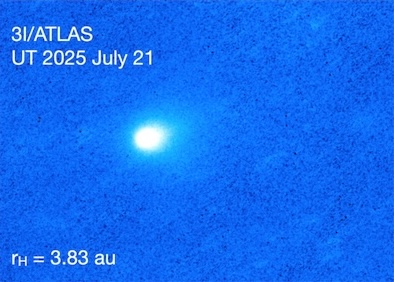
3I/ATLAS as seen by Hubble on 21 July 2025, when the comet was 3.83 au from the Sun. [Adapted from Jewitt et al. 2025]
3I/ATLAS is just the third known object to visit our solar system from another planetary system. With such a small sample size, every interstellar object discovered is a source of fascination. Are these objects more like comets or asteroids? How many of them roam the space between the stars? What, exactly, launches them into interstellar space? Using all available tools, including powerful observatories like Hubble, researchers can extract as much information as possible when interstellar objects make their brief journeys through our solar system, and get us closer to answering these key questions.
After interstellar objects 1I/ʻOumuamua and 2I/Borisov zipped through the solar system in 2017 and 2019, respectively, researchers knew it was only a matter of time before the next interstellar interloper paid a visit. In preparation for the next arrival, Jewitt’s team proposed a target-of-opportunity observation with Hubble. This allowed them to disrupt the telescope’s planned observing schedule once 3I/ATLAS was discovered, getting an early high-resolution look that could guide further observations. Since then, researchers have published more than 30 articles in the AAS journals alone about 3I/ATLAS. In these articles, researchers have sought to understand where 3I/ATLAS came from, investigated its polarization properties, collected JWST data of the object, found it in pre-discovery data, and much more, crafting a comprehensive view of a rare visitor to our neighborhood.
David Jewitt et al 2025 ApJL 990 L2. doi:10.3847/2041-8213/adf8d8
The post Selections from 2025: Hubble Observes 3I/ATLAS appeared first on AAS Nova.
Jupiter dominates the Solar System’s architecture. At about 318 times Earth’s mass and orbiting far beyond Mars, it acts as a gravitational gatekeeper, tugging on asteroids and comets that might otherwise stay put or never reach the inner planets. Remove Jupiter from the picture and Earth’s impact environment would change in complicated ways. It would […]
The post If Jupiter Disappeared Would Earth Face More Asteroid Hits? appeared first on Curiosmos.