❌

Normal view

Distant Galaxies: Dead or in Disguise?

7 July 2026 at 17:00

distant starburst galaxies

Editor’s Note: Astrobites is a graduate-student-run organization that digests astrophysical literature for undergraduate students. As part of the partnership between the AAS and astrobites, we occasionally repost astrobites content here at AAS Nova. We hope you enjoy this post from astrobites; the original can be viewed at astrobites.org.

Title: MAGAZ3NE: Confirming Dust Deficiency and Quiescent Nature of Ultramassive Galaxies at 3 < z < 4 with ALMA Observations
Authors: Wenjun Chang et al.
First Author’s Institution: University of California, Riverside
Status: Published in ApJ

Distant galaxies offer a unique window into how stars, gas, and dust evolve over cosmic time. Tracing this evolution requires understanding not only how galaxies form, but also how and when they stop forming stars, a process known as quenching. Understanding how, when, and why galaxies quench is a fundamental question in astrophysics, and one that requires observations of star-forming, quenching, and fully quenched galaxies alike. Unfortunately, one complication is that identifying truly quenched galaxies is challenging: galaxies that appear “dead” may instead be actively forming stars, hidden behind a thick veil of dust.

In today’s article, the authors use observations from the Atacama Large Millimetre/submillimetre Array (ALMA) to investigate five ultramassive galaxies at redshifts, z, between 3 and 4, and ask a deceptively simple question: are these massive red galaxies genuinely quenched, or are they secretly forming stars behind the scenes?

Meet the Suspects: Ultramassive Galaxies at the Edge of Cosmic Noon

The five galaxies in this study are drawn from the Massive Ancient Galaxies at z > 3 NEar-infrared (MAGAZ3NE) survey, which targets some of the most massive galaxies known at early cosmic times. All five have stellar masses exceeding 100 billion solar masses and have been confirmed at z > 3. At these redshifts, we are observing the galaxies as they were when the universe was less than 2 billion years old. This is just before an epoch known as cosmic noon, when star formation across the universe reached its peak.

These galaxies also benefit from extensive multiwavelength observations from a range of observatories, including the ground-based Visible and Infrared Survey Telescope for Astronomy and the Spitzer Space Telescope. By combining imaging across wavelengths from the ultraviolet to the near-infrared, astronomers can measure the “colours” of galaxies and use these colours to infer the galaxies’ star-forming activity.

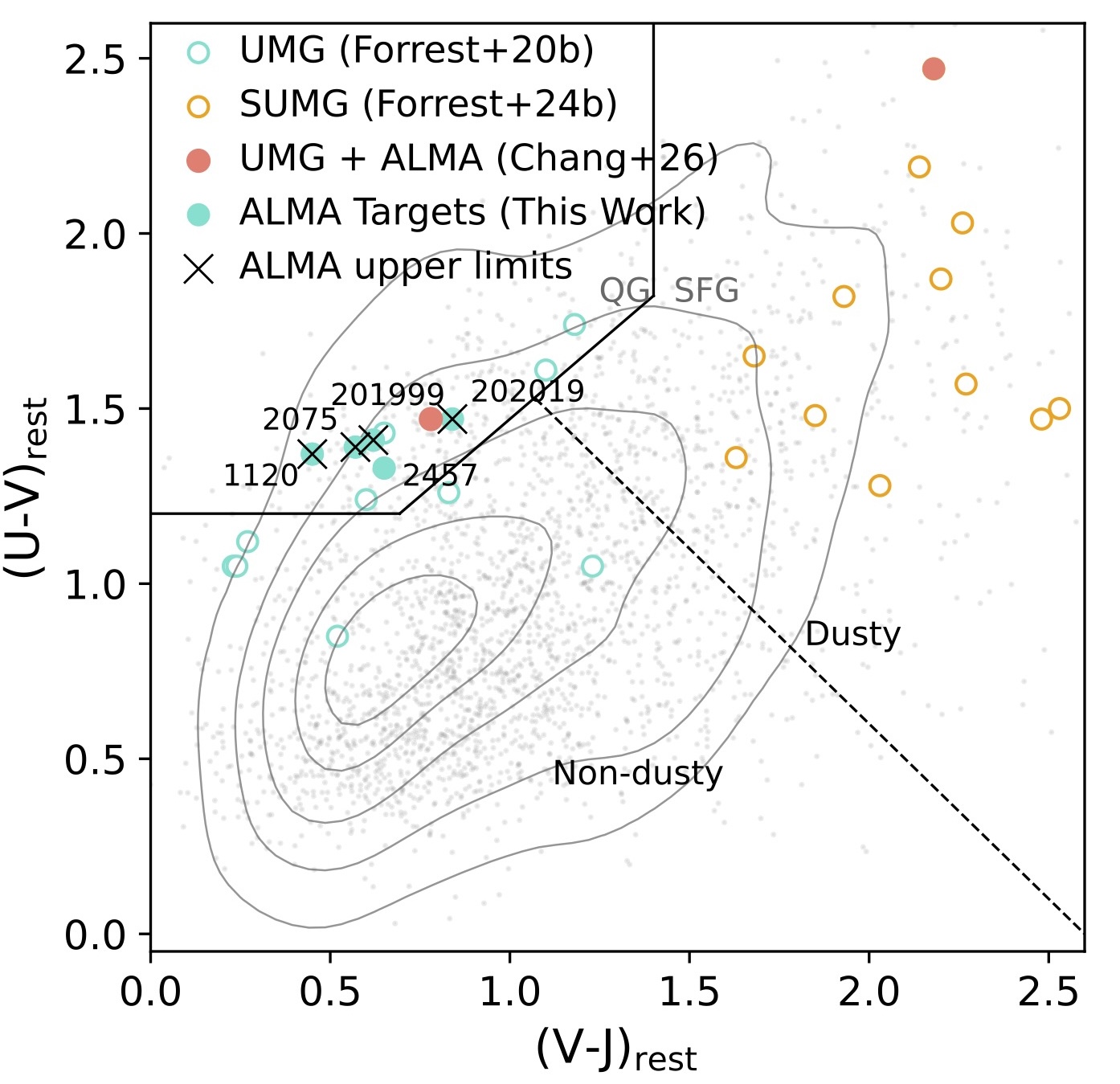
Galaxies that have quenched their star formation are dominated by older stellar populations, which makes them appear red (hence why they are often referred to as “red and dead” galaxies). However, dust can redden galaxies in a similar way by absorbing blue light and re-emitting it at longer wavelengths — meaning that a dusty, star-forming galaxy can easily masquerade as a quenched one. To uncover any hidden star formation, the authors turn to ALMA to search for far-infrared dust emission. The sample of galaxies investigated with ALMA is shown in Figure 1.
UVJ color–color diagram

Figure 1: UVJ colour–colour diagram, which uses galaxy colours in the ultraviolet (U), visible (V), and near-infrared (J) to identify quenched galaxies. The five ultramassive galaxies (UMGs) studied here (filled cyan circles) lie firmly in the quenched region (QG), consistent with a lack of ongoing star formation. Crosses indicate galaxies undetected in ALMA dust emission, while other massive galaxies at similar redshifts are shown in grey for comparison. [Chang et al. 2026]

ALMA on the Scene

ALMA observes light at sub-millimetre wavelengths, which at these redshifts traces emission from star-forming regions that are obscured by dust. Of the five ultramassive galaxies in this sample, only one is detected with ALMA. Even when the remaining four galaxies are stacked together, no dust emission is recovered, indicating that if any dust is present, it must be extremely faint.

To better quantify what these ALMA non-detections imply, the authors perform spectral energy distribution fitting (see a recent overview bite on spectral energy distribution fitting) using the Code Investigating GALaxy Emission, or CIGALE, a code that enforces energy balance between absorbed starlight and dust emission to estimate physical properties such as a galaxy’s star formation rate and dust content. With the ALMA constraints included, all five galaxies are found to lie more than 10 times below the star-forming main sequence. Even the single ALMA-detected galaxy remains formally quenched, showing only weak residual star formation.

In other words, these galaxies really are dead (or at least extremely dormant).

Extremely Dust-Poor Galaxies

The spectral energy distribution fitting also allows the authors to measure how much dust these galaxies contain relative to their stellar mass. This ratio provides a simple but powerful way to assess how much interstellar material remains in a galaxy — and therefore how much fuel is left for future star formation.

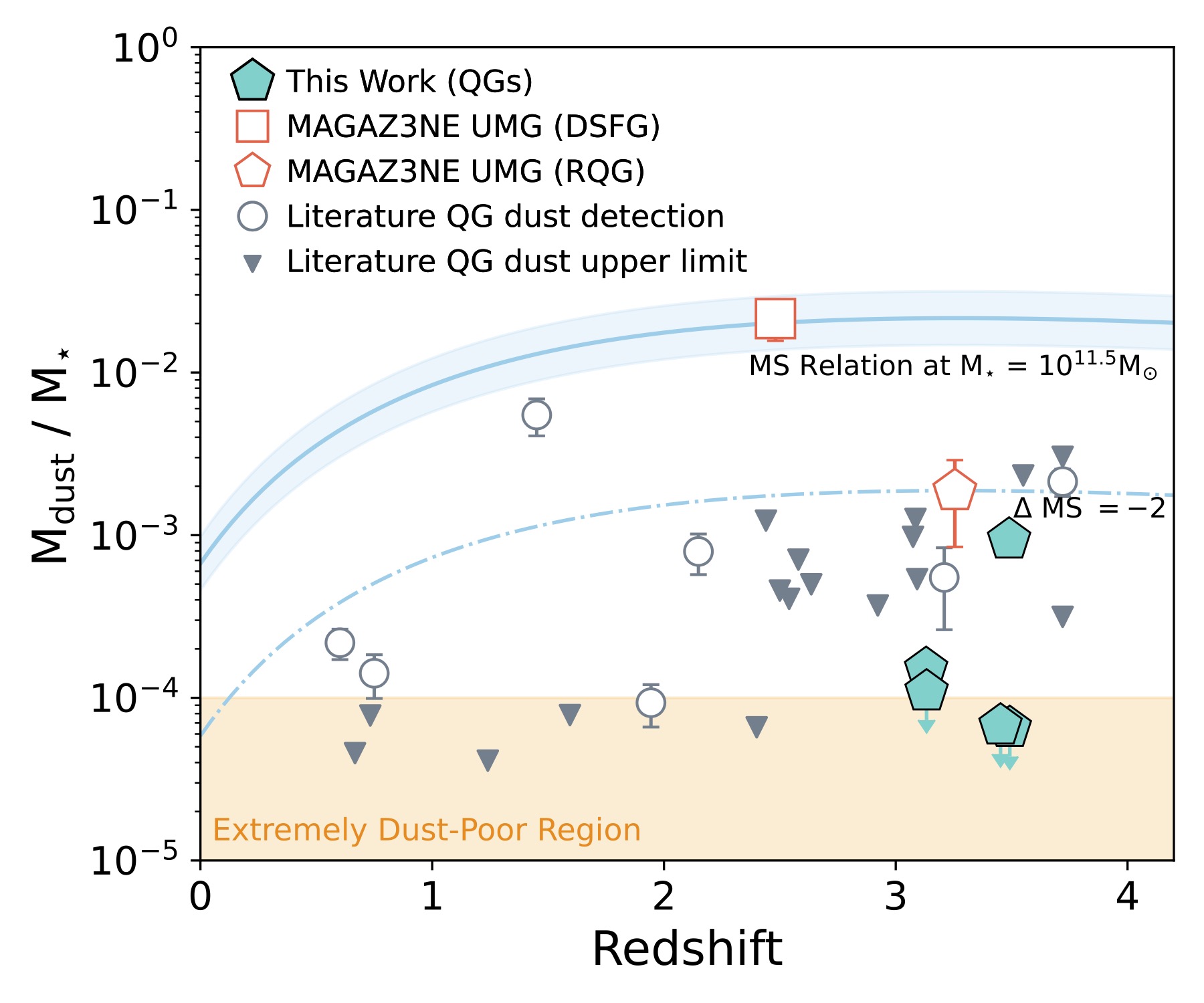
Three of the five ultramassive galaxies have ratios of Mdust/Mstar < 10-4 (Figure 2), placing them among the most dust-poor quenched galaxies confirmed at z > 3. The lone galaxy detected by ALMA contains slightly more dust, with Mdust/Mstar = 10-3, but even this is far below what would be expected for an actively star-forming galaxy. For comparison, typical star-forming galaxies at similar stellar masses host more than 100 times more dust.
Plot of dust-to-stellar mass ratio versus redshift

Figure 2: The ratio of dust mass to stellar mass versus redshift for massive quenched galaxies (QGs). This quantity measures how dust rich a galaxy is compared to its stellar mass. The ultramassive galaxies in this study (cyan pentagons) fall well below the dust content expected for star-forming galaxies (solid blue line), highlighting their extreme dust deficiency. [Adapted from Chang et al. 2026]

These results raise important questions about how galaxies can become ultramassive, quenched, and nearly dust-free within the first two billion years of cosmic history.

For now, ALMA has delivered a clear answer to the question of “dead or in disguise?”: at least some candidate ultramassive galaxies in the early universe really are quenched, and they are strikingly dust poor. By ruling out the dusty impostor scenario, this study shows that deep ALMA observations can cleanly distinguish genuinely quenched galaxies from dusty star-forming ones, even at the highest stellar masses and earliest cosmic times. How these galaxies lost their dust remains an open question, but one thing is clear: by the time cosmic noon arrived, some galaxies had already finished forming stars and quietly faded into dormancy.

Original astrobite edited by Viviana Cáceres.

About the author, Lucie Rowland:

I’m a fourth (and final!) year PhD student at Leiden Observatory in the Netherlands, studying massive, star forming galaxies in the early universe with ALMA and JWST. It’s a really exciting time to be interested in astronomy, so I hope to make groundbreaking new research more accessible!

The post Distant Galaxies: Dead or in Disguise? appeared first on AAS Nova.
Astronomers Finally Find Milky Way’s Missing Black Hole Wind

8 June 2026 at 18:42
This image shows the evidence for the wind blowing away from Sagittarius A*: the white dot in the center of the image shows the supermassive black hole; in orange is data from ALMA, mapping the location of cold gas composed of carbon monoxide in the image; in blue is X-ray data from Chandra; a large cone-shaped cavity, visible as an absence of cold gas in the ALMA data, is filled by hot X-ray-emitting gas in the Chandra data. Image credit: NASA / CXC / UMass / Wang et al. / ALMA / ESO / NAOJ / NRAO / Longmore et al. / Minniti et al.

After a 50-year search, astronomers have uncovered evidence that Sagittarius A* -- the 4.3-million-solar-mass black hole that resides at the center of our Milky Way Galaxy -- is blowing a hot cosmic wind into its surroundings, carving out a giant cavity near the Galaxy’s heart.

The post Astronomers Finally Find Milky Way’s Missing Black Hole Wind appeared first on Sci.News: Breaking Science News.

Hints for Massive Galaxy Evolution from Dusty Star-Forming Galaxies

15 May 2026 at 17:00

NGC 972

How do massive galaxies form and evolve? A recent study traces the stellar and dust distributions across evolutionary phases of massive galaxies to better understand how massive dusty star-forming galaxies fit into the picture.

Dusty Massive Galaxies

Massive galaxies, like the Milky Way or even larger, undergo phases of active star formation and quiescent phases of inactivity, but exactly how these galaxies evolve through these stages is not yet fully understood. Dusty star-forming galaxies, which are undergoing a period of intense star formation and shrouded in dust, might be the missing evolutionary step between star-forming and quiescent phases of massive galaxy evolution. 

Currently, the leading explanation for massive galaxy formation and evolution is inside-out growth — star formation and quenching start in the inner regions of a galaxy and progress outward. However, it’s not clear whether dusty star-forming galaxies also follow the favored inside-out pathway, or if they instead proceed outside-in, first growing their disks and then assembling a central bulge.

JWST NIRCam images

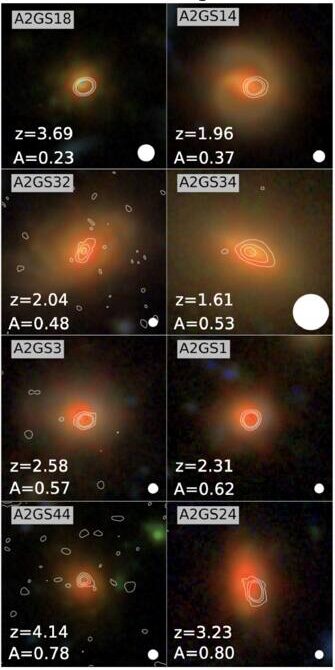
Example of JWST NIRCam images with ALMA contour lines overlaid for select dusty star-forming galaxies in the sample. [Modified from Bodansky et al 2026]

The spatial distribution (or morphology) of the stars and dust within dusty massive galaxies can help us trace their evolution. Thanks to high-resolution observations from JWST and the Atacama Large Millimeter/submillimeter Array (ALMA), researchers can now directly compare the morphologies of distant star-forming, quiescent, and dusty galaxies during the height of our universe’s star formation. Filling this gap will reveal how dusty star-forming galaxies may connect star-forming and quiescent galaxies in massive galaxy evolution.

Multiwavelength Morphological Comparisons

To directly compare the star and dust morphologies across massive galaxies, Sarah Bodansky (University of Massachusetts, Amherst) and collaborators selected a sample of 33 dusty star-forming galaxies from the GOODS-ALMA 2.0 survey that searched the sky for 1.1-mm dust emission as well as star-forming and quiescent comparison samples drawn from JWST observations. Combining the ALMA survey data with JWST imaging, the authors studied the rest-frame optical (stars) and rest-frame near-infrared (dust) morphologies of dusty, star-forming, and quiescent galaxies at redshifts around cosmic noon (a few billion years after the Big Bang).

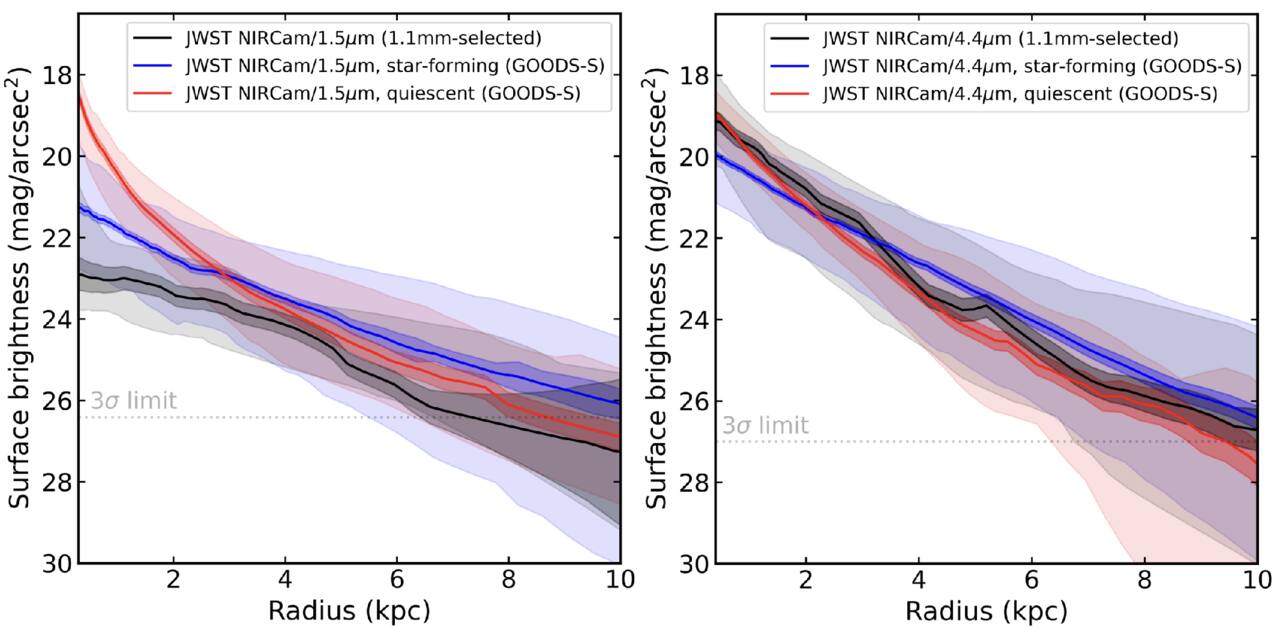
When comparing optical morphologies, the authors found that dusty star-forming galaxies and typical star-forming galaxies had similar distributions, but their near-infrared morphologies showed clear differences. Dusty galaxies tended to show more compact near-infrared emission, with dust tracing their stellar populations and more concentrated in the galaxies’ central regions. Though clearly different from star-forming galaxies, the authors noted striking similarities between the near-infrared morphologies of the dusty star-forming and quiescent galaxies, especially within their centers.

Surface brightness profiles

Average surface brightness profiles for the rest-optical (left) and rest-near-infrared (right) for the dusty (black), star-forming (blue), and quiescent (red) galaxies. In the near-infrared, the dusty star-forming galaxy profile appears very similar to the quiescent galaxy profile. [Bodansky et al 2026]

All of these properties suggest that dusty star-forming galaxies have built up stellar mass and dust in their cores, potentially forming a central bulge first and supporting an inside-out model of massive galaxy growth. This points to dusty star-forming galaxies as possible direct progenitors of early massive quiescent galaxies, hanging onto their last bit of star formation before becoming quiet as well. While this study morphologically distinguishes dusty galaxies from their star-forming and quiescent counterparts, future spectroscopic studies comparing the kinematics of these populations and investigations of molecular gas distributions are necessary to better pin down the evolutionary connection between star-forming, dusty, and quiescent massive galaxies.

Citation

“JWST+ALMA Reveal the Buildup of Stellar Mass in the Cores of Dusty Star-forming Galaxies at Cosmic Noon,” Sarah Bodansky et al 2026 ApJ 1001 235. doi:10.3847/1538-4357/ae4f64

The post Hints for Massive Galaxy Evolution from Dusty Star-Forming Galaxies appeared first on AAS Nova.

A Close Look at an Ancient Moon

5 September 2025 at 17:00

A photograph of a heavily cratered moon on a black background.

By piecing together observations from dozens of radio telescopes in Chile, planetary scientists recently completed the first-ever map of Callisto’s emission at millimeter wavelengths.

Old and Cold

In striking contrast to Io’s frenzied volcanism and Europa’s cracking ice shell, Jupiter’s moon Callisto is much quieter and colder than its Galilean siblings. Though a liquid water ocean hypothetically sloshes beneath its frigid surface, it’d be hard to infer that just by looking at the moon. Callisto’s terrain is ancient, static, and bears the scars of the millennia of exposure to space. There are no volcanoes, plate tectonics, or any other features to disturb what researchers call “evolved ruins” of the numerous craters. These have names like Valhalla, Asgard, and Lofn, since Callisto’s geologic features are named after settings and characters in Norse mythology to further reinforce their freezing existence.

This never-reset canvas makes Callisto an ideal laboratory for studying the long-term effects of asteroid impacts, dust accumulation from nearby natural satellites, and other processes that modify a planetary surface over time. One way to infer the composition and structure of the first few meters of material is to observe the way the temperature changes over the course of a day. For example, ice and rock respond differently to temperature changes; similarly, small-grains of either material warm up and cool down at different speeds than their larger-grain counterparts.

An image of a purple-orange blob against a black background.

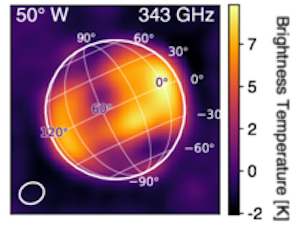
The residuals from one of ALMA’s observations of Callisto. [Adapted from Camarca et al. 2025]

In theory, planetary scientists can measure the temperature of a moon by noting how bright each patch of its surface appears in millimeter-wavelength observations. However, this is easier said than done, as only a handful of telescopes are capable of seeing Callisto as anything more than a fuzzy blob at those wavelengths. Back in 2016–2017, planetary scientists used the Atacama Large Millimeter/submillimeter Array (ALMA), a radio interferometer in Chile, to attempt the challenging feat of making a map of Callisto’s surface.

Mapping from Afar

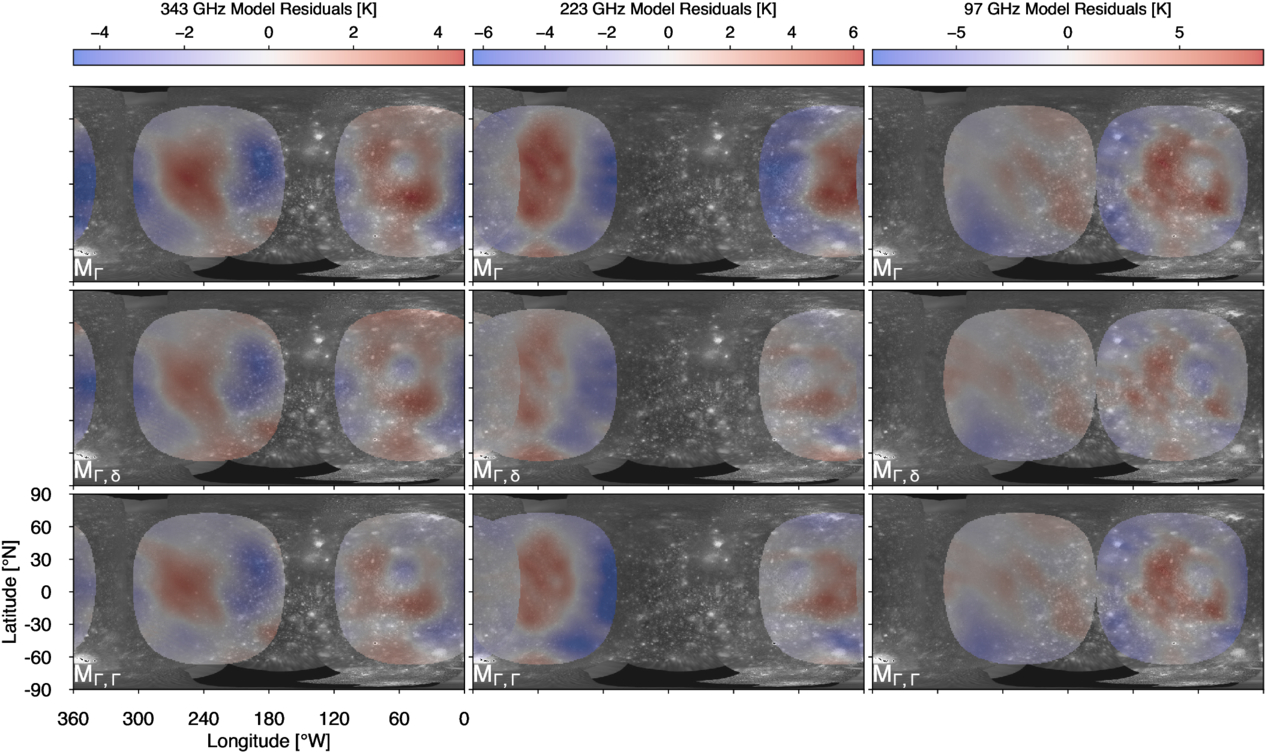
A team led by Maria Camarca, California Institute of Technology, just finished churning through all of the data and assembling their map of Callisto’s temperature residuals. Though the final spatial resolution was at best a few hundred kilometers, meaning a comparable map of Earth would blur all of New England together, this represents the most detailed thermal map of Callisto yet. The map was detailed enough to easily spot the largest craters, and several impact craters including Valhalla stood out as being 3–5K colder than all of the surrounding terrain. The team spotted another anomalously cold region that coincides with the location of maximum carbon dioxide gas density recently seen with JWST.

A multi-panel figure of a black and white surface beneath transparent red and blue blobs.

A map of Callisto’s thermal emission (red/blue) overlaid atop visible images of the surface collected by spacecraft. Click to enlarge. [Camarca et al. 2025]

The team also found that their data could not be explained by a simple model for Callisto’s surface that assumed one dominant material and structure. Instead, their images were better explained by more complex simulations that use two different thermal inertias. Though they are not sure yet why this may be, it is clear that Callisto, often overlooked compared to its flashier siblings, is a complex world worthy of further study. Luckily, the upcoming Jupiter Icy Moons Explorer mission and ALMA’s Wideband Sensitivity Upgrade will bring new knowledge of Callisto’s ancient surface.

Citation

“A Multifrequency Global View of Callisto’s Thermal Properties from ALMA,” Maria Camarca et al 2025 Planet. Sci. J. 6 183. doi:10.3847/PSJ/ade7ee

The post A Close Look at an Ancient Moon appeared first on AAS Nova.

Monthly Roundup: A Deep View of Planet-Forming Disks with ALMA

28 May 2025 at 17:00

radio images of eight protoplanetary disks

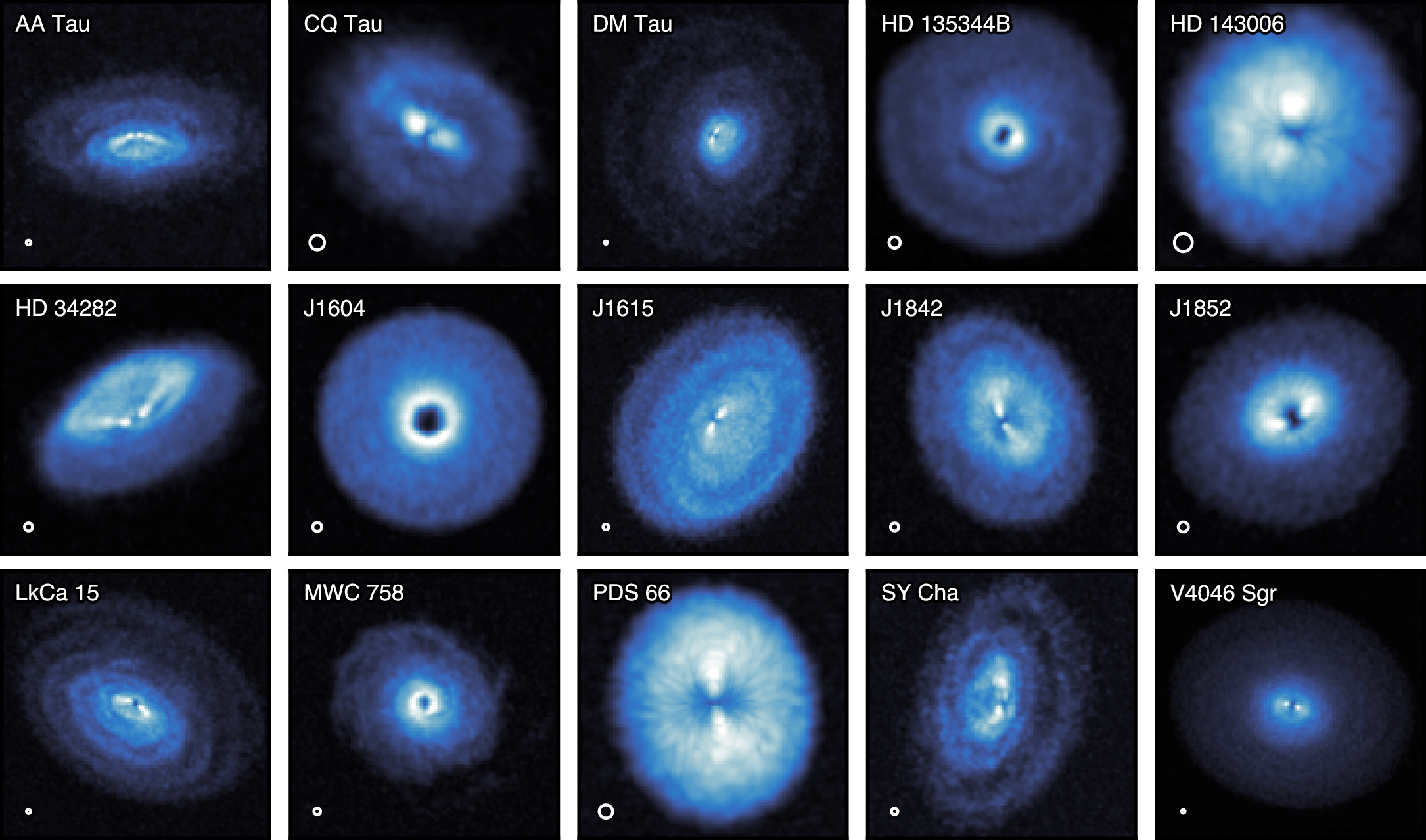
Protoplanetary disks, the sites of planet formation around young stars, are rich and complex objects. An in-depth investigation of 15 protoplanetary disks has recently been published in a Focus Issue of the Astrophysical Journal Letters. This investigation leveraged the exquisite resolution and sensitivity of the Atacama Large Millimeter/submillimeter Array (ALMA), a moveable network of 66 radio dishes in the Atacama Desert in Chile.

Featuring high-resolution observations of multiple gas species, updated image processing techniques, and state-of-the-art modeling, the exoALMA project examines the early stages of planet formation, when protoplanets embedded within dusty disks induce rings, gaps, spirals, and other structures.

This Monthly Roundup consists of quick snippets describing each of the currently published research articles in the exoALMA Focus Issue of the Astrophysical Journal Letters. Each snippet links to the corresponding research article, and the Focus Issue landing page is linked at the bottom of this post.

Introducing exoALMA

exoALMA disks

The full exoALMA sample. All 15 disks show evidence of substructure in their gas emission. [Teague et al. 2025]

First up, exoALMA project PI Richard Teague (Massachusetts Institute of Technology) and collaborators introduced the survey, the disk sample, and the science goals. The team mapped the dust and gas distributions of 15 protoplanetary disks that were selected for their brightness, large size, lack of obscuration, and low inclination angles. The three key science goals were to 1) detect protoplanets hidden within the disks, 2) study the disks’ dynamical structures, especially as these structures relate to instabilities that can perturb the disks and determine their lifetimes, and 3) determine the disks’ density and temperature structure.

Interpreting interferometric data from ALMA requires special care, as Ryan Loomis (National Radio Astronomy Observatory) and coauthors show in their overview of the data calibration and imaging pipeline. The team described their methods of processing the data, including a recently developed alignment method that greatly reduces the number of artifacts that could be mistaken for planet-induced velocity perturbations.

plot of emitting surface of J1615

Emitting height from images processed using the standard method (CLEAN) and using regularized maximum likelihood (RML). [Adapted from Zawadzki et al. 2025]

Although extreme care was taken not to introduce spurious signals through the calibration process, it’s critical to perform additional tests to confirm that detected signals are real, rather than artifacts. To that end, Brianna Zawadzki (Wesleyan University) and coauthors presented exoALMA images processed with a procedure called regularized maximum likelihood. The regularized maximum likelihood–processed images showed the same non-Keplerian features as the images processed with the standard algorithm, suggesting that these features are real.

Analysis Methods and Toolkit Testing

Analyzing observations of protoplanetary disks is challenging, motivating Thomas Hilder (Monash University) and collaborators to take the first step toward addressing issues like beam smearing, the creation of probabilistic data products, and incorporating a realistic noise model. Using their newly developed methods, the team analyzed several disks in the exoALMA sample, finding velocity substructures at greater velocities than existing methods.

Vertical structure and Keplerian rotation of the exoALMA sample

Vertical structure and Keplerian rotation of the exoALMA sample as inferred from modeling. Click to enlarge. [Izquierdo et al. 2025]

Andrés Izquierdo (University of Florida; Leiden University; European Southern Observatory) and collaborators described their methodology for investigating gas structure in the exoALMA sample. The team’s fitting method allowed them to separate the contribution of a disk’s front and back sides from the rest of its emission, leading to estimates of the orientation and vertical profile of each disk.

Jaehan Bae (University of Florida) and collaborators drew attention to the tools astronomers use to interpret observations of protoplanetary disks — namely, forward models. Bae’s team used five different hydrodynamics models to simulate a protoplanetary disk harboring an embedded giant planet. Then, they used two radiative transfer models to simulate carbon monoxide channel maps and calculate the temperature of the disk. Finally, they extracted the location of the synthetic planet. This investigation ultimately showed good agreements between the model outputs, showing that any combination of the models tested in this work is suitable.

plots of nonaxisymmetry of the exoALMA sample

Residual signal-to-noise ratio for the exoALMA sample, ordered from least to most nonaxisymmetric. Rings and gaps are marked with solid and dashed ellipses, respectively. Click to enlarge. [Curone et al. 2025]

Seeking Structure

A team headed by Pietro Curone (University of Milan; University of Chile) examined the rich ALMA dataset for signs of structure within the disks. The team modeled each disk with an axisymmetric model, then subtracted off the best-fitting model to reveal substructures and asymmetries in the disks. Several features were revealed, including shadows, offsets between inner and outer disks, spiral structures, and crescent-shaped asymmetries. Though one disk, PDS 66, was apparently without any internal structure, this investigation showed that structures are common in this sample of large, bright disks. Further work is needed, however, to explore whether these features are common in the disk population as a whole.

Maria Galloway-Sprietsma (University of Florida) and collaborators identified the disk surfaces that emit particular spectral lines. The team found that 12CO traced the upper atmosphere of the disks, while 13CO — an isotopologue of the more common molecule 12CO — and CS (carbon monosulfide) probed deeper regions. In addition, nearly all of the disks showed evidence of localized substructure, highlighting the need for theoretical work to explain the wide variety of disk structures and behaviors.

Evidence for Planets

exoALMA images of disks with velocity kinks due to the presence of a planet

From top to bottom: velocity kinks associated with an embedded planet; 12CO observations with the identified velocity kinks; filtered ALMA observations, showing the location of the planetary wake; exoALMA continuum emission; and polarimetric images. The blue circles show the locations of the purported planets. Click to enlarge. [Pinte et al. 2025]

Christophe Pinte (University Grenoble Alpes; Monash University) and collaborators analyzed substructures revealed by 12CO emission. These images revealed arcs, spiral arms, and kinks in 13 out of the 15 disks in the sample. Of these, six were consistent with wakes forming due to planets with masses between 1 and 5 Jupiter masses orbiting at 80–310 au.

Charles Gardner (Rice University; Los Alamos National Laboratory) and coauthors focused on LkCa 15, a disk that appears markedly different in dust and gas emission. The disk’s dust continuum emission shows a 40-au-wide region depleted of dust, while the gas emission, traced by CO, shows no depletion of gas in the same region. Though previous infrared observations have suggested that this dust-depleted region could host massive planets, Gardner’s team concluded that a chain of small planets or processes unrelated to planet formation likely excavated the region instead.

A team led by Jochen Stadler (Côte d’Azur University) searched for deviations from Keplerian rotational velocity — potential evidence for embedded protoplanets. The team discovered deviations up to 15% from the background velocity, with deviations appearing at both large and small radial scales. Rings and gaps visible in the dust emission tended to align with gas pressure maxima and minima, respectively. However, the team also found gas pressure structures in the outer disk that were beyond the dust emission and were not accompanied by rings or gaps.

Comparison of kinematic and emission-line-derived masses for the exoALMA sample

Comparison of kinematic and emission-line-derived masses. Click to enlarge. [Trapman et al. 2025]

Masses and Abundances

A team led by Cristiano Longarini (University of Cambridge; University of Milan) put the disks of the exoALMA sample on the scale. By modeling the rotation curves of 12CO and 13CO, the team constrained the masses of 10 disks and their central stars. Leon Trapman (University of Wisconsin-Madison) and collaborators also considered the problem of disk masses. The team used CO and N2H+ emission to measure the gas masses of 11 disks in the exoALMA sample and compared the results to previous kinematic measurements. The two sets of measurements tend to agree within a factor of three.

Giovanni Rosotti (University of Milan) and collaborators introduced a new model that connects the emitting height of CO molecules to the gas surface density and temperature. Unlike existing models, the team’s new model can be applied to optically thick observations. Comparing the results of this new method with dynamical estimates relying on interstellar medium abundances of CO yields lower gas masses, suggesting that the CO abundance in the protoplanetary disks studied is depleted relative to the interstellar medium.

Turbulence, Traps, and Vortices

Protoplanetary disks are expected to experience turbulence, large-scale gas motions, and instabilities. Marcelo Barraza-Alfaro (Massachusetts Institute of Technology) and collaborators investigated whether a program like exoALMA could detect signs of these processes at work. The team used 3D numerical simulations to explore the observational signatures of the vertical shear instability, the magnetorotational instability, and the gravitational instability. They found that rings, arcs, and spirals can arise from instabilities. While spirals present in the disks in the exoALMA sample could feasibly be due to the magnetorotational instability or the gravitational instability, ring-like and arc-like features due to the vertical shear instability were not detected.

Tomohiro Yoshida (National Astronomical Observatory of Japan; The Graduate University for Advanced Studies) and collaborators reported on their detection of pressure-broadened emission-line wings in RX J1604.3−2130 A. This detection allowed the team to constrain the disk’s gas surface density — a critical property related to the mass available to form planets. They also clearly showed a dust ring coinciding with a gas pressure maximum, proving that gas pressure maxima can create dust traps. The gas-to-dust surface density ratio at the location of this dust trap suggests that the disk has already birthed protoplanets or the dust trapping efficiency is low.

dust crescents in four protoplanetary disks

Locations of crescent-shaped dust clumps in the four disks from this study. Click to enlarge. [Adapted from Wölfer et al. 2025]

Vortices are theorized to shepherd dust grains into crescent-shaped traps, providing an environment for dust grains to clump together and grow into planetesimals and eventually planets. Lisa Wölfer (Massachusetts Institute of Technology) and collaborators searched for kinematic signatures of dust-trapping vortices in CO line emission from four disks that exhibit crescent-shaped concentrations of dust. None of the four disks exhibited the clear signature of a vortex, and higher-resolution data or observations of emission lines that trace motions closer to the midplane of the disk may be necessary to probe this signal further.

The full list of articles in this Focus Issue can be found here.

Citation

“exoALMA. I. Science Goals, Project Design, and Data Products,” Richard Teague et al 2025 ApJL 984 L6. doi:10.3847/2041-8213/adc43b

The post Monthly Roundup: A Deep View of Planet-Forming Disks with ALMA appeared first on AAS Nova.

❌