A new UC Irvine–led poll released four months before Election Day suggests Orange County remains a rare political battleground, with the governor’s race hovering near statistical dead heat. In a June 9–12 field survey of 809 Orange County adults, likely-voter preferences put Republican Steve Hilton ahead of Democrat Xavier Becerra, 47% to 44%, well within a reported ±4.2 percentage-point margin of error.
The deeper story is turnout mechanics. Becerra performs best among groups that report lower voting certainty—Latino and Asian-American respondents, women, and Independents—while Republicans show higher levels of commitment. Only about half of Independents say they are absolutely certain to vote in November, compared with roughly three-quarters of Republicans and Democrats, raising the possibility that the election hinges more on who shows up than on who is preferred.
Orange County’s issue landscape narrows to a single dominant demand: housing costs. Sixty-one percent of residents name housing among the top problems facing California, and 37% identify it as the single most important issue—nearly double the next closest category. That cross-cutting salience persists despite demographic and partisan differences, making housing the campaign’s defining scalar variable.
The electorate also shows a structural shift. Independents now match Democrats as the county’s largest bloc, leaving Republicans virtually tied. The resulting near-perfect three-way split—34% Democrat, 34% Independent or other, 32% Republican—mirrors the March 2026 results and reinforces Orange County’s classification as a highly competitive electorate.
Generation appears to be the strongest cleavage dimension. Approval for President Donald Trump ranges from 14% among Gen Z to 53% among Baby Boomers, while voting certainty spans from 45% (Gen Z) to 87% (Boomers). Explanations for skipping the June primary cluster around forgetfulness, registration barriers, and skepticism about vote efficacy, especially among younger and Independent residents.
Racial and ethnic patterns complicate conventional realignment narratives. Although Latino and Asian-American groups are becoming more independent rather than simply shifting left or right, their head-to-head lean remains Democratic in candidate matchups. However, the turnout gap—about half of Latino residents and 59% of Asian-Americans reporting absolute voting certainty versus 82% for White respondents—may determine which coalition converts into votes.
Gender divides are consistent across the ballot. Men back Hilton by 14 points, while women support Becerra by 8 points, and approval of Trump and opposition to Governor Gavin Newsom track similarly by gender. Unlike generations, however, the gender gap does not translate into different turnout intentions, with roughly two-thirds of both men and women expressing absolute certainty to vote.
Finally, perceptions of institutional direction show persistent anxiety. Around two-thirds of respondents say the United States is headed in the wrong direction, while California fares only slightly better. Locally, optimism is more stable and surprisingly bipartisan, suggesting that residents may differentiate between county-level functioning and national or state governance.
Subject of Research:
Political science / Public opinion (elections; social surveys)
Article Title:
Orange County’s governor race remains a statistical toss-up as housing dominates public priorities
News Publication Date:
Today (June 9–12 field dates; exact publication date not specified)
Web References:
https://sites.uci.edu/ocpoll/
References:
UC Irvine School of Social Ecology “UCI-OC Poll” (fielded June 9–12 among 809 Orange County adults)
Image Credits:
Not provided
Keywords:
public opinion, elections, housing affordability, voter turnout certainty, political polarization, Independents, generational gap, gender gap, Orange County
July’s full Buck Moon, the second full moon of summer in the Northern Hemisphere, will turn full on Wednesday (July 29). It will be the final full moon before a flurry of solar and lunar activity — notably, a total solar eclipse caused by the new moon on August 12, and a partial lunar eclipse during the following full moon on August 28.
Named for the new antlers that emerge from male deer during summer, July’s full moon is also known as the Thunder Moon and Hay Moon, according to Time and Date. The Anishinaabeg people call it Miin Giizis, or Berry Moon, according to the Center for Native American Studies.
The Buck Moon will be at its fullest at 10:37 a.m. EDT on Wednesday — however, it will also look bright and full on Tuesday and Thursday night. From North America, the best time to see it will be at moonrise in the southeast during dusk on Wednesday evening. The exact time of moonrise will depend on your location. A full moon looks most dramatic as it first appears above the eastern horizon shortly after sunset, with Rayleigh scattering making it loom orange — the same light-scattering phenomenon that makes the sky blue and sunsets red.
July's full moon is one of the lowest full moons of the year as seen from the Northern Hemisphere because it occurs relatively soon after the June solstice. A full moon always sits opposite the sun, so the path of July's full moon mirrors the sun's path in February.
Two weeks after theBuck Moon, the new moon will slide directly between Earth and the sun, causing a total solar eclipse. Observers along a narrow path of totality in eastern Greenland, western Iceland and northern Spain will see the moon block the sun for a few minutes, revealing the solar corona.
A deep partial solar eclipse will be visible across Europe, with a small partial solar eclipse observed over Canada and the northeastern U.S.. The largest eclipse in Canada will be 93% in northeastern Nunavut, while northeastern Maine in the U.S. will see 29% of the sun covered by the moon. Solar eclipse glasses must be worn at all times to safely view the partial phases.
The next full moon, the Sturgeon Moon, will rise on August 27 and be partially eclipsed by Earth overnight. More than 96% of the moon will pass into Earth's shadow as seen from Europe, Africa, North America and South America.
How much do you know about the moon? Test your lunar smarts with our moon quiz!
In a string of a dozen small galaxies hung in the sky like a row of cosmic fairy lights, astronomers have discovered a small, ghostly galaxy without any dark matter. The rare discovery offers additional evidence that violent galactic collisions can knock this invisible substance loose from visible matter.
Dark matter acts like cosmic glue, accumulating in "halos" in which galaxies form. It makes up about 85% of all the matter in the cosmos, meaning all the stars and other celestial objects we see account for a small fraction of the universe's mass. And as astronomer Vera Rubin observed, despite its invisible nature, dark matter seems essential to explain the apparent movement of stars around their galactic centers.
Yet in a study published June 16 in The Astrophysical Journal, astronomers report that a dwarf galaxy called DF9 may be devoid of dark matter, joining a couple of other apparently dark-matter-devoid dwarfs (DF2 and DF4) previously discovered in the same string of tiny, faint galaxies.
"The most surprising aspect is that this finding indicates that an entire trail of galaxies including DF2, DF4, and DF9 formed together in an extreme event producing galaxies not alike any we've ever seen before — the first of its kind," Michael Keim, an astrophysicist at Yale's Graduate School of Arts and Sciences and the study's first author, told Live Science via email. "As a result, they have a ghostly appearance, bright clusters of stars, and a lack of dark matter."
Following a trail of galactic crumbs
To study DF9, the researchers used the Keck Cosmic Web Imager at the W. M. Keck Observatory atop the dormant Mauna Kea volcano in Hawaii. The dwarf galaxy is situated within a long trail of a dozen similarly small, diffuse galaxies in the NGC 1052 field, nearly 70 light-years from Earth.
To calculate the mass of DF9, the researchers measured the motion of its stars by analyzing changes in their wavelengths. The analysis revealed that DF9 has a measly mass of approximately 100 million suns, which is consistent with its visible mass in stars. If it contained the expected amount of dark matter, it would be exponentially heavier, harboring a mass of more than 10 billion suns, the researchers said in a statement.
As revealed over the past decade, at least two of DF9’s nearby galactic siblings also appear to lack dark matter.
A video showing the galactic collision that resulted in this string of dwarf galaxies. (Image credit: Video courtesy of W. M Keck Observatory / Adam Makarenko)
"If DF2, DF4, and DF9 were the only galaxies known, one would not conclude there is any need for dark matter," the researchers wrote in the paper. These three galaxies do not display a mass-based discrepancy based on their visible and invisible matter; their mass, determined by the gravitational motion of their stars, matches their mass as measured by the light emitted from these same stars.
But this is hardly typical among most observed galaxies, especially the tiniest ones. Counterintuitively, low-mass dwarf galaxies such as these often have the highest fraction of dark matter. Because they are not as massive, they have lower escape velocities, allowing supernovas and other "feedback mechanisms," like intense black hole winds, to eject their gas more easily. This mass expulsion typically results in dark matter halos around galaxies that are 100 times more massive than all of a dwarf galaxy's stars, the researchers said.
Dark matter deficiency is linked to a violent past
The team likened this lineup of dwarf galaxies to a miniature version of the Bullet Cluster, located nearly 4 billion light-years from Earth. The collision of two galaxy clusters that created the Bullet Cluster is considered the most energetic event known since the Big Bang, astronomers say, and the massive mashup is responsible for separating the system's gas from its dark matter.
The Bullet Cluster seen by the Chandra Telescope (Image credit: (X-ray: NASA/CXC/CfA/M.Markevitch et al.; Optical: NASA/STScI; Magellan/U.Arizona/D.Clowe et al.; Lensing Map: NASA/STScI; ESO WFI; Magellan/U.Arizona/D.Clowe et al.))
Violent galaxy mergers are widespread in space, suggesting such galaxies without dark matter also may be more common throughout the cosmos than once thought.
"The Bullet Dwarf event in which DF9 is thought to have formed is named after the famous Bullet Cluster wherein the gas of two entire clusters of galaxies was separated out in a similar manner as this 'Bullet Dwarf' collision, so indeed this can occur at much larger scales," Keim explained via email. "But collisions between giant clusters are far less frequent than collisions of individual galaxies."
Yet being able to glimpse DF9 and its linearly laid-out counterparts still required an element of fortune. "High-speed collisions are, nevertheless, somewhat rare," Keim added. "DF9 is 67 million light years away from Earth; based on cosmological simulations, we would expect just 7 or so similar collisions to have occurred within that distance."
Additionally, celestial bodies are always in flux, so finding galaxies devoid of dark matter is difficult for other reasons. For example, they may exist in dense regions, where they are harder to view through the obscuring dust, gas and starlight surrounding them. Or, they may merge with other galaxies that do have dark matter.
The strange separation between dark matter and visible matter in the galaxies of the NGC 1052 field warrants further study, the researchers said. Finding any leftover gas from the collision would provide the "smoking gun" evidence for the collisional origin of this faint string of galaxies.
The astronomers are conducting follow-ups with other observatories, including the new MOTHRA facility, the "world's largest all-lens telescope," which is under construction in Chile. With an array of 1,140 telephoto lenses, "its line mapping sensitivity on large scales — like that of the trail — will be at least an order of magnitude deeper than any other facility," Keim added.
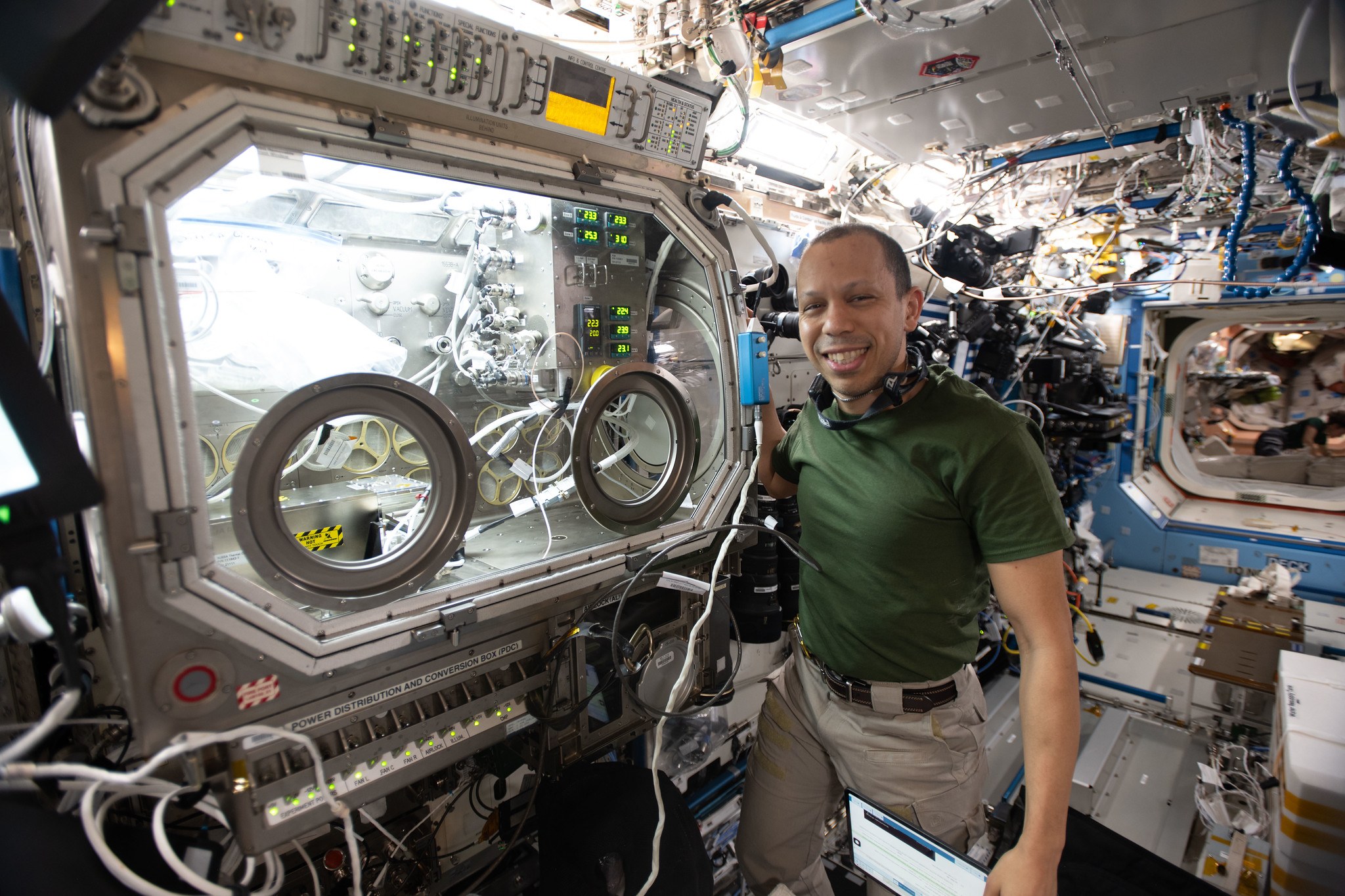
NASA astronaut and Expedition 74 flight engineer Chris Williams shows off the Destiny laboratory module’s Microgravity Science Glovebox aboard the International Space Station. Williams was supporting semiconductor crystal research to help advance the commercial space economy and promote Earth-based industries.
NASA/Chris Williams
NASA astronaut Chris Williams will recap his recent eight-month mission aboard the International Space Station during a news conference at 2:45 p.m. EDT Tuesday, Aug. 4, from the agency’s Johnson Space Center in Houston.
NASA will stream this event live through a variety of platforms. Learn where to watch online:
United States-based media interested in attending in person must contact the NASA Johnson newsroom no later than 5 p.m., Friday, July 31, at jsccommu@mail.nasa.gov.
Media wishing to participate by phone must contact the Johnson newsroom no later than two hours before the start of the event. To ask a question by phone, media must dial into the news conference no later than 15 minutes prior to the start of the call. NASA’s media accreditation policy is available online.
Williams returned to Earth on July 26, after logging 241 days as an Expedition 73/74 flight engineer during his first spaceflight. He returned along with Roscosmos cosmonauts Sergey Kud-Sverchkov and Sergei Mikaev, completing 3,856 orbits of the Earth over the course of their more than 102-million-mile journey. They also saw the arrival of six visiting spacecraft and the departure of eight.
During his mission, Williams supported a wide range of scientific investigations and technology demonstrations. He helped advance research for new cancer treatments and improved in-space manufacturing of materials used in high-performance computers and electronics. Williams also completed two spacewalks to prep for space station power system upgrades and to replace a faulty joint on the Canadarm2 robotic arm. The crew’s work aboard the space station helps improve life on Earth and prepare for future human missions to the Moon and Mars.
To learn more about International Space Station research, operations, and its crews, visit:
NASA astronaut Jessica Meir works inside the International Space Station’s Quest airlock in March, her reflection visible in a spacesuit helmet visor as she installs leg and arm components and swaps parts between suits.
Credit: NASA/Jack Hathaway
Editor’s note: This media advisory was updated July 27, 2026 to reflect an updated start time for the spacewalk on Thursday, Aug. 6.
NASA will provide coverage as astronauts venture outside the International Space Station during three spacewalks in August to continue upgrading solar arrays, replace a communications antenna, and connect power and data cables in support of space station operations.
Experts will preview the upcoming spacewalks during a news conference at 2 p.m. EDT, Thursday, July 30, from NASA’s Johnson Space Center in Houston.
NASA will stream these events through a variety of platforms. Learn where to watch online:
Bill Spetch, deputy manager of Commercial, Low Earth Orbit Program
Chris Dobbins, spacewalk flight director
Chloe Mehring, spacewalk flight director
United States-based media interested in attending in person must contact the Johnson newsroom no later than 3 p.m., Wednesday, July 29, at jsccommu@mail.nasa.gov. Media joining by phone should request dial-in details by the same deadline. To ask a question, media must dial in no later than 15 minutes before the start of the news conference.
Thursday, Aug. 6
NASA astronauts Jessica Meir and Anil Menon will exit the Quest airlock to install hardware that will modify the station’s 3B power channel and prepare it for the future installation of an International Space Station Roll-Out Solar Array (IROSA). The solar array, scheduled for delivery later this year, will be the seventh IROSA and will provide additional power to support critical station operations, including its safe and controlled deorbit.
Watch NASA’s live coverage of U.S. spacewalk 96 beginning at 7 a.m. The spacewalk is expected to start at 8:35 a.m. and last about six and a half hours.
This spacewalk will be the sixth for Meir and the first for Menon. Meir will serve as spacewalk crew member 1 and will wear a suit with red stripes. Menon will serve as crew member 2 and will wear an unmarked suit.
Thursday, Aug. 13
During U.S. spacewalk 97, two astronauts will replace a Space-to-Ground antenna on the orbital complex. The antenna is a critical communication system NASA uses to transmit data and high‑speed communication between the Mission Control Center in Houston and the space station.
Tuesday, Aug. 25
The U.S. spacewalk 98 crew members will connect power channel cables and data relay systems as part of ongoing maintenance, including preparations for the space station’s future deorbit. The astronauts also will replace a navigational aid used for spacecraft docking on the Harmony module’s forward port.
NASA will share additional details about U.S. spacewalks 97 and 98, including timing, assigned crew members, and coverage information, closer to each operation.
The spacewalks will be the 281st, 282nd, and 283rd conducted in support of space station assembly, maintenance, and upgrades.
To learn more about International Space Station research, operations, and its crews, visit:
Two meteor showers will peak together overnight on Thursday, July 30, into Friday, July 31 — but skywatchers should expect a moonlit challenge rather than a dazzling display.
Both the Southern Delta Aquariids and the Alpha Capricornids reach maximum activity just one night after July's full Buck Moon, which turns full on Wednesday, July 29. According to the American Meteor Society, the moon will still be 98% full during the peaks of those meteor showers, meaning bright moonlight will wash out many of the fainter "shooting stars."
This year, the Southern Delta Aquariids are active from July 12 to Aug. 23 and peak on the night of July 30-31. The meteor shower can result in about 25 shooting stars under ideal dark skies, but the full moon makes this year's timing far from perfect. The Alpha Capricornids, which are active from July 3 to Aug. 15 this year, offer around five meteors per hour on the same peak night. That's not many, but the Alpha Capricornid meteor shower is known for bright fireballs — space rocks that shine brightly, and sometimes colorfully, as they catch fire during the plunge through Earth’s atmosphere.
From North America, the moon will appear bright for much of the night around the meteor showers' peak. A nearly full moon does not stop meteors from occurring, but it brightens the sky enough to hide the faintest streaks. That's particularly important for the Southern Delta Aquariids, which can be faint and typically lack fireballs, according to the American Meteor Society. Even still, the overlapping showers make a great night for practicing your meteor shower photography or for taking pictures of the moon.
The best time to try watching will be between midnight and dawn, when the radiant — the point from which the meteors seem to emanate — of the Southern Delta Aquariids, the constellation Aquarius, is highest in the southern sky. Observers in the southern U.S., Mexico and the Caribbean will be better placed than those farther north because Aquarius climbs higher at lower latitudes.
For the best chance of seeing some shooting stars, keep the moon behind you or blocked by a building, tree or hill, and look toward the darkest part of the sky. Meteor showers are always best viewed with the naked eye.
If you're clouded out — or mooned out — during the July meteor peaks, don't worry, as you'll get a better opportunity in August. The Perseid meteor shower will peak overnight on Aug. 12-13, just after the Aug. 12 new moon, when skies will be moonless for the meteor shower's peak rate of 100 meteors per hour.
That same new moon will also cause a total solar eclipse to be visible along a narrow path through eastern Greenland, western Iceland and northern Spain. A partial solar eclipse will be seen from parts of Canada and the northeastern U.S. (Remember to protect your eyes with proper solar eclipse glasses at all times during the partial phases.)
The combination of a solar eclipse and the peak of a major meteor shower will make Aug. 12-13 potentially one of the most exciting days of the year for skywatchers.
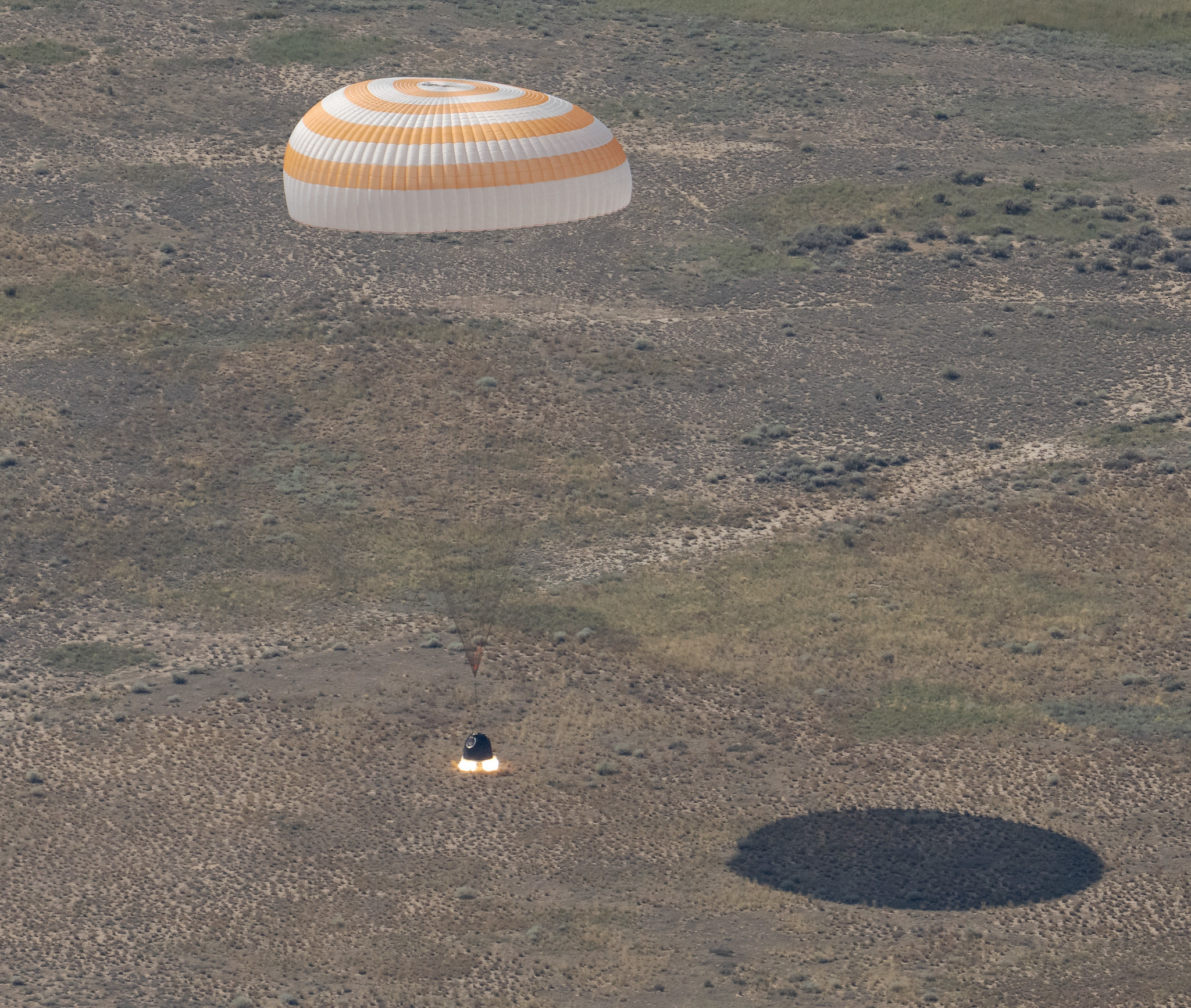
The Soyuz MS-28 spacecraft is seen as it lands in a remote area near the town of Zhezkazgan, Kazakhstan with Expedition 74 NASA astronaut Chris Williams, and Roscosmos cosmonauts Sergey Kud-Sverchkov, and Sergei Mikaev aboard, Sunday, July 26, 2026.
NASA/Bill Ingalls
Concluding an eight-month science mission aboard the International Space Station, NASA astronaut Chris Williams returned to Earth on Sunday alongside Roscosmos cosmonauts Sergey Kud-Sverchkov and Sergei Mikaev.
The crew made its safe, parachute-assisted landing at 5:27 a.m. CDT (3:27 p.m., Kazakhstan time), southeast of Dzhezkazgan, after departing the space station at 2:03 a.m., aboard the Soyuz MS-28 spacecraft.
The crew was in space for 241 days, orbiting the Earth 3,856 times and traveling more than 102 million miles. They launched to the International Space Station on Nov. 27, 2025. The mission was the first for Williams and Mikaev and the second for Kud-Sverchkov.
While aboard the orbiting laboratory, Williams supported a wide range of scientific investigations and technology demonstrations. He helped advance research for new cancer treatments and improved in-space manufacturing of materials used in high-performance computers and electronics. Williams also completed two spacewalks to prep for space station power system upgrades and to replace a faulty joint on the Canadarm2 robotic arm. The crew’s work aboard the space station helps improve life on Earth and prepare for future human missions to the Moon and Mars.
Following post-landing medical checks, the crew members will fly by helicopter to Karaganda, Kazakhstan, where recovery teams are based. Williams then will board a NASA aircraft bound for the agency’s Johnson Space Center in Houston.
For more than 25 years, people have lived and worked continuously aboard the International Space Station, advancing scientific knowledge and making research breakthroughs not possible on Earth. The space station helps NASA understand and overcome the challenges of human spaceflight, expand commercial opportunities in low Earth orbit, and build on the foundation for long-duration missions to the Moon, as part of the Artemis program, and to Mars.
To learn more about International Space Station research, operations, and its crews, visit:
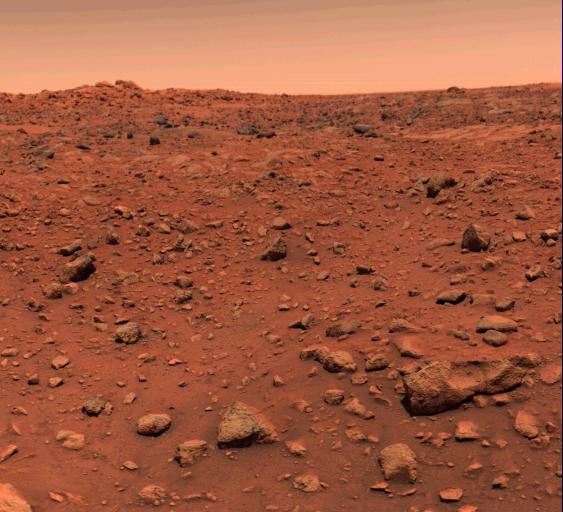
About 40 minutes after it landed on Mars on July 20, 1976, NASA's Viking 1 lander sent this first photo from the surface of the Red Planet. (Image credit: NASA/JPL)
Quick facts
What it is: The surface of Mars
Where it is: 189 million miles (305 million kilometers) from Earth
When it was shared: July 20, 2026.
For thousands of years, humans looked at Mars and wondered what lay on its surface. Fifty years ago this week, we finally found out when NASA's Viking 1 became the first spacecraft ever to land on the Red Planet and transmit images from its surface. It was humanity's first view from the surface of another planet.
Viking 1 had been programmed to take its first image just 25 seconds after touchdown, according to NASA. It occurred at 7:53 a.m. EDT on July 20, 1976 — exactly seven years after Apollo 11 landed on the moon. It was supposed to coincide with the U.S. Bicentennial on July 4, 1976, but the landing was delayed by the search for a flat landing zone.
Although the spacecraft landed safely at Chryse Planitia, north of the equator, mission controllers still had to wait another 19 minutes for the radio signal confirming success to cross the 212 million miles (340 km) between Mars and Earth.
Forty minutes after touchdown, the confirming image began appearing on monitors at NASA's Jet Propulsion Laboratory, slowly building line by line from left to right. Dr. Thomas Mutch, leader of the Viking lander imaging team, never forgot the moment.
"I studied the black screen, waiting for that narrow strip that will signal the first few lines of the first picture," he said. "Rocks and sand are visible and — finally at the far right — one of the spacecraft foot pads, a symbolic artifact that stamps our accomplishment with the sign of reality … Time and time again I repeat, 'It's incredible.'"
The image revealed a solid, slightly rocky surface, with dust and pebbles thrown up by the landing already settling back onto the spacecraft. Viking’s first color image came the next day, with a panorama following a few days later.
The first color image taken by the Viking I Lander in 1976. (Image credit: NASA)
The Viking mission consisted of four spacecraft: two orbiters and two landers. Viking 1 was joined six weeks later on the surface by Viking 2, which landed in Utopia Planitia, also in the northern hemisphere. Meanwhile, the two orbiters mapped Mars and relayed data — including more than 52,000 orbital images and 4,500 photographs from the surface — back to Earth.
Viking transformed our understanding of Mars, but its most intriguing scientific result remains unresolved. The landers carried the first experiments designed to detect life directly in Martian soil. Although the mission's official conclusion was that no convincing evidence of life had been found, some scientists have continued to argue that one of the experiments produced a genuine biological signal; others argue that Viking’s experiments destroyed the very evidence of life that they sought to prove. Discoveries by later missions — including organic molecules detected by Curiosity and perchlorate salts found by Phoenix — have prompted some researchers to revisit the Viking data.
Viking 1 fell silent in 1982, two years after Viking 2, following a software error during an update. The intrepid spacecraft showed us the surface of another planet for the first time, but whether Viking 1 also found the first hints of life off-Earth remains one of planetary science's most enduring mysteries.
What do you know about the Red Planet? Test your knowledge with our Mars quiz!
O app de leitura Instapaper foi atualizado hoje para a sua versão 10.0 com uma série de novidades — incluindo uma interface repaginada e adaptada ao Liquid Glass (e outras mudanças de design em grande parte do app), bem como novos recursos e melhorias de desempenho.
O Menu de Seções, por exemplo, agora pode mostrar as Contagens de seção em todos os lugares, bem como permite ordenar pastas e etiquetas por nome, ordem de adição ou contagem. Também há melhorias na exibição e suporte completo ao Liquid Glass no iPad.
Quando falamos na Lista de Artigos, ela foi redesenhada com um novo modo Condensado, opções de tipografia e uma nova ação de deslize para mover artigos para o topo. Ela também cria automaticamente listas de reprodução a partir da lista de artigos completa.
Por fim, o Leitor agora conta com quatro novas fontes de leitura (Literata, New York, Open Sans e Atkinson Hyperlegible), bem como permite escolher o que é aberto ao se tocar em um artigo (a Vista de Artigo, a Vista Web, o navegador integrado ou o padrão).
Também contando agora com um widget para ver os artigos lidos no momento ou os salvos recentemente, o Instapaper é grátis para baixar na App Store, mas para usá-lo por completo é necessária uma assinatura Premium, que sai por R$10/mês ou R$100/ano.
SpaceX's Friday launch of its massive Starship rocket "went quite smoothly," reports CNN, with a SpaceX spokesperson calling this mission "Lucky Number 13" (as the 13th integrated flight test for a Starship spacecraft with a Super Heavy rocket booster):
During Starship V3's inaugural test, there were numerous engine issues as several on the booster failed to relight and the Starship spacecraft experienced a nail-biting engine outage. SpaceX also was forced to replace six engines on this vehicle ahead of today's flight because of a likely issue with moisture that prevented at least four from starting up correctly during an initial launch attempt last week... [Friday's Super Heavy rocket booster] fired all 33 of its engines in a pristine performance off the launchpad. The rocket booster also managed to relight 13 engines, as planned, to steer itself back toward a controlled landing. Only when Super Heavy attempted to relight its engines for a controlled landing burn over the Gulf waters did problems arise. The landing was still controlled, though Huot said the vehicle was traveling a bit faster than the company had hoped when it made touchdown. (SpaceX always intended to discard this Super Heavy booster in the ocean.)
The Starship spacecraft had no obvious performance issues, making it all the way through its engine burn and managing to reignite one engine mid-flight as part of a test. It also made a controlled splashdown in the Indian Ocean — executing its "softest splashdown" to date in a "dream scenario," according to SpaceX's Dan Huot. The touchdown came about an hour after takeoff, as planned. During its coasting phase, Starship also deployed 20 Starlink test satellites, paving the way for operational missions later down the line in which SpaceX plans to deploy large batches of these satellites in a single launch. In another big win, SpaceX said it was able to make contact with each of those satellites.
CNN adds that SpaceX "is facing intense pressure to get Starship ready for a crucial NASA test flight next year that could pave the way for the next moon landing. This flight was also the first for SpaceX as a publicly traded company. Last week's aborted launch attempt sparked a selloff, and shares are still trading below their IPO price.
"To cap off the roaring success of today's flight test, SpaceX shared some stunning visuals of the upper Starship spacecraft sailing through space."
Astronomers studying the star system CD-35 2722 may have found the first known moon-like object outside our solar system. The classification is unusually tricky, however, because it orbits a brown dwarf rather than a planet, making it clearly an "exosatellite" but forcing scientists to rethink where the line between planet, moon, and failed star should be drawn. Space.com reports: The star CD-35 2722 is located around 73 light-years away and has around half the mass of the sun. It is orbited by a "failed star" or brown dwarf. These stellar bodies get their unfortunate nickname because they form like other stars but fail to gather enough mass to trigger the fusion of hydrogen to helium in their cores. In terms of mass, brown dwarfs are more massive than the largest gas giant planets, but smaller than the smallest stars, usually with around 13 to 80 times the mass of Jupiter, or around 0.013 to 0.08 times the mass of the sun.
The newly discovered object in CD-35 2722 is certainly moon-like, but rather than orbiting a planet as the moons in the solar system do, it orbits the system's brown dwarf. "This system is somewhat hard to define using solar-system-based words like 'planet' and 'moon.' The exosatellite is clearly massive enough to be a planet, but it does not orbit a star, though it orbits an object that orbits a star," team leader Kevin Hoy of the Universidad Diego Portales and the Millennium Nucleus of Young Exoplanets and their Moons (YEMS) in Chile, said in a statement. "Being the third wheel in this system makes us want to call it a moon, even if it is nothing like the small, rocky moons we have in our system."
The team currently isn't able to definitively claim this object in CD-35 2722 is an exomoon, because that would require really nailing down a new definition of what a moon is. "The satellite we report is a giant gaseous body orbiting a highly massive companion, itself several times the mass of Jupiter. We have a clear delineation between the planets and the sun in the solar system, so defining things like moons is simple," team member Alice Zurlo of the Universidad Diego Portales said. "In the CD-35 2722 system, where we are blurring the lines between stars, planets, and moons, the whole thing becomes more complicated to describe." Zurlo and colleagues can, however, confidently claim this is an exosatellite, meaning it is a first-of-its-kind detection no matter what the future holds for its classification.
The findings have been published in the journal Nature.
Researchers in China have cross-calibrated radiation detectors on 25 navigation satellites. Data from two decades of measurements have been combined to create a record of the flux of relativistic electrons that impinges on Earth’s atmosphere. The technique can be applied to other satellite data, and could boost our understanding of the threat that this radiation poses to satellites and shed light on the solar processes that generate the electron flux.
The Global Positioning System (GPS) uses signals from a constellation of satellites to locate the position of receivers on the Earth’s surface to within several metres. There are currently 32 GPS satellites orbiting about 20,000 km above the Earth and each of them carries a radiation detector. These detectors allow scientists to observe changes in radiation levels in space. Much of this radiation comes in the form of high-energy electrons from the Sun, which can disrupt the operation of satellites and even damage them.
The electron flux rises and falls with the solar cycle. This has a period of about 11 years and involves the waxing and waning of sunspots, solar flares and coronal mass ejections.
For those who design and operate satellites, it is crucial to understand this electron flux. However, it has proven difficult to make full use of the data generated by these detectors because the instruments had not been cross calibrated. Indeed, measurement values of high-energy electrons can vary between satellites by several orders of magnitude when the flux is low. One important issue is that not all satellites use the same detectors – with two different instruments having been deployed.
Cross calibration
Now, researchers in China have done a cross-calibration of the particle detectors on 25 GPS satellites. The result is a calibrated dataset of relativistic-electron flux that spans two complete solar cycles (2000–2020).
To do this, the team looked at two different measurements made by the detectors. One is the differential electron flux at 2 MeV arriving from one specific direction. The other is the integral electron flux electrons arriving from all directions at energies greater than 2 MeV.
Because electron flux is affected by Earth’s magnetic field, the team had to consider its effect on measurements. This was done using a concept called magnetic local time, which accounts for the fact that Earth’s magnetic poles are offset from our planet’s axis of rotation.
The team used a satellite called NS59 as the reference for their study because its detector has produced a consistent set of data from 2004 – overlapping in time all other satellites in the study. By doing several statistical analyses, the team was able incorporate data from 24 of the 25 satellites. One detector, however, remained problematic and the researchers recommend that data from this satellite not be used.
The team says that their technique can now be used to cross-calibrate the detectors at other energies – there are 14 differential and 29 integral channels that can be also be analysed. They have already used the same techniques to cross-calibrate the GPS data with measurements made by satellites in China’s BeiDou positioning system and observations made by NASA’s two Van Allen Probes.
Astronomers have raised concerns over a decision by the Federal Communications Commission (FCC) to permit the launch of a private satellite that can reflect sunlight onto the Earth’s surface after dark. Astronomers, however, fear that the mirror, and the several thousand that could follow it, will negatively impact both optical and radio astronomy.
The proposal by the Californian company Reflect Orbital involves putting a mirror-carrying-satellite – Eärendil-1 – into low-Earth orbit. Reflect Orbital aims to use the craft to test technology intended to deliver sunlight to solar farms after sunset, thus expanding the production of solar power at a time of peak demand for electricity.
In orbit, the satellite will unfold an 18 × 18 m aluminiumized Mylar reflector that can deliver a roughly 5 km circular spot of light to the ground with about the brightness of a full Moon.
In addition to providing solar power after dark, the company sees its technology as potentially effective for response to disasters, construction work and outdoor events at night.
Assuming Eärendil-1’s flight proves successful, the company plans to launch 1000 larger satellites in 2028, which would be able to reflect as much light as 100 full Moons with 5000 more satellites two years later.
The FCC has approved only the radio operations of “a single demonstration satellite [that is] an example of a potentially groundbreaking technology”. Other aspects of Eärendil-1, however, do not require official authorization.
Ben Nowak, chief executive and co-founder of Reflect Orbital, sees the licence as “the first step toward rigorously testing our technology’s efficacy and the safeguards we have developed”.
Flash points
Orbiting satellites’ impact on astronomy is hardly a new phenomenon. Their burgeoning number has already reduced observing times for optical astronomers, particularly after sunset.
Following the approval, the American Astronomical Society (AAS) has expressed “dismay” at the FCC’s decision. [Eärendil-1] carries the potential for significant harm to our members and the broader community of those who depend on a dark night sky,” the association says in a statement. “[This] could include damage to sensitive research equipment, potential flash-blinding of pilots and drivers, and potential permanent eye damage to anyone looking through a mid-sized telescope.”
While some satellite owners have been open to working with astronomers to reduce the impact on astronomy, astronomer Marcel Agüeros from Columbia University, who is also president of the AAS, told Physics World that Reflect Orbital “has been far less open” to discussing its plans. “We know nothing about the satellite’s orbit, for example,” adds Agüeros.
DarkSky International, a nonprofit organization that aims to preserve and protect the nighttime environment, has now called on the company to commission a “comprehensive, independent environmental impact assessment conducted by qualified experts”.
“The burden of proof rests with the operator to demonstrate that their system will not cause environmental or public harm, and a full, independent assessment is the necessary first step,” notes DarkSky International.
That move is backed by Agüeros, who adds that there doesn’t seem to have been much thought about the consequences of the FCC’s decision. “When you start to mess with the nighttime, there should be a very high bar you have to clear,” he adds. “We’re losing our ability to experience a dark sky – an experience that gives you a sense of your place in the universe that is pretty much unmatched.”
Reflect Orbital spokesperson Christopher Buscombe told Physics World that the company “care deeply” about the night sky and that they “want to preserve astronomical observation”.
“We’re also working with the National Science Foundation to develop a coordination agreement on these questions and look forward to their input,” adds Buscombe.
For decades, the Outer Space Treaty (OST) has prevented any nation from placing nuclear weapons in space. To date, however, no mechanisms have been put in place to determine whether a signing member’s satellite may be violating this treaty, or even developing other nuclear capabilities that the original treaty never considered.
Through new analysis of the problem, Areg Danagoulian at MIT suggests a safe and feasible approach to monitoring suspicious satellites, using neutrons emitted as radioactive material is impacted by naturally occurring protons in the Van Allen radiation belt.
At the height of the Cold War in the 1960s, there seemed a growing possibility that space could be used as a platform for developing nuclear weapons. With the prospect of nuclear strikes being launched from orbit with practically no warning, both the US and Soviet governments recognised the possibility of miscalculations by either side leading to a catastrophic nuclear conflict.
In 1967, this led to the signing of the OST: which in part, demands that no signing member should ever deploy nuclear weapons in orbit, on celestial bodies or in outer space. Today, it has been signed by 117 countries, including the US, Russia and China. However, in the decades since the treaty’s origins, both political and technological landscapes have profoundly transformed, creating entirely new concerns that nobody could have conceived in the 1960s.
“In 2022, Russia launched the Kosmos 2553 satellite, which the US has determined is a platform for testing components for a future nuclear anti-satellite weapon,” Danagoulian says. With the ability to target orbiting satellites, such a programme could ultimately destroy vital communication and navigation systems – bringing society to a standstill without any direct strike on the ground.
Despite this threat, no robust mechanism has ever been developed for verifying whether a country is violating the OST, and to date, very little research has even considered the problem.
To Danagoulian’s knowledge, the only related study was an undergraduate thesis by Stanford University student Isobel Portenous – who proposed that suspicious satellites could be probed for nuclear material by measuring radioactivity in the vicinity. However, not only is space already highly radioactive, likely drowning out the signal from a single satellite; it would also require spacecraft to closely approach the satellite, which could be interpreted as a hostile act.
To address this challenge, Danagoulian considered how satellites could instead by probed by naturally occurring, highly energetic protons in the Van Allen radiation belt: which mostly originate from the solar wind, and become trapped by Earth’s magnetosphere.
When interacting with nuclear material in a suspect satellite, “these protons would trigger a process known as spallation in the uranium radiation case of the thermonuclear weapon,” Danagoulian explains. “This would produce a large flux of neutrons that can be detected and used as a fairly specific signature of a nuclear weapon.”
Crucially, the kind of device needed to detect these neutrons wouldn’t need to be too close to the satellite. From a distance of 4 km, Danagoulian calculated that a standard CubeSat detection platform could accurately determine the composition of the nuclear payload of a satellite like Kosmos 2553, within just a week of measurement time.
For now, much more work will be needed before this kind of mechanism can be realistically applied. “Uncertainty remains regarding whether this approach will be practical, so much work is still needed,” Danagoulian says. “Can one build a reliable detector array to perform this measurement? That’s to be determined.”
Yet if these hurdles can be overcome, they could provide a valuable new layer of security in a fast-changing world, and could potentially guide new international policy decisions. “The required physics and basic technology are available to solve this problem,” Danagoulian continues. “If an inspector satellite can be built, it will finally create a mechanism for verifying the OST.”
A major astronomy facility in the Andes has begun a 10-year survey of the Southern sky with the aim of creating the most comprehensive, cinematic record of the universe ever made.
Based in Cerro Pachón in the Andes, the Vera C Rubin Observatory is named in honour of the US astronomer and dark-matter pioneer Vera Rubin.
The observatory is funded by the US National Science Foundation and the Department of Energy along with international partners including France and the UK.
Last year the observatory released its first images, featuring millions of galaxies and Milky Way stars and thousands of asteroids in exquisite detail. This was then followed by further commissioning work as well as an “operational readiness” review.
Now that is complete, the LSST has today begun its 10-year mission. It will now take a ultrawide, ultrahigh-definition picture of the southern night sky every 3–4 nights, replicating the process over a decade to produce almost 1000 full images of sky.
This will be used to plot the positions and measure the brightness of objects in the sky to help improve our understanding of dark matter and dark energy.
The survey will examine 20 billion galaxies as well as produce the most detailed star map of the Milky Way, imaging 17 billion stars and cataloguing some six million small objects within our solar system including asteroids.
When the LSST survey is complete, the final dataset will contain billions of objects with trillions of measurements, all accessible through regular data releases.
“It is amazing and humbling as we start the Legacy Survey of Space and Time, after more than two decades of incredible work by our dedicated team,” says Vera C Rubin Observatory director Bob Blum. “Rubin Observatory is for everyone; the LSST will change how we do astronomy and astrophysics, allowing researchers anywhere to participate in cutting-edge science.”
“Human beings have a remarkable ability to accept the abnormal and make it normal,” observes Ryland Grace, the main protagonist of Project Hail Mary, as he floats alone in interstellar space, millions of miles from Earth. And yet there is nothing ordinary about the spectacular film released earlier this year, based on Andy Weir’s bestselling 2021 novel of the same name.
With its sweeping plot that spans civilizations and light-years, at its heart, Project Hail Mary is a humorous and uplifting story routed in friendship, survival and what it means to be “human”. It also shines a bright light on international co-operation and scientific problem-solving under great pressure, as the human race is forced to come together in a time of dire need.
Starring Ryan Gosling (who also produced the film), the tale follows Grace, a middle-school science teacher turned extremely unwilling astronaut – “I put the ‘not’ in astronaut! I’ve never done a space walk, I can’t even moonwalk!” Strongarmed into becoming our interstellar saviour, Grace has the self-deprecating charm coupled with enough scientific acumen to make him a lead character that audiences can happily root for.
Art meets reality NASA astronaut Kjell Lindgren takes a selfie with the people behind Project Hail Mary, including Ryan Gosling and Andy Weir, and the audience during a panel about the movie at NASA’s Jet Propulsion Laboratory. (Courtesy: NASA)
The film is a visual masterpiece, with sequences that visualize the beauty and terror of space, often viewed from Grace’s disorienting and lonely perspective; alongside scenes on an increasingly more frantic Earth in a bid for survival and sunshine. It is directed and produced by Phil Lord and Christopher Miller (The Lego Movie and Spider-Man: Into the Spider-Verse), who are both well known for their funny and fast-paced movie style. If you expected a certain level of inventive energy in their adaption of this story you will not be disappointed, as Project Hail Mary is expansive in every aspect. New cinematic techniques were combined with the centuries old artform of puppetry to simulate the disorienting reality of long-term zero gravity and the unique physiology of alien life for gigantic IMAX screens.
A dual timeline narrative
Project Hail Mary opens with a familiar Weir set-up – a lone scientist in crisis, who must use all his ingenuity and scientific know-how to save the day. Indeed, Grace wakes up aboard a spacecraft, light-years from Earth with no memory of his identity or how he got there. He soon realizes that he is the sole surviving member of the crew on the ship, and as he slowly recovers his memories, he recalls their desperate, one-way mission to save humanity.
Interspersed in flashbacks, we learn that scientists have discovered a so-called “Petrova line” of infrared light between the Sun and Venus. They have worked out that this line is made up of a mysterious micro-organism, which seems to be consuming the Sun’s energy and threatens to plunge our planet into icy doom. Dubbed “astrophage” (Latin for “star eater”), the algae-like microbe has already noticeably dimmed the light that Earth receives from the Sun, and extrapolating, it will cause catastrophic global cooling within 30 years.
A “Petrova Taskforce” is created, made up of scientists and military personnel from across the globe. It is led by the formidable Eva Stratt – perfectly played by German actor Sandra Hüller – who brings a reticent Grace into the fold, who uses his skills as a one-time top molecular biologist to study the unicellular organism. It is Grace who, after some comedic and somewhat DIY experimentation, figures out that the astrophage are capable of absorbing and storing solar radiation; and later expelling it, which serves as a source of propulsion, allowing them to travel at near-light speeds.
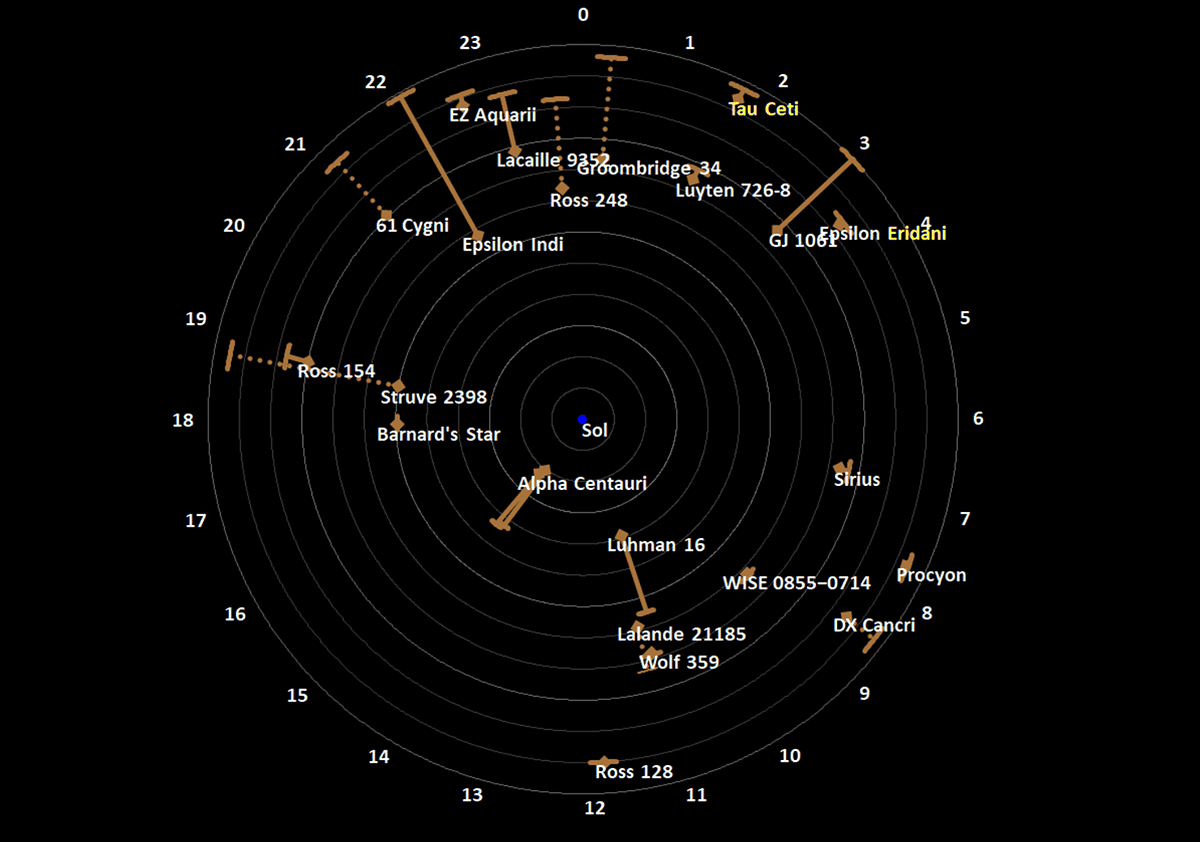
Further research shows that all but one of the stars in our galactic neighbourhood are similarly infected by the astrophage. The exception is Tau Ceti, which is 11.9 light-years away from Earth (see box “Around the Sun”) and hosts a few planets of its own. The taskforce decides to send a one-way crewed mission to this special star, to determine what makes it immune to these interstellar interlopers.
Around the Sun
(Courtesy: Nsae Comp by CC-BY-SA-4.0)
This stellar map is a graphical representation of nearby stars to our own star – Sol – all within 12 light-years of Earth. Each stellar object is jointly marked by two points, a diamond marked point (which shows the location of the stellar objects according to its declination) and a line marked point (which represents the distance in light-years from the centre). The circular lines indicate the distance from the centre by being set apart in one light-year steps.
The map accurately depicts these stars’ distance from Sol and their location in 3D space; to help visualize the distances to nearby stars in our galactic neighbourhood. Both Taue Ceti (2) and Eridani (4) can be seen on the map in the top right-hand quadrant.
In an interesting twist, it is the astrophage themselves that ultimately fuel the Hail Mary ship, after Grace discovers how to breed them on Earth. With only enough time to breed the required amount of astrophage for a one-way trip – they decide that any findings will be sent back to Earth via a series of much smaller and lighter probes. Despite Tau Ceti being almost 12 light-years away from Earth, it takes the spacecraft only about four years to get there, thanks to the fact that the ship travels at 92% the speed of light. This allows relativistic effects such as time dilation and length contraction come into play.
With this complex set-up, the real story picks up once Grace arrives at Tau Ceti, only to find that he is second in line, with another spaceship already there. Grace soon meets its sole occupant – the alien creature that he refers to as Rocky thanks to its stone-like morphology. Grace learns that Rocky is on the exact same mission as him, and that the alien hails from another nearby astrophage-infested star system called 40 Eridani. The pair soon realize that the only way to save both their planets is to work together.
Alongside Grace and Rocky’s adventures in space, the film does well in bringing in the more sober aspects of the story back on Earth – highlighting the trials and triumphs of the taskforce. These range from the global mobilization of scientists and engineers, working together to build and fuel a light-speed ship in record time; to Stratt’s character bypassing international law to ensure humanity’s survival. Lord and Miller use a distinct visual language to illustrate the two timelines. The Earth sequences look more bleak; while the scenes aboard the Hail Mary use visualizations of waveforms and light-absorption to show how Grace perceives the microscopic threat that is astrophage.
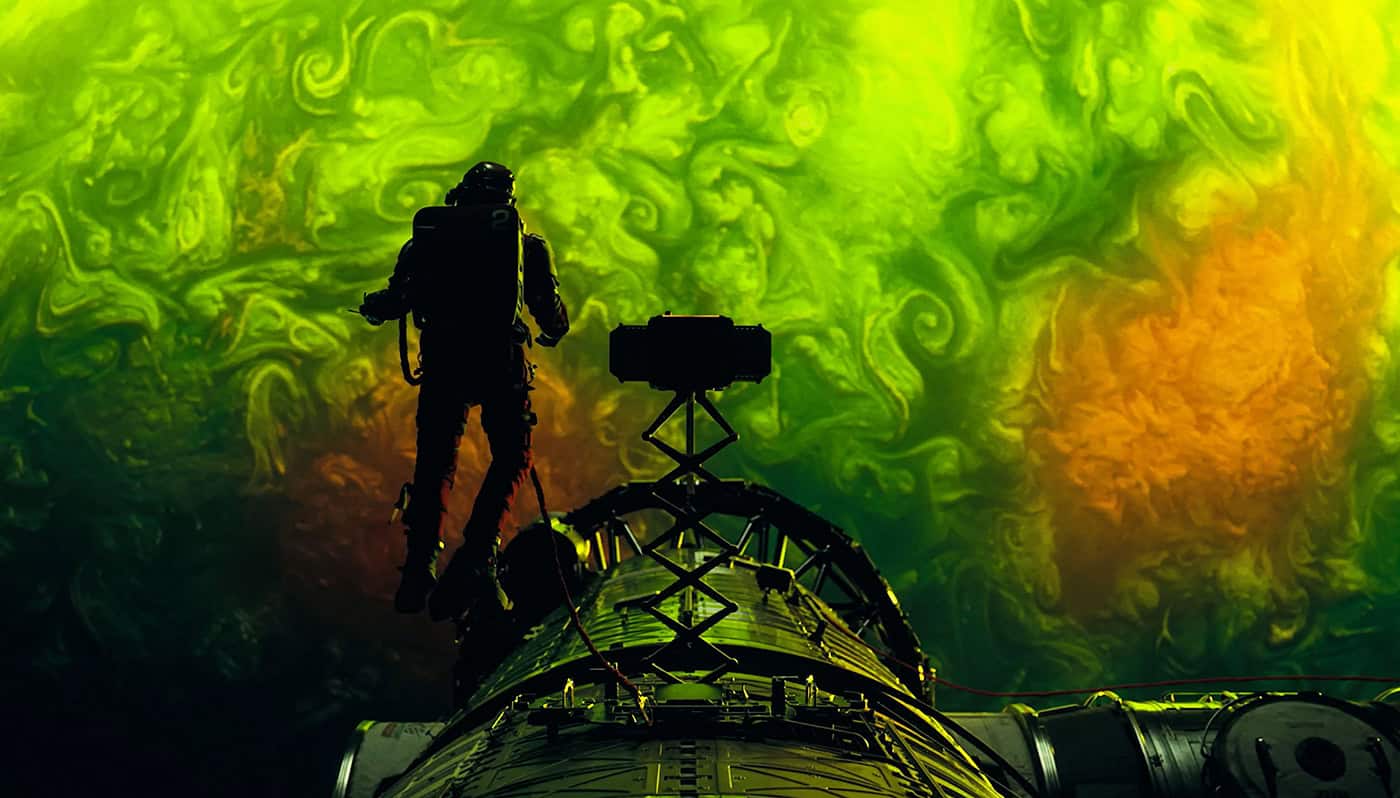
Natural predators Grace floats in space above the planet Adrian in the Tau Ceti system, to observe the native home of “Taumoeba”. (Courtesy: Landmark Media Studios / Amazon MGM / Alamy)
Rocky is one of the most lovable alien creatures to have graced our cinema screens in recent years, brought to life by the clever use of puppetry. The astrophage, by contrast, are meant to evoke fear and intrigue. We are treated to visualizations of how these “black matter” organisms absorb radiation, giving the audience a sense of how matter and energy can be manipulated on a grand scale. Visually, this metaphor continues throughout the film and, ultimately, to the survival of the planet.
Science and fiction, on screen and the page
It is clear that both Weir and the film’s producers and director were keen to highlight science and scientists throughout the book and film. For example, 40 Eridani is a real star system and Weir used astronomical data to build Rocky’s world.
In fact, when the book Project Hail Mary was written, the planet 40 Eridani-B was believed to be real. More recent data has revealed the dimming of the star that inferred the planet’s existence is in fact more likely a result of the composition of the star itself, and the planet most likely does not exist (see box “Exoplanetary exploits”).
In Project Hail Mary, Weir used the real-world observations of stars sometimes dimming for unknown reasons to come up with the idea of the astrophage and its effects on stars. The book also has much more detailed (if scientifically dubious) explanations, using neutrinos and quantum physics, for how astrophage devours starlight and manages to survive on the surface of stars.
Exoplanetary exploits: the science and speculation behind Rocky’s home world
(Courtesy: Gemini Observatory, NSF’s NOIRLab, NSF, AURA, Julien Rameau (University of Montreal), Christian Marois (NRC Herzberg))
Andy Weir based Rocky’s home planet in a star system that is beloved in science fiction, while existing in reality. 40 Eridani is a triple star system that is about 16.3 light-years from the Sun. Fans of Star Trek might also recognize 40 Eridani as the solar system that is home to planet Vulcan. The system comprises the larger star 40 Eridani A and a binary pair of stars, consisting of a red dwarf (40 Eridani C), and a white dwarf star (40 Eridani B).
The system has been well known and observed for a number of years, so much so that as of 1991, Star Trek creator Gene Roddenberry described how the binary stars would “gleam brilliantly in the Vulcan sky” in a letter to Sky & Telescope magazine.
In Project Hail Mary, Erid (or “40 Eridani A b”) is the closest planet to the main star in the system, with some extreme conditions compared with those found on Earth. For example, the planet’s gravity is more than twice Earth’s, and it has a very dense (28 Earth atmospheres) ammonia-based atmosphere at extremely high pressure. The planet has an average surface temperature of 210 °C – despite this, it is able to have liquid water on its surface, as the high surface pressure raises water’s boiling point above that temperature.
According to Weir, Erid’s dense atmosphere blocks almost all incoming light, meaning that Eridians are “blind” to visible light and use echolocation to “see” and communicate. Erid also has a strong magnetic field that blocks the large amount of radiation a planet so close to a star would be bathed in. The high-pressure environment, meanwhile, meant that Weir had to base Eridian biology on a high-mineral content, stone-like exoskeleton, with a circulatory system using liquid mercury, making it an especially unique alien life form.
In reality, astronomers at one point believed that 40 Eridani A was host to a planet or two, thanks to periodic variations in its radial velocity – a common signature of exoplanets. However, the observed variation was on the scale of 42 days, which is similar to the star’s rotation period, meaning that it was next to impossible to confirm the existence of a planet. After a series of observations over a number of years, as of 2024 astronomers sadly concluded that the radial velocity signal very likely does originate from stellar activity, and not from a planet.
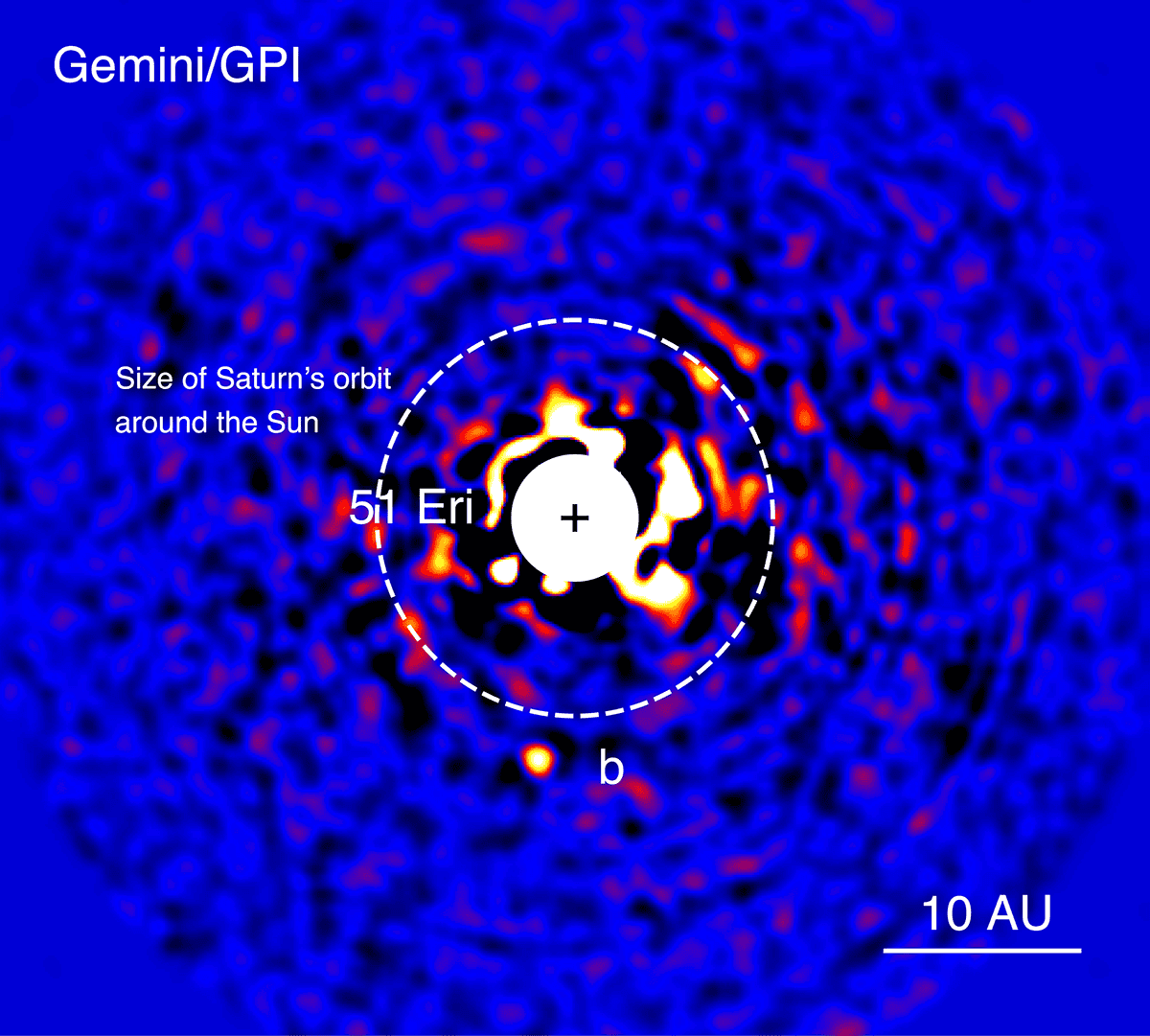
But all is not lost in the Eridian stellar neighbourhood – the not too far away system of 51 Eridani b (roughly 96 light-years from Earth) has a confirmed and directly imaged exoplanet (see image above). Dubbed 51 Eridani b, the Jupiter-sized planet orbits 11 billion miles from its star, a little farther out than Saturn’s orbit in our solar system. As of 2021, NASA announced that its James Webb telescope plans to probe the planet’s atmosphere at infrared wavelengths to learn more about this distant world – and the secrets it currently keeps.
Weir wrote the book before the global COVID-19 pandemic, but it was released in the very midst of it. Indeed, there are many parallels in the way humanity deals with global problems. As we see in Project Hail Mary, the fictional version of our world has this immediate burning issue and while not everybody quite agrees on a plan, there is a global realization and agreement that something must be done, no matter what it takes. Weir is not so convinced that it always works like this though, as he told us that “I do think that the world works together when there’s a common problem, but only if it’s a direct and immediate problem like COVID. We’re not so great at it when it’s a slow burn, like environmental damage.”
Filmmaker and scriptwriter Drew Goddard – who wrote the screenplay for Project Hail Mary as well as Weir’s previous bestselling-book-turned-movie The Martian – reportedly drew up a list of 10 things that he would like to bring from the pages to the film. He achieved nine of them – the missing one was the nuking of the polar ice-caps by Stratt to purposefully trigger global warming. It is a shocking and thought-provoking moment in the book, stripped from the film due to the necessary time it would take to explore and depict such a drastic decision (though one can imagine an entire story based on just that one issue). The film also could have included some more details from the book of the political machinations on Earth, though there are already a lot of ideas to take in, especially for those viewers who have not read the book.
Building a common language
When it comes to depicting an alien, the filmmakers did a great job, not only of realizing Rocky on screen, but also showing the growing friendship between two creatures from distant worlds. Despite their many differences, both Grace and Rocky have been displaced from their homes and tasked with the burden of saving them. To do so, they must overcome their fear of the unknown, and find ways to converse and connect.
On Earth, we are able to communicate in a number of ways – even sometimes between species. In science fiction, science and maths often become a common language. Rocky’s language is decidedly otherworldly. The script, which includes not just the spoken lines but also the complex “musical” language of the Eridian, was developed with linguists and xenobiologists. Via Grace, the audience is able to experience the genuine difficulty of two distinct life-forms learning to communicate for the first time (see box “Words of great encouragement”).
Despite the challenges the pair face in dealing with a culture alien to their own, the two of them go from being fearful and intrigued to amused and friendly; eventually making great sacrifices to help one another.
“Words of great encouragement”
Hannah Little, a linguist and lecturer in communication and media at the University of Liverpool, on the language and communication between Grace and Rocky:
I love Rocky and Grace’s first contact scene – they initially don’t know how the other communicates, but Rocky must find a way to tell Grace to leave the airlock. To do this, he creates a 3D model of Grace and the Hail Mary, to act out that he wants Grace to return to his ship. Grace understands this communication attempt immediately. Without a shared language at the start, the pair must use other strategies to converse, such as using something called “iconicity”. Iconicity is when we use sounds or gestures that depict what we are trying to communicate in some way. Humans often do this using gesture (imagine playing charades) or with drawings (like in Pictionary), but we don’t usually have a 3D printer to hand like Rocky does. This is an excellent opening concept as a 3D model can be a more accurate representation of a human or a ship than a 2D drawing, and it also tells us something about how Rocky perceives the world – he doesn’t have vision that uses light as we do, but instead something more similar to echolocation that can only detect 3D objects.
As they continue to interact, we see Rocky mimicking Grace in raising his index finger: a gesture Grace uses to communicate “can you wait a minute”. Through imitating him, Rocky is able to see what Grace does in response to this gesture and gather data about what the gesture means and the effect it has. This is exactly how humans learn language. When we speak to babies, we are constantly trying to get them to imitate us.
After these initial exchanges, Grace starts to build a translation programme where he logs different sounds Rocky makes and his best guess for what they mean in English. This is where the realism of the movie gets lost: to build reliable translation systems between different human languages, we need an enormous amount of data, even with everything we know about how human languages are produced and structured. It would be a mammoth task to work out what aspects of Rocky’s sounds are meaningful and how those meanings map to human concepts and grammar, but the film depicts this as relatively straightforward. We then suddenly jump forward in time to a point where they have a working translation model without much clue of how long this took. Of course, this has to happen for the sake of the story, and I prefer this as an explanation than some magical universal translator or a fish you put in your ear.
I also love how Rocky’s biology is such that he looks like a strange rocky spider with no discernible face. This makes Project Hail Mary a more exciting exploration of potential alien biology than other films and TV shows where the aliens all look and speak a lot like humans do. But Rocky still communicates with sound, as humans do, and presumably using structures that are very easy to translate. I’m always after depictions of alien communication that get away from a human-centric view of what language can be. It would have been entertaining if Rocky communicated via smell or vibrations or electricity.
“I’m going to have to science the **** out of this.”
Alongside the intriguing linguistics, a side-effect of the interwoven timelines is that viewers are confronted with the reality of scientific progress: it is often messy, desperate and driven by people who are deeply flawed. For the most part, the characters are shown as tenacious individuals, who refuse to give up in the face of a dying sun.
Grace is the embodiment of a reluctant hero. He is also painted as something of a lone voice in academia, having presented a paper at a conference about non-carbon-based life, and being ridiculed for the idea. He is then ostracized by the scientific community, and so turns to being a school-teacher instead, making him a rather unlikely candidate for a space mission.
Despite Grace’s reticence, it turns out he is perfect for the role of saviour of the planet, mainly thanks to his relentless resolve to find the answer, even when armed with minimal resources. Gosling’s face, initially confused, then increasingly determined, fills the screen as we see him try to come to terms with his mission.
It is, however, impossible to know for sure how a person in such total isolation may truly feel or react. This uncertainty is core to the script. The big questions of the film about the value of sacrifice and the necessity of co-operation are left for the audience to decide. The directors are not didactic storytellers, and Weir himself is adamant that his main aim is to entertain. It will be a great bonus if readers and viewers come away with a new understanding of science and the scientific process.
Indeed, this story features many physics concepts, from exoplanetary science to the special theory of relativity; as well as space travel, artificial gravity and a healthy dose of quantum and materials science. Weir contends that the science of Project Hail Mary is sound until you get deep into the quantum level. It is there where he used a literary plot device often referred to as a “MacGuffin” that enabled interstellar travel, using a biological organism.
Becky Smethurst, an astrophysicist at the University of Oxford, recently joined the Physics World Stories podcast, and was delighted that Weir went to such lengths for the science in his narratives. “I think it really surprised me in terms of energy storage,” says Smethurst. “It’s mass-energy equivalence at the crux of the story, if the astrophage can take in the Sun’s energy and store it and then release it later. It’s just e = mc2.”
She goes on to explain that this fundamental physics concept is what allowed for interstellar travel, by harnessing huge amounts of energy to accelerate the spacecraft up to nearly the speed of light. In reality, the issue lies in terms of what kind of single-cell can store that much energy and with that much energy efficiency, which she estimates to be “a billion times more efficient” than any we know on Earth.
But Smethurst goes on to highlight that this is what makes Weir a creative writer, especially when it came to developing the biological and physical mechanisms that allow astrophage to interact with neutrinos. “He invented this whole term in the book called ‘super cross-sectionality’,” she says, “which is fun because it’s sort of a borrowed word from particle physics, when you talk about cross sections of particles and whether they’re likely to intersect. So I like that the idea is obviously sci-fi, but the fact that it’s rooted in some elements of physics and he made that effort to do that, I think was incredible.”
At the heart
Project Hail Mary succeeds as an entertaining space adventure because it trusts its audience to be as smart as its protagonist. It treats astrophysics and molecular biology not as hurdles to the plot, but as the plot itself. Without giving it all away, the story does not end with a straightforward “victory” and much of the lessons learned come from the realization that science is a universal language. In 2026, where global challenges often feel intractable, the film offers a fundamentally sunny outlook. It suggests that when people – or even different species from distant planets – come together to overcome impossible odds, survival is possible.
Using the immense format of IMAX, Project Hail Mary leads us into a total immersion of Grace’s lonely, pressurized world; only to show us that we are never truly alone – as long as we have the tools of discovery, and the ability to overcome our fear of the unknown.
In this episode of the Physics World Weekly podcast, Woosley and Nomoto talk about the astrophysics of supernovae – exploding stars – and what these spectacular events tell us about the elemental composition of the universe and how it has expanded since the Big Bang.
Nomoto is emeritus professor and visiting senior scientist at the Kavli Institute for the Physics and Mathematics of the Universe, at Japan’s University of Tokyo. Woosley is professor of astronomy and astrophysics at the University of California, Santa Cruz in the US.
This podcast is sponsored by the Shaw Prize Foundation.
The Shaw Prize is an international prize based in Hong Kong. Currently, it consists of three annual awards. The Shaw Prize in Astronomy; The Shaw Prize in Life Science & Medicine; and The Shaw Prize in Mathematical Sciences. In 2027 a fourth prize will be awarded for work in computer science. Each prize carries a monetary award of $1.2m. The prize was established by Runrun Shaw, a media mogul and philanthropist. It was first awarded in 2004 and since then 121 prizes have been given individuals from across the world.
Photos of research facilities in the former Soviet Union and its satellite nations might not seem the most promising subject matter for a coffee-table book. But French photographer Eric Lusito has done just that with Soviet Scientific Institutes, which contains more than 150 pictures from his travels across the former Soviet bloc. Unable to travel to Russia, Azerbaijan and Belarus, images from what Lusito calls the “authoritarian remnants” of the Soviet Union are absent. However, his photos across eight other countries depict the downfall of many once vibrant labs, from a rusty cosmic-ray telescope in Armenia to a defunct nuclear reactor in Georgia. The grim reality stands in contrast to the colourful 1970s mosaics in a Ukrainian cybernetics institute that seemed to herald a utopian future. Matin Durrani
Meet the Neighbours: Life on Mars and How to Find It By Steven A Benner
In 1976 Viking 1 achieved two remarkable things: it performed the first successful landing on Mars and it sent home evidence for life on the red planet. Yet shortly after, Mars was again declared dead and for decades any scientist who suggested otherwise was ostracized. What happened? This is the story that astrobiochemist Steven Benner traces in his book Meet the Neighbours. He clearly explains the science and history, but most of all the machinations and philosophy of how science works. The work is a little polemical and very US-focused, but also extremely enlightening. Kate Gardner
2026 Allen Lane
Amazing Worlds of Science Fiction and Science Fact By Keith Cooper
Fans of the British TV show Doctor Who might recall the 10th Doctor visiting the stunning and terrifying planet “Midnight” – a diamond-encrusted place, bathed in extreme radiation, replete with a “sapphire waterfall”. While some aspects of this fictional world will remain in the realms of fantasy, as of 2011 astronomers believe that the supermassive exoplanet 55 Cancri Ae orbits so close to its parent star that it is indeed bathed in extreme radiation. And it is mainly made up of carbon, in the form of diamond and graphite. This is a perfect example of the symbiotic relationship that science fiction and fact can have with one another, as Keith Cooper outlines in his fascinating book Amazing Worlds of Science Fiction and Science Fact. From the many “strange new worlds” of Star Trek to the Dyson spheres of Ringworld and beyond, this book is a must for “hard sci-fi” aficionados and astronomers alike. Tushna Commissariat
An Anthology of Stargazing: a Collection of Constellations and Other Wonders in the Sky By Abigail Beall, illustrated by Angela Rizza and Dilbag Singh
While the target audience of children will likely be immediately attracted to its beautiful cover and gold-edged pages, what makes An Anthology of Stargazing special is journalist Abigail Beall’s clear explanations alongside the artistic talents of Angela Rizza and Dilbag Singh. Despite covering everything from the history of stargazing and careers in the field, to the life of a star and the celestial sphere, Beall manages to tread that fine line of being informative while not losing the attention of young readers. There is a page devoted to each of the 88 recognized constellations, providing details on when and where you can see them, and a diagram of their configurations. These are accompanied by illustrations of the animals, people and objects astronomers saw in the patterns, and snippets of their myths and legends, helping the next generation of stargazers see the stories in the sky. Sarah Tesh
2025 DK Children
Hum
By Helen Phillips
A mother loses her job to AI, so to make some cash she agrees to have her appearance altered to fool face-recognition technology. With this money she takes her family on a trip of a lifetime to the Botanical Garden – the only place to glimpse nature in their arid, dirty city. A treat only for the well-off, the children are amazed to see trees, swim in waterfalls and encounter wildlife. Hum by Helen Phillips has just won the Climate Fiction Prize 2026 for its view of a harsh world where nature is something you have to pay to see – but perhaps its real power is in Phillips’ portrayal of the future of day-to-day technology. This fabulous book will leave you with a lot to think about. It will likely make you put down your phone, too. Kyla Rushman
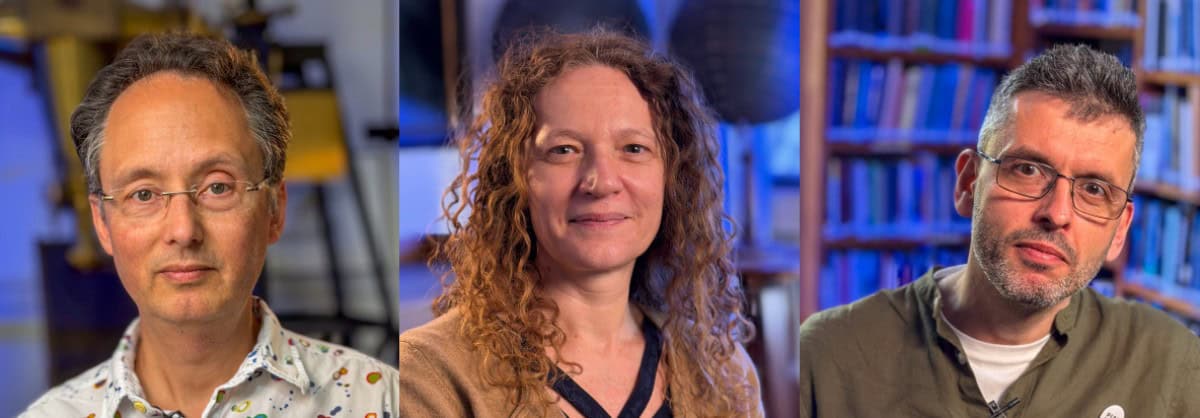
Belokurov is at the UK’s University of Cambridge; Helmi is at the Kapteyn Astronomical Institute at the Netherlands’ University of Groningen; and Ibata is at France’s University of Strasbourg.
Fossil hunters Left to right are Rodrigo Ibata, Amina Helmi and Vasily Belokurov. (Courtesy: The Kavli Prize)
This episode of the Physics World Weekly podcast features an interview with Helmi and Per Barth Lilje, who is chair of the Kavli Astrophysics Prize committee and is based at Norway’s University of Oslo.
In a wide-ranging conversation, we explore the history of the Milky Way and why the work of the Kavli laureates provides crucial evidence that our galaxy was formed by the merger of smaller dwarf galaxies. We talk about what hierarchical accretion tells us about dark matter and the Standard Model of cosmology – and we look forward to the future of the Milky Way.
Belokurov, Helmi and Ibata share the $1m prize money equally. The prize will be awarded in Oslo in September
Astronomer Jessica Dempseyhas become director-general of the Square Kilometre Array Observatory (SKAO), which will be the world’s largest and most sensitive radio telescope when it opens next year. Dempsey will now serve a five-year term as director-general and succeeds Philip Diamond, who held the role since 2012.
Three decades in the making, the SKAO is based in South Africa and Australia and consists of 197 dishes and 131 072 antennas to study how galaxies form, the nature of dark matter, and whether life exists on other planets.
The Australian side, known as SKA-Low, will focus on low-frequency obervations, while South Africa’s SKA-Mid will observe mid-range frequencies.
The headquarters of the organization is based in the UK at Jodrell Bank and SKAO has 13 full members, which includes China, Germany and India.
From film star to the stars
Dempsey studied both astrophysics and theatre and film science as an undergraduate at the University of New South Wales before becoming an actor in the late 1990s.
Dempsey then did a PhD in astronomy at UNSW, graduating in 2007 before working at the James Clerk Maxwell Telescope at Mauna Kea Observatory in Hawaii, becoming operations manager in 2012 and then deputy director of the telescope in 2016.
In 2022 Dempsey became director of the Netherlands Institute for Radio Astronomy and throughout her career has championed more equitable opportunity and experience for women and all underrepresented individuals in science, in 2023 becoming professor of ethics in astronomy at Radboud University.
Dempsey says it is “humbling” to lead the organization and is “passionately dedicated” to its success.
SKAO is currently preparing for the start of “science verification”, in which astronomers will gain access to the first SKAO data. This is due to begin for the SKA-Low telescope in Australia in the second half of 2027.
“As someone who loves nothing more than building and running telescopes, there is not a better time to be asked to take up this role – we are just getting to the cool stuff,” adds Dempsey. “This is a daring project, unprecedented in scale and scope, and it will need the skills of every single team member on three continents and all the support of our broad global partnership to see it come to light.”
Diamond, meanwhile, noted that the observatory is in “very good hands” with Dempsey’s appointment.
“This is a demanding role, with the need to balance scientific, political, diplomatic, financial and many other considerations,” adds Diamond. “I have full faith in [Dempsey’s] ability to lead this extraordinary organization through its next chapter.”

 Login