❌

Normal view

Advertising Cognitive Dissonance

24 July 2026 at 19:09

John Gruber (Mastodon):

This to me is proof that Apple leadership is suffering from cognitive dissonance over their slide into advertising. They’re conflating cause and effect. The Apple brand stands for high-quality superior user experiences because the devices and software Apple makes traditionally deliver high-quality superior user experiences. The work Apple ships is what makes the brand what it is. But now they’re stricken with the mindset that it’s the Apple brand that makes something a high-quality superior experience.

[…]

If you refuse to admit that the ads make these services worse, you also can’t admit that there’s a reason to offer an ad-free experience. So the thinking is something like “Apple always focuses on the user experience, and never deliberately makes the user experience worse. Therefore, if an Apple service shows ads, those ads are high quality and don’t detract from the quality of the product or the experience of using it. Therefore, there’s no reason to offer users a paid ad-free tier, because there’s no reason to want to avoid Apple’s ads.”

What a brand stands for can change over time. It’s eventually determined by the products, not the mantras.

  • “It just works.”
  • “A thousand no’s for every yes.”
  • “What happens on your iPhone, stays on your iPhone.”
  • “Music runs deep in Apple’s DNA.”
  • “Design is how it works.”

Manton Reece (2010):

I feel bad admitting it, because some of my friends are betting on iAd revenue to feed their family, but I’m just not on board with Apple running an advertising network. I don’t want to see ads in my apps, and I don’t want Apple to ever lose even a little of what it means to be a product-driven company.

Previously:

Update (2026-07-28): John Gruber (Mastodon):

The whole thing is funny because at a fundamental level we all just know in our bones that Apple never even considered putting “Intel Inside” stickers on Macs.

[…]

Apple still treats its hardware with that level of respect. With reverence. iPhones don’t even say “iPhone” on the hardware. No model or serial numbers. No small print. Just an Apple logo on the back.

[…]

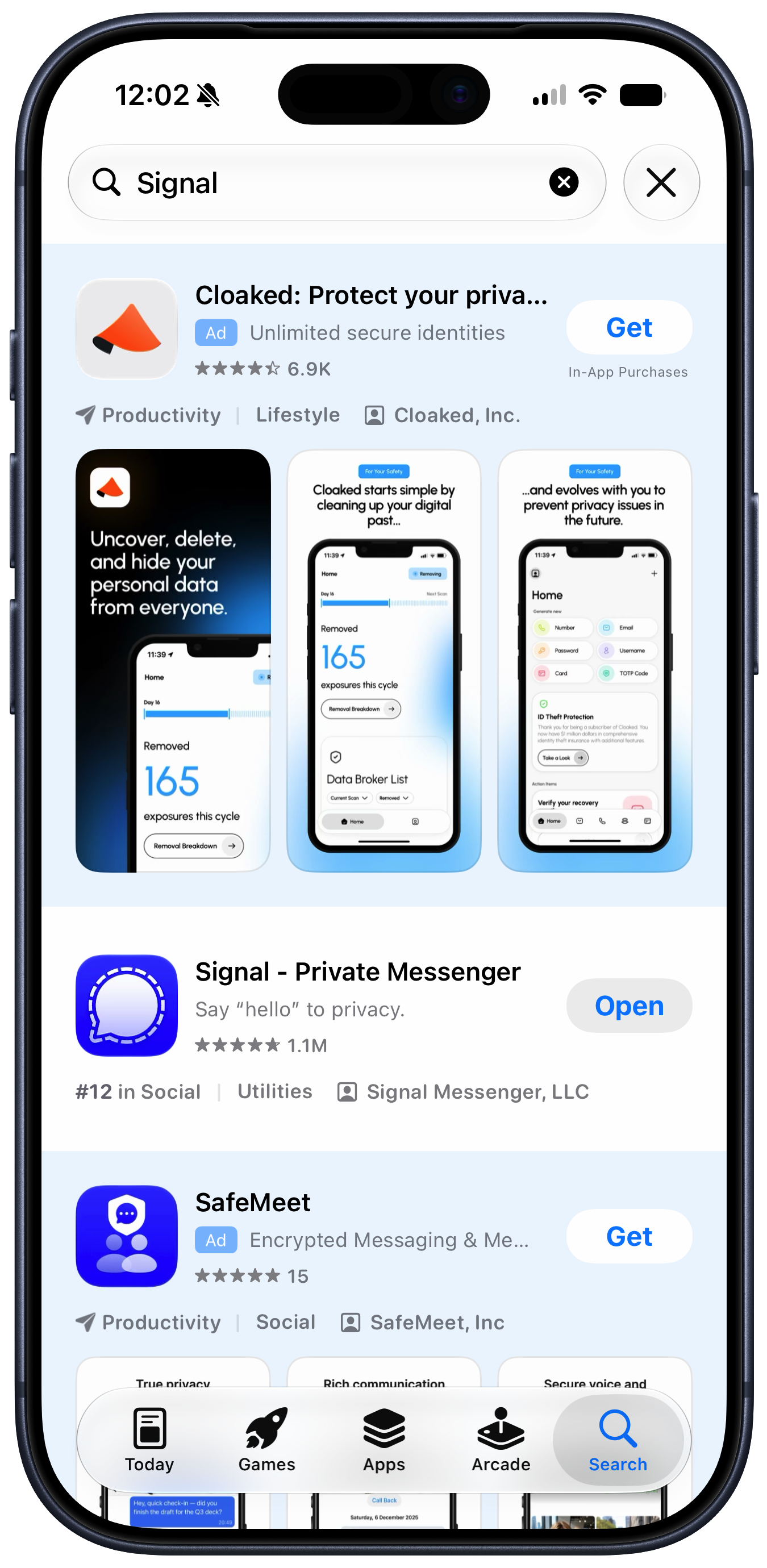
Putting themselves in customers’ shoes today, how many ads do Apple’s executives want stuck in the results when they search for an app in the App Store? We know the honest answer. But the answer evidenced by the actual App Store is “Two really big ones, including one in the first spot.”

At least you could peel off the stickers.

Jason Snell:

While Apple can spin adding ads to Apple Maps as a revolutionary new way for businesses to be discovered, it’s telling that its initial announcement was hidden inside a press release about an entirely different product, and introduced as “Enhanced Discoverability in Apple Maps.” Those choices show that this isn’t something Apple is actually proud of—and that the people in charge of communicating and explaining Apple’s decisions to the world are at odds with those who are making the decisions about expanding revenue.

[…]

To this day, you’re confronted with an ad for Creator Studio every time you create a new document in those apps, and their default toolbars contain buttons that won’t work unless you subscribe to the bundle. As a result, Apple has essentially turned its free productivity suite—software that was designed to enhance the inherent value of Apple’s products—into a freemium package with upsell to a creative professional subscription bundle that’s irrelevant (and a terrible value!) for most of its existing users.

[…]

There are many more examples. Using notifications to promote subscriptions and badging the Settings app to push AppleCare plans are among the ways Apple has chosen to intervene in the user experience to drive revenue. I’m actually not opposed to the idea that Apple should communicate opportunities for its customers to get more out of their devices—but it should be careful not to cross the line into actively annoying those customers. If someone doesn’t want to see what you offer, you need to accept that and go away—not keep needling them. Apple often falls on the wrong side of that line.

[…]

It makes me wonder if the people making these decisions at Apple have lost track of the Apple brand and what it stands for.

John Gruber:

What Snell’s column makes clear is that the incremental revenue Apple is gaining from putting shitty ads in its software comes at a price. They’re withdrawals from Apple’s brand equity. And I would argue that the value they’re detracting from the brand far out-values the dollar amount they’d padding to Apple’s bottom line.

[…]

If your competitors’ stores all smell like dogshit, don’t aim to have the store that smells the least like shit. Aim to have a store that smells pristine. “Our stores only carry a vague whiff of dogshit” is not insanely great.

Hotelling’s Law, like I was saying.

Adam Chandler:

This is not an “update”. This is an advertisement.

Update (2026-07-29): John Gruber:

The people haven’t changed, but Apple has. Strong leaders inevitably shape the personality — the spirit — of organizations over time. Apple in 2011 was peak Steve Jobs Apple. Apple in 2026 is peak Tim Cook Apple. But it was Cook who popularized the “you’re not the customer, you’re the product” argument against “free with ads” online services. But that was in 2014.

Marcin Wichary:

“Slippery slope” is a perfect term. But I wanted to add something here. In my experience, in the realm of UI, there is no middle notch. I’ve seen it time and time again… the moment you open the door to One, Infinity starts exerting its pull[…]

Previously:

Update (2026-08-03): Jon Snader:

I HATE, HATE, HATE having ads pop up when I’m trying to do something else. It’s bad enough on Web sites where at least they have the excuse of having to make money some how but it rises to intolerable when they put them up on a device I’ve already paid for.

The annoyance is reason enough to dislike Apple’s ads but for me the worst thing is that they’re corrupting and inevitably lead to the user being replaced by the advertiser as the customer.

Update (2026-08-05): John Gruber:

Only search engines that agree to pay Apple for the traffic are in the list, and there’s no option for users to add custom ones.

Tyler Hall:

It says a lot about modern Apple that I can’t find an unsubscribe link in this marketing email.

John Gruber:

Apple News ads have been going down the toilet for years, but it didn’t used to be literal.

Whisper and SpeechAnalyzer

22 July 2026 at 21:34

Om Malik (2023):

One of the key advantages of MacWhisper, as it utilizes the Whisper technology, is its superior accuracy in transcriptions compared to other services I have used. I was an early adopter of Rev.com and eventually switched to Otter.ai, for which I paid approximately $100/year. However, I have since canceled my subscription.

[…]

After comparing the audio transcripts from MacWhisper and Otter, I found that while Otter’s formatting is superior, there is hardly any difference in the transcriptions. I started with the free model, which was sufficient for my needs, and eventually upgraded to the large models. Nowadays, I primarily use MacWhisper to transcribe my voice memos, which I then import into Lex.Page.

Bon Adamson:

Whisper, which is made by OpenAI, has the distinct advantage of allowing you to transcribe audio in almost any language you may ever need to. For the time being, Otter can only transcribe English. The benefits of better accuracy and accurate punctuation that the service already holds over Siri hold up across other languages as well. If you’re looking to transcribe non-English audio accurately, Whisper is definitely the best option available on Mac.

Dan Moren:

By taking advantage of OpenAI’s Whisper framework, Audio Hijack can now take any audio it’s recording and generate a text transcript. While this process was possible before—see Jason’s lengthy post about his workflow—it required a lot of fiddling and several different tools to accomplish; it’s certainly a lot easier to simply drop Audio Hijack’s block into your existing session. If you record multiple sources, it can even appropriately label each one—though if you record multiple people via one input, say the other end of a Zoom call, it can’t distinguish between the various participants.

Inscribe (2026, Hacker News):

Apple’s new SpeechAnalyzer is the most accurate on-device speech engine we tested. It beat every Whisper model we ship, including Whisper Small, on both the clean and the noisy half of LibriSpeech, while running roughly three times faster than Small. And the API it replaces, SFSpeechRecognizer, came last on clean speech: behind even Whisper Tiny, a 40MB model.

[…]

The new API cuts word error rate by 3.5 to 4x on the same audio: from 9.02% to 2.12% on clean speech, and from 16.25% to 4.56% on noisy speech. There is no accuracy trade-off to weigh; the new API wins everywhere we measured, and it produces punctuated, cased text where the legacy engine’s output is rougher.

[…]

All five engines ran comfortably faster than real time: between roughly 12x and 40x on the M2 Pro, meaning an hour of audio transcribes in about 1.5 to 5 minutes on-device. SpeechAnalyzer was about 3x faster than Whisper Small per second of audio while beating it on accuracy.

Yuki:

SpeechAnalyzer’s ReportingOption.fastResults reads like a knob you’d reach for when you want to trade power for latency. That framing is what cost me the afternoon.

[…]

If a recording matters — and in a notes app, a lost meeting is the worst thing that can happen to a user — then the container you write while recording has to be PCM in CAF. Not m4a, and not AAC-in-CAF either.

[…]

AVAudioEngine’s inputNode silently ignores your device selection

[…]

I wanted summarization to run on-device. Everything else in Nib’s transcription path does, the audio never leaves the machine, and it would have been a much cleaner story to tell.

But 4,096 tokens for the Foundation Models isn’t enough.

Previously:

The EnshAIttification of Day One

21 July 2026 at 21:28

Aleem Shaun:

I’ve used Day One for more than a decade. It was an excellent journalling app. Private, minimal, easy to use, with excellent features such as geolocation, weather, ‘On this Day’, and book printing. Features that got out of the way and either worked quietly in the background or appeared only when you summoned them. That’s changed.

Now there are new subscription tiers. Previously, the tiers were Free and Premium. Simple. Premium included sync and a few other things that I can’t remember, but it was compelling enough that I’ve been a Premium subscriber from the beginning. Now, without consultation, I’m Silver (not Premium), and there’s a new, more expensive AI-driven tier, Gold. I don’t object solely on that basis. You would think I could just choose to remain on ‘Silver’ and all would be well. But no. Even with these features turned off in settings, I’m visually prompted in the app to upgrade to Gold and use the Daily Chat (with AI), which I’ve turned off and can only use if I upgrade. And yet, there it is, taunting me.

Via Eric Schwarz:

Even Apple is guilty of doing this in the Settings app and the former iWork apps.

Previously:

San Francisco Demands Removal of Nudify Apps

17 July 2026 at 22:16

Matt Burgess (MacRumors, ArsTechnica):

On Thursday, San Francisco city attorney David Chiu sent legal notices to Apple and Google demanding that they remove from their app stores 13 face-swapping apps, which allow users to create AI-generated nonconsensual nude images. The letters say the Silicon Valley giants should stop “aiding and abetting” the sale of explicit deepfake images and “sever” business relationships with the app developers.

[…]

Researchers have repeatedly found and reported apps in Apple’s App Store and Google’s Play Store that allow people to generate sexual images using AI—including some apps being rated as suitable for use by children. While new laws and bans aim to tackle the scourge of explicit deepfakes online, technology and social media companies consistently direct millions of people toward the harmful tech.

Both Apple and Google have developer policies that prohibit pornography, abuse, and harassment on their platforms.

Burgess gives the impression, which is my base assumption, that these 13 apps were clear about what they do, so App Review has no excuse for missing them. But I’m sure it’s keeping us all safe in other regards.

Meanwhile, in a preprint research paper published in May, researchers from Cornell University and Georgetown University identified 420 apps offering general face-swapping capabilities on Google’s and Apple’s app stores. They tested 155 to see if they could be used to create face swaps with nude images; in 70 percent of cases, it was possible, with the apps not including safety measures to prevent this.

Previously:

Update (2026-07-21): Danny Bradbury:

Chiu isn’t arguing that hosting an app automatically makes a platform liable for what it does. Platform operators already won that battle with Section 230 of the Communications Decency Act. That 30-year-old law says websites generally aren’t responsible for content posted by users, allowing platforms to host user-generated content without getting sued every time someone defames someone in a comment thread.

Courts have often extended those protections to cover app stores too. Apple and Google are treated as distributors of whatever a third-party developer uploads, rather than publishers.

Chiu is attempting to sidestep that argument by focusing on the companies’ payment systems, noting that Apple and Google collect a cut of every in-app purchase. According to the Tech Transparency Project (TTP), that means they profit from apps that generate revenue by creating non-consensual intimate imagery.

Flickr 5.0

15 July 2026 at 19:52

Phil Gyford:

Flickr recently updated their iOS/iPadOS app to version 5 (App Store link) and, while it’s not radically new, for a service whose changes have been incremental over recent years it contains a lot of differences. However I’ve yet to find any official changelog or update information.

[…]

When displaying multiple grouped photos from a person you’re following, it is no longer possible to view all the subsequent ones, other than the three or four initially displayed.

In the list of your Followers’ photos, their name now appears under their photos, so you must scroll down beyond the photos to see who took them.

[…]

When zooming into a photo the app no longer loads a higher resolution version, so now the zoomed-in version will be very pixellated.

He has a long list of missing features that may or may not be coming back. And there’s what seems like a major change: tags can no longer use capital letters.

The main changes I noticed were:

  • In the Home/Discover view, when there’s a large group of new photos, you can only go into the group and view them individually, swiping to see each one. There’s no longer a way to see the whole group at once and scroll through it. (And tapping on the group icon or number of photos doesn’t do anything.)

  • Double-tapping to favorite doesn’t work in some situations.

  • The interface is more busy, showing more interaction chrome like other social media sites, rather than focusing on the photos.

  • Swiping/navigation seems more clear than before, though without the old app side-by-side I can’t be exactly sure what’s changed.

Update (2026-07-16): Wesley Moore:

The Android version has been updated too:

“Flickr is back and better than ever — rebuilt from the ground up with a fresh new look and feel.”

I would guess it’s been built with cross-platform technology as it looks the same and came out the same time as iOS. The performance is terrible on Android. Scrolling my Photostream is juddery on my Pixel 9a (120 Hz display). It’s worse on my Android tablet.

Scrolling between photos swipes the whole UI (not just the photo), there’s also a flash of white loading the new photo. Needs some serious iteration.

See also: Reddit.

Update (2026-07-27): A. Lee Bennett Jr.:

Hooray! #Flickr restored a thumbnail view of all items from a specific post.

It turns out that Flickr 5.0.3 reverts back to the 4.x codebase.

Flickr (Reddit):

We know the new app hasn’t met the bar you expect from Flickr. Since launch, we’ve heard your feedback about bugs, missing features, and rough edges, and we want to acknowledge that directly. Here is where we currently stand:

iOS: We’re in the process of rolling back the iOS app to the previous version while we address these issues. You should see this reflected in the App Store shortly.

Android: The Android app will remain on the updated version. Due to technical limitations and the risks involved in reverting, a rollback isn’t possible on this platform. Instead, expect frequent updates as we fix bugs and restore preexisting features.

Across both platforms, this app refresh represents a significant, long-term investment in the Flickr app. The app was long overdue for an update and getting it right matters to us. Thank you for your patience, and for continuing to share what’s missing and not working. It’s shaping exactly what we address next.

Apple Still Designated a Gatekeeper

9 July 2026 at 19:38

Tim Hardwick:

Apple’s challenge against the EU’s designation of its App Stores and iOS platform as “gatekeepers” was dismissed by Europe’s top court on Wednesday, reports Reuters.

[…]

The company also disputed the classification of iMessage as a number-independent interpersonal communications service, or NIICS, which would subject the app to EU telecoms rules. But the General Court said Apple’s actions regarding the iMessage service are inadmissible.

William Gallagher:

Back in 2023, Apple acknowledged that it qualified under the then-new definition of being what the EU called a gatekeeper service. But key to that is the size of the operation, and since 2024, Apple has been claiming it runs five smaller App Stores rather than one large one.

[…]

“Irrespective of the devices in question,” ruled the judges, “those stores have the same purpose, namely to connect app developers with end users in order to facilitate the distribution of software applications.”

Steve Dent:

Apple disagreed with the decision but didn’t say yet if it would appeal. “We firmly believe the DMA’s mandate goes beyond what is lawful and proportionate, threatening to erode decades of privacy and security protections we’ve built and leaving our users vulnerable to new risks,” an Apple spokesperson said in a statement to multiple outlets. “We will continue advocating for the innovation and privacy our European customers deserve.”

Apple still has two cases pending with EU courts. The first is a challenge to the EU Commission’s decision last year forcing Apple to open iOS to third-party developers, and the second is an appeal against the €500 million fine imposed in April last year for anti-steering violations.

Previously:

Weathergraph 1.0.358

9 July 2026 at 19:38

Tomas Kafka:

Pressure is now much easier to read. A new Pro trend strip under the chart shows whether pressure is holding steady, rising, or falling. Fast changes stand out with stronger marks and colour, so you can spot a front moving in sooner - useful for hiking, sailing, flying, fishing, or weather-sensitive heads and joints.

You can now also design the chart more freely with the new theme editor. Mix palette, style, sky detail, and accent colour, or start from a preset, to make Weathergraph fit your style.

This is an example of what it looks like:

Weathergraph: Pressure

Previously:

Apple Silicon and AI

7 July 2026 at 20:51

Jason Hiner (MacRumors):

In an exclusive conversation with The Deep View ahead of WWDC 2026 in June, Doug Brooks, senior product manager of Apple silicon, discussed how Apple’s long-term investments in neural processing, unified memory, power-efficient computing, and hardware-software integration have positioned its devices for the AI era.

He also explained why Macs have become a favorite platform among AI developers, why Mac minis and Mac Studios are emerging as the preferred AI agent machines, and how Apple sees the future of on-device AI across iPhone, iPad, and Mac.

[…]

“We build a chip knowing exactly what systems it’s going to go into. The chip can influence the system design, and the system design can influence the chip requirements. They’re married together very tightly. I’d actually go a step further and include software in that equation. As we enable new capabilities in the chip, we want to make sure those capabilities are exposed all the way through the software stack so developers can benefit and customers can benefit. Because if those transistors go unused, what’s the point? It’s not about adding something and hoping somebody finds a use for it. We want those capabilities available to solve real problems. I think that’s what allows us to build better systems and ultimately better products.”

It seems like a lot of it is just that developers like macOS.

Previously:

Update (2026-07-10): See also: Hacker News.

Castro’s Customer Support Lessons

6 July 2026 at 19:45

Dustin Bluck (archive link, Hacker News):

I had an idea when I bought Castro that human support based around actual user experience was an easy differentiator. I’ve rarely gotten useful answers from support from services I use. I thought if I used my own product every day, read every email and answered it thoughtfully, people would appreciate this, and it would build some degree of loyalty and appreciation.

[…]

However, what I found is this whole thing didn’t work as I thought it would. Sure sometimes we were able to wow customers, particularly when we responded right away with an exact fix for them. But the vast majority of our honest, thoughtful answers were deeply unsatisfactory to users, and it often annoyed them more than anything else.

[…]

Customers email us with confusion about how podcasts work, how the App Store works, how their Mac works, and any number of tangential issues. What tends to happen is the same users do this over and over, and once they find out we answer, the requests get more frequent and more burdensome.

[…]

To the user, any response aside from “Okay, we’re going to build that right now” is meh-to-negative. Various honest responses, such as “I thought about this or tried it in the past and it unfortunately didn’t work very well” are not going to knock their socks off. These just don’t do much in terms of loyalty and rapport.

[…]

Avoiding explanations and specifics tends to get a neutral response and doesn’t suck anyone in or waste too much time. In other words, the best approach for us is what most companies do. Because building loyalty or rapport at the moment something isn’t working and the user is frustrated hasn’t worked. The real positive experience comes when you actually improve the product, so that’s where we’re spending our time.

I have definitely seen all these categories of customer interactions, but I don’t agree with the conclusion. Yes, in the end you want to be improving the product, but I don’t think that’s fully separable from interacting with customers as humans. I’ve found spending time on customer support incredibly valuable for making my products better. Even a lone report of an issue can often lead to a fix and learning something important that has wider implications. It’s also enjoyable and motivational to hear about real people making use of what I’ve built or to turn around someone who started with a negative view. And it seems to help with marketing, too.

I also see a correlation with the apps that I use—the better ones tend to also have good support. That said, I use a podcast app that famously doesn’t offer support. There are different situations, and there’s more than one way to a good product and a successful business.

I do think there’s an art to all this. Not everything can be measured, and there’s more to it than just committing to answering e-mails thoughtfully. You need to set boundaries and steer the interactions to make them productive, efficient, and satisfying for both sides. I’m still learning.

Previously:

Update (2026-07-07): Jeff Johnson:

This is what you get from the free with IAP business model: most of your support emails are from freeloaders!

My apps are upfront paid, thus most of my support emails are from customers. I don’t get overloaded with emails, and paid customers are more incentivized to solve issues with you, because they’ve invested money into the app.

Vitor:

I find myself agreeing with you that customer support is valuable and we should do it. But over the years I have also realised that, in a way, being good at support is punishing. I’ll explain[…]

UK CMA Proposals for External Payments and NFC

3 July 2026 at 19:23

Ben Lovejoy:

The EU required Apple to permit third-party app stores, while a US court ruled that developers have the right to direct iPhone users to third-party payment platforms for app purchases and subscriptions. Britain’s Competition and Markets Authority (CMA) is now proposing to apply this latter rule in the UK.

Tim Hardwick (John Gruber):

The U.K.’s competition regulator has proposed letting app developers direct users to payment options outside Apple’s App Store and Google’s Play Store, in a move aimed at increasing competition and reducing the fees charged by the two companies.

[…]

The regulator said any fees Apple and Google charge developers for enabling such “steering” must be fair and reasonable, remain below existing App Store and Play Store commissions, and allow developers to either pass savings on to consumers or reinvest them in innovation.

John Gruber (Mastodon):

Requiring Apple to allow apps to steer users to the web to make payments is, I’ve long argued, sensible regulation. I’ve also long argued that Apple has been obstinate in disallowing it. If in-app payments — through Apple’s system — can’t compete with out-of-app payments on the web, something is wrong with IAP. But it’s wrong to assume that payments outside IAP will result in lower prices and better policies for users.

Nick Heer:

They may increase prices when costs grow but that does not mean they do the opposite. But who cares? Lower costs permit more flexibility on pricing and, even if that money ends up in the pockets of developers instead of Apple, is that supposed to be a bad thing? Is there a reason why someone should be upset that they might pay the same amount but an indie developer gets to keep more of it?

The proposed policies are pretty straightforward from what I can see. Among other obligations, Apple is not allowed to use or require scare tactics when users are routed to an external payment mechanism and, while it is allowed to charge a steering fee, it is not allowed to count services not used by developers offering third-payments nor double-count for services already accounted for by other developer fees. Also, the CMA calls bullshit on Apple’s claim that third-party payments are particularly risky[…]

Previously:

Update (2026-07-30): Juli Clover:

Apple said new UK App Store rules would give regulators a “highly intrusive” role dictating how it runs its business, reports Reuters. Apple submitted feedback to the UK’s Competition and Markets Authority as it considers forcing Apple to change its App Store rules around steering.

[…]

UK regulators said Apple can charge developers a fee, but it must be fair and reasonable, and below existing App Store commissions, so developers can pass savings to customers or reinvest them in innovation.

According to Apple, the CMA’s proposed rules would undermine innovation and investment, and would amount to price regulation because of the restriction on fees.

Hide My Email Vulnerability Exposes Real Address

2 July 2026 at 20:44

Joseph Cox (MacRumors, Hacker News):

A vulnerability in Apple’s “Hide My Email” tool lets almost anyone discover a person’s real email address that is supposed to be hidden by the feature, and Apple has failed to fix it for more than a year, according to a security researcher and 404 Media’s own tests.

[…]

“Apple Hide My Email is leaking email addresses that are supposed to be hidden. We reported the issue and replication instructions to Apple over a year ago. We don’t know why it hasn’t been fixed, but we don’t feel comfortable waiting any longer. Hide My Email users deserve to know that it may be possible for attackers to discover their hidden email addresses,” Tyler Murphy, the co-founder of EasyOptOuts, which discovered and reported the issue to Apple, told 404 Media.

“Free, publicly accessible people-search sites make it easy to link an email address to other personal details, so people relying on Hide My Email for safety may be at risk,” Murphy added.

[…]

To test the issue I generated a new Hide My Email address and provided it to Murphy. Around five minutes later, he replied with my real email address linked to my Apple account which was supposed to be hidden.

Ben Lovejoy:

Murphy said that he reported the issue to Apple in June of last year, and the company told him it was looking into it. Apple said it had been fixed in March of this year, but Murphy found that wasn’t the case. He again contacted Apple, with the company saying that it would appreciate him not revealing the existence of the flaw until it had been resolved.

Apple then said it planned to address the issue in June, but since it still hasn’t been fixed[…]

Tyler Murphy:

March 19, 2026: Using the reproduction instructions from our initial report, we determined that the vulnerabilities hadn’t been fixed.

May 22, 2026: We realized that the vulnerabilities may have greater severity and scope than we thought initially and reported this to Apple. Apple never acknowledged the report of increased severity.

June 30, 2026: Apple again reported that the vulnerabilities were fixed and asked us to verify. We determined that the vulnerabilities hadn’t been fixed.

Jeff Johnson:

This is every fucking Feedback I file.

John Gruber:

Not good. Especially the “We reported the issue and replication instructions to Apple over a year ago” part.

This is becoming a pattern. At least Apple still allows third-party e-mail providers.

Nick Heer:

Very few details are available right now. I have seen speculation that the original email address is revealed when someone replies using their hidden email address, but the impression I get from Cox’s reporting is that no user interaction is necessary[…]

[…]

I am also unclear about how, as of May, the EasyOptOuts guys found the “vulnerability may have greater severity and scope” than initially reported. Ominous, though.

Previously:

Update (2026-07-13): Jeff Johnson:

I don’t know whether I’ve accidentally stumbled upon that vulnerability, or perhaps in this case the Hide My Email user just messed up in some way, but I’ve definitely discovered a bizarre and troubling Hide My Email bug in Mail app (on macOS Sequoia 15.7.7).

[…]

Bizarrely, however, Mail app displayed an alert that I’ve never seen before, “This message was forwarded to you by Hide My Email,” despite the fact that I have previously received many emails from people using Hide My Email.

[…]

  • Why I am seeing two different @icloud.com email addresses, one of which appears to be the sender’s unhidden address?
  • Why are the To: and From: fields in my reply disabled?
  • Why is my reply not from my @underpassapp.com email address but rather displayed falsely as from the sender’s @icloud.com address and really from my unrelated Apple Account address?

Update (2026-07-16): Joe Rossignol:

Apple this week was sued over a reported “Hide My Email” flaw that could expose a user’s real email address. The proposed class action lawsuit alleges that Apple violated California’s false advertising law and other consumer protection statutes by knowingly offering a feature that does not work as advertised.

This is interesting in that the June 2025 bug report is the evidence that Apple “knew” the feature didn’t work, while “Apple continued to represent to consumers that Hide My Email would actually hide users’ email.” How long are they supposed to get to fix a bug?

Update (2026-07-20): Jeff Johnson:

The misleading user interface elements in Mail app are a bug, but by themselves they’re not a vulnerability. The vulnerability is that when I send a reply to my maliciously crafted email, my Apple account email address is disclosed in the “From” field of the sent reply! In other words, the Mail app interface lies, fails to show the true sent value of the “From” field.

There are a couple of crazy aspects to this information disclosure vulnerability:

  1. It does not require that the victim actually use Hide My Email! I never use it. As I mentioned in my previous blog post, I don’t even have an icloud.com email account.
  2. It does not matter which of the victim’s email accounts receives the email from the attacker. If your Apple account email address is a@foo.com, but you receive a maliciously crafted email addressed to b@bar.com, Mail app will still send your reply from a@foo.com, thereby disclosing your Apple account address.

Update (2026-07-21): Juli Clover:

Apple addressed a vulnerability in Hide My Email that exposed a user's real email address, reports 404 Media. Apple told the site the issue was fully fixed in a patch released on July 3.

[…]

While the bug has now been addressed, email logs that pre-date the fix could still expose user email addresses.

Update (2026-07-22): See also: Hacker News.

Jeff Johnson:

It appears that the vulnerability I discovered, and which still occurs, is different from the vulnerability reported by others[…]

Hide My Email Moving to private.icloud.com Domain

2 July 2026 at 20:40

Apple (MacRumors):

Later this summer, Apple will unify the email domains used by Sign in with Apple and iCloud+ Hide My Email under a single, shared domain: private.icloud.com.

New addresses generated for both features will be issued on the new domain.

[…]

Existing addresses on the legacy domains will continue to work and forward mail to users without interruption.

It’s unclear to me what the benefit of this is. Is there a reason to migrate legacy addresses?

Arseniy Shestakov (Hacker News):

This makes it much easier to ban all aliases without affecting non-relay mailboxes on iCloud mail.

This is certainly a big hit for iCloud privacy, since some plausible deniability together with Apple’s backing made banning iCloud aliases costly. But now a lot of services will just refuse to accept these emails, just like what happens with free temporary mailboxes.

John Gruber:

But my retort is that a service that won’t accept these email addresses is one that I probably don’t want to have anything to do with. The only reason not to accept private.icloud.com email addresses is if you want to do something invasive with users’ actual email addresses.

The main problem I have with Hide My Email is that some customers use it and then have no way to look up their purchase info via e-mail because they don’t know which address they used. Of course, I wouldn’t reject such addresses, but I wonder if services will start using the new domain to recognize that Hide My Email is being used and nudge the user to provide a different address.

Previously:

iOS 26.5.2 and iPadOS 26.5.2

1 July 2026 at 21:05

Juli Clover (iOS/iPadOS release notes, security, no enterprise, no developer):

Apple told Reuters that it released the updates earlier than planned due to concerns about AI-assisted hacks.

Previously:

App Store Complaint From Chinese Developers

30 June 2026 at 20:48

Hartley Charlton:

A group of 48 China-based iOS developers have filed an antitrust complaint against Apple with the country’s market regulator over the App Store’s commission rates, the South China Morning Post reports.

The developers sent an open letter to China’s State Administration for Market Regulation (SAMR), alleging that Apple failed to deliver on a promise to offer the lowest commission rate to the Chinese market. The group asked the SAMR to investigate and penalize Apple for allegedly abusing its market dominance to impose “unfair and excessively high” costs on local developers.

Apple lowered the fees in March but not as much as it did in Brazil and Japan.

Previously:

Shutting Down Notion Mail

29 June 2026 at 18:37

Zac Hall:

Last year, Notion expanded its productivity suite to include Notion Mail, an AI-powered email client. Today, the company announced that it’s shutting down the Notion Mail inbox service this fall.

[…]

Today, more than half of Notion Mail users manage emails without ever opening their inbox. So, we’re going all in on using agents to run your inbox.

Previously:

Swift 6.3

24 June 2026 at 21:54

Holly Borla and Joe Heck (Hacker News):

Swift 6.3 introduces the @c attribute, which lets you expose Swift functions and enums to C code in your project. […] @c also works together with @implementation. This lets you provide a Swift implementation for a function declared in a C header[…]

[…]

Swift 6.3 introduces module selectors to specify which imported module Swift should look in for an API used in your code. If you import more than one module that provides API with the same name, module selectors let you disambiguate which API to use[…]

[…]

Provide pre-specialized implementations of a generic API for common concrete types using @specialize.

[…]

Guarantee inlining — a compiler optimization that expands the body of a function at the call-site — for direct calls to a function with @inline(always).

[…]

Expose the implementation of a function in an ABI-stable library to clients with @export(implementation). This allows the function to participate in more compiler optimizations.

The Swift Evolution proposals are listed here.

Florian Pircher:

I love that I can now name my module the same as the primary/only type of the module without making the module namespace unreachable.

Jordan Rose:

Congrats to my Swift colleagues for #finally pushing @c over the finish line! Been a long time coming.

Previously:

Apple Clearing App Store Clutter

19 June 2026 at 20:43

Ed Hardy:

Finding useful software in the App Store is about to get easier. Apple is apparently preparing to remove what it describes as “opportunistic” apps that provide little value to iPhone and iPad users.

It already had a policy of not approving applications that are “indistinguishable from what’s already widely available.” This week, it quietly warned developers that it will start removing low-value software that doesn’t attract attention from users.

App Review Guidelines (News):

4.3 (b) Don’t submit apps that are indistinguishable from what’s already widely available. Opportunistically creating variants of existing app categories or popular apps degrades App Store discovery, reduces overall app quality, and harms both users and developers. Certain kinds of apps, such as dating, flashlight, sound effects, wallpaper, simple timers, and fortune telling, are well established on the App Store and we will not accept new submissions unless they offer a meaningfully different or improved experience. We may remove these apps from the App Store going forward if they are not updated, improved, or do not attract customers. Other kinds of apps, such as drinking games, Kama Sutra, fart, and burp apps, are mediocre, low-quality, or low-effort and do not add value to the App Store. Repeated submissions of this kind may lead to removal from the Apple Developer Program.

Previously:

Update (2026-07-14): Aleksandar Vacić:

Waiting for Review enters day 3. I don’t recall when was the last time this happened for any of the apps I am working for.

[…]

I sent messages to App Review Board and received nothing in response (so far).

It seems that if Apple ever removed your app from App Store for reason of “not sending regular updates” that app is…gone. It’s not deleted but it seems to dwell in some sort of limbo.

Previously:

App Store Personalized Recommendations and Keylogging

12 June 2026 at 20:34

Sarah Perez:

This week, Apple announced a series of discovery features that will personalize app recommendations based on users’ interests and behavior, providing a new way for developers to have their app discovered.

At Apple’s Worldwide Developers Conference (WWDC), the iPhone maker introduced Personalized Collections in the App Store, which will showcase recommendations tailored to the individual. These will also include new “App Notes” that explain why the specific apps were recommended to you. Starting this week, you’ll find these new personalized suggestions in various places in the App Store, including the Apps or Games tab or on the Search tab.

Mysk:

Now Apple is putting the extensive identifiable analytics they collect in the App Store in action. They record every tap and there’s no way to turn it off.

They can even calculate your typing speed.

[…]

If you don’t like Apple Music privacy options, you can stream music from Spotify. But where else can you download apps on the iPhone?

The data is associated with your account and unencrypted.

Previously:

Update (2026-06-17): Mysk:

The screenshot in the sub-post was taken from a CSV file you get when requesting your data from Apple. It’s called “App Store Click Activity.” Every event contains 110 attributes 🤯

In this PDF, Apple describes the data points collected in this category.

I requested my own data yesterday but am still waiting for Apple to prepare it.

Mysk:

There’s an ongoing class action lawsuit against Apple related to this. In iOS 26, Apple added an option to “reset” the identifier associated with “usage statistics,” but we haven’t seen any effect for this option. The analytics are still identifiable and linked to the user.

See also: John Gruber, Thom Holwerda, MacRumors.

Update (2026-06-19): Mysk:

It is not only about recording your typing skills in the search field, the App Store app even reports how much time you spend on every part of an app description as you scroll, hence recording your reading skills 🙃.

Apple also forces iOS to open any App Store link in the App Store app, and that will immediately log a detailed event that user XYZ has viewed that particular app as well as the referrer.

[…]

This data collection is not new. Apple has been doing it at least since iOS 14 when we discovered it. All data collected is NOT anonymous. The data is associated with your Apple ID. This means that given a court order, Apple has to hand this data to law enforcement.

Mysk:

Just for fun, I generated a 1000-character text and pasted it in the search field in the App Store. Well, the analytics captured the entire text, linked it to my ID and sent it to Apple, before even pushing “enter”. Now imagine you accidentally paste something private in there🙃

Update (2026-06-23): I received my own personal data from Apple and can confirm that it does include my timestamped App Store search queries.

Como ativar a redução dos efeitos de brilho no Apple Watch

22 July 2026 at 12:00

Assim como os iPhones e iPads, os Apple Watches também possuem um ajuste que pode minimizar os efeitos de destaque e de luz intermitente nas interações com os elementos presentes na tela.

Batizado de Redução dos efeitos de brilho, o recurso veio para minimizar os efeitos do Liquid Glass, já que muita gente não curtiu os elementos introduzidos com as versões 26 dos sistemas operacionais da Maçã.

Veja como habilitar isso no seu smartwatch! ⌚️

Pelo iPhone

Com o app Watch aberto, toque na aba “Meu Relógio” e selecione “Acessibilidade”.

Em seguida, marque a opção “Redução dos efeitos de brilho”.

Pelo Apple Watch

No relógio, abra os Ajustes (Settings), vá até “Acessibilidade” e marque a opção “Redução dos efeitos de brilho”.

Apple Watch Ultra 3

Cores: natural ou preto
Pulseiras: loop Alpina, loop Trail, Oceano ou estilo milanês de titânio
R$ 7.850,50
R$ 10.499,00

Apple Watch Series 11

Material: alumínio ou titânio
Cores: cinza-espacial, prateado, ouro rosa, preto brilhante, natural, dourado ou ardósia
Tamanho: 42mm ou 46mm
Conectividade: GPS ou GPS + Cellular
Pulseiras: esportiva ou estilo milanês
R$ 4.599,00
R$ 5.499,00

Apple Watch SE 3

Cores: meia-noite ou estelar
Tamanhos: 40mm ou 44mm
Conectividade: GPS ou GPS + Cellular
Pulseira: esportiva
R$ 2.444,43
R$ 3.299,00

NOTA DE TRANSPARÊNCIA: O MacMagazine recebe uma pequena comissão sobre vendas concluídas por meio de links deste post, mas você, como consumidor, não paga nada mais pelos produtos/serviços usando os nossos links de afiliado.

❌