Archaeologists in El Salvador have uncovered the unusual burial of a face-down human skeleton that was interred along with a ceramic vessel shaped like a sea turtle nearly 3,000 years ago. The burial may be from a pre-Maya civilization that practiced human sacrifice.
According to a translated statement from El Salvador's Ministry of Culture, the burial was found July 2 in Antiguo Cuscatlán, a suburb of San Salvador, during excavation work directed by Carlos Flores Manzano, an archaeologist and doctoral student at Yale University.
Although the skeleton has not been radiocarbon-dated yet, it was discovered underneath a layer of volcanic ash from an eruption of the Plan de la Laguna volcanic crater thought to date to between 850 and 830 B.C., during the Middle Preclassic period (roughly 1000 to 400 B.C.) in Mesoamerica.
A ceramic vessel shaped like a sea turtle was discovered in the grave. (Image credit: El Salvador Ministry of Culture)
During this period, societies in southeastern Mesoamerica were becoming more sedentary and developing more complex cultures, archaeologists have found. But in addition to the archaeological remains of crop cultivation and painted ceramics discovered over the years in Antiguo Cuscatlán, experts have pointed to some burials as evidence of human sacrifice — and the newly uncovered burial may be similar.
In the late 1970s, archaeologist William R. Fowler excavated at Chalchuapa, an ancient town east of Antiguo Cuscatlán with thousands of years' worth of history. While digging in an area known as Structure E3-7, Fowler found 33 human skeletons — mostly adult males — that he interpreted as sacrifices of war captives due to signs that their feet and arms were bound.
The burial was encased in plaster to prevent damage during recovery. (Image credit: El Salvador Ministry of Culture)
According to the El Salvador Ministry of Culture's statement, the newly uncovered burial is likely not the only one in the area. Archaeologists may eventually find a burial mound with several dozen skeletons, similar to what Fowler uncovered at Chalchuapa. However, Fowler's interpretation of human sacrifice has been questioned in recent years, including by Flores Manzano in a 2020 study.
Instead of being linked to sacrifice, the unusual burial position might be related to an ancient understanding of the cosmos and underworld, Flores Manzano told Diario El Salvador. If that's the case, the sea turtle ceramic vessel found near the skeleton's hand may be associated with Orion's Belt, which features in later Maya astronomy as part of a sacred journey.
The fragile burial was encased in plaster before being removed for further study. Flores Manzano said the skeleton will now undergo chemical analysis so researchers can learn more about the individual's life, diet and possible cause of death. He expects the analyses to take about a year, after which the results will be announced to the public.
How much do you know about the first people to reach the Americas? Find out with our First Americans quiz!
Inca boys and girls chosen for human sacrifice trekked through Inca communities for thousands of miles on sacred pilgrimages before their ritual deaths, often near high peaks in the Andes Mountains, a new analysis of their mummies reveals.
The research also looks again at the manners of their deaths and found that none of three children in the Inca ritual, known as Capacocha, died in the ways that scientists previously thought.
"Capacocha was not limited to the final act of offering at the mountain," study first author Verónica Silva-Pinto, an archaeologist at Diego Portales University in Santiago, Chile, told Live Science in an email. "It was an extended ritual process that began months earlier and involved mobility, dietary changes, the participation of different communities, and the creation of sacred landscapes."
But some other experts, while welcoming the study, are cautious about some of its details.
The new study is based on new examinations of three Capacocha mummies from two sites: The "Niño de El Plomo" or El Plomo Boy, who was about 8 or 9 years old in the 15th century when he was sacrificed near the 17,700 foot (5,400 meter) summit of Cerro El Plomo, now in central Chile; and two girls, one about age 9 and the other about 18, who were sacrificed about 30 years earlier near the top of what's now Cerro Esmeralda in northern Chile's Atacama Desert.
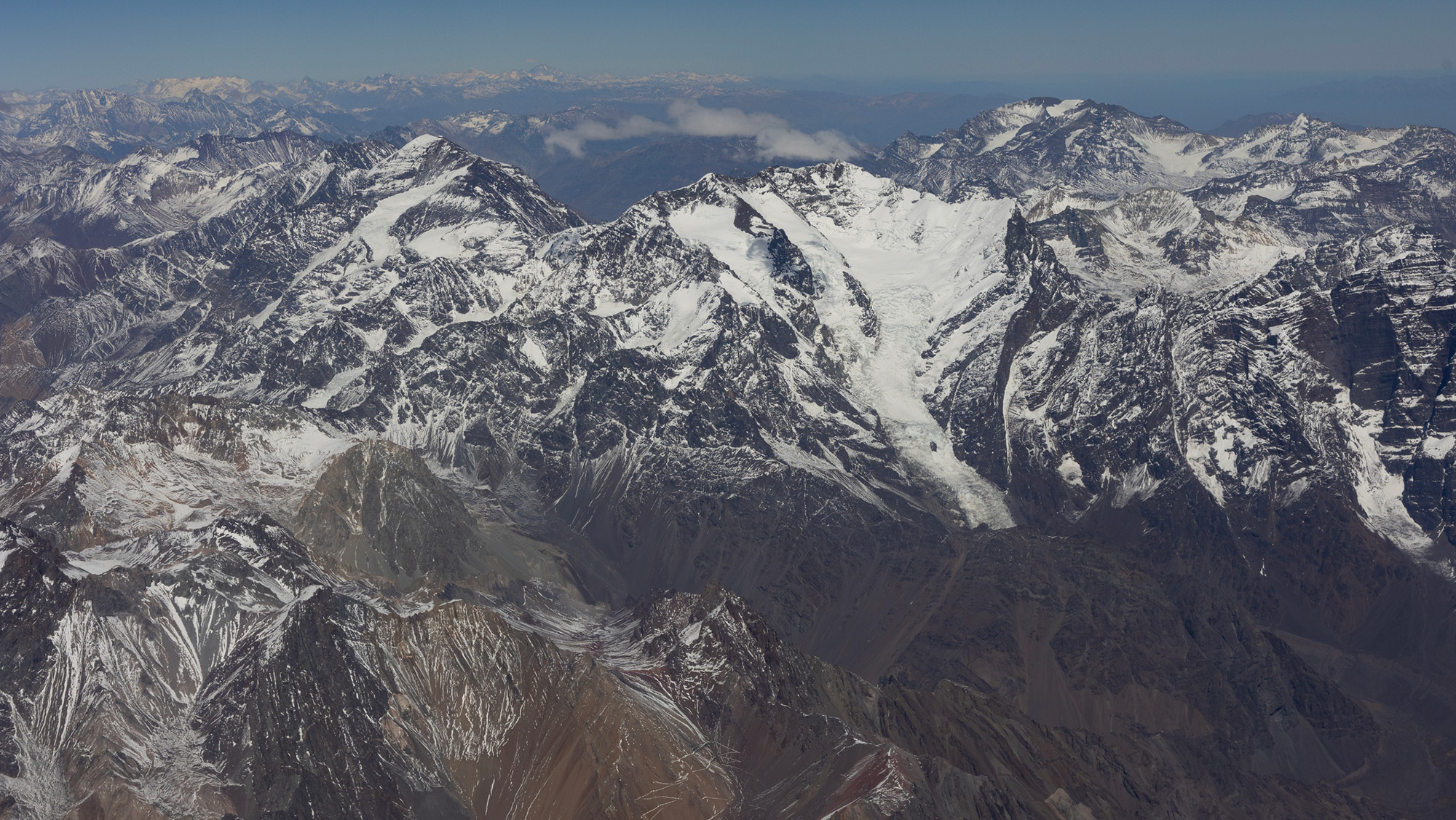
An aerial view of Cerro El Plomo in the Andes of Chile, where El Plomo Boy was sacrificed in about 1480. (Image credit: dreamextreme via Getty Images)
It was long thought that the El Plomo boy had died from hypothermia, or exposure to freezing temperatures, on the high peak, and that the Cerro Esmeralda girls were killed by strangulation. But the new study, published July 15 in the journal Science Advances, rejects those ideas.
Human sacrifice
Archaeologists found the El Plomo Boy in 1954 and the two Cerro Esmeralda girls in 1976. The new study applies modern archaeological techniques to them for the first time.
It "demonstrates that previously investigated contexts can continue to provide crucial information when revisited using new technologies, minimally invasive methods, and an ethical perspective," Silva-Pinto said.
Their examinations with CT scans and microscopy revealed that El Plomo Boy had been killed with blunt force trauma to the head — an injury that wasn't apparent to the initial investigators. The two Cerro Esmeralda girls, meanwhile, were previously thought to have been strangled because of marks on their necks. But the new study found that the marks were probably caused by their clothing after death, and that the hyoid bones of their throats were not fractured or displaced, which happens in most strangulations. The cause of the girls' deaths should now be considered "indeterminate," the researchers said.
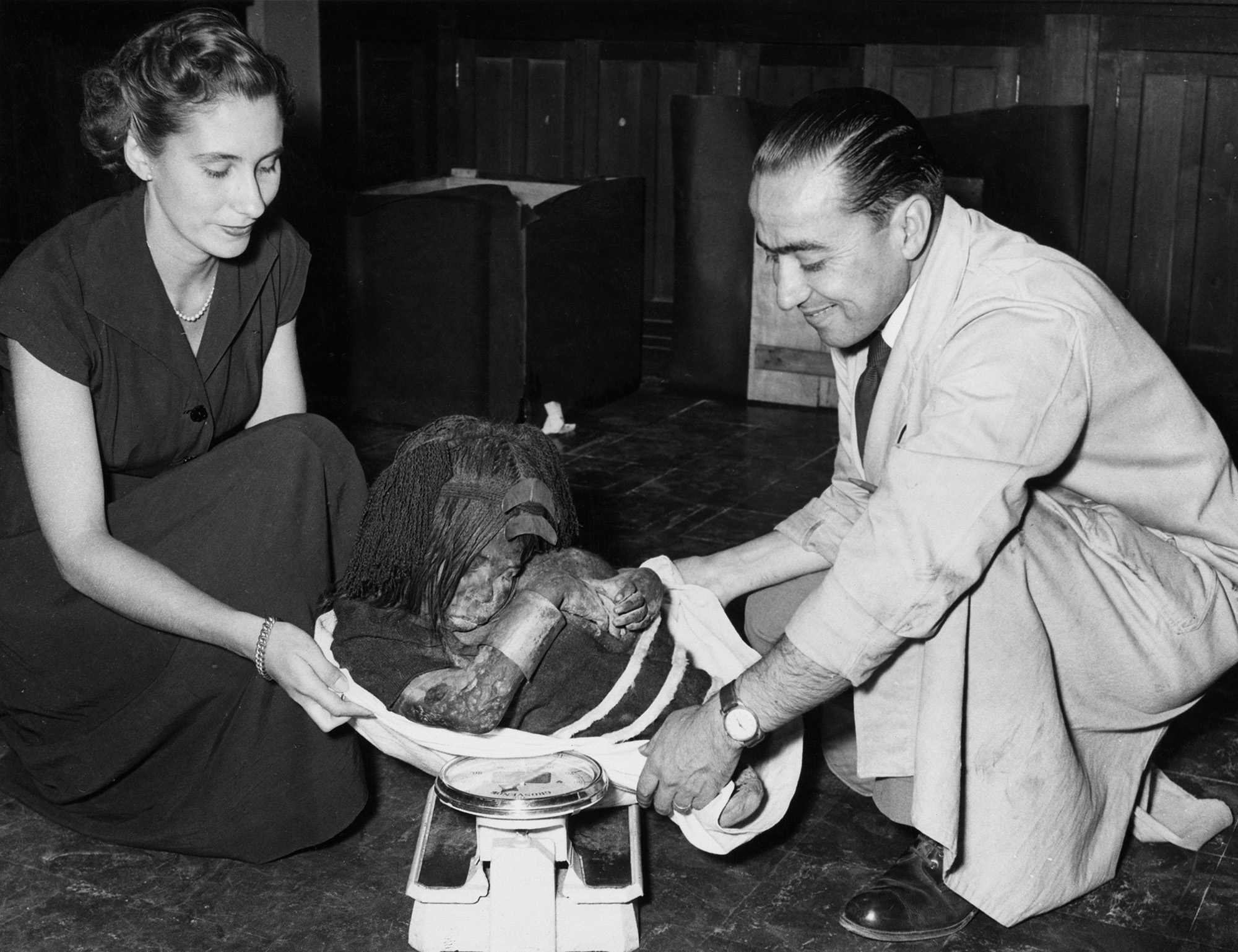
A new study finds that El Plomo Boy — whose mummy is shown here being weighed — didn't die from exposure to the cold, but from blunt force trauma to the head. (Image credit: FPG via Getty Images)
Silva-Pinto said the forensic examination should be considered within the Andean worldview, which didn't see death as the end of existence.
"Death was not necessarily understood as an absolute end, but rather as a transformation or passage into the realm of divinities, ancestors, and sacred forces," she said. "The individuals who were offered acquired a new ritual status and could become mediators between communities, mountains, divinities, and the state."
Sacred pilgrimage
The researchers carried out chemical studies on tiny samples of hair from the mummies by looking at isotopes, or different versions of the same element that have varying numbers of neutrons in their nuclei. The isotopes from food and water people consume are incorporated into their hair, shedding light on where they've lived. The team also examined samples of fractured bones for radiocarbon dating.
The hair isotopes showed that the children had moved over long distances between "ecologically distinct regions." The researchers estimated that El Plomo Boy traveled between 1,615 and 1,740 miles (2,600 and 2,800 kilometers) over his last nine months, probably starting from the Inca capital Cuzco, at the heart of the Inca Empire. The Cerro Esmeralda girls probably traveled between 560 and 745 miles (900 and 1,200 km) in their final three months.
Silva-Pinto said the pilgrimages connected outlying regions with the high mountains and other sites where the ceremonies culminated. "Along the routes, local communities would have received the pilgrims and participated in ceremonies involving the sharing of food and beverages," she said. The routes thereby became sacred landscapes, and the central Inca state used this to consolidate its presence in incorporated territories, she said.
The radiocarbon dates for the mummies showed they were all sacrificed in the 15th century: the Cerro Esmeralda girls in about 1450 and El Plomo Boy in about 1480. "The chronology shows that these were not isolated events, but rather a practice carried out at different moments," Silva-Pinto said.
Bioarchaeologist Dagmara Socha from the University of Warsaw in Poland, who studies the Capacocha mummies but who was not involved in this particular examination, cautioned that the conclusions drawn from the isotope analysis might be flawed. "Isotopic analyses alone do not allow us to reconstruct the potential route taken during the journey," she told Live Science in an email. "In several cases, the observed isotopic changes were not statistically significant and may also reflect seasonal variation in diet."
The study is "interesting and potentially valuable, but some of the interpretations go beyond what can be reliably concluded from the available evidence," she told Live Science in an email.
Archaeologist Pablo Mignone of Argentina's Institute for Research in Social Sciences and Humanities, who was also not involved, said the paper's interpretive framing could be questioned. "The paper leans on a fairly centralized, top-down narrative: children brought to Cuzco and then dispatched as instruments of 'biopolitical conquest,'" he told Live Science in an email.
But earlier studies showed that Capacocha individuals sometimes started their trek in Inca regions, not only at the capital: '''Cuzco as the sole engine of conquest' is an interpretive choice that neither this study nor the broader body of comparative evidence on Capacocha unequivocally supports," Mignone said.
How much do you know about the first people to reach the Americas? Find out with our First Americans quiz!
This wooden mask, which is decorated with human hair and a textile headband, adorned an Andean mummy up to a millennium ago. Made by an artist of the Chancay people, the mask was also painted red with the mercury-containing pigment cinnabar.
The Chancay were a pre-Inca people who lived along the central coast of Peru in the Late Intermediate Period (1000 to 1450). A common tradition among the Chancay was the funerary bundle — the end result of wrapping their dead in layers of textiles, vegetal material and animal skin. The bundle was then buried in a pit along with grave goods such as tools, food and figurines. Because the bodies were usually wrapped in a fetal position, however, it was not always clear exactly where the head was located once the bundle was complete.
According to The Walters Art Museum in Baltimore, which has this mask in its collection, "false heads" made from textiles or wood were sometimes tied onto the Chancay funerary bundles to act as a focal point for venerating the ancestor.
The mask is roughly life-size, measuring 12 by 8 inches (30.5 by 20.3 centimeters). Chancay funeral masks were not meant to be realistic. Instead, they had simplified features, such as the diamond-shaped eyes; triangular nose; and tiny, U-shaped smile on this mask. The wig was almost certainly made from human hair, according to a microscopic analysis The Walters Art Museum undertook in 2017.
The Chancay artist who made the mask painted it red using cinnabar, a toxic substance that is the brick-red form of mercury sulfide. Cinnabar was frequently used in Andean funerary rituals, and the color was associated with purification and commemoration rituals. But the mask was likely not placed on the outside of the bundle burial, as a patterned impression has been left on the cinnabar of this mask, probably from being wrapped in even more textiles, according to The Walters Art Museum.
A team of conservationists has discovered and restored the tombstone of Sebastian, a formerly enslaved man who died free in 1729.
"That discovery is likely one of the oldest gravestones of a free Black person in America," Michelle Wu, the mayor of Boston, said in a July 4 speech. "It's been there all along. We just had to go look and share the story."
The stone marker is inscribed with Sebastian's chosen name, Boston, and features an image common in 17th- and early 18th-century tombstones in New England: the death's head. The symbol includes a stylized skull flanked by wings, which were possibly intended to symbolize spiritual resurrection.
On the tombstone, a simple, five-line inscription reads:
Original Inscription
HERE LYES Ye
BODY OF BOSTON
AGED 70 YEARS
DECD FEBY Ye 28
1728
Modern English
HERE LIES THE BODY OF BOSTON AGED 70 YEARS DECEASED FEBRUARY THE 28 1728
In 18th-century American writing, the word "the" was often abbreviated with a Y-shaped letter form called a "thorn" representing the "th" sound. Tombstones also frequently abbreviated "deceased" and the month. Somewhat confusingly, before 1752, the American colonies regularly used the Julian calendar, as did Britain, in which the new year started on March 25. Boston's year of death is listed on the tombstone as 1728, but his February 28 death was actually in 1729 in our modern Gregorian calendar.
Kelly Thomas, the director of the Historic Burying Grounds Initiative for the Boston Parks and Recreation Department, told WBZ News Radio that she identified the gravestone during a restoration project at the Granary Burying Ground, the city's third-oldest cemetery. Established in 1660, the cemetery includes over 5,000 graves, including the final resting places of Declaration of Independence signers Samuel Adams and John Hancock; the U.S. Revolutionary War officer Paul Revere; and Crispus Attucks, a sailor of mixed African and Indigenous ancestry who is thought to be the first American killed in the Boston Massacre.
"I was reviewing the photos of headstones, and then I noticed that the stone only had one name," rather than a first and last name, Thomas told WBZ News Radio, suggesting that Boston was either enslaved or free when he died. Based on a search of historical records, Thomas determined that Boston's enslaved name was Sebastian and that he also went by Bastian.
A surprising amount of information was recorded about Boston and his wife, Jane Lake. In 1701, they had their daughter, also named Jane, baptized at First Church in Boston, where they regularly attended worship services. But while the two were married with children, they were also both enslaved and lived in different households, historian Gloria Whiting wrote in a 2016 study.
Boston was likely freed in the early 18th century, some time after the 1702 death of John Waite, who had held him in slavery. By 1708, a list of free Black people included the name Boston, and he had gained a reputation in the city as a hardworking handyman, according to Whiting's study. He had been freed for roughly 30 years when he died in 1729 and was well-known enough to have an obituary published for him in the New-England Weekly Journal, a rare occurrence for enslaved or freed Black people in colonial America.
Wu also said that, in recent weeks, archaeologists in Boston had discovered musket balls and gun flints from the infamous Battle of Bunker Hill that took place on June 17, 1775. The battle was fought by British Crown forces and New England troops in the first stage of the American Revolutionary War.
Archaeologists have discovered an iron cannonball fired by Texans at the Battle of the Alamo in 1836. This is the second intact cannonball they have discovered from the famous conflict. The first one, a bronze cannonball, was found earlier this year and was likely fired by the Mexican army.
"It's a huge deal," Tiffany Lindley, director of archaeology at the Alamo, said in a video statement from Alamo Trust. "We all thought, 'There's no way we can top it,'" she said, referring to the bronze cannonball discovered March 5, just a day before the 190th anniversary of the conflict that killed Davy Crockett, "and then we found another one."
Both cannonballs were recovered from the northeast corner of the church at the Alamo, which was originally built in 1718 as a Spanish mission and fortress in what is now San Antonio. But the Alamo is better known as the location of an 1836 battle during the Texas Revolution, in which Anglo-American settlers and Hispanic Texans known as Tejanos seceded from the Republic of Mexico.
In a 13-day siege culminating in a deadly assault on March 6, 1836, Mexican troops, commanded by Gen. Antonio López de Santa Anna, surrounded the Alamo and killed the 180 Texan rebels defending the structure, including Davy Crockett. The cry "Remember the Alamo!" was used in later skirmishes in the Texas Revolution as soldiers fought Mexican troops for independence.
The newly excavated iron cannonball was found June 2, according to a statement from Alamo Trust.
Of the two cannonballs, "the newest one is slightly larger" and was likely fired from a cannon that shot 6-pound [2.7 kilogram] cannonballs, Kolby Lanham, a senior researcher and historian at the Alamo, said in the statement. "The likelihood is that the bronze one belonged to the Mexican Army and the iron one belonged to the Texans."
Over the years, archaeologists have found numerous pieces of ammunition and shrapnel at the Alamo, Lindley said, but these cannonballs are the first examples of solid shots — spherical projectiles fired from a gun or cannon — they have ever found.
"It's just a huge kind of once-in-a-lifetime deal," Lanham said. "But obviously, it's happened twice."
The size and weight of the cannonball suggests it was fired by a cannon that shot 6-pound cannonballs. (Image credit: Alamo Trust)
The Mexican and Texan cannonballs were found near each other, so they are likely the historic remains of the two sides shooting at each other in the fateful siege nearly two centuries ago.
"Whenever they were dropped the very first time — possibly in 1836, probably — they haven't been touched since, and that's what makes them extra special," Lindley said. "I don't think you can undersell it."
The Alamo remains an active archaeological site, where experts have discovered artifacts that span its centuries of history, from Indigenous stone tools that predate the Spanish mission through the late 19th century, when the structure was converted into a general store and warehouse.
An analysis of corn, cassava and coca plants discovered with sacrificed Inca children reveals they died during the reign of one of the last Inca emperors.

 Login