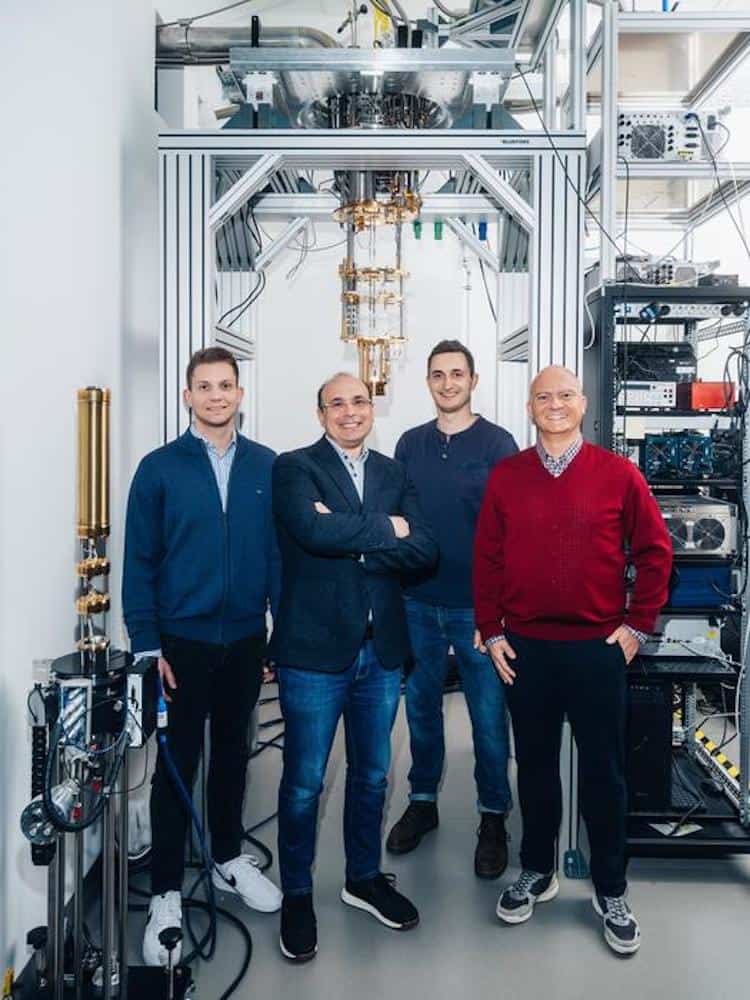
From left to right: University of Vienna researchers Rostyslav Serha, Andrii Chumak, David Schmoll and Sebastian Knauer standing in front of a cryostat. (Courtesy: Ian Ehm)
Bosonic quasiparticles such as magnons show much promise for enabling on-chip quantum information technologies that can be scaled down to the nanoscale, but their too-short lifetime has held back such applications until now. An international team of physicists says it has now increased this lifetime by a hundredfold, thanks to the discovery of a new class of magnons known as short-wavelength dipole-exchange magnons.
Magnons are the collective oscillations of coupled magnetic spins in a material. They are particularly promising for next-generation computing because they could allow for information processing based on the wave-like dynamics of these spins rather than the flow of electrons, thereby significantly reducing energy losses. They can also naturally couple to many other fundamental quasiparticles, such as phonons and photons, which makes them ideal as the building blocks for hybrid quantum systems.
The main drawback of magnons, however, is that they die too fast, explains Andrii Chumak of the University of Vienna, who led this latest study. “Indeed, their lifetimes are typically limited to a few hundred nanoseconds, something that puts a hard ceiling on what we can do with them in a quantum architecture.”
A lifetime of up to 18 µs
In this work, which is detailed in Science Advances, the researchers discovered short-wavelength dipole-exchange magnons in highly pure, single-crystal yttrium iron garnet (YIG) spheres held at millikelvin temperatures. These magnons last for up to 18 µs, which is nearly two orders of magnitude longer than that previously observed for these quasiparticles.
As often in science, the discovery was accidental, says Chumak. “We had prepared three YIG spheres with varying degrees of purity for planned quantum experiments with superconducting qubits, and we simply wanted to characterize these spheres and identify the one that hosted the longest magnon lifetime,” he recalls.
“An 18 microsecond lifetime places magnon coherence on a par with that of typical transmon superconducting qubits used in today’s quantum processors,” he tells Physics World. “This reshapes the role magnons can play in hybrid quantum architectures – from lossy intermediaries to robust quantum memories and low-loss links able to mediate interactions between distant qubits on a chip.”
A programmable on-chip “quantum bus”
And that’s not all: long-lived magnons coupled to superconducting circuits could act as a programmable on-chip “quantum bus”, entangling many distant quantum bits (qubits) made from these hybrid structures along a common waveguide, rather than only nearest neighbours, he adds. The results also point to a clear materials-science route to push magnon lifetimes even further, in particular by continuing to reduce rare-earth impurity concentrations in YIG.
There is a way to go before real-world applications see the light of day, however. For one, the researchers still have some physics to understand, but that is what makes the project so intriguing for them, they say.
Chumak says that the most immediate future step in his team’s work will be an echo-type experiment to measure the lifetime of these magnons directly, rather than inferring it from the so-called parametric instability threshold, as was done in this work. “In parallel, we will need to learn how to excite and detect these short-wavelength magnons efficiently using nanoscale transducers, which is essential before they can be integrated with superconducting qubits.”
“The field of quantum magnonics is still very young compared to other quantum platforms,” Chumak notes, “so it will take some time before we reach actual quantum computing applications – but the path is now much more concrete than it was a year ago.”
Celebrity gossip might break the Internet, but not in the way that quantum computers could. “The advent of quantum computers poses a critical threat, as they could break widely deployed encryption schemes,” warns Lily Chen, a cryptography expert from the US National Institute of Standards and Technology (NIST). Systems at risk include banking encryption, digital signatures, secure messaging, secure shell tunnelling, cryptocurrency and more.
Today’s quantum computers are still too small and error-prone to defeat gold-standard encryption. However, new results from Google Quantum AI and start-up Oratomic suggest that could change, with two widely used cryptographic systems – elliptic curve cryptography (ECC) and the Rivest-Shamir-Adleman (RSA) algorithm – potentially coming under threat sooner than many scientists predicted.
Space–time trade-off
At present, anyone who wants to access encrypted information needs a secret digital key. To obtain this key, an attacker must first solve a difficult mathematics problem. For example, breaking the RSA algorithm boils down to factoring a large number into its prime components. Breaking ECC involves finding a secret number that connects two points on an elliptic curve.
Classical computers might take billions of years to solve these problems. But if an attacker had access to a powerful enough quantum computer, they could solve the problems in mere minutes using an algorithm devised by Peter Shor in 1994.
Several years ago, experts estimated that cracking a typical RSA scheme with 2048-bit keys (RSA-2048) would require tens of millions of physical quantum bits (qubits), which are the building blocks of quantum computers. A year ago, this value dropped to a million. By February 2026 it was down to 100,000. The latest results from California-based Oratomic push the floor even lower, to 10,000 physical qubits. The largest neutral-atom qubit array – realized last year in the lab of Oratomic co-founder Manuel Endres – stands at 6100 qubits. This makes the benchmark of 10,000 feel alarmingly close, though Endres’ array hasn’t yet been used for computation.
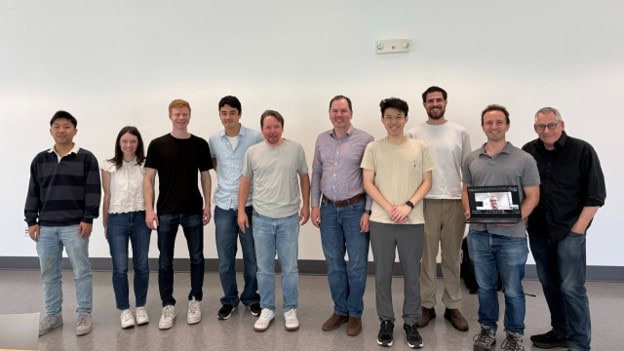
The team: Employees at Oratomic, a new neutral-atom quantum computing start-up. (Courtesy: Oratomic)
There are, however, trade-offs. Quantum computers that use fewer qubits or more space-efficient hardware generally have longer computation times. Oratomic’s proposed 10,000-qubit platform would require three years to crack ECC with 256-bit keys (ECC-256) and 120 years to crack RSA-2048. The company’s predicted time-efficient alternative could solve ECC-256 in 10 days, but that would require 26,000 qubits. Solving RSA-2048 in 97 days would take 100,000 qubits.
Oratomic’s numbers have not yet been peer-reviewed, and outside experts say they depend on different assumptions about future hardware developments. “The space-efficient [architecture] is mostly based on assuming aspects that have been demonstrated to work individually in state-of-the-art academic labs,” explains Maria Violaris, a quantum physicist at Oxford Quantum Circuits, who was not involved in the research. “Meanwhile, the time-efficient one relies on more speculative assumptions that need future innovation.”
A second perspective
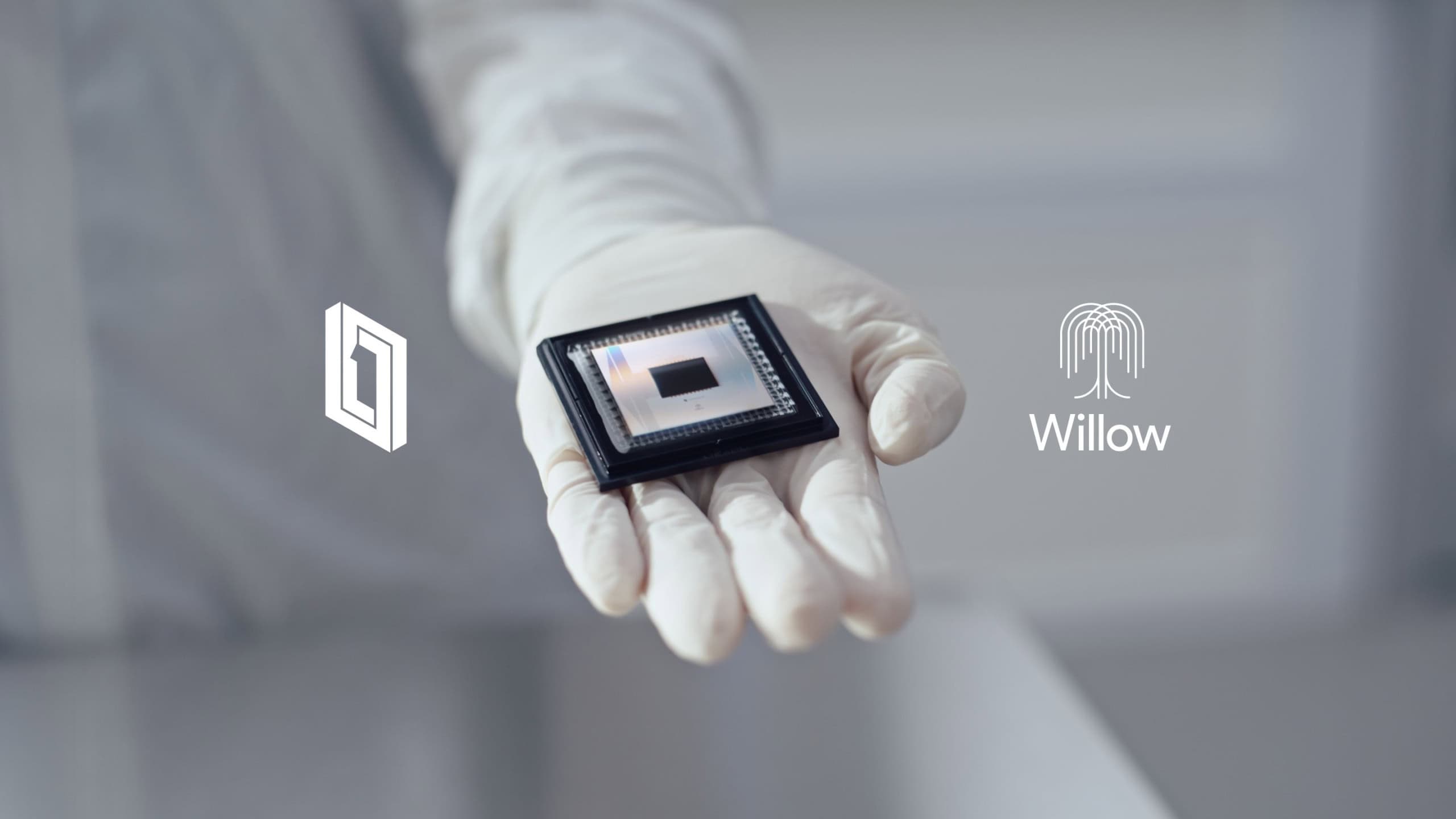
On the same day as the Oratomic team posted its findings on the arXiv preprint server, researchers at Google Quantum AI released a white paper with their own updated resource estimates. They report that a computer with 500,000 physical qubits made from superconducting circuits could solve ECC-256 in 18 minutes – and potentially even less (see box). Google’s current state-of-the-art processor, Willow, has 105 physical qubits. However, the researchers warn against assuming gradual and predictable progress because quantum computing developments are driven by overcoming scaling barriers rather than by steady increases in processor size.
The quantum threat to cryptocurrencies
Elliptic curve cryptography (ECC) underpins the security of most blockchain networks, including Bitcoin and Ethereum. Bitcoin transactions take an average of 10 minutes, so if a quantum computer can crack ECC and determine the secret key during that window, the transaction could be intercepted and funds stolen in real time.
While Google Quantum AI’s results predict that it would take 18 minutes to solve ECC on a 500,000-qubit quantum computer, they argue that the run time could be effectively shortened in some circumstances. To understand how, imagine planning a heist in which you need to open a safe. Although you won’t know the exact combination until you get your hands on the safe, if you know the model number in advance, you can prepare some tools to help you crack it faster.
A quantum computer could do something similar. According to the Google Quantum AI researchers, half the ECC algorithm only depends on the elliptic curve and not on the specific transaction. A quantum computer could precompute this half, wait in a primed state until a Bitcoin transaction begins, then quickly solve the second half in only nine minutes, dropping below the 10-minute threshold.
Quantum computing platforms that use superconducting, silicon, and photonic qubits are well-positioned for real-time attacks because they tend to compute faster than neutral-atom and ion-based computers. However, the latter could still pose a serious risk through “at-rest” attacks. Such attacks involve adversaries collecting archived and publicly available data, then decrypting it later with few time constraints.
Which threat arrives first will depend on how different quantum computing architectures mature and scale, a path still marked with considerable uncertainty. “Ultimately, feasibility is difficult to say as it depends on how challenging it will be to increase scale or to take a novel approach by engineering [new] hardware,” notes Maria Violaris of Oxford Quantum Circuits.
The high number of physical qubits required for quantum computation comes from the need to detect and correct errors. Google Quantum AI’s estimate is based on a well-known error-correction method known as the surface code. In this approach, physical qubits are arranged in a rectangular grid and interact with their nearest neighbours. Quantum information is spread redundantly across this grid, allowing errors on one physical qubit to be found and fixed. The entire grid is considered one logical qubit, and the ratio of logical to physical qubits is called the encoding rate.
In the surface code, reducing error amounts to adding more physical qubits per logical qubit, and typical encoding rates range from a few hundred to a few thousand. In contrast, the Oratomic team based its estimates on a newer method of error correction called quantum Low-Density-Parity-Check (qLDPC), which reduces error more efficiently by making the physical qubits interact over large distances. Hengyun (Harry) Zhou, a physicist at the Massachusetts Institute of Technology in the US who was not involved in the research, explains that this longer-range connectivity can significantly increase the encoding rate. For qLDPC codes, a typical rate is around 1 to 10, but rates can now go as high as 1 to 2.
Because neutral atoms are highly reconfigurable, neutral atom platforms like those used by Oratomic (and other companies, including QuEra Computing, Infleqtion, Pasqal, planqc and Atom Computing) are naturally suited to the required long-range connectivity that qLDPC codes require. However, Zhou argues that it’s “not completely out of the question” that superconducting qubit platforms could use these codes too. “There is some additional cost that the lack of reconfigurability in those platforms currently leads to, but I would say if we’re thinking about a beyond-10-year timescale, it’s quite imaginable that things could also change for other platforms as well,” he says.
Responsible disclosure
Google Quantum AI’s white paper may represent a turning point in another respect. Rather than being open about their circuit designs, its authors hid them behind a “zero-knowledge proof”, which provided enough information to verify claims while hiding details that they say could provide bad actors with an “instruction manual”.
Superconducting quantum computing: Google Quantum AI’s Willow processing chip. (Courtesy: Google Quantum AI)
This is a relatively novel approach within the quantum computing community, which has thus far followed the conventional academic practice of publishing results with full transparency. A Google blog post expresses hope that “our approach to responsible disclosure can spur an important conversation among quantum computing researchers and the broader public”.
Certainly, it has already spurred a conversation among experts. “This is the first time I’ve ever seen a new mathematical result actually announced that way,” Scott Aaronson, a quantum physicist at the University of Texas at Austin, US, wrote on his blog. “I’m not sure how much it will actually help, as once other groups know that a smaller circuit exists, it might be only a short time until they’re able to find it as well.”
Zhou echoes this sentiment. “These are the kind of results that could potentially have a lot of general societal safety implications, so you want to make sure that they’re safeguarded responsibly,” he observes. “That being said, I think it is also possible that other people, now that they know what is possible, might come up with related constructions.”
What comes next?
In the long run, protecting against threats likely means migrating away from RSA and ECC and towards new mathematical problems that are difficult for both classical and quantum computers to solve. Google recently introduced 2029 as an internal deadline for migrating major system to so-called post-quantum cryptography (PQC), and many experts believe the migration ought to begin now.
“Migrating to PQC is a massive undertaking that won’t happen overnight. Starting migration today is a necessary risk management strategy,” urges Chen from NIST. She notes that NIST has been instrumental in guiding this migration, beginning with its 2016 call for cryptography experts to design and evaluate new algorithms for PQC, and culminating in its publication of the three most promising ones in 2024.
The Google Quantum AI researchers also outline recommendations to help cryptocurrency communities and policymakers prepare for the PQC era. And while urgency permeates their white paper, ongoing PQC efforts prompted them to end it on a positive note. “These trailblazing projects demonstrate that transition to post-quantum cryptography is realistic and instil hope that it will have been completed before the first [cryptographically relevant quantum computers] come online,” they write.
Quantum materials could transform technologies ranging from powerful computers and highly secure communications to advanced energy systems, but one major obstacle has long stood in the way. Most quantum materials reveal their unusual properties only when chilled to temperatures near absolute zero. At room temperature, continual atomic vibrations caused by heat can overpower the fragile [...]
ISTA physicists have confirmed a theory proposed 20 years ago that could advance quantum technology. A future quantum computer may need separate modules to behave as one machine, even when they are physically apart. That requires distributed entanglement, a quantum connection between distant components that has typically depended on active control and repeated measurements. Physicists [...]
Researchers have revealed a microscopic engine that can convert heat into useful work while operating at temperatures only fractions of a degree above absolute zero.
Tinier than a single grain of sand, the machine marks the first demonstration of what researchers call a cyclic quantum heat engine composed of superconducting circuits, the technology behind modern quantum computers.
The findings, led by Academy Professor Mikko Möttönen, were published in Nature Communications.
A Sand-Grain-Sized Quantum Heat Engine
The tiny device, developed by researchers at Aalto University in Finland, relies on a single superconducting qubit, which represents the quantum world equivalent of a classical computer bit.
By heating, cooling, and extracting energy through quantum variations of the cycles that provide power to conventional engines by thermodynamic means, researchers say the machine’s demonstration of producing energy, while extremely small, marks a breakthrough that could one day allow for the simplification of much larger-scale quantum computers.
In the image above, a microscopic image of the sample is shown along with an added circuit diagram of the microwave drive and readout lines (Image Credit: Möttönen, et al, Nature Communications)
A flux-tunable transmon qubit—one of the most common building blocks of superconducting quantum processors—lies at the heart of the innovation. But as opposed to relying on separate hot and cold reservoirs, the Möttönen and the Aalto University research team used a single quantum circuit refrigerator capable of performing both roles.
The team guided the system through a sort of quantum version of what is known as an Otto cycle (the same essential process most gasoline engines employ) by leveraging precise control of the refrigerator and the qubit’s energy levels.
“In our experiment, we built a nanofabricated heat engine using superconducting circuits and operated it in a cryostat near absolute zero,” said lead author Tuomas Uusnäkki. “At its heart is a transmon qubit, one of the basic building blocks of modern quantum technologies.”
Single Shot Measurements on Repeat
The team also used repeated single-shot measurements to track the qubit, observing as it completed several engine cycles. This helped them calculate precisely how much heat was absorbed, as well as the amount of work produced, and the machine’s overall efficiency.
The results, they say, closely matched theoretical predictions, and now help to confirm that the device functioned as a genuine cyclic quantum heat engine.
Although this is not the first quantum heat engine, and previous demonstrations have been achieved using trapped ions, ultracold atoms, and other quantum systems, the Aalto team says this is the first that operates using superconducting circuits, which could present new possibilities for the future of quantum computing.
As quantum computers grow, such technologies could be especially helpful, since today’s superconducting processors rely on extensive networks of microwave cables connecting room-temperature electronics with processors that operate near absolute zero—the lowest temperature theoretically attainable.
These networks of cabling not only take up space, but also add to costs, while adding to the overall heat and electrical noise in systems that can also introduce interference affecting fragile quantum states.
A Look at the Future of Quantum Computing
With future refinements of their technology, the Aalto team hopes versions of their tiny engine may be able to perform control functions directly within cryogenic quantum processors, thereby reducing the need for external wiring altogether.
“Finland’s Quantum Technology Strategy envisions a quantum computer with one thousand logical qubits by 2035, which probably means hundreds of thousands of physical qubits,” Möttönen said in a statement, describing future large-scale quantum computers.
“Doing that with current technology requires millions of microwave cables costing thousands of euros each,” he added.
“The cables also introduce noise into the system,” Möttönen said. “Using autonomous devices instead would mostly eliminate the need for those cables.”
Micah Hanks is the Editor-in-Chief and Co-Founder of The Debrief. A longtime reporter on science, defense, and technology with a focus on space and astronomy, he can be reached atmicah@thedebrief.org. Follow him on X @MicahHanks, and at micahhanks.com.
There are some obvious big picture issues that stand between us and useful quantum computing. Issues like whether we can make enough high-quality hardware qubits to connect into the error-corrected logical qubits we need, and how we generate the states needed to perform universal computation on those logical qubits. But there are also many less prominent challenges that will need to be solved before we can perform calculations.
One of those challenges, which only affects some types of hardware, is calibration. For devices we manufacture, like superconducting qubits, there are always subtle variations among individual qubits. (This is not true when we use something like an atom to hold the qubit, but the lasers that control them can drift.) As a result, this hardware is put through a process called calibration, where we test different frequencies and amplitudes of the microwave pulses that control them to find the combination that produces the lowest error rates, and then save those settings for use in calculations.
However, you can't perform the typical calibration process while you're doing calculations, which means drift becomes an issue for long and complicated algorithms. Google, though, has figured out that it's possible to do calibration using the same data that's used for error correction.
Using a quantum computer alongside a supercomputer, scientists have developed a breakthrough pathway for modeling the physics inside a fusion reactor. The world-first experiment could help clear a path to developing clean, abundant nuclear power and solving the global energy crisis, the researchers said.
Using hybrid quantum computing and artificial intelligence (AI) methods, scientists with IBM and Oak Ridge National Laboratory (ORNL) have blueprinted how to make tritium, an extremely rare isotope of hydrogen that's critical to the fusion process.
Although their research — uploaded June 29 to the preprint server arXiv — has not been peer-reviewed, the researchers say it's the first time that different kinds of computing elements have come together to propose the most effective way to create this material.
Fusion reactors are experimental power sources that create energy by fusing atomic nuclei. The heat produced in the subsequent nuclear reaction is then harnessed as energy. This method produces no carbon byproducts or long-lived radioactive waste, making it one of the cleanest potential forms of mass energy production.
It's projected that, at scale, a single fusion reactor could produce about 4 million times as much energy as a coal-burning facility and around four times the amount of energy as a modern nuclear fission reactor.
Current attempts at building a viable fusion reactor have resulted in numerous laboratory experiments that prove the technology works, with magnetic confinement reactors, such as tokamaks, widely considered the front-runner. But many engineering challenges remain before the first commercial reactors could come online.
Turning seawater into fuel
The base fuel for nuclear fusion reactors is a hydrogen isotope called deuterium, which is commonly found in seawater. It's estimated that there are 33 grams of deuterium in every cubic meter of seawater.
But deuterium is only half of the equation. Nuclear fusion also requires tritium — a heavier hydrogen isotope — and the fusion released from just 1 gram (0.04 ounces) of deuterium-tritium fuel equals the energy from about 2,400 gallons (9,100 liters) of oil, according to the U.S. Department of Energy.
Unfortunately, tritium, a radioactive isotope, is extremely rare; only 44 pounds (20 kilograms) of it is produced on Earth each year, and its 12-year half-life makes it difficult to use in nuclear power plants.
Instead, scientists must painstakingly produce tritium in nuclear reactors by bombarding lithium atoms with neutrons. It's then superheated and bound with powerful magnets into a whirling ring of plasma within a tokamak, a special fusion chamber designed to shape and heat plasma using magnetic fields.
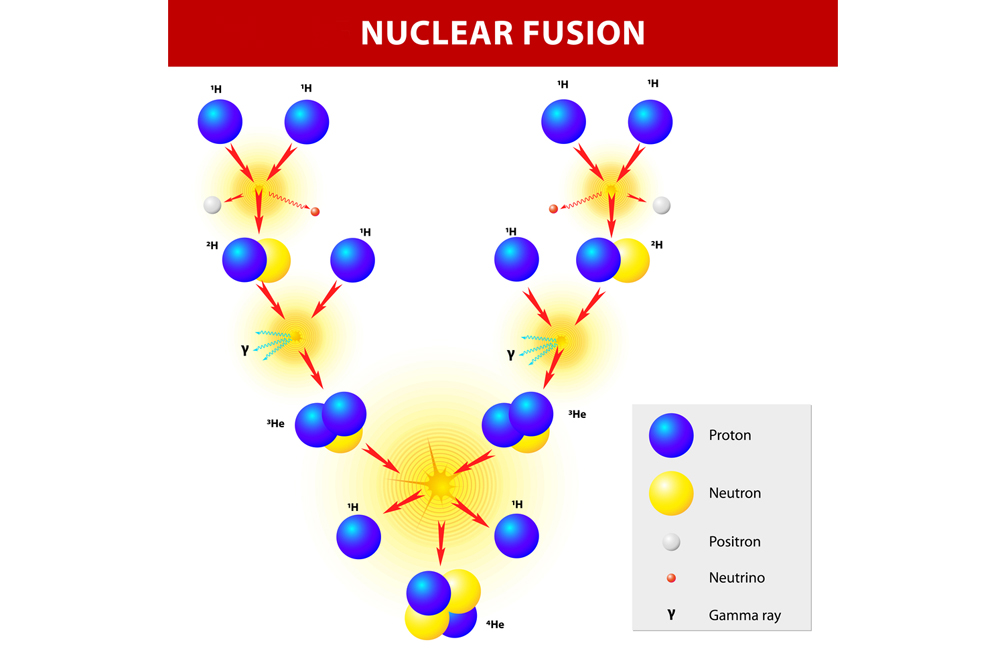
A diagram showing the process of nuclear fusion. (Image credit: Designua | Shutterstock)
Scientists add more deuterium and then bash the tritium and deuterium together, causing them to fuse into helium. The force of this reaction creates heat that's converted into energy.
The current bottleneck lies in creating enough tritium to sustain fusion long enough to produce energy. But modeling the particle physics and chemical reactions involved in the tritium-creation process has proved beyond the capabilities of classical supercomputers.
In the new study, however, scientists say they have addressed this bottleneck by simulating nine molecular configurations of a liquid salt that contains fluorine, lithium and beryllium (FLiBe) — one of the leading candidate materials for extracting tritium.
This is the first time quantum computers have been used to model reactions inside a fusion reactor. If perfected, FLiBe could provide a near-limitless source of fuel for nuclear fusion reactors, they said, but the chemistry involved is incredibly complex.
Demystifying complex chemistry
A "blanket of molten salt" made of FLiBe is wrapped around the nuclear reaction inside a fusion reactor, IBM researchers told Live Science. This provides both a fuel source and a thermal shield for the device.
To create enough tritium, the researchers had to calculate the physics involved while a process called "neutron bombardment" constantly altered the blanket's chemistry. Designing a salt that holds up under competing demands and keeps releasing tritium is a key problem in building this kind of reactor.
"If tritium grabs onto fluorine in the salt, it forms tritium fluoride, which is corrosive and stubborn to remove," the researchers explained. "If it binds to another tritium atom to form a gas, it bubbles out on its own. Predicting which way the reaction goes means modeling the interaction between tritium and the salt with high precision and accuracy that is challenging for classical methods."
Because no ordinary computer can perform the necessary calculations, the team used a combination of AI running on the Frontier supercomputer at ORNL, alongside quantum computing algorithms running on an IBM Quantum Heron quantum processing unit (QPU) in New York. The resulting workflow demonstrated a proof of concept for offloading complex chemistry computations to a quantum computer.
That workflow relied on a technique called wave-function-based embedding, which fragments the calculation into easier-to-calculate clusters, the scientists said in the study. They used classical computers to solve the smaller clusters and passed off the more difficult chunks to a quantum computer. The classical computers then stitched the molecule back together.
This is a method that study co-author Kenneth Merz, a biochemist and principal investigator at Cleveland Clinic Research, pioneered in previous research. Earlier this year, in collaboration with IBM and the Japanese national research institute RIKEN, he used quantum computers to calculate the structure of a 12,635-atom protein.
Fusing quantum and AI
In the new study, the researchers tested their model against known molecular configurations that were already solved by a nonhybrid classical system and determined that the accuracy was maintained with the addition of quantum computations.
This proof of concept should serve as a direct pathway for scaling the models used to predict tritium production within fusion reactors, potentially solving what may be the biggest hurdle to large-scale fusion energy production.
The broader workflow the scientists outlined in a technical blog post involved three stages. First, AI agents proposed and screened many candidate salts from the ORNL database, and for each candidate, calculations estimated various qualities in the tritium breeding process, including how much fuel the salt would make under neutron bombardment.
The most promising salts then went to a supercomputer, which modeled them atom by atom, using the density functional theory (DFT) process to approximate how a molecule's electrons would arrange themselves. These are expensive simulations, so the scientists used "AI stand-ins" trained to reproduce the physics to run them fast enough to be useful. The third stage brought in the quantum computer to figure out where the tritium would bind, which is a shortcoming for DFT.
In the future, the research team will model larger molten-salt systems and study more molecular configurations before evaluating whether AI can slash the time it will take to find a promising molten-salt material.
The wider aim, the scientists told Live Science, is to build a reliable computational pathway for fusion-materials discovery that can help researchers predict how well a blanket material breeds tritium, whether that tritium can be recovered, and how the material may perform in the extreme environment of a fusion reactor.
Can you match these ancient devices to their pictures? Find out with our computing quiz!
The White House is drastically shortening the deadline for government agencies and organizations to adopt new quantum-resistant encryption systems that will withstand attacks that use quantum computers, as the federal government seeks to protect decades’ worth of secrets belonging to militaries, banks, governments, and most individuals on Earth.
The executive order, titled Securing the Nation against Advanced Cryptographic Attacks, requires computing systems for “high-value assets” and “high-impact systems” to transition to post-quantum cryptographic key establishment schemes by December 31, 2030, and to quantum-safe digital signature schemes by December 31, 2031.
Heading off a significant threat
The new deadline, which for many organizations is about five years sooner than the previous one, comes on the heels of recent research showing that the resources and cost for building a cryptographically relevant quantum computer are far less than previous consensus estimates. In response, Google, Cloudflare, and other companies recently tightened their timelines for moving off vulnerable systems to 2029.
Researchers investigate how quantum time flow can be stretched, blurred, or even reversed. What if the direction of time isn’t as fixed as it seems? While our everyday experience tells us that time moves relentlessly forward, the microscopic laws governing quantum systems are far less restrictive. In fact, many of the equations of quantum mechanics [...]
Researchers have unveiled a groundbreaking advancement in the field of single-photon detection technology, introducing a novel dielectric grating design that harnesses Fano resonance to dramatically enhance the performance of superconducting nanowire single-photon detectors (SNSPDs). This transformative approach presents an ultralow-filling-factor detector that achieves unprecedented sensitivity and efficiency compared to conventional designs. Positioned at the forefront of quantum sensing and photonics research, the innovation promises sweeping impacts across quantum computing, secure communications, and fundamental physics research relying on photon detection.
SNSPDs have been critical instruments in detecting single photons with near-ideal timing resolution and low dark counts. However, their performance is inherently limited by the trade-offs in filling factor—the ratio of the active superconducting area to the total device area. Traditional nanowire designs with higher filling factors tend to maximize photon absorption but increase kinetic inductance and limit speed. Conversely, low-filling-factor designs, which offer faster recovery time and reduced device noise, often sacrifice detection efficiency due to diminished absorption cross-section.
In this pioneering study, the research team led by Zheng, Wei, Huang, and colleagues has engineered a dielectric grating structure capable of elevating photon absorption through carefully tailored Fano resonance effects. Fano resonance arises from the interference between a broad spectral continuum and a discrete resonance state, producing asymmetric and sharply peaked spectral features. By designing the grating to induce such resonance near the operational wavelength of the SNSPD, the device achieves enhanced electromagnetic field confinement and increased photon interaction with the superconducting nanowire.
The key to this enhancement lies in the subwavelength periodic patterning of the dielectric layer atop the superconducting nanowires. This grating serves as an optical antenna that channels incident photons into highly resonant modes, significantly concentrating the optical field intensity where it couples effectively to the sensor. As a result, even an ultralow filling factor, far below that used in traditional SNSPD geometries, can deliver detection efficiencies that rival or surpass current state-of-the-art devices.
From a materials science perspective, the researchers employed high-index dielectric materials with exceptionally low optical losses, ensuring minimal dissipation of resonant modes. This novel integration of dielectric gratings with superconducting films required meticulous fabrication techniques capable of producing uniform nanoscale features. The interplay between the dielectric environment and superconducting nanowire morphology was optimized through iterative electromagnetic simulations, including finite-difference time-domain (FDTD) methods, to maximize the resonance effect precisely at the targeted operational wavelengths.
The experimental validation of these devices showcases dramatically improved quantum efficiency, even at extremely low filling factors—below 20%—which is seldom achieved in commercial SNSPDs. This performance gain translates into faster detector reset times due to reduced kinetic inductance, enabling higher count rates without sacrificing sensitivity. Additionally, the refined optical design reduces polarization dependence, improving reliability in systems where photon polarization states fluctuate or remain uncontrolled.
Beyond efficiency improvements, the Fano-resonance-enhanced dielectric grating offers enhanced tunability across different wavelength regimes by adjusting the grating period and dielectric thickness. This opens pathways for customizing SNSPDs to meet the demands of emerging applications in telecommunications, where detection in the near-infrared regime is crucial, as well as in the visible spectrum for biomedical imaging and quantum optics experiments.
The implications for quantum technologies are profound. High-performance SNSPDs underpin many quantum key distribution (QKD) systems, and the ability to engineer ultralow-filling-factor detectors with enhanced absorption can significantly improve the fidelity and scalability of secure quantum communication networks. Moreover, the combination of faster operation speeds and enhanced efficiency aligns with the increasing requirements for temporal resolution and low noise in quantum computing hardware reliant on photonic qubits.
In addition to advancing photon detection, the underlying principles demonstrated by Fano resonance engineering in dielectric gratings could inspire broader innovations in photonic device design. Such resonant structures may be adapted for sensor applications where enhanced light-matter interaction is pivotal, including biosensing, nonlinear optics, and laser cavity engineering. The cross-disciplinary impact stems from achieving precise optical control using relatively simple and scalable fabrication methods.
Crucially, this research highlights the importance of synergizing optical physics concepts with materials science and nanofabrication expertise to solve pressing challenges in photodetection. By moving beyond incremental improvements to embrace fundamentally new resonance mechanisms, the study sets a new benchmark for SNSPD performance metrics, challenging the community to rethink how nanostructured elements can shape device functionalities.
Looking ahead, further optimizations could explore integrating these dielectric gratings with emerging high-temperature superconducting materials or novel two-dimensional superconductors, broadening operational regimes and simplifying cooling requirements. Additionally, combining this approach with multiplexed SNSPD arrays could revolutionize photon-counting capabilities in large-scale quantum sensor networks.
From a practical standpoint, the compatibility of these dielectric gratings with existing photonic integrated circuit platforms suggests potential for seamless incorporation into complex optical systems. This alignment accelerates the translation of laboratory breakthroughs into deployable technologies for real-world quantum instrumentation, telecommunication, and even space-based sensing where minimal detector footprint and efficiency are paramount.
The study’s comprehensive methodology, incorporating both theoretical simulations and experimental verification, provides a robust framework for future device engineering. The precise control over Fano resonance exemplified here serves as a new design paradigm, balancing light absorption and superconducting active area to unlock detector performance hitherto considered unattainable with traditional approaches.
In summary, the inventive design of Fano-resonance-enhanced dielectric gratings for ultralow-filling-factor superconducting nanowire single-photon detectors addresses a critical bottleneck in quantum photonic detection. By leveraging the subtle interference effects responsible for Fano resonance, the team achieves an elegant solution that preserves high detection efficiency while enabling faster response times and reduced detector noise. This leap forward opens exciting new avenues in photonic quantum technologies and beyond, heralding a new era of advanced optical sensing capabilities.
Subject of Research: The development and enhancement of superconducting nanowire single-photon detectors (SNSPDs) through photonic nanostructure engineering.
Article Title: Design of a Fano-resonance-enhanced dielectric grating for ultralow-filling-factor superconducting nanowire single-photon detector.
Article References:
Zheng, F., Wei, K., Huang, X. et al. Design of a Fano-resonance-enhanced dielectric grating for ultralow-filling-factor superconducting nanowire single-photon detector. Sci Rep (2026). https://doi.org/10.1038/s41598-026-58781-8
A single transistor that behaves like a brain cell in the deep freeze could help unlock the next generation of quantum computers and space exploration systems. Researchers at the University of Hong Kong (HKU) have developed a new type of brain-inspired electronic hardware that can operate at temperatures close to absolute zero. The breakthrough could [...]
Quantum computing news usually picks up near the end of the year, as companies try to provide evidence that they are hitting benchmarks on time. However, there have been interesting announcements as the summer starts this year, from incremental progress to attention-grabbing promises. As we did earlier this month, Ars has a rundown of some of the most significant announcements.
These include a promise of useful, error-corrected quantum computing as soon as 2028, details on an updated trapped ion processor, and a case in which claims of quantum supremacy have been cut back a bit thanks to advances in more traditional algorithms.
2028 is remarkably soon
Many people in the field expect that useful quantum computers are still about five to 10 years away. While there may be a few useful algorithms that can be run on existing error-prone hardware, almost all of the interesting problems that quantum computing can be applied to will require some form of error correction enabled by linking a small collection of hardware qubits together into what's called a logical qubit. Logical qubits include the redundant storage of information along with neighboring qubits that can be measured to determine when errors occur and how to fix them.
Researchers in Sweden have developed a machine-learning approach that embeds the laws of physics directly into neural networks. A new study from Chalmers University of Technology in Sweden shows that machine learning can become far more efficient when it starts with a built-in understanding of the laws of physics. Researchers found that giving an AI [...]

 Login