❌

Normal view

US models beat China’s Kimi K3 with a 76% score over 32% in cyber benchmarks, tests show

25 July 2026 at 15:38

Despite fears that China could race ahead of the US in AI, a joint UK-US evaluation found that Moonshot AI’s Kimi K3 performs “significantly below” leading American models in offensive cybersecurity capabilities.

The findings address growing concerns in Washington regarding China’s recent advancements in artificial intelligence following the release of Kimi K3, described as China’s most powerful large language model.

The UK Artificial Intelligence Security Institute (UK AISI) and the US Center for AI Standards and Innovation (CAISI) found that Kimi K3 achieved an overall cyber capability score of 32.2%, compared to an average of 76.2% for top, unnamed US models.

Evaluation identifies cybersecurity gap

Researchers tested Kimi K3 using ExploitBench, a public benchmark developed by Carnegie Mellon University that measures an AI system’s ability to develop end-to-end exploits for software vulnerabilities.

According to the evaluation, Kimi K3 “performs significantly below the most recent frontier cyber-capable models” when tasked with developing exploits. The model attained a score of 32 percent, outperforming GLM-5.2, another Chinese open-weight model, which scored 24 percent.

However, Kimi K3 still lagged behind leading US systems. The most cyber-capable US models achieved an average score of 76.2%.

The report also examined whether models could achieve arbitrary code execution (ACE)—a high-severity exploit outcome that allows attackers to take control of a target system. Kimi K3 achieved ACE on none of the 41 ExploitBench tasks, while “the most cyber-capable models achieved ACE on 20/41 samples on average,” according to the UK AISI and CAISI.

Simulated attack shows remaining capabilities

The evaluation also tested Kimi K3 on “The Last Ones” (TLO), a 32-step simulated corporate network attack designed to measure a model’s ability to conduct end-to-end cyber operations autonomously.

Kimi K3 reached step 17 of the attack path on average, compared with the 28.5 steps achieved by the most cyber-capable US models.

Despite this gap, the report noted that Kimi K3 completed the simulated attack in one of 10 attempts. The UK AISI and CAISI said this demonstrated that the model “is capable of autonomously attacking small, weakly defended, and vulnerable enterprise systems, when directed to do so and given initial network access.”

Furthermore, Kimi K3’s safeguards did not prevent it from attempting cyber exploit development or offensive cyber operations during testing.

Although the results were only preliminary, the research noted that Kimi K3’s overall cyber capability score was estimated from a single benchmark, whereas other models were evaluated across a larger number of cyber tasks.

Findings reshape AI competition debate

Kimi K3 has sparked attention, if not concern, following reports of its strong performance on other AI benchmarks. However, these new findings offer a different picture of the model’s cybersecurity capabilities, showing that it still lags behind US systems.

The South China Morning Post reported that the evaluation “offers a stark reality check amid mounting panic in Washington over Beijing’s AI advancements following Moonshot AI’s latest flagship release.”

David Sacks, former White House AI czar and current co-chair of US President Donald Trump’s Council of Advisers on Science and Technology, said the findings suggest that fears over Chinese model supremacy may be exaggerated. He urged policymakers to avoid over-regulating the sector.

“The Kimi Panic needs to stop,” Sacks said in a social media post. “American frontier models are still ahead.”

💾

New UK-US findings show that Moonshot AI’s Kimi K3 still lags behind top US models in cybersecurity threats.

US lab initiative targets 5x faster engineering with next-gen supercomputing

25 July 2026 at 13:37

US firm Rescale, a digital engineering platform that combines AI, simulation, and high-performance computing to help R&D and engineering teams design, test, and bring new products to market faster, has received funding under the Genesis Mission, a national initiative led by the US Department of Energy to build an advanced integrated science discovery platform.

As part of the program, Rescale will join Lawrence Berkeley National Laboratory, Lawrence Livermore National Laboratory, and Oak Ridge National Laboratory as a funded partner in the Agentic HPC Pipeline Initiative (AHPI). 

The initiative aims to use agentic AI on Rescale’s platform to help accelerate the adoption of national laboratory-developed computing tools and simulations by US industry.

Doubling scientific research output with AI and advanced computing

The Genesis Mission is an ambitious initiative aimed at accelerating scientific and technological breakthroughs by combining artificial intelligence, supercomputing, quantum systems, and advanced scientific instruments into a single research platform. 

Established through an executive order in November 2025, the program brings together the department’s 17 national laboratories and around 40,000 scientists and engineers to advance research in areas including energy, scientific discovery, and national security. 

Department officials have compared the scale and ambition of the initiative to landmark US efforts such as the Manhattan Project and the Apollo program, with the goal of doubling the productivity of the country’s scientific research within the next decade.

The US Department of Energy launched the first Genesis Mission funding round earlier this year, awarding $293 million to projects focused on areas including advanced manufacturing, biotechnology, nuclear energy, and quantum science. The program received more than 8,000 applications, making it the department’s largest-ever funding call.

Rescale’s AHPI was selected for Phase I funding to address a key challenge: helping industry access advanced simulation tools developed by US national laboratories that have often required specialized expertise and infrastructure.

Helping manufacturers access advanced AI-powered simulations

The company will work with three US national laboratories to bring agentic AI capabilities to advanced simulation tools. The project will integrate AI agents into WarpX, LiDO, and Adamantine, codes developed by Lawrence Berkeley National Laboratory, Lawrence Livermore National Laboratory, and Oak Ridge National Laboratory.

Using the Rescale platform, AI agents will help engineers choose simulation tools, configure inputs, monitor runs, and analyze results. The initiative aims to reduce the time and specialized expertise needed to use these simulations by more than five times, making advanced research capabilities more accessible to US manufacturers.

According to Rescale CEO Joris Poort, the Genesis Mission highlights the importance of making industrial AI technologies available to leading research and development teams that can apply them in real-world applications.

Building on Rescale’s existing partnership with ORNL’s Manufacturing Demonstration Facility, AHPI addresses a common gap: DOE-industry collaborations run for a fixed term, and once they end, partners keep the insight but lose the tools to act on it. AHPI keeps the resulting agentic workflows, surrogate models, and code environments live on Rescale, letting labs and industry keep collaborating long after a project’s funding ends.

💾

Rescale will help develop advanced digital engineering capabilities as the US expands efforts to use supercomputing in research.

Robot snakes searched for Venezuela earthquake survivors in collapsed buildings

24 July 2026 at 12:20

Robots slithered like snakes into the rubble of collapsed buildings to search for trapped survivors in the aftermath of Venezuela’s double earthquake disaster.

The so-called snake robots represented a unique technological aid for international search and rescue efforts following two earthquakes that struck Venezuela on June 24, killing more than 5,000 people and leaving behind 16,740 injured. Rescuers from around the world used trained dogs, seismic and acoustic listening devices, video cameras on sticks, or thermal imaging cameras to search for signs of survivors—but the snakebots equipped with a video camera could squeeze through tight spaces to search deep within fallen building debris.

“The reason why snake robots are useful is they can get into tightly packed volumes that machinery and people otherwise cannot, and that's important in search and rescue because we were able to extend the visual reach of the rescue workers in a safe way,” Howie Choset, head of the Biorobotics Lab at Carnegie Mellon University in Pittsburgh, told Ars. “In a sense, you're doing minimally invasive surgery on a structure with a snake robot.”

Read full article

Comments

© Carnegie Mellon University

A better future rather than faster robots: 'Sustainable Robotics' as a new academic field

23 July 2026 at 18:40
Professor Sukho Song of the Department of Robotics and Mechatronics Engineering at DGIST has proposed "Sustainability Robotics," a new academic field that evaluates robots not only in terms of their technical performance but also their contributions to environmental, social and economic sustainability.

Meet Phantom Twist, a stealthy new drone that hides in plain sight by tricking your eyes

23 July 2026 at 08:45

Engineers have created a drone that camouflages itself as a faint, hovering haze when it takes flight.

The "Phantom Twist" prototype drone is a carefully engineered robot that utilizes motion blur to hide in plain sight — opening up a new frontier in low-visibility flight. Scientists say it could reshape how drones monitor wildlife, survey ecosystems and inspect infrastructure.

Most stealth drones try to disappear by changing their appearance, using camouflage paint, transparent plastics or complex optical tricks to bend or scatter light. The Phantom Twist takes a fundamentally different approach by exploiting how humans and animals perceive motion.

The scientists who created the drone outlined their findings in a study presented July 16 at the conference Robotics: Science and Systems in Sydney, Australia.

"Most efforts to hide drones focus on making them look like their surroundings," said first author of the study Michael Rubenstein, associate professor of computing and mechanical engineering at Northwestern University, in a statement. "Instead, we asked whether we could design the drone itself around the way humans perceive motion.”

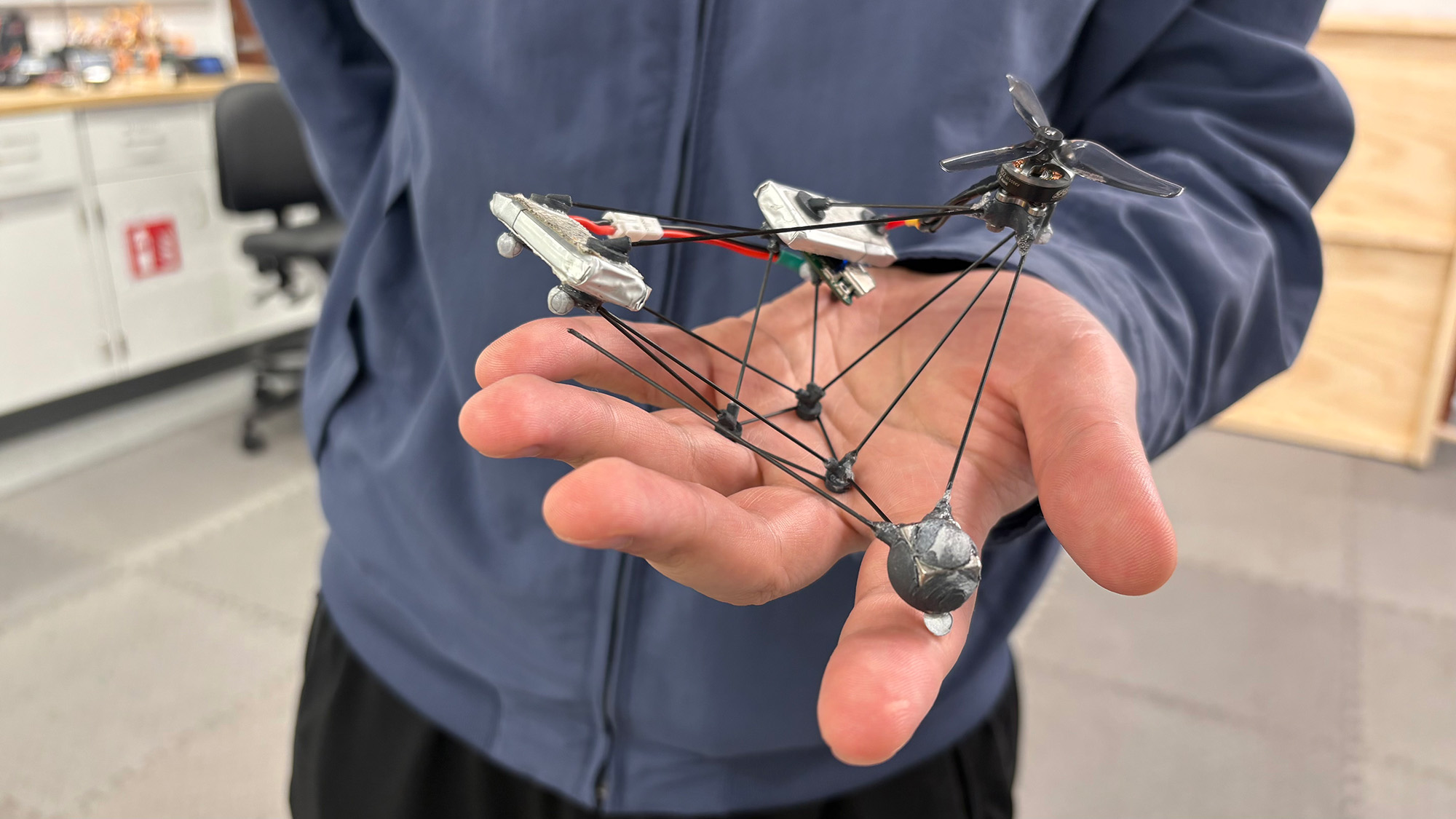
A small metal drone sits in the palm of a man's hand

(Image credit: Michael Rubenstein/Northwestern University)

The result is a machine that behaves more like a spinning fan than a conventional quadcopter. Typical drones have four rotors spinning around a largely stationary body, so your eye can lock onto the frame even as the propellers blur.

Phantom Twist strips this idea down to a single motor and single propeller. The propeller spins one way while the entire body counter‑rotates in the opposite direction with no stationary parts to visually latch on to — spinning 25 times per second, which is too fast for the human eye to resolve clearly.

A drone spins in the middle of a large room

(Image credit: Michael Rubenstein/Northwestern University)

It's about 10 times less visually perceptible than a conventional quadcopter, the scientists said. In practice, that means observers don’t see a crisp flying machine but a translucent smudge, with its few opaque components blending into a haze.

To get there, the team assigned algorithms to explore thousands of designs. First, they used a computational model to automatically generate about 20,000 drone configurations that could fly stably, at least in theory. Each configuration shuffled a motor, propeller, batteries, circuit board and counterweight into different positions.

Then artificial intelligence (AI) and optimization tools took over, iteratively rearranging those pieces to minimize how visible each design would be from almost any viewing angle — all while respecting the constraints of aerodynamic stability.

The researchers simulated each candidate spinning in midair and composited the images over 100 different real-world backgrounds, from skies to trees to buildings.

To determine the stealthiest designs, they applied a perception model that approximated human vision, with drones that better blended into their surroundings earning a lower visibility score. From there, the team selected the 500 lowest-scoring designs and ran their optimization loop again, squeezing out further decreases in visibility. When the team was confident in the design of a particular drone, they built it.

A drone spins over a green leafy plant

(Image credit: Michael Rubenstein/Northwestern University)

The final Phantom Twist isn’t a compact block of hardware; it’s deliberately spread out in three dimensions. Components sit at different heights and angles, with empty space between them, so that when the drone spins, the parts don’t visually overlap into a solid silhouette.

That geometry matters because of the way our eyes process images.

"The human eye takes time to accumulate signals, roughly analogous to the exposure time of a camera," said computer vision expert and co-author of the study Emma Alexander. When something spins fast enough, distinct edges smear together, and we perceive a blur instead of a shape.

The researchers' initial uses for the stealthy drones include monitoring nesting birds without startling them, surveying wetlands without scattering flocks of waterbirds, and inspecting aging infrastructure without altering human behavior, they said.

For now, Phantom Twist isn’t a perfect "ghost." The spinning propeller still generates a significant amount of noise and the spider‑web of thin wires and support rods remains partially visible. Rubenstein and his colleagues said in the study they’re already thinking about next-generation iterations that swap in more transparent materials and quieter propulsion systems.

We’re Admittedly Terrified That They’ve Now Invented Invisible Drones

21 July 2026 at 17:50

We can think of no possible way that a newly invented invisible drone can be used nefariously.

Rather than relying on camouflage, the flying gizmo created by researchers at Northwestern University exploits the motion blur effect in our fallible human vision to almost disappear by spinning at an absurd 25 times per second.

This is too quick for us and many animals to see clearly, becoming a gossamer smear that blends into the background, like the way the blades of a helicopter do, only more extreme. 

One day, this type of design could be used for completely peaceful pursuits, the researchers say — like observing wildlife, of course.

“Most efforts to hide drones focus on making them look like their surroundings,” Michael Rubenstein, an associate professor of computer science and mechanical engineering at Northwestern who led the research, said in a statement about the work.

“Instead, we asked whether we could design the drone itself around the way humans perceive motion,” he added. “This idea of low visibility through persistent motion is something few people have explored.”

To create the drone, dubbed “Phantom Twist,” the team used a computational model to churn out around 20,000 different drone designs, then used AI and optimization algorithms to repeatedly rearrange how its major parts, like their motor and propeller, were configured. 

Then they took the best configurations and used a model that simulates human perception to quantify how visible each design appeared. The least visible designs were chosen to be further rearranged with the optimization algorithm, until landing on the blurriest candidate of them all. 

“The design process was fully automated,” Rubenstein said. “Then, when we were confident that a drone met all our criteria, we built it.”

Their research, detailed in a paper awaiting peer review, was presented at the Robotics: Science and Systems 2026 conference in Sydney this month.

It’s not the first spinning drone, but it is the first that’s been optimized to be effectively invisible to the human eye. Its major components are carefully spaced enough from each other to never become a distinct shape when viewed from any angle while spinning — all while being capable of stable flight.

According to the researcher’s visibility model, this allows the Phantom Twist to be about ten times less visually perceptible than a conventional quadcopter drone. Impressive footage certainly bears this out: after the drone gets up to full speed, it almost looks like the ghost of a tiny UFO.

The drone is quite noisy, however. If something like it is going to be used to observe wildlife one day, it’ll have to be vastly quieter. Until then, if these faint apparitions are ever turned on humans, at least we’ll be able to hear them coming.

More on robots: Autonomous Robots Confirmed to Have Killed Human Soldiers

The post We’re Admittedly Terrified That They’ve Now Invented Invisible Drones appeared first on Futurism.

Chinese startup introduces next-gen optical links to connect thousands of high performing chips

18 July 2026 at 21:48

As AI models continue to grow in size and complexity, chipmakers are shifting their focus from individual processor performance to the ability to efficiently connect thousands of accelerators into a single computing system. 

These highly interconnected server architectures have become a key competitive area for AI infrastructure companies, which are racing to deliver the computing scale needed for models with trillions of parameters and the growing adoption of AI agents.

According to Ding Yunfan, vice president of AI framework architecture at Biren, improvements in the performance of a single graphics processing unit (GPU) are no longer enough to meet these demands. Instead, the industry’s biggest challenge is turning vast GPU clusters into unified, seamless computing platforms capable of operating as a single system.

Architecture designed to break GPU cluster limits

Biren believes the future of large-scale AI computing depends on replacing conventional electrical interconnects with optical technology. According to Ding, traditional copper-based connections are approaching their physical limits, effectively capping today’s server architectures at around 128 GPUs, the South China Morning Post reports.

To overcome that bottleneck, the company has developed a distributed, decoupled supernode architecture built around near-packaged optics (NPO), which positions optical fibres closer to the chips to increase bandwidth and improve data transmission. Biren said the approach could enable clusters with up to 1,024 AI accelerator cards, significantly expanding the scale of computing systems needed to support increasingly demanding AI workloads.

Ding said optical interconnects are becoming essential for overcoming the scalability limits of conventional server architectures. Shanghai-based Biren is among a growing number of Chinese companies tackling these infrastructure challenges. Rivals including MetaX, Enflame and Alibaba are also developing supernode architectures to compete with Nvidia’s NVL72 and next-generation NVL144 AI platforms.

Biren’s Shanghai-based rival MetaX has introduced its Xijing S600 AI supernode, featuring a single rack that connects 64 GPUs. The company said its design reduces signal loss by removing external cabling between compute nodes, switch nodes and interconnect systems, improving efficiency for large-scale AI workloads.

Looking beyond electrical links to build larger AI supernodes

Biren is also working on new approaches to expand the scale of its AI computing systems. The company’s orthogonal hardware architecture, co-developed with telecommunications giant ZTE, uses traditional electrical connections, while Biren is simultaneously testing a prototype near-packaged optics (NPO) interconnect system. 

The chipmaker said the optical approach could eventually support supernodes with more than 512 accelerator cards, helping address the growing demand for larger and more efficient AI infrastructure.

Despite growing interest in optical networking for AI infrastructure, Ding said the semiconductor industry is still in the early stages of developing and testing optical interconnect technologies. He noted that widespread adoption will require further advances before these systems can be deployed at scale.

Furthermore, Ding emphasized that the technology still requires real-world validation before it can be widely adopted. He projected that NPO optical systems could reach mass commercial deployment around 2028, as the industry continues refining the technology and addressing remaining engineering challenges.

💾

Chinese chip startup Biren has introduced a new optical supernode architecture designed to connect thousands of AI chips in a single cluster.

Striking Workers Bring Car Factory to a Screeching Halt Over Humanoid Robots

18 July 2026 at 15:00

From the factories of Detroit to the postal warehouses in Shenzhen, a new kind of worker is clocking in — and the humans it’s replacing aren’t going down without a fight.

In late June, thousands of rank-and-file workers in the Korean Metal Workers’ Union voted to authorize a strike in response to Hyundai’s announcement it would deploy over 25,000 humanoid robots across its factories.

Weeks later, that strike is slowing production at a Hyundai factory down to a trickle. According to the Wall Street Journal, the workers began a partial strike after negotiations broke down last week. Starting on Monday, workers refused to work for four hours of each shift, leaving production lines stalled for half the work day.

Per the WSJ, the economic impacts of the strike are stark: the pullback could disrupt production of about 5,000 cars, and cut into Hyundai’s sales revenue by around $135 million. Should Hyundai choose to dig in their heels after the labor action, the union said it could escalate the strike, either by prolonging the length of the strike, upgrading it to a full strike, or both.

The mobilization appears to be the first of its kind over humanoid robotics, specifically, marking a pivotal moment in labor history. At issue is Hyundai’s threat to deploy thousands of “Atlas” model robots built by Boston Dynamics, bipedal humanoids that measure about 6’2″ in height and can lift a maximum of 110 pounds.

While the robots have yet to be deployed, union organizers explained that the strike is meant to give workers the power to renegotiate their contracts on their own terms, before the automation drive begins in earnest.

“We have to prepare to ensure there are safeguards in place,” secretary general of the KMWU and lead negotiator Byun Jun-hwan told the WSJ.

Specifically, the union’s demands include job security guarantees designed around AI and automation, larger bonuses that reflect Hyundai’s profit margin, a transition away from hourly wages to a fixed salary agreement, and a formal agreement allowing workers final say on any humanoid robotics deployment.

More on automation: AI Is Pushing Older Employees Straight Out of the Workforce, New Report Finds

The post Striking Workers Bring Car Factory to a Screeching Halt Over Humanoid Robots appeared first on Futurism.

MIT’s GIFT framework improves CAD designs by turning its failures into training data

Creating a realistic 3D model from a simple image remains surprisingly difficult for artificial intelligence. 

While AI can generate impressive pictures, producing the precise CAD code engineers use to design aircraft parts, cars, and consumer products is far more challenging. Even a small mistake can make a design unusable. 

Now, researchers from MIT, IBM, and Red Hat have developed a framework that significantly improves the ability of AI systems to turn 2D images into functional CAD programs, producing more accurate designs while reducing inference computation by about 80 percent.

This new research work tackles one of the biggest obstacles in AI-driven engineering, which is the shortage of high-quality CAD training data. Existing image-to-CAD systems need vast numbers of examples linking 2D images to working CAD programs, but creating those datasets is expensive and labor-intensive. 

Instead of relying on more human-created data, the new approach teaches AI using the mistakes it already makes. “We want to obtain data augmentation that is informed by the model itself,” lead study author and AI researcher Giorgio Giannone said.

Turning failed designs into training material

The team’s framework, called Geometric Inference Feedback Tuning (GIFT), works with vision-language models that convert a 2D image and text description into Python code that can be executed in CAD software to create a 3D object.

To understand where a model struggles, GIFT asks it to solve the same CAD problem multiple times in parallel. Some outputs are correct, some are close to the target design, and others are much further away. 

According to the researchers, these ‘near-misses’ are the most valuable because they reveal exactly what the model does not yet understand.

The system executes each generated CAD program and compares the resulting 3D geometry with the target using a standard engineering metric known as Intersection over Union (IoU), which measures how closely two 3D shapes match. 

Rather than discarding imperfect outputs, GIFT identifies those that are close to correct and uses them to generate new training examples.

Giannone explained, “If we sample the model 10 times and it generates 10 correct answers to the same problem, then there is not much for it to learn. We care about the in-between cases, where the model might only solve the problem 50 percent of the time.”

Teaching the model how to fix its own errors

GIFT improves the model through two complementary techniques. The first, called GIFT-REJECT, keeps alternative CAD programs that generate the correct geometry even if the code differs from the original reference solution. 

Traditional AI training often assumes there is only one correct CAD program for each object, even though engineers can create the same part in many different ways. By exposing the model to multiple valid solutions, GIFT broadens its understanding of how CAD designs can be constructed.

The second method, GIFT-FAIL, focuses on imperfect outputs. The system takes a nearly correct 3D model generated by the AI, converts it back into an image, and pairs that image with the correct CAD program. By doing so, it creates new examples that effectively teach the model how to recover from specific mistakes.

More importantly, this process requires no human intervention. The framework automatically identifies errors, creates new training data, and uses that information to improve the model.

The researchers also designed GIFT around a technique known as inference-time scaling. Instead of retraining an entire AI model, which can be extremely expensive, the system improves performance during generation. 

Rather than discarding the extra computation spent searching for better CAD programs, GIFT converts successful and near-successful attempts into new training examples that can later be used to improve the model through fine-tuning.

Moreover, users can decide how much computation they want to spend depending on their budget and time constraints.

Better CAD designs with a fraction of the computing power

When evaluated on the GenCAD-Code dataset, models enhanced with GIFT achieved a 12 percent improvement in geometric accuracy compared with a strong supervised-learning baseline. 

The framework also reduced the inference computation needed to achieve comparable performance by about 80%.

“With GIFT, we started with geometry because with engineering problems, if the geometry of a 3D shape is not correct, nothing else will be correct, but there are many other aspects to consider,” Giannone said. 

The system’s ability to learn from its own mistakes could help accelerate product development by making AI-generated CAD models more reliable. 

Engineers could move more quickly from sketches to testable 3D designs, reducing development costs, shortening design cycles, and exploring a wider range of ideas without creating large amounts of new training data.

The researchers say this is only the beginning. So far, GIFT focuses on generating correct geometry, but future versions will aim to teach AI how to design parts that are not only accurate in shape but also easier to manufacture and better suited for real-world performance. 

The study is published on arXiv.

Brutal Humanoid Robot Cage Match Stops Abruptly When One of the Robot’s Heads Pops Off

17 July 2026 at 20:49

You might wince at the professional spectacle of two humans beating each other to a pulp. But when it’s two robots? We want maximum carnage.

Thankfully, the inaugural Ultimate Robot Knock-out Legend (URKL) competition in Shenzhen, China, has delivered on providing the most brutal-but-bloodless spectacle you can lay eyes on.

In a video of a cage match between two mechanical humanoids, one of the clanker combatants literally knocks its opponent’s block off by delivering a flying kick to the face.

The robot continues to fight with its head dangling from between its shoulders and throws a few punches, but not for long.

After being knocked to the ground again, it flails uncontrollably while trying to get to its feet. The violent jerking severs the cable connecting the hanging head, and the robot collapses onto the ground. The other robot, victorious, dances over its unmoving body.

According to the state-run tabloid Global Times, the URKL competition featured 32 teams from around the world who all used the T800 humanoid robot from EngineAI, a Chinese robotics company.

The point of the competition, according to EngineAI CEO Zhao Tongyang, was twofold: create a global commercial robot fighting brand and promote research and industrialization.

“Let the event feed back into technology, and let technology drive the industry,” Tongyang told Global Times.

You can’t accuse Tongyang of not putting his money where his mouth is. In a video that went viral last December, he donned a suit of armor and let himself take blows from one of his T800 robots. One kick was so powerful that it slammed him to the ground.

It’s hard to tell how much of a splash the event made in the country, but it must’ve been a wild spectacle to witness in person. Legendary martial arts movie star and filmmaker Donnie Yen was in attendance and sounded blown away by what he saw.

“Honestly, I used to see robot fighting only in science fiction movies,” Yen said at the event’s opening, per Global Times. “But today, for the first time, I got to watch real robots fighting up close.”

“The weight of the machines, the precision of their movements — it was incredible,” he added.

Martial arts is one of Chinese robot companies’ favorite ways to show off their capabilities. China stunned the world earlier this year with a televised martial arts display performed by a group of Unitree G1 robots that shared the stage with human actors.

More on robots: Startup Upset After Journalist Points Out How Creepy Its Humanoid Robots’ Hands Are

The post Brutal Humanoid Robot Cage Match Stops Abruptly When One of the Robot’s Heads Pops Off appeared first on Futurism.

Nvidia Taps Japan’s Robot Giants to Build Smarter Factories

16 July 2026 at 18:47
Nvidia is partnering with Japan’s robotics leaders to develop smarter factories using physical AI, new models, and domestic computing infrastructure.

New metal alloys that beat 1,832°F heat could help jet engines and nuclear reactors

16 July 2026 at 13:49

Researchers at the University of Toronto Engineering have developed six new metal alloys using an artificial intelligence-driven discovery platform that could improve the durability of parts used in jet engines, nuclear power plants, and other extreme environments. The findings show that the AI-assisted system identified promising alloys within just a few weeks, significantly speeding up the search for high-performance materials.

These new alloys also work well with 3D metal printing, enabling the production be complex parts that are hard or impossible to produce with traditional methods.

AI speeds up alloy discovery

Led by Yu Zou, Canada Research Chair in Materials and Manufacturing for Extreme Environments, the team worked with Jason Hattrick-Simpers to build a system that uses computer modeling, machine learning, and robots to help with manufacturing.

Their method, called active learning, acts like a self-driving laboratory. Rather than testing thousands of metal combinations by hand, the system picks the best options, makes them, tests how they perform, and uses those results to guide the next experiments.

“There’s enormous demand for materials that can stand up to huge swings of temperature and pressure, such as what you would find inside a jet engine or in the steam generators inside nuclear power plants, anywhere conventional steel just can’t survive,” said Yu Zou, who led the project.

“We also need materials that can be printed layer by layer, enabling us to make components that can’t be created by traditional manufacturing processes. For example, to make a material that is both lightweight and strong, you can vary the composition: a hard, tough alloy on the outside to something softer and lighter on the inside.”

The project was partly supported by the University of Toronto’s Acceleration Consortium, a group that uses AI and automation to accelerate the discovery of new materials.

Active learning cuts the need for massive datasets

Most AI systems need a large amount of experimental data to make accurate predictions. This becomes a problem when researchers look at materials that have not been tested yet.

“One problem you often run into when trying to use AI to design materials is that most machine learning models require lots of data about material properties to learn from,” revealed Ajay Talbot, a Ph.D. student in Zou’s lab and lead author of the study.

“But if you’re working in part of the design space that hasn’t been explored yet, that data doesn’t exist, so you’re kind of flying blind.”

“The way we get around that challenge is to use data-lean models that essentially feel their own way along. Our active learning model strategically selects a few samples to manufacture and test, and the data from those experiments is fed back into the model to inform where we go next. It really speeds things up.”

<a href=”https://www.youtube.com/watch?v=RFYJV7WvtOM“>https://www.youtube.com/watch?v=RFYJV7WvtOM</a>

New alloys outperform industry benchmark

To demonstrate the system, the researchers focused on compositionally complex alloys made from nickel, cobalt, and chromium. Within weeks, the automated platform identified six new alloy formulations with strong performance.

“One of the properties we were targeting was puncture resistance at temperatures of up to 1,112°F (600°C), which is what you’d find in the front section of a jet engine,” Talbot said.

“The industry standard in this space is nickel-based alloys such as Inconel 625. But we found one made of 12 percent nickel, 62 percent cobalt, and 26 percent chrome that was great for retaining hardness at extremely high temperatures. Even with just three components, our alloy outperformed Inconel 625, an alloy of more than 10 different elements, by 4.5 percent in our lab tests.”

The team also developed another alloy designed for hotter sections of jet engines, where temperatures can reach 1,832°F (1,000°C).

“One of the things that happens in an environment like that is the formation of oxide scale, which essentially means that your material is just getting burned away,” Talbot explained.

“We found a material made of 36 percent nickel, 14 percent cobalt, and 50 percent chrome that was extremely good for oxidation resistance at these high temperatures: It even outperforms Inconel 625 by 85 percent. We’re eventually aiming to ramp up to even higher temperatures, up to 2,192°F (1,200°C).”

Researchers plan to expand to more complex materials

The researchers say the current alloys represent an early demonstration of what the AI-driven discovery platform can achieve.

“This nickel-cobalt-chrome system has just three elements in it. In the grand scheme of things, it’s a relatively simple system,” he added.

“But it’s great for showing that this whole closed-loop discovery platform really works. What we want to do next is ramp up the complexity a bit more to make even crazier stuff, with maybe up to 10 or 12 different elements.”

“As you add more components, you can get different strengthening mechanisms, different kinds of useful properties. There’s a lot more out there just waiting to be discovered.”

The study was published in the journal npj Advanced Manufacturing.

Engineers develop robot that judges its surroundings and walks, runs, and jumps like an animal

16 July 2026 at 12:50
An era in which robots decide "how to walk" on their own has arrived. A four-legged robot has been developed that, much like a person or an animal, autonomously chooses the appropriate gait strategy for its surroundings—changing its gait on stairs, leaping over gaps and keeping its balance on forest trails.

❌