❌

Normal view

Quantifying the Impact of Starspot-Crossing Events on Retrieved Parameters from Transit Lightcurves

17 July 2026 at 17:00
Catriona A. Murray and Zachory Berta-Thompson 2026 AJ 171 344
An analysis of synthetic starspot-crossing events suggests that while starspot longitudes are tightly constrained in high signal-to-noise data, other properties are more loosely determined.

The post Quantifying the Impact of Starspot-Crossing Events on Retrieved Parameters from Transit Lightcurves appeared first on AAS Nova.

A Study of HH 270 with the James Webb Space Telescope

16 July 2026 at 17:00
A. N. Ortiz Capeles et al 2026 ApJ 1003 65
Using data from JWST, the Subaru Telescope, and the Atacama Large Millimeter/submillimeter Array, researchers have identified a previously unseen collimated protostellar jet in a Herbig–Haro object.

The post A Study of HH 270 with the James Webb Space Telescope appeared first on AAS Nova.

Seeking Technosignatures in Polluted White Dwarfs

15 July 2026 at 17:00

white dwarf with debris disk

White dwarfs often show signs of metals in their spectra, providing evidence that these evolved stars have accreted planetary material. Could white dwarf spectra also provide evidence for technological activity in these star systems?

A Record of Planets Past

When a Sun-like star reaches the end of its hydrogen-burning lifetime, it first puffs up into a red giant before exposing its white-hot core, which evolves into a white dwarf. This dramatic transition shakes up any planets that happened to be orbiting the star, and some close-in planets may end up crumbling apart, their rubbly remains peppering the surface of the white dwarf.

So far, astronomers have found hundreds of white dwarfs that appear to be polluted with heavy elements from their destroyed planets. These observations provide a valuable look into the bulk compositions of planetary materials outside our solar system. They may also provide a way to detect patterns of chemical abundances that are not natural, resulting from technological processes like industrial refining or the creation of alloys — in other words, a technosignature that is evidence of not just life, but technologically advanced life.

Seeking Signs of Technology

abundances of meteorites compared to white dwarfs

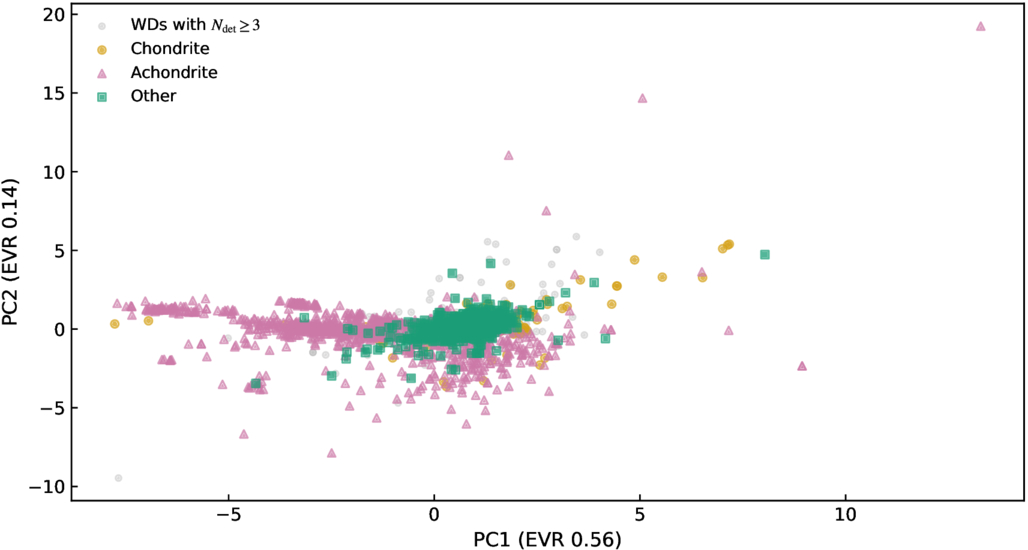
Representation of the chemical abundances of meteorites (pink, orange, and green) and white dwarfs (gray). Most white dwarf abundances overlap with the parameter space defined by the meteorite sample. Click to enlarge. [Huang et al. 2026]

A team led by Bo-Lun Huang (黄博伦) from Beijing Normal University recently investigated whether there is evidence for chemical technosignatures in the current sample of polluted white dwarfs. Huang and collaborators began their investigation with a catalog containing 697 measurements of white dwarfs with metals in their spectra. They applied Bayesian statistical methods to weigh the hypothesis that the chemical makeup of these white dwarfs is entirely natural against the possibility that they contain a blend of natural and technologically altered material.

The team used thousands of chemical abundance measurements from meteorites as a reference for the natural bulk composition of planetary material. For the mixture of natural and processed material, they combined the meteorite reference material with a template that is metal-rich and silicate-poor, with enhanced amounts of iron, nickel, chromium, and manganese.

plot showing evidence for a natural + processed model relative to a natural model as a function of the number of elements detected

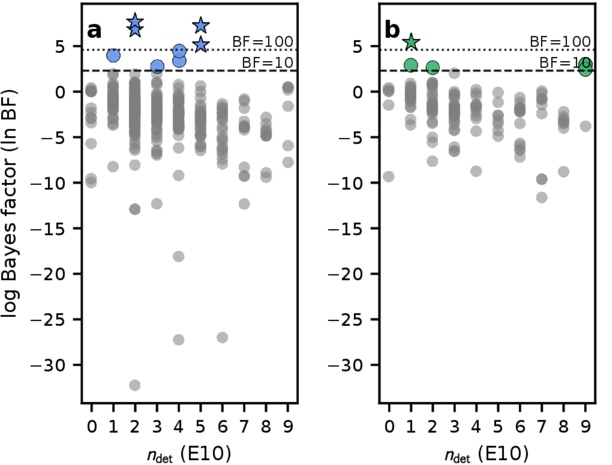
Evidence for a model including technologically processed material relative to a purely natural model, as a function of the number of elements detected in the white dwarf. ndet = 0 indicates that only upper limits were obtained on elemental abundances. Higher Bayes factors indicate stronger evidence. The left-hand plot is based on abundances measured from the white dwarfs’ photospheres, while the right-hand plot uses abundances adjusted for diffusion within the white dwarf. Click to enlarge. [Adapted from Huang et al. 2026]

No Strong Evidence, but a Path Forward

Ultimately, Huang’s team found that strong statistical support for the existence of technological processes was uncommon, though there were certain measurements in their sample of white dwarfs that were difficult to reconcile with a solely natural model.

Perhaps unsurprisingly, the team also found that the quality of the chemical abundance measurements affected the constraining power of the observation; some white dwarfs had upper limits for just a few elements, while others had definitive detections of many elements. They found that the most discerning observations recorded iron, magnesium, chromium, and titanium, plus either nickel, silicon, or sodium.

While this work didn’t dredge up firm evidence for technological activity, it provides a jumping-off point for future searches. The handful of white dwarfs in this sample that were fit poorly by a purely natural model could be compared against other technosignature models or targeted with high-resolution spectroscopy. Future measurements of iron and magnesium in polluted white dwarfs may be useful as a preliminary screening tool, helping to pick out intriguing targets for follow-up observations.

Citation

“A Calibrated Bayesian Search for Potential Chemical Technosignatures in Polluted White Dwarfs,” Bo-Lun Huang et al 2026 ApJ 1006 9. doi:10.3847/1538-4357/ae742c

The post Seeking Technosignatures in Polluted White Dwarfs appeared first on AAS Nova.

Chemical Fingerprints of Accreted Ultrafaint Dwarf Galaxies in the Milky Way Halo

15 July 2026 at 17:00
Diala M. Taneenah et al 2026 ApJL 1003 L11
Researchers have discovered two chemically distinct populations in a sample of 97 metal-poor stars in the Milky Way halo, potentially providing a way to identify accreted halo stars.

The post Chemical Fingerprints of Accreted Ultrafaint Dwarf Galaxies in the Milky Way Halo appeared first on AAS Nova.

Revisiting the Evidence for Double Sequences of Blue Straggler Stars in Globular Clusters

14 July 2026 at 17:00
Gourav Kumawat et al 2026 AJ 171 306
Analysis of blue straggler stars in 56 Milky Way globular clusters finds no evidence for a bimodal distribution in color–magnitude space due to differing formation pathways.

The post Revisiting the Evidence for Double Sequences of Blue Straggler Stars in Globular Clusters appeared first on AAS Nova.

Warped and Hooked: Mapping the Magellanic Clouds in Three Dimensions Using Red Clump Stars

13 July 2026 at 17:00
Slater J. Oden et al 2026 ApJ 1003 9
By constructing a detailed distance map to the Magellanic Clouds, researchers have revealed substructures within this interacting galaxy pair, including an azimuthal warp in the Large Magellanic Cloud.

The post Warped and Hooked: Mapping the Magellanic Clouds in Three Dimensions Using Red Clump Stars appeared first on AAS Nova.

When the Spacecraft Align: Rescuing Saturated Images of Solar Flares

13 July 2026 at 17:00

close-up image of the Sun showing a solar flare

Many observations of solar flares suffer from saturation and blooming, causing crucial information to be lost. Researchers recently validated a technique for retrieving information from saturated flare images, unlocking a treasure trove of powerful solar flares for examination.

Solutions for Saturation

Since 2010, the Atmospheric Imaging Assembly (AIA) on the Solar Dynamics Observatory (SDO) has been capturing nearly continuous extreme-ultraviolet images of the Sun’s disk, revealing our star’s dramatic high-energy behavior. Though SDO/AIA’s observations have transformed our understanding of the Sun’s activity, they have limitations: powerful solar flares can saturate the detector, spilling charge into nearby pixels.

This saturation and overflow compromises our ability to study the most energetic solar flares — but the “lost” information may actually be recoverable. When light from an intense flare enters SDO’s instruments, not all of it pools in the saturated region of the detector: some of the light is diffracted by the optics, and by mathematically inverting this pattern of diffracted light, researchers can attempt to extract the encoded information about the saturated region. Researchers have used this technique for more than a decade, but options for validating the results were limited until now.

Solar Orbiter Lends a Hand

Launched almost 10 years to the day after SDO, the Solar Orbiter spacecraft provides an excellent opportunity to test inversion techniques for recovering information from saturated solar images. Solar Orbiter’s Extreme Ultraviolet Imager snaps brief photos of the Sun at a rapid cadence, and its images remain unsaturated even when faced with energetic solar flares.

positions of Solar Dynamics Observatory and Solar Orbiter during a solar flare on 19 March 2024

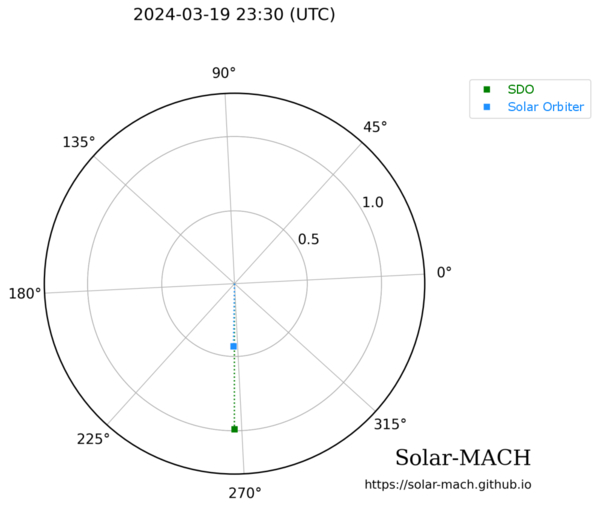
Positions of SDO (green) and Solar Orbiter (blue) during a solar flare on 19 March 2024. Click to enlarge. [Guastavino et al. 2026]

As described in a recent research article by Sabrina Guastavino (University of Genoa; Italian National Institute for Astrophysics) and collaborators, the ideal setup for testing the inversion technique arose on 19 March 2024, when SDO and Solar Orbiter both viewed a solar flare while separated by just 1 degree in longitude.

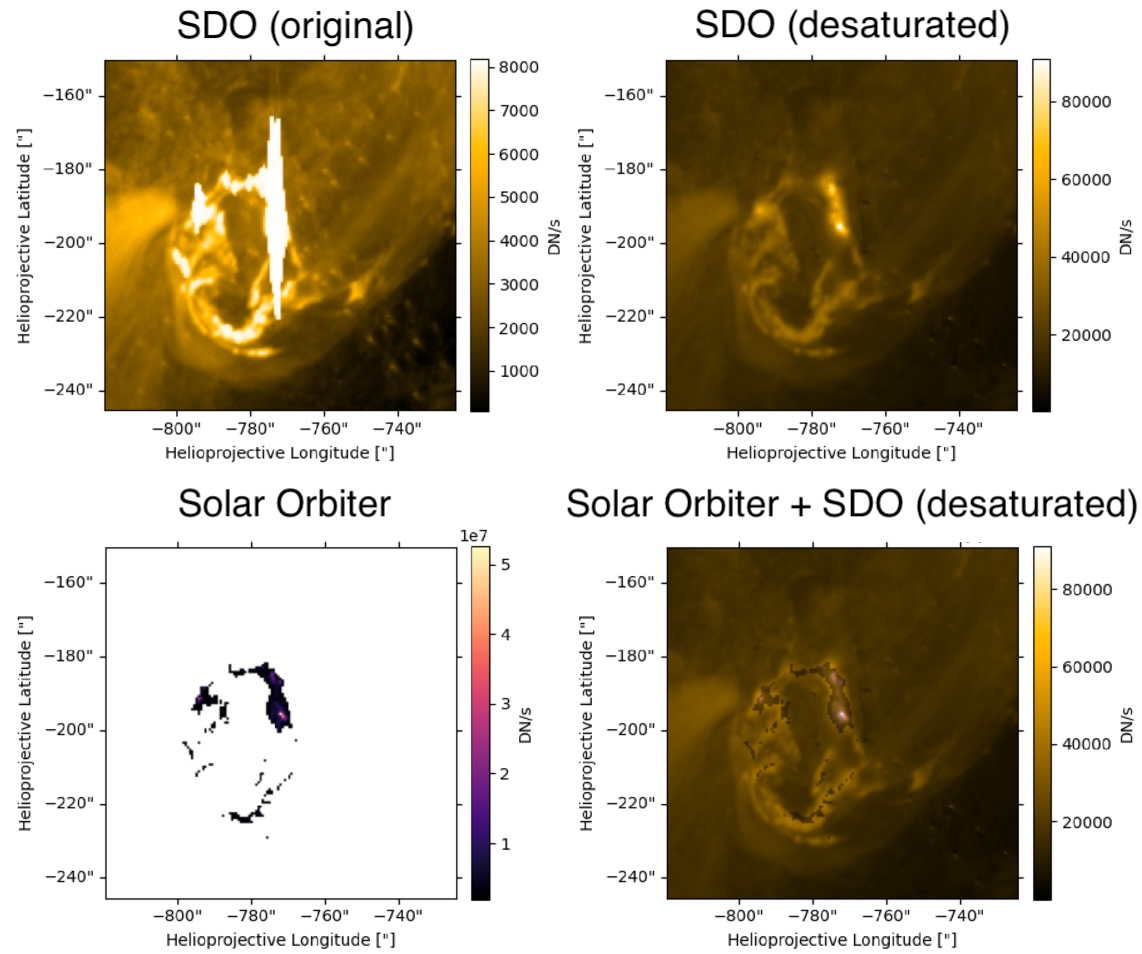
Guastavino’s team aligned and reprojected the data, accounting for the slightly different viewing angles of the two spacecraft, then applied an algorithm called Adaptive SE-DESAT to reconstruct the flux within the saturated portion of the SDO image. The team compared the desaturated SDO images to the unsaturated Solar Orbiter images over the course of the flare, finding the same flare morphology and similar time evolution between the two data sets.

sample results of the desaturation process

Example of unprocessed SDO data (top left), desaturated SDO data (top right), Solar Orbiter data (bottom left), and a combination of the two data sources (bottom right). Note that the Solar Orbiter observations have been clipped so that only the highest flare intensities were recorded. Click to enlarge. [Adapted from Guastavino et al. 2026]

A Treasure Trove of Desaturated Data

Overall, these results demonstrate the effectiveness of the inversion technique, though Guastavino and coauthors noted that improvements could be made during the impulsive phase of the flare, when the emission is increasing. The team identified several reasons why the results may not match during this phase, including rapid evolution of the flare during individual exposures.

Despite these areas that require further attention, the validation of this technique unlocks 16 years of solar flare observations from SDO. This especially enhances our sample of powerful solar flares, increasing the available records of the most energetic solar flares by orders of magnitude.

Citation

“Validation of an Extreme-Ultraviolet Desaturation Technique for the Atmospheric Imaging Assembly on Board the Solar Dynamics Observatory Using Observations from the Extreme Ultraviolet Imager on Board Solar Orbiter,” Sabrina Guastavino et al 2026 ApJL 1005 L50. doi:10.3847/2041-8213/ae7d2e

The post When the Spacecraft Align: Rescuing Saturated Images of Solar Flares appeared first on AAS Nova.

Potential Interaction of 99942 Apophis with the High Earth Orbit Population During the 2029 Close Approach

10 July 2026 at 17:00
Giulia Schettino and Alessandro Rossi 2026 Planet. Sci. J. 7 110
Though the asteroid Apophis will not collide with Earth in 2029, there is a slim but present possibility that it will strike an artificial object orbiting Earth, potentially compromising future missions to the asteroid.

The post Potential Interaction of 99942 Apophis with the High Earth Orbit Population During the 2029 Close Approach appeared first on AAS Nova.

The First Systematic Survey of Stellar Halos in High-Inclination Galaxies Reveals Unusually Quiescent Merger Histories of Nearby Galaxies

9 July 2026 at 17:00
Bojun Tao et al 2026 ApJS 284 31
Analysis of 93 stellar halos detected in a sample of 169 high-inclination galaxies showed that high-mass galaxies have more extended halos and more active merger histories, among other findings.

The post The First Systematic Survey of Stellar Halos in High-Inclination Galaxies Reveals Unusually Quiescent Merger Histories of Nearby Galaxies appeared first on AAS Nova.

Gaia Data Show That the Initial Mass Function Is Not Universal

8 July 2026 at 22:48

star-forming cloud OMC-2

Do all star-forming regions birth stars with the same distribution of masses? Theory suggests that they do not, but researchers often assume they do for simplicity. Now, ultra-precise observations from Gaia have demonstrated that the initial mass function varies across star clusters in the Milky Way.

A Universal Initial Mass Function?

JWST image of galaxies in the iconic Hubble Ultra Deep Field

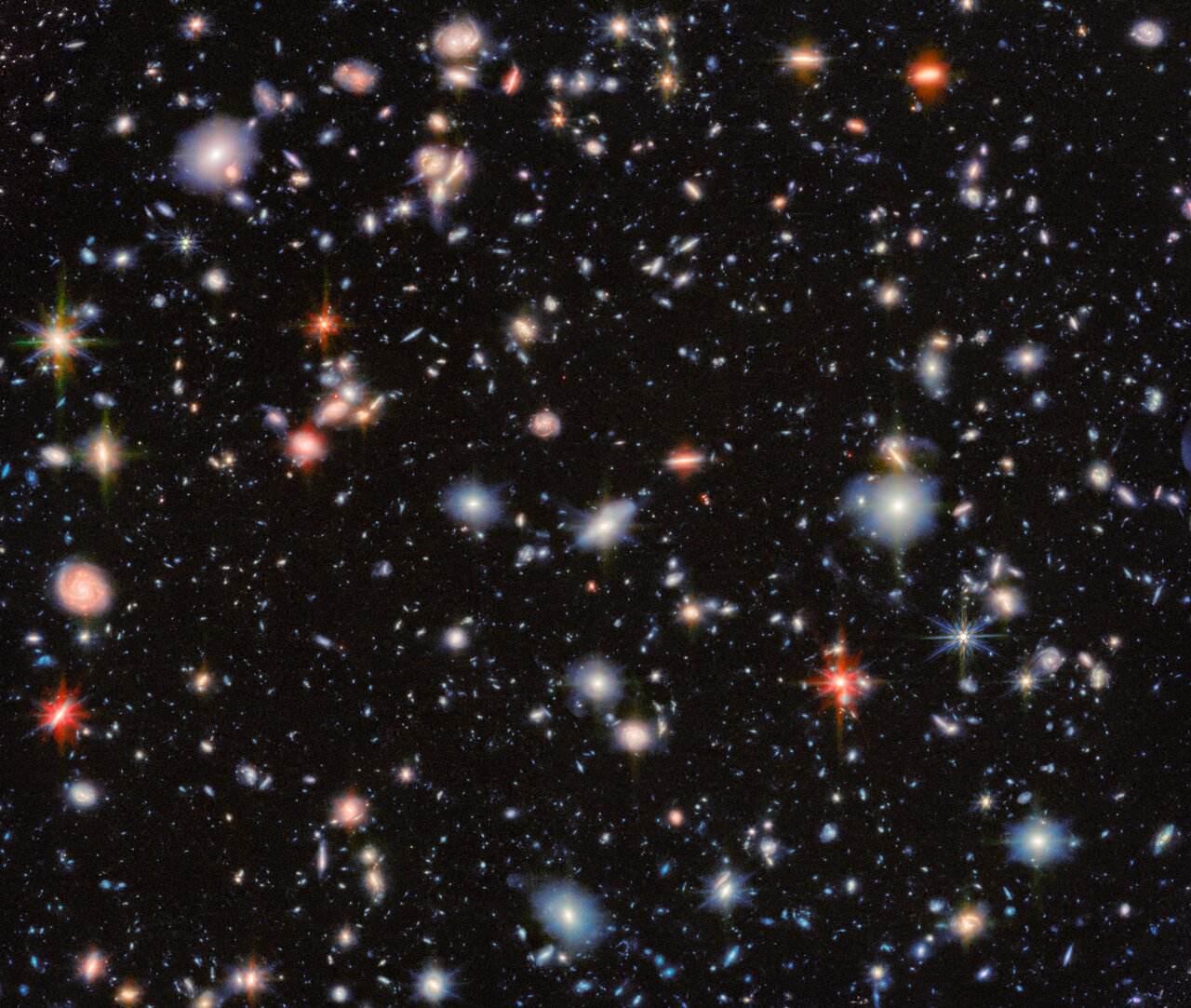
The light from distant galaxies is dominated by high-mass stars, requiring the use of the IMF to estimate the stellar mass of a galaxy. [ESA/Webb, NASA & CSA, G. Östlin, P. G. Perez-Gonzalez, J. Melinder, the JADES Collaboration, the MIDIS collaboration, M. Zamani (ESA/Webb); CC BY 4.0]

When a molecular cloud fragments, collapses, and births a star cluster, how many stars form, and what are their masses? The answer to that question is what astronomers term the initial mass function, or IMF: the distribution of masses of stars born in a cluster.

The IMF is important in many areas of astronomy, and it’s relied on especially heavily in studies of distant galaxies. The light from these galaxies is dominated by high-mass stars, with the emission from lower-mass stars lost in the glare, so astronomers must use the IMF to reconstruct the stellar populations of these far-off locales.

Though theory suggests that the IMF should vary with factors like temperature and metallicity, demonstrating these variations has been difficult, even within our own galaxy. Because of this, researchers often adopt a universal IMF drawn from observations of star clusters in the Milky Way. But is the IMF truly universal?

The More the Slope Changes, the More the Break Mass Stays the Same

Determining whether the IMF is universal is more complicated than simply comparing the stars in one cluster to those in another. That’s because what astronomers measure in present-day star clusters is not the initial mass function, but a version of the IMF that has been skewed by millions to billions of years of evolution; over time, high-mass stars die and low-mass stars get ejected, warping the shape of the mass function.

Plots of the stellar mass function

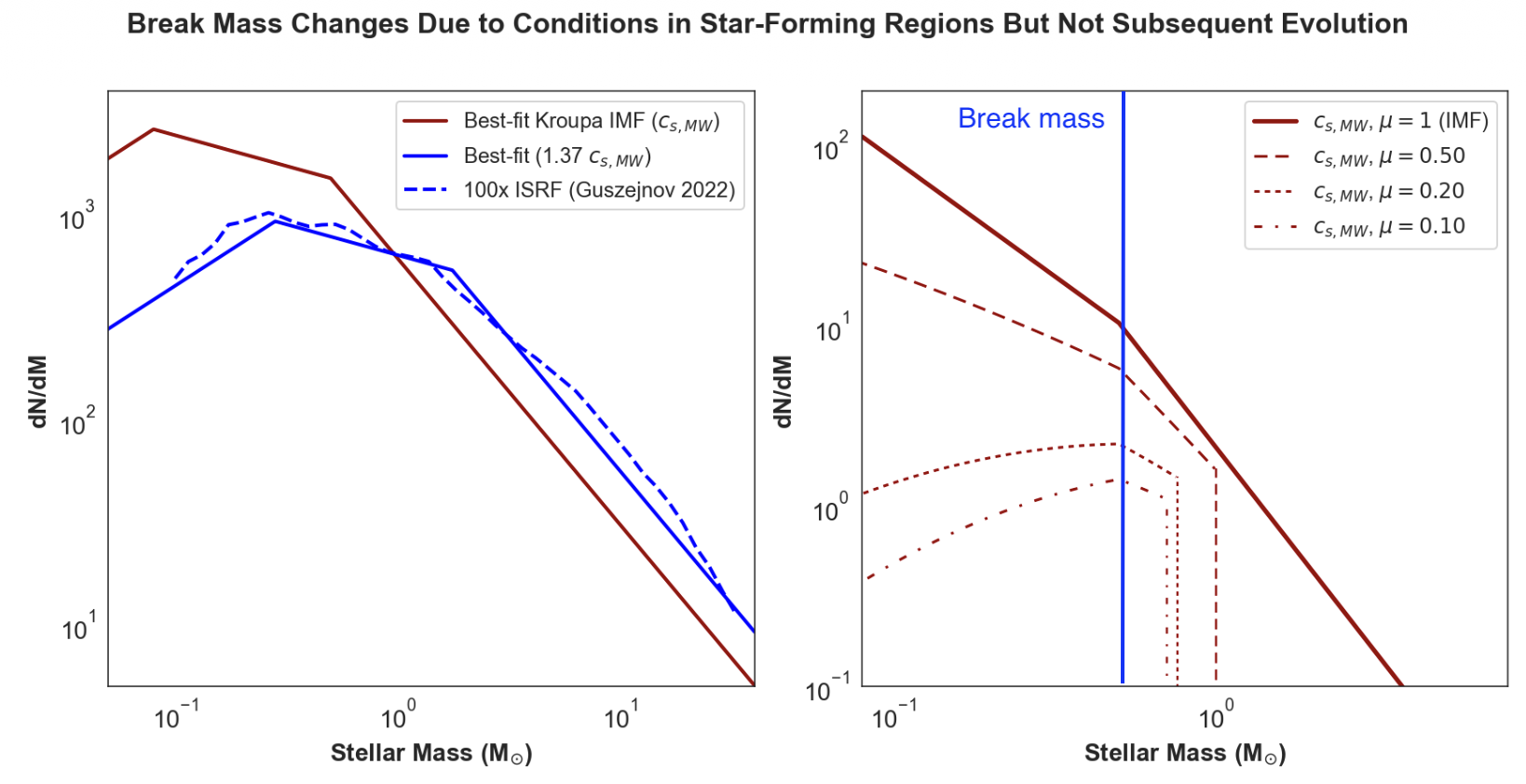
Left: Different break masses arise for different properties (here, the sound speed) of a given star-forming cloud. Right: Evolution of the mass function over time for a single star cluster. Over time, high-mass stars die and low-mass stars are ejected from the cluster, resulting in a decrease in the remaining mass fraction, μ, from 1 to 0.1. The slopes change, but the break mass does not. Click to enlarge. [Adapted from Steinhardt et al. 2026]

However, as demonstrated in a recent research article led by Charles L. Steinhardt (University of Missouri), certain aspects of the IMF may remain unchanged as clusters evolve. When the mass function of a star cluster is described using a broken power law (commonly called a “Kroupa-like” IMF in reference to work by Pavel Kroupa), the slopes of the power-law segments are affected by stellar evolution and dynamical interactions. Crucially, these effects appear not to alter the break mass — the mass at which the IMF transitions from one slope to another. Therefore, differences in the break mass from cluster to cluster reflect differences in the underlying IMF rather than the stellar and dynamical evolution of the clusters.

Insights from Gaia

Thanks to the Gaia spacecraft, which made precise observations of more than 2 billion stars in the Milky Way and beyond, it’s now possible to measure and compare the break masses of individual star clusters. Out of an initial catalog of 7,167 Milky Way clusters observed with Gaia, Steinhardt’s team selected just 110 that were of high enough quality and contained a sufficient number of stars to measure cluster break masses accurately.

Plot of stellar mass function for four Milky Way clusters

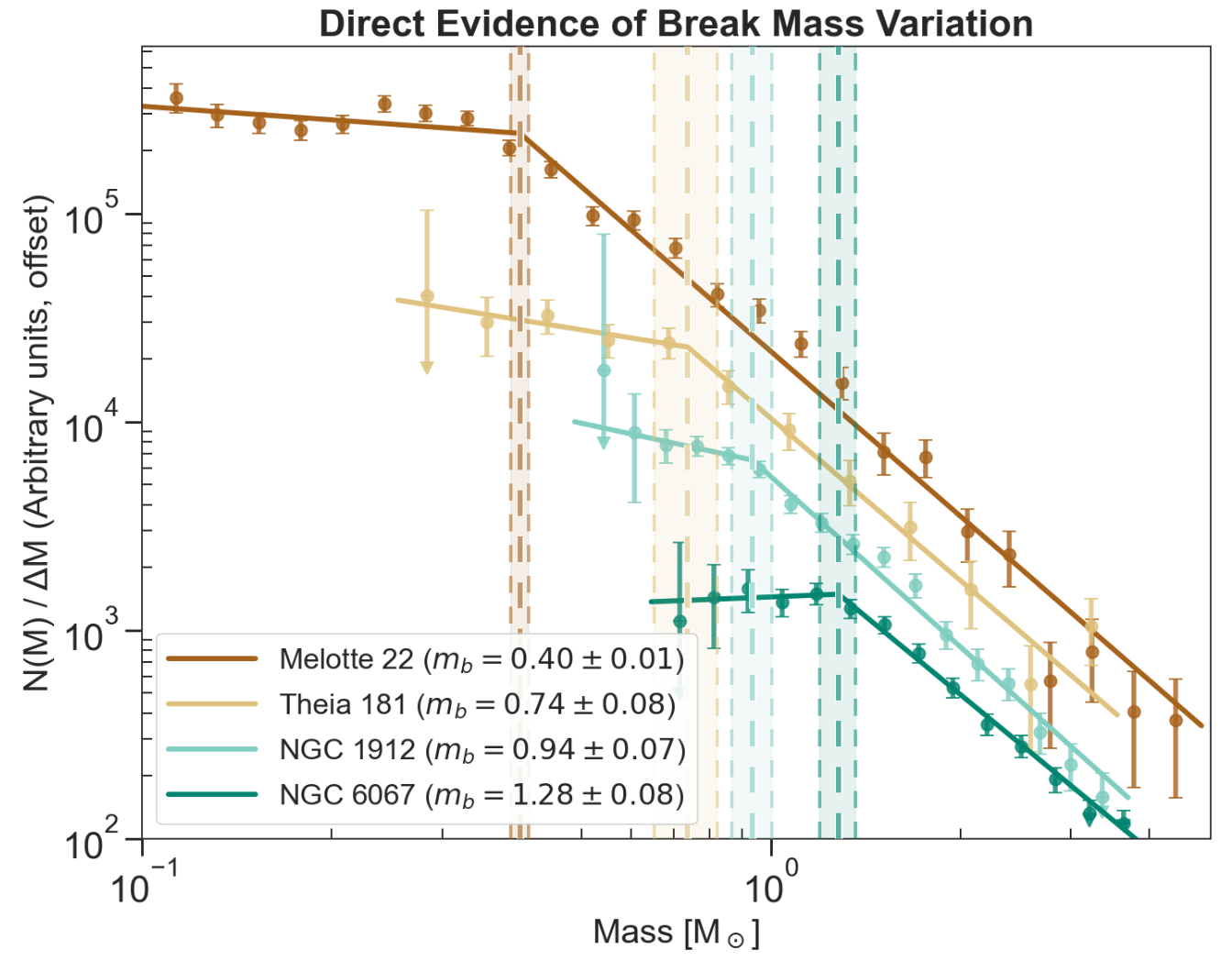
Observed mass functions of four Milky Way star clusters. The break masses are clearly different, showing that the IMF must vary from cluster to cluster. Click to enlarge. [Steinhardt et al. 2026]

The team found that the break mass differs considerably between the clusters in their sample, showing that the IMF is not universal. The observed variety of break masses appears to be linked to the age of the cluster, but instead of reflecting the impact of stellar and dynamical evolution — which have no effect on the break mass — these differences reflect the properties of the clouds in which the clusters were born. This implies that the properties of star-forming clouds in the Milky Way have, on average, changed over cosmic time. Thus, a star cluster that formed billions of years ago would have had a different IMF than one forming today.

This finding has implications for studies of high-redshift galaxies, where the properties of star-forming clouds are markedly different from those in the Milky Way. Going forward, Steinhardt and coauthors recommend developing a flexible parameterization of the IMF to capture how this critical function behaves in environments vastly different from our own.

Citation

“Direct Evidence for Stellar Initial Mass Function Variation in the Milky Way,” Charles L. Steinhardt et al 2026 ApJL 1005 L40. doi:10.3847/2041-8213/ae7444

The post Gaia Data Show That the Initial Mass Function Is Not Universal appeared first on AAS Nova.

Spectroscopic Confirmation of a Large and Luminous Galaxy with Weak Emission Lines at z = 13.53

8 July 2026 at 17:00
Callum T. Donnan et al 2026 ApJ 1002 134
PAN-z14-1 is the fourth most distant galaxy known to date, and its properties are consistent with the emerging picture of two separate galaxy populations at redshifts greater than 10.

The post Spectroscopic Confirmation of a Large and Luminous Galaxy with Weak Emission Lines at <em>z</em> = 13.53 appeared first on AAS Nova.

Featured Image: A Mass Mystery in the Bullet Cluster

6 July 2026 at 17:00

Bullet Cluster with mass countours

The Bullet Cluster is best known for being considered a “smoking gun” for the existence of dark matter, but even a famous galaxy cluster like this one has its secrets. For more than two decades, different measurements of the merging clusters’ dynamical mass ratio have yielded vastly different results. In a recent research article, Boseong Young Cho (Yonsei University) and collaborators used data from JWST and the Dark Energy Camera to revisit the Bullet Cluster and measure its mass ratio using new data. The image above shows a near-infrared view of the Bullet Cluster from JWST, with an overlay of mass contours derived from gravitational-lensing measurements. The team’s analysis assigned a mass of 1.5 quadrillion solar masses for the main cluster (on the left side of the image above), and a mass of 150 trillion solar masses for the subcluster. This suggests a mass ratio of roughly 10, which matches the value supported by hydrodynamical simulations and cements the event as a minor merger. The team also identified three distinct cluster halos (two in the main cluster and one in the subcluster), providing an important constraint on the cluster configuration for future modeling. To learn more about this investigation of the Bullet Cluster, be sure to check out the full research article linked below!

Citation

“Joint JWST–DECam Lensing Reveals that the Bullet Cluster Is a Minor Merger,” Boseong Young Cho et al 2026 ApJ 1005 28. doi:10.3847/1538-4357/ae6a90

The post Featured Image: A Mass Mystery in the Bullet Cluster appeared first on AAS Nova.

Traces of Helium Detected in Type Ic Supernova 2014L

6 July 2026 at 17:00
Jing Lu et al 2026 ApJL 1002 L11
Though Type Ic supernovae are classified in part by the lack of helium lines in their spectra, recent modeling of a near-infrared supernova spectrum suggests that helium is present but undetectable in the optical.

The post Traces of Helium Detected in Type Ic Supernova 2014L appeared first on AAS Nova.

UGC 2369S: A Kiloparsec-Scale Triple Merger Candidate Identified in a Nearby Luminous Infrared Galaxy

2 July 2026 at 17:00
Yuanze Ding et al 2026 ApJ 1002 130
Researchers present the first high-resolution multi-wavelength observations of a triple-nucleus merger, showing one black hole with mass of order 100 million solar masses and two with evidence of tidal disruption.

The post UGC 2369S: A Kiloparsec-Scale Triple Merger Candidate Identified in a Nearby Luminous Infrared Galaxy appeared first on AAS Nova.

Radar-Derived Compositional Diversity of the Youngest Martian Volcanics: An Exploratory Study

1 July 2026 at 17:00
Gareth A. Morgan and Bruce A. Campbell 2026 Planet. Sci. J. 7 99
Using the SHAllow RADar split-chirp technique, researchers showed how orbital radar loss estimates could be used to map the composition of Mars’s volcanics on a global scale.

The post Radar-Derived Compositional Diversity of the Youngest Martian Volcanics: An Exploratory Study appeared first on AAS Nova.

Two More Thoughts on Little Red Dots

1 July 2026 at 03:54

little red dots seen with JWST

One of the biggest discoveries from JWST’s tenure is a population of compact reddish objects nicknamed “little red dots.” Numerous theories have been proposed to explain the small sizes, high luminosities, and characteristic “V”-shaped spectra of these objects, and today we’ll examine two recent research articles that have explored the identity of the universe’s most mysterious inhabitants.

Red Dot, Blue Dot

You can tell a lot about a person by looking at their friends — and the same might be true for little red dots. A team led by Josephine Baggen (Yale University) examined a sample of 83 little red dots imaged with JWST. They found that 43% of the little red dots in this sample had a little blue companion: an ultraviolet-bright object within a projected separation of 1,630–16,300 light-years. The brightest little red dots were even more likely to have a blue companion; 80% of the brightest objects in the sample were paired up.

Baggen’s team set out to test the hypothesis that these red–blue pairs are fundamentally linked rather than coincidental. Under this hypothesis, the ultraviolet-bright blue companions were assembled first. The ultraviolet radiation from these objects suppressed the cooling of molecular hydrogen in pristine gas clouds in the early universe, causing the gas to skip the usual star-forming process and instead form a massive compact object such as a black hole star, supermassive star, or quasi-star — which we see as a little red dot.

plot of Lyman-Werner radiation versus projected separation

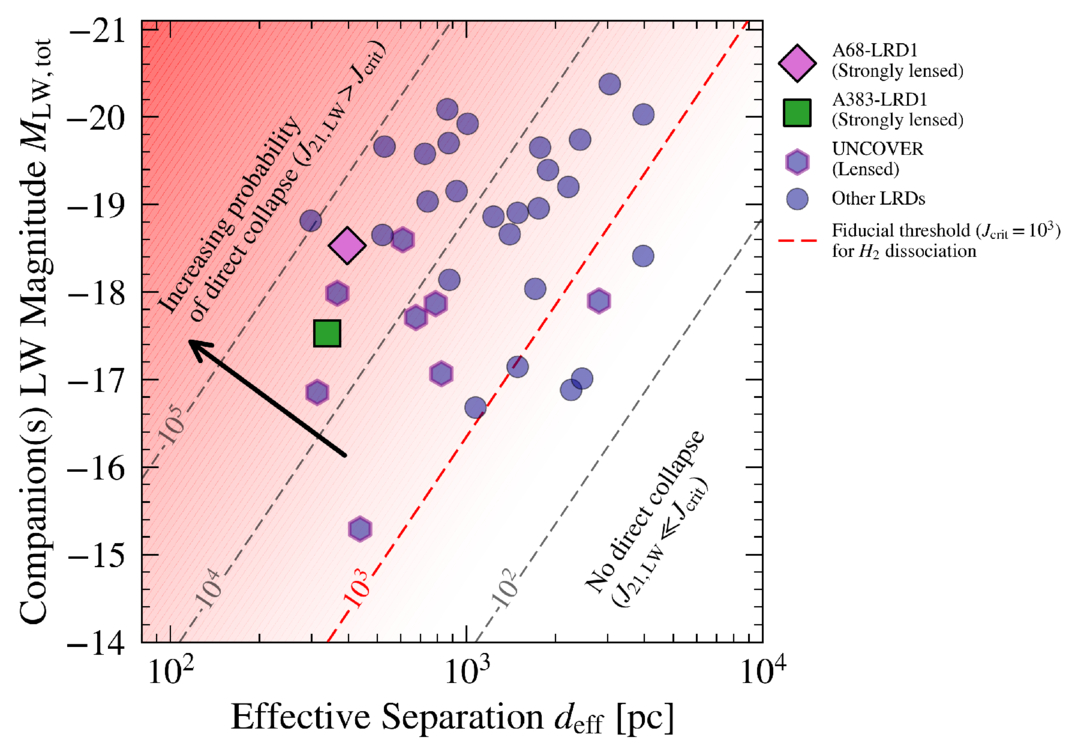
The companion’s mean flux density from 91.2 to 111 nm versus projected separation between the blue companion and the little red dot. The red dashed line shows the estimated values necessary for gas clouds to collapse. Click to enlarge. [Baggen et al. 2026]

Baggen and coauthors investigated whether the ultraviolet radiation from the blue companions is strong enough to have triggered this transformation. The team used spectral energy distribution modeling to determine the luminosities of the blue companions from 91.2 to 111 nanometers. This analysis showed that the radiation from the blue companions is equal to or greater than the threshold necessary to encourage the direct collapse of a gas cloud into a massive compact object.

If little red dots form thanks to their little blue companions, that would imply that every little red dot has or had such a companion. Though little blue companions weren’t so universal in the sample used in this work, the team noted that their analysis techniques, combined with observational limitations and other factors, likely yielded a smaller number of blue companions than are actually present. Further simulations exploring the collapse of pristine gas clouds into massive compact objects and high-resolution spectroscopic observations of little red dots can illuminate the potential link between these objects.

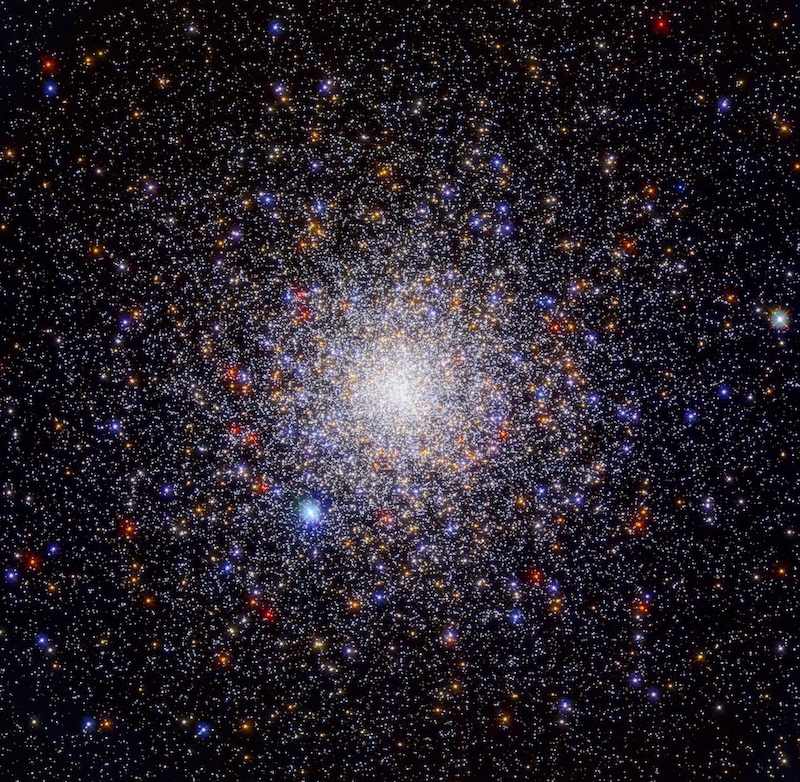
globular cluster NGC 1851

The densely packed globular cluster NGC 1851, as seen by the Hubble Space Telescope. [NASA, ESA, and G. Piotto (Università degli Studi di Padova); Processing: Gladys Kober (NASA/Catholic University of America)]

Little Red Dots as Young Globular Clusters

John Chisholm (The University of Texas at Austin) and collaborators hypothesized that little red dots represent a brief phase in the formation of globular clusters. In this hypothesis, the rest-frame ultraviolet emission of little red dots comes from the hot young stars of the newborn cluster, while the rest-frame optical emission comes from a single supermassive star at the cluster’s heart. Thus, in this framework, the little red dot phase lasts only as long as the fleeting lifespan of the supermassive star.

Chisholm’s team first showed that the spectrum of a young globular cluster with a supermassive star at its center is similar to the observed spectrum of a little red dot. But showing that the emission properties of globular clusters in formation and little red dots are similar is not enough — it’s also necessary to investigate whether the numbers and masses of these objects line up.

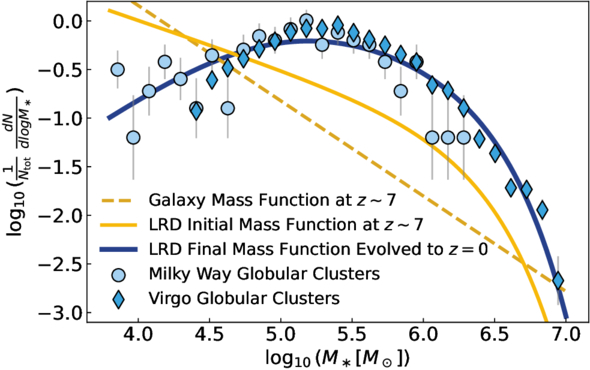
mass functions of little red dots and globular clusters

Comparison of the mass functions of little red dots evolved forward to the present day (blue line) and globular clusters in the Milky Way and Virgo (blue symbols). The results for both populations have been normalized to emphasize the shape of the distributions. Click to enlarge. [Chisholm et al. 2026]

To do this, the team propagated the observed mass function of little red dots at a redshift of z = 7 forward in time to z = 0. This process accounted for the rapid evolution of the supermassive star into a black hole, as well as the evolution of and feedback from the massive stars in the cluster. Comparing the resulting mass function to the population of present-day globular clusters, the team found that the mass functions had very similar shapes, and the number densities of little red dots and globular clusters in the present day are estimated to be of the same order of magnitude: 0.1–0.3 Mpc-3 and 0.8 Mpc-3, respectively.

In addition to describing how the properties of globular clusters in formation match those of little red dots, Chisholm’s team outlined some testable predictions for this scenario, including formation timescales and chemical abundance patterns. If this hypothesis withstands further scrutiny, little red dots may provide a valuable look at the early years of some of our universe’s oldest star clusters.

Citation

“Connecting the Dots: UV-Bright Companions of Little Red Dots as Lyman–Werner Sources Enabling Direct-Collapse Black Hole Formation,” Josephine F. W. Baggen et al 2026 ApJL 1002 L4. doi:10.3847/2041-8213/ae58a5

“Little Red Dots as Globular Clusters in Formation,” John Chisholm et al 2026 ApJL 1004 L4. doi:10.3847/2041-8213/ae6dae

The post Two More Thoughts on Little Red Dots appeared first on AAS Nova.

Excavating the Ruins: An Ancient z = 2.675 Galaxy Which Formed in the First 500 Myr

30 June 2026 at 17:00
Ian McConachie et al 2026 ApJ 1002 74
Analysis of JWST and Hubble Space Telescope observations of the galaxy “Eridu” suggests that the galaxy formed within 300 million years of the Big Bang and was quenched by a redshift of z ~ 10.

The post Excavating the Ruins: An Ancient <em>z</em> = 2.675 Galaxy Which Formed in the First 500 Myr appeared first on AAS Nova.

Probing the Origin of the Kilonova Candidate GRB 230307A: Analysis of Host Galaxy and Offset

29 June 2026 at 17:00
Clecio R. Bom et al 2026 ApJL 1001 L37
The combination of data and binary neutron star merger simulations shows that the source of GRB 230307A is unlikely to be a globular cluster; a disk origin is possible but requires finely tuned conditions.

The post Probing the Origin of the Kilonova Candidate GRB 230307A: Analysis of Host Galaxy and Offset appeared first on AAS Nova.

Searching for Extragalactic Exoplanets: A Survey of the Sagittarius Dwarf Galaxy Stream with TESS

26 June 2026 at 17:00
William Schap et al 2026 AJ 171 273
A search for extragalactic exoplanets in data from the Transiting Exoplanet Survey Satellite detected none, but the analysis suggested that investigations of additional stellar streams may find these sought-after worlds.

The post Searching for Extragalactic Exoplanets: A Survey of the Sagittarius Dwarf Galaxy Stream with TESS appeared first on AAS Nova.

❌