Scientists may have found a more realistic set of thermodynamic rules for black holes that never stop changing. Black holes are among the most extreme objects known in the universe. They compress enormous amounts of mass into remarkably small regions, creating gravitational fields so powerful that nothing, not even light, can escape once it crosses [...]
New research is revealing possible links between one of the most enduring cosmic mysteries—dark matter—and the existence of a “hidden” fifth dimension.
Dark matter is widely believed to exist according to several leading cosmological theories, although this nonluminous material remains invisible through direct detection. However, its presence can be inferred through the gravitational influence this mysterious form of matter has on the surrounding universe.
Now, according to researchers at the University of Sheffield, one reason dark matter may have remained so elusive involves the possibility that it exists within a “hidden” dimension—a concept that has gained traction in past research.
The Sheffield team’s recent look at this possibility, detailed in a study published in Physical Review D, takes the concept one step further by introducing a new potential framework that could help reveal clues to the behavior of dark matter, as well as why astronomers have had such a hard time detecting it.
A Dark Secret Lurking in a Hidden Dimension?
In their new research, the Sheffield team says that dark matter may be lurking within a hidden dimension accompanied by dark photons, a variety of particles among those which physicists call “hidden sector particles,” and which are believed to represent potential force carriers for dark matter.
Due to the specific geometry present within this hidden dimension, a phenomenon known as dark matter resonance may occur, where dark photons align in specific arrangements.
“Dark matter resonance is already known to be a powerful idea,” according to Yu-Dai Tsai, Ph.D., a Royal Society Dorothy Hodgkin Senior Research Fellow at the University of Sheffield and one of the new paper’s coauthors.
Tsai adds that the concept has “the potential to change our understanding of how dark matter was produced in the early universe and how we search for it today,” although reconciling it with our current understanding of dark matter has presented issues for researchers in the past, which include questions about its specific origins.
“Many previous resonant dark matter models have treated the resonance as an assumption,” Tsai recently said in a statement. “[Our team’s] work gives a possible deeper origin for it: The resonance may come directly from the geometry of hidden dimensions.”
Unlocking Dark Matter Resonance
According to Tsai and his co-author, Taegyu Lee, understanding dark matter resonance more fully could hold significant implications for unlocking new clues about how matter behaved at early stages in our universe, and why that may differ significantly from what astrophysicists see occurring right now.
“This resonance can make dark matter interactions much stronger at crucial epochs in cosmic history,” Tsai says. “Crucially, the model allows for these strong interactions in the past while still explaining why dark matter appears so inert and hard to detect today.”
Although Tsai concedes that the concept of dark matter resonance has been explored in the past, unlike previous studies, the Sheffield duo’s new work suggests that dark matter may essentially be “in tune” with conditions in a hidden fifth dimension already, arising naturally from its innate mathematical structure.
Tsai says this approach toward understanding dark matter, if correct, “would represent a profound advance in humanity’s knowledge of the cosmos and what it is made of.”
A New Approach Toward Unraveling Dark Matter’s Mysteries
Fundamentally, the team’s findings point to promising new ways physicists may be able to explore the underlying mysteries of both dark matter and the possibility of additional dimensions in which it may operate.
“Our research gives physicists clear new targets in the search for dark matter,” Tsai says, “while connecting two of the biggest ideas in fundamental physics: the mystery of dark matter and the existence of hidden dimensions.”
Micah Hanks is the Editor-in-Chief and Co-Founder of The Debrief. A longtime reporter on science, defense, and technology with a focus on space and astronomy, he can be reached atmicah@thedebrief.org. Follow him on X @MicahHanks, and at micahhanks.com.
About 25 years ago, astrophysicists noticed that the universe’s expansion is accelerating. To account for this observation, physicists came up with a new type of energy – called dark energy – which supposedly makes up more than 75% of the universe, and also has negative pressure. In a new paper, mathematicians claim that dark energy isn’t needed to explain that accelerating expansion, and
WD 1856 b is the only confirmed case of a planet that survived the death of a Sun-like star. It’s a Jupiter-size world orbiting a white dwarf—the burned-out remnant of a Sun-like star. Now, a team of astronomers has used the James Webb Space Telescope to take a closer look at this planet for the first time, and what they found makes an already strange system even stranger.
A feeding frenzy
WD 1856 b was an accidental discovery. Astronomers pointed the TESS observatory at a sample of roughly 2,000 white dwarfs in 2020. These stars are the remains of a Sun-like star that have already gone through a red-giant phase, leaving behind an Earth-size body that’s primarily composed of elements like carbon and oxygen. The TESS team was searching for small objects like comets or asteroids that might transit across the face of these dead stars.
What they found in the WD 1856 system was a gas giant. “As soon as they looked at it, they said, okay, that’s weird,” said Christopher O’Connor, a theoretical astrophysicist at Cornell University and co-author of the recent Nature study on WD 1856 b.
Satellites perform a delicate dance to maintain their orbit, by locking themselves to a speed just fast enough to counteract the downward pull of gravity.
To stop their orbit from decaying too much, satellites use small in-space thrusters, which broadly speaking, fall into two categories: chemical or electric. The former uses a combustible fuel source that gets accelerated through a nozzle, while the latter uses electrical energy to convert propellant into kinetic energy.
Now, New Zealand space startup Zenno Astronautics says it’s tested an entirely new type of thruster that, unlike either of those conventional technologies, uses superconducting magnets to maintain a satellite’s orbit and orientation. As Space.com reports, the magnets convert solar energy directly into momentum, effectively harnessing the Earth’s magnetic field itself.
“Energy is the one thing that is abundant in space, and you can use it to energize the magnet to create a magnetic acceleration device,” Zenno Astronautics CEO and founder Max Arshavsky told the site. “It gives you acceleration without fuel.”
The company’s “Supertorquer” system, attached to a Mira satellite developed by Impulse Space, was launched into space as part of a SpaceX rideshare mission in November.
“It’s a technology that allows a spacecraft to not tumble violently in space and point in the right direction,” Arshavsky told Space.com.
When the spacecraft needs to move, superconducting coils draw energy from a solar powered battery.
“The unit has multiple superconducting magnets that are positioned in different axes,” Arshavsky added. “When we power up the magnets, they generate a magnetic field, which interacts with Earth’s magnetic field, and because we can control the magnetic field on the satellite, we can control the way in which it turns with respect to Earth.”
During its test last fall, the Supertorquer successfully altered the Mira satellite’s orientation on command, just as designed.
For superconducting magnets to work, they have to be cooled to extremely low temperatures. On Earth, that requires cryogenic liquids, which are ill-suited for a satellite. Even in space, the satellite is warmed up to around 68 degrees Fahrenheit by the Sun’s rays, which meant that Zenno had to get creative.
Using a heat pump, the extensively insulated magnet system expels heat to allow the coils to power up at temperatures as low as 77 kelvin, or -321 degrees Fahrenheit. Zenno claims its cooling system is highly efficient, drawing only up to 48 watts at peak.
The startup has some ambitious plans and is hoping to scale up the system to enable future spacecraft to perform docking maneuvers or even help propel them to the Moon or Mars by exclusively relying on solar power. How feasible those lofty plans will turn out to be remains to be seen, but the startup is optimistic.
Arshavsky even suggested that superconducting magnets could create “umbrellas of magnetic fields” that could “shield people in space” from harmful levels of radiation.
A new, computer-based calculation shows that our solar system used to have 5 or 6, rather than 4 gas giants. It seems that, billions of years ago, we lost two planets due to an instability that probably also tilted Uranus’s axis and scrambled up its moons. Let’s have a look.
When you think of an asteroid impact, you’re probably imagining something like the cataclysmic event that nearly wiped out the dinosaurs. In an astonishingly rare event, a rock the size of the island of Manhattan could come hurtling from deep space towards Earth and destroy the world.
On the contrary, asteroids are generally leftover debris from the primordial solar system that didn’t become part of a larger body, like a planet or moon, and they’re not particularly rare. Scientists estimate that there are about 1 billion asteroids and comets classified as near-Earth objects, or NEOs. NEOs are generally much smaller than the asteroid that killed the dinosaurs. They range from weakly held-together piles of rubble 200 meters (700 feet) across, to the minuscule 2024 BX1, approximately 44 centimeters (17 inches) across.
For several decades, astronomical surveys of the sky have looked for these asteroids. NASA’s Center for Near-Earth Object Studies (CNEOS) Fireball and Bolide Database has records of over 1,000 incidents of objects colliding with our planet since the mid-1990s. Among these is a set of 11 objects that scientists detected before they hit Earth, known as imminent impactors. Finding imminent impactors allows scientists unique opportunities to study the smallest building blocks of the solar system, enabling them to learn more about asteroid composition, structure, and history.
A team of scientists recently conducted a study on how the newly built Vera Rubin Observatory could detect more imminent impactors before they strike Earth. They examined the CNEOS Fireball and Bolide Database impact records spanning February 1, 1994, to January 1, 2026, for records of the asteroids’ coordinates, velocities, and the energy they released at the time of collision.
They found that 343 NEOs met this criterion, including 5 known imminent impactors. Using these recorded data, they reconstructed the objects’ pre-impact characteristics. The team predicted the asteroids’ orbital paths from the recorded coordinates and velocity. Assuming the objects were spherical, they estimated the size from velocity and impact energy. From this information about the asteroids’ state before impact, the team could then simulate whether the Rubin Observatory would have detected them.
When small asteroids hit Earth, they mostly burn up in the atmosphere, producing a bright flash that is relatively easy to spot compared to when they are in space. The Rubin Observatory can see objects up to 10 billion times dimmer than the brightest star in the night sky, Sirius. To predict if the Rubin Observatory can detect dim NEOs, the team used the solar system simulator SORCHA. SORCHA takes an observatory’s specifications and the physical properties of the NEOs and uses these to determine whether the observatory could detect them. It also estimates the measured sizes and speeds of the NEOs, and predicts when the observatory would have seen them.
At the Rubin Observatory, an imminent impactor is considered discovered if it’s observed at least 3 separate times over 15 days before hitting Earth. So this team applied this same criterion to their simulation. They found that of their 343 impactors, SORCHA estimated that the Rubin Observatory would have discovered 14 of them before impact.
They also found that SORCHA predicted 4 additional impactors that could have been observed at least once, potentially allowing scientists to search other telescope data for evidence of their existence in pre-collision images. Based on these results, the team estimated that the Rubin Observatory could find 4% of all objects longer than 1 meter (3 feet) before they hit Earth. This percentage of discovery translates to 1 to 2 imminent impactors detected every year, at least double their current discovery rate.
The ability to more consistently find imminent impactors would allow researchers to study the smallest pieces of the solar system in detail and to draw general conclusions about the properties of objects that could potentially collide with Earth. This would also allow scientists to more accurately calculate the orbits of imminent impactors, determine where more meteorites land to recover them, and keep tabs on the extremely rare but more hazardous large impactors for planetary defense initiatives. So, humanity can learn more about the ancient solar system, and hopefully avoid going the way of the dinosaurs while doing so!
Physicists have been arguing about dark matter for almost a century, and now, after all this time, their most favourite evidence for dark matter – the Bullet Cluster – disappeared. This isn’t just an interesting development from a scientific perspective, it is also a good illustration for what is going wrong in this research area. I have a brief summary.
In 2011, three physicists won the Nobel Prize for showing that the expansion of the universe speeds up, which is usually attributed to aa mysterious type of energy called “dark energy”. But last year, though, a different group published research showing that universal expansion isn’t actually getting faster. Since then, the two groups have engaged in a whole bunch of back-and-forth refuting each
The first direct measurements of exoplanet magnetic fields reveal that ultra-hot Jupiters possess strong magnetism that shapes their atmospheres and may provide new insights into planetary habitability. Astronomers have achieved a major advance in the study of worlds beyond our Solar System by estimating the strength of the magnetic fields surrounding seven ultra-hot Jupiters. The [...]
Researchers have identified the most distant dormant black hole known, dating back to the universe’s early history. Astronomers have long relied on brilliant quasars, supermassive black holes actively feeding on surrounding matter, to study the early universe. Yet these luminous objects reveal only part of the story. Now, researchers have detected the most distant dormant [...]
Northrop Grumman’s Stargazer took off Thursday, June 18, 2026, from NASA’s Wallops Flight Facility in Virginia. The modified L-1011 aircraft carried the company’s Pegasus XL rocket hosting LINK, a robotic servicing spacecraft from Katalyst Space. LINK will launch from the air-deployed Pegasus XL later this month on a mission to boost the orbit of NASA’s Neil Gehrels Swift Observatory.
NASA/Jeanette Kazmierczak
An airplane carrying a rocket loaded with a robotic spacecraft designed to raise NASA’s Neil Gehrels Swift Observatory departed the agency’s Wallops Flight Facility in Virginia on Thursday, June 18.
Stargazer, a modified L-1011 operated by Northrop Grumman, took off for Kwajalein Atoll, part of the Republic of the Marshall Islands in the South Pacific Ocean. Attached to the belly of the aircraft was one of the company’s Pegasus XL rockets with LINK inside.
NASA contracted Katalyst Space to design and build LINK to rendezvous and dock with Swift and lift it back to a higher altitude.
Spacecraft in low Earth orbit experience drag caused by our planet’s atmosphere, which gradually reduces their altitude if they do not have propulsion systems to counteract the effect.
Recent solar activity magnified this effect on Swift, which began to sink faster than anticipated.
Katalyst selected Northrop Grumman’s Pegasus XL launch vehicle as the best means of reaching Swift on a short timeline based on orbital and programmatic needs.
Stargazer will carry Pegasus and LINK to Kwajalein Atoll, part of the Republic of the Marshall Islands in the South Pacific Ocean with stopovers in California and Hawai’i.
NASA/Jamie Adkins
Later this month, Stargazer will carry the rocket to an altitude of around 40,000 feet before releasing it.
After several seconds in free-fall, Pegasus XL will fire the first of its three-stage rocket motors, delivering LINK into orbit in about 10 minutes.
A new cosmic bounce model suggests that remnants from a pre-Big Bang Universe may still exist today. What if some of the Universe’s oldest objects are actually older than the Big Bang itself? A new study from the University of Portsmouth suggests that ancient black holes may have survived from a time before the Universe [...]
WALLOPS ISLAND, Virginia—Just 10 months ago, NASA asked three companies if they could do something nobody had done before. Could they build and launch a satellite to save a $500 million astronomy mission at risk of crashing back to Earth? What's more, could they do it in less than a year on a tight budget?
Katalyst Space Technologies, a startup founded in 2020, presented the most compelling solution. "They came back with a response that was technically and programmatically plausible, and then we were like, 'Yeah, let’s do it,'" said Shawn Domagal-Goldman, director of NASA's astrophysics division.
That was in August of last year. In September, NASA awarded Katalyst a $30 million contract to build, test, and launch a small satellite to chase down Swift and latch onto it with three robotic arms. Then, Katalyst's Link servicing spacecraft will boost Swift's orbit back to a safe operating altitude, allowing it to resume scientific observations. Easier said than done.
WALLOPS ISLAND, Va.—Just 10 months ago, NASA asked three companies if they could do something nobody had done before. Could they build and launch a satellite to save a $500 million astronomy mission at risk of crashing back to Earth? What's more, could they do it in less than a year on a tight budget?
Katalyst Space Technologies, a startup founded in 2020, presented the most compelling solution. "They came back with a response that was technically and programmatically plausible, and then we were like, 'Yeah, let’s do it,'" said Shawn Domagal-Goldman, director of NASA's astrophysics division.
That was in August of last year. In September, NASA awarded Katalyst a $30 million contract to build, test, and launch a small satellite to chase down Swift and latch onto it with three robotic arms. Then, Katalyst's Link servicing spacecraft will boost Swift's orbit back to a safe operating altitude, allowing it to resume scientific observations. Easier said than done.
This NASA Hubble Space Telescope image features a swarm of galaxies in the galaxy cluster called CL0016+1609 or MACS J0018.5+1626.
NASA, ESA, H. Ebeling (University of Hawaii), D. Coe (STScI, ESA, JWST); Image Processing: G. Kober (NASA/Catholic University of America)
This NASA Hubble Space Telescope image features a galaxy cluster, called CL0016+1609 or MACS J0018.5+1626, that is very bright at X-ray wavelengths and is one of the most extensively studied clusters at X-ray and radio wavelengths. The X-ray observations of this cluster revealed that it is two clusters merging along our line of sight.
Researchers requested time to observe CL0016+1609 with Hubble’s Advanced Camera for Surveys because that data would help them accurately measure the cluster’s dark-matter distribution, which helps them study the merger and the role of CL0016+1609 in the large-scale structure of the universe. Hubble can’t directly see dark matter, but its infrared and visible light observations can detect dark matter’s gravitational lensing effects on the normal matter Hubble observes.
The data in this image also includes observations with Hubble’s Wide Field Camera 3 taken as part of an observing program that obtained the first Hubble infrared images of 46 massive galaxy clusters and looked for distant galaxies gravitationally lensed by these clusters. Called RELICS (Reionization Lensing Cluster Survey), this survey found some 300 high-redshift candidate galaxies lensed by these clusters.
You can see the faint vertical arc of one of these distant galaxies in the image above. Look for it just to the left of the large elliptical galaxies in the center of the image. Another brighter, though shorter arc is visible just above and to the right of the large elliptical galaxies in the center of the image.
NASA’s Fermi Mission Uncovers Possible Sibling Supernova Remnants
A new study of two supernova remnants, the debris left behind after stars explode, suggests the explosions came from stellar siblings that once orbited each other. The first star’s detonation sent its binary companion hurtling through space, and then, after traveling for thousands of years, the surviving star blew up too.
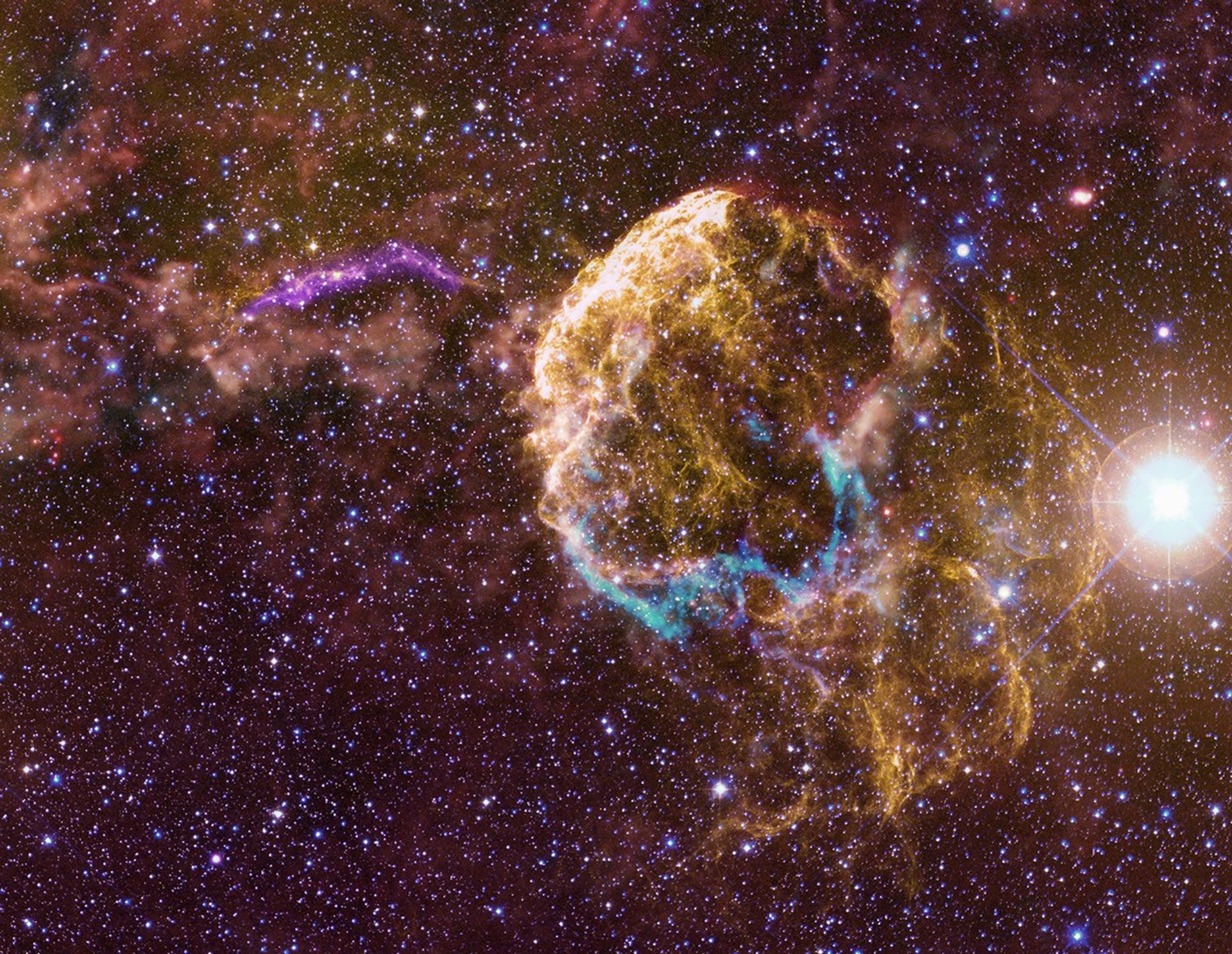
This multiwavelength scene shows the Jellyfish Nebula supernova remnant (right), the interstellar cloud it’s interacting with, and a distinctive curving filament to its upper left. The filament, which is shown here both in optical and ultraviolet (UV) light, is the visible part of an overlapping supernova remnant, G189.6+3.3, that is more prominent in radio and X-rays. Visible light is shown in yellow, UV from NASA’s Neil Gehrels Swift Observatory is shown in violet, and infrared light from NASA’s retired WISE (Wide-field Infrared Survey Explorer) mission appears in cyan, red, and orange. Both remnants are located about 6,000 light-years away in the constellation Gemini. The brilliant star at far right is Propus, also known as Eta Geminorum.
NASA Goddard Space Flight Center and M. Michailidis et al. 2026; optical: DSS; infrared: NASA/WISE/JPL-Caltech/UCLA; ultraviolet: NASA/Swift
“Using 16 years of data from NASA’s Fermi Gamma-ray Space Telescope, our analysis uncovered gamma rays associated with a supernova remnant that was hidden in the glare of its neighbor, the Jellyfish Nebula, one of the brightest gamma-ray-emitting supernova remnants known,” said Miltiadis Michailidis, a postdoctoral fellow in the physics department at Stanford University in California. “There are so many striking connections between the two remnants that we conclude they’re likely related, giving us the first known example of a binary system where both stars have undergone supernova explosions.”
Michailidis presented the findings Wednesday at the 248th meeting of the American Astronomical Society in Pasadena, California. A paper describing the results will appear in a future edition of Nature Communications.
The study focused on a faint supernova remnant called G189.6+3.3, which is mainly visible in X-rays. It is upstaged by its brighter and better-known neighbor, the Jellyfish Nebula (IC 443). The two star wrecks, both located in the constellation Gemini, appear to partially overlap as seen in X-rays. Recent X-ray evidence suggests that hot plasma likely associated with G189.6+3.3 may extend across the entire region, a hint that the overlap may be nearly total.
A massive star explodes when its energy-producing core runs out of fuel and collapses under its own weight, triggering an explosion that blows the star apart. The explosion’s shock wave encloses a hot cloud of debris that rapidly expands into space. So far, astronomers have cataloged about 300 supernova remnants in our galaxy.
The Fermi mission is part of NASA’s fleet of observatories monitoring the changing cosmos to help humanity better understand how the universe works. More than a decade ago, observations from Fermi’s LAT (Large Area Telescope) showed that the shock waves of supernova remnants accelerated particles to within a fraction of the speed of light, a process first proposed by physicist Enrico Fermi — the mission’s namesake — in 1949.
These high-speed particles, called cosmic rays, interact with interstellar gas to produce gamma rays, the highest-energy form of light. Protons make up 99% of cosmic ray particles. To prove that accelerated protons are responsible for the glow, astronomers search for a specific gamma-ray feature. When cosmic-ray protons smash into interstellar gas, they produce a short-lived particle called a neutral pion, which almost immediately decays into a pair of gamma rays. This emission occurs within a specific band of energies associated with the neutral pion’s mass and lies within the range detected by Fermi’s LAT instrument.
In 2013, Fermi observations proved that the Jellyfish Nebula, which is interacting with part of a glowing cloud of hydrogen gas known as Sharpless 249, produced gamma rays through this mechanism. Its neighbor, G189.6+3.3, was discovered in 1994 as part of an X-ray survey by the German-led ROSAT (Roentgen Satellite) mission.
A bright filament of gas lies between the overlapping remnants. New observations of this feature reveal that the shock wave from G189.6+3.3 slammed into dense interstellar gas there and dramatically slowed, key evidence that both remnants are interacting with the same cloud system.
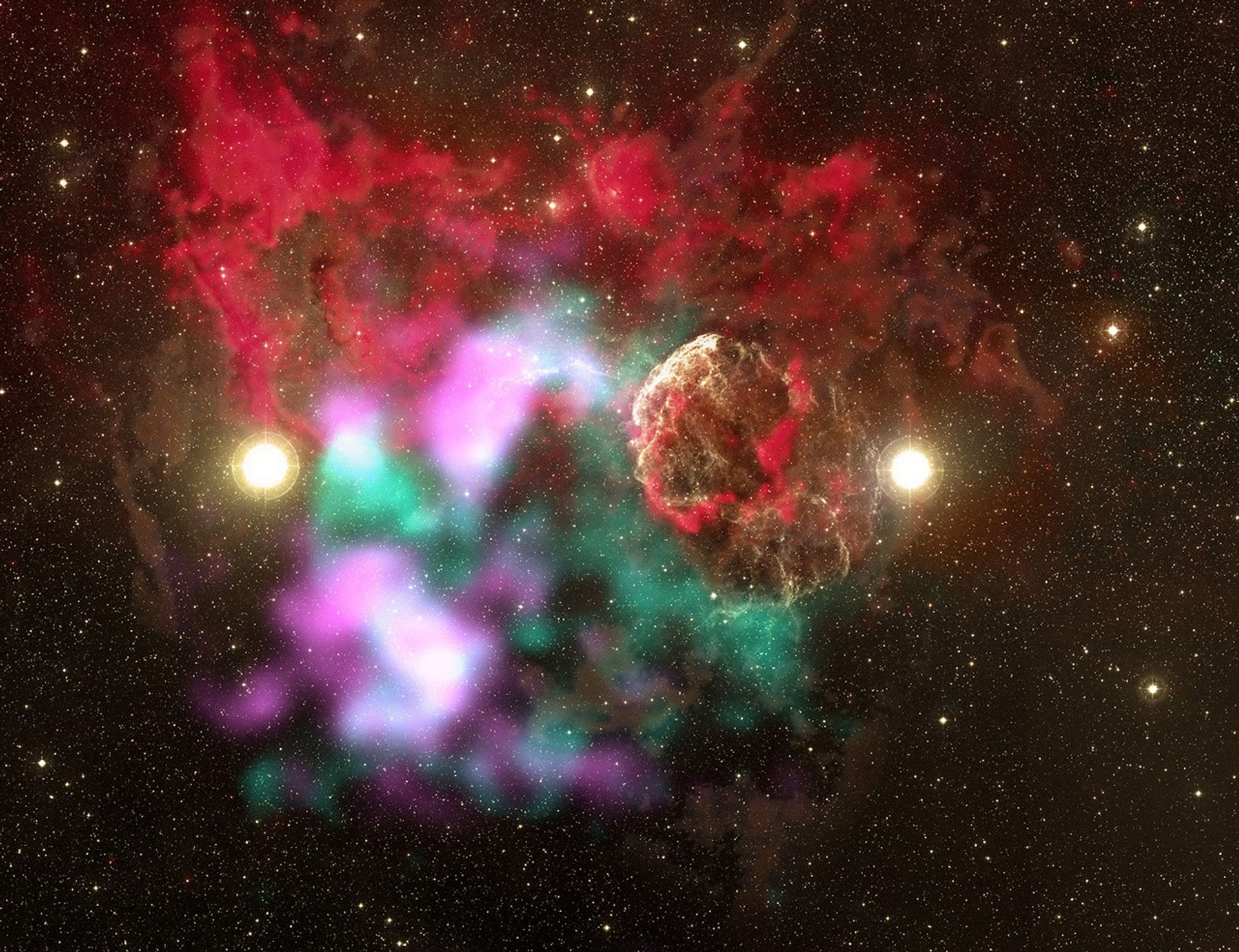
The well-known supernova remnant IC 443 (right) has an older, fainter neighbor (shown here in blue-green and magenta) called G189.6+3.3. A filament of gas between them, glowing in visible and ultraviolet light (violet arc at center), traces the neighbor’s shock wave and shows that both remnants are interacting with the same molecular cloud, shown in red, orange, brown for infrared and radio data and yellow for visible light. Blue-green shows X-rays from the fainter remnant, while magenta shows gamma rays with energies greater than 10 billion electron volts; for comparison, visible light has energies between about 2 and 3 electron volts. In this view, high-energy light from the much brighter IC 443 has been removed for clarity. Gamma-ray emission near the filament stems from protons accelerated in the supernova’s shock wave as it expands into the cloud.
NASA Goddard Space Flight Center and M. Michailidis et al. 2026; radio, MWISP and ESA/Planck; infrared: NASA/WISE/JPL-Caltech/UCLA; optical: DSS; ultraviolet: NASA/Swift; X-ray: SRG/eROSITA; gamma ray: NASA/DOE/Fermi LAT Collaboration
Astronomers think the Jellyfish Nebula is also a candidate PeVatron, a cosmic particle accelerator capable of boosting protons to energies so high they could nearly escape our galaxy. Such particles can produce gamma rays with trillions of times more energy than visible light. Finding a second particle accelerator near the Jellyfish Nebula could offer scientists new clues for how supernova remnants develop into PeVatrons.
“The overlapping remnants, a connecting gas filament, and the availability of data from Fermi and other facilities motivated us to delve into this complex but little-studied region,” said co-author Marianne Lemoine-Goumard, an astrophysicist at the French National Centre for Scientific Research (CNRS) based at the University of Bordeaux. “With Fermi’s LAT instrument, we found gamma-ray emission associated with accelerated protons in the northern part of the fainter remnant. If both remnants are interacting with the same structure, then they must share a common distance from us.”
The team concludes the remnants lie about 6,000 light-years away, their explosion centers are separated by roughly 40 light-years projected onto the plane of the sky, and the original stars may have been 20 or more times the Sun’s mass.
Estimates of the remnants’ ages vary widely, but the team concludes that the age of the Jellyfish Nebula is 8,000 to 9,000 years, while G189.6+3.3 is between 20,000 to 110,000 years old. This means the delay between the explosions could have extended for up to 100,000 years.
In addition, the team conducted computer simulations of a million massive binary systems. They show that systems where the stars orbit close enough to exchange matter and interact during their lives can readily produce dual supernova explosions with similar separations and time delays as those found for the remnants. The team also estimated that the chance of randomly encountering this combination of observed spatial alignment and compatible distances to be less than 1%, strongly supporting a physical association.
“The evidence we’ve compiled — including observations across the spectrum, the chemical and physical properties of the remnants, simulations, and more — paints a compelling picture of a dual supernova event,” said Michailidis.
This study identifies a unique possible example of a binary system where both stars exploded as supernovae and left behind separate, detectable supernova remnants. Astronomers think that most massive stars form in binary or multiple-star systems. The Jellyfish Nebula/G189.6+3.3 complex offers astronomers a rare opportunity to study how massive binary stars evolve, exchange matter, explode, and experience velocity changes — called kicks — induced by the supernova blast. It also provides a powerful new laboratory for understanding how coupled supernova remnants behave, including how they accelerate particles, generate gamma rays, and shape their surrounding environments.
“Fermi’s gamma-ray observations of supernova remnants continue to reveal the dynamic lives of stars,” said Elizabeth Hays, the Fermi project scientist at NASA’s Goddard Space Flight Center in Greenbelt, Maryland. “We can now connect the glowing remains of two massive stars to a powerful pair that evolved together over thousands of years.”

 Login

 Scientists may have found a more realistic set of thermodynamic rules for black holes that never stop changing. Black holes are among the most extreme objects known in the universe. They compress enormous amounts of mass into remarkably small regions, creating gravitational fields so powerful that nothing, not even light, can escape once it crosses [...]