O retorno da produção, que conta com Reese Witherspoon e Jennifer Aniston como protagonistas e produtoras executivas, está marcado para o ano que vem, com boa parte do elenco já conhecido e algumas adições.
Ao longo de suas quatro temporadas, “The Morning Show” já foi indicada a diversas premiações (vencendo algumas delas) e debateu temas como a pandemia de COVID-19 e assédio, tendo como pano de fundo os bastidores do telejornalismo.
O Apple TV está disponível no aplicativo Apple TV em mais de 100 países e regiões, seja em iPhones, iPads, Apple TVs, Macs, dispositivos Android, smart TVs ou online — além de também estar em aparelhos como Roku, Amazon Fire TV, Chromecast com Google TV, consoles PlayStation e Xbox. O serviço custa R$29,90 por mês, com um período de teste gratuito de 7 dias. Por tempo limitado, quem comprar e ativar um novo iPhone, iPad, Apple TV ou Mac ganha 3 meses do Apple TV. Ele também faz parte do pacote de assinaturas da empresa, o Apple One.
NOTA DE TRANSPARÊNCIA: O MacMagazine recebe uma pequena comissão sobre vendas concluídas por meio de links deste post, mas você, como consumidor, não paga nada mais pelos produtos/serviços usando os nossos links de afiliado.
On Thursday, San Francisco city attorney David Chiu sent legal notices to Apple and Google demanding that they remove from their app stores 13 face-swapping apps, which allow users to create AI-generated nonconsensual nude images. The letters say the Silicon Valley giants should stop “aiding and abetting” the sale of explicit deepfake images and “sever” business relationships with the app developers.
[…]
Researchers have repeatedly found and reported apps in Apple’s App Store and Google’s Play Store that allow people to generate sexual images using AI—including some apps being rated as suitable for use by children. While new laws and bans aim to tackle the scourge of explicit deepfakes online, technology and social media companies consistently direct millions of people toward the harmful tech.
Both Apple and Google have developer policies that prohibit pornography, abuse, and harassment on their platforms.
Burgess gives the impression, which is my base assumption, that these 13 apps were clear about what they do, so App Review has no excuse for missing them. But I’m sure it’s keeping us all safe in other regards.
Meanwhile, in a preprint research paper published in May, researchers from Cornell University and Georgetown University identified 420 apps offering general face-swapping capabilities on Google’s and Apple’s app stores. They tested 155 to see if they could be used to create face swaps with nude images; in 70 percent of cases, it was possible, with the apps not including safety measures to prevent this.
Chiu isn’t arguing that hosting an app automatically makes a platform liable for what it does. Platform operators already won that battle with Section 230 of the Communications Decency Act. That 30-year-old law says websites generally aren’t responsible for content posted by users, allowing platforms to host user-generated content without getting sued every time someone defames someone in a comment thread.
Courts have often extended those protections to cover app stores too. Apple and Google are treated as distributors of whatever a third-party developer uploads, rather than publishers.
Chiu is attempting to sidestep that argument by focusing on the companies’ payment systems, noting that Apple and Google collect a cut of every in-app purchase. According to the Tech Transparency Project (TTP), that means they profit from apps that generate revenue by creating non-consensual intimate imagery.
SpamSieve 3.3.1 is an update of my Mac e-mail spam filter that improves the filtering accuracy and includes various optimizations, fixes, and updates for macOS 27. Some interesting engineering issues were:
I’m still supporting macOS 10.13, but the app can now build with the macOS 12 deployment target in preparation for Xcode 27. The way Swift handles calling deprecated APIs remains annoying. You need workarounds like protocols to suppress a warning in a particular region of code. Often, I am updating to a newer API, but I want to continue using the old one on earlier versions of macOS. Right now I am heavily testing on macOS 26, so I would like to only deploy the new code there. Sometimes the initial versions of APIs are buggy, and I don’t want to have to retest every feature on every version. But Swift doesn’t like me to gate the calls to macOS 26 and later if the new API was actually introduced in, say, macOS 11.
The most risky update was probably switching to the Swift API for Scanner. This is tricky because the current scan position changes from being based on UTF-16 indexes to String.Index. And in some cases my code was intentionally scanning into the middle of a combining character. I was really glad to have extensive tests here.
Recent versions of Tahoe introduced a Core Data bug that broke save recovery (when invalid Unicode can’t be written to the database and we have to fix it up first). When the error comes in, SpamSieve looks under the NSDetailedErrorsKey key, but the value of this key is "NSDetailedErrorsKey" while the actual error info is under the key "NSDetailedErrors".
Database corruption combined with a Core Data bug and two Swift behaviors were causing crashes. The root problem, I think, is that in this situation Core Data neglects to set the error pointer for -[NSManagedObjectContext countForFetchRequest:error:]. Normally, Swift would detect this and throw a generic nilError. However, this method signals errors by returning NSNotFound instead of nil. It’s annotated as swift_error(nonnull_error), which I think means that Swift doesn’t even look at the return value, only the (unset) error. So my code was receiving NSNotFound on the non-error path, treating it as a real count, and doing some math with it, which (by default in Swift) leads to a crash if there’s overflow. Now my code checks for NSNotFound and uses Int.addingReportingOverflow().
I reimplemented Core Data batch fetching because of two problems with the fetchBatchSize option. First, it logs spurious errors when fetching from multiple stores at once. Second, it leads to high memory use. It will load objects in batches, but it never releases the earlier batches. You can manually refault objects that you no longer need, but it will still hold onto the full object shells, which can add up. My implementation only holds onto IDs, and it can fetch the IDs using a different context than the objects to push more work to background threads.
I’m now using String.makeContiguousUTF8() in various places to avoid slow iteration of bridged strings.
There was a regression where some menu code could crash on macOS 10.13. -[NSMenu setItemArray:] is only available on macOS 10.14 and later, whereas the getter is always available. With old Objective-C, the two methods could be annotated with separate availabilities. The Objective-C property syntax doesn’t allow this, so there’s no way for the compiler to flag calls where the setter is missing.
The AppleScript support works much better with large data sets. The key, I think, is to never return an array to Cocoa for a scripting property/element. First, if you give it a lazy array it will sometimes try to access all the elements even if it only needs a few. And, second, AppleScript will run out of memory if the array is too large. By using indexed accessors, you can maintain laziness and only convert one object to a descriptor at a time. By caching a batch-fetching collection, you can limit the number of fetches and respond quickly when AppleScript requests individual objects.
Finding useful software in the App Store is about to get easier. Apple is apparently preparing to remove what it describes as “opportunistic” apps that provide little value to iPhone and iPad users.
It already had a policy of not approving applications that are “indistinguishable from what’s already widely available.” This week, it quietly warned developers that it will start removing low-value software that doesn’t attract attention from users.
4.3 (b) Don’t submit apps that are indistinguishable from what’s already widely available. Opportunistically creating variants of existing app categories or popular apps degrades App Store discovery, reduces overall app quality, and harms both users and developers. Certain kinds of apps, such as dating, flashlight, sound effects, wallpaper, simple timers, and fortune telling, are well established on the App Store and we will not accept new submissions unless they offer a meaningfully different or improved experience. We may remove these apps from the App Store going forward if they are not updated, improved, or do not attract customers. Other kinds of apps, such as drinking games, Kama Sutra, fart, and burp apps, are mediocre, low-quality, or low-effort and do not add value to the App Store. Repeated submissions of this kind may lead to removal from the Apple Developer Program.
Waiting for Review enters day 3. I don’t recall when was the last time this happened for any of the apps I am working for.
[…]
I sent messages to App Review Board and received nothing in response (so far).
It seems that if Apple ever removed your app from App Store for reason of “not sending regular updates” that app is…gone. It’s not deleted but it seems to dwell in some sort of limbo.
Os novos dobráveis chegam meses antes de a Apple alegadamente adentrar nesse segmento do mercado com o famigerado “iPhone Ultra” — logo, as apostas da gigante sul-coreana baterão de frente com o futuro dispositivo da Maçã.
Sem mais delongas, vamos conferir os detalhes de cada anúncio abaixo!
Galaxy Z Fold8
Divulgação/Samsung
Agora que os dobráveis da Samsung possuem três variantes, o Z Fold tradicional passou por um reposicionamento, tornando-se talvez a adição mais diferente dentre toda a linha de novos produtos anunciados.
Seu grande destaque é a reformulação no design, adotando um formato que se convencionou chamar de “passaporte”, com uma proporção maior do que aquilo que foi estabelecido nas últimas gerações do dobrável principal da Samsung. Isso resultou em uma tela externa de 5,5 polegadas e aspect ratio de 10:16, além de uma principal de 7,6″ e proporção de 4:3 — especificações bem semelhantes ao que se especula sobre o “iPhone Ultra” —, ambas com taxas de atualização de até 120Hz.
A sul-coreana destacou ainda o peso do modelo, sendo o celular dobrável mais leve já lançado por ela até agora (201 gramas, para ser exato).
Uma das principais diferenças do modelo em relação ao Z Fold8 Ultra está nas câmeras: o modelo padrão conta apenas com duas lentes traseiras (um sensor principal e uma lente ultra-angular, ambos com 50 megapixels), além dos 200mAh de diferença na bateria (4.800mAh no caso do Z Fold8 e 5.000mAh no caso do Z Fold8 Ultra). A linha também marca a estreia das baterias de silício-carbono nos celulares da fabricante.
Quanto ao restante das suas especificações técnicas, destaca-se pela implementação da tecnologia Flex Titanium — baseada em alumínio — para a resistência da tela, a presença do chip Snapdragon 8 Elite Gen 5, opções a partir de 12GB de memória e 256GB de armazenamento (até 1TB), resistência IP48 contra água e poeira, além de suporte ao carregamento de 45W com fio e 15W sem fio. Assim como os demais aparelhos, ele chega com o Android 17 e a One UI 9.
Nos Estados Unidos, ele chega a partir de US$1.900 (US$200 a menos que o Z Fold8 Ultra e US$100 a menos que o Z Fold7) nas cores preta, branca, lavanda e verde pistache (esta última exclusiva para compra no site oficial da Samsung).
Galaxy Z Fold8 Ultra
Divulgação/Samsung
Para os entusiastas do tradicional formato dos dobráveis da Samsung, a melhor opção é o modelo Ultra. Ele conta com as mesmas 8″ na tela principal e 6,5″ na tela externa do Z Fold7, com aspect ratios de 3:2 e 21:9, respectivamente.
Outra diferença notável em relação ao modelo menor é a presença da lente teleobjetiva de 10MP, aos moldes da presente no Z Fold7.
Como citado anteriormente, o aparelho conta com uma bateria de 5.000mAh de silício-carbono, além de compartilhar o Snapdragon 8 Elite Gen 5, as mesmas opções de memória/armazenamento, a resistência IP48 e o suporte aos 45W de carregamento com fio e 15W sem fio do Z Fold8.
Um de seus maiores destaques (nesse caso, negativo) é o preço: US$2.100 — um aumento em comparação ao modelo equivalente da geração passada (vale lembrar, o Z Fold7 chegou por US$2.000 lá fora). Ele está disponível nas cores preta, branca, roxo escuro e verde escuro (esta última exclusiva para compra no site oficial da Samsung).
Galaxy Z Flip8
Divulgação/Samsung
Modelo mais básico da nova linha, o Z Flip8 se destaca pela redução na espessura (13,1mm dobrado contra os 13,7mm do antecessor) e no peso (188g contra 180g do Z Flip7), possibilitando o que a Samsung chama de “uma experiência cotidiana sem vinco”.
Ele conta com uma tela interna de 6,9″, enquanto a externa tem 4,1″, com proporções de 22:9 e 1:1, respectivamente, e suporte a taxas de atualização de 120Hz em ambas. O aparelho chega com um conjunto duplo de câmeras, sendo a lente principal de 50MP, um sensor ultra-angular de 12MP e câmera frontal de 10MP.
Ele chega com o processador Exynos 2600, resistência IP48, 12GB de memória e opções de armazenamento de 256GB e 512GB. Em termos de bateria e recarga, o componente de silício-carbono possui uma capacidade de 4.300mAh, carregamento de até 25W por fio e 15W sem fio.
O Z Flip8 custa US$1.200 (um aumento de US$100 em relação ao Z Flip7) e está disponível nas cores azul, preta, vermelha coral e menta (esta última exclusiva para compra no site oficial da Samsung).
Galaxy Watch9 e Ultra2
Ambos os modelos ganharam suporte ao recurso “levante para falar”, que aciona de imediato o Gemini do Google sem a necessidade de toque ou botão. Os dois relógios contam com o Wear OS 7 e a One UI 9 Watch, compatíveis com smartphones que possuam Android 13 ou superior.
Divulgação/Samsung
Com especificações e design um tanto semelhantes ao seu antecessor, as grandes novidades do Galaxy Watch9 incluem a ampliação de bateria (o modelo de 40mm ganhou um aumento de quase 20%, com 390mAh, enquanto a versão de 44mm possui 445hmAh), a pulseira com design Air Pocket (até 25% mais leve que a presente no Watch8) e a estreia do processador Snapdragon Wear Elite.
Ele continua com as opções de 2GB de memória e 32GB de armazenamento e está disponível em caixas de 40mm e 44mm, nas cores preto e creme, custando a partir de US$380 (um aumento de US$30 em relação ao Watch8).
Já o Galaxy Watch Ultra2 adota uma reformulação na identidade visual que o aproxima do restante da linha, sendo até 12% mais fino que o seu antecessor, mantendo a bateria de 800mAh. A tela também ganhou melhorias, contando com 5.000 nits de brilho máximo.
Para experiências aquáticas, o Ultra2 atende o padrão EN13319 para mergulho e possui certificação IP69K. Além disso, o app Marz deverá receber suporte à metrificação de velocidades e orientações de descompressão.
Disponível nas cores titânio preto e titânio prata, o modelo está disponível a partir de US$700, um aumento de US$50 em relação à primeira geração.
Inteligência artificial
Durante o evento, a Samsung reforçou sua ciência e presença quanto às IAs agênticas, expandindo a experiência para além das telas dos smartphones e passando a oferecer assistência contínua de IA em tempo real nos dispositivos do seu ecossistema; o foco da Samsung é a entrega da experiência hands-free (ou seja, mãos livres). Ela afirmou ainda que essa integração contará com mecanismos de proteção e segurança, embora não tenha adentrado em detalhes técnicos de como fará isso.
A empresa também mencionou a integração de dados biométricos coletados pelos Galaxy Watch ao fluxo de trabalho médico, focada na prevenção de riscos de saúde com o auxílio da inteligência artificial (IA), permitindo a sugestão de refeições e treinos adaptados com base em interpretações de biossinais.
Preço e disponibilidade
Os novos smartphones chegarão ao Brasil no dia 6 de agosto, mas ainda não tiveram seus preços divulgados; ainda assim, a Samsung já antecipou que a aquisição de algum dos dispositivos durante a pré-venda garantirá até seis meses de Google AI Pro sem custos adicionais.
NOTA DE TRANSPARÊNCIA: O MacMagazine recebe uma pequena comissão sobre vendas concluídas por meio de links deste post, mas você, como consumidor, não paga nada mais pelos produtos/serviços usando os nossos links de afiliado.
O Mozilla Firefox foi atualizado hoje para a versão 153, tanto no macOS quanto no iOS/iPadOS. Entre as várias novidades introduzidas pelo update, estão os Contêineres (Containers), que permitem separar as diferentes partes da sua vida online na mesma janela do navegador.
Assim como a extensão Multi-Account Containers, o novo recurso torna possível logar em diferentes contas sem precisar abrir uma outra instância do Firefox. Ao recorrer aos Contêineres (que ainda estão em preview, diga-se), você também mantém os seus cookies e dados de anúncios direcionados isolados em ambientes distintos.
Segundo a Mozilla, ao tornar um recurso desse tipo em uma ferramenta nativa do navegador, a versão 153 livra usuários de ter que procurar por um add-on, além de facilitar a abertura, a criação e o gerenciamento de contêineres de páginas que você já costuma acessar. Usuários de longa data do Multi-Account Containers, no entanto, não serão deixados de lado, uma vez que a nova solução mantém “a funcionalidade, a flexibilidade e a identidade visual” da extensão.
Nesse preview, já é possível abrir páginas em contêineres específicos, customizá-los com nomes, cores e ícones da sua escolha e gerenciá-los diretamente do menu “Configurações”. Para abrir uma aba contêiner, basta clicar com o botão direito do mouse ou tocar e segurar no botão de nova aba (+) e selecionar a opção correspondente.
Outras novidades
Agora, é possível compartilhar qualquer página com um código QR ao clicar com o botão direito do mouse em uma aba e ir em Compartilhar » Gerar código QR.
Divulgação/Mozilla
Também passou a ser possível juntar múltiplos PDFs em um único documento ao arrastar um arquivo do tipo para a barra lateral de PDF, bem como adicionar imagens como novas páginas de um documento usando o editor de PDF nativo do Firefox.
Ademais, digitar “pick color”, “color picker” ou “eyedropper” na barra de endereço agora faz com que o seletor de cores nativo do Firefox, o Pick a color, seja ativado. Na mesma toada, o Firefox passou a permitir que usuários digitem “labs” ou “experiment” na barra de endereço para acessar a ação rápida “Open Firefox Labs” facilmente.
Usuários de Mac, por sua vez, notarão que o atalho de teclado fn (tecla representada por um globo) F agora é suportado pelo Firefox, permitindo entrar rapidamente no modo de tela cheia do macOS.
O ícone de acesso à localização do usuário agora fica destacado em vermelho sempre que um site obtém acesso às suas coordenadas, além de ficar visível em páginas de resultados de busca (antes ele era ocultado).
Divulgação/Mozilla
Por fim, o assistente Smart Window (ainda em beta) agora permite selecionar diferentes modelos de inteligência artificial (IA) diretamente da sua interface, e a Nova aba (New Tab) do recurso ganhou uma barra de endereço mais familiar para acessar sites ou pesquisar na web.
Divulgação/Mozilla
O Firefox 153 já está disponível para download tanto no desktop quanto em dispositivos móveis. Em ambos os casos, o update também introduz uma série de correções de bugs e melhorias de desempenho, as quais podem ser conferidas aqui e na página do browser na App Store.
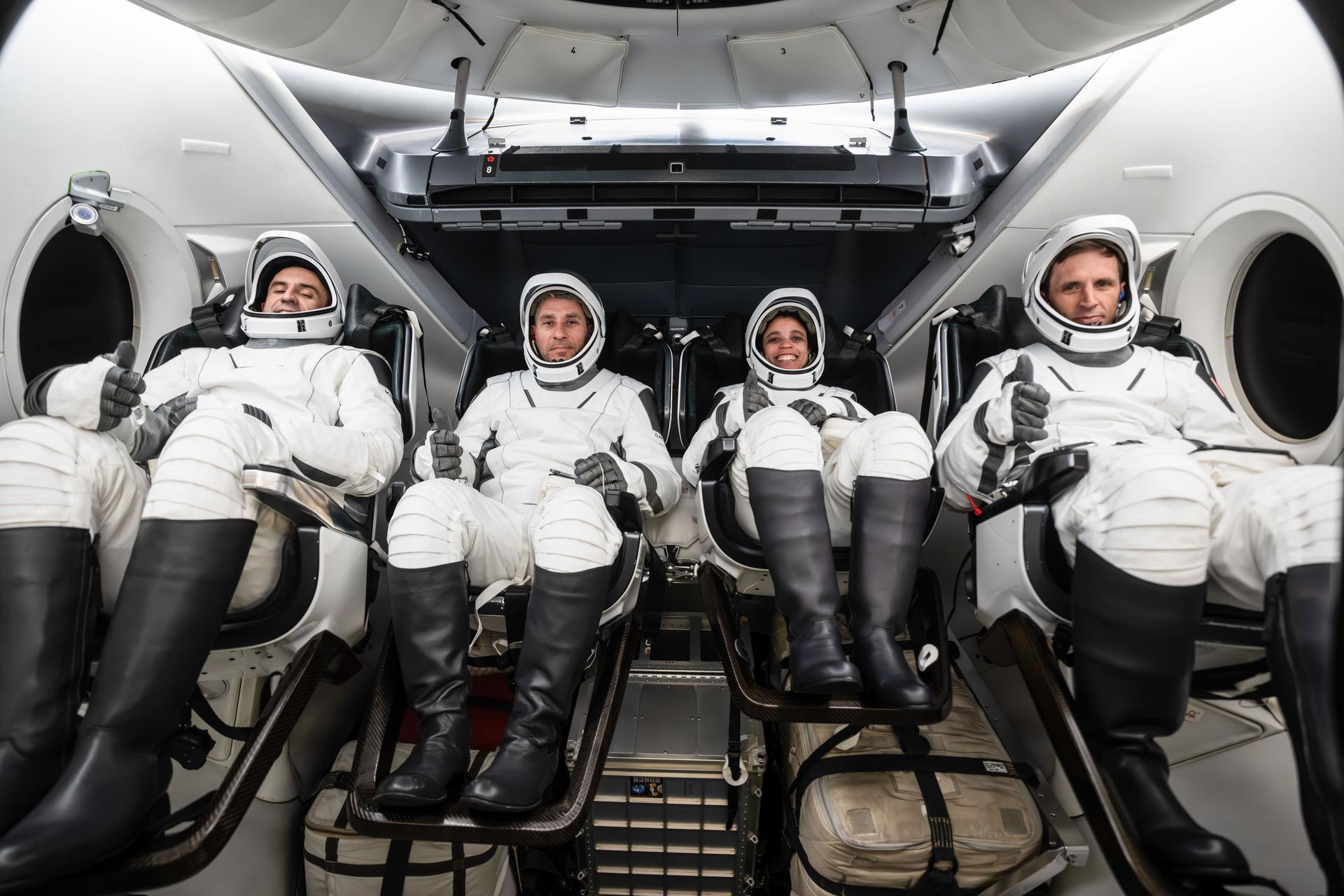
NASA’s SpaceX Crew-13 members are pictured in their pressure suits seated inside a mockup Dragon spacecraft during a preflight training session at the company’s headquarters in Hawthorne, California. From left are Roscosmos Sergey Teteryatnikov, NASA astronauts Luke Delaney and Jessica Watkins, and CSA (Canadian Space Agency) astronaut Joshua Kutryk.
Credit: SpaceX
NASA and its partners will discuss the upcoming crew rotation mission to the International Space Station during a pair of news conferences on Monday, Aug. 3, from the agency’s Johnson Space Center in Houston.
Mission leadership will provide an overview of NASA’s SpaceX Crew‑13 mission at 12 p.m. EDT. Next, crew members will discuss their training and mission preparations at 2 p.m. This is Crew-13’s final media availability prior to traveling to the agency’s Kennedy Space Center in Florida for launch.
NASA will stream these events live. Learn where to watch online:
The Crew-13 mission will carry NASA astronauts Jessica Watkins and Luke Delaney, CSA (Canadian Space Agency) astronaut Joshua Kutryk, and Roscosmos cosmonaut Sergey Teteryatnikov to the orbiting laboratory. The crew will launch aboard a SpaceX Dragon spacecraft on the company’s Falcon 9 rocket from Space Launch Complex 40 at Cape Canaveral Space Force Station in Florida no earlier than mid-September.
International media attending in person must email the NASA Johnson newsroom at jsccommu@mail.nasa.gov by 5 p.m., Tuesday, July 21. United States-based media attending in person must respond by 5 p.m., Thursday, July 30. Media joining virtually must respond by 10 a.m. the day of the event. NASA’s media accreditation policy is available online.
Briefing participants are as follows (all times Eastern and subject to change based on real-time operations):
12 p.m.: Mission Overview News Conference
Joel Montalbano, deputy associate administrator, Human Spaceflight Mission Directorate, NASA Headquarters
Dana Weigel, manager, Low Earth Orbit Program, NASA Johnson
Mathieu Caron, director, Astronauts, Life Sciences, and Space Medicine, CSA
Julianna Scheiman, director, NASA Science and Dragon Programs, SpaceX
Following the news conference, crew members will be available for limited media interviews. All interview requests must be submitted by 5 p.m. on July 30, to the NASA Johnson newsroom at: jsccommu@mail.nasa.gov.
This will be the second flight to the space station for Watkins, who was selected as a NASA astronaut in 2017. Watkins grew up in Lafayette, Colorado, and earned an undergraduate degree in geological and environmental sciences from Stanford University, as well as a doctorate in geology from the University of California, Los Angeles. As a geologist, she studied the Martian surface and was a member of the Curiosity rover science team at NASA’s Jet Propulsion Laboratory in Southern California. Watkins first launched to the space station as a crew member aboard NASA’s SpaceX Crew-4 mission, spending a total of 170 days in space across space station Expeditions 67/68 in 2022. She will be the first NASA astronaut to launch aboard a SpaceX Dragon spacecraft twice.
Selected as a NASA astronaut in 2021, Delaney earned a bachelor’s degree in mechanical engineering at the University of North Florida and a master’s degree in aerospace engineering at the Naval Postgraduate School. The Florida native is a distinguished naval aviator who participated in exercises throughout the Asia Pacific region and conducted missions in support of Operation Enduring Freedom. As a test pilot, Delaney evaluated developmental aircraft systems and served as a test pilot instructor. He also worked as a research pilot at NASA’s Langley Research Center in Hampton, Virginia, where he supported airborne science missions. This is the first spaceflight for Delaney.
The Crew-13 mission also is the first spaceflight for Kutryk. Prior to his selection as a CSA astronaut in 2017, he served as a CF-18 fighter pilot, flying missions in support of Canada’s NATO, U.N., and North American Aerospace Defense Command commitments. A native of Fort Saskatchewan, Alberta, Kutryk also worked as an experimental and operational test pilot at the Aerospace Engineering Test Establishment in Cold Lake, Alberta. Kutryk received a bachelor’s degree in mechanical engineering from the Royal Military College of Canada in Kingston, Ontario, and he is a distinguished graduate of the United States Air Force Test Pilot school in Edwards, California. He has master’s degrees in space studies, flight test engineering, and defense studies.
This mission will be Teteryatnikov’s first trip to the orbiting laboratory. He graduated from the Naval Academy, St. Petersburg, Russia, in 2011 as an engineer specializing in ship power plant operations. Before his selection as a test cosmonaut, Teteryatnikov served in various naval engineering roles, including undersea vessels and specialized engine room operations. He was selected for the Gagarin Research and Test Cosmonaut Training Center Cosmonaut Corps in 2021 and has served as a test cosmonaut since 2023.
Anya Taylor-Joy stars in “Lucky,” premiering July 15, 2026 on Apple TV.
Written by Jonathan Tropper and Cassie Pappas and based on Marissa Stapley’s bestselling novel, “Lucky” centers on a young woman (Anya Taylor-Joy) who left behind the life of crime she was raised in years ago, but must now embrace her darker, criminal side one final time in a desperate attempt to escape her past.
Apple TV’s seven-episode series premieres this Wednesday.
Anya Taylor-Joy finds herself in a familiar setting this summer: In the desert, fighting to stay alive.
She did it in “Furiosa” and the upcoming “Dune: Part Three.” Now she’s under the blazing California sun for “Lucky,” a propulsive Apple TV crime thriller that has her trading blows with goons, bloodying her otherworldly face.
“Listen, I’ve been to the desert so many times at this point it’s kind of unreal. I don’t look like a desert creature, and yet I’m always there and I love it,” says the actor. “People like to see me struggle, and they like me to survive. And, luckily, I enjoy doing it, too, so it works out.”
Reese Witherspoon’s Hello Sunshine media company approached Taylor-Joy with the book, asking her to not just consider leading the series as an actor but also offering to make her debut as an executive producer.
“I remember crossing my fingers and thinking, ‘God, I really hope I like this book.’ And then I did and I fell in love with Lucky and I felt that I had something to contribute in this space, which I think if you’re coming on as an executive producer is the feeling that you want to have,” says Taylor-Joy.
MacDailyNews Take: Congrats to Taylor-Joy on her first executive producing gig!
MacDailyNews Note: Apple TV is available on the Apple TV app in over 100 countries and regions, on over 1 billion screens, including iPhone, iPad, Apple TV 4K, Apple Vision Pro, Mac, popular smart TVs from Samsung, LG, Sony, VIZIO, TCL and others, Roku and Amazon Fire TV devices, Chromecast with Google TV, PlayStation and Xbox gaming consoles, and at tv.apple.com, for $12.99 per month with a seven-day free trial for new subscribers. For a limited time, customers who purchase and activate a new iPhone, iPad, Apple TV 4K or Mac can enjoy three months of Apple TV for free.
Please help support MacDailyNews — and enjoy subscriber-only articles, comments, chat, and more — by subscribing to our Substack: macdailynews.substack.com. Thank you!
iOS 27 Developer Beta 1 has been out since WWDC 2026, with the second beta slated to be released soon. There are a number of changes and performance improvements to be appreciated in this very first developer beta, along with oddities to be expected with prerelease software. Just like last year, I decided to take […]
Carter Sherman has been covering sex, gender, and the complex personal and national politics that accompany them for years. She was a senior reporter for Vice and has written for Elle, Ms. magazine, and Los Angeles magazine as well. Along the way, she's garnered a Scripps Howard Award, a National Press Club Journalism Award, and four Emmy nominations.
She's also the author of The Second Coming: Sex and the Next Generation's Fight Over Its Future. That book looks at how the internet and our polarized political landscape have changed sex and relationships, from school board battles over sex ed to abortion access. These days she finds herself …
It's been a good few weeks for games on rails. Nintendo's Star Fox remake wisely kept the tightly scripted, action-packed levels from Star Fox 64 largely the same, and they're still fun to fly through nearly 20 years later. Denshattack!, a new game from Undercoders, similarly features levels packed with carefully orchestrated sequences to great effect. Except instead of flying through space as an unnervingly realistic anthropomorphic fox, you're flying - and flipping, and spinning, and grinding - through Japan while driving a blindingly fast train.
Calling Denshattack! a train game radically undersells what you actually do. Across a bright …
When Lucid introduced the Air electric sedan in late 2021, the first Air Dream Edition I tested packed over 1,100 hp (820 kW) and carried a $180,000-plus window sticker. It's easily the most powerful street car I've tested; the only vehicle I've driven with more power was a purebred race car with a third the mass, and it was on a proper track. Its combustion engine was also about 1,000 times louder than the Air, helping to remind us that "combustion" really does mean explosion after explosion.
For Lucid's second act, the company debuted the Gravity electric SUV last year, and I've just tested the 2026 Gravity Touring, which starts at about $82,000 in the US, including the required destination charge.
My test model carried a bevy of options, including a 22-speaker audio system, the Comfort and Convenience package, third-row seating, a Dynamic Handling package (combining rear-wheel steering and three-chamber air suspension), a luxury seating package (bundling Nappa leather and massaging and ventilated front seats), and special metallic paint.
The entrepreneur is known in Washington as the financial power behind the president’s crypto fortune. How did Sun’s business love-in with the Trump family spiral into dueling lawsuits?
The most infamous financial scandal in US presidential history – the 1920s Teapot Dome affair – involved then president Warren G Harding’s interior secretary, Albert Fall, taking roughly $400,000 in bribes. Adjusted for inflation, that’s about $6m today. Last year, Donald Trump made at least $2.2bn; his single year of income is on the order of 200 to 300 times larger than the bribe that defined “presidential corruption” in the American imagination for a century.
It’s taken for granted that Trump flogs items like Bibles and gold sneakers as a way to wring more money from his loyal base. But of the president’s $2.2bn, at least $1.4bn came from his crypto businesses. That’s an extraordinary achievement, even for an unscrupulous sitting president. How exactly did he do it without any prior background in crypto?

 Login