The price increases for Apple Music come after Spotify announced its own round of price hikes earlier this year, which Apple poked fun at on social media. Even with today’s price hikes, though, Apple Music remains cheaper than Spotify.
Apple Music no longer makes sense when I’m already paying for YouTube Premium. Apple Music goes up to £11.99, YouTube Premium is £12.99 and on top of a good music service you get no ads on YouTube.
Distilling my longtime argument down to its simplest bit, I’d ask “do you want to pay $10 a month for music for the rest of your life?”
But truly, it was never going to just be $10 per month. The price was going to go up over time. It was going to get more expensive to have access to the same music.
If you purchase your music, though, I think most people would reach a point in their life where they stop buying new music entirely or they’re only buying a few albums per year. The cost of music would go down for you over time.
That was my thinking, too, but then I found that music I’ve purchased from Apple won’t work on my HomePod. I refuse to condone that behavior, so now I have two solid reasons not to subscribe to Apple Music.
While the monthly and annual prices of AppleCare+ plans for Macs and iPads received a slight increase this week, AppleCare One continues to start at $19.99 per month in the U.S., making the multi-device plan even more valuable.
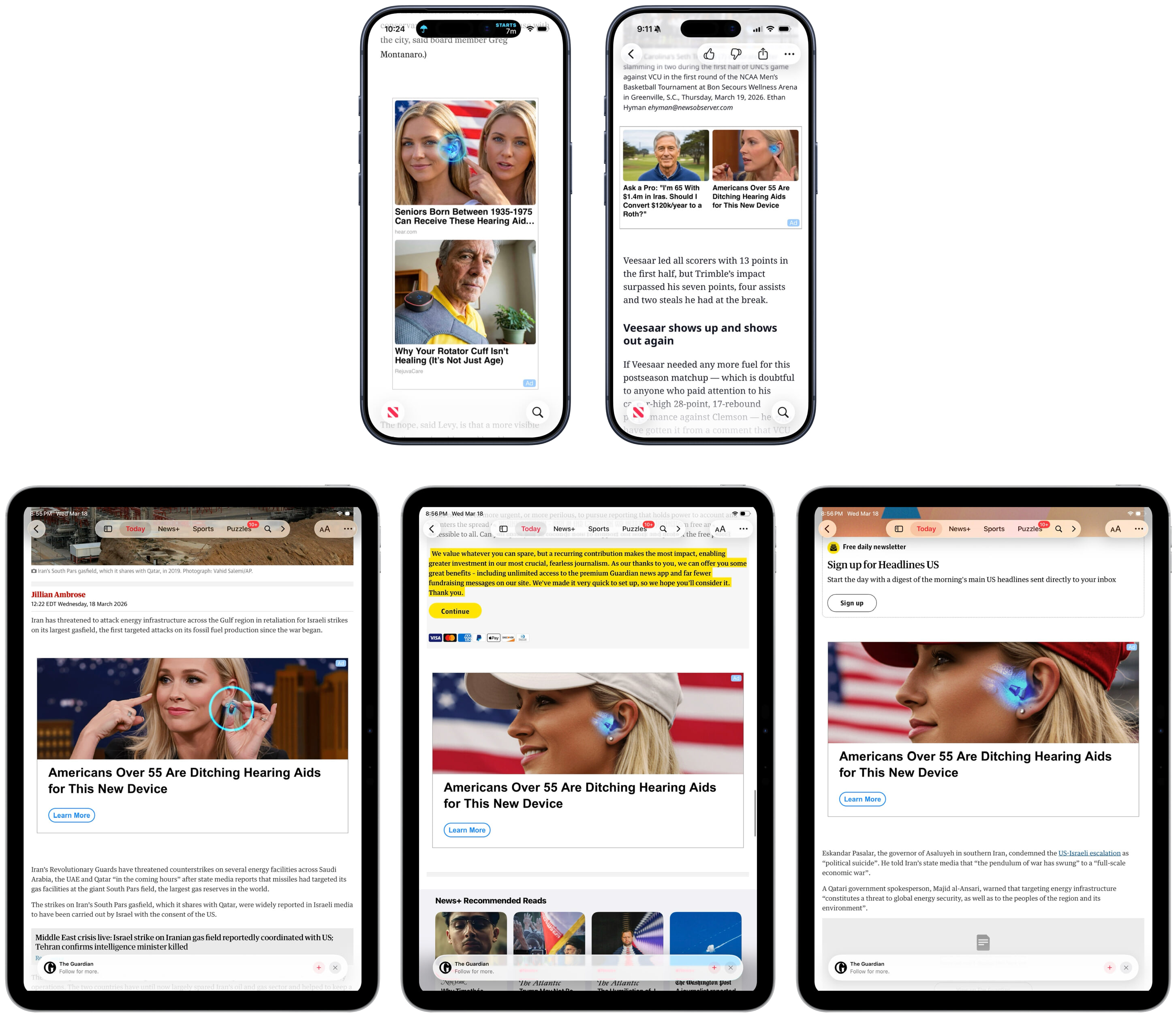
Some of [Cook’s letter] remains true, but has lost some truthiness — and truthiness matters. But some of it is no longer true, period. It’s no longer just “one small part” of Apple’s business that serves advertisers. Here in 2026, search results in the App Store not only show paid ads — frequently for casinos — but the search results are visually dominated by paid ads now that Apple has added a second ad to results. Apple News+ is a paid subscription that offers a genuinely great value for the number of paywalled publishers whose content it includes, but articles on the News app tend to include the weirdest AI-generated ads on the Internet. (How many young blond women am I supposed to believe need hearing aids?) And — at this writing, still “coming soon” — Apple is launching ads on Apple Maps. Apple Maps remains free of charge to use, so according to Tim Cook, we’re not the customer. We’re the product. Or, if you prefer, our frustration is the product.
[…]
The ratio of ads to organic results in App Store search — especially when measured in screen area — is clearly not aligned with Cook’s 2014 statement that “Our software and services are designed to make our devices better. Plain and simple.” Obviously not. App Store search today is designed primarily to generate more revenue for Apple. That’s not criminal, but it’s a change.
[…]
What gave Tim Cook’s privacy letter heft in 2014 wasn’t just the clarity of its plain language, but the fact that you didn’t have to take his word for it that the ads Apple showed you respected your privacy, because Apple didn’t show you ads in 2014. Apple today can’t say that.
[…]
John Ternus should return Apple’s privacy policy to its 2014 clarity. The trust Apple would earn from such a move would far out-value whatever revenue these ads pad to their already hefty and ever-increasing quarterly Services numbers.
I wish that were the case, but I fear this is kind of a Hotelling’s Law situation, where Apple can get most of the benefit by being just slightly better on this axis. Where else do its customers have to go?
In the second fiscal quarter of 2018, services generated $9 billion in revenue (net sales), whereas in Q2 2026, that amount had grown to $31 billion! In this blog post, I want to focus on understanding the relative financial importance of products and services for Apple.
[…]
In 2025, services were 42% of Apple gross margin. How does 26% of net sales become 42% of gross margin? The explanation is that services have a much lower cost of sales. The products gross margin was 37% of products net sales, while the services gross margin was an astonishing 75% of services net sales. In other words, Apple services are almost pure profit!
Does this 75% account for TV and movie production costs?
With persistent general inflation, consumers do not have unlimited money to spend on Apple products. At least in the near future, it’s reasonable to question how much further room is available for growth in profits from Apple products. To satisfy the demands of investors, Apple executives including CEO-elect John Ternus may be forced to rely even more than before on growth in services, which do not face as much pressure on cost of sales as hardware products.
macOS Golden Gate also has design changes. For example, apps now have a unified toolbar at the top, and the sidebar now expands to the edge of the window.
Sidebar behavior is also being updated. Sidebars will now expand to the full edge of the window, with refraction effects continuing beneath them rather than cutting off at the sidebar boundary. Sidebar icons will also retain their color, a change that addresses a common complaint about the original Liquid Glass implementation.
I’m really happy for these changes, but it’s not clear to me that they’re improvements over what we had pre-Tahoe or, especially, pre-Big Sur.
Instead of properly fixing the Liquid Glass implementation of NSToolbar buttons in macOS 27 Golden Gate, Apple decided to simply place an ugly, semi-transparent macOS 15-ish background bar behind the buttons, which makes Liquid Glass completely useless in the toolbar.
The macOS standard sidebars don’t live in a blob with very uncomfortable margins (which were required for there to be a layer fit in between the “traffic light” window controls and the window’s edge).
No more progressive blur for scroll edges in System Settings on macOS. This is definitely a very welcome change and overall one of the many little enhancements -- driving the entire UI in the right direction. Love it.
A new study is turning an elegant quantum idea into a practical platform for light. In research published in Light: Science & Applications, physicists report “topological Jackiw–Rebbi” states engineered inside photonic van der Waals heterostructures—systems built by stacking atomically thin materials with precisely tailored interfaces. The result is a photonic phenomenon that echoes how particles can be trapped at boundaries where the rules of their governing equations change.
The work builds on the classic Jackiw–Rebbi mechanism, originally proposed for relativistic particles. In those models, a localized mode appears when a mass term flips sign, effectively creating a domain wall. The authors translate this concept into optics by designing photonic structures where an effective “mass” characterizing light propagation changes across an interface.
What makes the platform especially compelling is the van der Waals architecture. Unlike conventional fabrication routes that can introduce disorder, the layered nature of these materials enables sharp, controllable boundaries and tunable photonic band structures. By adjusting the stacking and interlayer optical responses, the researchers create conditions in which topological modes become robust against typical imperfections.
The study emphasizes that these states are not merely conventional guided resonances. Instead, they are tied to topology: the light modes are associated with an invariant property of the band structure. As a consequence, the Jackiw–Rebbi-like photonic states are expected to persist even when the system’s details vary, so long as the relevant symmetry and band configuration remain intact.
Topological protection is more than a slogan. In photonics, it can translate into reduced sensitivity to fabrication tolerances and a pathway toward devices that rely on stable boundary transport. The paper therefore positions these localized states as building blocks for future optical components that route signals along designed interfaces.
The authors demonstrate the concept theoretically and connect it to experimental observables by focusing on how the interface should host modes localized near the domain wall region. Such localization is a hallmark of the Jackiw–Rebbi scenario, now realized in a controllable, designer photonic environment.
Beyond fundamental interest, the approach could influence the design of reconfigurable photonic circuits. Because van der Waals stacks can be combined and adjusted, the same topology-driven logic may be extended to new material systems, wavelengths, and device geometries.
Overall, the report signals a broader trend: using topological field-theory ideas to engineer light–matter behavior in atomically precise platforms, potentially enabling the next generation of robust, interface-based photonic technologies.
Subject of Research: Topological photonic states (Jackiw–Rebbi) in van der Waals heterostructures.
Article Title: Topological Jackiw-Rebbi states in photonic Van der Waals heterostructures.
A new study highlights what shapes how older adults choose dental services, offering insights that could help clinicians and policymakers make care more reachable for aging populations. Published in BMC Geriatrics, the research examines preferences from the perspective of elderly people, focusing on the practical and psychological drivers behind where they seek treatment.
Researchers report that dental service choice is not determined by clinical need alone. Instead, older participants weigh multiple factors, including perceived quality, trust in providers, and the comfort they expect during visits. Such preferences can influence whether seniors present early for care or delay until symptoms become more severe.
The analysis also underscores the role of access-related conditions. Transportation difficulties, scheduling constraints, and the overall convenience of clinics can strongly affect whether elderly adults follow through on appointments. In practice, even when dental services are available, logistical friction can reduce uptake.
Cost perception emerges as another key theme. The study points to the way affordability, expected out-of-pocket expenses, and insurance-related clarity can shape willingness to seek preventive services. When costs feel uncertain, older adults may prioritize only urgent needs rather than routine checkups.
Beyond logistics and economics, communication quality matters. Participants appear to value providers who explain procedures clearly, demonstrate patience, and treat them with respect. For many seniors, feeling heard can improve satisfaction and reinforce continued engagement with dental care.
The findings also suggest that health-related experiences influence preference. Prior dental outcomes, fear of pain, and past interactions with the healthcare system can steer individuals toward specific service settings. This is particularly relevant for older adults who have accumulated years of unmet needs or negative impressions.
Importantly, the study frames these determinants as modifiable targets. By improving appointment accessibility, strengthening patient-provider communication, and ensuring transparent pricing, dental programs could better align services with senior expectations.
As populations age worldwide, these behavioral insights may help reduce barriers to oral healthcare. The research calls for strategies that address both the measurable elements of service delivery and the lived concerns of older adults deciding where to go for treatment.
Subject of Research: Factors influencing elderly preferences for dental services
Article Title: Factors related to the preference for dental services from the perspective of the elderly
The president joined Republican officials who slammed the National Academies of Sciences for a chapter about climate science in an educational guide for judges.
The president joined Republican officials who slammed the National Academies of Sciences for a chapter about climate science in an educational guide for judges.
Das Sicherheitsforschungsunternehmen Group-IB hat eine neue Mac-Malware entdeckt, die es „ClickLock Stealer“ getauft hat. Im Rahmen der Installation von ClickLock Stealer sperrt das Installationsprogramm Ihren Mac im Wesentlichen so lange, bis ein Anmeldekennwort in einem dauerhaft angezeigten Fenster eingegeben wird.
Sobald ein Passwort eingegeben wurde, wird die Malware installiert und erfasst heimlich Daten: Browser-Anmeldedaten, Krypto-Wallet-Erweiterungen, Desktop-Wallet-Dateien, Daten aus Passwortmanagern und vieles mehr.
Die Nutzer werden von Angreifern über ein gefälschtes Cloudflare-CAPTCHA ins Visier genommen, das sie dazu verleitet, einen Befehl in das Terminal von macOS zu kopieren und einzufügen. Sobald die Installation ausgelöst wird, werden Malware-Komponenten auf dem Mac installiert, während ein gefälschtes Cloudflare-Fortschrittsfenster angezeigt wird.
Versucht ein Nutzer jedoch, die laufende Installation abzubrechen, beendet die Malware laut Group-IB „alle sichtbaren Anwendungen alle 210 Millisekunden und lässt nur einen Passwortdialog auf dem Bildschirm stehen, bis der Nutzer gezwungen ist, den Anweisungen zu folgen“.
Dem Bericht zufolge befinden sich die meisten betroffenen Nutzer in Italien, den USA, Jordanien und Großbritannien. „Die geografische Verteilung passt zu einer finanziell motivierten Kampagne, die auf Nutzer in Regionen mit hohem Einkommen abzielt, in denen sowohl die Verbreitung von Kryptowährungen als auch der Marktanteil von macOS hoch sind“, so Group-IB.
So schützen Sie sich vor Malware
Der einfachste Weg, sich vor Malware zu schützen, besteht darin, das Herunterladen von Software von unbekannten Download-Seiten zu vermeiden. Öffnen Sie niemals Links in E-Mails oder SMS, die Sie von unbekannten und unerwarteten Absendern erhalten.
Wenn Sie eine Nachricht erhalten, die so aussieht, als stamme sie von einem Unternehmen, mit dem Sie geschäftlich zu tun haben, überprüfen Sie die E-Mail-Adresse des Absenders und sehen Sie sich die URL genau an. Wenn Sie einen Link oder eine Schaltfläche sehen, können Sie mit der Ctrl-Taste darauf klicken, „Link-Adresse kopieren“ auswählen und diese dann in einen Texteditor einfügen, um die tatsächliche URL dort zu überprüfen.
Apple hat die Software im Mac App Store geprüft, und dies ist der sicherste Weg, um Apps zu beziehen. Wenn Sie den Mac App Store nicht nutzen möchten, kaufen Sie Software direkt beim Entwickler über dessen Website. Wenn Sie darauf bestehen, geknackte Software zu verwenden, gehen Sie stets das Risiko ein, sich mit Malware zu infizieren.
iOS 27 Developer Beta 1 has been out since WWDC 2026, with the second beta slated to be released soon. There are a number of changes and performance improvements to be appreciated in this very first developer beta, along with oddities to be expected with prerelease software. Just like last year, I decided to take […]
On June 8th 2026 at WWDC 2026, Apple announced the iOS 27 Developer Beta, which is set for consumer release in September 2026. iOS 27 was announced alongside macOS Golden Gate, iPadOS 27, visionOS 27, watchOS 27, and tvOS 27. Aimed to be a like a “Snow Leopard” sort of release, this new version brings […]
In a new paper published in the Proceedings of the National Academy of Sciences, a team of 41 authors from around the globe argue that virtual reality has the potential to do the same for behavioral science and help solve the reproducibility crisis.
The spacecraft aced its encounter with Mars. Now, mission scientists are studying a trove of data from the flyby in preparation for its arrival at asteroid Psyche in 2029.
On first impressions, the Laifen T1 Pro wows. Open the box and you're greeted with Apple-inspired packaging, while the shaver itself immediately looks the part. Its CNC-machined unibody aluminium body looks and feels genuinely premium and, if you're used to cheaper shavers like the Philips OneBlade – my usual razor – it's impossible not to grin at the magnetically attached shaving head, which somehow manages to feel genuinely futuristic.
Modern conveniences like USB-C charging, an aeroplane mode to stop the power button being pressed in your bag while travelling and IPX7 waterproofing all add to the premium feel. Based on the spec sheet and those first impressions, you'd be forgiven for thinking the Laifen T1 Pro was one of the best electric shavers on the market.
The problem is that, with a shaver, the only thing that really matters is the shave itself, and that's where the Laifen T1 Po disappoints. I shave twice a week and have fairly coarse stubble, and despite repeated attempts the T1 Pro simply couldn't deliver a comfortable shave and often snagged on my hairs, which was painful and left me with patchy stubble. You have to limit your expectations a bit with single-blade razors, but I've been getting an effective shave with my Philips OneBlade for years, and often I found myself reaching for it to finish up and get the hairs that survived the T1 Pro's efforts.
This leaves the Laifen T1 Pro in an awkward position. It's beautifully designed and genuinely pleasant to use in every respect until it comes to shaving, but if I have to reach for a second razor to finish the job, the premium build and thoughtful features become little more than a nice distraction. I'd love to see Laifen revisit the shaving head in a future model because the engineering elsewhere is genuinely impressive, but as it stands I can't recommend the T1 Pro.
(Image credit: Future)
Laifen T1 Pro: price and availability
List price: $149 / £149 / AU$246
Launched: September 2025
The Laifen T1 Pro launched in September 2025. Listing prices vary but are consistent with other premium shavers. In the US it's currently selling for around $129, in the UK it's £149 and in Australia it's $239. However, it doesn't come with a case, cleaning materials or anything else so it may feel steep in comparison
Value score: 2/5
Laifen T1 Pro: design
CNC-machined aluminum feels premium
Magnetic head feels futuristic and makes cleaning a breeze
USB-C means you're just taking one cable away with you
The Laifen T1 Pro makes an excellent first impression. Unlike the plastic-bodied shavers that dominate the market, the T1 Pro is built around a CNC-machined unibody aluminium chassis that immediately feels more like a premium gadget than a bathroom appliance. The fit and finish are excellent, while the magnetically-attached shaving head snaps satisfyingly into place and makes cleaning refreshingly simple.
Laifen has also packed in plenty of thoughtful features. USB-C charging means one less proprietary cable to keep track of, an airplane mode prevents the power button from being accidentally pressed in your luggage, and the IPX7 waterproof rating means you can use the shaver wet or dry before simply rinsing it under the tap to clean it up.
(Image credit: Future)
The compact dimensions work in the T1 Pro's favour. It's comfortable to hold despite the lack of any rubberized grip, and the aluminum body never felt slippery during my testing, even during a heatwave when I was, perhaps a little sweatier than I'd like to admit. Its low weight, just 3.3oz / 93g, makes it easy to use precise movements in the tricky areas like the jawline and around the mouth — areas that can be difficult with larger, clunkier, shavers.
It's a minor thing, but I found myself squeaking with joy each time I opened the little cap at the bottom of the razor to reveal the USB-C charging port. It's a small thing, but the cap fits so neatly in and comes away so delicately it sparks joy every time I charged it.
In many ways, the T1 Pro feels like the product of a company obsessed with industrial design. From the premium materials to the magnetic shaving head and clean, minimalist aesthetic, there's very little to criticize about the hardware itself.
Design score: 4/5
Laifen T1 Pro: performance
Foil snags on coarse hair, which is painful
The shave is patchy and inconsistent
Long-lasting battery means you'll only need to charge occasionally
Ultimately, the Laifen T1 Pro lives or dies by the quality of its shave, and that's where it struggles. I have fairly coarse facial hair and typically shave twice a week, which proved to be a challenge the T1 Pro never really overcame.
Rather than cutting cleanly through my stubble, the shaver frequently pulled at beard hairs, making each shave less comfortable than it should have been. It also struggled to achieve an even finish. Even after several passes, I was often left with patches of missed stubble that required further attention. The trimmer head was more prone to this snagging, but the shaver head didn't eliminate the problem and also left my skin irritated.
The T1 Pro's light weight makes it easier to use, but its small size means covering your face takes longer than with a larger foil shaver. As a result, multiple passes quickly became the norm, and each additional pass increased the likelihood of the shaver snagging on thicker patches of hair.
(Image credit: Future)
I repeatedly found myself reaching for another razor to finish the job. Not only did it clean up the areas the T1 Pro had missed, but it also did so more comfortably. That's difficult to overlook given the T1 Pro's premium price.
The 120-minute battery life is excellent and should last most people several weeks between charges.
Unfortunately, The Laifen T1 Pro looks and feels like a premium electric shaver, but in my experience it simply doesn't deliver the shave the design promises, which makes it impossible to travel with because I also have to toss a second razor into my bag.
Performance score: 1/5
Should you buy the Laifen T1 Pro?
Laifen T1 Pro score card
Attribute
Notes
Score
Value
A disappointing shave that is often painful.
2/5
Design
Beautifully designed with some thoughtful choices.
4/5
Performance
A premium price backed up by the design but not the shave.
1/5
Buy it if
You want a premium looking shaver
The Apple comparisons hold up; it really is a great looking shaver that feels good in your hand
You hate carrying extra cables
Charging from a USB-C means you've almost definitely got one with you, wherever you are.
Don't buy it if
You want a good clean shave
I feel like I've gone on about this a lot, but honestly it's really annoying to have a shaver that's doesn't give you a clean shave.
You have delicate skin or coarse hair
The Laifen T1 Pro can be quite a harsh shave. I found it struggled with my coarse stubble, catching on it painfully and often not cutting cleanly through. The shaver attachment left my skin sore and irritated after each use.
Laifen T1 Pro: also consider
Philips OneBlade 360
If you have sensitive skin, you'll likely find this versatile shaver a better option. It doesn't offer the closest shave but it's gentle, suitable for wet and dry shaving, and affordably priced too.
At the other end of the price scale, we have this premium model, which our reviewer called "the Bugatti Veyron of shavers". It delivers excellent performance, with an ergonomic design and good battery life, and has a price tag to match.
EU tech regulation, Digital Markets Act, Apple Europe sales, Apple regulation, European Union, Siri AI, iPhone features, device interoperability, App Store changes, alternative marketplaces, iPhone Mirroring, AirPods translation, Apple privacy, iPhone security, app sideloading, platform competition, DMA compliance, Apple Intelligence, European technology, government control
EU tech regulation is no longer limited to App Store payment rules or competition disputes hidden from ordinary consumers. It is beginning to determine which features reach European devices, how quickly they arrive and how deeply third-party companies can interact with the iPhone, iPad and Mac.
The Digital Markets Act was designed to reduce the control of large technology platforms over software distribution, payments, browsers, digital assistants and connected hardware. For Apple, compliance has already produced alternative app marketplaces, web distribution, third-party payment options, additional default-app controls and expanded access to iPhone technologies.
The next phase reaches much deeper into the operating system. European regulators want competing accessories, cloud services and AI assistants to receive access to capabilities traditionally reserved for Apple’s own products.
Apple argues that some of those demands could weaken privacy and security. The European Commission says the company is responsible for creating compliant systems that preserve both competition and user protection.
Between those positions sits a large and commercially significant group of customers. Europe generated $28.06 billion in Apple sales during the quarter ending March 28, 2026, up from $24.45 billion one year earlier. Six-month European sales reached $66.20 billion, compared with $58.32 billion during the same period of fiscal 2025.
Europe therefore represented more than one-quarter of Apple’s latest quarterly revenue. It is too valuable to leave behind, but increasingly difficult to serve with the same software experience available elsewhere.
EU Tech Regulation Is Splitting Feature Availability
Regional differences once centered mainly on language support, licensing agreements or local services. EU tech regulation is creating a more structural divide.
Apple has blamed Digital Markets Act requirements for delaying Siri AI across the European Union. The company says regulators expect competing AI assistants to receive extensive access to personal information, apps and device actions before Apple can reserve those capabilities for its own assistant.
The disagreement concerns more than answering questions. Siri AI is designed to read personal context, understand onscreen information and complete actions across apps. That may include finding messages, accessing files, making purchases or sending information on the user’s behalf.
Opening those capabilities to outside AI systems requires new permission structures, technical interfaces and safeguards. Apple says it cannot release its assistant first and add competing access later without risking regulatory action. The Commission says Apple had sufficient time to design an interoperable solution.
Other delayed European features have included iPhone Mirroring on Mac, Live Translation through AirPods and certain location-based Maps capabilities. Each feature touches a different part of the ecosystem, but all depend on privileged communication between Apple devices, software and services.
The consequence is becoming visible at purchase. Two customers can buy the same iPhone model at similar prices and receive different capabilities because one lives inside the European Union.
Image Credit: Apple Inc.
Feature Adoption Becomes Slower and Less Predictable
Delayed availability can weaken the adoption of new hardware features even when the devices themselves continue selling well.
Siri AI is intended to become a central part of newer iPhones, iPads and Macs. Buyers who cannot access it lose part of the justification for newer chips, additional memory and on-device AI processing. Developers also face a smaller addressable audience for apps built around the new assistant.
AirPods Live Translation presents a similar problem. A feature designed to demonstrate the combination of iPhone processing, microphones and wearable audio becomes unavailable in a region built around dozens of languages and frequent cross-border travel.
iPhone Mirroring affects the relationship between iPhone and Mac. Users outside the EU can interact with the phone from macOS, while European users may receive notifications without gaining the complete experience.
These differences do not necessarily stop hardware sales. Apple’s newest results show strong European demand despite years of regulatory conflict. They can, however, reduce the speed at which customers use the ecosystem’s newest capabilities.
The effect may grow as software becomes a larger part of hardware differentiation. A faster processor has limited emotional value when the feature designed to demonstrate it is unavailable.
Apple Sales Show Why Europe Cannot Be Ignored
Apple does not report European Union revenue separately. Its Europe segment also includes countries outside the bloc, along with India, the Middle East and Africa. The official segment remains the best regularly published measure of the region’s commercial weight.
European sales rose approximately 15% year over year in Apple’s latest reported quarter. During the first six months of fiscal 2026, the segment expanded by roughly 14%.
Those figures weaken the argument that regulation is already driving customers away from Apple hardware. Demand remains strong, supported by the iPhone 17 family, Mac sales, services and the company’s installed base.
The financial risk is more gradual. Regional software fragmentation can raise engineering costs, delay launches and make European devices less competitive against products able to offer complete feature sets.
Apple must maintain separate distribution rules, payment systems, browser options and eligibility checks. Developers must decide whether alternative stores, external payments or EU-specific business terms justify additional work. Support teams must explain why features differ between countries using the same operating-system version.
A market responsible for more than $28 billion in one quarter can absorb considerable compliance expense. It can also influence Apple’s global product decisions when regulators demand interfaces that cannot be restricted to Europe easily.
A Slow Transfer of Ecosystem Control
The escalating regulatory environment also creates a more fundamental concern: control over complex technology ecosystems can gradually move away from the companies that designed them and toward government committees, regulatory bodies and administrative processes.
That transfer rarely happens through one dramatic order. It develops through repeated obligations covering app distribution, payment systems, browser engines, digital assistants, hardware access, data portability and interoperability. Each requirement may appear narrow when considered alone. Together, they can redefine who determines how the ecosystem operates.
Apple built its platform around tight integration between hardware, software, services and security. Regulators increasingly treat parts of that integration as market power that must be opened to competitors. The danger is that an ecosystem designed as one coordinated environment becomes subject to decisions made by committees that do not carry direct responsibility for product quality, reliability or long-term maintenance.
This can become a slow trap. Once a platform is required to expose one layer, regulators may use that access as the basis for demanding another. A payment exception can be followed by alternative app stores. Alternative stores can lead to broader installation rights. Device interoperability can expand into access for AI assistants, personal data and system actions.
The boundaries of the platform are then set less by engineering judgment and more by regulatory negotiation.
Government agencies have legitimate authority to address competition and consumer harm. The concern appears when regulation shifts from preventing abusive conduct to directing product architecture. At that point, public authorities begin influencing feature design, release timing, software permissions and the relationship between first-party and third-party services.
That creates consequences beyond Apple. Any company considering a tightly integrated product may decide that deep integration invites intervention. Businesses could avoid building ambitious ecosystems if successful coordination later becomes grounds for forced access.
Innovation then becomes shaped by what regulators are likely to permit rather than by what engineers believe will produce the safest or most coherent experience.
Image Credit: Ink Drop / Alamy Stock Photo
Competition Gains Come With Real Consumer Choices
EU policy has produced benefits that Apple rarely emphasizes. Users can install apps through alternative marketplaces or directly from authorized developers. Developers can offer external payment methods, promote different prices and avoid relying entirely on Apple’s distribution system.
Alternative browser engines can compete with WebKit, while users have more control over default apps. Contactless payment access has expanded beyond Apple Pay, allowing competing wallet providers to use the iPhone’s NFC technology under approved conditions.
Interoperability requirements could also improve third-party accessories. Smartwatches, headphones and other devices may gain better notification access, background connectivity and proximity pairing with the iPhone.
These changes can increase competition and reduce the advantage Apple gives its own services and accessories. A third-party smartwatch should not become artificially less useful simply because it was not made in Cupertino.
The difficulty is separating legitimate platform access from unlimited access. A notification interface is one thing. An autonomous AI assistant capable of reading messages, accessing files and acting across apps introduces a different level of sensitivity.
Privacy and Security Risks Are Not Theoretical
Alternative app distribution increases user choice, but it also moves some responsibility away from the App Store. Apple continues to notarize apps distributed through approved alternative channels, checking for known malware and severe fraud. That process is narrower than a complete App Store review.
Purchases made outside Apple’s payment system also fall outside its normal refund and billing support. Users may need to resolve disputes directly with the developer or payment provider.
A malicious marketplace, deceptive payment page or compromised developer account can create opportunities for fraud. Enterprise users face additional concerns when employees install software from sources their organization has not approved.
The AI question reaches further. A third-party assistant may need permission to access messages, photos, calendars, documents and app controls. Even a reputable provider can collect more information than the user expects or introduce vulnerabilities through poorly designed integrations.
Apple can build permission prompts, app isolation and revocation controls, but technical access always creates some exposure. Security depends on how narrowly permissions are defined, how visibly they are used and whether the operating system can stop unauthorized actions.
The Commission maintains that interoperability and privacy can coexist. Apple maintains that regulators are demanding access before adequate protections are ready. Both positions contain a legitimate concern: dominant platforms should not block competition, and competition should not require users to surrender control of personal data.
When regulators require a company to alter its architecture, responsibility can become blurred.
Apple remains the company customers blame when an iPhone feature fails, a third-party marketplace distributes a harmful app or an outside assistant misuses personal data. Regulators may have required the access, but they do not operate the device, provide technical support or repair the damage to the platform’s reputation.
This creates an accountability gap. Government committees can mandate openness without assuming the commercial and security consequences of that openness. Apple must comply, maintain the system and explain the outcome to users.
The same problem applies to delayed features. Regulators may argue that Apple chose not to release a service, while Apple may argue that the required conditions made the launch unsafe or technically impractical. Customers are left with less functionality and no simple way to determine who caused the delay.
Over time, the ecosystem can become a negotiated compromise rather than a product with one coherent direction. That may satisfy formal compliance while producing a weaker experience for everyone involved.
The risk is not that governments will literally operate Apple’s software. It is that committees increasingly define the conditions under which Apple can design, connect and release its own features. Control shifts through constraints.
The Industry Will Follow Europe’s Experiment
The consequences extend beyond one company. Google, Meta, Microsoft, Amazon and other platform operators face related European obligations. Hardware makers must consider whether ecosystem advantages can survive when core services are required to support rivals.
Smaller developers may gain new distribution and payment choices, but they may also inherit more compliance, customer-service and security responsibilities. Accessory companies could compete more effectively while becoming accountable for handling sensitive device data.
Other governments are watching. Rules introduced in Europe can influence legislation elsewhere, particularly when companies decide that maintaining one global technical framework is easier than operating several regional versions.
Apple is unlikely to abandon Europe or stop adapting its products. Its sales provide too much evidence of the region’s importance. The company will continue negotiating, appealing decisions and building compliance systems while withholding features it considers unsafe under current demands.
European customers may receive more app stores, payment choices and accessory compatibility. They may also wait longer for headline features included with the same hardware elsewhere.
The deeper consequence may be a technology industry that becomes more cautious about building tightly integrated products. Companies may design around anticipated regulatory demands from the beginning, limiting exclusive features, reducing private-system integration or avoiding innovations that depend on controlled access.
EU tech regulation began as an effort to constrain dominant platforms. Its long-term effect may be to transfer part of the power to shape those platforms from companies and users to regulatory institutions.
That shift deserves scrutiny equal to the market power it is intended to correct. Competition rules can restrain abuse. They can also become a slow mechanism for placing product design, security choices and ecosystem evolution under government supervision.
Shady Control and Bureaucracy
The danger grows when regulatory discretion becomes buried beneath permits, approvals, negotiations and technical committees that operate beyond meaningful public scrutiny.
The more power officials hold over which features, contracts or technologies may proceed—and when—the greater the opportunity for lobbying, favoritism and selective enforcement to influence outcomes. What begins as oversight can gradually become a system in which delay itself is leverage, while responsibility disappears inside layers of administration.
For the technology industry, that risks replacing transparent product decisions with political access, negotiated exceptions and regulatory influence exercised far from the consumers expected to live with the consequences.
Mass shooting incidents and car crashes may seem like two unrelated incidents, but a recent study has uncovered that there might be an unexpected link. Every year, more than a hundred mass shootings take place across the United States, many leaving behind four or more lives lost. In the aftermath, the tragedy quickly spreads across every avenue of media, from newspaper headlines and TV news to social media feeds and even online searches. This constant stream of coverage can leave people feeling anxious, distracted, and emotionally overwhelmed.
When I wrote my Ninja Creami Swirl review, I decided that the main reason that anyone should consider buying a Ninja Creami machine is so that they could make frozen treats that match their health goals. Whether you are trying to avoid processed foods, cut calories, reduce sugar, avoid dairy, or cater to any other specific dietary needs, any Ninja Creami model can make you a healthier version of ice cream or sorbet. I've tried tons of recipes, and here I'm sharing the ones I like best, specifically without artificial sweeteners. You can alter any recipe to best suit your own preferences.
Just fruit
Canned fruit makes the easiest possible sorbet. Just open a can of your favorite fruit, pour it in, freeze for 24 hours, and spin it on the Sorbet cycle. Canned fruit is so soft that there's no need to blend before freezing. I used a can of mangoes in 100% juice here. If you want more protein, you could add some yogurt or milk of your choice; I suggest a 2:1 fruit to dairy ratio.
I had a ton of watermelon left over from a recent party, so I threw some into the Ninja Creami container. Again, watermelon is a soft fruit so I didn't blend it first, but I did squash it down a bit to release some of the liquid so it would freeze as a solid block. The resulting sorbet had a lovely texture, but it really wasn't sweet enough for my palate so I'd recommend adding some honey before freezing. You could also add milk for some protein, or coconut water for extra electrolytes.
Here is the recipe I used, but there are many alterations you could make here. If you don't want nuts at all, you could use cacao powder instead of nut butter for a chocolate flavor. Or use both for a chocolate-nut option.
1/2 cup plain Greek (or vanilla) yogurt
2/3 cup water (or use milk for more protein)
2 tbsp nut butter (I use PB2 powder but any works)
1/2 large banana (or 2/3 small)
4-6 dates to taste (can skip if using flavored yogurt)
(optional) 1 tbsp hemp seeds
(optional) 1 scoop unflavored collagen powder
After blending and freezing for 24 hours, process this on the Frozen Yogurt setting. I used the hemp seeds and collagen for their health benefits, and they don't have an effect on the taste. You could skip those entirely if you like.
Ninja Creami banana date nut ice cream - yes, I ate the whole thingKaren Freeman / FutureKaren Freeman / Future
Pistachio ice cream
I think this is tasty, though a friend of mine remarked that while it had the texture and mouthfeel of ice cream, it "tastes healthy". Do with that what you will.
1/2 cup cottage cheese (I used 2%)
1/4 cup yogurt (I used plain nonfat Greek)
1/2 cup pistachios (I used salted but rinsed them off)
1/2 cup milk (I used almond)
4-8 dates (I used 8 small)
1/4 tsp almond extract
Honey/maple syrup/agave syrup to taste if needed (I used about 1/2 tbsp agave)
If you use unsalted nuts you’ll want to add a pinch of salt. You do need to blend this well before freezing. Taste it before you freeze it to see if you need to add honey or syrup. You want it to be slightly sweeter than you think you need, because frozen food tastes less sweet.
Process this on the Frozen Yogurt cycle. If you like, add more nuts and/or chocolate chips in the Mix-In cycle.
Juice or milk to fill line (if milk you’ll want to add a little honey for sweetness)
Blend, then freeze for 24 hours and spin on the Sorbet setting. Top with berries, seeds, nuts, granola, coconut, nut butter, cacao nibs, or whatever you like. I enjoyed mine with chia pudding, pumpkin seeds, and granola.
Karen Freeman / FutureKaren Freeman / Future
Real ice cream
If by healthy you mean wholesome, with no fake anything, just real ingredients, then this is the way. Credit goes to the New York Times. It's a plain base, but by adding vanilla (or any flavor) extract, cacao powder, fruit, or just about anything, including Mix-Ins, you can make any flavor you can imagine. While it's obviously not low in calories, fat, or sugar, it doesn't have any unpronounceable junk in it. It's absolutely delicious and rivals anything you can buy, anywhere.
Here is the basic recipe:
2 cups heavy cream
1 cup whole milk
2/3 cup granulated sugar
1/8 tsp fine sea salt
6 large egg yolks
In a small pot, simmer the cream, milk, sugar, and salt until the sugar dissolves, about five minutes. Remove from heat.
In a separate bowl, whisk the yolks. Whisking constantly, slowly whisk about a third of the hot cream into the yolks.
Whisk the yolk mixture back into the pot with the cream. Return pot to medium-low heat and gently cook until the mixture is thick enough to coat the back of a spoon (about 170 degrees.) Strain through a fine-mesh sieve.
Pour mixture into the Creami containers no higher than the fill line; this will be enough for two containers. Freeze for 24 hours and process on the regular Ice Cream setting.
Don't be afraid to experiment
It's worth noting that the Ninja Creami is sort of magic in the sense that it creates a lovely texture, almost regardless of what you put into it. However, it doesn't magically change the flavor, as people often hope. If you don't particularly like what you're putting in (a protein shake, for example) hoping that it will taste better after the Ninja Creami treatment, well, you'll be disappointed. You get out what you put in.
The Ninja Creami lends itself to experimentation. Even following someone else's tried and true recipe doesn't guarantee you'll like the results. But keep trying, you'll find the recipes that suit your tastes and health preferences.
A new review in Limnology and Oceanography led by scientists at UC San Diego's Scripps Institution of Oceanography warns that the rapid loss of oxygen from the ocean and other aquatic ecosystems is pushing Earth toward an "unsafe space," with consequences that could be irreversible on human timescales.

 Login