Genetic prediction models are poised to revolutionize medicine. But because they have been trained on European DNA, they threaten to widen health care disparities.
During the Covid-19 pandemic, wastewater testing became a virus warning system. Now, scientists are using the approach to understand how communities eat.
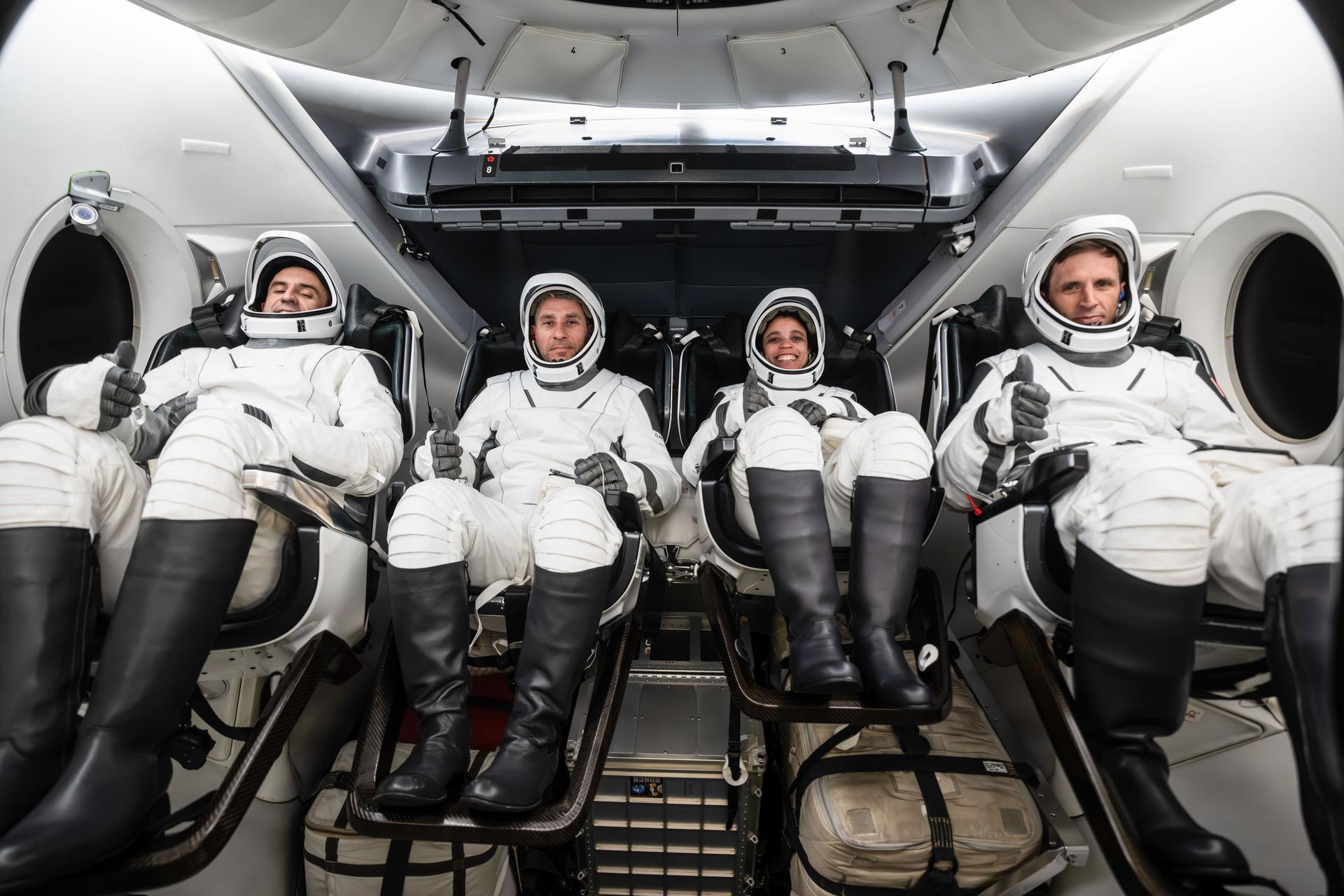
NASA’s SpaceX Crew-13 members are pictured in their pressure suits seated inside a mockup Dragon spacecraft during a preflight training session at the company’s headquarters in Hawthorne, California. From left are Roscosmos Sergey Teteryatnikov, NASA astronauts Luke Delaney and Jessica Watkins, and CSA (Canadian Space Agency) astronaut Joshua Kutryk.
Credit: SpaceX
NASA and its partners will discuss the upcoming crew rotation mission to the International Space Station during a pair of news conferences on Monday, Aug. 3, from the agency’s Johnson Space Center in Houston.
Mission leadership will provide an overview of NASA’s SpaceX Crew‑13 mission at 12 p.m. EDT. Next, crew members will discuss their training and mission preparations at 2 p.m. This is Crew-13’s final media availability prior to traveling to the agency’s Kennedy Space Center in Florida for launch.
NASA will stream these events live. Learn where to watch online:
The Crew-13 mission will carry NASA astronauts Jessica Watkins and Luke Delaney, CSA (Canadian Space Agency) astronaut Joshua Kutryk, and Roscosmos cosmonaut Sergey Teteryatnikov to the orbiting laboratory. The crew will launch aboard a SpaceX Dragon spacecraft on the company’s Falcon 9 rocket from Space Launch Complex 40 at Cape Canaveral Space Force Station in Florida no earlier than mid-September.
International media attending in person must email the NASA Johnson newsroom at jsccommu@mail.nasa.gov by 5 p.m., Tuesday, July 21. United States-based media attending in person must respond by 5 p.m., Thursday, July 30. Media joining virtually must respond by 10 a.m. the day of the event. NASA’s media accreditation policy is available online.
Briefing participants are as follows (all times Eastern and subject to change based on real-time operations):
12 p.m.: Mission Overview News Conference
Joel Montalbano, deputy associate administrator, Human Spaceflight Mission Directorate, NASA Headquarters
Dana Weigel, manager, Low Earth Orbit Program, NASA Johnson
Mathieu Caron, director, Astronauts, Life Sciences, and Space Medicine, CSA
Julianna Scheiman, director, NASA Science and Dragon Programs, SpaceX
Following the news conference, crew members will be available for limited media interviews. All interview requests must be submitted by 5 p.m. on July 30, to the NASA Johnson newsroom at: jsccommu@mail.nasa.gov.
This will be the second flight to the space station for Watkins, who was selected as a NASA astronaut in 2017. Watkins grew up in Lafayette, Colorado, and earned an undergraduate degree in geological and environmental sciences from Stanford University, as well as a doctorate in geology from the University of California, Los Angeles. As a geologist, she studied the Martian surface and was a member of the Curiosity rover science team at NASA’s Jet Propulsion Laboratory in Southern California. Watkins first launched to the space station as a crew member aboard NASA’s SpaceX Crew-4 mission, spending a total of 170 days in space across space station Expeditions 67/68 in 2022. She will be the first NASA astronaut to launch aboard a SpaceX Dragon spacecraft twice.
Selected as a NASA astronaut in 2021, Delaney earned a bachelor’s degree in mechanical engineering at the University of North Florida and a master’s degree in aerospace engineering at the Naval Postgraduate School. The Florida native is a distinguished naval aviator who participated in exercises throughout the Asia Pacific region and conducted missions in support of Operation Enduring Freedom. As a test pilot, Delaney evaluated developmental aircraft systems and served as a test pilot instructor. He also worked as a research pilot at NASA’s Langley Research Center in Hampton, Virginia, where he supported airborne science missions. This is the first spaceflight for Delaney.
The Crew-13 mission also is the first spaceflight for Kutryk. Prior to his selection as a CSA astronaut in 2017, he served as a CF-18 fighter pilot, flying missions in support of Canada’s NATO, U.N., and North American Aerospace Defense Command commitments. A native of Fort Saskatchewan, Alberta, Kutryk also worked as an experimental and operational test pilot at the Aerospace Engineering Test Establishment in Cold Lake, Alberta. Kutryk received a bachelor’s degree in mechanical engineering from the Royal Military College of Canada in Kingston, Ontario, and he is a distinguished graduate of the United States Air Force Test Pilot school in Edwards, California. He has master’s degrees in space studies, flight test engineering, and defense studies.
This mission will be Teteryatnikov’s first trip to the orbiting laboratory. He graduated from the Naval Academy, St. Petersburg, Russia, in 2011 as an engineer specializing in ship power plant operations. Before his selection as a test cosmonaut, Teteryatnikov served in various naval engineering roles, including undersea vessels and specialized engine room operations. He was selected for the Gagarin Research and Test Cosmonaut Training Center Cosmonaut Corps in 2021 and has served as a test cosmonaut since 2023.
The global smartphone market faced significant headwinds in the second quarter of 2026, with shipments slumping to the lowest Q2 level in 13 years due to a deepening memory chip crisis. According to Counterpoint Research, overall shipments declined sharply year-over-year. Yet Apple stood out as a bright spot, bucking the trend with resilient demand for its premium iPhone lineup.
Apple’s Strong Performance in a Challenging Market
Apple’s iPhone shipments grew by approximately 3% year-over-year in Q2 2026, even as the broader market contracted by around 11%. This growth propelled Apple to a record 20% global market share for the quarter. Key factors included:
• Sustained consumer demand for the iPhone 17 series and other premium models.
• Apple’s strategy of keeping prices stable despite rising component costs, unlike many competitors who faced pressure from the memory shortage.
• Strong performance in key regions, supported by promotions and trade-in programs.
This marks a notable achievement for Apple, highlighting the enduring appeal of its ecosystem and product quality in an environment where many Android vendors struggled with higher bill-of-materials costs and softer demand.
Top 5 Smartphone Brands Global Sell-in Shipment Share (Preliminary Data) Source: Counterpoint Research’s preliminary Market Monitor report (based on sell-in). Notes: OPPO includes OnePlus and realme. Percentage totals may not add up to 100% due to rounding.
Broader Market Context: The Memory Crisis Takes Its Toll
The memory chip shortage has ripple effects across the industry, leading vendors to adjust shipment plans and pass on higher costs. Global shipments hit multi-year lows for a Q2 period, reflecting cautious buying from both consumers and supply chains. While some brands saw sequential improvements through promotions (e.g., during China’s 618 festival), year-over-year declines dominated for most players.
Apple’s ability to maintain pricing power and grow shipments underscores its premium positioning, which has helped it capture higher revenue shares even in softer quarters.
What This Means for the Industry and Consumers
• For Apple: Hitting a record 20% share reinforces its leadership in the premium segment. With innovations like advanced AI features and consistent ecosystem updates, the company continues to attract loyal users and convert new ones, particularly in emerging markets.
• For Competitors: Brands reliant on mid-range and budget devices face tougher conditions. The memory crunch may lead to further consolidation or shifts toward value-oriented strategies.
• For Consumers: Expect continued pressure on prices in the short term, but Apple’s stable pricing offers a relative value proposition. Trade-ins and promotions could become even more important for upgrades.
MacDailyNews Take: As the memory crisis persists into late 2026 and potentially beyond, analysts will watch how Apple sustains its momentum—especially with the upcoming iPhone 18 cycle on the horizon. The company’s focus on software optimization, services growth, and selective hardware advancements positions it well to navigate challenges.
This Q2 result isn’t just a bright spot in a down market, it’s a testament to Apple’s strategic resilience. In an industry grappling with supply constraints, premium differentiation continues to pay off!
Please help support MacDailyNews — and enjoy subscriber-only articles, comments, chat, and more — by subscribing to our Substack: macdailynews.substack.com. Thank you!
Apple Watch Series 11, Apple Watch Ultra 3, and Apple Watch SE 3.
Global shipments of Edge AI-capable smartwatches experienced robust growth in the first quarter of 2026, with Apple maintaining overwhelming dominance in the emerging category of on-device AI wearables. According to Counterpoint Research, the Apple Watch accounted for the vast majority of these AI-enabled shipments, highlighting the company’s lead in integrating advanced intelligence directly into its devices.
Edge AI Reaches 25% Market Penetration with Strong Growth
Counterpoint Research reported that global Edge AI-capable smartwatch shipments grew by 70% year-over-year in Q1 2026, achieving a market penetration of 25%. One in every four smartwatches shipped during the quarter now features Edge AI capabilities, enabling local machine learning inference for improved speed, privacy, and efficiency.
Apple solely accounted for ~90% of Edge AI smartwatch shipments in Q1 2026. This dominance stems from its custom Neural Engine technology, which powers seamless on-device features such as Siri intent recognition, high-frequency sleep apnea monitoring, and advanced gesture detection without cloud dependency.
Health Monitoring Features Accelerate
The adoption of Edge AI aligns with rapid growth in advanced health capabilities. Shipments of smartwatches with blood pressure monitoring doubled, while those with sleep apnea detection tripled between Q1 2025 and Q1 2026. Key penetration shifts include:
• Blood pressure monitoring: rose from 11% to 23% of shipments
• Sleep apnea detection: increased from 5% to 18%
• ECG: grew from 31% to 34%
These developments reflect a broader industry move toward clinically relevant, real-time health insights powered by on-device AI.
Apple’s Overall Market Performance
Apple’s shipments grew 21% year-over-year, securing a 23% share of the total global smartwatch market. Counterpoint Principal Analyst Anshika Jain said in a statement: “Apple captured the highest shipment share and was the strongest performer in the quarter, helped by its refreshed lineup, meaningful health upgrades and the more affordable Apple Watch SE 3.”
Counterpoint’s Research Director Mohit Agrawal commented on the transition in Edge AI, “Edge AI in smartwatches is shifting from primarily a hardware integration to one that also includes software optimization. The real unlock is smaller, more efficient models and OS-level access that lets any app run inference locally. AI needs to turn from a single application into a personal layer that works on personal data. This enables instant health alerts, gesture control, and richer personalized experiences, and that is why Edge AI penetration is set to approach 32% in 2026.”
MacDailyNews Take: Counterpoint expects Edge AI penetration in smartwatches to near 32% by the end of 2026. As the category evolves from basic tracking to intelligent, personalized health and interaction tools, Apple’s integration of hardware, software, and privacy-focused AI continues to give it a substantial edge in the competitive wearable market.
Please help support MacDailyNews — and enjoy subscriber-only articles, comments, chat, and more — by subscribing to our Substack: macdailynews.substack.com. Thank you!
CISOs at government organizations and universities have an unexpected ally coming to their aid: OnlyFans models.
For some time, hackers have exploited weaknesses in the websites of universities or government departments to host scams or malware, using content stolen from the OnlyFans website as bait to attract victims.
Now, according to security researchers at Upguard, the fightback has begun: creators of adult content on OnlyFans are leveraging Google search results and the protection offered by copyright law to break up the traffic distribution systems created by bad actors.
These distribution systems work in three stages: entry points using adult or other content to attract and capture web traffic, a routing system sends it to destination sites, and those sites monetize the traffic through scams and malware. It has proved to be a lucrative business for the scammers.
Google recognizes the approach and calls such actors SEO parasites as they benefit from the reputations of other organizations — in particular government or academic sites, which Google views as having high authority.
Since the creators of OnlyFans content are also the copyright holders, they are able to issue Digital Millennium Copyright Act (DMCA) take-down notices for the stolen content posted by the bad actors to other sites. Upguard was able to track this through Google’s DMCA Transparency Report, and through the Lumen Database, another tracker of takedown notices, to which it was granted research access.
“This allows us to identify likely compromised sites: government and university domains advertising unlicensed adult content,” Upguard said.
The OnlyFans creators’ action has two benefits for the operators of the affected websites: The adult content associated with their domain disappears from Google search results, no longer affecting their reputation — and if they receive takedown notices for such content they can check their webservers for the vulnerabilities that enabled the bad actors to post it there in the first place.
NEW YORK — A study published last week in Nature Astronomy has proposed a new satellite design and technique to detect thermonuclear warheads in space. Funded in part by the […]
Keith Thomas can move arms and hands, and feel sensation of touch after ‘double neural bypass’ and months of training
A man who was paralysed from the chest down in a swimming accident six years ago has been able to feed himself and drink from a cup thanks to a brain implant that bypasses his spinal cord injury.
Keith Thomas of Massapequa, New York, could not lift his arms off his wheelchair when he agreed to trial the technology in 2021, but after surgery to implant electrodes in his brain and many months of training, he was able to move the limbs again.
Scientists hoped for years to make a machine that could emulate the movements of diving birds, such as puffins, and offer an affordable, unobtrusive way to monitor fragile marine ecosystems. A team of researchers at M.I.T. has been able to create such a waterproof winged robot, according to a study published July 9 in the journal Science.
It’s the first time a sugar molecule has been detected in interstellar space. The discovery provides tantalizing new clues into how life may have arisen on Earth.

 Login