❌

Normal view

CERN Provides Good News on Climate Change as Nature Proves Unexpectedly Resilient

26 June 2026 at 13:30

New climate change research conducted at CERN offers rare, hopeful news about the planet’s resilience to global warming, finding that phytoplankton are producing far more heat-mitigating aerosols than previously understood.

In a paper recently published in Nature, the researchers reveal an unexpected picture of how clouds and aerosols have changed since the beginning of widespread fossil fuel use, offering a brighter outlook than may have been expected. The new study identifies our planet’s resilience to anthropogenic climate change, suggesting that Mother Nature may be tougher than we think.

Cloud Formation and Climate Change

Cloud condensation nuclei (CCN), tiny particles suspended in the atmosphere, are the cores around which clouds form. When the amount of aerosol particles in the atmosphere increases, they can produce a cooling effect, both by directly reflecting sunlight before it reaches the Earth’s surface and by acting as CCNs. When the number of particles available in the atmosphere for cloud formation increases, more small clouds form, which are also brighter and provide greater coverage.

Ironically, the particles formed by burning fossil fuels act in this way, mitigating the heating effect of the greenhouse gases released by the same processes, and producing a substantial offset in global warming.

Nucleation, the spontaneous condensation of trace vapors, produces more than half of the CCN in Earth’s atmosphere. The burning of fossil fuels releases sulfur dioxide, which in turn creates sulfuric acid, the most important of these nucleating vapors.

Unexpected Consequences

As emission controls have reduced atmospheric sulfur dioxide, this has created a catch-22, according to the CERN researchers. These particles are detrimental to human health, increasing the risk of lung problems and even heart disease. However, by reducing their atmospheric concentrations, these interventions are projected to increase global warming as aerosol concentrations trend back toward pre-industrial levels.

“Most climate models currently consider only sulphuric acid-driven nucleation,” explained co-author Jasper Kirkby, of the CLOUD Collaboration. “However, it is vital to understand and properly account for biogenic sources to reliably predict the Earth’s future climate and air quality. Observations over the Southern Ocean and in the upper troposphere over the Atlantic and Pacific Oceans indicate that a major source of marine aerosol particles is unaccounted for by current models.”

The CLOUD survey may finally have landed on the identity of this mysterious source. About 20% of atmospheric sulfur comes from marine phytoplankton emitting dimethyl sulfide. As that dimethyl sulfide oxidizes in the atmosphere, it then produces sulfuric acid (SA) and methanesulphonic acid (MSA). While scientists have long understood SA’s role in new particle formation, MSA was poorly understood.

Climate Change Resistance

Through a series of experiments and computer modeling, the CLOUD collaboration discovered that at temperatures below -10 °C, MSA drives particle nucleation in the presence of ammonia just as well as SA, and at temperatures below +10 °C, it drives particle growth, even with minimal ammonia.

“Since MSA and SA generally coexist at similar concentrations in cool marine regions, our findings indicate that particle nucleation rates might be accelerated up to tenfold and growth rates up to twofold compared with sulphuric acid and ammonia alone,” Kirkby said. “Our model simulations indicate that MSA-driven new particle formation may account for the major missing source of marine aerosol particles in current models.”

This work provided important new knowledge to supplement CLOUD’s earlier work identifying large amounts of isoprene-driven new particle formation above tropical rainforests. Between identifying that activity over land and MSA’s newly understood marine CCN formation, CLOUD’s work suggests that the biosphere may be more resilient than previously understood, capable of creating those CCN without anthropogenic emissions to compensate for continuing global warming.

“The CLOUD Collaboration has made an important advance in our understanding of climate”, commented Gautier Hamel de Monchenault, CERN Director for Research and Computing, who was not an author on the study. “It is crucial to deepen our understanding of aerosols: in this case, increased biogenic CCN will affect estimates of the Earth’s climate sensitivity as well as projections of climate warming.”

The paper, “Role of Methanesulfonic Acid in Atmospheric Particle Nucleation and Growth,” appeared in Nature on June 24, 2026.

Ryan Whalen covers science and technology for The Debrief. He holds an MA in History and a Master of Library and Information Science with a certificate in Data Science. He can be contacted at ryan@thedebrief.org, and follow him on Twitter @mdntwvlf.

Featured Image: A Spiral Cloud in the Milky Way

22 June 2026 at 17:00

image of a multicolored nebula

The image above shows a newly discovered molecular cloud. This cloud was discovered through the Milky Way Imaging Scroll Painting project, which uses a 13.7-meter millimeter telescope to survey molecular clouds in our galaxy. Xuepeng Chen (Purple Mountain Observatory; University of Science and Technology of China) and collaborators came upon this cloud in survey data from a region of the Milky Way opposite the galactic center. The newfound cloud is roughly 5,400 light-years away, spans an area of 245 by 294 light-years, and contains an estimated 80,000 solar masses. The most remarkable feature of the cloud is its structure: it appears to have a central cavity, an elliptical disk-like body, and spiral arms. Chen’s team has suggested that the cloud owes its surprising structure to density wave theory — the same process thought to govern the formation of spiral arms in galaxies — but other possibilities such as collisions between molecular clouds can’t yet be ruled out. To learn more about the properties of this unusual molecular cloud, be sure to check out the full research article linked below.

Citation

“Discovery of a Giant Spiral Molecular Cloud in the Galactic Anticenter,” Xuepeng Chen et al 2026 AJ 172 4. doi:10.3847/1538-3881/ae6800

The post Featured Image: A Spiral Cloud in the Milky Way appeared first on AAS Nova.

Detecting New Icy Molecules Around a Newly Forming Star with JWST

31 March 2026 at 17:00

Large Magellanic Cloud

Editor’s Note: Astrobites is a graduate-student-run organization that digests astrophysical literature for undergraduate students. As part of the partnership between the AAS and astrobites, we occasionally repost astrobites content here at AAS Nova. We hope you enjoy this post from astrobites; the original can be viewed at astrobites.org.

Title: Protostars at Subsolar Metallicity: First Detection of Large Solid-State Complex Organic Molecules in the Large Magellanic Cloud
Authors: Marta Sewiło et al.
First Author’s Institution: NASA Goddard Space Flight Center
Status: Published in ApJL

Stars and planets form when clouds of molecules collapse in on themselves due to the overwhelming force of gravity (which, relatable). This process is quite mysterious, as these clouds will only live for a couple million years before collapsing, and the newly forming protostars only live for about half a million years before becoming main-sequence stars.

But we are able to find some protostars in the Milky Way and in the Small and Large Magellanic Clouds near us, and observing the molecules around these protostars can help us understand how protostars form.

To look for molecules around protostars, astronomers take spectra of the protostars in the infrared, which is a wavelength region where molecules emit a lot of light. As better instruments are being built, astronomers are more often able to look for what are called complex organic molecules, which are carbon-bearing molecules with at least six atoms.

These complex organic molecules can be detected in different states: most detections have been of gaseous molecules in and around protostars or planet-forming disks, but they can also be found in a solid state on the surfaces of dust grains in the interstellar medium in a galaxy. In this state, they are called complex organic molecule “ices.” These “ices” were rarely found pre-JWST, but since its launch, detections have been more numerous, mainly in the Milky Way. Observing these complex molecules on the surfaces of dust grains tells us more about protostellar dust chemistry, which is an important but still mysterious aspect of star formation.

In this study, researchers look outside of our own galaxy to explore the complex organic molecules in the Large Magellanic Cloud (LMC). The LMC is an interesting place to look for these molecules because it has lower metal content (i.e., elements heavier than hydrogen and helium) than the Milky Way, as well as a harder radiation field. This means photons flying around in the LMC generally have higher energies than photons flying around in the Milky Way, and elements like carbon, oxygen, and nitrogen are less abundant. This is important because these conditions are more similar to what typical galaxies were like in the early universe. Thus the LMC is a better test bed to look at protostars than the Milky Way if we want to understand how stars formed in the early universe.

The authors of this study have found signatures of complex organic molecules in protostars forming in the LMC. They focus on the protostar ST6 in the LMC, shown in the right image in Figure 1. They used JWST’s Mid-Infrared Instrument to take spectra of the region around ST6.

Large Magellanic Cloud and N158

Figure 1: The LMC (left) and a zoomed-in view of region N158 (right) containing protostar ST6, the focus of this study. In the inset panel of the right picture, contours of carbon monoxide emission are shown. [Sewiło et al. 2025]

Spectroscopic Signatures of Molecules on Dust Grains

The researchers used the Python tool called dEcompositioN of Infrared Ice features using Genetic Modelling Algorithms (ENIIGMA) to fit the spectroscopy. This code compares the spectra to laboratory data of these complex organic molecules at the temperatures we see in the LMC. The authors fit for complex organic molecules they might expect to see, and they detect methanol (CH3OH), acetaldehyde (CH3CHO), ethanol (CH3CH2OH), methyl formate (HCOOCH3), and acetic acid (CH3COOH); of these, acetaldehyde, ethanol, and methyl formate have never before been detected outside of the Milky Way. Interestingly, this is the first time acetic acid has been definitively detected in any astrophysical environment. The spectral contribution from each molecule is shown in Figure 2; all the individual contributions added together make up the observed spectrum.

spectrum of the protostar ST6

Figure 2: Model fits to the spectrum of the protostar ST6 using the code ENIIGMA. Molecules and their fitted emission are given in the legend. [Sewiło et al. 2025]

These detections provide evidence that these complex organic molecules can be produced on the surfaces of dust grains. Further, their detection in the LMC provides evidence that these molecules can be produced in “harsh” environments like the LMC, with lower metal content and harder radiation fields.

When the authors compared the abundances of these ices to other protostars in the Milky Way galaxy, they found that the abundances are slightly lower around the LMC protostar. This may happen because the dust temperatures are generally higher in the LMC due to the higher-energy photons, which affect the chemistry happening on the dust. Some species they found, however, do have similar abundances to the Milky Way protostars, indicating that the harder radiation field of the LMC does not affect how these species form. Finding more complex organic molecules in the Magellanic Clouds will help us understand further how these compounds form on dust grains and how the galactic environment may affect their formation.

Original astrobite edited by Shalini Kurinchi-Vendhan.

About the author, Caroline von Raesfeld:

I’m a third-year PhD student at Northwestern University. My research explores how we can better understand high-redshift galaxy spectra using observations and modeling. In my free time, I love to read, write, and learn about history.

The post Detecting New Icy Molecules Around a Newly Forming Star with JWST appeared first on AAS Nova.

Disrupted Dwarf Galaxy: Investigating the History of the Small Magellanic Cloud

16 March 2026 at 16:00

Small Magellanic Cloud

Researchers show that the highly disrupted state of the Small Magellanic Cloud can be attributed to a long history of interactions with its neighbor, the Large Magellanic Cloud.

A Disrupted Dwarf Galaxy?

The Small Magellanic Cloud (SMC) is one of the largest and nearest satellites of the Milky Way. At a distance of just 200,000 light-years, the SMC has long been used as an accessible analog for low-metallicity star-forming galaxies in the early universe.

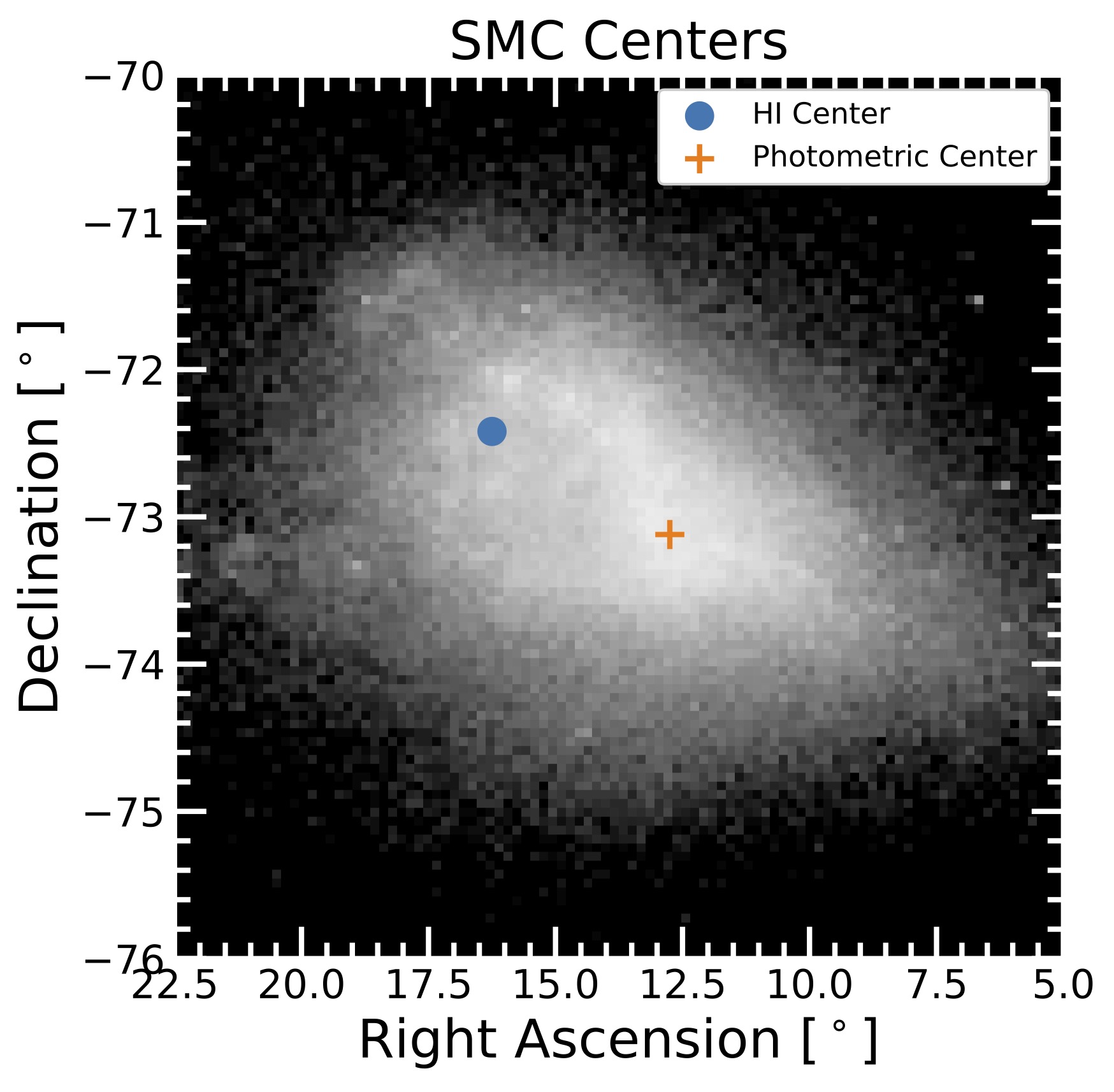
Small Magellanic Cloud photometric and HI kinematic centers

Locations of the SMC’s photometric center and hydrogen gas kinematic center. The two locations are separated by several thousand light-years. [Adapted from Rathore et al. 2026]

However, observations increasingly suggest that the SMC may not be an ideal analog for high-redshift galaxies. The SMC appears to have been disrupted: its gas seems to rotate while its stars do not, it has an unusually large line-of-sight depth compared to its extent on the sky, and its gas distribution has two peaks.

The source of this disequilibrium might be the Milky Way’s largest satellite, the Large Magellanic Cloud (LMC). As the SMC inches along its orbit around the Milky Way, it also engages in a gravitational dance with the LMC. These galaxies may be clumsy dance partners, with data suggesting a potential direct collision between the SMC and LMC within the past 200 million years.

Modeling the Magellanic Clouds

To understand how a potential collision between the Magellanic Clouds might have impacted the present-day properties of the SMC, Himansh Rathore (University of Arizona) and collaborators used hydrodynamical simulations to explore the interconnected histories of the SMC, the LMC, and the Milky Way.

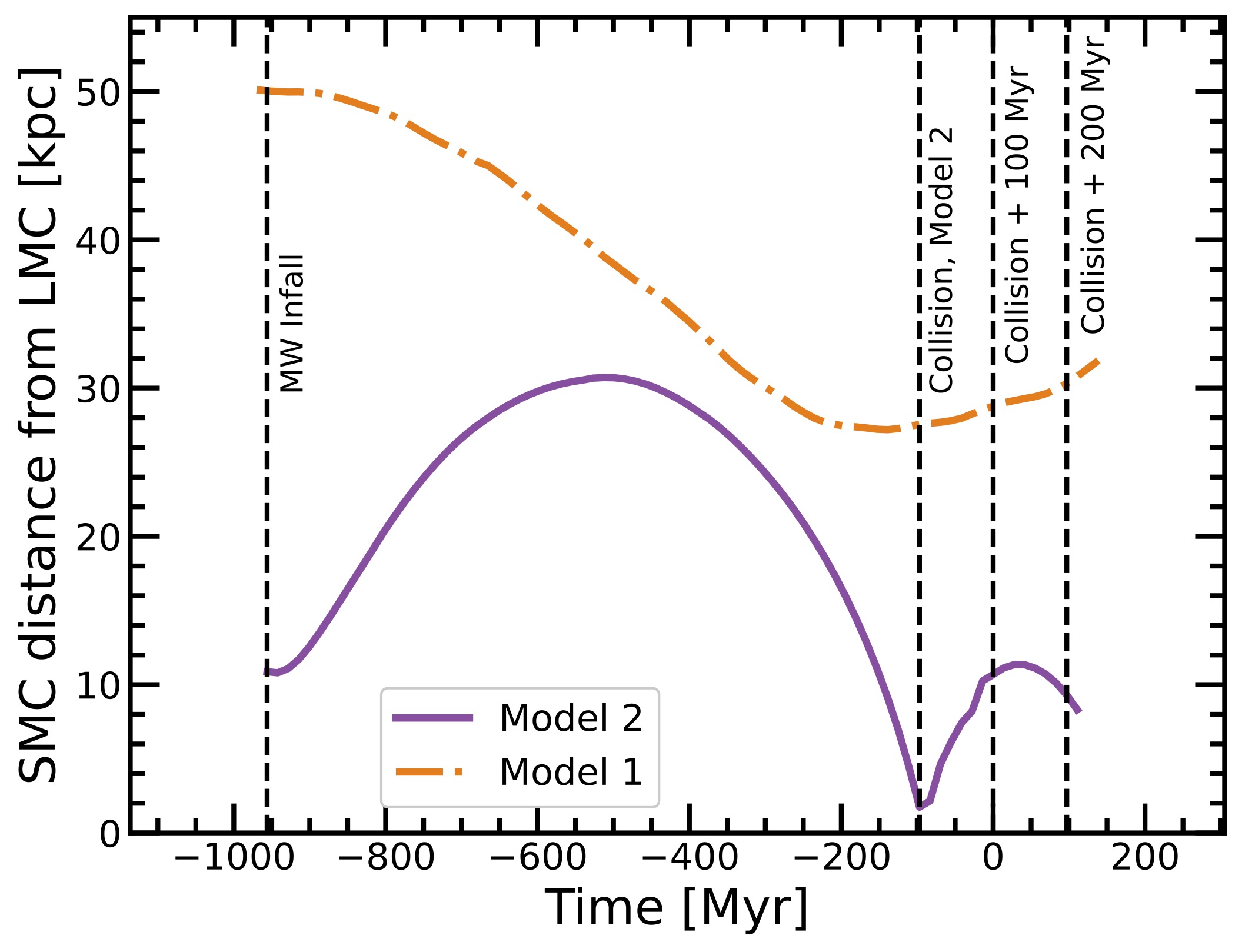
SMC–LMC separation in the authors' models

SMC–LMC separation over time in the control model (orange dot-dashed line) and the collision model (purple solid line). Click to enlarge. [Rathore et al. 2026]

At the beginning of the simulations, the SMC is in equilibrium, with its stellar and gaseous components neatly rotating in unison. From there, its fate diverged: in a control simulation, the SMC and LMC maintained a respectful distance, never getting less than about 100,000 light-years from one another. In the collision simulation, the galaxies collided 100 million years ago.

Both of these model scenarios reproduced certain features of the SMC–LMC system, such as the bridge of gas that spans the distance between them. Only the collision scenario, though, can explain the apparent discrepancy between the SMC’s stars and gas.

An Impactful Collision

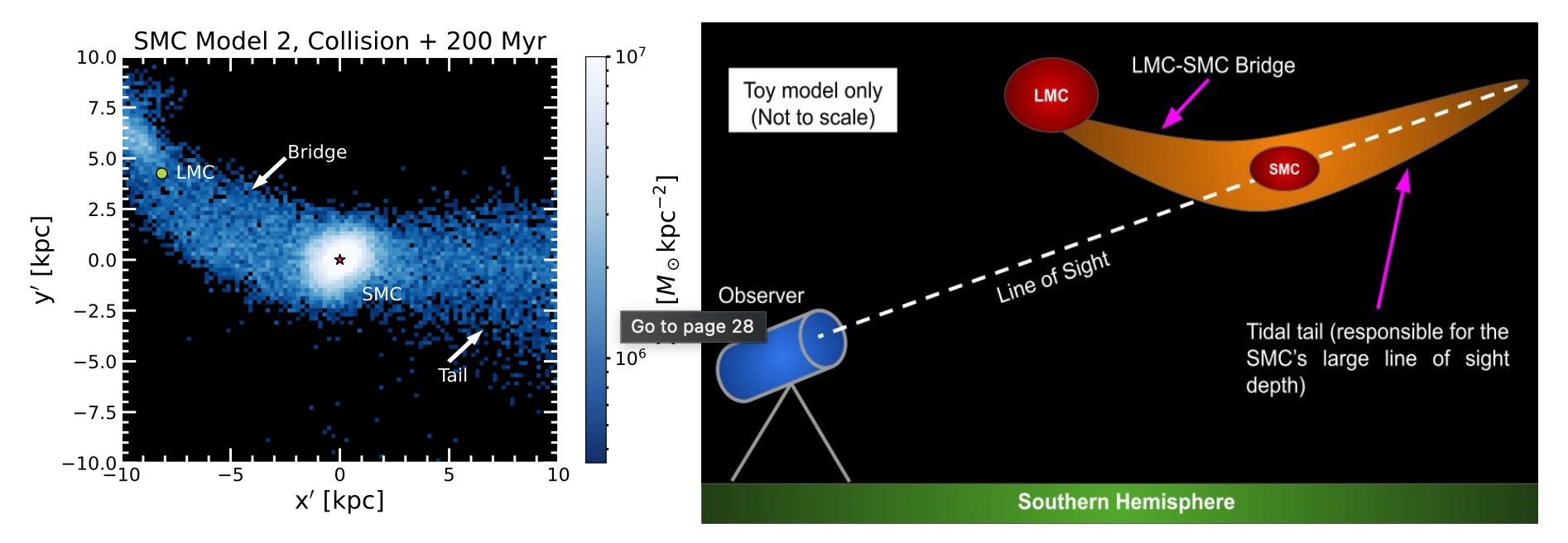
SMC stellar density and viewing schematic

Left: Simulated stellar density 200 million years post-collision. Right: A schematic of our likely perspective on the post-collision SMC–LMC system. Click to enlarge. [Rathore et al. 2026]

Post-collision, the SMC’s stellar population is significantly elongated and features a tidal tail. If this tidal tail is oriented along our line of sight, it would explain why the galaxy’s depth in that direction is unexpectedly large. The presence of a gas tidal tail may also help to explain the two peaks in the galaxy’s gas density.

In terms of the galaxy’s rotation, only the stars nearest the SMC’s center rotate, while the rest move radially outward, swayed by the tidal pull of the LMC. This radial motion is also present in the galaxy’s gas. While previous work has interpreted the observed velocity dispersion of the SMC’s gas as a sign of rotation, Rathore’s team showed that radial expansion, viewed from an inclined angle, can mimic a rotational signature. 

The team also showed that the gas is far more disturbed than the stars, reflecting the pressure exerted by the LMC’s gas when the two galaxies collided. This type of interaction can transform an irregular dwarf galaxy into an ellipsoidal or spheroidal dwarf galaxy — a transition that Rathore’s team argues is underway for the SMC.

Ultimately, these simulations demonstrate that the SMC is a profoundly disrupted galaxy, likely still reeling from a recent collision with its larger neighbor. Viewing the SMC through this lens is critical to understanding its role as an analog to early universe galaxies.

Citation

“A Galactic Transformation — Understanding the SMC’s Structural and Kinematic Disequilibrium,” Himansh Rathore et al 2026 ApJ 1000 50. doi:10.3847/1538-4357/ae4507 

The post Disrupted Dwarf Galaxy: Investigating the History of the Small Magellanic Cloud appeared first on AAS Nova.

Clouds Confuse Climate Cult Catastrophe Claims

1 August 2024 at 02:41
Water vapour and clouds are very important in regulating Earth’s temperature and supporting life. I question why the Climate Cult's focus is primarily on carbon dioxide. I emphasize the role of the essential molecules in the planet’s design and climate regulation.

UArizona Team Creates Instrument to Study Invisible Clouds that Warm Earth

29 November 2021 at 10:16

UArizona Team Creates Instrument to Study Invisible Clouds that Warm Earth The doctoral student leading the project ushered the instrument from concept to launch into near space. The instrument will eventually be deployed onboard a NASA CubeSat to monitor invisible clouds. Mikayla Mace Kelley Today University Communications IMG_1250.jpeg Kira Hart Shanks’ instrument takes it first […]

The post UArizona Team Creates Instrument to Study Invisible Clouds that Warm Earth appeared first on Science Bulletin.

❌