Billions of years ago, an hours-long Martian sandstorm blew so intensely that sand ripples began to climb upon one another as they moved across the surface. These layers of sediment eventually hardened into the multilayered rocks seen in this image, which was taken by NASA’s Curiosity rover on Dec. 12, 2024, the 4,391st Martian day, or sol, of the mission.
Scientists believe this is the first evidence of climbing wind ripple strata on the Red Planet. Spotted at a location nicknamed “Jawbone Canyon,” these rocks are a rare time capsule preserving a dramatic wind event early in Martian history. A paper detailing the discovery was featured on the cover of the journal Geology on July 1, 2026.
This orbital map shows the path NASA’s Perseverance Mars rover took to get to a location the science team has dubbed the “Broom Point member,” a sequence of layered bedrock likely more than 3.9 billion years old. As planned, the rover landed inside Jezero Crater on Feb. 18, 2021. It investigated the crater’s western delta and inlet river valley, Neretva Vallis, before summiting the crater rim in December 2024 following a rim-to-crest climb of 2,620 feet (800 meters).
The Broom Point region is situated on the outer edge of the crater rim and was visited by the rover in mid-2025. The yellow dot indicates location where the rover took a selfie.
NASA’s Jet Propulsion Laboratory, which is managed for the agency by Caltech in Pasadena, California, built and manages operations of the Perseverance rover. Arizona State University leads the operations of the Mastcam-Z instrument, working in collaboration with Malin Space Science Systems in San Diego, on the design, fabrication, testing, and operation of the cameras, and in collaboration with the Niels Bohr Institute of the University of Copenhagen on the design, fabrication, and testing of the calibration targets.
JPL manages the Mars Reconnaissance Orbiter for NASA’s Science Mission Directorate in Washington as part of NASA’s Mars Exploration Program portfolio. Lockheed Martin Space in Denver built MRO and supports its operations. The University of Arizona, in Tucson, operates HiRISE, which was built by Ball Aerospace & Technologies Corp., in Boulder, Colorado.
A 2,600-year-old discovery in China has revealed an archaeological enigma: why were dozens of bronze artifacts within an ancient tomb scattered and broken at the time of their placement?
The discoveries, made within the Zaoshulin Cemetery, a major archaeological site in Suizhou City, Hubei province, China, included several bronze bells that were dispersed throughout the lord’s final resting place, following the destruction of their wooden hanging components.
Now archaeologists think the unusual discovery wasn’t an accident, but instead could be evidence of the “deactivation” of these ancient objects as part of a widespread ritual phenomenon from the ancient world.
For Whom the Bells Toll
Archaeologist Chinglong Tse, who is presently a Ph.D. candidate at the University College London’s Institute of Archaeology, says the bells found within the tomb were more than just instruments used to create sonorous ringing: they were the implements of a world filled with belief in spirits of our ancestors and other supernatural presences.
“If archaeologists treat objects as tools, they risk projecting the image of a modern, rational, secular man onto the past,” Tse recently said of the discoveries, which he details in a new study featured in the Cambridge Archaeological Journal.
The bells, according to Tse, were likely crafted sometime in the early to mid 600s B.C., when Lord Qiu of the Zeng state commissioned them as implements for summoning the strength of his ancestors in combating an enemy state in the region. During Qiu’s time, known as the Spring and Autumn period, rival states in China’s Zhou dynasty waged war for power over the region, and the period is recognized as one of early China’s most turbulent.
The collection of bronze artifacts uncovered in Lord Qiu’s tomb comprise two sets of ornate bells, which archaeologists say were “deactivated” at the time of their entombment with the powerful State leader’s remains (Image Credit: Cambridge Archaeological Journal (2026). DOI: 10.1017/s0959774326100651)
Before the ancient Chinese lord’s death, peace was achieved between the Zeng state and its enemies in the state of Chu. As an act of ritual to prepare Lord Qiu’s changing role in the afterlife, the dismantling of the bells was a means of “deactivating” them, as their purpose had already been fulfilled.
With their powerful supernatural effects disabled, Lord Qiu’s own path into the afterlife to join his ancestors was prepared for.
The Dragon Bells of Lord Qiu
Qiu commissioned the crafting of these bronze bells as a charm to aid him during the period of unrest during which he reigned. The bells are magnificent artifacts, decorated in stylized dragons and featuring gemstones inlaid on their surfaces alongside inscriptions praising Qiu’s ancestors, all aimed at ensuring the protection of the Zeng territory.
According to history, Qiu would eventually wed the sister of the King of Chu, ending the rivalry between states, and thereby making these specially crafted bronze artifacts obsolete. Upon his death, the bells were intentionally “deactivated” with their wooden components removed, and the bells were scattered within Qiu’s tomb to prevent their intended function from carrying on into the afterlife.
Artifacts that Tell Stories
Appearing nearby within the tomb were a newer set of simpler bronze bells, which were neatly stacked and facing toward the southeast, bearing inscriptions that indicate their intended role had been for the afterlife, rather than to aid during times of regional conflict during Qiu’s lifetime.
“We still know very little about how bronze bells were produced in the Zeng state,” says Tse, adding that archaeologists may be able to discern a significant amount of information about the beliefs and capabilities of the people who lived during Qiu’s time if deeper knowledge about the bronze bells they constructed could be gleaned.
Fundamentally, Tse argues that while it is tempting to project a materialist, utilitarian mindset onto such ancient artifacts, doing so risks misunderstanding their actual purpose and their relationship to the worldview and belief systems of their ancient creators.
In that sense, the curious collection of dragon bells within lord Qiu’s tomb is more than merely artifacts—they are part of an ancient story of conflict, peace, and traditional views on the afterlife in the world of ancient China.
Tse’s findings were recently published in a study, “The Bells Are Harmonious and Resonant’: Numinous Ancestors, Resonant Bells and the Personhood of Lord Qiu of Zeng in Tomb M190 at Zaoshulin, Hubei,” which appeared in the Cambridge Archaeological Journal.
Micah Hanks is the Editor-in-Chief and Co-Founder of The Debrief. A longtime reporter on science, defense, and technology with a focus on space and astronomy, he can be reached atmicah@thedebrief.org. Follow him on X @MicahHanks, and at micahhanks.com.
Desert Field Test With NASA Advanced Rover Prototype
PIA26701
Credits: NASA/JPL-Caltech
Downloads
Desert Field Test With NASA Advanced Rover Prototype
PNG (27.94 MB)
PIA26701 Figure A
JPEG (26.03 MB)
PIA26701 Figure B
JPEG (951.75 KB)
PIA26701 Figure C
JPEG (16.03 MB)
PIA26701 Figure D
JPEG (16.46 MB)
Description
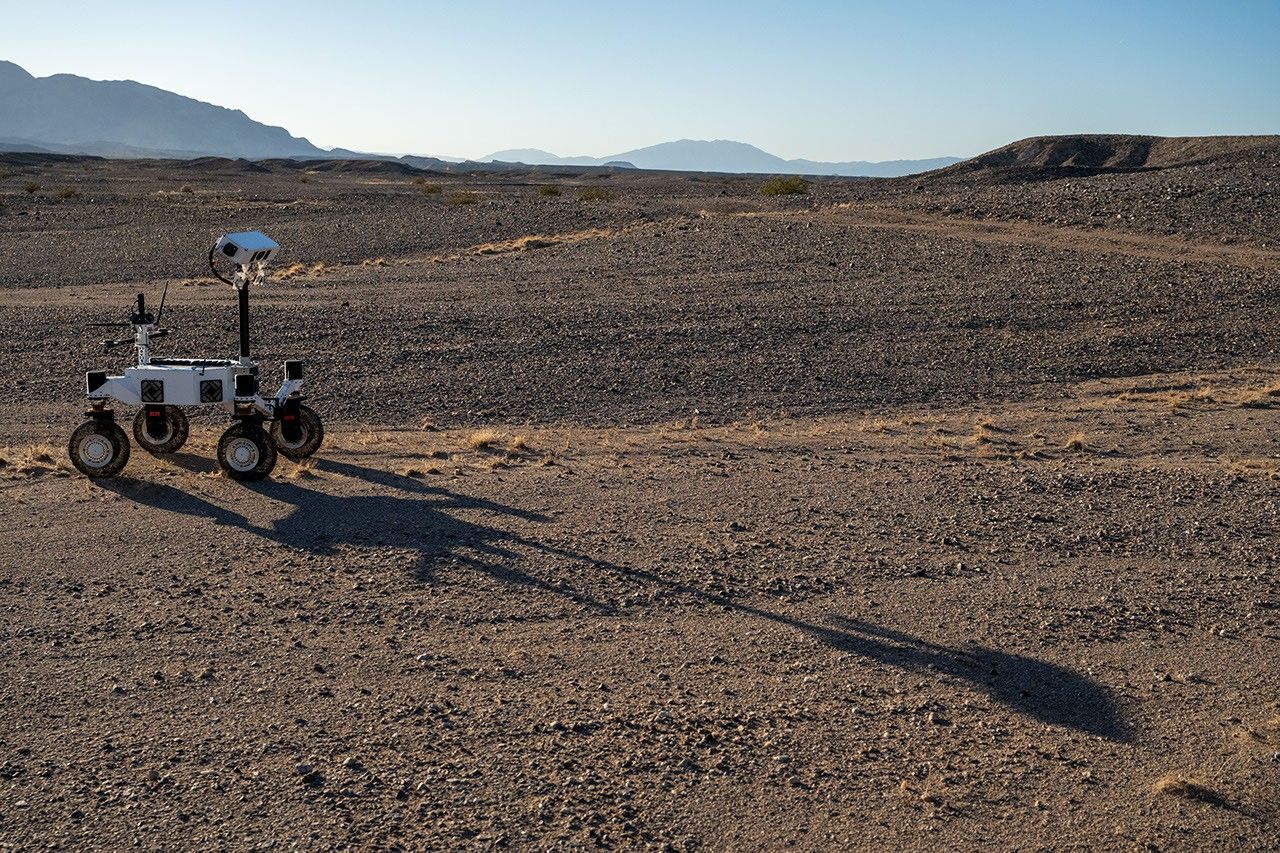
A prototype four-wheel rover developed at NASA’s Jet Propulsion Laboratory with advanced mobility and robotic autonomy capabilities trundled across the Colorado Desert near Plaster City, California, during a field test in March 2026. Called ERNEST (Exploration Rover for Navigating Extreme Sloped Terrain), the rover served here as a testbed for autonomy software developed for a potential lunar mission requiring higher speeds and much greater mileage than can be achieved with current planetary rovers.
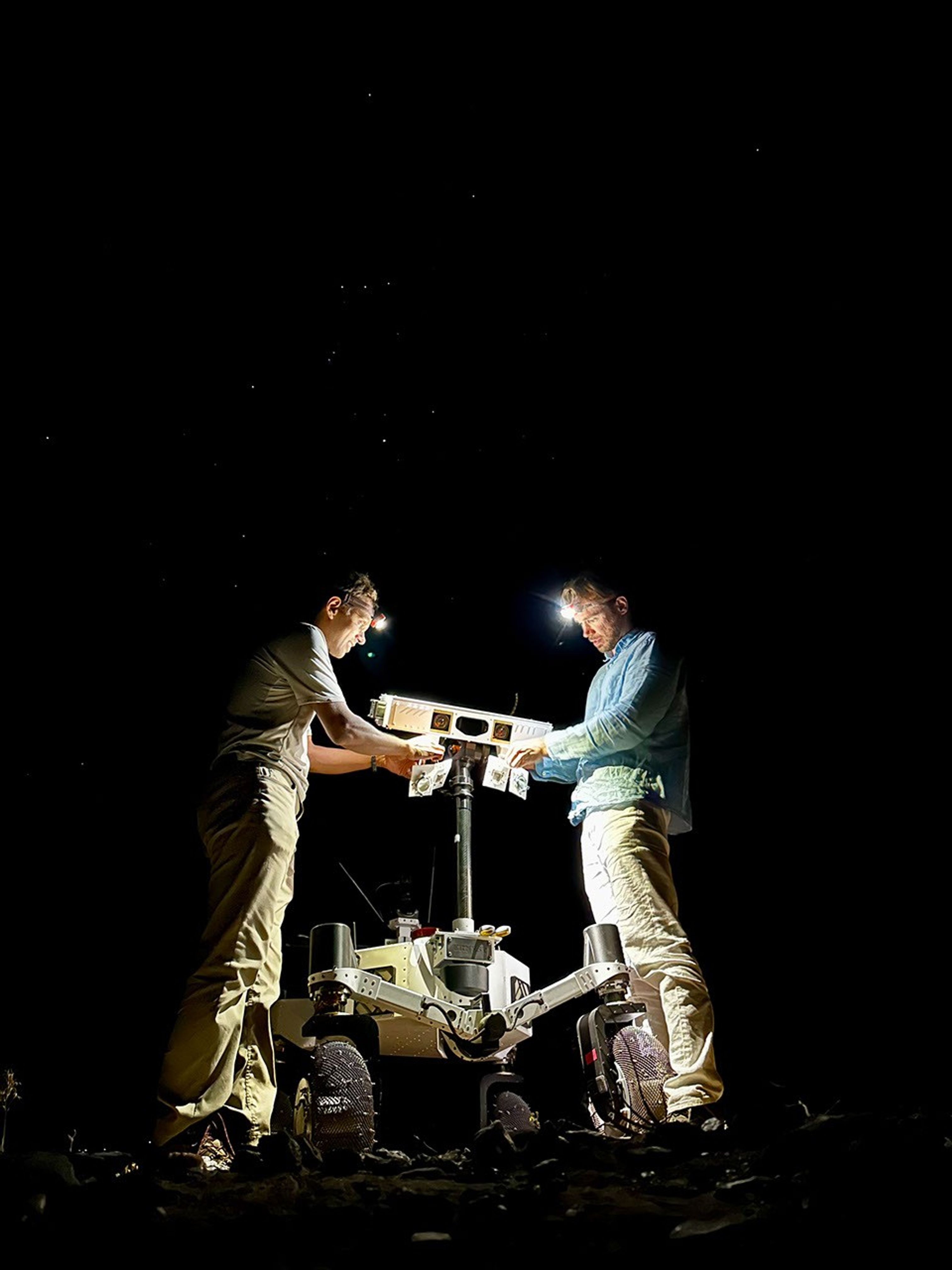
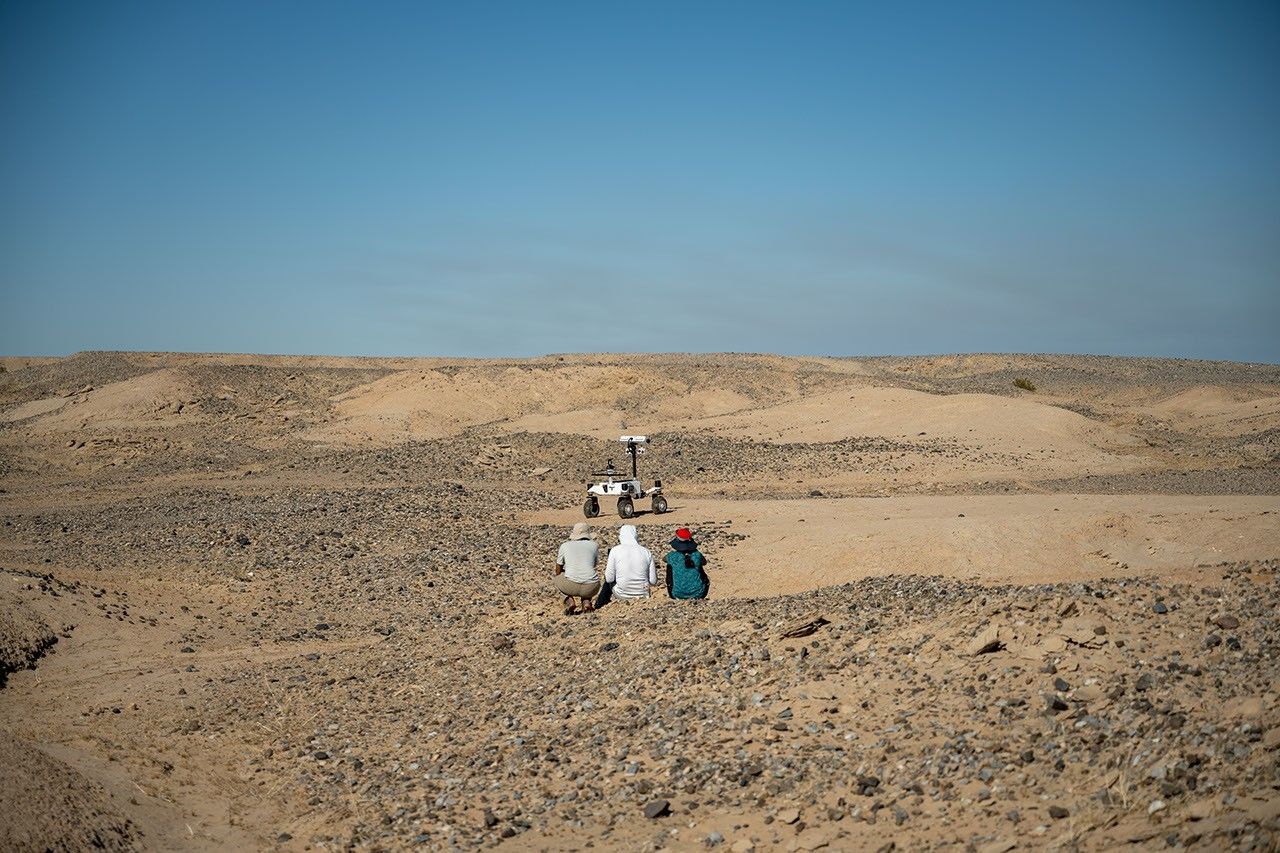
ERNEST was trailed by engineers as it traveled about 16 miles over the course of 37 hours of drive time. That’s more than 10 times the speed at which NASA’s Perseverance rover can navigate on Mars. The team also tested how well the rover traveled at dusk, dawn, and nighttime to simulate the experience of large terrain shadows in polar regions on the Moon.
Figure A
Figure A shows the rover traveling toward its shadow.
Figure B
Figure B shows two team members setting up illuminators on the rover at night.
Figure C
Figure C shows three team members observing the rover during its long-range traverse.
Figure D
Figure D shows the rover with one wheel up on a rock.
Work on ERNEST began in 2022 and was initially supported by JPL internal research and development funds. It is currently funded by NASA’s Mars Exploration Program and the agency’s Exploration Science Strategy Integration Office under its Science Mission Directorate in Washington. Caltech in Pasadena, California, manages JPL for NASA.
Astronaut Jessica Meir Assists With Hardware Updates for NASA’s Cold Atom Lab
PIA26725
Credits: NASA
Downloads
Astronaut Jessica Meir Assists With Hardware Updates for NASA’s Cold Atom Lab
JPEG (4.91 MB)
Description
NASA astronaut Jessica Meir inspects optical fibers while installing hardware updates to the agency’s Cold Atom Lab, or CAL, aboard the International Space Station on May 8, 2026.
About the size of a minifridge and operated from Earth, CAL chills atoms to temperatures below minus 459 degrees Fahrenheit (minus 273.15 degrees Celsius), so close to absolute zero that they form a large quantum object called a Bose-Einstein condensate (BEC) — a fifth state of matter distinct from solids, liquids, gases, and plasma. In a BEC, scientists can observe the quantum properties of atoms at a scale visible to the naked eye. For instance, atoms and particles sometimes behave like solid objects and sometimes behave like waves, a quantum property called “wave-particle duality.”
Managed by Caltech in Pasadena, NASA’s Jet Propulsion Laboratory designed, built, and operates Cold Atom Lab, which is sponsored by the Biological and Physical Sciences (BPS) division of NASA’s Science Mission Directorate at the agency’s headquarters in Washington. The BPS division pioneers scientific discovery and enables exploration by using space environments to conduct investigations that are not possible on Earth. Studying biological and physical phenomena under extreme conditions allows researchers to advance the fundamental scientific knowledge required to go farther and stay longer in space, while also benefiting life on Earth.
Astronaut Jessica Meir Assists With Hardware Updates for NASA’s Cold Atom Lab
PIA26725
Credits: NASA
Downloads
Astronaut Jessica Meir Assists With Hardware Updates for NASA’s Cold Atom Lab
JPEG (4.91 MB)
Description
NASA astronaut Jessica Meir inspects optical fibers while installing hardware updates to the agency’s Cold Atom Lab, or CAL, aboard the International Space Station on May 8, 2026.
About the size of a minifridge and operated from Earth, CAL chills atoms to temperatures below minus 459 degrees Fahrenheit (minus 273.15 degrees Celsius), so close to absolute zero that they form a large quantum object called a Bose-Einstein condensate (BEC) — a fifth state of matter distinct from solids, liquids, gases, and plasma. In a BEC, scientists can observe the quantum properties of atoms at a scale visible to the naked eye. For instance, atoms and particles sometimes behave like solid objects and sometimes behave like waves, a quantum property called “wave-particle duality.”
Managed by Caltech in Pasadena, NASA’s Jet Propulsion Laboratory designed, built, and operates Cold Atom Lab, which is sponsored by the Biological and Physical Sciences (BPS) division of NASA’s Science Mission Directorate at the agency’s headquarters in Washington. The BPS division pioneers scientific discovery and enables exploration by using space environments to conduct investigations that are not possible on Earth. Studying biological and physical phenomena under extreme conditions allows researchers to advance the fundamental scientific knowledge required to go farther and stay longer in space, while also benefiting life on Earth.
One of the three satellites that make up NASA’s INCUS (Investigation of Convective Updrafts) mission sits on a fixture at the facilities of Blue Canyon Technologies in Lafayette, Colorado. The satellite completed testing in preparation for launch in late May 2026. The mission will make the first space-based survey of the dynamics of tropical convective storms.
The three nearly identical satellites will fly in tight coordination in low Earth orbit, with the first and second satellites separated by 30 seconds, and the second and third satellite separated by 90 seconds.
Each satellites carries a radar designed to observe the vertical motion of air and water — known as convective mass flux — as storms develop and evolve. The middle satellite will also carry a microwave radiometer.
The INCUS mission is set to launch in 2027 from NASA’s Wallops Flight Facility in Virginia.
Funded through the Earth Venture Mission-3 acquisition under NASA’s Earth System Science Pathfinder Program and led by principal investigator Sue van den Heever at Colorado State University in Fort Collins, INCUS is one of several missions fulfilling the clouds, convection, and precipitation requirements of NASA’s Earth System Observatory, a set of interconnected missions set to study our home planet’s dynamic natural systems and how they interact. The mission is also part of FALCON (Fleet for the Atmosphere Linking Commercial Observations with NASA), a fleet of atmosphere-observing satellites that will combine hardware contributions from NASA centers, universities, and commercial partners.

 Login