❌

Normal view

Acapulco Leads Imagen Awards With 13 Nominations

By: Jack
17 July 2026 at 21:31

Acapulco Imagen Awards recognition has given Apple TV’s bilingual comedy one more victory after its fourth and final season. The series leads the 41st Annual Imagen Awards with 13 nominations, placing its cast, directors, music team and production among the year’s most celebrated examples of Latino creative work.

The Imagen Foundation announced the nominations Thursday as part of its annual program recognizing Latino talent and representation across film, television, music, documentaries and digital media. Acapulco received more nominations than any other series, including recognition for Best Comedy Series and multiple acting and directing performances.

The awards organization also announced that actor, filmmaker, producer and musician Andy Garcia will receive its Lifetime Achievement Award. Garcia is separately nominated for his supporting performance in Landman, giving the ceremony another connection between a career-spanning honor and current screen work.

For Apple TV, the nominations extend the life of a series that completed its run in September 2025. Acapulco may have checked out of Las Colinas, but the Imagen Awards are giving the resort one more crowded week.

Acapulco Imagen Awards Reach Across the Production

The 13 nominations show how widely the Imagen Foundation recognized the series rather than concentrating only on its lead actors.

Acapulco is nominated for Best Comedy Series, while Oscar Almengor and Santiago Limón both received Best Director nominations. Javier Nuño and Joe Rodríguez were recognized for Best Music Supervision for Film or Television.

Enrique Arrizon and Camila Perez are both nominated in the Best Actor — Comedy category. Although the category name uses “Actor,” the Imagen Foundation placed performers of different genders together in the 2026 comedy field.

The supporting categories gave Acapulco an especially strong presence. Eugenio Derbez, Fernando Carsa, Carlos Corona and Cristo Fernández received Best Supporting Actor — Comedy nominations. Vanessa Bauche and Keyla Monterroso Mejia are nominated for Best Supporting Actress — Comedy.

That distribution reflects the ensemble structure that allowed Acapulco to run for four seasons. The series used Máximo Gallardo’s memories as its entry point, but Las Colinas worked because the hotel was filled with characters whose ambitions, friendships and disasters could carry stories of their own.

The show’s visual identity often received attention first. Its bright colors, resort setting and polished 1980s design made it easy to recognize within seconds. The Imagen nominations reach beyond that appearance and recognize the performances, direction and music that gave the setting its emotional rhythm.

Samantha Orozco and Enrique Arrizon in Acapulco
Image Credit: Apple Inc.

A Final Season That Kept the Ensemble Moving

The fourth season returned to Las Colinas with two connected timelines. In the present day, Máximo worked to restore the hotel before its reopening. In 1986, his younger self tried to protect Las Colinas after a competing resort claimed the top position in Acapulco’s annual hotel rankings.

That structure allowed the series to close the distance between the ambitious young employee played by Arrizon and the successful older man played by Derbez. The final episodes had to complete character relationships, resolve the hotel’s future and explain how youthful choices shaped the life Máximo later built.

The Imagen nominations suggest the final season avoided becoming a farewell built only around nostalgia. Its actors remained competitive across several categories, and both nominated directors received recognition for guiding individual parts of the closing chapter.

Acapulco also maintained its bilingual identity throughout the run. English and Spanish were not treated as occasional flavor or a translation exercise. They reflected the characters, workplace and cultural setting. That helped the series reach an international audience without removing the Mexican identity at its center.

For Apple TV, that combination provided a comedy that could travel globally while remaining tied to a specific place and community.

Apple TV Earns Recognition Beyond One Series

Acapulco delivered Apple TV’s largest Imagen Awards presence, but it was not the service’s only nominated production.

Pluribus received a nomination for Best Drama Series, while Carlos-Manuel Vesga was nominated for Best Supporting Actor — Drama. The Morning Show earned nominations for director Miguel Arteta and supporting actor Nestor Carbonell.

Peter Dager of Stick joined Carbonell in the supporting comedy category, while Mariana Treviño received a Best Supporting Actress — Comedy nomination for the same series. Isabella Gomez was recognized for Shrinking, and Aimee Carrero received a nomination for Your Friends & Neighbors.

Apple’s animated series also appeared in the youth category, with WondLa and Wonder Pets: In the City both nominated for Best Youth Programming. Harvey Guillén received a Best Voice-Over Actor nomination for Shape Island.

The broader list reinforces Apple TV’s ability to attract Latino performers and creators across genres rather than through one designated cultural title. Drama, workplace comedy, animation and mystery all contributed to the service’s presence.

Acapulco remains the centerpiece because its 13 nominations represent recognition of an entire production, not a single breakout performance.

Enrique Arrizon in Acapulco
Image Credit: Apple Inc.

Andy Garcia Receives a Career Honor

Andy Garcia’s Lifetime Achievement Award gives the ceremony a different scale. His career has moved through major studio films, independent productions, television, directing, producing and music over several decades.

Garcia became widely known through films including The Untouchables, Internal Affairs, The Godfather Part III and Ocean’s Eleven. His performance as Vincent Mancini in The Godfather Part III earned him an Academy Award nomination, while later roles allowed him to move between crime drama, comedy, family stories and television.

His Imagen recognition also reflects a career shaped by Cuban American identity without limiting him to one type of role. Garcia has frequently spoken about cultural representation, creative ownership and the difficulty of bringing Latino-centered stories through the traditional Hollywood system.

The Lifetime Achievement Award arrives while Garcia remains active rather than functioning as a retirement tribute. His nomination for Landman places him directly inside the current awards field he is being asked to help represent.

That combination suits the Imagen Foundation’s mission. The honor recognizes longevity, but it also connects Garcia’s career with the actors, directors and producers building the next generation of Latino entertainment.

A Strong Farewell for Las Colinas

Acapulco ended after four seasons, which makes the scale of its Imagen recognition especially satisfying. The series did not need a fifth season announcement to extend its cultural presence. Its final production year generated enough work to lead an entire awards field.

The show also leaves Apple TV with a useful model for international programming. Acapulco was local without being narrow, bilingual without turning language into a gimmick and colorful without allowing its visual style to replace character development.

Its 13 nominations cover the exact areas that sustained that model: acting, direction, music and the series as a whole. The result is less like one last souvenir from Las Colinas and more like a full luggage cart.

Winners of the 41st Annual Imagen Awards will be announced during the ceremony in August. Acapulco will arrive with the largest number of chances, while Andy Garcia receives an honor that extends far beyond one performance or season.

The hotel may have closed its final television chapter, but the Imagen Awards have found 13 reasons to reopen the doors.

The post Acapulco Leads Imagen Awards With 13 Nominations appeared first on AppleMagazine.
Apple and Google Hit With Demand to Pull AI 'Nudify' Apps [Updated]

18 July 2026 at 21:19
A San Francisco City Attorney has sent cease-and-desist letters to Apple and Google demanding the removal of 13 AI "face-swap" apps that can generate nonconsensual nude images, according to WIRED.


The letters, sent on Thursday, target eight apps on the App Store and five on the Play Store that market themselves as face-swapping tools but are used to "undress" photos of real people. The attorney's office wants both companies to cut ties with the developers and stop taking a cut of in-app payments, arguing they are effectively "aiding and abetting" the sale of explicit deepfake images. The attorney called the practice "illegal, harmful, and completely unacceptable" and believes Apple and Google have collected millions in fees from the apps.

Both companies have developer rules against pornography and have removed batches of nudify apps in the past after being flagged by researchers. A Google spokesperson told WIRED that the company has deleted "hundreds" of apps with nudifying features for policy violations, including the five named in the letters. In June, it emerged that Apple had already tightened its ‌App Store‌ guideline language on developer responsibility for pornographic content.

Update: Apple told MacRumors that it takes reports of apps against its guidelines seriously. Apple applies App Review Guidelines to all developers, which include specific provisions to prohibit overtly sexual or pornographic content. As such, "nudificiation" apps are against its guidelines and the company has proactively rejected and removed many such apps, including when they have been flagged by users.

The App Store was designed to be a safe and trusted place for users, and we have always strictly prohibited apps designed to generate, distribute, or consume pornography. "Nudification" apps are against our App Review Guidelines and we have proactively rejected many of these apps and removed many others, including when users have flagged them via our reporting tools. We have removed three of the apps in question and are in the process of terminating their developer accounts from our program. We are in contact with four others that need to address policy violations or risk being removed as well.


Users can go to reportaproblem.apple.com to report illegal, offensive, or abusive content, as well as scam or fraud on the ‌App Store‌.
Tags: Google, Wired

This article, "Apple and Google Hit With Demand to Pull AI 'Nudify' Apps [Updated]" first appeared on MacRumors.com

Discuss this article in our forums

Climate Change Alters Resource Adequacy Risks and Optimal Wind, Solar Siting

16 July 2026 at 14:40

Climate change is poised to reshuffle the reliability problem facing decarbonized power systems, according to a new study that links weather extremes, long-term climate projections, and real-world infrastructure constraints. As grids rely more heavily on wind and solar, they become sensitive not just to the amount of renewable capacity installed, but to where that capacity is sited relative to transmission lines, load centers, and the local meteorological patterns that govern output.

Using high-resolution climate projections at 12-km scale, the researchers examined how future conditions could alter both renewable generation and electricity demand across two distinct US regions: New England and Texas. They then coupled these climate inputs with an optimization model operating at the county level, allowing the team to test how system design choices—particularly spatial siting of wind and solar and the presence of transmission bottlenecks—affect long-run adequacy.

The results suggest a sharp increase in resource inadequacy risk by mid-century. In both regions, climate change can drive prolonged periods of low renewable generation, which occur when meteorological conditions reduce wind and solar output while demand simultaneously rises. For Texas, the study finds the frequency of inadequacy events could increase dramatically—up to fivefold—if planning proceeds using non-climate-informed assumptions.

Crucially, the work shows that these risks are not determined by aggregate capacity targets alone. Fine-scale siting decisions can lock the system into unfavorable “weather-resource–grid” pairings, amplifying periods when local supply falls short and transmission limits prevent imports from compensating.

Yet the study also offers a pathway to resilience. Climate-informed planning can mitigate the emerging adequacy threat at relatively modest cost. Texas, for example, can maintain near-zero marginal investment cost by shifting wind capacity westward, improving alignment with future wind patterns and reducing reliance on constrained transfers.

New England requires a different strategy. The region faces a higher investment need—about a 2.34% increase—achieved through targeted solar and transmission expansion closer to load centers. This approach helps buffer localized shortfalls during future, climate-driven demand and renewable output mismatches.

Overall, the study argues that achieving climate-resilient decarbonization means moving beyond simple build-out schedules. Instead, it calls for high-resolution, climate-aware spatial planning that reveals siting opportunities invisible to coarse models—turning reliability from a static design metric into a dynamic, region-specific forecast problem.

Subject of Research: Climate change and resource adequacy risks in wind/solar grids, including optimal renewable siting
Article Title: Climate change reshapes resource adequacy risks and optimal renewable energy siting in wind and solar energy systems
Article References: Qiu, L., Khorramfar, R., Wang, S. et al. Climate change reshapes resource adequacy risks and optimal renewable energy siting in wind and solar energy systems. Nat Energy (2026). https://doi.org/10.1038/s41560-026-02109-3
Image Credits: AI Generated
DOI: https://doi.org/10.1038/s41560-026-02109-3
Keywords:

Le Dell 14 perd 250 € : Core Ultra 5, écran 14 pouces FHD+ et 16 Go de RAM pour un ultraportable Copilot+ à moins de 430 €

16 July 2026 at 14:00
Le Dell 14 modèle DC14250 mise sur une équation simple : proposer une configuration Copilot+ pertinente dans un format compact et à un prix agressif. Avec son processeur Intel Core Ultra 5 avec NPU intégré, son écran 14 pouces au format 16:10 en résolution FHD+, ses 16 Go de RAM et son châssis...

Scientists May Have Finally Solved One of Human Evolution’s Biggest Mysteries: When Our Ancestors Grew Larger

16 July 2026 at 13:52

For decades, paleoanthropologists have largely agreed that somewhere along the evolutionary course from apelike ancestors to modern humans, our bodies got dramatically larger. However, one lingering mystery has been when this intense growth began.

Did our ancestors gradually grow bigger over millions of years? Did the shift coincide with the emergence of the genus Homo? Or did it occur later, after some of the earliest human species had already appeared?

A new study published in the Proceedings of the National Academy of Sciences (PNAS) argues that the answer is more complex than any single theory has suggested.

Rather than supporting a single long-standing hypothesis, researchers used a sophisticated statistical method to show that human body size likely followed two evolutionary courses simultaneously: a slow, steady increase spanning millions of years, punctuated by a much larger leap in later members of the genus Homo.

The findings help reconcile decades of conflicting research while offering one of the clearest pictures yet of how, and perhaps why, our ancestors evolved into larger-bodied humans.

“Despite its central role in hominin evolution, there is little consensus on how body size increased through time,” researchers write. “We provide strong evidence for a marked size increase in later-occurring Homo, alongside a moderate general increase over time among all hominins.”

Body size is one of the defining characteristics of an organism. In humans and our extinct relatives, it has been linked to everything from brain expansion and walking efficiency to metabolism, hunting behavior, and the ability to travel across increasingly large landscapes. Understanding when body size changed, therefore, helps researchers reconstruct not only what our ancestors looked like, but how they lived.

Yet despite decades of fossil findings, scientists have struggled to agree on the evolutionary pattern behind those changes.

Some previous studies suggested that hominins simply became larger over time. Some contended that body size remained relatively stable until the emergence of Homo. Still others have proposed that the real transformation arose only after early species such as Homo habilis, often regarded as one of the first members of our genus.

According to researchers, one reason for the disagreement is that earlier analyses typically examined these competing ideas independently. They also often failed to account for uncertainties inherent in the fossil record, including disagreements over species classification, differences in body mass estimation methods, and uncertainties in evolutionary relationships among fossil species.

To address those limitations, researchers compiled one of the largest hominin body-size datasets assembled to date, incorporating body mass assessments from 386 fossil specimens representing 21 different taxa.

They then analyzed the data using Bayesian phylogenetic generalized linear mixed models—a statistical approach that accounts for evolutionary relationships while encompassing multiple layers of uncertainty.

The team repeated its analyses across 1,000 different phylogenetic trees and 1,000 separate datasets, allowing them to test whether the overall pattern remained consistent despite uncertainties.

The results pointed to two simultaneous trends.

The first was a modest but persistent increase in body size across the hominin family as a whole. On average, body mass increased by roughly 2 pounds (0.9 kilograms) every million years, suggesting that larger bodies gradually became more common throughout human evolution.

However, the second trend proved far more dramatic.

Instead of all members of Homo becoming substantially larger, the researchers found the strongest evidence for a distinct jump in body size among later members of the genus, particularly species that appeared after Homo habilis. That pattern regularly emerged regardless of how the fossil data were analyzed.

In other words, early members of Homo may not have represented the major biological turning point scientists once assumed.

This finding disputes a common assumption that simply belonging to the genus Homo meant possessing a significantly larger body. Instead, the study suggests that some hallmark features traditionally associated with humans, including larger body size, may have evolved after the genus’s origin.

That interpretation also corresponds to broader changes that occurred later in human evolution.

Researchers note that this period coincides with evidence for more efficient upright walking, greater reliance on meat consumption, and expanding home ranges. Larger bodies may have been both a consequence of and a contributor to those behavioral and ecological shifts.

The study likewise reinforces another growing theme that evolution rarely follows a straight line.

Species such as Homo floresiensis, often nicknamed the “Hobbit” because of its diminutive stature, and Homo Naledi frequently appeared as outliers with unusually small body sizes despite belonging to relatively recent branches of the human family tree. Their existence demonstrates that body size did not simply increase in a uniform march toward modern humans.

Instead, evolution repeatedly experimented with different solutions depending on local environments and ecological constraints.

The researchers also argue that part of the longstanding disagreement over body-size evolution stems from the fossil record itself. Different studies have estimated fossil body masses using different skeletal elements, comparison populations, and statistical techniques, sometimes producing substantially different results for the same individual.

By expressly incorporating those uncertainties into their analysis, rather than treating them as fixed values, the new framework seeks to capture the range of plausible evolutionary scenarios rather than relying on a single interpretation.

Even so, researchers caution that important questions remain unresolved.

Improved fossil discoveries, more accurate body-mass estimation methods, and a better understanding of species relationships could all further refine the picture. The study also does not explicitly account for sexual size differences between males and females, which may have been greater in some early hominin species than in modern humans.

Nevertheless, the wider conclusion is intriguing.

Rather than choosing between competing theories, the evidence suggests both contain elements of the truth.

Body size did increase gradually across the hominin lineage. But the most considerable leap appears to have occurred later, after the earliest representatives of Homo had already evolved.

That conclusion may help settle one of paleoanthropology’s longest-running debates while showing how advances in statistical methods are transforming scientists’ ability to extract new insights from fossils that have often been studied for decades.

“Overall, these findings bring clarity to a fundamental question in human evolution and show how the application of rigorous phylogenetic comparative tools can unlock patterns previously hidden in the fossil record while accounting for multiple sources of uncertainty,” researchers write. “By reconciling conflicting findings within a single framework, our results clarify key evolutionary transitions and highlight the complex nature of body size change in human evolution.”

Tim McMillan is a retired law enforcement executive, investigative reporter and co-founder of The Debrief. His writing typically focuses on defense, national security, the Intelligence Community and topics related to psychology. You can follow Tim on Twitter: @LtTimMcMillan.  Tim can be reached by email: tim@thedebrief.org or through encrypted email: LtTimMcMillan@protonmail.com 

Votre linge n'attendra plus : ce sèche-linge Candy cartonne pendant les soldes

16 July 2026 at 13:00
Le sèche-linge pompe à chaleur Candy GD 8N2B-S Pro Dry 300 de 8 kg simplifie le séchage du linge tout en limitant la consommation d'énergie. Grâce à sa promotion du moment, il affiche un excellent rapport qualité-prix pour équiper votre buanderie à moindre coût.

Le célèbre Samsung Galaxy S25 Ultra AI passe en mode soldes avec une remise monstre

16 July 2026 at 11:00
Envie de passer à un smartphone haut de gamme sans payer le prix fort ? C'est le moment d'en profiter. Le Samsung Galaxy S25 Ultra AI, l'un des modèles les plus populaires de la marque, bénéficie actuellement d'une remise spectaculaire qui fait tomber son prix à seulement 684 € au lieu de 1...

Bricoleurs, foncez : Cdiscount lâche une énorme remise sur cette boîte à outils Makita avant la fin des soldes

16 July 2026 at 09:00
Impossible de bricoler efficacement sans un équipement digne de ce nom. Si vous cherchez une mallette à outils complète à prix réduit, Cdiscount a peut-être le bon plan qu'il vous faut. Le coffret Makita E-08713, qui réunit 120 outils indispensables dans une mallette robuste et facile à...

Robots, AI and drones: how the Dutch navy is using tech to transform its sea defences

Uncrewed systems are the future for armed forces and the Netherlands is leading the way ‘to keep people out of danger zones’

On each side of the target ship, a black vessel keeps a watchful distance. Defender 1 and Defender 2 are the eyes and ears of the navy – but they have nobody onboard, and their paths are controlled by a computer system.

This is the future of the Royal Netherlands Navy, according to Capt Sjoerd Feenstra, head of the expertise centre for unmanned systems. He is leading a five-week mission, off the coast of Den Helder in the north of the country, to test the limits of systems that operate without the human touch.

Continue reading...

© Photograph: John van Helvert/Media Centrum Defensie

© Photograph: John van Helvert/Media Centrum Defensie

© Photograph: John van Helvert/Media Centrum Defensie

NASA Study of Pristine Meteorite Adds to Story of Ancient Asteroids

15 July 2026 at 20:28

6 min read

NASA Study of Pristine Meteorite Adds to Story of Ancient Asteroids

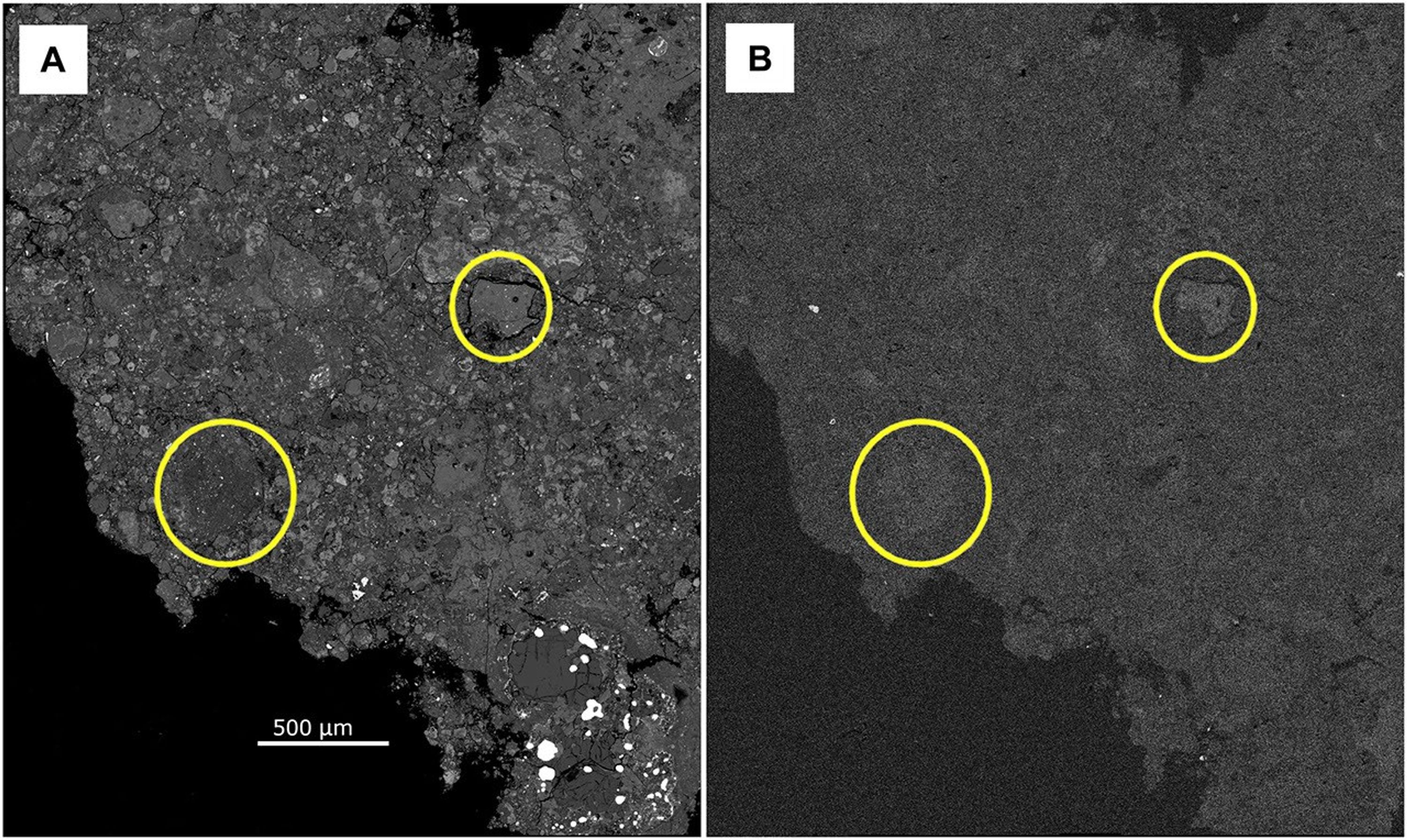
Two grayscale microscope images of the same area of the Hillsborough meteorite are shown side by side. In both panels, two circular features are outlined in yellow. The left panel is a backscattered electron image that reveals the meteorite's internal structure and the locations of two C1 clasts. The right panel is an X-ray elemental map of the same area, where the circled clasts appear brighter than the surrounding material, indicating elevated sodium concentrations. The comparison shows that sodium is concentrated within the C1 clasts.
C1 clasts in Hillsborough: On the left is a back-scattered electron image with two C1 748 clasts circled. On the right, an X-ray map of the same area as (A), indicating Na enrichment in 749 of the C1 clasts relative to the bulk of Hillsborough. Credit: NASA/SETI

A meteorite recovered immediately upon its fall to Earth on July 16, 2024, is helping NASA scientists uncover new clues about ancient water, the chemical evolution of primitive asteroids, and the ingredients that may have helped make life possible throughout the early solar system.

This rapid recovery began when an amateur astronomer in New Jersey quickly recognized that a newly fallen meteorite had landed on his property. Recognizing its scientific value and wearing protective gloves, he collected the fragments and stored them in aluminum foil and glass containers, which preserved delicate minerals and organic compounds that are often altered by moisture, weather, and contamination.

As the meteorite fell to Earth, cameras across New Jersey captured its fiery passage through the atmosphere. Scientists used these observations to reconstruct the fireball’s trajectory and, after recovering the meteorite, combined this data with laboratory analyses to determine where in the solar system the rock most likely originated. In a study published Wednesday in the journal Science Advances, researchers found evidence that ancient salty water altered minerals within the meteorite’s parent asteroid, preserving unique minerals and a rich inventory of organic compounds.

“When we have both a documented fireball and a quick recovery of its meteorite, we can learn not only what the rock is made of, but where it came from in the asteroid belt,” said Peter Jenniskens, meteor astronomer at both NASA’s Ames Research Center in California’s Silicon Valley and the SETI Institute, and lead author of the study.

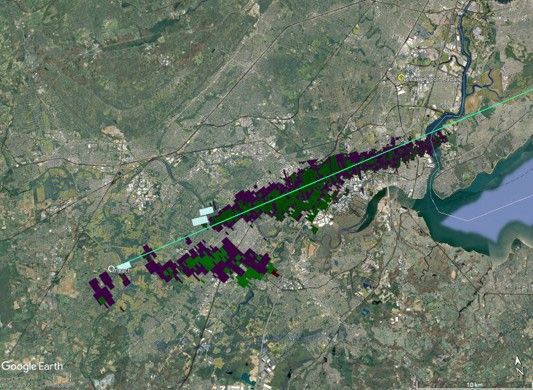
Satellite map of the Hillsborough, New Jersey, area with the meteorite's projected flight path shown as a green diagonal line extending from southwest to northeast. Colored radar detections along and below the flight path indicate where falling meteorite fragments were detected as winds carried them east-northeast during their descent. The figure illustrates how radar observations helped scientists reconstruct the meteorite's fall.
Combined radar detections from the Hillsborough meteorite fall. The green line shows the fireball’s projected path, while colored radar signatures show falling meteorite fragments drifting east-northeast with prevailing winds. Credit: NASA/Marc Fries

Named for the township where it was recovered, the Hillsborough meteorite belongs to a class of carbon-rich meteorites known as CM carbonaceous chondrites. These primitive rocks preserve some of the oldest materials in the solar system, recording the chemical processes that shaped asteroids more than 4.5 billion years ago.

While examining the unusually pristine meteorite, researchers found a mosaic of tiny broken-up rocks and noticed that some contained unusually high concentrations of sodium — an unexpected finding for this type of meteorite. The surprising signal prompted a closer investigation using powerful electron microscopes that allowed scientists to examine the meteorite from the millimeter scale down to individual atoms. By combining observations across multiple scales, researchers reconstructed the history of the minerals and the fluids that once flowed through them.

These analyses revealed microscopic fractures filled with sodium-rich material left behind by ancient brines. Unlike pure water, brines contain dissolved salts that allow them to transport elements and chemically alter the rocks they move through. In the case of the Hillsborough sample, those ancient fluids altered the asteroid’s minerals and left behind chemical evidence that remained preserved for billions of years.

Scientists were also able to detect fragile sodium-carbonate salts that normally react with moisture in Earth’s atmosphere before they can be studied. Jangmi Han, a paper co-author and mineralogist at NASA’s Johnson Space Center in Houston, identified evidence of ancient brines preserved within microscopic fractures. Similar salts were identified in samples returned from the asteroids Bennu and Ryugu by NASA’s OSIRIS-REx mission and JAXA’s (Japan Aerospace Exploration Agency) Hayabusa2 mission. However,Hillsborough marks the first time the salts have been identified in a CM carbonaceous chondrite meteorite, offering a new glimpse into the surfaces of the primitive asteroids that produced these meteorites.

Together, these findings suggest that ancient, salt-rich brines were more widespread among primitive asteroids than previously recognized, and provide scientists with new opportunities to compare how water altered different asteroid bodies across the early solar system.

“The chips of the most salt-rich bits of this meteorite are quite comparable to the samples returned by the Hayabusa2 and OSIRIS-REx missions,” said Mike Zolensky, a meteorite researcher at NASA Johnson and co-author of the study. “They’re not identical. They’re different in some very interesting ways, but they’ve seen very similar processes.”

Following the history of water through the solar system is an essential part of understanding the origin of life.

Mike Zolensky

Meteorite Researcher

Scientists expected Hillsborough to contain a rich suite of organic compounds because it is a CM carbonaceous chondrite. What made the meteorite exceptional was how quickly it was recovered, allowing researchers to study those compounds before prolonged exposure to Earth’s environment could contaminate the sample.

“One of the big surprises for me when we analyzed a small chip of the Hillsborough meteorite was the complexity of amino acids and other organic compounds,” said Danny Glavin, senior scientist in the Astrobiology Analytical Laboratory at NASA’s Goddard Space Flight Center in Greenbelt, Maryland, and co-author of the study.

Its diversity of amino acids and other organic compounds is, comparable to the Murchison meteorite, a nearly 100-kilogram carbonaceous chondrite that fell in Australia in 1969 and became the benchmark for extraterrestrial organic chemistry.

“It’s just more proof that the chemical building blocks of life could have been delivered — and are still being delivered — to Earth today by these carbonaceous asteroid fragments,” said Glavin, who was a co-investigator on OSIRIS-REx, leading an international team that studied the organic composition of the samples delivered to Earth from asteroid Bennu in 2023.

Understanding the Hillsborough meteorite required expertise from multiple scientific disciplines.

Astronomers reconstructed the meteorite’s journey through space, finding evidence that it may have originated from the Erigone asteroid family in the inner asteroid belt, home to the asteroid Donaldjohanson, which was visited in 2025 by NASA’s Lucy spacecraft. Mineralogists identified evidence of ancient brines preserved within microscopic fractures, while organic chemists analyzed the meteorite’s inventory of amino acids and other organic compounds.

“Together, those complementary studies are helping scientists build one of the clearest pictures yet of how primitive asteroids such as the asteroid Erigone evolved chemically over billions of years,” said Jenniskens.

Researchers continue to study the Hillsborough meteorite, revealing new details about how water transformed primitive asteroids and shaped the early solar system.

By tracing the history of water on primitive asteroids, scientists are learning how water and the chemical ingredients for life were distributed throughout the early solar system.

“If you follow the water through the solar system, you’re actually following life,” Zolensky said. “Following the history of water through the solar system is an essential part of understanding the origin of life.”

For more information on NASA’s astromaterials research and exploration, visit:

https://science.nasa.gov/astromaterials

Karen Fox / Molly Wasser
Headquarters, Washington
240-285-5155 / 240-419-1732
karen.c.fox@nasa.gov / molly.l.wasser@nasa.gov

Victoria Segovia
NASA’s Johnson Space Center, Houston 281-483-5111
victoria.segovia@nasa.gov

About the Author

Victoria Segovia

Keep Exploring

Discover More Topics From NASA

New Winged Robot Can Fly and Swim Like a Puffin

Scientists hoped for years to make a machine that could emulate the movements of diving birds, such as puffins, and offer an affordable, unobtrusive way to monitor fragile marine ecosystems. A team of researchers at M.I.T. has been able to create such a waterproof winged robot, according to a study published July 9 in the journal Science.

Les meilleures enceintes Bluetooth étanches (Waterproof) pour la piscine

15 July 2026 at 17:30
Piscine, plage, jardin ou vacances : les enceintes Bluetooth étanches sont devenues les meilleures alliées des écoutes en plein air. Notre sélection rassemble des modèles Waterproof fiables, performants et adaptés à toutes les envies.

Le Galaxy Z Fold6 cache un immense écran : les soldes révèlent son meilleur prix (-54 %)

15 July 2026 at 17:00
Profitez des soldes d'été pour vous offrir le Samsung Galaxy Z Fold6 à un tarif exceptionnel. Ce smartphone pliable haut de gamme, capable de se transformer en tablette de 7,6 pouces, bénéficie actuellement d'une remise de 54 % chez Rakuten, pour une durée limitée.

Rothéneuf : comment 300 visages sculptés dans la falaise ont créé l’un des sites les plus mystérieux de France

À quelques kilomètres de Saint-Malo, les rochers de Rothéneuf abritent plus de 300 visages, monstres et corsaires figés dans le granit. Œuvre monumentale de l’abbé Fouéré, ce site sculpté à même la falaise intrigue autant qu’il fascine, entre légende locale et énigme artistique. Un lieu unique...

❌