Para João Barros, presidente da AI², um dos grandes desafios para a próxima década em Portugal é fazer evoluir o “sistema científico e tecnológico altamente fragmentado” para um ecossistema em que “todos os componentes estão profundamente interligados". A ideia é um dos objetivos da nova agência que funde a ANI e a FCT.
Using the Karl G. Jansky Very Large Array (VLA) s and the Five-hundred-meter Aperture Spherical Radio Telescope (FAST), astronomers have created the sharpest-ever radio maps of neutral hydrogen around the Orion Nebula.
Using the upgraded GRAVITY+ instrument on ESO’s Very Large Telescope Interferometer (VLTI), astronomers have measured the ratio of carbon isotopes in the atmosphere of the young exoplanet Beta Pictoris, offering new insights into how giant planets form.
A private seller in Littleton, Colorado has listed a brand-new 2027 Rivian R2 Performance on Cars.com for $79,900 — roughly $20,000 over what Rivian charges for the same vehicle.
The listing went up July 1, just weeks after Rivian started delivering the R2 to its first customers, and it comes with the kind of cover story flippers tend to lean on.
With the arrival of America’s 250th birthday this Independence Day weekend, NASA is marking the occasion with a patriotic-themed perspective on the cosmos.
While a patient is fully anesthetized and unresponsive, neurons in the hippocampus continue to process language, distinguish different types of words, and generate neural activity consistent with predicting upcoming words.
As America celebrates its 250th birthday, we look at technological revolutions that have shaped the country—and the AI revolution now poised to redefine its future.
Researchers have discovered a potentially habitable exoplanet just 25 light-years from Earth—but is its precarious location on the cosmic shore too dangerous for extraterrestrial life?
The Chinese Tianwen-2 mission has captured the first imagery of a space object that some astronomers are calling Earth’s “quasi-moon.”
The object was captured in images released by the China National Space Administration (CNSA), after its Tianwen-2 spacecraft reached the tiny asteroid 469219 Kamoʻoalewa. Initially discovered in 2016, the asteroid became the target of a sample return mission launched by China on 28 May 2025.
Officially the CNSA’s second mission under its Planetary Exploration of China Program, Tianwen-2 aims to return close to 100 grams of samples from the surface of the small object.
Earth’s Mysterious Quasi-Moons
Quasi-moons are the name astronomers have for small, very distant objects that do not impact our planet’s tides or possess other characteristics associated with our primary moon.
These objects are nonetheless considered moon-like because they remain in our celestial neighborhood for extended periods, providing unique opportunities for studying near-Earth objects (NEOs) like asteroids, and the impact things like solar radiation and gravity have on them.
Although Kamoʻoalewa (also known as asteroid 2016 HO3) is the most well-known of Earth’s quasi-moons, it is one of seven that are currently known to astronomers. Kamoʻoalewa’s orbit is technically also around the Sun, rather than Earth, although its synchronized path keeps it locked closely to Earth’s orbit, thereby justifying its recognition as a “quasi-satellite.”
The object’s size and distance make it an ideal target for studying NEOs, and China leaped at the opportunity with the CNSA’s Tianwen-2 mission.
Approaching a Quasi-Moon
The Tianwen-2 spacecraft is currently nearing 20 kilometers from the 130 to 330-foot space rock, according to a statement CNSA released on Monday.
Along with a mission update, the CNSA also released new images, which are the first to officially document the object’s appearance. According to current mission timelines, Tianwen-2 will remain in the vicinity of 469219 Kamoʻoalewa until next April, and by sometime in November 2027, its return capsule is expected to reach Earth.
After its study of 469219 Kamoʻoalewa, Tianwen-2 will then make its way with the aid of a gravity assist in the direction of the comet 311P/PANSTARRS, arriving in its vicinity by January 2035.
“Going forward, the probe will gradually conduct more detailed scientific explorations to obtain information on the asteroid’s shape, material composition, and internal structure,” read the CNSA’s statement on Monday.
The agency said its ongoing collection of information will help to provide “support for preparations for sampling,” and the spacecraft will spend the next several months conducting reconnaissance of the asteroid before its sample collection begins, which will combine high-speed maneuvers with the deployment of a specialized robotic arm.
Following their collection, the samples will be delivered to a recovery site in the Gobi Desert after dropping into Earth’s atmosphere in November 2027.
Micah Hanks is the Editor-in-Chief and Co-Founder of The Debrief. A longtime reporter on science, defense, and technology with a focus on space and astronomy, he can be reached atmicah@thedebrief.org. Follow him on X @MicahHanks, and at micahhanks.com.
Rivian has commenced an underwritten public offering of 75 million shares of common stock, a raise worth roughly $1.5 billion based on the stock’s recent price.
The capital raise lands just days after Rivian’s stock rallied on stronger-than-expected Q2 delivery results and a raised full-year outlook.
The Hayabusa2 spacecraft completed its flyby of the asteroid Torifune over the weekend, according to a statement issued by Japan’s space agency.
The intrepid Japan Aerospace Exploration Agency (JAXA) probe’s visit marks one of the closest approaches a spacecraft has ever made to a distant asteroid, and follows Hayabusa2’s successful 2020 mission to return samples from the asteroid Ryugu.
Information obtained during the flyby, which occurred on Sunday, may help to provide new insights into both the composition of these ancient space rocks drifting through our solar system, as well as how to defend our planet if one large enough to pose a significant risk were ever to make its way here.
Hayabusa2 completes a Historic Close Encounter
At approximately 6:30 p.m. Japan Standard Time on Sunday, Hayabusa2 passed the asteroid while traveling at speeds approaching 5 kilometers per second.
The recent achievement comprises part of the probe’s extended mission, which will include a future visit to the small asteroid 1998 KY26, which is expected to occur in 2031.
Infrared image of the asteroid Torifune, obtained by JAXA’s Hayabusa2 spacecraft on July 5, 2026 (Image Credit: JAXA)
Over the weekend, the spacecraft’s flyby of Torifune helped to showcase Hayabusa2’s orbital guidance systems, as well as its ability to monitor asteroids and collect data to aid in the protection against potentially dangerous near-Earth objects (NEOs) before they become a threat, the Japanese Timesreported.
Fortunately, asteroids with life-threatening potential only reach the Earth every few hundred years on average, and none currently being monitored by space agencies around the world are believed to represent any imminent threat.
Close Approach, not a Collision
One of the most difficult aspects of flybys like the one on Sunday involves the speeds at which spacecraft are moving, which can make avoiding a collision with the asteroid complicated. This is partly because of their dark coloration, which prevents visual confirmation of their location until just days before the flyby occurs, leaving only a small window for planning and preparation.
In a statement, Japan’s space agency said that these difficulties mean “that the flyby operation is similar to orbit-inducing technologies used to collide a spacecraft with an asteroid.”
If such technologies were to be used for planetary defense in the future, such a direct collision would be the goal, thereby aiming to set any potentially dangerous NEOs off course and keep Earth out of their line of fire.
Future Opportunities
In addition to the probe’s 2031 visit to 1998 KY26, JAXA officials say that additional opportunities for future reconnaissance will be likely, and that Sunday’s flyby served as an important dress rehearsal in that regard.
Additionally, data obtained from the flyby will be useful in helping JAXA officials and other space agencies around the world to know what to expect should a planetary defense effort become a requirement at any time in the future.
Once Hayabusa2 reaches 1998 KY26 in the early 2030s, it will mark the first time a spacecraft has engaged in close-range explorations of such an asteroid, which is currently estimated to be approximately 30 meters in diameter.
Micah Hanks is the Editor-in-Chief and Co-Founder of The Debrief. A longtime reporter on science, defense, and technology with a focus on space and astronomy, he can be reached atmicah@thedebrief.org. Follow him on X @MicahHanks, and at micahhanks.com.
Electricity powers the world, and electricians are the ones who get it where it needs to go. An electrician is an expert who is trained to make sure electrical systems and equipment are installed safely and working correctly. Electricians are involved in a variety of systems, including power, lighting, communications, and more – anything that needs electricity to run.
While electricians ensure systems and equipment have the power they need, electrical technicians focus on building, modifying, or testing electronic devices.
What are some of the different types of work electricians and electrical technicians do at NASA?
At NASA, electricians keep the lights on and the power flowing for rocket launches, scientific research, and everything in between. Their skills support engineers and scientists in building and testing spacecraft, aircraft, satellites, telescopes, and the equipment that makes human spaceflight possible. Electricians make sure all facilities and equipment have the power and functionality they need to be safe and ready to support NASA’s missions.
Electrical technicians at the agency help bring big ideas to life. They might build and wire control systems, connect tiny sensors to circuit boards, or write the software to make a device work in a specific way. They also test instruments in conditions that mimic space – extreme temperatures, intense vibrations, and even a vacuum – to make sure they will survive and perform well during their missions. Technicians use specialized tools, earn certifications, and work with incredible precision.
Being an electrician or electrical technician at NASA is careful, hands‑on work carried out with expertise. Because space hardware is headed to places like low-Earth orbit, the Moon, or even Mars, every detail has to be perfect.
What are the different certification levels for electricians?
The information below is a general overview of the career path of an electrician. Specific guidelines for these roles vary from state to state. It’s important to look up the license requirements in your state.
Apprentice electrician: This four-year job training program provides an entry into the industry. An apprentice works as an assistant to an experienced supervisor, gaining vital hands-on experience to move ahead as an electrician.
Journeyman electrician: A journeyman is an electrician who has finished an apprenticeship, then passed a test. At this stage, the electrician is licensed and allowed to work without supervision.
Master electrician: This is the highest certification possible for an electrician. Typically, a master electrician is someone who has completed approximately 4,000 hours as a journeyman, then passed a licensing exam. These electricians are qualified to work on complicated projects. They can also serve as supervisors for apprentices or journeymen following in their footsteps.
How can I become an electrician?
There are many options that provide the training needed to get started as an electrician or electrical technician.
Many community colleges, trade schools, and technical institutes offer a two-year program leading to an associate degree in electrical technology. Additionally, trade unions and apprenticeship programs provide real-world experience in the field.
Additionally, all branches of the U.S. military offer electronics training that may be transferrable to college credits or civilian certifications.
How can I start preparing today to become an electrician?
It’s never too early to set the stage for an electrifying career! In high school, you can take courses in math, science, and technical education. At the same time, you can start learning about basic electrical concepts such as circuitry and safety.
Begin researching associate degree programs and apprenticeship opportunities so you can consider which pathway seems right for you. Weighing these options now will help you understand program requirements and ensure you’re ready to take the next step.
You can also gain useful experience through part-time work, or shadowing electricians on the job.
What skills will I need to be a successful electrician?
Technical skills focus on the basics – how electricity works, how to stay safe, and how to read schematics and wiring diagrams. Some jobs also call for special hands‑on abilities, like soldering tiny components, putting together cables, or even having some familiarity with chemistry.
Being curious, open‑minded, and a good communicator matters, too. Any time you’re building or improving a device, you must understand who will use it and what they need it to do. Asking questions, sharing ideas, and being able to take feedback are essential to consistently building systems and devices that work well.
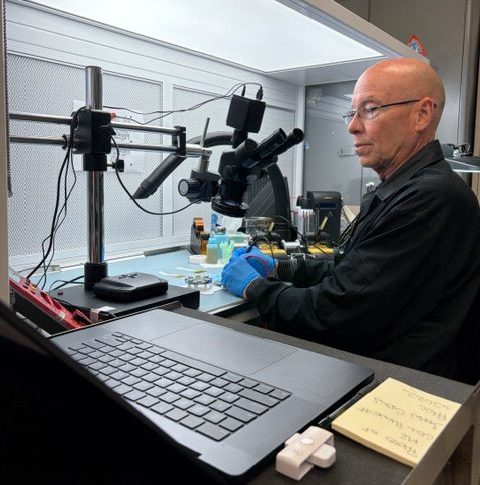
David McClaeb, electronic technician, NASA’s Goddard Space Flight Center in Greenbelt, Maryland
Advice from NASA electricians and electronic technicians
“As an aerospace technician, you have the opportunity to make a big difference. You can make a really big impact.” – Christopher Johnson, aerospace electrical engineering technician, NASA’s Kennedy Space Center in Florida
“What I wish I knew in high school is how many opportunities there are for electricians. I didn’t realize how big of a scale it really was. Everything needs electricity, and the sky’s the limit on what you can do with it. NASA needs electricians for everything from their testing campaigns to keeping their facilities running.” – Levi James, electrician apprentice, NASA’s Glenn Research Center at Armstrong Test Facility in Sandusky, Ohio
“It’s so gratifying when somebody comes in and says, ‘Hey, we want to build this, but it looks really difficult,’ and we say, ‘Yeah, it looks difficult, but we can do it’ – and we build it and then we hand it over to them, and then we’re on to the next thing. It’s a challenge, and I’m telling you, it is just so fun.” – David McClaeb, electronic technician, NASA’s Goddard Space Flight Center in Greenbelt, Maryland
At NASA, electricians keep the lights on and the power flowing for rocket launches, scientific research, and everything in between. Their skills support engi...
Entrou hoje em vigor o Regulamento do Regime Jurídico da Cibersegurança que dá início à contagem de prazos para as medidas de cibersegurança que decorrem da transposição da NIS2. A plataforma de registo MyCiber já está disponível e há prazos curtos a cumprir.
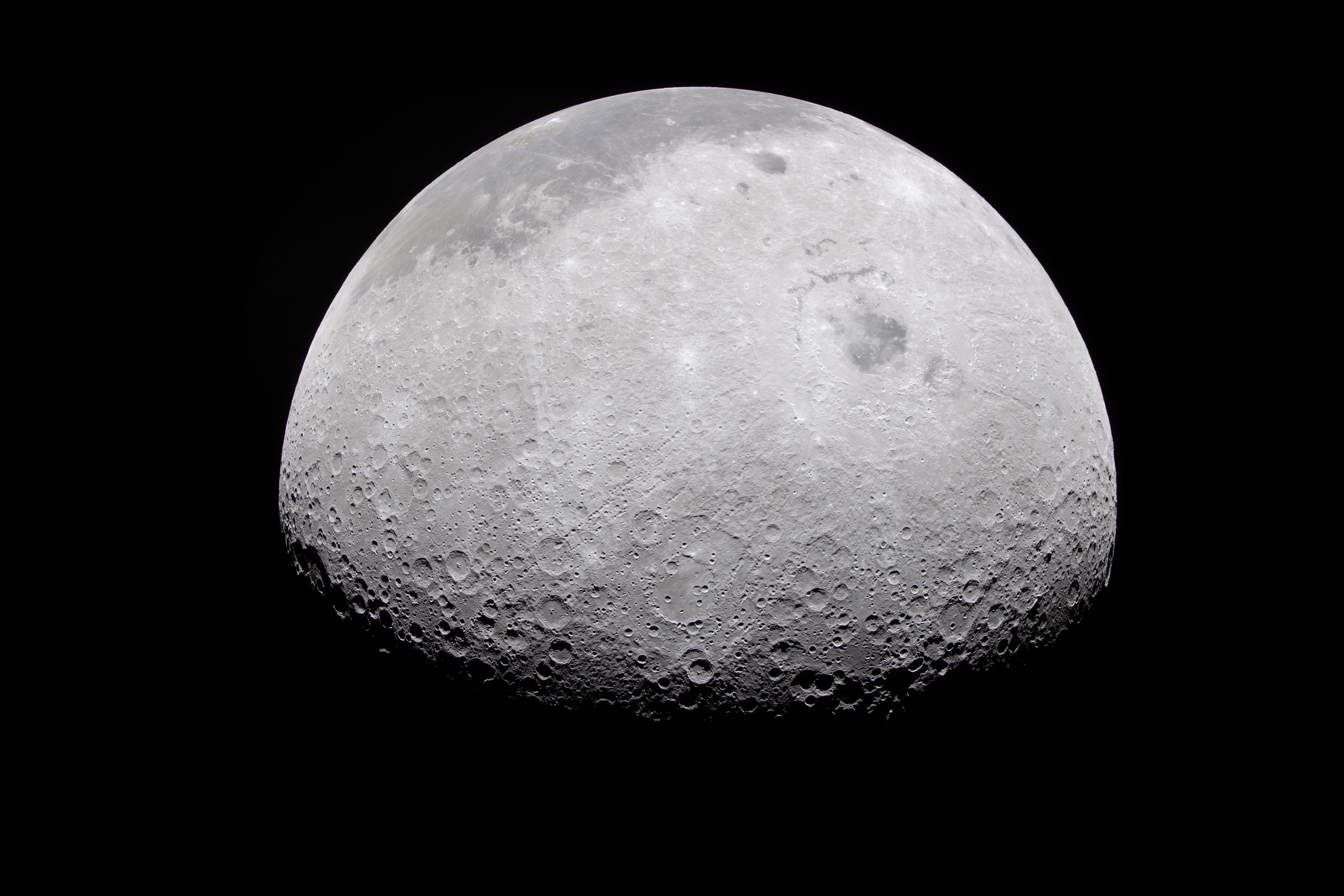
The Moon’s rocky, uneven, and otherworldly surface features are highlighted by the terminator – the difference between light and darkness.
NASA
The Moon appears half-illuminated in this photo captured by the Artemis II crew on flight day 6. The terminator – the difference between light and darkness – provides a stark contrast and even greater perspective of the Moon’s rocky, uneven, and otherworldly surface features. The near side, which is what we can see from Earth, appears in the dark gray regions at the top of this image.
NASA’s Jason Peterson is the range operations manager at NASA’s Stennis Space Center. For Artemis II, he supported the team responsible for delivering video and communication feeds for launch and splashdown.
Credits: NASA/Danny Nowlin
Jason Peterson’s responsibilities for NASA’s Artemis II mission went beyond his usual role as the range operations manager at NASA’s Stennis Space Center near Bay St. Louis, Mississippi.
For Peterson, working at NASA is a surreal full-circle moment.
“I grew up in DeLisle, Mississippi, right down the road from NASA,” said Peterson. “You would hear NASA testing, the windows would shake, and you knew they were out there. Not in a million years would I have ever dreamed I would work with NASA.”
His career journey took a few turns before reaching the space agency.
“I got out of school, welded, went to college and then to the Air Force. The path to NASA really started to develop from there,” said Peterson.
Peterson spent 24 years in the U.S. Air Force and Air National Guard, working in airfield and air-to-ground range operations, followed by a few years working as an aircraft dispatcher at Airbus Final Assembly Line.
Peterson credits his military experience with preparing him for the 12-to-16-hour workdays that helped bring the Artemis II test flight around the Moon and into view for audiences around the world.
He supported the team responsible for delivering video and communication feeds for the launch of NASA’s SLS (Space Launch System) rocket with the Artemis II crew aboard the Orion spacecraft, and then splashdown in the Pacific Ocean.
During the nearly 10-day mission, NASA astronauts Reid Wiseman, Victor Glover, Christina Koch, and CSA (Canadian Space Agency) astronaut Jeremy Hansen completed a record-setting lunar flyby, taking them 252,756 miles at their farthest distance from Earth.
Aboard the USS John P. Murtha, Peterson was the first on the ship to spot the capsule returning with the crew.
“The sonic boom was the moment it truly hit me. Even though I was tracking the capsule, it did not fully register until then. Chills went down my neck and back. You realize our astronauts are coming home. It was an incredible and emotional moment.”
JASON PETERSON
Range Operations Manager for NASA Stennis
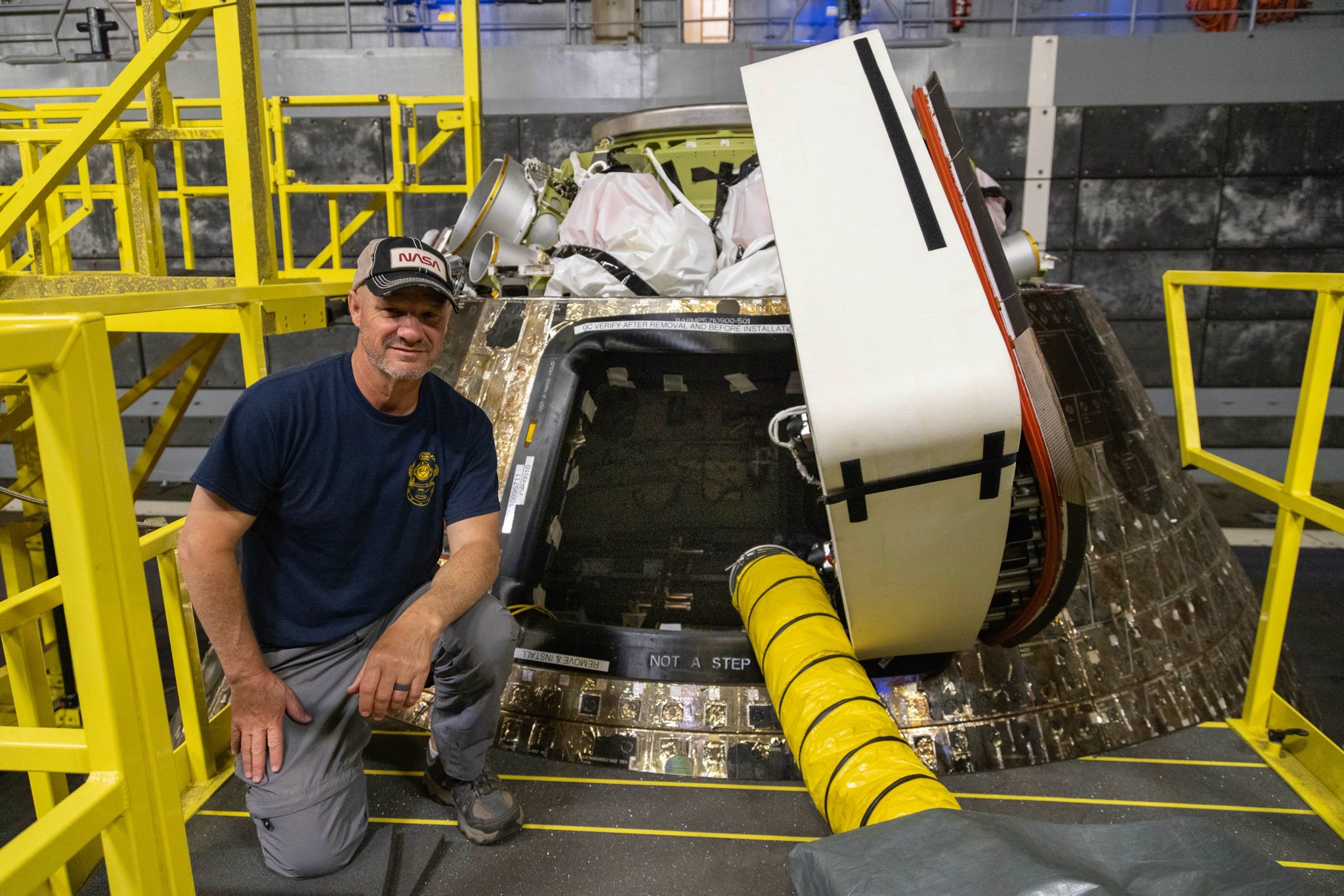
Jason Peterson, NASA Stennis range operations manager, is shown with the Orion spacecraft aboard the USS John P. Murtha on April 13, 2026. Peterson was the first to spot the capsule returning with the Artemis II crew as he supported the team responsible for delivering video and communication feeds during splashdown operations. Credits: NASA
NASA
Peterson operated one of six cameras providing live coverage by using a high‑resolution, multi‑sensor system with thermal capabilities. Using the ship’s heading and Orion’s predicted trajectory, he located the capsule within minutes and began tracking it.
Orion entered Earth’s atmosphere at about 400,000 feet above the planet’s surface, traveling nearly 35 times the speed of sound and about 1,956 statute miles from its splashdown point off the coast of California. Peterson tracked Orion from the release of the small parachutes that first slow and steady the capsule, through the main parachutes opening, and all the way to splashdown.
“You are fully locked in, keeping it centered, in focus, and steady,” said Peterson.
Peterson’s focus on the mission began weeks earlier at NASA’s Kennedy Space Center in Florida.
In the days leading to launch, Peterson worked with the team running full systems checks, staging communications gear, and preparing drones and fixed‑wing camera assets. He helped configure and operate the systems that ensured live video flowed from the launch pad, the crowds, and surrounding air and ground platforms.
On April 1, the launch day of Artemis II, the team unloaded and set up high‑resolution sensors, connection terminals, routers, monitors, fiber lines, and drone equipment. They flew drones to capture crowd scenes and aerial views before liftoff.
As the SLS rocket launched, Peterson’s full attention was on positioning the drone and maintaining the shot.
“There is not much time to step back and take in the moment, as you are concentrating on precision,” said Peterson.
As the mission got underway, Peterson and the team packed up, returned to the facility, and downloaded the day’s footage.
The Artemis II crew were more than halfway to the Moon as Peterson arrived in San Diego on April 4. In the days leading to splashdown, the team loaded and installed high‑fidelity cameras and supporting equipment, all to help the world witness a historic milestone when the Artemis II crew returned to Earth on April 10.
Next up will be Artemis III. NASA will launch four astronauts from NASA Kennedy aboard the Orion spacecraft on the SLS rocket. Building on the successful Artemis II crewed test flight in April, Artemis III will pave the way for future surface missions, with experts like Peterson helping every step of the way.
The interstellar comet 3I/ATLAS carries a chemical fingerprint unlike anything in our Solar System, and it may have formed 10 to 12 billion years ago, before our Sun even existed, according to two papers published in the journal Nature.
In a groundbreaking study soon to redefine neuroscientific understanding of memory mechanisms, researchers have uncovered the pivotal role played by Neurensin-2 (NRSN2) in regulating hippocampal synaptic plasticity and memory functionality. This newly published research reveals how deficiency in NRSN2 leads to profound impairments in memory, traced back to disrupted excitatory synaptic transmission and weakened long-term potentiation (LTP) within the hippocampus, a brain region critically involved in memory formation and cognitive processing.
The hippocampus serves as the brain’s memory hub, integrating myriad neuronal signals to encode and retrieve information efficiently. Central to this integration is the function of excitatory synapses that employ glutamate receptors, especially the N-methyl-D-aspartate (NMDA) receptor, which plays an essential role in synaptic plasticity—the ability of synapses to strengthen or weaken over time. This plasticity underlies learning and memory. The study elucidates how NRSN2 exerts a regulatory influence on the expression of NMDA receptor subunits, with deficiency in NRSN2 tipping the balance unfavorably and compromising synaptic efficacy.
Utilizing advanced genetic models, the investigators engineered mice lacking NRSN2 to dissect its functional contributions. Behavioral assays showcased a marked decline in memory performance, particularly in spatial and recognition tasks reliant on hippocampal circuits. These deficits were not attributed to developmental anomalies but to disrupted synaptic physiology, signaling a direct role for NRSN2 in maintaining synaptic integrity and plasticity during adult cognition.
At the molecular scale, the absence of NRSN2 triggered a significant downregulation of key NMDA receptor subunits, notably NR1, NR2A, and NR2B. These subunits orchestrate receptor assembly and gating properties critical for calcium influx, a signal cascade necessary for potentiation of synaptic strength. The reduction in their expression correlated tightly with the inhibition of LTP induction, a process considered the cellular analog of memory encoding, confirming the hypothesis that NRSN2 deficiency impairs memory by hampering core synaptic mechanisms.
Electrophysiological recordings from hippocampal slices further substantiated the disrupted synaptic function. In control animals, robust LTP was readily induced by theta burst stimulation—a protocol mimicking physiological neuronal firing during learning. Conversely, hippocampi from NRSN2-deficient mice exhibited significantly weakened potentiation, underscoring the protein’s critical role in modulating synaptic responsiveness. This impairment was not a general defect of synaptic transmission but selectively impacted excitatory plasticity mediated through NMDA receptors.
Delving deeper, the team explored the intracellular cascades influenced by NRSN2, discovering that its absence perturbed the trafficking and surface expression of NMDA receptor complexes. NRSN2 appears to act as a chaperone or scaffold protein, ensuring proper receptor assembly and synaptic localization. Without it, receptor subunits fail to achieve adequate membrane insertion, resulting in diminished postsynaptic sensitivity to glutamate and compromised signal transduction.
This mechanistic insight offers a fresh perspective on how synaptic architecture and molecular composition govern cognition. The study’s integration of molecular biology, electrophysiology, and behavioral neuroscience draws a comprehensive picture of how a single protein’s deficit can destabilize the neural substrates of memory. Such findings not only enrich fundamental neuroscience but also hint at novel targets for cognitive-enhancing therapies.
Intriguingly, alterations in NRSN2 expression and NMDA receptor dysfunction have been implicated in various neuropsychiatric disorders, including schizophrenia and major depressive disorder. By illuminating this molecular nexus within the hippocampus, the research opens doors to understanding disease pathophysiology at a finer scale and may spur development of precision interventions aimed at restoring synaptic balance in affected individuals.
The investigators also examined compensatory mechanisms that might mitigate NRSN2 absence. While some plasticity-related proteins showed upregulation, these changes failed to rescue the deficits in NMDA receptor expression and synaptic potentiation. This highlights the non-redundant and indispensable nature of NRSN2 in maintaining synaptic homeostasis and cognitive function.
Beyond the laboratory findings, the study raises fascinating questions about how synaptic proteins coordinate to sustain the dynamic range of neural connectivity required for adaptive learning. The delicate equilibrium modulated by NRSN2 and NMDA receptors underscores the complexity of neuronal networks and their vulnerability when key molecular elements are compromised—insights that are pivotal as the field seeks to decode the neural basis of memory disorders.
Future research directions spawned by this work include investigating how NRSN2 interacts with other synaptic scaffold proteins and cytoskeletal elements, potentially shaping the three-dimensional organization of the postsynaptic density. Additionally, exploring the developmental timeline of NRSN2 expression could reveal critical periods during which intervention might prevent or reverse memory impairments.
From a translational perspective, the study’s revelations beckon the clinical neuroscience community to consider NRSN2 and its pathways as therapeutic candidates. Pharmacological strategies aimed at upregulating NRSN2 or mimicking its stabilizing effects on NMDA receptors could hold promise for enhancing cognition or slowing neurodegenerative progression in disorders marked by synaptic decline.
In sum, this landmark research defines NRSN2 as a vital regulator of excitatory synaptic plasticity and memory formation. Its deficiency causes a cascade of molecular disturbances culminating in impaired NMDA receptor expression and disrupted LTP, ultimately compromising hippocampal-dependent memory functions. This work not only advances our understanding of the molecular machinery underlying memory but also charts new territory in the quest to ameliorate cognitive dysfunction.
As neuroscience inches closer to mapping the intricate cellular and molecular landscape of cognition, findings such as these underscore the profound impact a single synaptic protein can have on brain function. The compelling evidence presented lays a robust foundation for future explorations into synaptic plasticity and memory, promising strides in both basic science and clinical applications that may soon transform lives burdened by memory loss.
Subject of Research: Impact of Neurensin-2 (NRSN2) deficiency on hippocampal memory functions and synaptic plasticity
Article Title: Impact of NRSN2 deficiency on memory: Altered excitatory synaptic plasticity associated with reduced expression of NMDA receptor subunits and impaired LTP in the hippocampus.
Article References:
Wei, J., Wu, Y., Yi, Y. et al. Impact of NRSN2 deficiency on memory: Altered excitatory synaptic plasticity associated with reduced expression of NMDA receptor subunits and impaired LTP in the hippocampus. Transl Psychiatry (2026). https://doi.org/10.1038/s41398-026-04163-7

 Login