Japan has succeeded in the first-ever flight test of its RV-X experimental reusable rocket prototype.
The launch — or hop, considering its duration and distance — took place at the Japan Aerospace Exploration Agency's (JAXA) Noshiro test facility on July 11 and lasted about 40 seconds. The 24-foot-tall (7.3 meters) test vehicle, powered by a single engine, rose just over 33 feet (10 m) in the air and traveled a horizontal distance of approximately 50 feet (15 m) across the site's concrete pad before touching down softly on the side opposite its liftoff point.
The short test flight went exactly as planned and puts JAXA and its partners one step closer to the development of a technological spaceflight achievement only ever accomplished by a small handful of orbital rockets — SpaceX's Falcon 9, Falcon Heavy and Starship, Blue Origin's New Glenn and, most recently, China's Long March 10B.
Japan's RV-X reusable rocket prototype takes its first hop, on July 11, 2026. (Image credit: JAXA)
JAXA's RV-X is being developed and operated in conjunction with Japan's Mitsubishi Heavy Industries and is a precursor vehicle to a single-stage reusable flight experiment project called CALLISTO. CALLISTO is a joint venture involving JAXA, France's space agency CNES and the German Aerospace Center (DLR) to design and build a single-stage rocket capable of vertical launch, landing, refurbishment and reuse. That vehicle will itself be a pathfinder rocket as JAXA seeks its own entry into the cost-saving playing field of reusable launch services.
Japan's most advanced rocket in operation, the H3, was introduced in 2023 but wasn't designed for reusability. The H3 is more efficient and cost-effective than its H-2A predecessor, which was retired last year. But two of the new rocket's eight launches have not been fully successful, and it falls short in its cost-effectiveness compared to more advanced reusable rocket stages. So JAXA is hard at work on the H3's future replacement.
"Reusable rockets require consideration of operational feasibility," JAXA's website says. "By repeatedly verifying maintenance, operation, vehicle movement and launch pad setup using an actual experimental vehicle in preparation for flight tests, we were able to establish operational procedures that will contribute to the repeated operation of future rockets."
The test, and the RV-X vehicle itself, slightly resemble a similar flight article from SpaceX's early Starship development days. The "Starhopper" Starship prototype was compared to a water tower during its first "hopper" test in 2019. The first time the stumpy, three-legged, steel Starhopper jumped off the ground at SpaceX's Starbase facility in South Texas, it flew about 65 feet (20 m) straight up and back down.
Starhopper's success paved the way for higher jumps for longer durations as SpaceX honed Starship's early design, and the same is planned for RV-X. Now that JAXA's test rocket has completed its first 33-foot (10 m) hop, Japan's space agency is looking higher, too. RV-X's next launch is expected to fly as high as 330 feet (100 m), with another lateral crossover and hover included in its flight before landing.
Skyroot Aerospace successfully launched its Vikram-1 rocket to low Earth orbit (LEO) early Saturday morning (July 18), making India just the third country with a private orbital launch capability. The other two are established space powers — the U.S. and China.
"It is the dawn of a new space era," one of Skyroot's commentators said during the company's launch webcast on Saturday.
The view from the third stage of Skyroot Aerospace's Vikram-1 rocket during its debut launch on July 18, 2026. (Image credit: Skyroot Aerospace)
Skyroot Aerospace is based in the central Indian city of Hyderabad and was founded in 2018. The company made history for the first time four years later with its Vikram-S suborbital rocket, becoming the first private Indian outfit ever to reach space.
Vikram-1 is the next step for Skyroot: an orbital vehicle. The four-stage, seven-story-tall rocket is a small-satellite launcher; it can haul about 770 pounds (350 kilograms) of payload to LEO, according to the company.
"The small satellite launch market is deeply constrained on the supply side," Skyroot co-founder and CEO Pawan Kumar Chandana said in an emailed statement on Thursday (July 16).
"At the same time, the demand for services enabled by satellites in space will only continue to grow, and that is where Skyroot's opportunity lies," added Chandana, who, like company co-founder Naga Bharath Daka, used to work for the Indian Space Research Organisation.
The company began exploiting that opportunity on Saturday morning, with a test flight called Aagaman (Sanskrit for "Arrival"). The main goal was to see how Vikram-1 and its various systems performed during flight. But the rocket also carried some customer payloads, which were scheduled to be deployed at an altitude of 280 miles (450 kilometers).
Those payloads included a technology demonstration from the German company DCUBED; the Solaras S3 nanosatellite pathfinder from Indian startup Grahaa Space; and Embrace, a robotic arm built by the Indian company Cosmoserve Space that's designed to capture space debris.
Vikram-1 also carried Skyroot's SCOPE satellite, which collected a variety of data to help the company assess the rocket's performance during flight. There were two symbolic payloads on board as well — a small, 18-karat gold rocket from the artist Ajay Kumar Mattewada and "Cosmic Bloom," which was designed by Cosmos Diamonds, a company that makes jewelry using lab-grown gems.
Aerial view of Skyroot Aerospace's Infinity Campus in Hyderabad, India, showing a life-size model of the company's Vikram-1 rocket outside. (Image credit: Sumil Sudhakaran/Skyroot Aerospace)
All of them made it to space safe and sound. Vikram-1 lifted off from the Satish Dhawan Space Centre, on the Indian barrier island of Sriharikota, on Saturday at 2:35 a.m. EDT (0635 GMT; 12:05 p.m. India Standard Time), roaring off the pad in a flash thanks to its first-stage solid rocket motor.
The rocket performed as planned, sticking to a nominal trajectory and deploying the payloads right on schedule. Vikram-1 had ticked all of its boxes by just 17 minutes after liftoff, leading to a pronouncement from mission control.
"The Vikram-1 Aagaman mission is a grand success," the mission director said, eliciting cheers from the folks in the room.
It was a big moment for Skyroot and for India, and it augurs big things to come, according to Lt. Gen. AK Bhatt (retired), Director General of the Indian Space Association.
"The successful orbital launch of Skyroot Aerospace’s Vikram-1 (Mission Aagaman) is a defining milestone for India’s space journey," Bhatt said in an emailed statement shortly after the mission wrapped up. "By executing the nation's first fully private orbital flight, Skyroot has shattered legacy boundaries, demonstrating that our domestic industry is primed to handle end-to-end space missions."
Editor's note: This story was updated at 3:25 a.m. ET on July 18 with news of successful launch and satellite deployment.
Astronauts just flew to Earth orbit space atop a rocket emblazoned with an energy-drink ad.
The Soyuz MS-29 launch to the International Space Station on Tuesday (July 14), from the Russian-run Baikonur Cosmodrome in Kazakhstan, used a Soyuz rocket festooned with ads for Лимонад ("Lemonade") LIT ENERGY. The ads are visible in shots of the rocket's rollout on July 11, published here and here via NASA's Flickr account.
The Soyuz used for the launch also featured drawings from children with cancer — as well as the phrase "Life has no end" — to advertise the Unity Charitable Foundation, according to a Russian-language state media report machine-translated into English. The campaign is part of a series in support of the foundation that began in November 2025, the media report added.
Zoomed-in view of the above photo, highlighting the ad for Lit Energy. (Image credit: NASA/Bill Ingalls)
To be sure, the Russian space agency Roscosmos (like other space agencies) often adorns its rockets with colorful artwork and logos that may not necessarily result in payment. In June 2018, for example, a Soyuz launched with a FIFA World Cup logo that may have been a publicity campaign to advertise the soccer competition, which was occurring that month in Russia.
While there have been some experiments by other space agencies regarding advertising — anyone remember the space cola wars? — here are a few notable examples from Russia and its predecessor state, the Soviet Union.
A 1990 cosmonaut launch, partly for the Tokyo Broadcasting Service, carried a Japanese journalist from TBS — as well as advertisements on the side of the Soviet Soyuz rocket. Sony, Unicharm and Pocari Sweat patches were also reportedly flown on the mission.
After the breakup of the Soviet Union, the Mir space station featured advertisements for companies like RadioShack, Pepsi and Israel's Tnuva Milk.
A Pizza Hut ad flew on a Russian Proton rocket in 2000 for roughly $1.25 million (nearly $3 million in today's dollars). The restaurant chain then followed up in 2001 with a special space pizza delivery — but using salami, as it is more shelf-stable than pepperoni.
A Pizza Hut ad on a Russian Proton rocket that launched the Zvezda service module to the International Space Station (seen on far left in the above ISS photo). (Image credit: Khrunichev State Research and Production Space Center/NASA)
So Russia's practice of launching ads into space is not new. However, Ars Technica has suggested that contractions in the Russian economy led to very recent changes in the country's laws for space advertising that could lead to more examples like this.
Russia's unsanctioned invasion of Ukraine in February 2022 caused many international partnerships in space (and other projects) to fall apart, which Ars believes may have led to Russian President Vladimir Putin's authorization for recurring space ads. The new legislation was cited on Roscosmos' Telegram account in October 2025, the Ars report added.
"According to the amendments, Roscosmos has been granted the right, effective January 1, 2026, to place advertising on space objects owned by both the state corporation itself and federally," said the Roscosmos statement, according to Ars. "The amendments will create a mechanism for attracting private investment in Russian space exploration, and reduce the burden on the state budget."
Roscosmos and NASA continue to work together on the ISS despite sanctions imposed after the invasion of Ukraine, which is ongoing. And Tuesday's launch marked a milestone in that cooperation, as NASA Administrator Jared Isaacman became the first with his title to attend a Soyuz launch in eight years.
SpaceNews noted that Isaacman and Roscosmos Director General Dmitry Bakanov had the first reported face-to-face meeting between the agency heads since the last in-person NASA chief visit, for an October 2018 launch. After the meeting between Isaacman and Bakanov, Russia announced a two-year extension of its ISS commitment, to 2030, as well as an agreement in principle to continue offering NASA astronauts seats on the Soyuz in exchange for seats on commercial U.S. vehicles, among other developments.
Update for 1:15 p.m. ET on July 17: SpaceX is now targeting Monday (July 20) for the launch of Starship Flight 13, during a 90-minute window that opens at 6:45 p.m. EDT (2245 GMT).
Starship wasn't quite ready to fly today (July 16).
SpaceX tried to launch the Starship megarocket on its 13th test flight today but couldn't quite pull it off. Something went wrong just as the giant vehicle's 33 first-stage Raptor engines started to fire up, and an abort was triggered.
"We'll take some time, dig into what triggered that abort once the booster was igniting to launch, and then we'll figure out what our path forward is going to be," SpaceX's Dan Huot said during the company's launch webcast today.
SpaceX's second V3 Starship vehicle tries to launch on July 16, 2026. The attempt was aborted at the last second. (Image credit: SpaceX)
It didn't take long for SpaceX to narrow in on the root cause and address it.
"To be confident of a good flight, 2 Raptors will be removed & replaced. Most probable launch timing is early next week," company founder and CEO Elon Musk said this evening via X, the social media platform he owns.
Starship Flight 13 will fly from SpaceX's Starbase site in South Texas. Today's attempt occurred at 6:45 p.m. EDT (2245 GMT; 5:45 p.m. local time), right at the beginning of a 90-minute launch window.
Even if you can't see SpaceX's Starship in person, you can score a model of your own. Standing at 13.77 inches (35 cm), this is a 1:375 ratio of SpaceX's Starship as a desktop model. The materials here are alloy steel and it weighs just 225g.View Deal
Flight 13 will be the second test launch of Starship Version 3 (V3), an upgraded variant of the megarocket designed to get it up to operational status.
V3's first jaunt, Flight 12 on May 22, was mostly successful, but there were a few issues. For example, Starship's Super Heavy first stage didn't steer itself back for a controlled splashdown in the Gulf of Mexico as planned, and the Ship upper stage wasn't able to relight one of its Raptor engines in space.
Starship V3 will get a second chance on Flight 13, whose goals are similar to those of Flight 12: Get Super Heavy down on target in the Gulf and send Ship most of the way around the world, for a controlled splashdown of its own off the coast of Western Australia. (Ship pulled that off on Flight 12.)
There are a few new objectives, however.
The most notable is the payload suite flying on Flight 13 — 20 of SpaceX's next-gen Starlink V3 internet satellites. The company wants to build a constellation of 100,000 Starlink V3 spacecraft in low Earth orbit using Starship, and Flight 13 will mark the satellites' first-ever trip to space.
They won't stay up there, however; the spacecraft will be deployed on Ship's suborbital trajectory and will crash back to Earth after about 20 minutes, according to SpaceX.
Six of the 20 Starlinks going up on Flight 13 will be equipped with cameras, to image Ship's heat shield. SpaceX did this with a couple of V2 Starlinks on Flight 12 as well.
Editor's note: This story was updated at 9:38 p.m. ET on July 16 with information from an Elon Musk X post.
Starship is about to take to the skies on a bold new test flight of the world's most powerful rocket.
After several days of testing, SpaceX has stacked and readied its massive Starship rocket for its 13th test flight. The company tried to launch on Thursday, but that attempt was aborted at the last second. SpaceX is now targeting Monday (July 20), during a 90-minute launch window that opens at 6:45 p.m. EDT (2245 GMT), from pad 2 at SpaceX's facility in Starbase, Texas.
Both stages had been in their respective Starbase hangars for final checkouts following successful engine tests. Booster 40, the Super Heavy first stage launching on Starship Flight 13, was returned to the pad on Wednesday (July 15). Ship 40, the mission's upper-stage spacecraft, was rolled from the hangar beginning on Wednesday evening. The rocket was stacked overnight, according to a SpaceX post on X, and now awaits prelaunch procedures ahead of the beginning of Flight 13's launch countdown.
Starship is stacked at Starbase, Texas, ahead of its planned 13th test launch on July 16, 2026. That attempt was aborted; SapceX is now targeting July 20. (Image credit: SpaceX)
Flight 13 will launch the second "Version 3" (V3) Starship, a new iteration featuring extensive design upgrades to help mature the rocket toward clearing the vehicle for official operation. Compared to its Version 2 predecessor, V3 is taller, carries more propellant, and has lost significant mass around its engine section due to upgraded avionics systems. V3 is also equipped with 33 of SpaceX's upgraded Raptor 3 engines on Super Heavy, and another six (three sea-level, three vacuum-optimized) Raptor 3s on Ship.
Starship is designed for full reusability, with both Super Heavy and Ship capable of returning to their launch site for landing and refurbishment, which means making sure there's enough fuel in the tank to make the journey back. One critical upgrade for Starship V3 involves the propellant transfer docking ports that have been added to Ship's dorsal side (opposite the heat-shield tiles on its belly, or ventral side). Ship uses the majority of its fuel getting to space and will therefore require propellant transfers from various refueling flights in order to fly beyond low Earth orbit.
NASA is eyeing the development progress of Starship very closely, with a vested interest in the spacecraft's yet-unproven ability to transfer and maintain the types of cryogenic fuels that power its Raptor 3s. NASA has contracted SpaceX to design a lunar lander version of Starship to return astronauts to the moon as a part of the agency's Artemis program, and effectively managing its onboard propellants is one of the requirements on NASA's checklist to certify the vehicle to fly with crews.
Even if you can't see SpaceX's Starship in person, you can score a model of your own. Standing at 13.77 inches (35 cm), this is a 1:375 ratio of SpaceX's Starship as a desktop model. The materials here are alloy steel and it weighs just 225g.View Deal
SpaceX plans to complete such a demonstration later this year in preparation for Artemis III, targeted for mid-to-late 2027, which will fly a crew of four aboard NASA's Orion spacecraft to dock with Ship in Earth orbit ahead of the program's first moon landing mission on Artemis IV in 2028. NASA contracted Blue Origin's Blue Moon spacecraft as an additional Artemis lander, which will also launch to Earth orbit for docking operations with Orion during Artemis III.
Starship's readiness to fly those future missions will largely be determined by the rocket's performance on Flight 13, and its subsequent test launches in the coming months. The launch aims to smooth over a few rough patches that the vehicle ran into during V3's debut on the mostly successful Flight 12, which occurred on May 22. Those hiccups included Super Heavy failing to steer itself back to Earth for a controlled splashdown and Ship not relighting one of its Raptor engines in space as planned.
Stacking Starship for Flight 13 pic.twitter.com/L4XN6gqgRtJuly 16, 2026
If all goes according to plan on Flight 13, Super Heavy will perform a boostback burn and soft splashdown in the Gulf of Mexico. Ship will carry on with a suborbital trajectory, and is expected to release 20 Starlink V3 satellites — the first of the upgraded Starlinks to fly to space. Six of those spacecraft are equipped with cameras to inspect Ship's heat-shield tiles during flight. The satellites, though, will be on the same suborbital trajectory as Ship, and are expected to burn up during reentry through Earth's atmosphere. Ship is scheduled to perform a landing burn and soft splashdown of its own a little more than an hour after liftoff, and will meet a watery demise in the Indian Ocean.
Live coverage of Starship Flight 13 will begin about 30 minutes prior to liftoff, and can be streamed here on Space.com or directly on SpaceX's website and social media channels.
Editor's note: This story was updated at 1:15 p.m. ET on July 17 with the new target launch date of July 20.
Starship isn't the only SpaceX rocket flying today.
A Falcon 9 rocket launched from California's Vandenberg Space Force Base today (July 16), carrying 21 satellites for the U.S. military's advanced new "Tranche 1 Transport Layer" (T1TL) constellation to orbit.
Liftoff took place at 4:32 p.m. EDT (2032 GMT; 1:32 p.m. local California time).
A SpaceX Falcon 9 rocket launches the Third Tranche 1 Mission for the U.S. Space Development Agency from Vandenberg Space Force Base in California on July 16, 2026. (Image credit: SpaceX)
SpaceX's Starship megarocket — the biggest and most powerful launch vehicle ever built — is slated to make its 13th test flight a few hours later. It will lift off from the company's Starbase site in South Texas during a 90-minute window that opens at 6:45 p.m. EDT (2245 GMT; 5:45 p.m. local Texas time).
SpaceX will stream that mission live, and Space.com will carry the feed. Coverage will begin about half an hour before launch.
Today's Falcon 9 flight helps assemble the T1TL, a network in low Earth orbit (LEO) that will be operated by the U.S. Space Force's Space Development Agency (SDA).
The T1TL "will provide global communications access and deliver persistent regional encrypted connectivity in support of warfighter missions around the globe," SDA officials wrote in a explainer.
The T1TL will eventually consist of 126 satellites, which will be built by York Space Systems, Lockheed Martin and Northrop Grumman. Sixty-three of the spacecraft have now launched to date, on three Falcon 9 launches from Vandenberg — one last September, another last October and today.
These 126 spacecraft will be part of a larger LEO network that the SDA calls the Proliferated Warfighter Space Architecture.
The PWSA is "a proliferated constellation of hundreds of optically linked small satellites, in low-Earth orbit (LEO), delivering capability at speed to the warfighter," SDA officials wrote in a Tranche 1 fact sheet.
"SDA leverages spiral development to deploy and proliferate new capability into a new generation of the PWSA every two years, called a 'tranche,' to continually increase capability used by the warfighter," they added.
The first stage of a SpaceX Falcon 9 rocket rests on a drone ship after launching the Third Tranche 1 Mission for the U.S. Space Development Agency on July 16, 2026. (Image credit: SpaceX)
Everything went according to plan today, at least during the mission's early stages. The Falcon 9's first stage came back to Earth about 8.5 minutes after liftoff for a landing in the Pacific Ocean, on the drone ship "Of Course I Still Love You." According to a SpaceX mission description, it was the fourth flight for this particular booster, which is designated 1103.
The Falcon 9's upper stage continued hauling the 21 satellites to LEO. We don't know when or exactly where they'll be deployed; the SpaceX mission description doesn't provide that information, and the company cut off its launch webcast shortly after booster landing at the request of the SDA.
Editor's note: This story was updated at 4:44 p.m. ET on July 16 with news of successful launch and booster landing.
SpaceX's Starship megarocket will take to the skies again on Monday (July 20), and you can watch the thundering action live.
Starship, the biggest and most powerful rocket ever built, is scheduled to lift off from SpaceX's Starbase site in South Texas on Monday — the 57th anniversary of NASA's Apollo 11 moon landing, by the way — during a 90-minute widow that opens at 6:45 p.m. EDT (2245 GMT; 5:45 p.m. local Texas time). It will be Starship's 13th flight overall and its second mission of 2026. (SpaceX originally tried to launch Flight 13 on Thursday, July 16, but that attempt was aborted at the last second.)
You can watch Starship Flight 13 live here at Space.com, courtesy of SpaceX; coverage will begin about 30 minutes before liftoff. Follow our Starship live blog for updates and other news about the test flight.
A potentially revolutionary rocket
SpaceX's first Starship V3 vehicle launches on a test flight on May 22, 2026. (Image credit: SpaceX)
Starship consists of a first-stage booster called Super Heavy and an upper-stage vehicle known (somewhat confusingly) as Starship, or simply Ship. Both elements are made of stainless steel and are designed to be fully and rapidly reusable.
The stacked vehicle stands more than 400 feet (122 meters) tall and can carry more than 110 tons (100 metric tons) to Earth orbit. SpaceX thinks Starship's combination of power and reusability will revolutionize spaceflight, allowing humanity to settle the moon and Mars, among other bold exploration feats.
Starship debuted in April 2023 and has flown 11 more suborbital flights since, most recently on May 22. That Flight 12 test was the first mission for Starship Version 3 (V3), an advanced iteration of the megarocket that was many months in the making. (Flight 11, the last launch of Starship V2, lifted off in October 2025.)
Starship V3 will be the first operational variant of the vehicle. It will fly on NASA's Artemis III mission to Earth orbit in 2027, for example, and land the agency's Artemis IV astronauts on the moon a year later, if all goes to plan.
Starship V3 performed quite well during its launch debut in May. During Flight 12, Ship successfully deployed 22 payloads via its "PEZ dispenser" slit — 20 dummy versions of SpaceX's Starlink broadband satellites and two actual Starlinks equipped with imaging sensors — and came back to Earth in one piece, splashing down as planned off the coast of Western Australia.
There were a few hiccups, however. Super Heavy suffered engine issues during its return to Earth, for instance, and ended up crashing in the Gulf of Mexico rather than making a controlled splashdown there.
SpaceX will run it back on Flight 13, shooting mostly for the same objectives that Flight 12 targeted — with a few notable exceptions.
The plan for Starship Flight 13
Eventually, SpaceX plans to return both Super Heavy and Ship directly to the launch pad after liftoff, catching each with the "chopstick" arms attached to Starbase's two launch towers. (Starship will also fly from Florida and perhaps other places as well in the coming years; these future pads will have chopstick arms, too.) This strategy will allow each vehicle to fly multiple times per day, according to the company.
SpaceX has caught Super Heavy three times to date, but it's been a while; the last such snag came on Flight 8 in March 2025. And the company has never tried a chopsticks catch with Ship.
Those trends will continue on Flight 13. If all goes to plan, Super Heavy will steer its way to a controlled splashdown in the Gulf of Mexico (which the Trump administration has renamed the Gulf of America) about seven minutes after launch.
"The booster’s primary test objective will be executing a successful launch, ascent, stage separation, boostback burn and landing burn at an offshore landing point in the Gulf of America," SpaceX wrote in a Flight 13 mission description. "There have been several modifications to hardware and software to address issues seen on the previous flight."
Ship will again target a splashdown in the Indian Ocean off the coast of Western Australia, which will occur about 65 minutes after launch. And the vehicle will again deploy some objects into suborbital space — but here's where Flight 13 will break new ground.
Those objects will be 20 V3 Starlink satellites — next-gen versions of the broadband spacecraft, which will "greatly expand the network's capacity and user speeds," SpaceX wrote in the mission description.
The Starlink V3 plan will require thousands of launches — a load that's beyond even the capabilities of SpaceX's workhorse Falcon 9 rocket, which flew 165 times in 2025. (Adding to the difficulty: Starship V3 satellites are considerably heavier than their predecessors. Each one will apparently weigh around 4,400 pounds, or 2,000 kilograms.)
Even if you can't see SpaceX's Starship in person, you can score a model of your own. Standing at 13.77 inches (35 cm), this is a 1:375 ratio of SpaceX's Starship as a desktop model. The materials here are alloy steel and it weighs just 225g.View Deal
The 20 Starlink V3 satellites "will extend solar arrays and antennas and will attempt to connect with the larger Starlink constellation via high-capacity lasers," SpaceX wrote in the Flight 13 description. "The Starlink satellites will be on the same suborbital trajectory as Starship and are expected to demise upon reentry approximately 20 minutes after deployment."
Six of the 20 spacecraft are equipped with cameras, which they will use to scan and study Ship's heat-shield tiles. SpaceX wants to gather more data about the heat-shield system before it attempts to bring Ship back to the launch pad for a chopsticks catch.
And SpaceX won't just passively observe the heat shield during Flight 13; it will conduct some experiments as well.
For example, the shield "will have load-sensing tiles to take measurements as the vehicle experiences higher dynamic pressure on ascent than previous flights, putting added stress on the tile attachments in exchange for increased payload-to-orbit capability," the mission description reads.
So there will indeed be some new things to look out for during Flight 13. And watching the world's biggest and brawniest rocket lift off is a treat no matter what sort of mission it's flying, so be sure to tune in!
Editor's note: This story was updated at 1:25 p.m. ET on July 17 with the new target launch date of July 20.
A dried-out felt-tip marker and a snapped-off piece of molded black plastic sold for $857,600 at a Sotheby's auction on Wednesday.
What otherwise might have been worthless bits of trash commanded the highest bids due to where the two items were 57 years ago—lifting off aboard NASA's Apollo 11 spacecraft on humanity's first mission to land astronauts on the Moon. More than flown odds and ends, one was the problem that almost stranded Neil Armstrong and Buzz Aldrin on the lunar surface, and the other was the simple solution to saving the mission.
"Houston, Tranquility. Do you have a way of showing the configuration of the engine arm circuit breaker?" radioed Aldrin to Mission Control after realizing he or Armstrong had inadvertently broken off the top of the circuit breaker switch that would enable their ascent engine to ignite, beginning their trip back to Earth. "The reason I'm asking is because the end of it appears to be broken off. I think we can push it back in again. I'm not sure we could pull it out if we pushed it in, though."
NASA is picking up the pace on its Artemis III mission preparations, pressing forward on multiple fronts to assemble launch vehicle hardware and beginning routine simulations inside Artemis mission control.
The agency is "full steam ahead," according to a July 13 NASA update. Across Kennedy Space Center (KSC) in Florida, components of Artemis III's Space Launch System (SLS) rocket are coming together, undergoing tests and awaiting transportation for final integration ahead of next year's launch. NASA is targeting mid-to-late 2027 for Artemis III, which will launch four astronauts into low Earth orbit (LEO) aboard the Orion spacecraft. It will be the second crewed mission of NASA's Artemis program, which aims to establish a permanent human presence on the moon.
Artemis III will be a critical stepping stone in NASA's lunar landing architecture, despite the mission not actually flying to the moon. Instead, SLS will launch Orion and its four-person crew into LEO for rendezvous and docking operations with the program's two commercial lunar lander vehicles: SpaceX's Starship and Blue Origin's Blue Moon spacecraft.
With the completion of the massively successful Artemis II mission that flew astronauts around the moon in April and the second half of 2026 beginning to count down, NASA has shifted into full gear to complete assembly and testing of the hardware that will launch Artemis III.
Several components for the mission's SLS rocket have arrived in the Vehicle Assembly Building (VAB) at KSC. The SLS core stage was delivered at the end of April, and it was connected with the rocket's engine block section in May. The first two of the core stage's four RS-25 engines arrived in June and will be installed on the SLS engine block once the remaining two are delivered, after which NASA plans to begin integration with the mobile launch platform (MLP) and launch operations tests. A temporary weather cap was also delivered in June, which will protect the stage when NASA transports it to the launch pad for tests before the full vehicle is stacked.
The bottom segments of both SLS solid rocket boosters (SRBs) were delivered over the last week, and they have been mounted on the MLP, according to NASA's update. The upper SRB segments arrived at KSC via train in June and will undergo inspection and testing before the twin boosters are fully stacked.
Per NASA: Artemis launch director Charlie Blackwell-Thompson participates in the launch countdown simulation on July 2, 2026, in Firing Room 1 of the Launch Control Center.NASA/Chad SiwikPer NASA: Employees pose for a photograph following work inside the VAB to secure the left-hand aft assembly solid rocket booster segment to the mobile launcher at the VAB on July 9, 2026.NASA/Ben SmegelskyPer NASA: The left-hand and right-hand aft assembly solid rocket booster segments for NASA’s Artemis III SLS (Space Launch System) rocket are secured to the mobile launcher at the agency’s Vehicle Assembly Building at NASA’s Kennedy Space Center in Florida on July 11, 2026. NASA/Frank MichauxPer NASA: Artemis III astronauts Randy Bresnik and Andre Douglas visit the Multi-Payload Processing Facility at NASA's Kennedy Space Center on July 10, 2026.NASA/Cory Huston
Inside KSC's Neil Armstrong Operations and Checkout Building, the Artemis III Orion is making significant progress — engineers have now finished installation of the spacecraft's heat shield.
Artemis III will be the first Orion mission to use an upgraded heat shield, featuring design improvements gleaned from analysis of unexpected wear on the heat shield flown on Artemis I. Orion's service module is also currently inside the Operations and Checkout Building and recently completed acoustic testing. Both the service module and Orion capsule are now being prepared for joining and eventual transportation to the VAB for stacking.
The pieces for Artemis III are coming together at @NASAKennedy.The twin solid rocket boosters? They’re getting stacked.The launch team? They’re simulating the countdown.The heat shield? It’s now attached to the Orion spacecraft.Full steam ahead for Artemis III. pic.twitter.com/2f92kv6HEiJuly 13, 2026
On the personnel side of things, Artemis III team members at KSC have begun monthly launch simulation tests to hone procedures for SLS propellant loading, terminal count operations (the final 10 minutes prior to liftoff) and launch day operations. Those tests will continue regularly leading up to Artemis III's launch next year, according to NASA.
As teams across NASA are busy readying all the pieces for Artemis III, others are looking ahead to the program's first lunar landing, planned for Artemis IV. That mission, scheduled for late 2028, will deliver a crew of astronauts to the surface of the moon for the first time since 1972. The SLS that will get them there is also coming together piece by piece.
The liquid oxygen (LOX) tank for the Artemis IV SLS core stage was recently relocated within NASA's Michoud Assembly Facility in New Orleans, positioning the tank for testing as it enters its next phase of production.
Rocket Lab has completed a major qualification test for its formidable Archimedes engine, which will power the company's next-gen Neutron launch vehicle.
As Rocket Lab continues with regular launches of its workhorse small-lift Electron rocket, development of Neutron has carried on in the background, progressing toward a possible debut later this year. The company recently completed a full-duration burn of a second-stage Archimedes, paving the way for integration with Neutron in the coming months.
The burn took place at Rocket Lab's Archimedes Test Complex, housed at NASA’s Stennis Space Center in Mississippi. The full-duration test aimed to simulate flight-like requirements and lasted just under 5.5 minutes. "What a thing of beauty," the company said in a July 13 social media post announcing the success, calling it a "critical preparation for Neutron's first flight."
Rocket Lab performs a test burn of its Archimedes engine at NASA's Stennis Space Center in Mississippi. (Image credit: Rocket Lab)
Neutron is equipped with eight Archimedes engines on its first stage, which together provide nearly 1.5 million pounds of thrust at liftoff. The output of each is comparable to that of each Merlin 1D engine, which powers the first stage of SpaceX's Falcon 9 rocket. Like the Falcon 9, Neutron is also designed for partial reusability: Its first stage will be capable of returning for landing back at its launch site or on droneship vehicles stationed at sea.
The vehicle's second stage, however, is unique compared to other rockets. Conventional launch vehicles secure their payloads inside protective fairings that fall away from the rocket completely once damaging aerodynamic forces disappear in the vacuum of space. But Neutron's fairing halves separate like a clam shell. Rocket Lab has dubbed the system the "Hungry Hippo," after the popular children's game.
Neutron's fairings are also unique in the way they house the rocket's second stage, which emerges from the open fairing jaws to provide its payload a final push into orbit. A single vacuum-optimized Archimedes (AVac) powers Neutron's second stage. It features an engine bell that stretches about eight feet (2.5 meters) taller than the rocket's first-stage engines and produces 1.2 times the thrust of its first-stage counterparts in a vacuum.
Archimedes second stage engine full duration burn - complete ✅ (and what a thing of beauty). The AVac (Archimedes Vacuum) engine produces 1.2x lbf of its Stage 1 variant and stands ~2.5m taller thanks to its extended nozzle optimized for the vacuum conditions of space.Recent… pic.twitter.com/zFb6cKNy1gJuly 14, 2026
For the recent engine test, Rocket Lab installed a shorter sea-level variant skirt on the AVac to compensate for its grounded altitude, which can expose the full-length nozzle to "flow separation and instability," the company's post said. "Stub skirts are used to anchor our engineers' analysis for how the engine will perform with the full nozzle in vacuum conditions."
Rocket Lab had targeted late 2025 for Neutron's debut but pushed that date to the first half of 2026 as last calendar year was approaching its end with the rocket far from being ready for launch. Neutron's timeline suffered another blow in January, when the main stage tank ruptured during a pressure test taking place at the company's Wallops, Virginia, launch facility.
Setbacks aside, Rocket Lab founder and CEO Peter Beck has repeatedly voiced his stance that the Neutron team is focused on reaching orbit when the vehicle is ready, not meeting an arbitrary target date.
New research indicates that Pluto’s largest moon, Charon, may continue to lose rotational energy despite the pair’s long-standing tidal lock, offering scientists a rare glimpse into the hidden interiors of distant icy worlds.
SpaceX's Starlink satellites made over 355,000 collision avoidance maneuvers throughout the past year, with each satellite now dodging debris and other spacecraft on an almost weekly basis.
The numbers are based on disclosures made by SpaceX in its latest semiannual report to the Federal Communications Commission (FCC). According to the latest report, Starlink satellites performed an overall 207,152 avoidance maneuvers between December 2025 and May 2026, up nearly 60,000 from the 148,696 reported in the previous half year. That brings the yearly total to over 355,000, more than three times as many as the constellation performed in 2024. On average, each Starlink satellite performed more than 40 space dodging maneuvers per year between June 1, 2025 and May 31, 2026.
Experts fear the situation might soon get out of hand. "I think we're heading towards a situation where there will be a collision involving an operational satellite in the constellation," Hugh Lewis, a space sustainability expert and professor of astronautics at the University of Birmingham in the U.K., told Space.com. "And it will not be for the lack of trying to avoid those things. It will be in spite of all those maneuvers."
The increase coincides with the growth of the internet-beaming constellation and the overall number of satellites in space in the past five years. Starlink grew from about 6,000 satellites in 2024 to more than 10,000 as of June 2026. Over the same time period, the overall number of operational spacecraft in orbit rose from around 10,000 to about 16,000.
The SpaceX constellation orbits at altitudes between 298 miles (480 km) and 342 miles (550 kilometers) and uses an autonomous collision avoidance system that initiates a maneuver when the probability of a collision appears higher than 3 in 10 million. Lewis says that although SpaceX is "doing an excellent job" managing orbital traffic, the steep growth cannot continue without risks.
"The avoidance maneuvers reduce the probability of a collision to about one in a million, which is so small that it's negligible," Lewis said. "The problem is that if you make a million maneuvers and you have a residual probability of one in a million, you end up with an aggregate risk across your entire constellation that you can't get rid of."
Lewis points out that with the expected continued rise in avoidance maneuvers (SpaceX has applied to the FCC to increase the size of its constellation to 100,000 satellites), SpaceX will have made a million avoidance maneuvers over the lifetime of the Starlink constellation as early as June 2027. By 2030, the constellation may be making more than a million maneuvers every year. At that point, the one in a million risk of a collision may no longer be negligible at all.
NASA astronaut Don Pettit captured SpaceX Starlink satellites below the International Space Station on November 2024. (Image credit: NASA/Don Pettit)
Tommaso Sgobba, the Director of the International Association for the Advancement of Space Safety, told Space.com that the increase in collision avoidance maneuvers is a predictable certainty.
"The more satellites you pack into [an orbital] shell, the more pairs of satellites exist that could potentially cross paths," Sgobba wrote in an email. "Adding satellites does not just add risk one unit at a time, it multiplies the number of possible pairings. Double the satellites in a shell and you roughly quadruple the number of pairs that need to be watched."
Sgobba also said that the collision probabilities predicted are highly inaccurate as the effects of air drag, which change frequently with space weather, are currently impossible to predict.
He said that due to the vast uncertainties in satellite trajectory predictions "operators lack tools to tell a real threat from statistical confusion," adding that "satellites are frequently dodging ghosts, burning fuel and shortening their operational lives in the process."
SpaceX, being the largest constellation currently in orbit, takes the bulk of responsibilities for orbital maneuvering. Instead of communicating with the other operator to decide who will make the dodge, Starlink satellites automatically avoid other objects — both space debris fragments or operational satellites — whenever there is a conjunction alert.
Other ambitious constellations, such as Amazon LEO or China's Thousand Sails, or Qianfan, are currently being deployed, actively adding to the high number of satellites operating in low Earth orbit.
A 30-minute exposure of the night sky showing the high number of satellites in orbit as of June 2024. (Image credit: Alan Dyer/VWPics/Universal Images Group via Getty Images)
Lewis said that the only way to safely manage multiple constellations is to make sure their orbits do not intersect. That, however, is not the case based on available information. The Thousand Sails constellation, in particular, is expected to occupy similar regions as Starlink. Many of the recently announced orbital data center projects want to launch into particular orbital regions that are convenient for their operations and are therefore likely to overlap.
"The safe thing to do is to separate the constellations," Lewis said. "But then you are talking about orbital carrying capacity and the first mover benefit, because if I go into a particular altitude with my constellation, then nobody else can use it."
Sgobba calls for predicted numbers of collision avoidance maneuvers based on satellite numbers to be mandatorily disclosed to regulators before applications are granted.
"Right now, there is no clear requirement for a company to say, before launch, how many collision avoidance maneuvers a constellation of this size and density will need every year and whether the satellites carry enough fuel and automation to actually perform them all," Sgobba wrote.
"In short, the crowding of orbit is not an accident waiting to happen. It is a manageable, predictable engineering workload and the argument worth making publicly is that regulators should be treating it that way, by asking for these numbers up front rather than reacting to headlines about near misses after the fact."
SpaceX is just a few days away from its first Starship test flight of the summer, and if you're hoping to watch the world's largest rocket lift off, you'll need to know where and when to tune in. But don't worry — we've got you covered.
The next Starship test flight, called Flight 13 (SpaceX doesn't appear to be superstitious), is scheduled to launch from the company's test site in Starbase, Texas near Boca Chica Beach on Monday, July 20. Liftoff is set for 6:45 p.m. EDT (2245 GMT).
As its name suggests, the upcoming flight will be the 13th test launch overall of SpaceX's Starship megarocket. It will be the second such flight this year, after the May 22 launch of Starship Flight 12. SpaceX is designing Starship, which stands more than 400 feet (121 meters) tall, to be a fully reusable rocket capable of launching missions to the moon, Mars or beyond.
NASA picked Starship to land its Artemis IV astronauts on the moon by 2028, and SpaceX has sold at least one Starship passenger flight to Mars as well. But before SpaceX can carry astronauts to other worlds with Starship, it has to complete a series of suborbital flights and, eventually, reach Earth orbit for in-flight fueling tests, docking demonstrations and more.
SpaceX's Starship Flight 13 is a suborbital test that will be the second flight of SpaceX's new V3 Starship. Below you'll find details on what time Flight 13 will launch, what the mission will do and a full timeline for the mission.
What time is SpaceX's Starship Flight 13 launch?
(Image credit: SpaceX)
SpaceX is currently targeting the launch of Starship Flight 13 for no earlier than 6:45 p.m. EDT (2245 GMT) on Monday, July 20. (The company originally tried to lift off on Thursday, July 16, but that attempt was aborted at the last second.) However, the exact timing of the launch could change.
That's because SpaceX has a 90-minute window in which to launch Flight 13 from Starbase Pad 2. Liftoff could occur anytime between 6:45 p.m. and 8:15 p.m. EDT (2245 to 0015 GMT). SpaceX's launch webcast will begin 30 minutes before liftoff.
And remember, SpaceX likely has backup days, so the launch could slip a bit if needed. In that case, it would likely lift off at the same time — 6:45 p.m. EDT — and have a 90-minute window, as on the coming attempt.
Even if you can't see SpaceX's Starship in person, you can score a model of your own. Standing at 13.77 inches (35 cm), this is a 1:375 ratio of SpaceX's Starship as a desktop model. The materials here are alloy steel and it weighs just 225g.View Deal
Can I watch SpaceX's Starship Flight 13 launch?
Yes, you'll be able to watch SpaceX's Starship Flight 13 launch online, but you'll have your pick on where to watch.
SpaceX will provide its own livestream of the launch via its X account and the official Flight 13 mission page. If everything is on time, that livestream will begin at 6:15 p.m. EDT (2215 GMT) — 30 minutes before the planned Flight 13 liftoff.
Space.com will simulcast the SpaceX Flight 13 launch webcast on this page, as well as an our homepage and YouTube channel.
A prelaunch show
Now, if you need to get your Starship Flight 13 fix earlier than SpaceX's stream, a good place to look is the NASASpaceflight show: Its livestream will start several hours before liftoff.
The NASASpaceflight launch webcast will begin on July 20 at 3:45 p.m. EDT (1945 GMT). NASASpaceflight has a wealth of cameras installed around SpaceX's Starbase test facility, and the company will share up-close views and live commentary for many preflight activities.
In-person launch options
While SpaceX does not have an official Starship launch viewing site, there are several places where you can see the launch in person around the Starbase area.
For first-time spectators, I recommend watching Starship launch from near the Cameron County Amphitheater at Isla Blanca Park on South Padre Island, which is just across the bay from Starbase. The rocky beaches around the amphitheater offer a clear line of sight of the Starship launch pad, and there are often spectators on boats out of nearby Port Isabel offering a picturesque view. It's about 5 miles (8 kilometers) from the launch site, and the park has bathrooms.
The traffic getting to South Padre Island (if you're not staying at a hotel on the island) can be heavy on launch days, so another option is watching from the shore in Port Isabel, which is home to Hopper Haus, a SpaceX-themed bar and grill that I can confirm makes awesome burgers.
There is also a shoreline stretch of Highway 48 between Brownsville and Port Isabel, from 6 to 8 miles (10 to 13 km) from the launch site, where you can pull up for the day to watch the launch. It's just the side of the highway, so you won't find amenities like bathrooms there. You can learn more about that at the site SpaceLaunchSchedule.com.
If you're looking for a more rustic experience (and have cash for a $200 ticket, though kids under 17 are $40), you can camp at the Rocket Ranch, which is 3.8 miles (6.1 km) from the Starbase launch site, and camp there for one day and night. It has two viewing locations available, one at an "Outpost" and the other on the campground itself. The Outpost location is the closest and has "unmatched media service," so you can stay connected. Larger four-day camping packages are also available. The ticket includes bus transportation from the ranch campground to a viewing site and back for one launch attempt. I've actually never visited this ranch, but I wanted to include it so you know it's an option. Be sure to read the full Rocket Ranch FAQ so you know what to expect.
How long is SpaceX's Starship Flight 13?
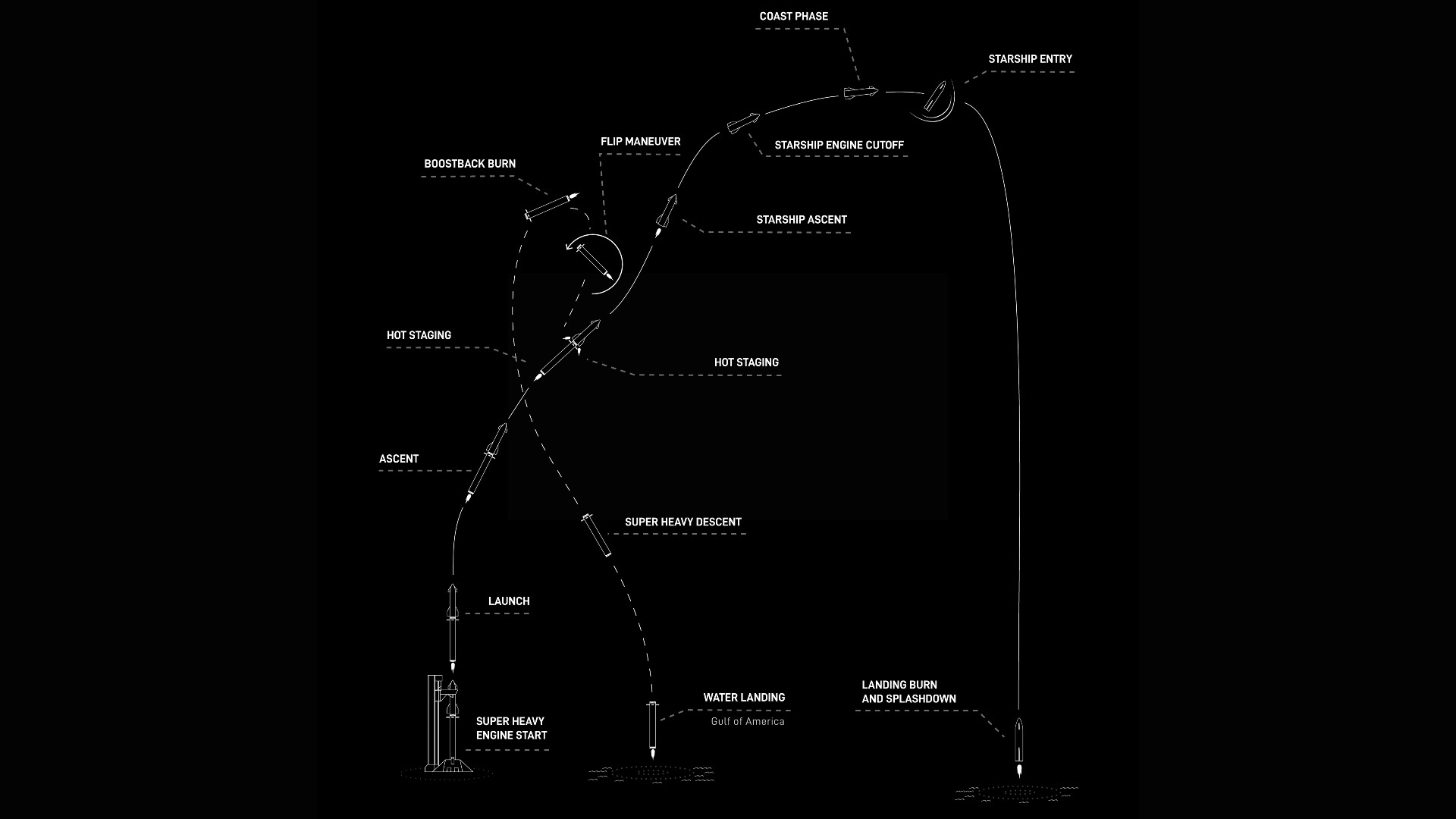
A diagram showing SpaceX's Flight 13 Starship mission profile. The flight should last just over 1 hour. (Image credit: SpaceX)
SpaceX's Starship Flight 13 test flight will last just over 1 hour and 5 minutes and should follow the same mission profile as the company's last test, Flight 12, in May. This will be the second flight of SpaceX's new Starship Version 3, or V3.
During Flight 12, the giant Super Heavy booster stage failed to return to Earth properly for a controlled landing and splashdown in the Gulf of Mexico (which the Trump Administration has renamed the Gulf of America). Instead, the booster crashed into the ocean.
"The booster’s primary test objective will be executing a successful launch, ascent, stage separation, boostback burn, and landing burn at an offshore landing point in the Gulf of America," SpaceX wrote in a mission overview. "There have been several modifications to hardware and software to address issues seen on the previous flight."
Starship Flight 13 will launch from SpaceX's new Pad 2 at Starbase, which the company upgraded with shorter, faster "chopsticks" — capture arms that can catch returning Starship Super Heavy boosters and Ship upper stages during landing, as well as lift vehicles into place on the pad for launch. Check out our full overview on how SpaceX changed Starship for V3 here.
SpaceX Starship Flight 13 Launch Timeline
TIME (Hr:Min:Sec)
EVENT
T-0:50:00
Flight director polls for fueling
T-0:37:30
Ship liquid oxygen loading begins
T-0:37:00
Super Heavy liquid oxygen loading begins
T-0:35:25
Super Heavy liquid methane loading begins
T-0:34:48
Ship liquid methane loading begins
T-00:21:30
Raptor engine chilldown begins on Ship and Super Heavy
Super Heavy landing burn shutdown (followed by splashdown)
T+08:05
Starship engine cutoff
T+16:40
Payload deploy demo starts
T+27:29
Payload deploy demo complete
T+38:58
Ship engine relight demonstration
T+47:30
Ship reentry
T+01:02:23
Ship transonic
T+01:03:01
Ship is subsonic
T+01:05:01
Landing burn start
T+01:05:03
Landing flip
T+01:05:12
Landing burn three to two engines
T+01:05:19
Landing burn two to one engines
T+01:05:26
"An exciting landing!" SpaceX says.
SpaceX will not try to reach orbit with Starship Flight 13 or return its Ship back to Earth for a capture at the launch pad. Instead, both vehicles aim to make controlled descent and water landings, before falling over and sliding into the sea.
While the Super Heavy booster will splash down in the Gulf of Mexico off the coast of Boca Chica, the Ship upper stage will follow a suborbital trajectory for a target splashdown in the Indian Ocean off the coast of Western Australia.
During the flight, the Ship vehicle will attempt to deploy 20 Starlink V3 satellites, the company's newer and larger satellite-internet units, but they won't reach orbit. They will follow Starship's suborbital trajectory back down to Earth and burn up in the atmosphere.
Six of the Starlink V3 satellites are equipped with cameras to record live views of Starship and its heat shield and beam them back to Earth for analysis.
"For the first time, Starship will carry V3 Starlink satellites to space, which aim to greatly expand the network's capacity and user speeds. As part of this initial test, Starship is planned to deploy 20 satellites which will extend solar arrays and antennas and will attempt to connect with the larger Starlink constellation via high-capacity lasers," SpaceX wrote in the mission overview. "The Starlink satellites will be on the same suborbital trajectory as Starship and are expected to demise upon reentry approximately 20 minutes after deployment."
What if Starship Flight 13 can't launch?
If SpaceX can't launch Starship Flight 13 on July 20, the company likely has multiple backup opportunities. So, if bad weather or another technical issue delays launch, SpaceX could try again in the coming days.
Whichever date SpaceX launches Starship Flight 13, you will be able to follow the mission on Space.com. Be sure to return to Space.com on launch day for complete Starship Flight 13 coverage.
Editor's note: This story was updated at 1:15 p.m. ET on July 17 with the new target launch date of July 20.
SpaceX reached a milestone with its latest Starlink launch, sending the satellites into orbit on its 600th flight of a flight-proven booster.
The sexacentennial launch came on the second of two Falcon 9 missions that lifted off less than eight hours apart overnight from Monday to Tuesday (July 13 to July 14). The first flight, with Starlink batch 15-14, launched at 9:28 p.m. EDT (0128 GMT or 6:28 p.m. PDT local time) from Space Launch Complex 4 East at Vandenberg Space Force Base in California.
Both flights also successfully recovered their Falcon 9 first stage boosters. B1093, launched from Florida, completed its 15th flight. B1080, launched from California, achieved its 28th mission. The record for a single Falcon 9 first stage's re-flight stands at 36 launches.
The addition of 56 more Starlink satellites to SpaceX's megaconstellation brought the total active number of broadband internet relay units to 10,839, according to tracker Jonathan McDowell.
In addition to Tuesday's launch being the 600th launch of a flight-proven Falcon 9 stage, SpaceX now stands at 83 Falcon 9 missions this year to date.
Titan’s resources could one day make Saturn’s largest moon a major outpost for deep space exploration. Titan is one of the few places in the Solar System where the landscape can feel strangely familiar and completely alien at the same time. Saturn’s largest moon has weather, clouds, rain, lakes, and seas, but its cycle is [...]
SpaceX's next Starship test flight aims to achieve a major milestone by deploying 20 upgraded Starlink satellites, marking the first Starlink Version 3s to deploy in space..
Liftoff for the spacecraft’s upcoming 13th test flight was originally scheduled for Wednesday (July 16) from the company's Starbase facility in South Texas. That attempt was aborted at the last second, however; SpaceX is now targeting Monday (July 20), during a 90-minute window that opens at 6:45 p.m. EDT (2245 GMT; 5:45 p.m. local Texas time).
You can watch the launch live on Space.com, courtesy of SpaceX, beginning 30 minutes before liftoff. Follow our Starship live blog for more mission updates.
SpaceX's Starship megarocket launches on its 12th test flight, on May 22, 2026. (Image credit: SpaceX)
The mission follows a nearly two-month pause after Flight 12 ended with the loss of the Super Heavy booster during its return to the Gulf after stage separation. After reviewing the anomaly and SpaceX's corrective actions, the Federal Aviation Administration cleared the company to resume Starship launches.
“The upcoming flight will aim to complete similar objectives targeted on the previous flight test, which debuted the Starship and Super Heavy V3 vehicles, while also carrying next-generation Starlink V3 satellites for the first time,” SpaceX officials said in a statement announcing the test flight.
As with previous flights, Flight 13's primary goal is to gather engineering data while testing upgrades to the world's most powerful rocket. Here's what to watch for:
The mission will begin with all 33 Raptor 3 engines igniting on the Super Heavy booster, generating up to 18 million pounds (about 8,200 metric tons) of thrust at liftoff. About 2.5 minutes later, the booster will separate from the Starship upper stage and begin its return toward the Gulf of Mexico for a controlled splashdown rather than a launch tower catch. SpaceX is continuing to refine its booster recovery procedures following Flight 12's landing burn failure.
Even if you can't see SpaceX's Starship in person, you can score a model of your own. Standing at 13.77 inches (35 cm), this is a 1:375 ratio of SpaceX's Starship as a desktop model. The materials here are alloy steel and it weighs just 225g.View Deal
One of Flight 13's biggest milestones will come after stage separation, when Starship is expected to deploy 20 Starlink V3 satellites for the first time. The satellites are designed to test Starship's payload deployment capabilities and will intentionally reenter Earth's atmosphere after completing the demonstration rather than remain in orbit.
The flight will also continue testing SpaceX's upgraded Starship vehicle, including improvements to its propulsion system, avionics and overall performance. Engineers will closely monitor the rocket throughout ascent to evaluate how the latest design performs under flight conditions.
After completing its satellite deployment, Starship will continue along a suborbital trajectory before reentering Earth's atmosphere over the Indian Ocean. The spacecraft's descent will provide additional data on its heat shield, flight controls and guidance systems before ending with a planned splashdown roughly an hour after launch.
While Flight 13 remains another developmental mission, it represents an important step toward making Starship an operational launch vehicle. Successfully deploying Starlink satellites would demonstrate the rocket's ability to begin carrying real payloads while continuing to advance SpaceX's goal of building a fully reusable system for missions to Earth orbit, the moon and eventually Mars.
Editor's note: This story was updated at 1:15 p.m. ET on July 17 with the new target launch date of July 20.
SpaceX's massive Starship, the world's largest and most powerful rocket, was scheduled to launch its critical test flight on Thursday, July 16, at 6:45 p.m. EDT (2245 GMT) from Starbase, Texas. The mission was scrubbed at the very end of the countdown. SpaceX is now targeting July 20 for Starship Flight 13.
You can see our latest updates on the Starship V3 (short for Version 3) rocket, including its test flight goals, system upgrades and more. Flight 13 is the 13th test launch of the Starship vehicle since 2023.
Even if you can't see SpaceX's Starship in person, you can score a model of your own. Standing at 13.77 inches (35 cm), this is a 1:375 ratio of SpaceX's Starship as a desktop model. The materials here are alloy steel and it weighs just 225g.View Deal
SpaceX targeting July 16 for Starship Flight 13
The next Starship launch has arrived!
SpaceXis targeting no earlier than July 16 for the next launch of its massive Starship rocket, the company announced on in a post on X. Flight 13 will be the second launch of the vehicle's Version 3 configuration and will be similar in profile to Flight 12. It will be the second launch for Starship "Version 3" (V3), a bigger, more powerful upgrade from previous Starship designs, and will come a little less than two months after V3's debut.
A 90-minute launch window will begin on Thursday at 6:45 p.m. EDT (2245 GMT). A livestream of the mission will begin about 30 minutes prior to liftoff and stream on the company's mission page, profile on X and here on Space.com.
Following a static fire engine test last Friday (July 10), SpaceX has lowered the Flight 13 Super Heavy, Booster 20, from the launch stand and transported the stage back to its hangar at the company's Starbase, Texas, facility.
The booster will roll back to the pad in the next day or so, along with Ship 40, the Flight 13 Starship upper stage. The pair will be stacked a Starbase's pad 2, where it's expected the rocket will undergo at least one additional engine test prior to launch.
SpaceX is still targeting July 16 for liftoff of Starship's 13th test flight, scheduled to get off the ground during a 90-minute window that opens at 6:45 p.m. EDT (2245 GMT).
SpaceX readying Starship to launch in just over 24 hours
(Image credit: Background: SpaceX, clock added in Canva Pro)
Starship's next big test launch is just a day away.
SpaceX has transported Booster 20, the Super Heavy first stage for the massive launch vehicle, back to pad 2 at the company's Starbase facility in Texas. If all goes according to plan, that will be its last relocation before launch, currently scheduled for tomorrow (July 15) during a 90-minute launch window beginning at 6:45 p.m. EDT (2245 GMT).
Ship 40, Starship's upper stage for Flight 13, will be trasnported to the pad today, and stacked on Super Heavy for a full wet dress rehearsal to confirm the vehicle's readiness ahead of tomorrow's launch attempt.
SpaceX's first Starship V3 vehicle launches on a test flight on May 22, 2026. (Image credit: SpaceX)
SpaceX's massive Starship rocket is stacked and ready for this evening's Flight 13 launch. Booster 20, the Super Heavy vehicle supporting the mission, was rolled back to Starbase's pad 2 yesterday, with the upper stage Ship 40 joining the booster overnight, when the two were stacked for (hopefully) the final time before liftoff.
SpaceX is progressing toward a 90-minute launch window that opens today (July 16) at 6:45 p.m. EDT (2245 GMT). The mission can be streamed live here on Space.com, or directly via SpaceX on the Flight 13 website and the company's X account. Read our full mission breakdown for a complete mission profile:
SpaceX has released photos and video of last night's Starship stacking. Super Heavy 20 was rolled back to pad 2 yesterday (July 15), with Ship 40 following its trail after sunset. Both recently completed static test fires of the Raptor 3 engines, followed by final prelaunch checkouts back at their respective hangars.
Now that both have been transported to the launch pad and stacked, SpaceX is preparing the rocket and ground infrastructure for liftoff.
The Flight 13 launch window opens at 6:45 p.m. EDT (2245 GMT), and will last for up to 90 minutes.
Stacking Starship for Flight 13 pic.twitter.com/L4XN6gqgRtJuly 16, 2026
Starship Flight 13 on track for launch
Starship Flight 13, with Booster 20 and Ship 40 stacked at Starbase pad 2 on July 16, 2026. (Image credit: SpaceX)SpaceXSpaceXSpaceX
SpaceX is moving ahead today with Starship Flight 13, according to a post on the company's social media page. Beach and road closures around Starbase close to the public this afternoon around 1:30 p.m. EDT (1730 GMT), clearing all but essential personnel from the surrounding facility.
A 90-minute launch window will open at 6:45 p.m. EDT (2245 GMT), with several opportunities for teams to reset if liftoff doesn't occur at the top of the window. SpaceX's livestream is expected to begin about 30 minutes before launch, and will be simulcast here on Space.com.
On track for Starship’s 13th flight test later today – the 90-minute launch window opens at 5:45 p.m. CT. Live coverage starts ~30 minutes before launch https://t.co/QF9Qolqlvp pic.twitter.com/9drzTb14C0July 16, 2026
SpaceX Straship Flight 13 launch stream is live
Live coverage has begun for SpaceX's Starship Flight 13! You can watch the action and follow along with live updates here, and on the Space.com homepage. SpaceX's direct stream is available on the company's website.
Liftoff is currently set for 6:45 p.m. EDT (2245 GMT), with a launch window that extends to 8:15 p.m. EDT (0015 GMT, July 17).
Super Heavy booster propellant load had begun
(Image credit: SpaceX)
SpaceX has begun loading cryogenic fuel into the Super Heavy booster at Starbase's pad 2. Starship uses a mixture of liquid methane and liquix oxygen, together known as "methalox," to power both Super Heavy and Ship stages of Starship.
SpaceX is fueling Starship for Flight 13 right now, and is not tracking any issues as the opening of the launch window approaches. The day began with a 90% probability of favorable launch conditions, according the SpaceX livestream host Dan Huot, who is voicing confidence in the success of today's mission.
According to SpaceX commentators, success on today's mission will open the door for "near future orbital flights" and the first-ever attempt to catch Starship's Ship upper stage using the launch tower at Starbase's pad 2.
Barring any delays in fueling or weather constraints, Starship is scheduled to lift off at 6:45 p.m. EDT (2245 GMT). The launch window extends for 90 minutes.
T-1 minute to launch!
(Image credit: SpaceX)
SpaceX has entered the terminal count for Starship! Just one minute to go until Starship Flight 13 liftoff! Let's go!
SCRUB
Starship's onboard systems initiated and automated aboard at T-0. (Image credit: SpaceX)
SpaceX's Starship Flight 13 is scrubbed for the day.
At T-0, the rocket's automated flight computer initiated a hold and abort call. It isn't immediately clear what caused the abort, but its execution so far into the countdown means a scrub for the day. "We did trigger a hold on the booster that aborted our liftoff as we were starting to light those Raptor engines," SpaceX livestream host Dan Huot said.
"At this point," Huot said as the coverage ended, "they're going to get into [propellant] offload. We're gonna get all the methane, all the oxygen off the vehicle, and then we'll figure out next steps."
A new launch date for Starship Flight 13 has not been determined.
SpaceX assessing new launch date
The 33 Raptor 3 engines on Starship's Super Heavy booster seen from beneath the Starbase pad 2 launch stand on July 16, 2026. (Image credit: SpaceX)
Following the last-second scrub of last night's Starship Flight 13 launch, SpaceX stood down from Thursday's launch attempt.
It was not immediately clear what caused the automated abort, but SpaceX CEO Elon Musk posted to social media shortly after the launch was called off, saying a failure of a few of Straship's Raptor 3 engines failed to light at ignition. "Next launch attempt hopefully in a few days," Musk said in a post.
He clarified later yesterday evening, saying, "To be confident of a good flight, 2 Raptors will be removed & replaced. Most probable launch timing is early next week."
To be confident of a good flight, 2 Raptors will be removed & replaced. Most probable launch timing is early next week.July 17, 2026
SpaceX targeting July 20 for Starship Flight 13 test launch
We have a new (tentative) launch date: After a last-second abort scuttled SpaceX's first attempt to launch Starship Flight 13 yesterday (July 17), the company is now targeting no earlier than Monday (July 20) for the liftoff. The 90-minute launch window opens at 6:45 p.m. EDT (2245 GMT; 5:45 p.m. local time).
You can watch the launch here at Space.com when the time comes and learn about the mission in our Flight 13 preview.
Yesterday's abort was triggered when several of the 33 Raptor engines on Starship's first-stage booster failed to ignite as planned, according to SpaceX founder and CEO Elon Musk. "To be confident of a good flight, 2 Raptors will be removed & replaced," Musk said via X, the social media platform he owns, shortly after yesterday's abort.
July 20 is a very meaningful date in spaceflight history, by the way. Apollo 11 landed on the moon on July 20, 1969, and NASA's robotic Viking 1 lander touched down on Mars exactly seven years later.
The International Space Station has three new residents.
NASA's Anil Menon and cosmonauts Pyotr Dubrov and Anna Kikina lifted off atop a Russian Soyuz rocket from Baikonur Cosmodrome in Kazakhstan at 10:47 a.m. EDT (1447 GMT; 7:47 p.m. local time in Baikonur), heading toward the orbiting lab.
Their Soyuz executed nominal side booster separation about two minutes after launch, followed by second stage separation about 2.5 minutes later, as the rocket flew at 105 miles (169 kilometers) in altitude. Third stage orbital insertion and separation was completed at about 8 minutes and 46 seconds, putting Russia's Soyuz MS-29 spacecraft and crew on course to chase down the International Space Station (ISS).
A Soyuz rocket launches NASA astronaut Anil Menon and cosmonauts Pyotr Dubrov and Anna Kikina toward the International Space Station from Baikonur Cosmodrome on July 14, 2026. (Image credit: Roscosmos/NASA)
The trio caught up to the ISS after just two orbits, docking with the outpost at 1:52 p.m. EDT (1752 GMT). The two spacecraft were flying 260 miles (418 kilometers) above the Mediterranean Sea at the time, NASA officials said during the agency's docking webcast.
That webcast will resume at 3:30 p.m. EDT (1930 GMT) ahead of the opening of the hatches between the Soyuz and the ISS, which is expected around 3:55 p.m. EDT (1955 GMT).
The MS-29 trio will join the seven astronauts already living aboard the ISS — NASA's Jessica Meir, Jack Hathaway, and Chris Williams, the European Space Agency's Sophie Adenot, and Sergey Kud-Sverchkov, Sergei Mikaev, and Andrey Fedyaev of the Russian space agency Roscosmos.
NASA astronaut Anil Menon (left) and Roscosmos cosmonauts Pyotr Dubrov and Anna Kikina, Soyuz MS-29 prime crew members, pose for a portrait at the Gagarin Cosmonaut Training Center in Russia. (Image credit: GCTC)
This is the first spaceflight for Menon, who was selected as a NASA astronaut candidate in December 2021, in the agency's Group 23. He's married to Anna Menon, who was picked in the next astronaut candidate class, Group 24, in September 2025.
Anna Menon has already been to space, though not with NASA. In September 2024, while an employee of SpaceX, she flew on the company's Polaris Dawn mission to Earth orbit. That five-day flight, which was funded and commanded by current NASA Administrator Jared Isaacman, featured the first-ever commercial spacewalk and reached a maximum altitude of 870 miles (1,400.7 kilometers) — higher than any previous crewed Earth-orbiting mission had gotten.
Anil Menon is a former SpaceX-er as well; he was the company's first-ever flight surgeon.
MS-29's flight is the second-ever space mission for both Dubrov and Kikina. Dubrov lived aboard the ISS from April 2021 to March 2022, and Kikina spent five months on the outpost, from October 2022 to March 2023.
Kikina, the only female member of Russia's active astronaut corps, flew to and from the ISS back then on SpaceX's Crew-5 mission. That was a big deal: She was the first Russian ever to fly on a private U.S. spacecraft, and the first cosmonaut to fly on any American space vehicle since December 2002, when cosmonauts Valery Korzun and Sergey Treshchov came back to Earth from the ISS aboard the space shuttle Endeavour.
The MS-29 trio will spend about eight months living and working on the orbiting lab. Menon will help conduct a wide variety of scientific experiments during that stretch.
"He will continue research to refine in-space production of semiconductor crystals to enable the large-scale manufacturing of components needed for high-performance computers, artificial intelligence, and improved medical devices," NASA officials wrote in a July 9 media advisory.
"Menon also will perform ultrasoundusing augmented reality and artificial intelligence methods that could eliminate the need for medical support from Earth on future space missions," they added.
Editor's note: This story was updated at 1:55 p.m. ET with news of successful docking.
The assembly of NASA's next Artemis rocket is well underway, with the recent arrival of one of the launch vehicle's solid fuel booster sections to the agency's integration facility at Kennedy Space Center in Florida.
The bottom segment of the left-hand solid rocket booster (SRB) that will help launch Artemis III was transported to KSC's Vehicle Assembly Building (VAB) this week, according to a NASA social media post. It's one of two SRBs that will be affixed to either side of NASA's Space Launch System (SLS) rocket, which together provide a combined 7.2 million pounds of force — more than 75% of the rocket's power at liftoff.
"Soon, assembly of the rocket will begin as we prepare to send crew aboard Orion to test the rendezvous and docking capabilities needed for future lunar landings," the NASA post said.
It took about one year for NASA to stack the Artemis II SLS once each of the rocket's components were delivered to the VAB. The same timeline gives Artemis III a small amount of wiggle room, as it progresses toward a targeted launch in mid-to-late 2027 — and stacking of the entire rocket may not begin immediately.
The Artemis III SLS core stage arrived in the VAB in May. Unlike the core stage's arrival for Artemis II, Artemis III's was delivered without the engine section. Once that's attached, it may be some time before other components are stacked onto the main vehicle. NASA Administrator Jared Isaacman has said that the agency aims to complete a wet dress rehearsal on the rocket before the end of the year. In the meantime, other SLS components and SRB segments will continue arriving at the VAB.
Each SRB stands about 177 feet (54 meters) tall. They're packed with polybutadiene acrylonitrile (PBAN), ammonium perchlorate, and aluminum powder, which bring their combined weight to 3.2 million pounds (1.45 million kg). Unlike liquid-fueled rocket engines, once the SRBs' solid propellants ignite, they cannot be turned off. Without them, the four RS-25 engines on SLS's core stage would not be powerful enough to lift the rocket off the launch pad.
NASANASANASA
Artemis III will be the second crewed mission of the Artemis program — NASA's next-generation push to return astronauts to the moon. And, while Artemis III itself won't actually fly to the moon, it will help progress the hardware and spacecraft technologies the space agency needs to ensure success on future missions to the lunar surface.
Like Artemis II, which flew four astronauts on a 10-day mission around the moon in April, the Artemis III astronauts will launch on SLS aboard the Orion spacecraft — but they won't fly beyond low Earth orbit this time. Instead, the four-person crew will spend about two weeks testing out rendezvous and docking procedures with prototypes for the two Artemis moon landers, both of which have been privately contracted by NASA.
Big move for @NASAArtemis III!The left-hand aft assembly solid rocket booster segment for NASA’s Space Launch System arrived at the Vehicle Assembly Building at Kennedy Space Center. This segment is part of one of two boosters that will provide more than 75% of the rocket’s… pic.twitter.com/L7k4Qh3Jn9July 8, 2026
The space agency has partnered with SpaceX and Blue Origin for those vehicles, each of which is expected to launch once the Artemis III crew are on orbit. They'll first meet up with Blue Origin's lander, Blue Moon. After docking, the astronauts will have the opportunity to enter Blue Moon's crew cabin, where they will also have the chance to test parts of the Artemis extravehicular activity (EVA) suit designed for astronauts to wear on the lunar surface.
A rendezvous with SpaceX's Starship will follow Orion's stint with Blue Moon. SpaceX has indicated it will fly a boilerplate Starship V3 (Version 3) vehicle equipped with a docking adapter, but it will not have a crew cabin. V3 is SpaceX's newest version of Starship, which has been upgraded for high launch efficiency and capacity, but it will lack a fully developed life support system in time for the Artemis III launch next year.
If all goes according to plan and NASA is able to maintain its current mission timeline, the first moon landing of the Artemis program will take place on Artemis IV, scheduled to launch in late 2028.

 Login