❌

Normal view

This ball of stars named Terzan 5 may be one of the Milky Way's original building blocks

22 June 2026 at 22:00

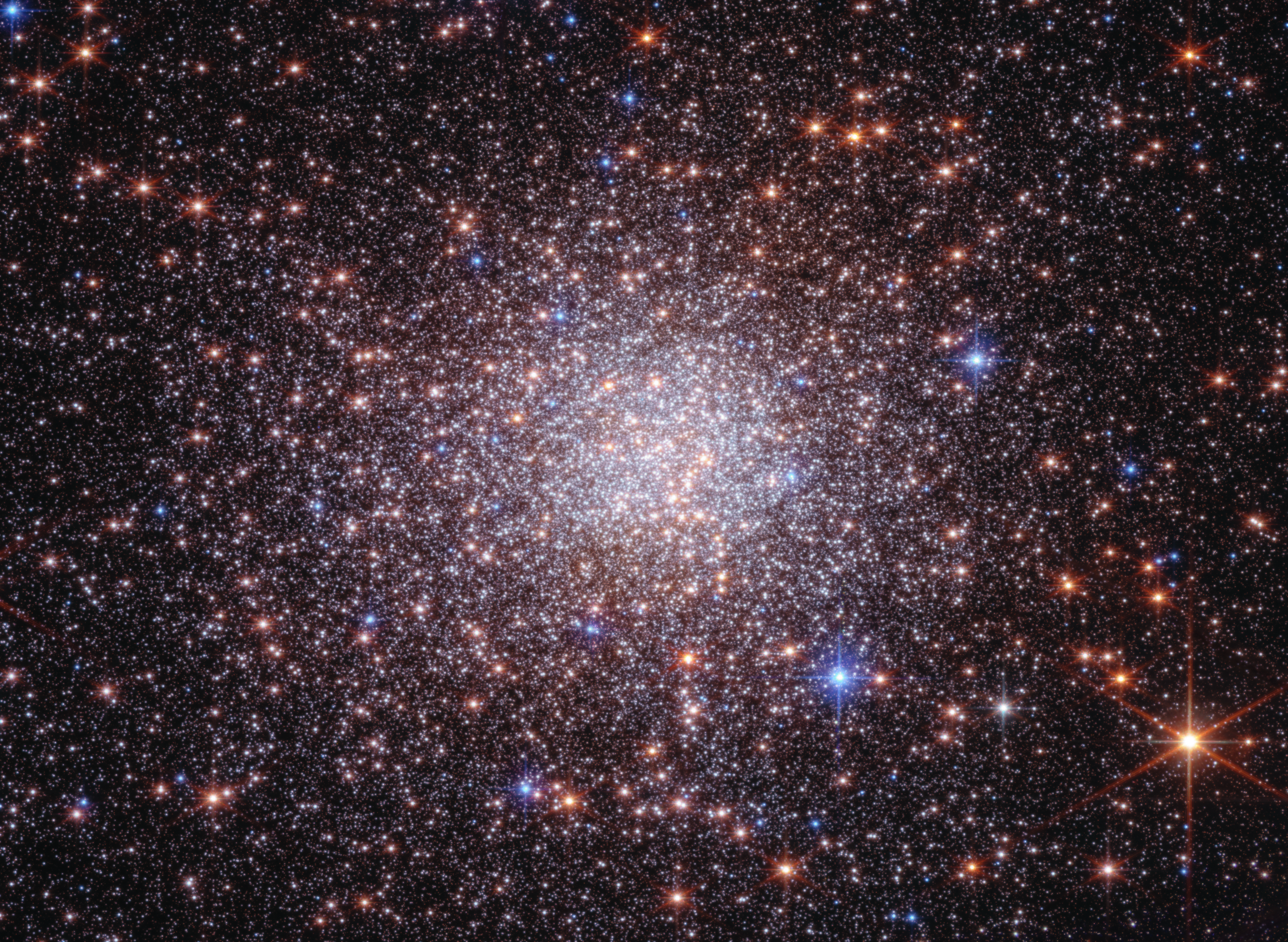
A huge, shining bauble of stars called Terzan 5 could be a clump of our galaxy's central bulge that hasn't been smoothed out into the mix, and has instead survived as a fossil relic leftover from the birth of the Milky Way galaxy.

"Terzan 5 may provide direct evidence that can help explain how bulges formed in galaxies throughout the universe," said Barbara Lanzoni of the University of Bologna in a statement. Lanzoni is a member of a team of astronomers, led by Bologna colleagues Giorgia Zullo and Francesco Ferraro, who tackled Terzan 5 with the James Webb Space Telescope (JWST).

Terzan 5 is a globular cluster — a huge sphere of stars with a total mass two million times greater than our sun's and a total luminosity 800,000 times greater. The problem is, Terzan 5 lies about 18,800 light-years away in the bulge of the Milky Way galaxy. This means dense lanes of intervening galactic dust block our view, significantly dimming Terzan 5's apparent brightness. That's why it wasn't discovered until 1968 by the Turkish–French–Armenian astronomer Agop Terzan.

Globular clusters tend to be ancient. They also tend to have formed all their stars in one giant burst. As such, all their stars should be the same age, 12 to 13 billion years old. Yet, a select few globular clusters show evidence of having more than one generation of stars. These include Omega Centauri, NGC 2808 and NGC 1783 in the Milky Way galaxy, as well as NGC 411 in the Small Magellanic Cloud and NGC 1696 in the Large Magellanic Cloud. Several explanations have been put forward, including the possibility that they are the core remnants of dwarf galaxies that have been stripped of most of their stars by gravitational tidal forces emanating from the Milky Way. Or perhaps these clusters were simply massive enough to retain some molecular gas for future stellar generations.

When the Hubble Space Telescope took a look at Terzan 5 in 2009 and then again in 2016, it found that it too was among the ranks of weird globular clusters with two generations of stars, dating back 12.5 and 4.7 billion years. However, because it is behind so much galactic dust, not even Hubble has the clearest of views.

The JWST, however, does. Its near-infrared vision can see through the dust.

"Webb's new near-infrared observations, cross-referenced with Hubble's archival observations, have given us a much clearer picture of the history of Terzan 5," said study leader Giorgia Zullo, who is a Ph.D. student at Bologna.

The JWST detected two further generations of stars, one generation born 3.8 billion years ago and another 2.5 billion years ago. Four generations of stars is hard to explain for any globular cluster, which is why the team think that Terzan 5 could be something more primordial: a leftover building block of the Milky Way's bulge that was never quite assimilated by our galaxy.

"For some reason, this peculiar clump of stars formed separately from the bulge and was not destroyed as the bulge itself formed," said Ferraro. "Terzan 5 is what we now call a bulge fossil fragment because it resembles the primordial clumps that contributed to the formation of the bulge."

Disk galaxies sport two main components: a relatively narrow disk formed from spiral arms, and a bulbous core called the bulge. Galactic bulges tend to be the oldest parts of galaxies, forming billions of years before the disks, at least in the Milky Way's case. The JWST is seeing this process occurring in the early universe, revealing clumpy, young galaxies, but given the great expanse of space and time that JWST is looking across, the observations of the building blocks that go into making these galaxies are still not totally clear. With Terzan 5, we could be looking at one of the building blocks of the Milky Way's bulge relatively close-up, and it could provide new insights into the birth of our galaxy.

An artist's impression of the James Webb Space Telescope flying through space against a star strewn deep blue sky featuring nebula clouds.

An artist's impression of the James Webb Space Telescope. (Image credit: NASA, ESA, CSA, Northrop Grumman)

Terzan 5 is probably not the only bulge fossil fragment either. As well as those other aforementioned globular clusters, some of which might be fossil fragments and others might be the cores of dwarf galaxies, the globular cluster Liller 1 close to the center of our galaxy shares many of Terzan 5's properties, including its high abundance of heavy elements produced by multiple generations of stars that have died either in supernova explosions.

The team are now looking to chase up another 40 or 50 globular clusters in the bulge to see if they could also be bulge fossil fragments, or whether they are just regular globular clusters.

The findings were presented at the 248th meeting of the American Astronomical Society in Pasadena, California which took place between June 14 and June 18. A paper describing the JWST observations has also been published in the journal Astronomy & Astrophysics.
Our sun is destined to 'kick and spit' its way across the solar system when it dies

22 June 2026 at 15:00

Scientists have discovered that dying stars don't go down without a fight. New research suggests that when stars like the sun enter their red giant phase, they spit out blobs of plasma and receive a corresponding "kick" in the opposite direction.

Stars become red giants when the hydrogen in their cores is exhausted, and that core collapses. This results in the outer layers of the star where nuclear fusion is still occurring, puffing out and expanding the star's radius to as much as 100 times its original size. Those outer layers are eventually lost altogether, leaving behind a dense stellar remnant known as a white dwarf. The sun itself will undergo this transformation in around 5 billion years, swelling out to around the orbit of Mars and engulfing the inner rocky planets, including Earth.

California Institute of Technology researcher Jim Fuller calculated that before a star becomes a white dwarf, it will receive around 10,000 little kicks over the course of hundreds of thousands of years. The cause of these kicks is the ejection of blobs of plasma from the red giant stars.

"In this model, blobs of matter are chaotically being ejected from the surface of the bloated stars in an asymmetric fashion," Fuller said in a statement. "And every time that happens, the star gets a little kick in the opposite direction. Like Newton said, for every action there is an equal and opposite reaction."

The blobs of plasma will be chaotically ejected in random directions, but this will still result in an overall net push on the red giant, a phenomenon mathematicians call a "random walk." This is akin to randomly flipping a coin to decide whether to move north or south and still eventually finding yourself moved from your starting position.

Fuller determined that for a red giant, this random walk would see a movement in a random direction at a speed of around 2,200 mph (3,540 km/h). This may seem like a lot, but it pales in comparison to the kicks received by massive stars that explode as supernovas.

An illustration shows a red giant ejecting plasma and receiving a kick in the opposite direction

An illustration shows a red giant ejecting plasma and receiving a kick in the opposite direction (Image credit: Jim Fuller/Caltech)

The lack of an explosion in the transformation of an average-sized star into a white dwarf makes these events less dramatic, but we have still seen evidence of this happening.

Caltech researcher Kareem El-Badry has previously discovered that widely separated binaries are less common in cases when one star has undergone the transformation into a white dwarf. One possible explanation is that repeated kicks during the red giant phase eventually break apart these loosely bound stellar pairs.

"If the orbital speed of the binaries is less than the kick speed, the wide binaries will become gravitationally unbound," Fuller said. Fuller's model also suggests something that astronomers are yet to see. He predicts that in some cases the kicks received by a red giant could send it pinballing toward a stellar companion, causing a massive explosion when the two collide.

Astronomers could now search the cosmos for such events, the discovery of which would help verify Fuller's model.

Fuller's results were presented at the 248th meeting of the American Astronomical Society in Pasadena. The study has been submitted to the Proceedings of the Astronomical Society of the Pacific.

Stages of Star Formation

18 June 2026 at 17:13
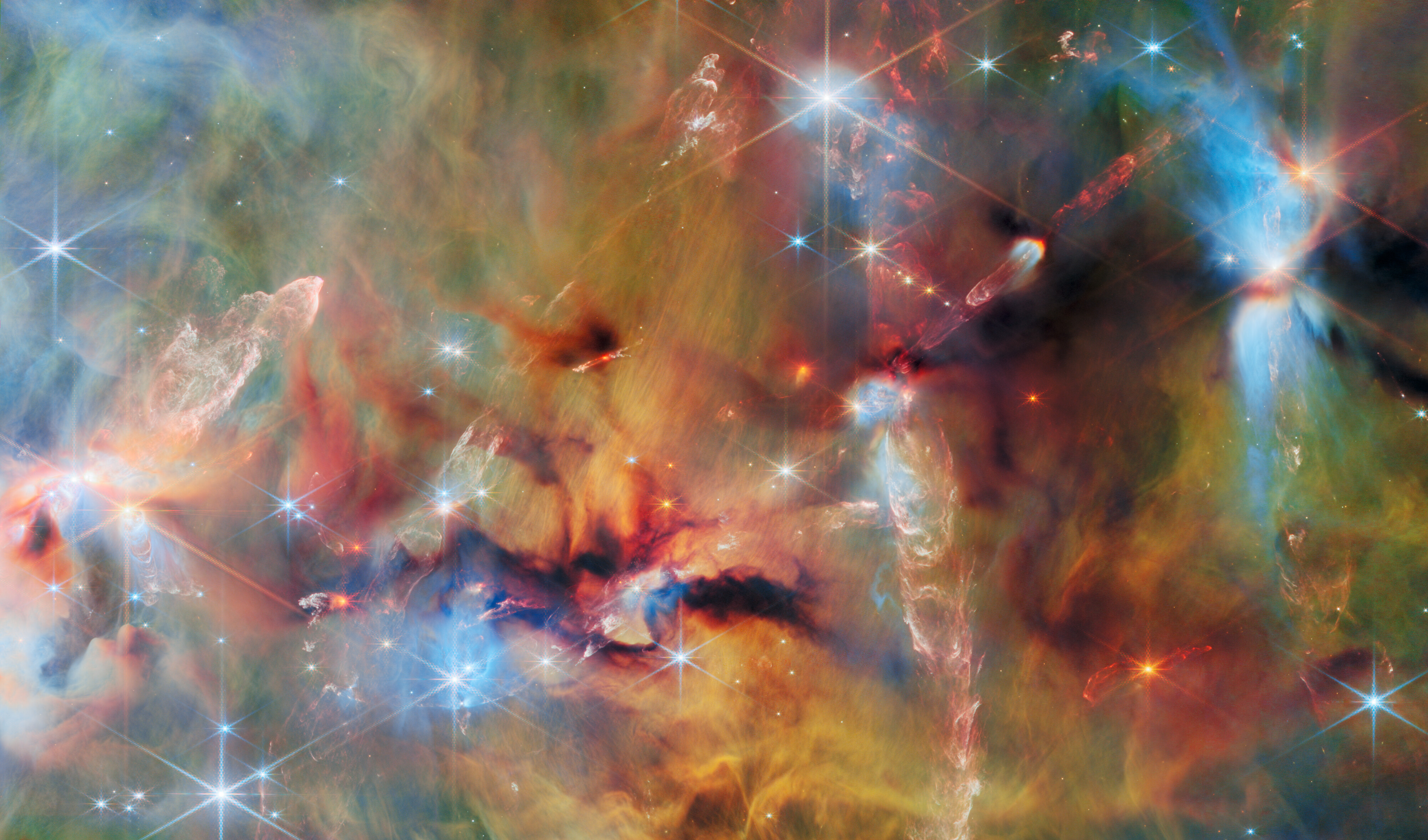
An area inside a star-forming molecular cloud. The background is covered with layers of gas and dust in blue, green and yellowish colors. Thicker clumps of cold dust, dark brown to black, block out light completely. Stars lie among and atop the clouds, from small orange ones to large white or blue ones. Waves and streams of glowing whitish gas are created by jets from protostars colliding with the surrounding material.
This NASA/ESA/CSA James Webb Space Telescope Picture of the Month shows the giant molecular cloud Orion A, an area of the sky replete with star-forming clouds.
ESA/Webb, NASA & CSA, T. Megeath, M. Zamani (ESA/Webb) Acknowledgement: M. H. Özsaraç

This image, captured by NASA’s James Webb Space Telescope and released on June 5, 2026, shows just a small portion of one of the Orion Molecular Clouds, a long and massive filament of cold gas and dust beyond the Orion Nebula. Every stage of star formation — from the youngest stellar embryos to protoplanetary discs to newly-minted pre-main sequence stars — is contained within this scene which stretches 150 light-years across.

Read more about this image.

Image credit: ESA/Webb, NASA & CSA, T. Megeath, M. Zamani (ESA/Webb); Acknowledgement: M. H. Özsaraç

The post Stages of Star Formation appeared first on NASA Science.

Stages of Star Formation

18 June 2026 at 17:13
An area inside a star-forming molecular cloud. The background is covered with layers of gas and dust in blue, green and yellowish colors. Thicker clumps of cold dust, dark brown to black, block out light completely. Stars lie among and atop the clouds, from small orange ones to large white or blue ones. Waves and streams of glowing whitish gas are created by jets from protostars colliding with the surrounding material.
This NASA/ESA/CSA James Webb Space Telescope Picture of the Month shows the giant molecular cloud Orion A, an area of the sky replete with star-forming clouds.
ESA/Webb, NASA & CSA, T. Megeath, M. Zamani (ESA/Webb) Acknowledgement: M. H. Özsaraç

This image, captured by NASA’s James Webb Space Telescope and released on June 5, 2026, shows just a small portion of one of the Orion Molecular Clouds, a long and massive filament of cold gas and dust beyond the Orion Nebula. Every stage of star formation — from the youngest stellar embryos to protoplanetary discs to newly-minted pre-main sequence stars — is contained within this scene which stretches 150 light-years across.

Read more about this image.

Image credit: ESA/Webb, NASA & CSA, T. Megeath, M. Zamani (ESA/Webb); Acknowledgement: M. H. Özsaraç

Sun-like star may have swallowed an exoplanet with help from a mysterious companion: 'You are what you eat, right?'

18 June 2026 at 17:00

Astronomers have a cosmic mystery on their hands, investigating a celestial crime scene to determine if a distant star has eaten a super-Earth exoplanet. The star may have had an accomplice — a failed star or "brown dwarf" companion — which may have steered the unfortunate planet toward its fiery doom.

The team charged with investigating this mystery first discovered hints of the crime when they found the star, TOI-5882, located around 1,300 light-years away, is surprisingly rich in the element lithium.

"You are what you eat, right?" team leader Brooke Kotten of the University of Michigan said in a statement. "We know that there's much more lithium in planetary material than there is in stars. So if a star eats a planet, it's going to take on a bunch of lithium."

So-called engulfment events such as this one occur very rapidly, on a timescale of a few days to a couple of weeks, which means catching stellar beings in the act of enjoying a planetary meal is extremely rare. Thus, astronomers have to act as cosmic crime scene investigators to reconstruct these events with the evidence at hand.

"That's what makes this field so exciting. You really are solving a mystery," Kotten said. "We can't just watch the crime happen, so we have to work with all the clues we're given to figure out whodunit."

One of the aims of these investigations is to discover the ways in which a star can devour a planet. One of the most common engulfment scenarios happens when a star runs out of hydrogen at its core at the end of its main sequence lifetime. This results in it swelling out to up to 100 times its original diameter, engulfing its attendant planets during its so-called red giant phase. This will occur in the solar system in around 5 billion years when the sun will puff out to around the orbit of Mars, swallowing the inner rocky planets, including our own.

However, Kotten and colleagues know this isn't what has happened in the TOI-5882 system, as this star hasn't yet become a red giant. Instead, the researchers think the sun-like star had assistance from its brown dwarf companion.

Companion brown dwarf of partner in crime?

Brown dwarfs get their slightly unfortunate nickname of "failed stars" because, despite forming from collapsing clouds of gas and dust, just like stars, they fail to grow to the masses needed to trigger the nuclear fusion of hydrogen to helium in their cores, the process that defines what a main-sequence star is. They're quite mysterious by existing in this sort of limbo between planet and star.

This particular brown dwarf has around 20 times the mass of Jupiter, or around 2% of the mass of the sun. That's not massive enough to trigger nuclear fusion, but is massive enough for it to have enough of a gravitational influence over planets orbiting TOI-5882. That means the team suspects this brown dwarf could have perturbed the orbit of this unfortunate planet enough to send it plummeting into its star.

This is something the scientists will need to investigate further. They may not have enough information yet to determine this planet's cause of death, but they do have some evidence that helps them identify the kind of world it would have been before it was obliterated. This comes from observations of the chemical composition and lithium content of 62 stars with similar ages and masses to TOI-5882.

"Lithium atoms delivered by planetary engulfment to a star are like sports fans arriving at a stadium," team member Seth Jacobson of Michigan State University said. "There may already be a few early arriving fans present, representing the initial amount of lithium in the stellar atmosphere, but they are quickly outnumbered."

A red glowing orb with a smaller red orb in the background.

An illustration of the lithium-enriched star TOI-5882 with its brown dwarf. (Image credit: Robert Lea (created with Canva))

From the lithium abundance they measured, the team has determined that this planet was a so-called super-Earth with a mass somewhere between two times that of our planet and the mass of the solar-system ice giant Neptune, which is around 18 times as massive as Earth.

"The fact that we can look at a star 1,300 light-years away and say with confidence, 'This star has more lithium than you would expect,' is a testament to both the precision of modern instrumentation and the hard interpretive work that goes into making sense of that signal," said Melinda Soares-Furtado, a senior author of the study and assistant professor at the University of Wisconsin. "And it's not like you have to cherry-pick the data to make it stand out. It's robust. No matter how you slice it, TOI-5882 is so enriched in lithium it shows up as being at least in the 97th percentile."

Soares-Furtado added that TOI-5882 is one of the few stars she has seen demonstrating evidence of planetary engulfment, although a few of the other stars in the control sample were enriched in lithium, albeit not to the extent of TOI-5882. That leaves another mystery for the team to solve, something that Soares-Furtado may well be quite content with.

"When I was growing up, I dreamed about becoming a private investigator," she said. "I think that explains a lot about where I ended up. I do feel like a detective."

The team's research was published on Monday (June 15) in The Astrophysical Journal.

NASA’s Fermi Mission Uncovers Possible Sibling Supernova Remnants

17 June 2026 at 18:15

6 min read

NASA’s Fermi Mission Uncovers Possible Sibling Supernova Remnants

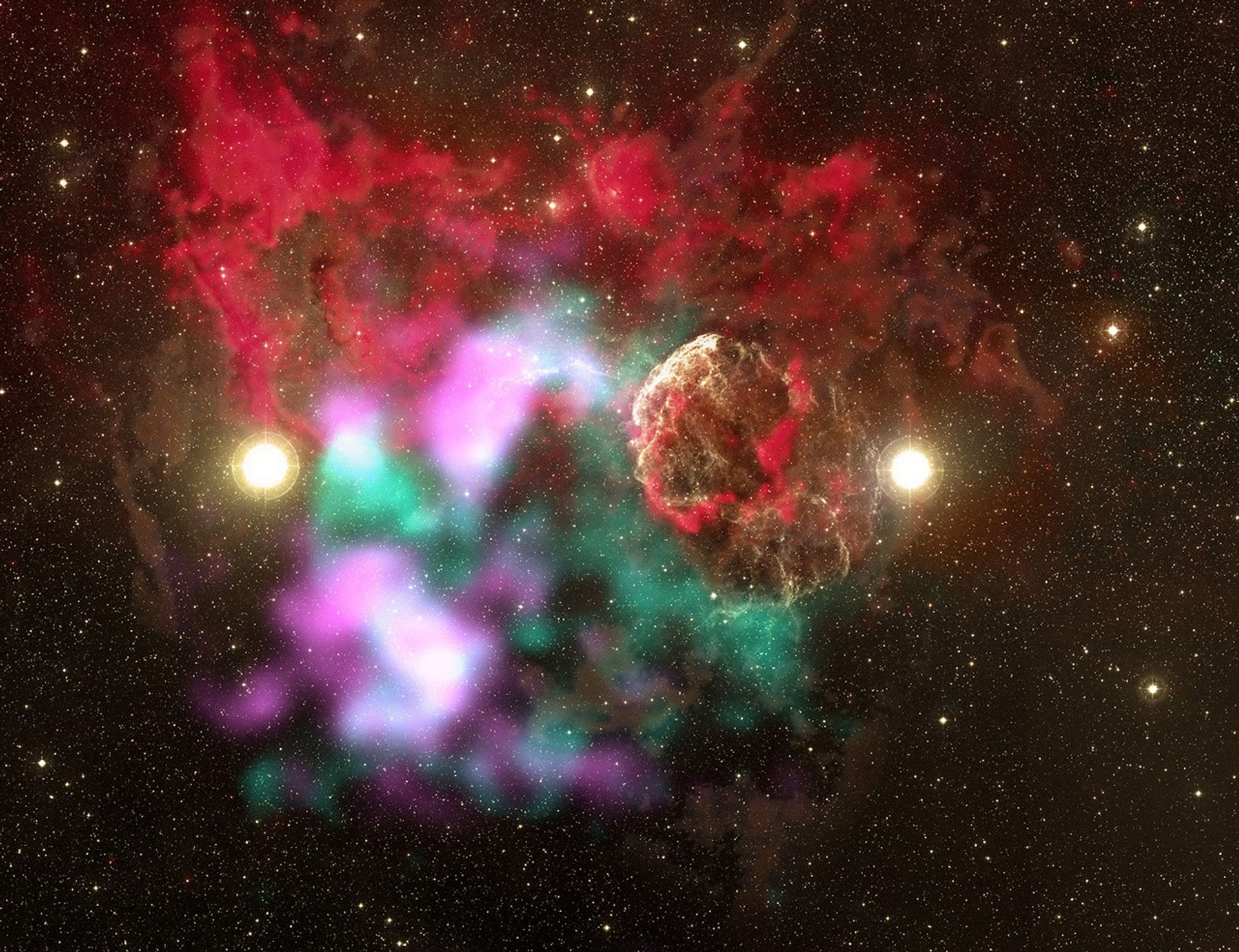
A new study of two supernova remnants, the debris left behind after stars explode, suggests the explosions came from stellar siblings that once orbited each other. The first star’s detonation sent its binary companion hurtling through space, and then, after traveling for thousands of years, the surviving star blew up too.

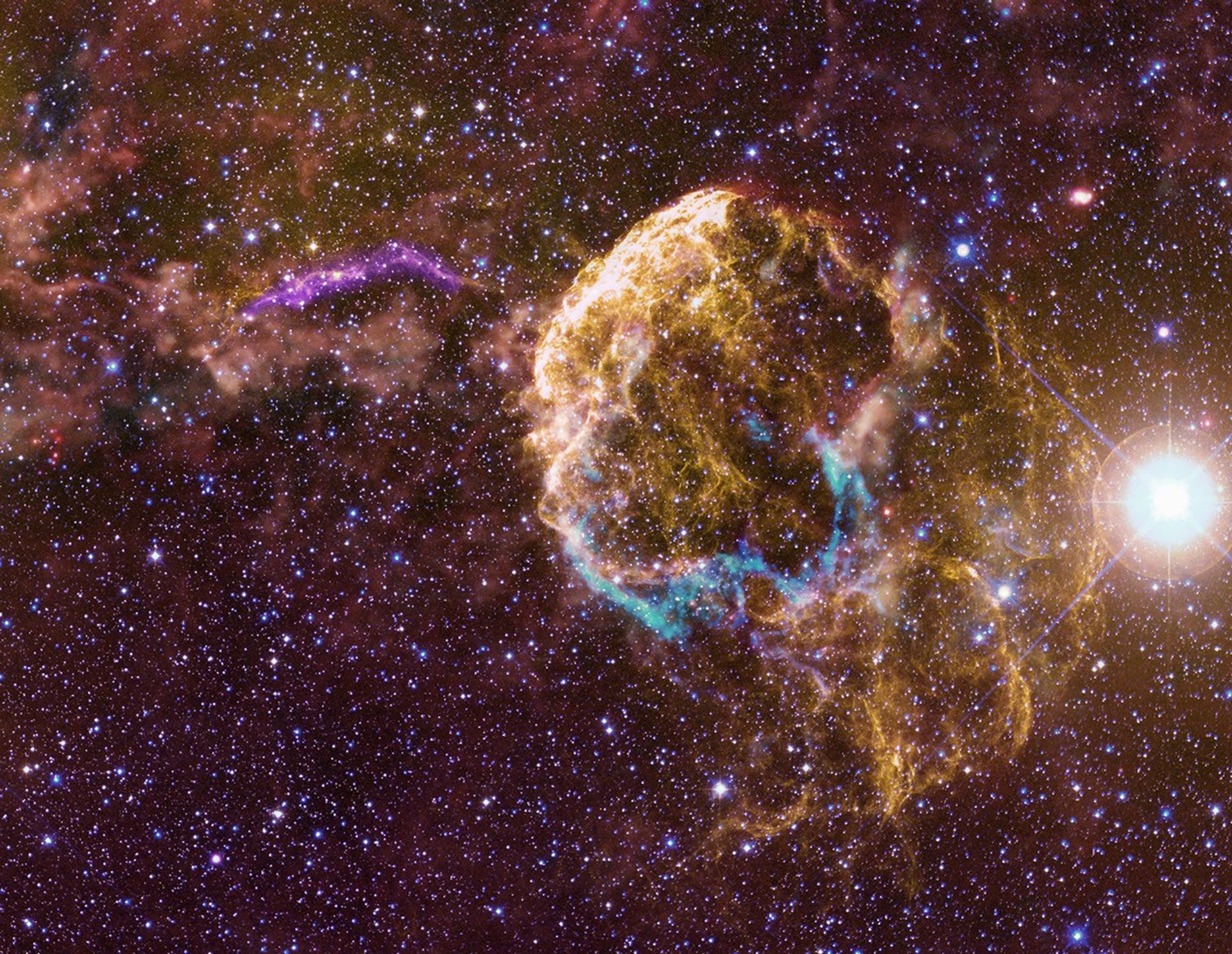
Infrared, visible, and ultraviolet image of the area around the Jellyfish Nebula
This multiwavelength scene shows the Jellyfish Nebula supernova remnant (right), the interstellar cloud it’s interacting with, and a distinctive curving filament to its upper left. The filament, which is shown here both in optical and ultraviolet (UV) light, is the visible part of an overlapping supernova remnant, G189.6+3.3, that is more prominent in radio and X-rays. Visible light is shown in yellow, UV from NASA’s Neil Gehrels Swift Observatory is shown in violet, and infrared light from NASA’s retired WISE (Wide-field Infrared Survey Explorer) mission appears in cyan, red, and orange. Both remnants are located about 6,000 light-years away in the constellation Gemini. The brilliant star at far right is Propus, also known as Eta Geminorum.
NASA Goddard Space Flight Center and M. Michailidis et al. 2026; optical: DSS; infrared: NASA/WISE/JPL-Caltech/UCLA; ultraviolet: NASA/Swift

“Using 16 years of data from NASA’s Fermi Gamma-ray Space Telescope, our analysis uncovered gamma rays associated with a supernova remnant that was hidden in the glare of its neighbor, the Jellyfish Nebula, one of the brightest gamma-ray-emitting supernova remnants known,” said Miltiadis Michailidis, a postdoctoral fellow in the physics department at Stanford University in California. “There are so many striking connections between the two remnants that we conclude they’re likely related, giving us the first known example of a binary system where both stars have undergone supernova explosions.”

Michailidis presented the findings Wednesday at the 248th meeting of the American Astronomical Society in Pasadena, California. A paper describing the results will appear in a future edition of Nature Communications.

The study focused on a faint supernova remnant called G189.6+3.3, which is mainly visible in X-rays. It is upstaged by its brighter and better-known neighbor, the Jellyfish Nebula (IC 443). The two star wrecks, both located in the constellation Gemini, appear to partially overlap as seen in X-rays. Recent X-ray evidence suggests that hot plasma likely associated with G189.6+3.3 may extend across the entire region, a hint that the overlap may be nearly total.

A massive star explodes when its energy-producing core runs out of fuel and collapses under its own weight, triggering an explosion that blows the star apart. The explosion’s shock wave encloses a hot cloud of debris that rapidly expands into space. So far, astronomers have cataloged about 300 supernova remnants in our galaxy.  

The Fermi mission is part of NASA’s fleet of observatories monitoring the changing cosmos to help humanity better understand how the universe works. More than a decade ago, observations from Fermi’s LAT (Large Area Telescope) showed that the shock waves of supernova remnants accelerated particles to within a fraction of the speed of light, a process first proposed by physicist Enrico Fermi — the mission’s namesake — in 1949.

These high-speed particles, called cosmic rays, interact with interstellar gas to produce gamma rays, the highest-energy form of light. Protons make up 99% of cosmic ray particles. To prove that accelerated protons are responsible for the glow, astronomers search for a specific gamma-ray feature. When cosmic-ray protons smash into interstellar gas, they produce a short-lived particle called a neutral pion, which almost immediately decays into a pair of gamma rays. This emission occurs within a specific band of energies associated with the neutral pion’s mass and lies within the range detected by Fermi’s LAT instrument.

In 2013, Fermi observations proved that the Jellyfish Nebula, which is interacting with part of a glowing cloud of hydrogen gas known as Sharpless 249, produced gamma rays through this mechanism. Its neighbor, G189.6+3.3, was discovered in 1994 as part of an X-ray survey by the German-led ROSAT (Roentgen Satellite) mission.

A bright filament of gas lies between the overlapping remnants. New observations of this feature reveal that the shock wave from G189.6+3.3 slammed into dense interstellar gas there and dramatically slowed, key evidence that both remnants are interacting with the same cloud system.

Multiwavelength composite showing high-energy light from the G189 supernova remnant
The well-known supernova remnant IC 443 (right) has an older, fainter neighbor (shown here in blue-green and magenta) called G189.6+3.3. A filament of gas between them, glowing in visible and ultraviolet light (violet arc at center), traces the neighbor’s shock wave and shows that both remnants are interacting with the same molecular cloud, shown in red, orange, brown for infrared and radio data and yellow for visible light. Blue-green shows X-rays from the fainter remnant, while magenta shows gamma rays with energies greater than 10 billion electron volts; for comparison, visible light has energies between about 2 and 3 electron volts. In this view, high-energy light from the much brighter IC 443 has been removed for clarity. Gamma-ray emission near the filament stems from protons accelerated in the supernova’s shock wave as it expands into the cloud.
NASA Goddard Space Flight Center and M. Michailidis et al. 2026; radio, MWISP and ESA/Planck; infrared: NASA/WISE/JPL-Caltech/UCLA; optical: DSS; ultraviolet: NASA/Swift; X-ray: SRG/eROSITA; gamma ray: NASA/DOE/Fermi LAT Collaboration

Astronomers think the Jellyfish Nebula is also a candidate PeVatron, a cosmic particle accelerator capable of boosting protons to energies so high they could nearly escape our galaxy. Such particles can produce gamma rays with trillions of times more energy than visible light. Finding a second particle accelerator near the Jellyfish Nebula could offer scientists new clues for how supernova remnants develop into PeVatrons.

“The overlapping remnants, a connecting gas filament, and the availability of data from Fermi and other facilities motivated us to delve into this complex but little-studied region,” said co-author Marianne Lemoine-Goumard, an astrophysicist at the French National Centre for Scientific Research (CNRS) based at the University of Bordeaux. “With Fermi’s LAT instrument, we found gamma-ray emission associated with accelerated protons in the northern part of the fainter remnant. If both remnants are interacting with the same structure, then they must share a common distance from us.”

The team concludes the remnants lie about 6,000 light-years away, their explosion centers are separated by roughly 40 light-years projected onto the plane of the sky, and the original stars may have been 20 or more times the Sun’s mass.

Estimates of the remnants’ ages vary widely, but the team concludes that the age of the Jellyfish Nebula is 8,000 to 9,000 years, while G189.6+3.3 is between 20,000 to 110,000 years old. This means the delay between the explosions could have extended for up to 100,000 years.

In addition, the team conducted computer simulations of a million massive binary systems. They show that systems where the stars orbit close enough to exchange matter and interact during their lives can readily produce dual supernova explosions with similar separations and time delays as those found for the remnants. The team also estimated that the chance of randomly encountering this combination of observed spatial alignment and compatible distances to be less than 1%, strongly supporting a physical association.

“The evidence we’ve compiled — including observations across the spectrum, the chemical and physical properties of the remnants, simulations, and more — paints a compelling picture of a dual supernova event,” said Michailidis.

This study identifies a unique possible example of a binary system where both stars exploded as supernovae and left behind separate, detectable supernova remnants. Astronomers think that most massive stars form in binary or multiple-star systems. The Jellyfish Nebula/G189.6+3.3 complex offers astronomers a rare opportunity to study how massive binary stars evolve, exchange matter, explode, and experience velocity changes — called kicks — induced by the supernova blast. It also provides a powerful new laboratory for understanding how coupled supernova remnants behave, including how they accelerate particles, generate gamma rays, and shape their surrounding environments.

“Fermi’s gamma-ray observations of supernova remnants continue to reveal the dynamic lives of stars,” said Elizabeth Hays, the Fermi project scientist at NASA’s Goddard Space Flight Center in Greenbelt, Maryland. “We can now connect the glowing remains of two massive stars to a powerful pair that evolved together over thousands of years.”

By Francis Reddy
NASA’s Goddard Space Flight Center, Greenbelt, Md.

Media Contact:
Claire Andreoli
301-286-1940
NASA’s Goddard Space Flight Center, Greenbelt, Md.

NASA’s Fermi Mission Uncovers Possible Sibling Supernova Remnants

17 June 2026 at 18:15

6 min read

NASA’s Fermi Mission Uncovers Possible Sibling Supernova Remnants

A new study of two supernova remnants, the debris left behind after stars explode, suggests the explosions came from stellar siblings that once orbited each other. The first star’s detonation sent its binary companion hurtling through space, and then, after traveling for thousands of years, the surviving star blew up too.

Infrared, visible, and ultraviolet image of the area around the Jellyfish Nebula
This multiwavelength scene shows the Jellyfish Nebula supernova remnant (right), the interstellar cloud it’s interacting with, and a distinctive curving filament to its upper left. The filament, which is shown here both in optical and ultraviolet (UV) light, is the visible part of an overlapping supernova remnant, G189.6+3.3, that is more prominent in radio and X-rays. Visible light is shown in yellow, UV from NASA’s Neil Gehrels Swift Observatory is shown in violet, and infrared light from NASA’s retired WISE (Wide-field Infrared Survey Explorer) mission appears in cyan, red, and orange. Both remnants are located about 6,000 light-years away in the constellation Gemini. The brilliant star at far right is Propus, also known as Eta Geminorum.
NASA Goddard Space Flight Center and M. Michailidis et al. 2026; optical: DSS; infrared: NASA/WISE/JPL-Caltech/UCLA; ultraviolet: NASA/Swift

“Using 16 years of data from NASA’s Fermi Gamma-ray Space Telescope, our analysis uncovered gamma rays associated with a supernova remnant that was hidden in the glare of its neighbor, the Jellyfish Nebula, one of the brightest gamma-ray-emitting supernova remnants known,” said Miltiadis Michailidis, a postdoctoral fellow in the physics department at Stanford University in California. “There are so many striking connections between the two remnants that we conclude they’re likely related, giving us the first known example of a binary system where both stars have undergone supernova explosions.”

Michailidis presented the findings Wednesday at the 248th meeting of the American Astronomical Society in Pasadena, California. A paper describing the results will appear in a future edition of Nature Communications.

The study focused on a faint supernova remnant called G189.6+3.3, which is mainly visible in X-rays. It is upstaged by its brighter and better-known neighbor, the Jellyfish Nebula (IC 443). The two star wrecks, both located in the constellation Gemini, appear to partially overlap as seen in X-rays. Recent X-ray evidence suggests that hot plasma likely associated with G189.6+3.3 may extend across the entire region, a hint that the overlap may be nearly total.

A massive star explodes when its energy-producing core runs out of fuel and collapses under its own weight, triggering an explosion that blows the star apart. The explosion’s shock wave encloses a hot cloud of debris that rapidly expands into space. So far, astronomers have cataloged about 300 supernova remnants in our galaxy.  

The Fermi mission is part of NASA’s fleet of observatories monitoring the changing cosmos to help humanity better understand how the universe works. More than a decade ago, observations from Fermi’s LAT (Large Area Telescope) showed that the shock waves of supernova remnants accelerated particles to within a fraction of the speed of light, a process first proposed by physicist Enrico Fermi — the mission’s namesake — in 1949.

These high-speed particles, called cosmic rays, interact with interstellar gas to produce gamma rays, the highest-energy form of light. Protons make up 99% of cosmic ray particles. To prove that accelerated protons are responsible for the glow, astronomers search for a specific gamma-ray feature. When cosmic-ray protons smash into interstellar gas, they produce a short-lived particle called a neutral pion, which almost immediately decays into a pair of gamma rays. This emission occurs within a specific band of energies associated with the neutral pion’s mass and lies within the range detected by Fermi’s LAT instrument.

In 2013, Fermi observations proved that the Jellyfish Nebula, which is interacting with part of a glowing cloud of hydrogen gas known as Sharpless 249, produced gamma rays through this mechanism. Its neighbor, G189.6+3.3, was discovered in 1994 as part of an X-ray survey by the German-led ROSAT (Roentgen Satellite) mission.

A bright filament of gas lies between the overlapping remnants. New observations of this feature reveal that the shock wave from G189.6+3.3 slammed into dense interstellar gas there and dramatically slowed, key evidence that both remnants are interacting with the same cloud system.

Multiwavelength composite showing high-energy light from the G189 supernova remnant
The well-known supernova remnant IC 443 (right) has an older, fainter neighbor (shown here in blue-green and magenta) called G189.6+3.3. A filament of gas between them, glowing in visible and ultraviolet light (violet arc at center), traces the neighbor’s shock wave and shows that both remnants are interacting with the same molecular cloud, shown in red, orange, brown for infrared and radio data and yellow for visible light. Blue-green shows X-rays from the fainter remnant, while magenta shows gamma rays with energies greater than 10 billion electron volts; for comparison, visible light has energies between about 2 and 3 electron volts. In this view, high-energy light from the much brighter IC 443 has been removed for clarity. Gamma-ray emission near the filament stems from protons accelerated in the supernova’s shock wave as it expands into the cloud.
NASA Goddard Space Flight Center and M. Michailidis et al. 2026; radio, MWISP and ESA/Planck; infrared: NASA/WISE/JPL-Caltech/UCLA; optical: DSS; ultraviolet: NASA/Swift; X-ray: SRG/eROSITA; gamma ray: NASA/DOE/Fermi LAT Collaboration

Astronomers think the Jellyfish Nebula is also a candidate PeVatron, a cosmic particle accelerator capable of boosting protons to energies so high they could nearly escape our galaxy. Such particles can produce gamma rays with trillions of times more energy than visible light. Finding a second particle accelerator near the Jellyfish Nebula could offer scientists new clues for how supernova remnants develop into PeVatrons.

“The overlapping remnants, a connecting gas filament, and the availability of data from Fermi and other facilities motivated us to delve into this complex but little-studied region,” said co-author Marianne Lemoine-Goumard, an astrophysicist at the French National Centre for Scientific Research (CNRS) based at the University of Bordeaux. “With Fermi’s LAT instrument, we found gamma-ray emission associated with accelerated protons in the northern part of the fainter remnant. If both remnants are interacting with the same structure, then they must share a common distance from us.”

The team concludes the remnants lie about 6,000 light-years away, their explosion centers are separated by roughly 40 light-years projected onto the plane of the sky, and the original stars may have been 20 or more times the Sun’s mass.

Estimates of the remnants’ ages vary widely, but the team concludes that the age of the Jellyfish Nebula is 8,000 to 9,000 years, while G189.6+3.3 is between 20,000 to 110,000 years old. This means the delay between the explosions could have extended for up to 100,000 years.

In addition, the team conducted computer simulations of a million massive binary systems. They show that systems where the stars orbit close enough to exchange matter and interact during their lives can readily produce dual supernova explosions with similar separations and time delays as those found for the remnants. The team also estimated that the chance of randomly encountering this combination of observed spatial alignment and compatible distances to be less than 1%, strongly supporting a physical association.

“The evidence we’ve compiled — including observations across the spectrum, the chemical and physical properties of the remnants, simulations, and more — paints a compelling picture of a dual supernova event,” said Michailidis.

This study identifies a unique possible example of a binary system where both stars exploded as supernovae and left behind separate, detectable supernova remnants. Astronomers think that most massive stars form in binary or multiple-star systems. The Jellyfish Nebula/G189.6+3.3 complex offers astronomers a rare opportunity to study how massive binary stars evolve, exchange matter, explode, and experience velocity changes — called kicks — induced by the supernova blast. It also provides a powerful new laboratory for understanding how coupled supernova remnants behave, including how they accelerate particles, generate gamma rays, and shape their surrounding environments.

“Fermi’s gamma-ray observations of supernova remnants continue to reveal the dynamic lives of stars,” said Elizabeth Hays, the Fermi project scientist at NASA’s Goddard Space Flight Center in Greenbelt, Maryland. “We can now connect the glowing remains of two massive stars to a powerful pair that evolved together over thousands of years.”

By Francis Reddy
NASA’s Goddard Space Flight Center, Greenbelt, Md.

Media Contact:
Claire Andreoli
301-286-1940
NASA’s Goddard Space Flight Center, Greenbelt, Md.

The post NASA’s Fermi Mission Uncovers Possible Sibling Supernova Remnants appeared first on NASA Science.

June 17, 2 BCE: A conjunction between Venus and Jupiter

17 June 2026 at 14:00

On June 17, in the year 2 B.C.E, a significant planetary conjunction occurred involving Venus and Jupiter. From Earth’s perspective, these two bright planets appeared to draw so close that they would have seemed to merge into nearly a single, brilliant object in the sky. This type of celestial alignment occurs because planets move inContinue reading "June 17, 2 BCE: A conjunction between Venus and Jupiter"

The post June 17, 2 BCE: A conjunction between Venus and Jupiter appeared first on Astronomy Magazine.

NASA Webb, Hubble Reveal History of Relic of Milky Way’s Formation

16 June 2026 at 18:15
 
7 Min Read

NASA Webb, Hubble Reveal History of Relic of Milky Way’s Formation

A dramatically crowded starfield that looks like a just-shaken snow globe. The black background of space, which is clearer at the edges, is covered by thousands of tiny white, orange, and blue points of light, which are stars. The stars are most concentrated in the center, forming a roughly circular orb, and sparser at the edges of the image. Several larger orange stars, particularly those largest near the edges of the frame, have prominent diffraction spikes.
New observations from Webb combined with multiple observations from Hubble prove that Terzan 5 is a self-contained, self-enriching stellar system that contains up to four distinct star populations. It orbits within our Milky Way galaxy’s central bulge.
Credits:
Image: NASA, ESA, CSA, STScI, Giorgia Zullo (University of Bologna), Francesco Ferraro (University of Bologna); Image Processing: Alyssa Pagan (STScI)

Researchers using two of humanity’s most powerful observatories — NASA’s James Webb and Hubble Space Telescopes — have definitively shown that Terzan 5 is not a globular star cluster as it was once classified, offering new insight into how galaxies like our own form and evolve over time. A globular star cluster typically has only one ancient star population. New data not only confirms the existence of two distinct populations of stars in Terzan 5, but also provides evidence for two more recent rounds of star formation. Although located within the crowded bulge of our Milky Way, our galaxy’s central, spherical region of older stars, Terzan 5 was massive enough to maintain its separate identity while lighter weight systems spread out and mixed to form the bulge billions of years ago. It’s like a lump in an otherwise well-mixed cake batter.

“Webb’s new near-infrared observations, cross-referenced with Hubble’s archival observations, have given us a much clearer picture of the history of Terzan 5,” said Giorgia Zullo, who led the research and is a PhD student at the University of Bologna in Italy.

These results were presented at a press conference Tuesday at the 248th meeting of the American Astronomical Society in Pasadena, and were published in Astronomy & Astrophysics.

Image: Bulge Fossil Fragment Terzan 5 (Webb and Hubble Image)

A dramatically crowded starfield that looks like a just-shaken snow globe. The black background of space, which is clearer at the edges, is covered by thousands of tiny white, orange, and blue points of light, which are stars. The stars are most concentrated in the center, forming a roughly circular orb, and sparser at the edges of the image. Several larger orange stars, particularly those largest near the edges of the frame, have prominent diffraction spikes.
New observations from Webb combined with multiple observations from Hubble prove that Terzan 5 is a self-contained, self-enriching stellar system that contains up to four distinct star populations. It orbits within our Milky Way galaxy’s central bulge.
Image: NASA, ESA, CSA, STScI, Giorgia Zullo (University of Bologna), Francesco Ferraro (University of Bologna); Image Processing: Alyssa Pagan (STScI)

Four generations of stars

Discovered in 1968 by astronomer Azop Terzan, Terzan 5 resembles a globular cluster in many ways. However, in 2009 this system was discovered to harbor two distinct populations of stars. In 2016 Hubble provided the first estimate of their ages, showing that one formed roughly 12 billion years ago — as the Milky Way itself was assembling — and the other about 5 billion years ago, just before Earth started forming. This pointed to a more complex history than a typical globular cluster.

Studying Terzan 5 is complicated by its location in a region of our galaxy crowded with stars and heavily obscured by dust. This is where Webb stepped in. Its infrared view allowed the research team to peer through the dust and catalog many more stars, and fainter stars, than previous work. By measuring star colors and brightnesses, astronomers can classify them into populations of different ages and chemistries.

Webb was able to measure these key properties for every star within the field of view in the sky — both stars within Terzan 5 and unrelated foreground stars. To isolate the stars of Terzan 5, the team relied on the power and longevity of Hubble. The 12-year separation allowed the team to measure very small movements of individual stars, known as proper motions, to determine which stars belong to Terzan 5 and which are part of the Milky Way bulge.

By combining data from both Webb and Hubble, the researchers found strong evidence for two more stellar populations, one that formed 3.8 billion years ago and another only 2.5 billion years ago. They also were able to determine the ages of the previously known stellar populations with unprecedented precision, finding that they formed 12.5 billion and 4.7 billion years ago.

With the previously known two generations of stars, astronomers could not rule out the possibility that Terzan 5 interacted with another object, like a globular cluster or a giant molecular cloud, becoming enriched with new gas and dust that set off a second round of star formation. With four stellar generations, those explanations are ruled out.

Measurements of the stellar composition of Terzan 5 populations made at the W. M. Keck Observatory and European Southern Observatory’s Very Large Telescope also point toward very distinct populations. “Along with the ages of these populations, the cluster preserves a fossil record of progressive enrichment of heavy elements by supernovae,” said co-author R. Michael Rich, a research astronomer at the University of California, Los Angeles.

Terzan 5 formed multiple generations of stars because it was able to retain the necessary raw materials. There is evidence of powerful supernova explosions in Terzan 5 that forged heavier elements that were swept up by subsequent generations of stars. In lighter weight systems, the force of the explosions themselves could have ejected the resulting elements as well as sweeping out leftover gas and dust. The progenitor of Terzan 5 had enough mass to retain those stars’ ejections, allowing new generations of stars to form over billions of years.

‘Bulge fossil fragment’

The results show that Terzan 5 is most likely the remnant of a much more massive stellar system that initially formed 12.5 billion years ago. Terzan 5 is extraordinary because it survived — and never merged or fully “mixed in” with the Milky Way’s bulge. “For some reason, this peculiar clump of stars formed separately from the bulge and was not destroyed as the bulge itself formed,” said Francesco R. Ferraro, a professor at the University of Bologna and principal investigator of the Webb observations. “Terzan 5 is what we now call a bulge fossil fragment because it resembles the primordial clumps that contributed to the formation of the bulge.”

To date, there’s one other known cosmic object like Terzan 5. Liller 1 was the second to be reclassified from a globular star cluster to a bulge fossil fragment. It also contains multiple generations of stars. There may be more objects like it. Between 40 to 50 additional globular clusters that orbit within the bulge will be examined by Ferraro’s team to determine if their stellar populations are all the same, like globular clusters, or have several generations, like bulge fossil fragments. 

Video: Zoom to See Terzan 5 Near Our Milky Way Galaxy’s Bulge

Zoom in to Terzan 5, a star cluster that lies within the crowded central region of our Milky Way galaxy known as the bulge. The scene starts with a ground-based image of our Milky Way bulge and zooms in on and circles Terzan 5, ending with the composite image of the star system from the James Webb and Hubble Space Telescopes.
Video: NASA, ESA, CSA, Alyssa Pagan (STScI); Acknowledgment: ESO, Pan-STARRS, DSS2, Akira Fujii

Potential parallels for galaxy formation near, far

Ultimately, this research may improve what we know about how the central bulges of galaxies form over hundreds of millions of years. “Based on observations and in-depth simulations, we think that galaxies in the early universe had huge disks of gas that fragmented into clumps and formed stars. These clumps migrated to the center of the galaxies, and many merged to form their bulges,” said Barbara Lanzoni, a co-author and associate professor at the University of Bologna. For example, Webb has turned up several examples of “clumpy” galaxies that were actively forming when the universe was only a few hundred million years old, like the clumps in the Firefly Sparkle galaxy. “Terzan 5 may provide direct evidence that can help explain how bulges formed in galaxies throughout the universe,” Lanzoni said.

The James Webb Space Telescope is the world’s premier space science observatory. Webb is solving mysteries in our solar system, looking beyond to distant worlds around other stars, and probing the mysterious structures and origins of our universe and our place in it. Webb is an international program led by NASA with its partners, ESA (European Space Agency) and CSA (Canadian Space Agency).

The Hubble Space Telescope has been operating for over three decades and continues to make ground-breaking discoveries that shape our fundamental understanding of the universe. Hubble is a project of international cooperation between NASA and ESA (European Space Agency). NASA’s Goddard Space Flight Center in Greenbelt, Maryland, manages the telescope and mission operations. Lockheed Martin Space, based in Denver, also supports mission operations at Goddard. The Space Telescope Science Institute in Baltimore, which is operated by the Association of Universities for Research in Astronomy, conducts Hubble science operations for NASA.

To learn more about Webb, visit:

https://science.nasa.gov/webb

To learn more about Hubble, visit:

https://science.nasa.gov/hubble

Downloads & Related Information

The following sections contain links to download this article’s images and videos in all available resolutions followed by related information links, media contacts, and if available, research paper and Spanish translation links.

Related Images & Videos

A dramatically crowded starfield that looks like a just-shaken snow globe. The black background of space, which is clearer at the edges, is covered by thousands of tiny white, orange, and blue points of light, which are stars. The stars are most concentrated in the center, forming a roughly circular orb, and sparser at the edges of the image. Several larger orange stars, particularly those largest near the edges of the frame, have prominent diffraction spikes.

Bulge Fossil Fragment Terzan 5 (Webb and Hubble Image)

New observations from Webb combined with multiple observations from Hubble prove that Terzan 5 is a self-contained, self-enriching stellar system that contains up to four distinct star populations. It orbits within our Milky Way galaxy’s central bulge.

Image titled u201cJames Webb and Hubble Space Telescopes; Terzan 5,u201d with compass arrows and color key. A dramatically crowded starfield that looks like a just-shaken snow globe. The black background of space is covered by thousands of tiny white, orange, and blue points of light, which are stars. The stars are most concentrated in the center, forming a roughly circular orb. At the bottom left are compass arrows indicating the orientation of the image on the sky. The east arrow points toward 12 ou2019clock. The north arrow points toward 3 ou2019clock. At the bottom right is a scale bar labeled 2 light-years. The length of the scale bar is about one seventh of the total image. Below the image is a color key showing which Hubble ACS/WFC and Webb NIRCam filters were used to create the image, and which visible-light color is assigned to each filter. Hubble ACS filters, from left to right: F606W is blue and F814W is teal. Webb NIRCam filters: F115W is orange, F200W is red.

Terzan 5 (Webb and Hubble Compass Image)

This image of bulge fossil fragment Terzan 5 was captured by the James Webb and Hubble space telescopes. Webb’s data are from its NIRCam (Near-Infrared Camera) and Hubble’s from its Advanced Camera for Surveys (ACS). The image shows a scale bar, compass arrows, and co…

Telescope image shows the Milky Way. The Milky Wayu2019s central region runs from top left to bottom right and has dark lanes of dust overlapping bright regions of stars. At the center is a label, Milky Way Center. The entire image is mostly black with pinpoints of light throughout. Thin blue lines connect several stars of two constellations, including the shape of a teapot representing Sagittarius at left and a long, arced line representing Scorpius at right. On the left, a large illustration of a centaur represents Sagittarius, with the teapot over his right arm. On the right, a large illustration of a scorpion represents Scorpius, with the line running throughout the center of its body.

Zoom to See Terzan 5 Near Our Milky Way Galaxy’s Bulge

Zoom in to Terzan 5, a star cluster that lies within the crowded central region of our Milky Way galaxy known as the bulge. The scene starts with a ground-based image of our Milky Way bulge and zooms in on and circles Terzan 5, ending with the composite image of the star system f…

Related Links

Read more: Hubble’s star clusters

Explore more: ViewSpace | Forms of light: the Cluster Omega Centauri

Watch: Globular Clusters, Stellar Pockets

Watch: Sorting the Stars in Omega Centauri

Webb: News | Images | Science | Home Page

Hubble: News | Images | Science | Home Page


Share

Details

Last Updated
Jun 16, 2026
Contact
Media

Laura Betz
NASA’s Goddard Space Flight Center
Greenbelt, Maryland
laura.e.betz@nasa.gov

Christine Pulliam
Space Telescope Science Institute
Baltimore, Maryland

Claire Blome
Space Telescope Science Institute
Baltimore, Maryland

NASA Webb, Hubble Reveal History of Relic of Milky Way’s Formation

16 June 2026 at 18:15
 
7 Min Read

NASA Webb, Hubble Reveal History of Relic of Milky Way’s Formation

A dramatically crowded starfield that looks like a just-shaken snow globe. The black background of space, which is clearer at the edges, is covered by thousands of tiny white, orange, and blue points of light, which are stars. The stars are most concentrated in the center, forming a roughly circular orb, and sparser at the edges of the image. Several larger orange stars, particularly those largest near the edges of the frame, have prominent diffraction spikes.
New observations from Webb combined with multiple observations from Hubble prove that Terzan 5 is a self-contained, self-enriching stellar system that contains up to four distinct star populations. It orbits within our Milky Way galaxy’s central bulge.
Credits: Image: NASA, ESA, CSA, STScI, Giorgia Zullo (University of Bologna), Francesco Ferraro (University of Bologna); Image Processing: Alyssa Pagan (STScI)

Researchers using two of humanity’s most powerful observatories — NASA’s James Webb and Hubble Space Telescopes — have definitively shown that Terzan 5 is not a globular star cluster as it was once classified, offering new insight into how galaxies like our own form and evolve over time. A globular star cluster typically has only one ancient star population. New data not only confirms the existence of two distinct populations of stars in Terzan 5, but also provides evidence for two more recent rounds of star formation. Although located within the crowded bulge of our Milky Way, our galaxy’s central, spherical region of older stars, Terzan 5 was massive enough to maintain its separate identity while lighter weight systems spread out and mixed to form the bulge billions of years ago. It’s like a lump in an otherwise well-mixed cake batter.

“Webb’s new near-infrared observations, cross-referenced with Hubble’s archival observations, have given us a much clearer picture of the history of Terzan 5,” said Giorgia Zullo, who led the research and is a PhD student at the University of Bologna in Italy.

These results were presented at a press conference Tuesday at the 248th meeting of the American Astronomical Society in Pasadena, and were published in Astronomy & Astrophysics.

Image: Bulge Fossil Fragment Terzan 5 (Webb and Hubble Image)

A dramatically crowded starfield that looks like a just-shaken snow globe. The black background of space, which is clearer at the edges, is covered by thousands of tiny white, orange, and blue points of light, which are stars. The stars are most concentrated in the center, forming a roughly circular orb, and sparser at the edges of the image. Several larger orange stars, particularly those largest near the edges of the frame, have prominent diffraction spikes.
New observations from Webb combined with multiple observations from Hubble prove that Terzan 5 is a self-contained, self-enriching stellar system that contains up to four distinct star populations. It orbits within our Milky Way galaxy’s central bulge.
Image: NASA, ESA, CSA, STScI, Giorgia Zullo (University of Bologna), Francesco Ferraro (University of Bologna); Image Processing: Alyssa Pagan (STScI)

Four generations of stars

Discovered in 1968 by astronomer Azop Terzan, Terzan 5 resembles a globular cluster in many ways. However, in 2009 this system was discovered to harbor two distinct populations of stars. In 2016 Hubble provided the first estimate of their ages, showing that one formed roughly 12 billion years ago — as the Milky Way itself was assembling — and the other about 5 billion years ago, just before Earth started forming. This pointed to a more complex history than a typical globular cluster.

Studying Terzan 5 is complicated by its location in a region of our galaxy crowded with stars and heavily obscured by dust. This is where Webb stepped in. Its infrared view allowed the research team to peer through the dust and catalog many more stars, and fainter stars, than previous work. By measuring star colors and brightnesses, astronomers can classify them into populations of different ages and chemistries.

Webb was able to measure these key properties for every star within the field of view in the sky — both stars within Terzan 5 and unrelated foreground stars. To isolate the stars of Terzan 5, the team relied on the power and longevity of Hubble. The 12-year separation allowed the team to measure very small movements of individual stars, known as proper motions, to determine which stars belong to Terzan 5 and which are part of the Milky Way bulge.

By combining data from both Webb and Hubble, the researchers found strong evidence for two more stellar populations, one that formed 3.8 billion years ago and another only 2.5 billion years ago. They also were able to determine the ages of the previously known stellar populations with unprecedented precision, finding that they formed 12.5 billion and 4.7 billion years ago.

With the previously known two generations of stars, astronomers could not rule out the possibility that Terzan 5 interacted with another object, like a globular cluster or a giant molecular cloud, becoming enriched with new gas and dust that set off a second round of star formation. With four stellar generations, those explanations are ruled out.

Measurements of the stellar composition of Terzan 5 populations made at the W. M. Keck Observatory and European Southern Observatory’s Very Large Telescope also point toward very distinct populations. “Along with the ages of these populations, the cluster preserves a fossil record of progressive enrichment of heavy elements by supernovae,” said co-author R. Michael Rich, a research astronomer at the University of California, Los Angeles.

Terzan 5 formed multiple generations of stars because it was able to retain the necessary raw materials. There is evidence of powerful supernova explosions in Terzan 5 that forged heavier elements that were swept up by subsequent generations of stars. In lighter weight systems, the force of the explosions themselves could have ejected the resulting elements as well as sweeping out leftover gas and dust. The progenitor of Terzan 5 had enough mass to retain those stars’ ejections, allowing new generations of stars to form over billions of years.

‘Bulge fossil fragment’

The results show that Terzan 5 is most likely the remnant of a much more massive stellar system that initially formed 12.5 billion years ago. Terzan 5 is extraordinary because it survived — and never merged or fully “mixed in” with the Milky Way’s bulge. “For some reason, this peculiar clump of stars formed separately from the bulge and was not destroyed as the bulge itself formed,” said Francesco R. Ferraro, a professor at the University of Bologna and principal investigator of the Webb observations. “Terzan 5 is what we now call a bulge fossil fragment because it resembles the primordial clumps that contributed to the formation of the bulge.”

To date, there’s one other known cosmic object like Terzan 5. Liller 1 was the second to be reclassified from a globular star cluster to a bulge fossil fragment. It also contains multiple generations of stars. There may be more objects like it. Between 40 to 50 additional globular clusters that orbit within the bulge will be examined by Ferraro’s team to determine if their stellar populations are all the same, like globular clusters, or have several generations, like bulge fossil fragments. 

Video: Zoom to See Terzan 5 Near Our Milky Way Galaxy’s Bulge

Zoom in to Terzan 5, a star cluster that lies within the crowded central region of our Milky Way galaxy known as the bulge. The scene starts with a ground-based image of our Milky Way bulge and zooms in on and circles Terzan 5, ending with the composite image of the star system from the James Webb and Hubble Space Telescopes.
Video: NASA, ESA, CSA, Alyssa Pagan (STScI); Acknowledgment: ESO, Pan-STARRS, DSS2, Akira Fujii

Potential parallels for galaxy formation near, far

Ultimately, this research may improve what we know about how the central bulges of galaxies form over hundreds of millions of years. “Based on observations and in-depth simulations, we think that galaxies in the early universe had huge disks of gas that fragmented into clumps and formed stars. These clumps migrated to the center of the galaxies, and many merged to form their bulges,” said Barbara Lanzoni, a co-author and associate professor at the University of Bologna. For example, Webb has turned up several examples of “clumpy” galaxies that were actively forming when the universe was only a few hundred million years old, like the clumps in the Firefly Sparkle galaxy. “Terzan 5 may provide direct evidence that can help explain how bulges formed in galaxies throughout the universe,” Lanzoni said.

The James Webb Space Telescope is the world’s premier space science observatory. Webb is solving mysteries in our solar system, looking beyond to distant worlds around other stars, and probing the mysterious structures and origins of our universe and our place in it. Webb is an international program led by NASA with its partners, ESA (European Space Agency) and CSA (Canadian Space Agency).

The Hubble Space Telescope has been operating for over three decades and continues to make ground-breaking discoveries that shape our fundamental understanding of the universe. Hubble is a project of international cooperation between NASA and ESA (European Space Agency). NASA’s Goddard Space Flight Center in Greenbelt, Maryland, manages the telescope and mission operations. Lockheed Martin Space, based in Denver, also supports mission operations at Goddard. The Space Telescope Science Institute in Baltimore, which is operated by the Association of Universities for Research in Astronomy, conducts Hubble science operations for NASA.

To learn more about Webb, visit:

https://science.nasa.gov/webb

To learn more about Hubble, visit:

https://science.nasa.gov/hubble

Downloads & Related Information

The following sections contain links to download this article’s images and videos in all available resolutions followed by related information links, media contacts, and if available, research paper and Spanish translation links.

Related Images & Videos

A dramatically crowded starfield that looks like a just-shaken snow globe. The black background of space, which is clearer at the edges, is covered by thousands of tiny white, orange, and blue points of light, which are stars. The stars are most concentrated in the center, forming a roughly circular orb, and sparser at the edges of the image. Several larger orange stars, particularly those largest near the edges of the frame, have prominent diffraction spikes.

Bulge Fossil Fragment Terzan 5 (Webb and Hubble Image)

New observations from Webb combined with multiple observations from Hubble prove that Terzan 5 is a self-contained, self-enriching stellar system that contains up to four distinct star populations. It orbits within our Milky Way galaxy’s central bulge.

Image titled u201cJames Webb and Hubble Space Telescopes; Terzan 5,u201d with compass arrows and color key. A dramatically crowded starfield that looks like a just-shaken snow globe. The black background of space is covered by thousands of tiny white, orange, and blue points of light, which are stars. The stars are most concentrated in the center, forming a roughly circular orb. At the bottom left are compass arrows indicating the orientation of the image on the sky. The east arrow points toward 12 ou2019clock. The north arrow points toward 3 ou2019clock. At the bottom right is a scale bar labeled 2 light-years. The length of the scale bar is about one seventh of the total image. Below the image is a color key showing which Hubble ACS/WFC and Webb NIRCam filters were used to create the image, and which visible-light color is assigned to each filter. Hubble ACS filters, from left to right: F606W is blue and F814W is teal. Webb NIRCam filters: F115W is orange, F200W is red.

Terzan 5 (Webb and Hubble Compass Image)

This image of bulge fossil fragment Terzan 5 was captured by the James Webb and Hubble space telescopes. Webb’s data are from its NIRCam (Near-Infrared Camera) and Hubble’s from its Advanced Camera for Surveys (ACS). The image shows a scale bar, compass arrows, and co…

Telescope image shows the Milky Way. The Milky Wayu2019s central region runs from top left to bottom right and has dark lanes of dust overlapping bright regions of stars. At the center is a label, Milky Way Center. The entire image is mostly black with pinpoints of light throughout. Thin blue lines connect several stars of two constellations, including the shape of a teapot representing Sagittarius at left and a long, arced line representing Scorpius at right. On the left, a large illustration of a centaur represents Sagittarius, with the teapot over his right arm. On the right, a large illustration of a scorpion represents Scorpius, with the line running throughout the center of its body.

Zoom to See Terzan 5 Near Our Milky Way Galaxy’s Bulge

Zoom in to Terzan 5, a star cluster that lies within the crowded central region of our Milky Way galaxy known as the bulge. The scene starts with a ground-based image of our Milky Way bulge and zooms in on and circles Terzan 5, ending with the composite image of the star system f…

Related Links

Read more: Hubble’s star clusters

Explore more: ViewSpace | Forms of light: the Cluster Omega Centauri

Watch: Globular Clusters, Stellar Pockets

Watch: Sorting the Stars in Omega Centauri

Webb: News | Images | Science | Home Page

Hubble: News | Images | Science | Home Page

Share

Details

Last Updated
Jun 16, 2026
Contact
Media

Laura Betz
NASA’s Goddard Space Flight Center
Greenbelt, Maryland
laura.e.betz@nasa.gov

Christine Pulliam
Space Telescope Science Institute
Baltimore, Maryland

Claire Blome
Space Telescope Science Institute
Baltimore, Maryland

The post NASA Webb, Hubble Reveal History of Relic of Milky Way’s Formation appeared first on NASA Science.

June 12, 2021: Seiji Ueda discovers Nova Herculis 2021

12 June 2026 at 17:00

On June 12, 2021, Nova Herculis 2021 (V1674 Herculis) erupted, and was discovered by amateur astronomer Seiji Ueda of Japan. The white dwarf quickly became visible to the naked eye, surging to 10,000 times brighter than it originally had been. Its speed was unprecedented: V1674 Herculis faded from that peak brightness in just over oneContinue reading "June 12, 2021: Seiji Ueda discovers Nova Herculis 2021"

The post June 12, 2021: Seiji Ueda discovers Nova Herculis 2021 appeared first on Astronomy Magazine.

Eyes on Exoplanets Tutorial

12 June 2026 at 00:20

Eyes on Exoplanets Tutorial

Video tutorial showing how to use NASA’s 3D interactive tool “Eyes on Exoplanets.”
NASA/JPL-Caltech

Welcome to NASA’s Eyes on Exoplanets! Use this tutorial to start exploring worlds beyond our own. With this 3D interactive tool, you can visit all the stars beyond the Sun where we’ve found other planets, called exoplanets. 

Choose a star or exoplanet and see an artist’s concept of what it might look like. Spin it around to see its sun and planetary system. Learn how long a trip there from Earth would take at light speed — or by jet plane, or family car!

Study the real versions of planets and stars cited in your favorite science fiction. See which planets reside in habitable zones, where liquid water could exist on their surfaces. Or, search “Where We Explore,” stars that future space telescopes will target when looking for Earth-like planets. You can also choose your location on Earth and see what’s in the sky above you right now.

Select any of the stars shown to see how many planets have already been found there. Examine how those star systems compare to the layout of our solar system, or check the sizes of individual planets — are they as small as Earth, or as big as Jupiter? 

See all the different techniques we’ve used to confirm the 6,000+ exoplanets discovered so far — among the billions we believe exist in the galaxy — and the many observatories, on Earth and in space, that have detected them. You can also browse some of our favorite weird worlds, or destinations featured in our Exoplanet Travel Bureau.

Where will you explore?

Transcript

Welcome to NASA’s Eyes on Exoplanets. With this interactive tool, you can explore all of the stars beyond the Sun where we’ve discovered planets known as exoplanets. When you enter the site, the default is this view from space. You can start your exploration here. Or if you know of a specific star or exoplanet you want to visit, enter that in the search bar at upper right. 

You can also select View from Earth. Choose your location and see what’s in the sky above you right now. Click and drag to explore different parts of the sky. In the lower right corner, you can choose different display options. You can see the constellations, view only stars that are visible to the naked eye, or see the stars that are good places for future telescopes to search for planets like Earth. 

These future target stars are shown as filled-in circles. If you click the gear symbol and switch from the star symbol to the circled number, you will see how many exoplanets have already been found around the star shown. 

When you select a star, you have three different view options. Starting in System View, you will see the star and where planets are located around it. The shaded green area marks the habitable zone, the region around a star where a planet could have liquid water on the surface, a key to the search for life beyond Earth. You can also see how this system compares to our solar system by selecting that feature in the lower right. The star view will show a hypothetical view of what the star might look like. 

Click “Learn More” to see basic information about the star, including its history and pop-culture references. You can see how it compares to our Sun and solar system and what we found so far. Under “How to Detect a Planet in the System,” you can learn about the different ways to discover an exoplanet and see how many planets have been found with each technique, as well as the prospects for discovering more. Finally, the planet view allows you to explore each planet in the system. 

For each confirmed exoplanet, you’ll see an artist’s concept of what it might look like and see how it compares to other planets. Planets also have an option to learn more, where you can see how far away it is, how long it would take to get there, how it was discovered, and which observatory found it. 

To see other discoveries made by that observatory, click “Browse Destinations” in the upper right menu. There you can also find curated lists of featured discoveries and truly weird worlds. 

As you can see, there are so many worlds to discover. Where will you explore?

The post Eyes on Exoplanets Tutorial appeared first on NASA Science.

New Analysis Confirms the Universe is Still Expanding, Refuting Controversial 2025 Claims and Prompting Immediate Response

11 June 2026 at 14:55


A new study has taken a fresh look at a late 2025 Yonsei University study claiming the universe’s expansion is stalling out and instead has found that the universe is still expanding as previously believed.

Led by researchers from the University of Southampton, the team behind the new analysis acknowledged the scientific value of the 2025 team’s work, noting that their calculations were not wrong but lacked the additional data needed to confirm the universe’s expansion rather than refute it.

The lead author of the 2025 study, Dr. Chul Chung, told The Debrief that he and his colleagues “have already submitted our response to Wiseman, Riess et al. 2026 on May 14,” adding that the paper, “Still accelerating: age bias correction in supernova cosmology is robust to host-progenitor age mapping,” has also been posted on arXiv.

“The abstract summarizes the two main issues we identify in Wiseman et al., so I think it provides a concise overview of our position,” Chung told The Debrief.

Challenging Universal Expansion

According to a statement announcing the findings, scientists first confirmed the universe’s expansion was accelerating in 2011, a discovery that won astrophysicists Professor Adam Riess and Professor Brian Schmidt the Nobel Prize in Physics. Since that discovery, cosmological models have incorporated this accelerating expansion, with experiments on dark matter and dark energy attempting to explain it.

Then last year, a separate team of astronomers announced that a new analysis of stellar phenomena indicated that the universe was no longer expanding. Adding to the controversy was the team’s claim that dark energy may not exist, citing the lack of concrete evidence for a universe undergoing accelerating expansion.

According to the Southampton-led team behind the new study, the 2025 study suggested that previous methods used to measure the universe’s expansion, such as measuring supernovae, “were fundamentally flawed.”

“This points to a time-varying dark energy and a universe that is no longer accelerating, representing a potential paradigm shift in cosmology if confirmed,” explained Professor Chul Chung, co-lead author on the study, in a 2025 email to The Debrief.

The claims sent shockwaves through the scientific community, a result that the researchers note could have dismantled the Nobel Prize-winning team’s historic findings, and “nearly three decades of astronomical progress.”

When discussing the 2025 team’s work, the lead author of the new study, Dr Phil Wiseman, said the team’s findings and the resulting debate were not necessarily incorrect. Instead, the Southampton researcher said it was primarily a result of a scientific understanding.

“The previous and well-accepted measurements were, in fact, fine and our current understanding of the fate of the universe remains robust.”

Recalculating Galaxy Masses and White Dwarf Star Ages Reestablishes Expansion

In their reanalysis, the Southampton-led team recalibrated the original data to account for variables not in the original study. According to Wiseman, these included “different host environments and populations.”

For example, the research team looked at Type 1a supernovae, which are violet, extremely bright explosions of white dwarf stars. The authors of the 2025 study claimed that this class of supernova had “different maximum brightness,” which had tricked astronomers into thinking the cosmos was accelerating, when their analysis said it was actually slowing down.

When they took a fresh look at the data, the Southampton team found that they had incorrectly estimated the age of these stars. The new study also says the 2025 team didn’t account for the mass of the galaxies hosting these cosmological phenomena, which they described as “a standard correction used in modern cosmology to prove accuracy.”

When his team factored those data points in, Wiseman said the evidence for a stalling expansion was not supported. Instead, the researcher observed that “the evidence for cosmic acceleration remains remarkably consistent.”

In their reply on ArXiv, the Yonsei University team said the new research failed to factor in two variables of their own, adding that “when these two effects are consistently combined in computing the redshift-dependent magnitude correction, the final correction, and hence the resulting cosmological impact, remain largely unchanged,” from the original 2025 calculations.

“Extraordinary Claims Require Especially Careful Testing”

When discussing the new study’s findings, Southampton Professor Mark Sullivan highlighted the benefits of scientific review, noting that “this is how progress is made.”

“Although this idea did not turn out correct, it has opened up new ways of thinking about how supernovae explode and how we can measure dark energy more accurately,” the researcher added.

Paper co-author, Dr Brodie Popovic agreed, noting that the 2025 study provided astronomers a good opportunity to “go back over all of our assumptions,” adding that “it turns out, yes, we do understand this stuff, and we’re accounting for it in our cosmology measurement.”

In a salute to the Sagan Standard established by astronomer Carl Sagan, which says “extraordinary claims require extraordinary evidence,” Reiss seemed to celebrate the new findings that reestablish his original work by quipping that “extraordinary claims require especially careful testing.”

With the accelerating expansion of the universe seemingly reestablished, at least for now, Dr Wiseman said: “we can get back to trying to understand what dark energy actually is, rather than wondering if it exists at all.”

“Thankfully we have averted this crisis, but the mystery about why the universe is still accelerating in size remains,” he added. 

The study “Still Accelerating: Type Ia supernova cosmology is robust to host galaxy age evolution” was published in Monthly Notices of the Royal Astronomical Society.

Christopher Plain is a Science Fiction and Fantasy novelist and Head Science Writer at The Debrief. Follow and connect with him on X, learn about his books at plainfiction.com, or email him directly at christopher@thedebrief.org.

Shot from the Heart of the Milky Way: Discovery of an Old Hypervelocity Star

10 June 2026 at 17:39

Hypervelocity stars in galaxy

Zooming through the galaxy faster than they should, hypervelocity stars are a curious population of stars whose origins are often difficult to determine. A recent study presents the first evidence of an old, low-mass hypervelocity star launched from the Milky Way’s center, providing clues into this elusive set of fast-moving stars.

Flinging Fast Stars

Astronomers have caught a number of hypervelocity stars zipping through the Milky Way since their first discovery in 2005. With speeds fast enough to escape the galaxy, hypervelocity stars were launched off course by some strong dynamical interaction. One such method, known as the Hills mechanism, predicts that when a binary star system approaches the Milky Way’s central supermassive black hole, one binary member is captured by the black hole and the other is flung away with high velocity.

However, constraining a hypervelocity star’s origin to the galactic center is limited by uncertainties in distances and proper motions, muddling how well researchers have been able to trace their orbits backward. Among a number of candidate galactic center–origin hypervelocity stars, only one has been confidently identified as having been kicked from the galaxy’s center. Intriguingly, this hypervelocity star and most galactic center–origin candidates are young, massive stars — old, low-mass hypervelocity stars from the galactic center have yet to be identified.

What does this dearth of old, low-mass zooming stars mean? Either stars in the galactic center are preferentially young and massive, with fewer than expected old and small stars, or low-mass hypervelocity stars are missed by selection effects, challenging to detect in current surveys. Searching for hypervelocity stars with higher precision and sensitivity may allow astronomers to tease out this missing population and trace back more zooming stars to a Hills mechanism origin.

Discovering An Old Hypervelocity Star

Leveraging high-quality spectra from the Dark Energy Spectroscopic Instrument (DESI) survey and precise astrometry from Gaia, Shunhong Deng (University of Chinese Academy of Sciences; China West Normal University) and collaborators reported the discovery of the hypervelocity star DESI-HVS1. From the spectroscopic and astrometric analyses, the authors determined that DESI-HSV1 is a ~14-billion-year-old low-metallicity star with a mass about 80% that of the Sun’s, moving through the galaxy at 523 km/s.

Backward orbit integration

Backward-integrated orbits of DESI-HVS1 for three different galactic potential models. The blue, red, and green points show the star’s current position, closest approach to the galactic center, and position 50 million years ago, respectively. Click to enlarge. [Deng et al 2026]

Exploring the possible origins of this hypervelocity star, the authors integrated the star’s orbit backward in time for one billion years. The backward orbit integrations show the star approaching the galactic center where it then turns around, traveling away faster than the local escape velocity of the galaxy. Even when varying the galactic potential and constants, all orbit integrations suggest DESI-HVS1’s motion through the galaxy is most naturally explained by the Hills mechanism.

While more refined galaxy models and comparison to other candidate galactic center–origin hypervelocity stars are necessary to fully confirm its origins, DESI-HVS1 provides the first compelling evidence for an old, low-mass hypervelocity star candidate consistent with a galactic center launch. This suggests that the observed lack of such stars is likely not a reflection of the Milky Way’s central stellar population, but rather a consequence of observational constraints making such small hypervelocity stars particularly difficult to detect. As large spectroscopic and astrometric surveys continue to advance, the sample of galactic-center hypervelocity star candidates will grow, enabling further exploration of the stellar environment and dynamical processes at the Milky Way’s core.

Citation

“An Old, Low-mass, Metal-poor Hypervelocity Star Candidate Consistent with Galactic Center Origin,” Shunhong Deng et al 2026 ApJL 1003 L9. doi:10.3847/2041-8213/ae6505

The post Shot from the Heart of the Milky Way: Discovery of an Old Hypervelocity Star appeared first on AAS Nova.

The Oldest Starlight

28 April 2026 at 17:00

illustration of stars in the early universe

Editor’s Note: Astrobites is a graduate-student-run organization that digests astrophysical literature for undergraduate students. As part of the partnership between the AAS and astrobites, we occasionally repost astrobites content here at AAS Nova. We hope you enjoy this post from astrobites; the original can be viewed at astrobites.org.

Title: Hunting for the First Explosions at the High-Redshift Frontier
Authors: Junehyoung Jeon et al.
First Author’s Institution: The University of Texas at Austin
Status: Published in ApJ

Back in the 1920s, astronomers discovered that we live within just one of many, many galaxies in the big, wide universe. Since then, we’ve been racing to search for the most distant galaxy that can be observed — in other words, searching for the oldest starlight we can see, since the light from these distant sources has been travelling towards us for most of the age of the universe. (Remember: more distant = higher redshift = longer lookback time.)

This race to the redshift frontier has had a pretty eventful history (see a great overview video here), which became even more eventful with the launch of JWST. JWST rapidly smashed the previous redshift (z) record of z = 10.6 by discovering a galaxy at z = 13.2, and then it broke its own record twice more. The current title holder sits at z = 14.4, observed less than 300 million years after the Big Bang.

Several galaxy candidates (to date unconfirmed) have now even been proposed at z ~ 25–32 (e.g., Capotauro), only 100 million years after the Big Bang! If real, these sources would pose a serious challenge to our understanding of the formation of the first galaxies, as galaxies shouldn’t really be observable at such early times. In today’s article, the authors put forward an intriguing alternative: what if some of these ultra-high-redshift candidates aren’t galaxies at all, but transient explosions from the universe’s first stars?

The First Stars and Their Explosive Endings

The earliest generation of stars (Population III; see my previous bite on these here) formed from pristine hydrogen and helium gas. Without metals to cool the gas efficiently, theory predicts that these stars were extremely massive, often exceeding 100 solar masses. While such stars would be short-lived, their deaths could be spectacular.

Population III stars of sufficient mass are predicted to end their lives as hyper-energetic pair-instability supernovae (PISNe). This is a long-winded name for a rapid, intensely hot explosion that leaves no remnant behind — not even a trace of the pre-existing star. Whilst nothing would remain of the star, the light emitted in that explosion could be bright enough to masquerade as a high-redshift galaxy candidate in current JWST surveys, but only if three key conditions are met:

  1. JWST must observe a sufficiently overdense region, where lots of Population III stars can form very early.
  2. A PISN must occur while JWST is “watching.”
  3. The explosion must be bright enough to rise above JWST’s detection limits.

Simulating a (Biased) Universe

To address the likelihood of these conditions having already been met by existing JWST observations, the authors turn to cosmological simulations. Rather than simulating an “average” patch of the universe, they focus on an extremely overdense region (Fig. 1). This creates a rare but important environment where structures collapse earlier than usual. These regions are exactly where large numbers of Population III stars are expected to form at the highest redshifts.

projection of the gas density in the simulated overdense region at z = 30.4

Figure 1: A projection of the gas density in the simulated overdense region at z = 30.4. The densest structures stand out clearly, tracing the locations where the first stars are able to form. Black dots mark newly formed groups of stars, while the most massive dark matter halo in the region is highlighted with an orange circle. The figure illustrates that in such an unusually dense patch of the early universe, star formation can already be underway just 100 million years after the Big Bang, creating the conditions needed for early Population III stars and their explosive deaths. [Adapted from Jeon et al. 2026]

In their simulations, star formation begins as early as z ~ 30–40 (within the first hundred million years after the Big Bang), producing Population III stars and, by extension, potential PISNe very shortly afterwards. While such overdense regions are rare, the authors show that the total area already surveyed by JWST (including large surveys such as CEERS, JADES, PRIMER, and COSMOS-Web) is large enough that it is plausible JWST has already observed at least one such region.

Catching a Cosmic Explosion in the Act

So, we can tick off condition #1: it’s possible that a sufficiently overdense region has already been observed by JWST. Next up, how lucky do we have to be to catch an explosion in the act (condition #2), so to speak? For this condition, cosmic time dilation actually works in our favour. A PISN explosion at z > 20 that lasts only months in its own rest frame can last for decades in the observed frame. (This whole time-being-relative thing sounds wacky because it is — please join me, Neil deGrasse Tyson, and countless others in struggling to imagine this.)

But would any such explosion be bright enough (condition #3)? Using theoretical PISN spectra, the authors show that these explosions could reach observed magnitudes of ~28–29 at z ~ 30 — right at the depth of current JWST deep surveys (Fig. 2). In fact, the predicted brightness and colours are somewhat comparable to those of some proposed z ~ 30 candidates (Fig. 3), raising the possibility that these objects could be PISNe rather than galaxies.

plot of predicted PISN brightness

Figure 2: This plot compares the predicted brightness of PISNe originating from different types of extremely massive stars to the depth reached by existing JWST surveys, showing that these explosions could remain detectable for ~20 years at peak brightness in the observed frame. [Jeon et al. 2026]

Theoretical PISNe spectra compared to a proposed z = 32 source

Figure 3: A comparison of theoretical PISNe spectra with the observed photometry of one proposed z ≈ 32 source (Capotauro). The coloured curves show model spectra for PISNe originating from extremely massive stars, at different stages of the explosion, while the data points represent the observed brightness of the high-redshift candidate across multiple JWST filters. [Jeon et al. 2026]

So… Are We Seeing the First Stars Die?

It’s not time to throw a party just yet. The authors note there are several caveats and uncertainties. The nature of Population III stars is still highly uncertain, JWST does not continuously monitor the same patch of sky, and identifying a PISN at such high redshift would be extremely challenging. Thanks to time dilation, these explosions would fade very slowly, making them hard to distinguish from steady sources using photometry alone. Alternatively, there are other plausible explanations for these ultra-high-redshift candidates: lower-redshift interlopers (a rather infamous example is CEERS-93316), local brown dwarfs, or even nearby exoplanets.

Still, the idea is exciting. If JWST were to detect a genuine PISN at z > 20, it would represent a direct glimpse of the very first stars, pushing observational astronomy into truly uncharted territory. For now, the most distant explosions in the universe may already be hiding in JWST images; we just have to learn how to recognise them.

Original astrobite edited by Nathalie Korhonen Cuestas.

About the author, Lucie Rowland:

I’m a fourth (and final!) year PhD student at Leiden Observatory in the Netherlands, studying massive, star forming galaxies in the early universe with ALMA and JWST. It’s a really exciting time to be interested in astronomy, so I hope to make groundbreaking new research more accessible!

The post The Oldest Starlight appeared first on AAS Nova.

A Possible GLIMPSE of the Universe’s First Stars

21 April 2026 at 17:00

Population III stars

Editor’s Note: Astrobites is a graduate-student-run organization that digests astrophysical literature for undergraduate students. As part of the partnership between the AAS and astrobites, we occasionally repost astrobites content here at AAS Nova. We hope you enjoy this post from astrobites; the original can be viewed at astrobites.org.

Title: GLIMPSE: An Ultrafaint ≃105 M⊙ Pop III Galaxy Candidate and First Constraints on the Pop III UV Luminosity Function at z ≃ 6–7
Authors: Seiji Fujimoto et al.
First Author’s Institution: University of Toronto; The University of Texas at Austin
Status: Published in ApJ

You, me, your laptop, my $8 matcha, and just about everything else on Earth was forged in the fiery bellies of dying stars. Generations of stars had to live and die before the universe became enriched with any elements heavier than helium (what astronomers call “metals”). The first stars to undergo this cosmic cycle are known as Population III (Pop III) stars. Though their existence has been hypothesized since the 1960s, astronomers have failed to observe these distant metal-free stars or the faint, low-mass galaxies that host them.

The first Pop III stars likely formed around 100 million years after the Big Bang in pristine pockets of hydrogen gas. Although these are too distant for us to observe, we expect that as the universe started to become metal enriched, there were still existing pockets of gas introverted enough to survive unpolluted and form metal-free Pop III stars up to a redshift of z ~ 6–7 (when the universe was around 900 million years old)!

JWST is the perfect instrument to search for these systems. You can read other astrobites on the search for possible Pop III systems with JWST here and here. The authors of today’s article seek to develop the most efficient way of using JWST’s Near-Infrared Camera (NIRCam) to find the galaxies hosting Pop III stars. Using their selection method on existing NIRCam data, the authors identified one promising Pop III galaxy candidate.

I’m Not Like Other Galaxies

In order to find a Pop III galaxy, we need to take a look at galaxies’ spectral energy distributions (SEDs). These are graphs that show the energy emitted by a galaxy at different wavelengths of light. Pop III galaxies are expected to have SEDs that differ from your everyday, metal-enriched galaxy. NIRCam will be especially sensitive to three key spectral features that show up in the SEDs of Pop III galaxies: an absent [O III] line (light emitted by doubly ionized oxygen atoms), a strong H-alpha line (light emitted when a hydrogen atom transitions from its third to its second energy level), and a significant Balmer jump (light absorbed to ionize electrons in the second energy level of a hydrogen atom). To identify these key SED characteristics, the authors use SED fitting and color–color diagrams to execute an efficient Pop III search with NIRCam.

The first selection method involves SED fitting. Astronomers create template SEDs that represent different types of galaxies and then compare these templates to the observed SEDs to see which one matches best. In this work, the authors use metal-rich galaxy templates and Pop III templates to fit the galaxies observed with NIRCam. They then calculate the chi-squared χ2 (a statistical measure of best fit) between the data and all the SED templates. A galaxy is selected as a Pop III candidate if the Pop III model provides a good fit (χ2 < 10) to the photometry and is significantly better than any metal-rich model. It’s kind of like looking for Cinderella by making every woman in the kingdom try on the glass slipper.

A color-color diagram showing how Pop III models lie in a different parameter space than metal-rich galaxies.

Figure 1: Color–color diagram for selecting Pop III galaxies where the x and y-axes show the different NIRCam filters being subtracted. The cyan symbols are different Pop III models while the other colored dots are different metal-rich galaxy models. [Adapted from Fujimoto et al. 2025]

A color–color diagram plots the difference in magnitude between two filters on each axis. NIRCam filters are specially chosen to emphasize the SED characteristics above. When these filters are chosen, Pop III galaxies occupy a distinct region of this diagram as compared to metal-rich galaxies. For example, subtracting the F356W filter from the F277W filter is sensitive to the presence of the [O III] line and the Balmer jump. Figure 1 demonstrates how this color selection separates Pop III galaxies from typical galaxies.

O Pop III, Pop III, Wherefore Art Thou?

The authors apply their fresh new selection criteria to publicly available NIRCam data from large surveys. And (drum roll please) the slipper fits! The Pop III galaxy candidate GLIMPSE-16043 is an ultra-faint galaxy at z = 6.5. It was imaged in the GLIMPSE survey, which uses the technique of gravitational lensing to observe faint and distant galaxies.

The GLIMPSE survey targeted a massive galaxy cluster, Abell S1063. The cluster bends the light from distant galaxies and, like a giant lens, magnifies faraway objects, providing some of the deepest JWST imaging to date. The Pop III candidate passes both tests: it resides in the Pop III region of the color–color diagram, and its SED is best fit by a Pop III model, not a metal-rich galaxy model (see Figure 2). Next, spectroscopic follow-up is needed to ensure that this galaxy is truly metal free and not just extremely metal poor.

The spectral energy distribution of a Pop III galaxy candidate. This plot shows that the JWST data is best fit by a Pop III model rather than a metal-rich galaxy.

Figure 2: SED of GLIMPSE-16043 with the best-fit Pop III template (blue) and best-fit metal-enriched template (gray). The top panel is the galaxy imaged in different filters from NIRCam and the Hubble Space Telescope. [Fujimoto et al. 2025]

The authors conclude that our best shot at identifying additional Pop III galaxy candidates is using NIRCam to image large numbers of gravitationally lensed clusters. Without magnification from gravitational lensing, it may be impossible to see these ultra-faint Pop III galaxies. Once candidates have been identified, they can be followed up with deep spectroscopy to confirm their redshift and their lack of metals. Who knows? With these new methods, we may soon get a glimpse of the universe’s very first stars.

Original astrobite edited by Chris Layden and Margaret Verrico.

About the author, Madison VanWyngarden:

I am a first-year PhD student in astronomy and NSF Graduate Research Fellow at the University of Arizona. I study galaxy formation and evolution in the distant universe and am particularly interested in dusty star-forming galaxies. In my free time, I love reading, hiking, and baking bread!

The post A Possible GLIMPSE of the Universe’s First Stars appeared first on AAS Nova.

❌