Login

The Black Hole Tango: Kicks and Spins in Hierarchical Mergers

Editor’s Note: Astrobites is a graduate-student-run organization that digests astrophysical literature for undergraduate students. As part of the partnership between the AAS and astrobites, we occasionally repost astrobites content here at AAS Nova. We hope you enjoy this post from astrobites; the original can be viewed at astrobites.org.
Title: Gravitational-Wave Kicks Impact Spins of Black Holes from Hierarchical Mergers
Authors: Angela Borchers, Claire S. Ye, and Maya Fishbach
First Author’s Institution: Max Planck Institute for Gravitational Physics
Status: Published in ApJ
The room is large and densely packed. As you twirl across the floor, someone extends their hand, inviting you to dance. The two of you spin around each other, the tension building with every step. As you draw closer and closer, you realize this isn’t a ballroom, and you’re not people. This is outer space, and you and your partner are black holes, spiraling toward one another in one of the most energetic events in the universe: a black hole merger.
In this cosmic dance, black holes in a binary system orbit each other while also spinning around their own axes. Their spins are inherited from the angular momentum of the massive stars that collapsed to form them. After the two black holes merge, the remnant black hole also spins. The final spin depends on the spins of the two merging black holes and the ratio of the mass of the larger black hole to that of the smaller one. The higher the mass ratio, the more the larger black hole dominates the final spin. To quantify how fast black holes spin, physicists use a dimensionless spin parameter that ranges from 0 (not spinning at all) to 1, the maximum allowed by general relativity.
Observing the distribution of black hole spins helps us understand how binary systems form. For example, binaries formed through isolated channels, where the black holes are born and evolve together, are likely to have similar spin magnitudes, and the directions of their spins tend to align with their orbital motion. In contrast, black holes that form separately and later become a pair through dynamic encounters in dense environments typically have randomly oriented spins (see Figure 1). To determine which formation channels are more common, we need accurate predictions of the expected spin distributions for each scenario to compare them directly to merger observations from detectors like LIGO/Virgo or future gravitational-wave observatories.
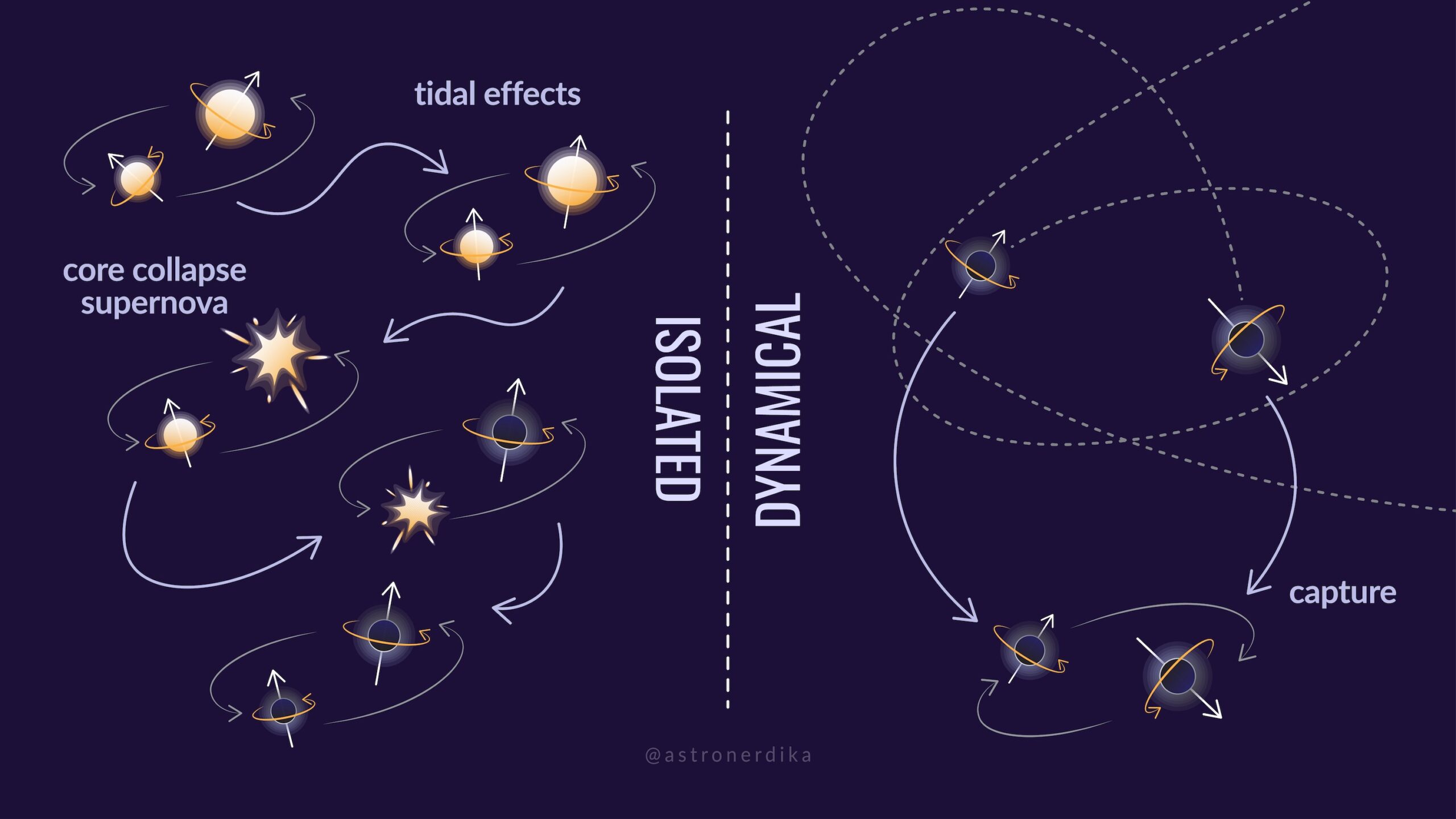
Figure 1: Graphic showing two main formation channels of black hole binaries. [Reproduced with permission from Shanika Galaudage/Space Australia]
After a merger, the newly formed black hole receives a “kick” velocity — a shove that sends it moving through space. This happens because gravitational waves carry away linear momentum asymmetrically during the merger, and to conserve momentum, the remnant black hole recoils in the opposite direction. If its kick exceeds the escape velocity of its cluster, the remnant is ejected, making it unlikely to merge again. However, remnants that receive smaller kicks are retained and can go on to merge again, contributing to the spin distribution over multiple generations. The authors of this article study the final spin distribution of black holes that remain within a cluster after forming from hierarchical mergers.
Simulating Binaries in a Globular Cluster
The authors simulate a first-generation population of one million black holes that are assumed to all have the same initial spin, labeled ai. The authors use data from globular cluster simulations to determine the properties of binaries found in dense environments. The final spin, af, and kick velocity of the black holes are calculated using a high-accuracy model of black hole merger remnants. Only black holes with kick velocities less than the escape velocity of typical globular clusters are kept in the population for future mergers. For their analysis across multiple merger generations, the authors test escape velocities of 50, 100, and 200 km/s.
Some initial binary configurations are more likely to produce high kick velocities that could eject the remnant from the cluster. Figure 2 shows that binaries with isotropic (randomly oriented) spins tend to produce larger kicks than those with spins aligned with the orbital motion.
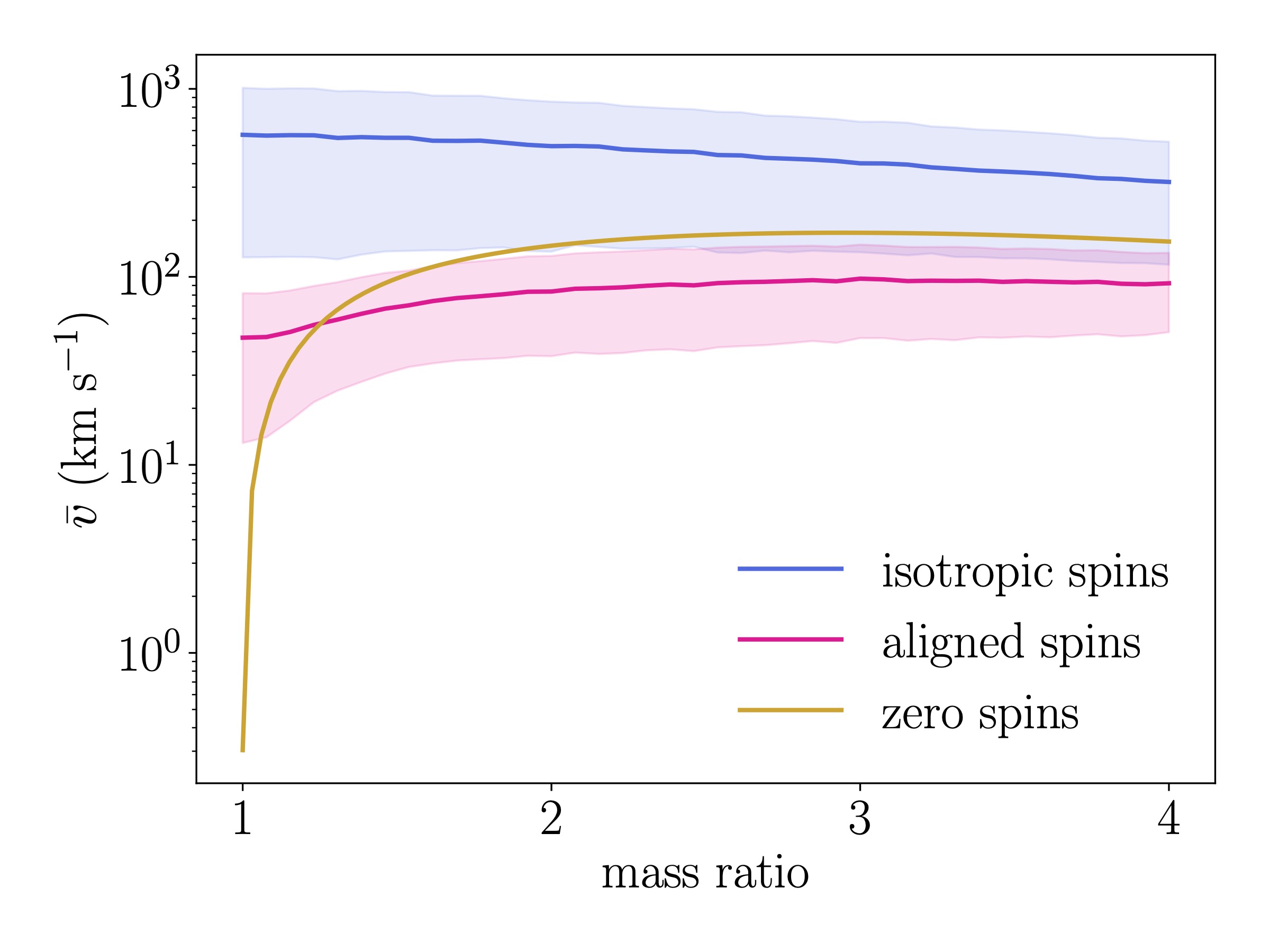
Figure 2: Kick velocity as a function of mass ratio for three types of black hole binaries: ones with random spin directions (blue), ones with spins aligned with the orbital motion (pink), and ones with zero spin (yellow). Each point shows the average from 10,000 simulated binaries, with spin magnitudes up to 0.8. Solid lines show the average kick velocity; shaded regions show the spread. [Borchers et al. 2025]
Spin Distribution of 1G + 1G Mergers
Figure 3 shows the final spin distribution from mergers between two first-generation black holes for different initial spin values. It compares all merger remnants (global population) to those that stay in the cluster (retained population). As expected, the distribution peaks around 0.7 for the global population. However, the peak shifts to higher spin values when only retained remnants are considered.
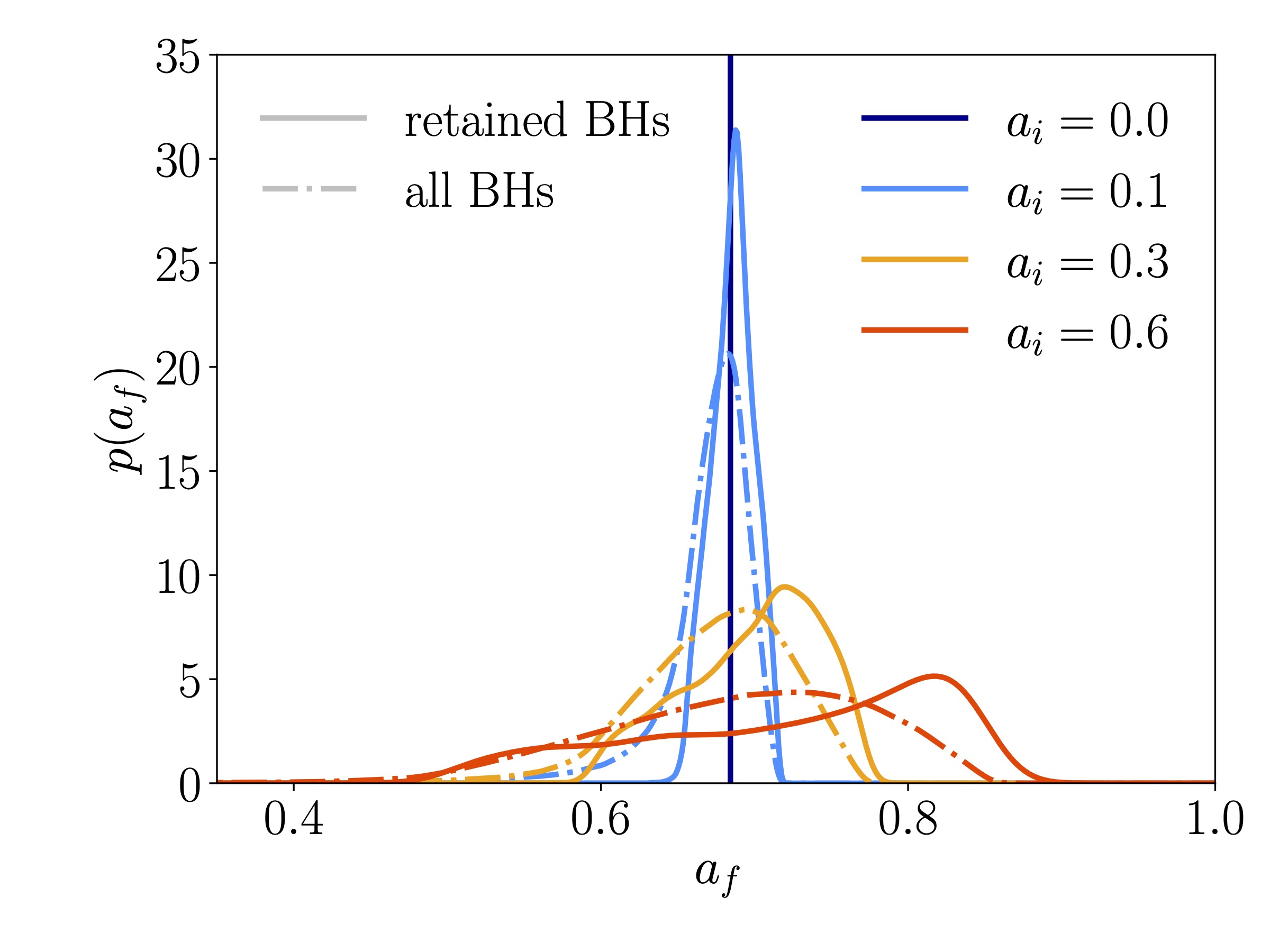
Figure 3: Spin distribution of 1G+1G merger remnants with different initial spin magnitudes and randomly oriented spins. The dashed lines show the distribution for all remnants, while the solid lines show the distribution for those that remain in the cluster. For the ai = 0.0 case, the vertical line is centered at af = 0.69. [Borchers et al. 2025]
The authors also examine the effect of escape velocity on the spin distribution. Higher escape velocities make the distribution more similar to the global population, while lower escape velocities lead to broader distributions with more support at higher and lower spins.
Spin Distributions of Higher-Generation Mergers
Figure 4 shows how the spin distribution changes over several generations of black hole mergers. As more generations pass, the spin distribution of the retained black holes starts to look quite different from the global one. In particular, it spreads out and shows a broader range of spin values.

Figure 4: Final spin distribution for different merger generations. The dashed lines show the distribution for all remnants, while the solid lines show the distribution for those that remain in the cluster. [Adapted from Borchers et al. 2025]
Hierarchical mergers are considered a pathway to forming intermediate-mass black holes, potentially explaining events like GW190521. Current gravitational-wave detectors are observing more and more black hole mergers, and future detectors will measure their spins more precisely. Accounting for the spin distributions of black holes that remain in clusters rather than the universal distribution will help us better understand and measure how hierarchical mergers contribute to the gravitational-wave population.
Original astrobite edited by Ryan White.
Authored by Viviana Cáceres.
The post The Black Hole Tango: Kicks and Spins in Hierarchical Mergers appeared first on AAS Nova.