❌

Normal view

'Time was speeding up, slowing down, or even stopping': Physicist demonstrates a key theory of time by building a 'mini-universe' in his lab

7 July 2026 at 17:18

For the first time, a physicist has experimentally watched time emerge from within an isolated quantum system β€” by creating a β€œmini-universe.” This bizarre experiment raises an intriguing question: If the universe has nothing outside it, where does time come from?

In a new study published June 11 in the journal Physical Review Research, Giovanni Barontini, an experimental physicist at the University of Birmingham in the U.K., used a cloud of ultracold atoms to build his mini-universe. The system was so well isolated from its surroundings that, like the universe itself, it had nothing external to use as a clock. He split that system in two and ignored one half β€” what he called the "dark sector" β€” to show that time could arise entirely from within the system.

The result offers the first experimental look on why the universe has time at all. "When you put everything together, things really start to make sense," Barontini told Live Science. "How time inside the system was speeding up or slowing down, or even stopping β€” this was quite surprising, how well everything came together. Very neatly, in a way. Which is something that doesn't happen that often in experiments."

The work is an experimental verification of ideas that have been floating around in quantum cosmology and thermodynamics for decades. This is not a bombshell claim that time is an illusion, but it is the first time anyone has put those ideas to a direct, quantitative test in the lab.

A universe with nothing outside

Barontini set out to look at a problem that physicists have puzzled over for nearly 60 years. The Wheeler-DeWitt equation β€” a central equation in quantum gravity, the field that seeks to unify Einstein’s theory of gravity with quantum mechanics β€” describes the universe as a whole system with no external time parameter. There is no cosmic clock ticking away outside the universe. So where does our experience of time come from?

One influential idea, called relational time, says that time doesn't exist as a fundamental ingredient of reality. Instead, it emerges from relationships inside the universe, with one part of the system acting as a clock for another. But this idea had never been tested directly in the lab.

Barontini's inspiration came from watching his son play with building toys. "I thought that it's something very similar to what we do in our labs," he told Live Science. "We play with very expensive toys. We create our own small samples of reality."

In his lab, that sample is a Bose-Einstein condensate β€” a state of matter that forms only at near absolute zero. In a Bose-Einstein condensate, thousands of atoms slow to a near standstill and blur together into a single quantum object, behaving as one.

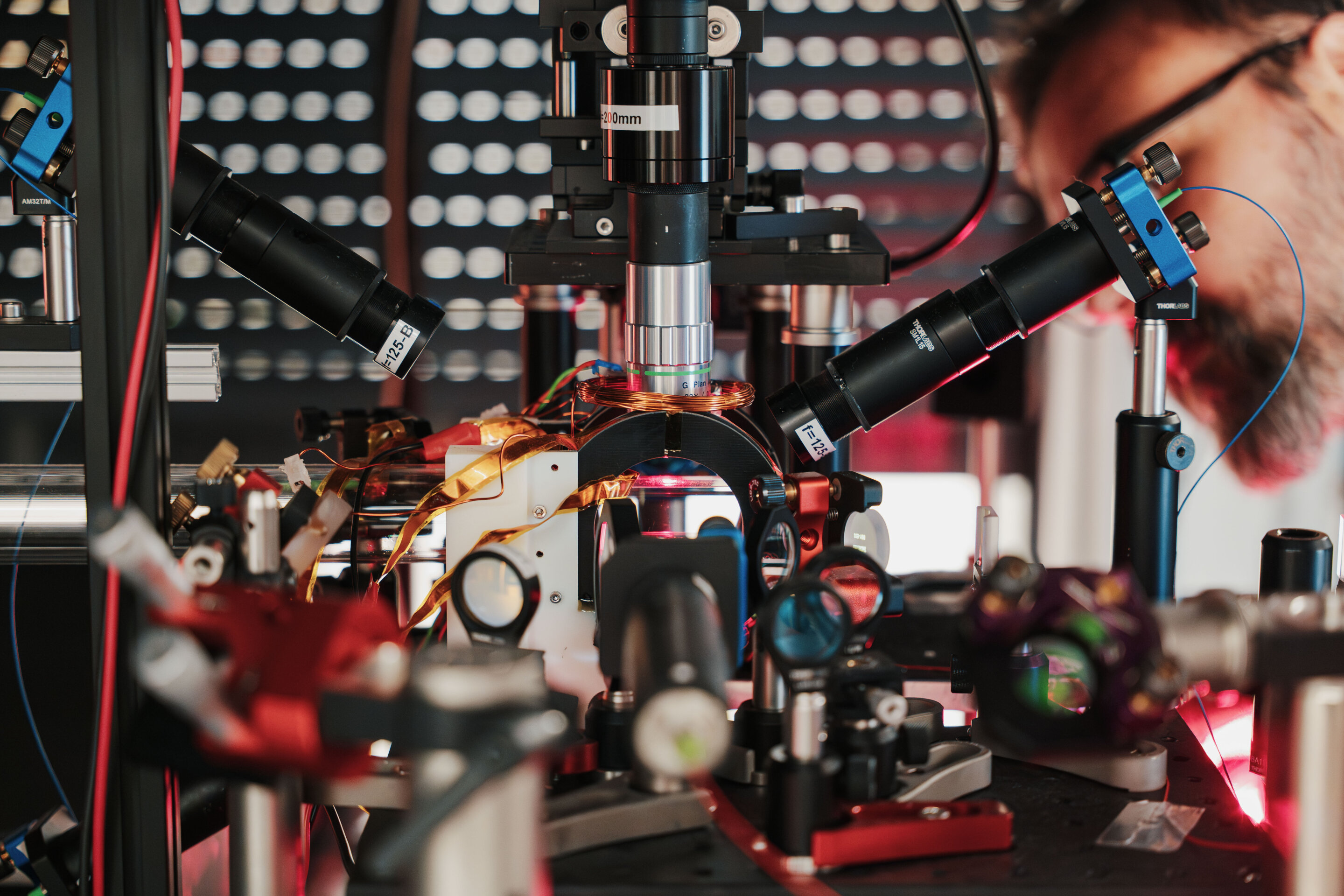
A man with glasses and a beard peers into an eye piece on a laser table with lenses and mirrors everywhere.

The University of Birmingham experiment to trap and cool rubidium atoms close to absolute zero β€” the first step in assembling the mini-universe. (Image credit: University of Birmingham)

The dark side of time

To mimic a universe with nothing outside it, Barontini placed the condensate in a trap and divided it down the middle with a thin sheet of laser light. He watched one half, the "bright sector," closely and deliberately ignored the other half, which he called the "dark sector."

The atoms in the bright sector sloshed back and forth in the trap, periodically spilling over the barrier and back again. Barontini called the moments when atoms flooded into the bright sector the "Big Bang" and the times when they drained out the "Big Crunch" (the nickname for one theory of how the universe will end, with the universe collapsing in on itself). Then, he tracked how entropy β€” a measure of disorder, or how spread out energy is within a system β€” was exchanged between the two halves as atoms crossed the barrier.

Instead of using laboratory time to order events, he built an "entropic time" β€” a clock defined entirely by how much entropy was flowing between the two halves of the system. If entropy was flowing, time was ticking. If no entropy was exchanged, time stopped. "The entropy exchange between the two systems could be transformed into an internal time variable," Barontini said.

Time speeds up, slows down and stops

What surprised Barontini most was how cleanly everything fit together. The internal, entropic time reliably ordered events in the bright sector. It matched the sequence seen in laboratory time, but it flowed at a different rate.

When entropy was flooding between the sectors, entropic time ran fast. When the exchange slowed, so did the clock. And when the two halves reached equilibrium (no more entropy flowing), the internal clock stopped altogether.

Both time and the arrow of time β€” maybe they just are born from ignorance.

Giovanni Barontini, experimental physicist at the University of Birmingham

"Time was speeding up or slowing down, or even stopping, depending on what the system was doing," Barontini said.

He then went a step further: Using this internal time, he derived a version of the SchrΓΆdinger equation and showed it accurately reproduced what he saw in the experiment. "This was quite surprising, how well everything came together," he said β€” "very neatly, in a way, which is something that doesn't happen that often in experiments."

Both time itself and the arrow of time β€” why time flows in one direction rather than the other β€” may arise from the same source: an observer giving up information. When Barontini chose not to look at the dark sector, he gave up knowledge of that half of the system. That act of ignorance, encoded in entropy, is what gave rise to time in the other half.

"Both time and the arrow of time β€” maybe they just are born from ignorance," Barontini said. "To have time and to observe, you have to give up some degrees of freedom."

Barontini sees this as just the beginning. The same cold-atom tool kit that generated a miniature Big Bang and Big Crunch in his trap could, in principle, be engineered to simulate far more exotic phenomena, such as black hole analogues, the conditions of the early universe, and what will happen at the moment of the Big Crunch itself.

"These are things we can do very simply, using the tools we already have to engineer our systems," he said.

The study is a proof of concept β€ͺ—‬ a first demonstration that controlled quantum systems can serve as a test bed for some unanswered questions in physics. For now, those questions remain open.

CERN shuts down Large Hadron Collider until 2030, upgrading the atom smasher to its most powerful form yet

30 June 2026 at 18:50

The Large Hadron Collider (LHC), the world's largest and most powerful atom smasher, has entered a planned four-year shutdown that will upgrade it to its most capable form yet.

The particle accelerator was switched off Monday (June 29) and is scheduled to come back online in 2030 as the High-Luminosity Large Hadron Collider (HiLumi LHC), with improvements that will allow it to smash together roughly 10 times more particles than its original design. That data could help spark new discoveries in fundamental physics and shed light on the nature of dark matter, antimatter and the early universe.

"This is a very important moment," HiLumi LHC project chief Markus Zerlauth told Agence France-Presse. "From Monday, we will be entering a new phase."

Since its first successful proton collision in 2009, the LHC has allowed physicists to test theories about particle physics and the Standard Model of the subatomic world. It was essential to the discovery of the Higgs boson in 2012, which helped explain how tiny fundamental particles acquire mass. The collider covers a 17-mile (27 kilometers) loop at the border between France and Switzerland near Geneva.

The current shutdown is the third long-term, planned pause in the collider's operations. The first, a two-year shutdown beginning in 2013, consolidated connections between superconducting magnets and boosted the energy of the colliding proton beams. A second pause, from 2018 to 2022, involved a series of upgrades, replacements and preventive maintenance.

In the current period of dormancy, dubbed Long Shutdown 3 (LS3), specialists will install upgrades to boost the collider's luminosity by a factor of 10. That will increase the number of particle collisions, roughly tripling the number of times particles will smack into each other compared with the existing setup. Once the final version of the particle accelerator is online, it will run until the end of its operational lifespan in the 2040s and will be earmarked for replacement by a new, higher-energy particle accelerator in the years that follow.

"It really is an opportunity to explore the universe in a way we haven't done before," Mark Thomson, director general of CERN (the European Organization for Nuclear Research), where the LHC is housed, told New Scientist.

A large piece of construction machinery is seen next to a blue-lit tunnel.

Civil engineers work on upgrades to turn the Large Hadron Collider into the High Luminosity Large Hadron Collider, significantly increasing the facility’s rate of particle collisions. (Image credit: Samuel Joseph Hertzog, CERN)

That jump means that experiments will produce much more data, which will allow scientists to study known phenomena, such as the Higgs boson, in more detail and increase the odds of observing rare events. For example, the HiLumi LHC is expected to produce about 380 million Higgs bosons over its lifetime of a decade or so, compared with the 55 million it's made to date. The data could help scientists solve problems with the Standard Model, which currently doesn't incorporate dark matter or dark energy, the primary forms of mass and energy in the universe.

"The LS3 represents a huge and complex logistical and engineering undertaking," Jean-Philippe Tock, head of the LS3 coordination team, said in a statement. "In the LHC alone, 1.2 km [0.75 miles] of magnets and components will be removed and replaced with new equipment, and across the whole complex, dozens of projects are planned, involving thousands of engineers, physicists, technicians and support personnel."

While the LHC won't be smashing any particles together during the shutdown period, researchers will continue to analyze data already collected during experiments during the prior operational window.

Though the LHC's primary purpose is fundamental physics research, technologies used to upgrade the collider could find their way into everyday life. For example, some instruments and techniques originally developed at CERN are now being used in medical imaging, sensors and art restoration.

'A mixture from zero to infinity': Physicists split apart a photon β€” and ended up with an improbable swarm of particles

17 June 2026 at 18:50

Physicists recently wondered what would happen if you tried to split a photon β€ͺ—‬ and they found some unexpected behavior that may transform the way we think about particles.

The experiment, in which researchers simulated a photon being sliced by a shutter under various conditions, showed that a severed photon can lead to a complex mixture of zero to infinitely-many photons β€” raising some big questions about the nature of particle interactions.

Photons are elementary packets of light, which means they are not made up of anything else. So what does it even mean to try splitting a photon? It may be possible thanks to wave-particle duality β€” a core principle of quantum mechanics, the bizarre physics of the very small.

According to wave-particle duality, a photon is not only a particle but also a wave. Using theoretical calculations, the researchers investigated what would happen if you sent this photon through a shutter and closed it while the photon was passing through, effectively cutting off the tail end of the photon wave.

"I think that most physicists would expect there to be a certain probability that you have zero photons and a certain probability that you have a single photon left after you have done this," Johannes Skaar, co-author of the new study and a professor of theoretical physics at the University of Oslo, told Live Science. "And that is approximately true, but it is not exactly true."

What are the chances?

This brings up another strange aspect of quantum mechanics: its probabilistic nature. Particles exist as a cloud of probabilities stretching to infinity. Until a particle is observed, its properties, such as its position or energy, are in a superposition of possible values; all we can know are the chances of finding it in a certain state.

Through their calculations, Skaar and his colleagues determined how cutting a photon affects these probabilities. In their study, recently accepted in the journal Physical Review Letters, they found that it would create a complex mixture of photon states, including one with an infinite number of photons.

Each of these states has a probability that depends on how quickly the shutter cuts the photon. The expected number of photons becomes infinite only if the shutter is closed infinitely quickly. For realistic shutter speeds, even a thousand photons would be extremely unlikely.

This may sound very strange, but the quantum physicists were unfazed. In fact, what surprised Skaar and his colleagues was what happens if you make measurements of the cut photon from different perspectives.

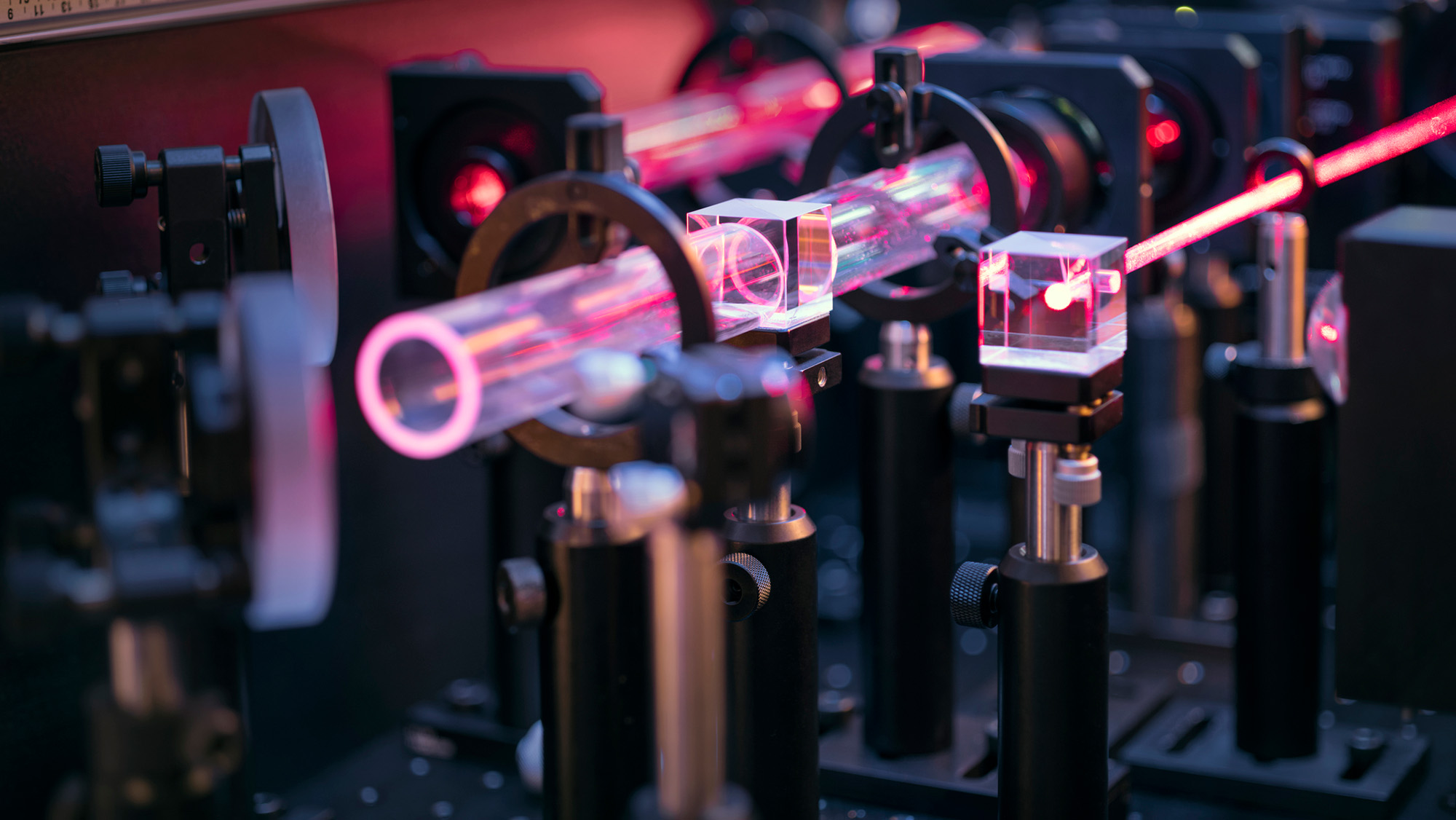
A close up of an optical table with various red lasers beamed across lenses and mirrors

A photo of an optical table with laser and beam-splitting cube, often used in photonics research. (Image credit: EschCollection via Getty Images)

"When you measure from one side of the shutter, then it will look like a single photon state," Skaar said. "Then, on the other side, it will look like a vacuum state β€” that means no photons. And that is very strange because the actual state globally is this mixture from zero to infinity."

Changing how we think about particles

The fact that these complex mixtures can be treated locally as very simple states raises fundamental questions about the nature of particles. Skaar said they are still reckoning with the full extent of these implications and they are now considering how this process could play out for other quantum particles, such as electrons.

They hope that by following this theoretical thread through, they may be able to develop a neater way of describing particle interactions. Currently, particles' infinite stretching means they have been interacting for an infinite amount of time. This then poses a problem for causality β€ͺ—‬ the order of cause and effect β€ͺ—‬ in particle interactions, the team said.

These new theoretical photons with a cutoff tail would not have this problem, meaning the causal link in an interaction would be clear, Skaar said. He admitted that there is much more work to be done to develop the theoretical description of this interaction. However, the new result is an important step toward describing particle interactions with a clear causal relationship, which Skaar described as the team's "ultimate goal."

The world's first nuclear clock just ticked on β€” and it could help detect a fifth fundamental force of physics

16 June 2026 at 16:05

For decades, physicists have pursued a goal that sounds nearly impossible: to build a clock that keeps time using an atom's nucleus rather than the electrons orbiting it.

Now, researchers have demonstrated the first functioning nuclear clock β€ͺ—‬ an advancement that could eventually lead to more robust timekeeping devices and new ways to search for dark matter and physics beyond the Standard Model.

"Having worked in this field for more than 15 years, it is just beautiful, how a very 'wild' idea such as manipulating an atomic nucleus with a laser has turned into reality," Thorsten Schumm, a professor of quantum metrology at the Vienna University of Technology and a member of the research team, told Live Science via email.

How is a nuclear clock different from an atomic clock?

Today's most accurate clocks are optical atomic clocks, which measure the frequency of electrons jumping between different energy levels inside atoms. These clocks are so precise that they would lose less than a second over a 100 million years.

A nuclear clock works similarly, but it uses a transition within the nucleus itself, where the nucleus jumps between energy levels. Because the nucleus sits deep inside the atom, it's far less affected by external disturbances from things like electric or magnetic fields. According to Schumm, the nuclear transition can be 1,000 to 10,000 times less sensitive to environmental noise than atomic transitions are.

A diagram showing how a nuclear clock works

A diagram showing how a nuclear clock works. (Image credit: N. Hanacek/NIST)

"This means that it would be easier to stabilize a nuclear clock over long periods of time," Jacob Higgins, a postdoctoral researcher at Northwestern University who previously worked on thorium clock experiments at JILA in Colorado but was not affiliated with the study, told Live Science in an email. "The transition used for the nuclear clock experiment has a higher quality factor than optical atomic clock transitions, which means that in principle, it can be measured more precisely given the same amount of measurement time."

Together, those advantages could allow nuclear clocks to outperform even today's best atomic clocks according to Higgins.

Why thorium-229 is special

The nuclear clock relies on a rare isotope called thorium-229, whose nucleus contains an unusually low-energy excited state that can be manipulated with ultraviolet laser light.

For decades, scientists had suspected thorium had a low transition, but identifying and controlling it proved extremely challenging. Researchers spent years testing different thorium-containing materials, laser systems and detection methods before finally pinning down the transition.

"It was a long road," Higgins said.

One key advancement was the development of continuous-wave lasers that operate at the precise wavelength needed to excite the thorium nucleus. Before those lasers existed, researchers had to excite the nucleus and then wait several minutes for it to decay and emit a detectable signal. That process was too slow to build a practical clock.

"With the continuous lasers, we can measure the nucleus in absorption and get an immediate response, whether the laser is still at the right frequency (and if not, correct it back)," Schumm said. "Once we had that, it was 'just' implementing some electronics and atomization to have the clock stabilize itself to the nucleus."

Thanks to this set-up, the researchers kept the nuclear clock running continuously for 24 hours.

Unlike many optical atomic clocks, which require ultracold atoms to be suspended in a vacuum chamber, the thorium nuclei are embedded inside a crystal at room temperature.

Because the thorium transition remains stable inside a solid material, researchers may eventually be able to build compact clocks that are useful for navigation systems, telecommunication networks and data synchronization.

NASA's Deep Space Atomic Clock, seen here in an artist's illustration, will test out new technology to for deep-space navigation.

NASA's Deep Space Atomic Clock, seen here in an artist's illustration, was launched in June 2019 to use atomic clocks in space. (Image credit: NASA)

A tool for studying the universe

Some physicists are more excited about what nuclear clocks could reveal about fundamental physics, rather than the clocks' timekeeping abilities.

Atomic clocks primarily probe electromagnetic interactions involving electrons. Nuclear clocks, by contrast, are sensitive to the strong nuclear force, weak nuclear force and electromagnetism β€” three of the four fundamental forces of the universe, along with gravity. This can make them useful detectors of new physics, in a way.

"The nuclear clock is foremost a different clock, ticking on different fundamental physics mechanisms," Schumm said. "Essentially all modern theories beyond the standard model predict additional particles or 5th forces … which can be probed with the nuclear clock in some parameter regime."

Thorium-229 is particularly intriguing because the energy difference between its two nuclear states results from a delicate balance between electromagnetic and nuclear forces. Because those large contributions nearly cancel each other out, even tiny changes in the underlying forces could shift the clock's frequency.

"So small shifts in these forces β€” like if the nucleus were to couple to certain forms of dark matter or if there were an oscillation of a fundamental constant β€” will be amplified in our measurement," Higgins said.

Researchers, including Higgins, have already used early versions of the clock to place constraints on some dark matter models, and they expect its sensitivity to improve as the technology itself gets better.

Although the first functioning nuclear clock is a major achievement, these timekeepers remain in their infancy. Scientists still need to gain a better understanding of how the thorium transition responds to factors like temperature and magnetic fields while developing more powerful and stable laser systems.

"I think it will be many years before the thorium clock can compete with today's best optical atomic clocks," Higgins said, "but we will learn a lot of new science on the pathway to getting there."

❌