❌

Normal view

Outdoor cats can be exposed to dangerous germs β€” here's how to protect you and your pets, according to more than 400 studies

20 June 2026 at 15:00

Pets form an important part of many people's lives, providing meaningful companionship. However, our pets can sometimes also be a source of unwelcome pathogens and diseases, particularly if they frequently roam outdoors.

We are ecologists and a veterinarian who study wildlife health and the movement of pathogens among wildlife, domestic animals and people. If you let your cat outdoors, or if outdoor cats visit your yard, our recent findings may be relevant.

Zoonotic pathogens are organisms that can infect both animals and humans. From a pathogen's perspective, humans are just another animal host. Wildlife is often emphasized as a source of emerging disease for humans because there are vastly more wild animal species than domestic animal species.

However, even if a pathogen is capable of infecting people, it needs a way to reach us. Humans share more zoonotic pathogens with domestic animals than with wildlife, because domestic animals live close to us. Pathogens benefit even further if they can infect a companion animal.

In our newly published research, we compiled data from more than 400 studies to investigate how a cat's lifestyle, whether they're mostly indoors, outdoor-roaming or feral, affects that cat's likelihood of carrying pathogens that can infect people.

Across this compilation, there were nearly 100 pathogens detected in cats that are considered zoonotic and capable of infecting humans. Familiar examples are rabies, Toxoplasma gondii, roundworms and Salmonella.

Our research

We found that outdoor-roaming pet cats had three to five times the odds of carrying a zoonotic pathogen compared with indoor-only cats. More surprisingly, cats allowed to roam outdoors had similar odds of carrying at least one zoonotic pathogen as feral cats. Outdoor-owned cats carried fewer types of pathogens than feral cats, but the same pathogens that infect feral cats can also infect owned cats.

These risks become a large-scale problem because pet cats that roam freely interact closely with people, wildlife and other domestic animals. Across the studies we reviewed, about 60 per cent of owned cats had unsupervised outdoor access; in some regions, that rate exceeded 90 per cent.

Roaming cats hunt, interact with wildlife or other domestic animals, and move through environments contaminated with pathogens and toxins. Research suggests that cat owners may underestimate hunting by around 80 per cent, meaning that many prey captures and animal contacts go unnoticed.

These interactions are not uncommon and not limited to so-called pest species. Single-country estimates of wildlife killed by cats run into the billions, with more than 2,000 wildlife species documented as prey for domestic cats.

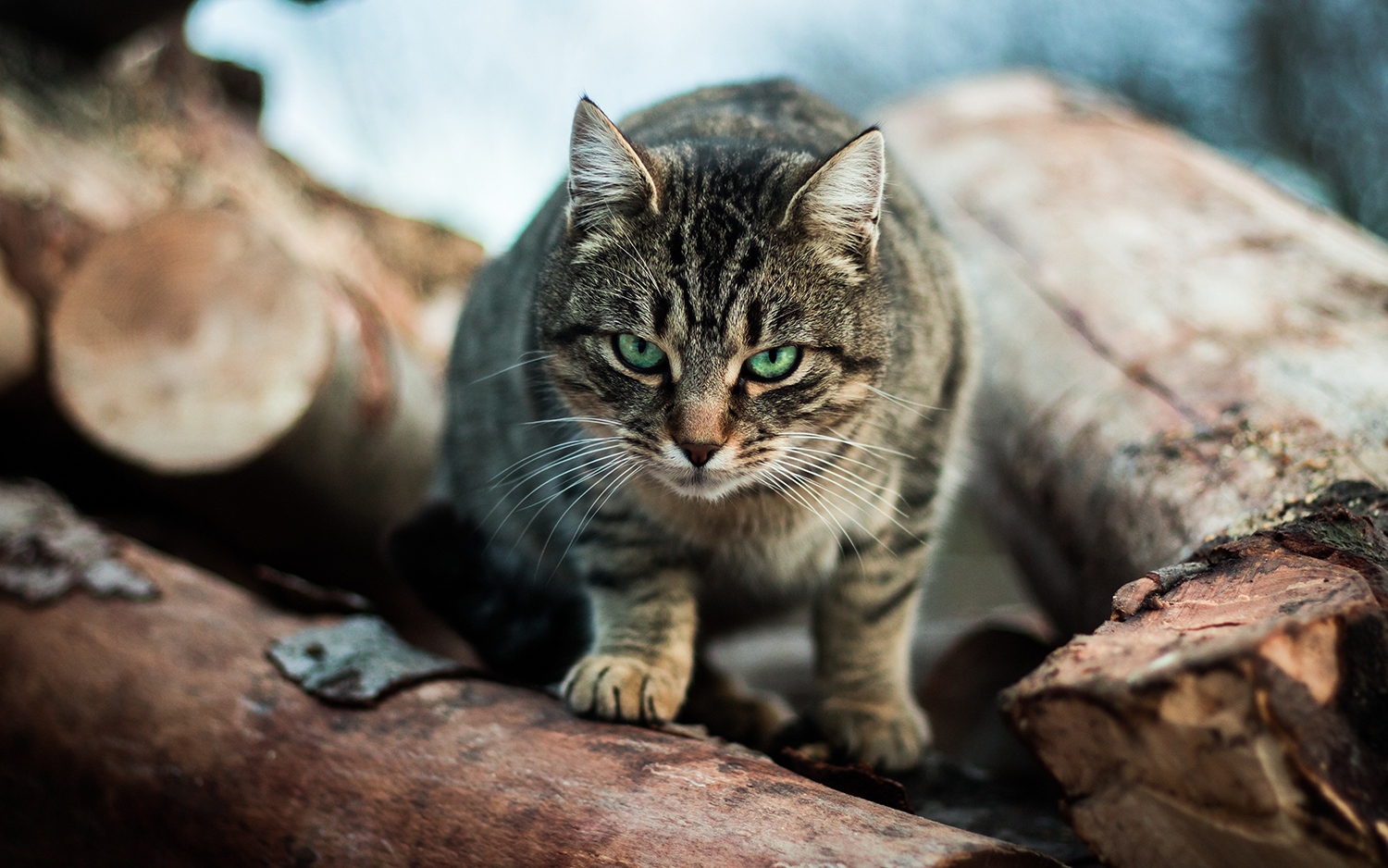
A gray and black striped cat sits on some broken tree trunks and looks at the camera.

Cats hunt animals that can carry zoonotic pathogens, including rodents, birds and bats, many of which would otherwise have little direct contact with people. (Image credit: Anton Darius)

Cats hunt animals that can carry zoonotic pathogens, including rodents, birds and bats, many of which would otherwise have little direct contact with people. Owned cats might bring home rodents carrying viruses, and there are documented cases of cats bringing rabies-positive bats into homes. A cat returning home with prey can therefore create a pathway by which pathogens circulating in wildlife populations reach people.

In addition, it is not only owners who are at risk. Outdoor cats defecate in gardens, parks, playgrounds and other shared spaces, potentially leading to high contamination rates. One study estimated that outdoor cats deposited more than 60 tonnes [60 tons] of feces per 10,000 households each year.

Depending on the parasite, feces can contain hundreds to hundreds of thousands of parasite eggs that can persist in soil or water for months to years, which can infect people or other animals that come in contact with those eggs.

What cat owners can do

The most straightforward intervention is also the most economical and humane: prevent unsupervised roaming. That does not mean denying cats access to the outdoors. It can mean building "catios" or enclosures, leash walks, supervised time outside or other forms of contained outdoor access.

House cats, as well as cheetahs, cougars and lynxes, can purr but can't roar, while other cats, such as lions, tigers and jaguars, can roar but can't purr.

Using systems like "catios" or leash walks can help minimize pathogens for cats. (Image credit: Carlos G. Lopez)

Veterinary care still matters. Treating existing parasitic infections and vaccinating against diseases like rabies are essential precautions, even for indoor cats. Since neither vaccines nor anti-parasitic treatment cover the full spectrum of wildlife-associated pathogens, managing exposure remains the more comprehensive protective approach.

The free-roaming debate is often framed as a false choice: either cats roam freely, or they are deprived of a natural life. That framing is misleading and inconsistent with how we manage other companion animals.

We do not assume dogs need unrestricted access to roads, neighbors' yards or to hunt wildlife to have good welfare. Indoor cats and cats with supervised outdoor access can live healthy, enriched and longer lives.

Policies and strategies that address how and where owned cats roam outdoors can help safeguard biodiversity, feline and wildlife welfare and public health. That is the central insight of One Health, that the same choices that protect ecosystems can also protect the animals and people who share them.

This article was co-authored by David Lapen, who works for and receives research funding from Agriculture and Agri-Food Canada.

This edited article is republished from The Conversation under a Creative Commons license. Read the original article.

How much of a cat fan are you? Find out by taking our cat quiz!

Watch bison herd defend a newborn calf from wolf attack in a primeval Polish forest

A camera trap in an ancient Polish forest has captured extremely rare and unexpected footage of wolves attacking a bison herd made up of adults, youngsters and a newborn calf, a new study shows.

The event took place on Sept. 15, 2025. Five wolves (Canis lupus) enter the camera frame, closely followed by three bison cows and the newborn calf. In the footage, the cows chase after the wolves, leaving the calf alone and exposed. The wolves then surround the calf, bite its neck and try to drag it away, but two cows come to its rescue. The wolves return and seize the calf a second time in the background of the video β€” however, this time the entire bison herd comes to its defense to end the attack.

The clip is from the Bialowieza Primeval Forest, the oldest and best-preserved temperate lowland forest in Europe, which hosts the world's biggest population of European bison (Bison bonasus). The forest covers 350,600 acres (141,900 hectares) on the border between Poland and Belarus. There are more than 870 bison on the Polish side, according to the new study, while the Belarussian side has roughly 730 bison.

Also known as "the king of the forest," the European bison is typically considered a non-prey species, meaning it has no predators except humans. But the footage calls this into question.

Still images from a video of wolves attacking a bison herd in Poland.

These still images from the video show (a) the wolves grabbing the newborn calf for the first time; (b) the wolves seizing the newborn calf for the second time; and (c) the bison herd forming a protective circle around the newborn calf after both attacks. (Image credit: Wijnands & Borowik, 2026. (CC BY 4.0). Mammal Research Institute, Polish Academy of Sciences.)

"To our knowledge, we present the first video-recorded evidence of wolves attacking a European bison herd in the BiaΕ‚owieΕΌa Primaeval Forest," researchers wrote in the study, published May 29 in the journal Ecology and Evolution. "Although the video did not capture a direct kill, it suggests that other attacks on European bison could potentially be successful."

Historical documents show that wolf attacks on European bison used to be more common, with about 8 kills recorded annually in the Bialowieza Primeval Forest between 1840 and 1849. The forest was a popular hunting ground for monarchs from the 14th century onward, explaining why such detailed records exist.

European bison went extinct in the wild in 1919, but they were reintroduced in the Bialowieza Primeval Forest in 1952. The first confirmed bison kill since then dates to the mid 1990s, and after that, it seems as though wolves stuck to a diet of roe deer (Capreolus capreolus), red deer (Cervus elaphus) and wild boar (Sus scrofa), likely because these are much easier prey than bison, the researchers wrote in the study.

But now, "our observation demonstrated that the European bison is in fact a potential prey for wolves," they wrote. "This raises questions about why predation attempts are so rare, whether the bison can still be described as a non-prey species, and what this could mean for conservation and management of the species."

An intriguing trend in the Bialowieza Primeval Forest is that wolf packs are growing in size, possibly thanks to a late 1980s hunting ban. This shift could increase wolf predation on bison in the future, because bigger packs can handle bigger prey.

"If predation on European bison, specifically young animals, occurs more frequently than previously assumed, wolves could play a small but potentially important role in the natural regulation of bison numbers," the researchers wrote in the study. "In turn, such regulation could possibly lead to mitigation of human-bison conflicts."

Elusive dwarf fox, feared extinct, photographed for the first time on island off YucatΓ‘n

16 June 2026 at 15:58

An elusive dwarf fox that was feared extinct has been photographed for the first time, after being spotted near a highway in Cozumel, Mexico.

The tiny animal was part of the mysterious Cozumel fox population, a potentially undescribed species that had not been officially sighted in more than 20 years.

Cozumel foxes live only on Cozumel, an island near CancΓΊn. Researchers know very little about these mysterious predators, which are roughly 20% to 40% smaller than their gray fox (Urocyon cinereoargenteus) cousins that live on the mainland.

Park and museum officials spotted and captured the fox in 2023 and, after a health assessment, released it back into the wild. Researchers have now shared the photographs and documented the encounter in a new study published May 4 in the journal Neotropical Biology and Conservation.

Although the rediscovery confirms that Cozumel foxes are still alive, they are likely on the brink of extinction, the study authors noted; the photographs highlight the need for focused research and conservation efforts.

"The biggest challenge facing the Cozumel fox is that we still know almost nothing about it, including its remaining population size, distribution, or ecology," study first author Travis Bayer, executive director of the conservation organization Pathos Wildlife, said in a statement. "That uncertainty alone is dangerous, because it makes effective conservation extremely difficult."

Cozumel foxes are an example of insular dwarfism, an evolutionary process in which larger animals, including fox-sized mammals, evolve to be smaller after colonizing islands, where there are limited resources and less space than on the mainland. The foxes aren't the only mammals that have shrunk on Cozumel over time; other examples include the island's critically endangered pygmy raccoons (Procyon pygmaeus) and dwarf coatis.

Archaeological evidence suggests that Cozumel foxes have lived on the island for at least 5,000 years, likely since before the arrival of the Maya within the past few millennia, and potentially for tens of thousands of years before that. Prior to this rediscovery, the last confirmed sighting of a Cozumel fox was in 2001, according to the study.

A photo of a Cozumel fox partially obscured by foliage.

This photo, taken as the fox was partially obscured by foliage next to a highway, is the first known photograph of a Cozumel fox (Image credit: Rafael ChacΓ³n)

The rediscovery began with reports of a disoriented animal wandering near the highway on the southeastern side of the island. Officials with the Parks and Museums Foundation of Cozumel located and captured the fox, an adult male, on Sep. 14, 2023. They checked its health and later released the fox in the Laguna Colombia State Reserve, a protected area just south of where it was captured.

Recent and historical sightings suggest that Cozumel foxes could have an extremely restricted range in the island's South, where nature is increasingly threatened by development, land-use change, invasive species and natural disasters, the study authors noted.

The researchers recommended surveys to determine the current distribution and size of the Cozumel fox population, along with morphological and genetic assessments to establish its evolutionary status and conservation efforts to protect its assumed habitat in southern Cozumel and minimize human-wildlife conflict.

"Ultimately, we hope this work helps move the Cozumel fox from a little-known, uncertain presence on the island to a better-understood key part of Cozumel's ecosystems," Bayer said. "We also hope it demonstrates that conservation is often most urgent when certainty is lowest and that uncertainty itself can be a call to action."

❌