There are some sights in this world that no photograph can truly capture.
Think of the rolling ribbons of the aurora in the northern and southern skies, the depth and breadth of the Grand Canyon, or the sense of immersion when diving on the Great Barrier Reef. Astronauts will tell you that not even large-format cameras can truly capture the blackness of outer space or the majesty that is our planet as seen from orbit or beyond.
It's not every day that a new one of those sights debuts. But such will be the case on Friday, November 13, when the California Science Center in Los Angeles finally reveals the launch-pad-like display of the space shuttle Endeavor inside the new Samuel Oschin Air and Space Center.
The head of the European Space Agency has issued a wakeup call to decision makers amid partners cancelling missions and geopolitical changes affecting the space sector, calling for Europeans to be pilots rather than passengers.
"Europe has become too exposed to decisions beyond its control," Aschbacher wrote, before laying out the challenge the continent faces. "The choice before Europe is clear: Do we pilot, or are we merely passengers?"
The situation for ESA and its 23 member states is complex, requiring Europe to both develop agency and autonomy while balancing this with fruitful collaboration, Aschbacher noted.
"The current environment demands both diversified international partnerships and strengthened autonomous capabilities," he wrote. "Only under these conditions can Europe decide when to act independently and when to cooperate globally, protecting our investments and our industrial base amid geopolitical uncertainty."
With trust in the U.S. as a reliable partner taking a hit, collaboration with other space actors such as Japan, South Korea and Australia could grow, while Europe also pursues its own capabilities.
Human spaceflight is one area Aschbacher is keen to push Europe forward, describing it as a necessity rather than a luxury, and one needed to secure ESA's freedom to unlock the "scientific, economic, strategic and geopolitical benefits of space and to inspire a new generation to shape Europe's future."
The question is not new — it has long been debated by European policy makers and the space sector — but recent events and Aschbacher's comments have brought the issue to the fore. And there is clear support and grounds for greater European autonomy in space.
"The disruption brought by the Trump administration has made this question more pressing," said Marco Aliberti, associate manager and lead on international engagement at the European Space Policy Institute (ESPI) in Vienna, an independent think tank that advises European space policymakers. "There is a realization in Europe that so far we have not been pursuing autonomy."
Europe, Aliberti argued, has built genuine technical capacity, including the ability to build and operate world-class space systems, but, at the same time, has consistently failed to secure the political autonomy to decide how and with whom those capabilities are deployed.
"Participation without agency is yet another form of dependency dressed up as ambition," he said. In other words, Europe has built the capacity to execute in space, but not the autonomy to decide its own agenda.
Aliberti pointed out that this is not the first time Europe has needed to move to acquire greater autonomy. The birth of Europe's Ariane rocket in the 1970s was a response to an asymmetric relationship. The United States refused to launch the Franco-German Symphonie communications satellite unless Europe agreed to forgo commercial use, with the aim of protecting American dominance in commercial communications. European governments concluded they had no choice but to build their own launch capability.
Aliberti went on to point out that history could, potentially, repeat itself, this time in the lunar realm, as a European partner dependent on U.S. transportation could face unacceptable conditions. "The U.S. may tell us: I will continue bringing you to the lunar surface, provided that you do not engage in commercial activity," he said. "We do not see the risks that being a passenger entails."
And investment in space can bring huge payoffs. For example, NASA's Commercial Orbital Transportation Services contracts in the 2000s gave early funding to SpaceX, enabling the development of the company's workhorse Falcon 9 rocket, and ultimately, the rise of its Starlink broadband megaconstellation.
"It was the billions that NASA gave to SpaceX that enabled the birth and growth of SpaceX," Aliberti stated. "Let's not neglect the impact that space exploration investment has across other parts of the ecosystem."
Eartly artist's illustration of the major parts of a planned NASA-ESA Mars sample return campaign. NASA has canceled that version of the project and is looking for other ways to get samples collected by its Perseverance rover back to Earth. (Image credit: NASA/JPL-Caltech)
(Image credit: NASA/JPL-Caltech)
ESA's DG has signaled the need for action and its urgency, although he admitted it will take years to build autonomous capability. "If not now, then when? If not ESA, then who?" Aschbacher asked.
What comes next is unclear. Institutionally, Aschbacher sees opportunities in a convergence of key meetings and milestones, including an ESA Council in mid-June, a ministerial focused specifically on exploration scheduled for December, and the crucial once-every-three-years ESA Ministerial Council in 2028. At the same time, the European Union, with a growing interest in space separate to ESA, is drafting its Multiannual Financial Framework for 2028-2034.
Aliberti warned that, if ESA cannot act promptly, its member states could move to act alone to address shorter-term needs. He cited the recent development of the French government reaching an agreement to send a pair of its astronauts on missions with U.S. space station firm Vast.
As confidence in the partnership with the U.S. government erodes, individual European nations may look to explore bilateral arrangements with commercial American providers, meaning less interest in investing into joint European efforts. The window for collective European action is open, but perhaps not for long.
"If we take decisions by the Ministerial Council in 2028, we will be able to play a role and be pilots in 10 years," Aliberti says. "If not, it may become too late."
A lot has changed since NASA last sent astronauts to the moon — including the attitudes of those space explorers.
That's the view of Victor Glover, the NASA astronaut who served as pilot on the Artemis 2 mission around the moon's far side this past April.
"When you look back on the Apollo missions, there was a lot more competition back in the office. Everybody wanted to be the first, and then everybody wanted to be the next," Glover told Angels Broadcast Television on June 12, shortly before he threw out the first pitch before a baseball game between the Los Angeles Angels and the Tampa Bay Rays.
"I think our office learned a lot from them," he added. "There are some good things about that. It makes you work really hard, but it also can create some unnecessary conflict. And so my office really wants to support everybody — wants you to be the guy that does it, and somebody just gets picked to do it, and that's OK."
Glover and his Artemis 2 crewmates — NASA's Reid Wiseman and Christina Koch and Jeremy Hansen of the Canadian Space Agency — did indeed seem to forge a very strong bond during their training and their time in space.
For example, shortly before Artemis 2's April 1 launch, Glover, Koch and Hansen came up with a plan to name a crater on the moon after Wiseman's wife Carroll, who died of cancer in 2020.
"They said the three of them had talked, and they would like to do this," Wiseman said on April 6, the day Artemis 2 looped around the moon and got farther from Earth than any crewed mission ever had. "That was an emotional moment for me. And I just thought that was just a total treasure, that they had thought through this, and they had offered this."
Wiseman, Artemis 2's commander, said he broke down when Hansen radioed mission control with the naming request. In fact, all four astronauts were overcome with emotion at that moment.
"That was, I think, where the four of us were the most forged, the most bonded, and we came out of that really focused on that day ahead," Wiseman said.
This image taken by Buzz Aldrin of the Apollo 11 landing site is the only good picture of mission commander Neil Armstrong on the lunar surface. (Image credit: NASA)
The atmosphere was a bit different during the 1960s and early 1970s, as Glover noted; undercurrents of competition and rivalry reportedly ran through the Apollo crews.
For example, multiple people, including Apollo 17 astronaut Gene Cernan, have said that Buzz Aldrin lobbied to be the first person to set foot on the moon, an honor that eventually went to Apollo 11 crewmate Neil Armstrong. (Aldrin has disputed this version of events, saying he didn't want to be the first-ever moonwalker.)
There are other big differences between Artemis and Apollo, of course. Apollo was designed to get people to the moon before the Soviet Union could do so, a goal that was regarded as a national security imperative because it would demonstrate American technological supremacy. As a result of this need for speed, Apollo did not build anything permanent on the moon, leaving behind only flags, footprints and defunct spacecraft.
Artemis, on the other hand, aims to establish a permanent and sustainable presence on Earth's nearest neighbor. If all goes to plan, NASA will build one or more moon bases near the lunar south pole, then use the skills and knowledge gained from this endeavor to get astronauts even farther afield — to Mars.
SpaceX just launched a brand-new return capsule that it has been developing in the dark.
That vehicle, called Starfall, lifted off atop a Falcon 9 rocket this morning (June 23), on a test mission designed to show that it can fly in a controlled fashion and survive the fiery trip down through Earth's atmosphere.
The demonstration flight may have caught some space fans by surprise, for SpaceX has revealed little about Starfall to date. And that air of secrecy extended through today's launch; the company cut off its webcast about 10 minutes after liftoff, a practice usually associated with national security missions.
SpaceX provided a very brief overview of Starfall today, saying via X that the new vehicle "will enable affordable, routine access to the microgravity environment for scientific research and in-space manufacturing."
Details about the vehicle are harder to come by — but we have some, thanks to an environmental assessment published by the U.S. Federal Aviation Administration (FAA) last month. That report looked at the potential environmental impact of two Starfall demonstration reentries, one or both of which was set in motion by today's launch. (It's unclear how many Starfall vehicles the Falcon 9 lofted on this initial flight.)
According to the FAA document, Starfall is a disk-shaped spacecraft that stands about 2.5 feet (0.75 meters) tall, with a diameter of 10.2 feet (3.1 m). It weighs roughly 4,600 pounds (2,100 kilograms) and can carry about 2,200 pounds (1,000 kg) of payload. The vehicle can launch on both the workhorse Falcon 9 and Starship, the megarocket SpaceX is developing to help humanity settle the moon and Mars, among other tasks.
Starfall consists of two parts: an aluminum "top plate" that weighs about 3,090 pounds (1,400 kg) and a detachable carbon-fiber heat shield. Cargo rides in the top plate, which features a payload bay 8.2 feet long, 4.9 feet wide and 1.6 feet tall (2.5 by 1.5 by 0.5 m).
For comparison, SpaceX's Dragon capsule, which routinely flies people and cargo to and from the International Space Station, stands about 14.7 feet (4.5 m) tall, with a diameter of 13.0 feet (4.0 m). Dragon can haul about 13,230 pounds (6,000 kg) to low Earth orbit and bring 6,600 pounds (3,000 kg) back down, according to its SpaceX specifications page.
Artist's illustration of a SpaceX Starfall capsule reentering Earth's atmosphere. (Image credit: SpaceX)
Starfall is not capable of carrying astronauts. And, in another departure from Dragon, the newly debuted return vehicle does not have a traditional propulsion system.
It has only "an attitude control system which uses compressed inert gas (for example, compressed nitrogen gas) to perform small attitude control maneuvers, such as pointing the capsule's heat shield in the correct direction to safely reenter Earth's atmosphere," the FAA's assessment reads.
"Capsules do not have the ability to de-orbit themselves and can only control their attitude," it adds. "Individual capsules would reenter Earth's atmosphere on a pre-planned trajectory and splash down with the assistance of parachutes."
That splashdown — at least of the first two Starfall vehicles — will take place in the open Pacific Ocean, about 700 nautical miles (1,300 kilometers) off the west coast of the United States. Starfall, and its cargo, will then be collected by recovery boats.
SpaceX has two main goals for Starfall, according to the FAA document. The vehicle will "enable point-to-point delivery of critical cargo through space on rapid timelines" and also "create a self-sustaining commercial in-space manufacturing market by offering access to microgravity and vacuum, loiter on orbit, and safe return from orbit as a service at scale."
An illustration of a Starfall vehicle from an Environmental Assessment published by the Federal Aviation Administration. (Image credit: Federal Aviation Administration (FAA).)
SpaceX isn't alone in pursuing these opportunities. For example, the California-based company Varda Space has already launched and landed five of its 650-pound (300 kg) "W-series" spacecraft, which are designed to be both orbital mini-factories and return capsules.
And another California outfit, Outpost Space, is developing a line of "CarryAll" return vehicles that can get very large payloads — those weighing up to 22,000 pounds (10,000 kg) — down from space with pinpoint accuracy, within 80 feet (25 m) of a target anywhere on Earth.
The CarryAll Block 3 will be a "flagship vehicle for in-space manufacturing and warehousing, Earth return, military resilience and humanitarian aid," Outpost's website states.
SpaceX is targeting an area 700 nautical miles (1,300 km) off the United States West Coast for Starfall splashdowns. (Image credit: Federal Aviation Administration (FAA))
So SpaceX is not breaking new ground with Starfall. But the company is poised to play a leading role in the nascent Earth-return field, thanks to its launch dominance and vertical integration.
The Falcon 9 flew a whopping 165 times in 2025, after all, and SpaceX envisions launching Starship thousands of times per year when that massive rocket comes fully online. So it shouldn't be too difficult for SpaceX to send hundreds of Starfall vehicles up and then back down again, delivering space-made pharmaceuticals and other high-value goods to customers around the world.
Hey, space fans! For over 25 years, we here at Space.com have dedicated ourselves to bringing you the best space mission news, astronomical discoveries, night sky guides and out-of-this-world sci-fi. Now, we're launching into a whole new frontier. Yes, we have an app.
Are you wondering how to prepare for this summer's great total solar eclipse in August? We've got that. How about NASA's plans to launch the first-ever commercial spacecraft to rescue a falling space telescope? We've got that. (That Swift Boost mission will launch this Saturday, June 27, by the way.) And if you're wondering just how close Steven Spielberg's "Disclosure Day" is to how the U.S. government could handle the real discovery of E.T. in real life, we even have that. The Space.com app also allows you to curate your space news experience by picking your favorite news categories and saving articles and features for later reading.
If you download our Space.com app, register for free and get your daily space news fix, but are still left wondering how you can better support the amazing work of our news and reviews team, there is a way. Our Space.com app has an ad-free version available for a small recurring monthly fee (or one annual subscription) that helps support or live on-site coverage of space missions like NASA's upcoming Artemis 3 moon lander test flight and more.
I'm extremely excited to welcome you to our Space.com app and look forward to any thoughts and feedback you might have about it. Have a question, comment or complaint? You can let me know directly through my email above or below.
Thank you all for your interest in space and for supporting Space.com over the years. We look forward to another 25 years and more of taking you out of this world, every day.
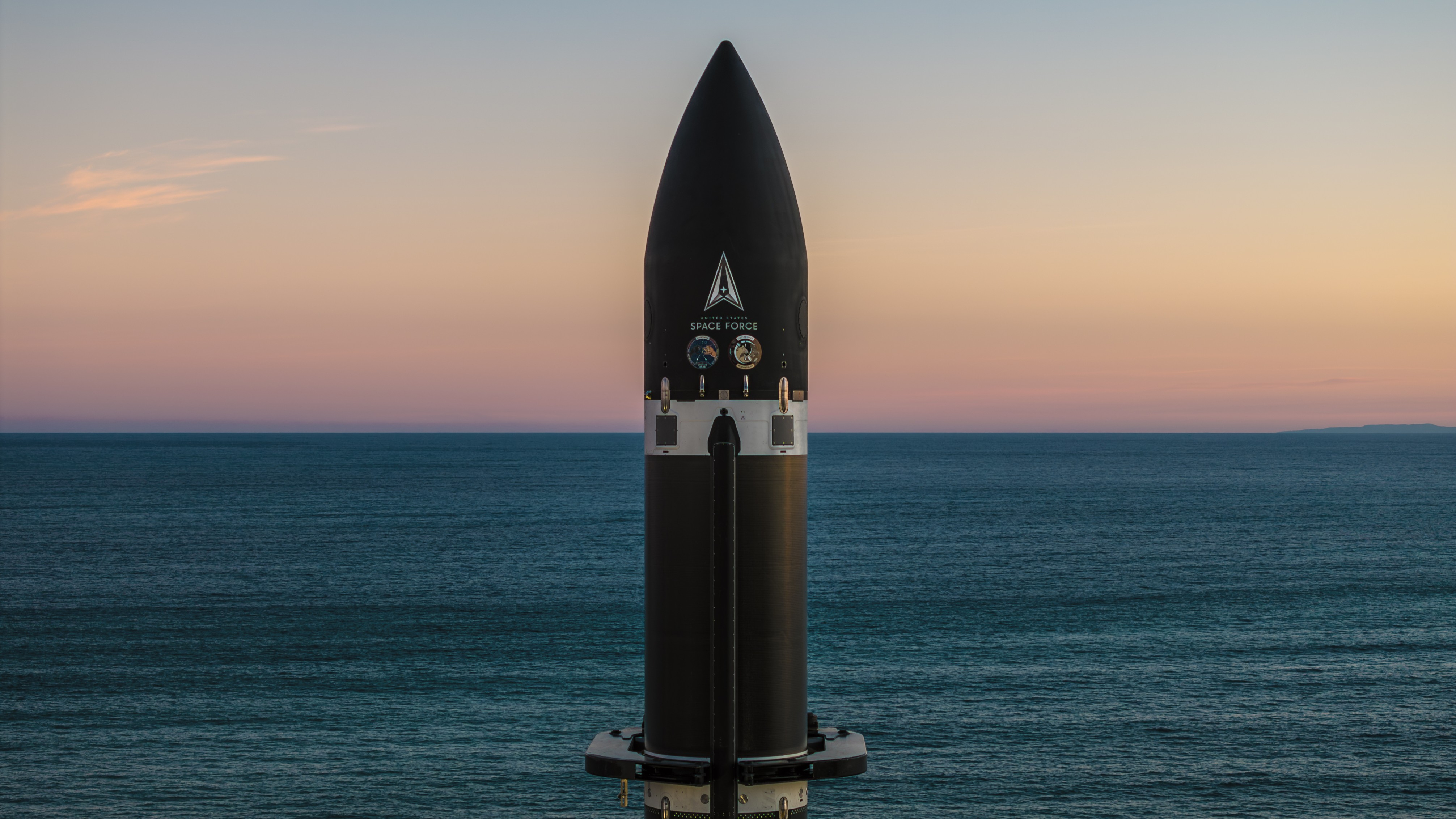
Rocket Lab has successfully launched the second spacecraft for the U.S. Space Force's Victus Haze Tactically Responsive Space (TacRS) mission, setting a new readiness record in the process.
Only 16 hours and 42 minutes passed between Rocket Lab receiving the Notice To Launch from the Space Force's Space Safari Program Office and liftoff of the company's Electron launch vehicle, beating the previous TacRS record set by Firefly Aerospace on the September 2023 Victus Nox mission by more than 10 hours.
Liftoff occurred on Friday (June 19) at 6:19 a.m. EDT (1019 GMT, 10:19 p.m., local time), from Rocket Lab's Launch Complex-1, in New Zealand, beginning a rapid-response demonstration designed to simulate a real-world orbital threat scenario.
Rocket Lab's Electron rocket launched on Friday (June 19) at 6:19 a.m. EDT (1019 GMT, 10:19 p.m., local time), from Rocket Lab's Launch Complex-1, in New Zealand. (Image credit: Rocket Lab)
Electron delivered a Rocket Lab-built Pioneer spacecraft to low Earth orbit (LEO), where it has begun pursuit of another Victus Haze spacecraft that was launched by SpaceX in May and serves as the target vehicle for the demonstration — True Anomaly's Jackal satellite. According to a June 22 Rocket Lab statement, "[Pioneer] is now fully commissioned and conducting complex orbital maneuvers to chase down another spacecraft on orbit and conduct Rendezvous and Proximity Operations (RPO)."
Victus Haze is a TacRS mission managed by Space Systems Command's Space Safari Program Office, with the objective of demonstrating the rapid acquisition, launch and operation of spacecraft in response to orbital threats and "non-compliant satellites," the Rocket Lab release said.
"Rendezvous and Proximity Operations on such short timelines are certainly not trivial, especially in a crisis or conflict scenario, but this demonstration of our ability to commission a complex and capable space vehicle within less than 72 hours, and immediately begin an RPO scenario thereafter, shows that we can field capability to deny adversaries first-mover advantage into novel orbits,” said Lt. Col. Lincoln Miller, Space Safari system program manager, in the statement.
Rocket Lab and True Anomaly teams are now managing their respective spacecraft in orbit. They will soon enter the RPO phase of Victus Haze, conducting space domain awareness (SDA) threat-response scenarios and "dynamic engagements with the other," according to a separate statement from the U.S. Space Force (USSF).
The VICTUS HAZE mission explained. Phase 1: Launch on demand 🚀 The @USSpaceForce's @USSF_SSC called, told us to launch, and just 16 hours 42 minutes hours later, Electron successfully left the pad from LC-1.Phase 2: 🛰️ With Pioneer spacecraft checkouts complete 34 hours… pic.twitter.com/lJK226LhzTJune 23, 2026
Space Force officials have increasingly looked to commercial providers to develop new capabilities and technologies to address potential conflicts in space. “Victus Haze is primed to further demonstrate our readiness to lean on our commercial partners to deny, disrupt, and counter any adversarial advantage — no matter where they try to operate in space,” acting Space Force portfolio acquisition executive Col. Bryon McClain said in the USSF statement.
With its Electron rocket and Pioneer spacecraft both vertically integrated into Rocket Lab's manufacturing processes, this Victus Haze launch marks the first TacRS mission to be carried out by a single prime contractor, providing the spacecraft, launch vehicle and on-orbit operations.
"This is what modern space power looks like: the ability to reinforce and reimagine national security space architecture at will," said Rocket Lab CEO Peter Beck. "We’re proud to be providing the nation with those next-generation space capabilities, today.”
China's Shenlong space plane appears to have released a mystery object while in orbit, according to a private space surveillance firm.
Shenlong launched on its fourth mission on Feb. 6, 2026 atop a Long March 2F rocket that lifted off from China's Jiuquan Satellite Launch Center in the Gobi Desert. As with previous flights, the objectives of this mission were not disclosed to the public. But according to recent observations by the commercial orbital intelligence company LeoLabs, one part of Shenlong's latest mission appears to involve releasing an unknown object.
"At 02:30 UTC on 22 June 2026, LeoLabs detected an unknown object in the vicinity of the Chinese Shenlong reusable space plane," LeoLabs posted to X. "This object did not correlate to any other object in our catalog. It was first observed by our Tracker radar in New Zealand."
"Following additional observations across our global network and analysis via LeoLabs Delta, we have independently cataloged this object and assessed with high confidence that it was released from the Chinese space plane," the company added in the post. "This activity is consistent with sub-satellite deployments conducted by the space plane in previous missions."
Space tracker Jonathan McDowell noted on X that the object has now been catalogued by the U.S. Space Force.
Shenlong, or "Divine Dragon," is a reusable space plane that launches atop a rocket but lands on a runway like an aircraft. Its overall design is believed to be similar to the United States Space Force's X-37B, or somewhat like NASA's storied space shuttle. Exact specifications are difficult to come by, given how secretive China's space program remains about Shenlong.
Very few images exist of Shenlong, and most of what we have seen of the space plane are telescopic images of the vehicle taken from ground-based telescopes.
Imagery of China's Shenlong space plane caught on camera in 2024 by Felix Schöfbänker in Upper Austria. (Image credit: Felix Schöfbänker )
This isn't the first time that Shenlong has appeared to release objects while in orbit. In June 2024, observers noticed that the space plane may have released a subsatellite or ejected an unnecessary piece of hardware as it approached the end of its mission.
Six months earlier, observers believed the space plane had ejected six objects at once, but those were later determined to be debris left over from launch.
On previous missions, Shenlong has appeared to conduct what are known as rendezvous and proximity operations (RPO), meaning it tested the capability to maneuver close to other objects in space, according to SpaceNews.
White these RPOs can be conducted for peaceful purposes such as repairing or refueling other spacecraft, it might also be the case that space superpowers such as China and Russia are developing these capabilities to potentially tamper with adversary satellites should warfare ever make it to space. In May, two Russian satellites came within 10 feet (3 meters) of one another in orbit, following a pattern of the country testing the capabilities of these so-called "inspector" spacecraft.
NASA's plan to deorbit the International Space Station in coming years has fallen under the scrutiny of a government watchdog group and stirred up a wave of reaction by a leading ocean conservation organization.
As presently blueprinted by NASA, the International Space Station will be de-orbited via a series of actions. Firstly, in early to mid-2028, the ISS will start to be lowered through a combination of Earth's natural atmospheric drag and the execution of re-entry maneuvers by the ISS's Russian segment. Then, in mid-2029, NASA plans to launch a SpaceX-supplied, government paid for, U.S. Deorbit Vehicle (USDV) and attach that craft to the ISS, which will fire its 46 Draco thrusters and push the station down to a watery grave.
But there's one issue that has ecology experts concerned. The Ocean Foundation, a Washington, D.C.-headquartered group with a mission to improve global ocean health and the human relationship with the sea via carefully chosen strategies and projects, says the planned deorbit of the International Space Station "raises serious concerns for ocean health that the space community has not adequately grappled with," according to Mark Spalding, president of the foundation.
A troubling gap
A just-issued U.S. Government Accountability Office (GAO) report has focused on issues related to NASA's plan to bring down the International Space Station (ISS) and transition from the ISS to commercial space stations, namely NASA's concern about having a "gap" in continuous human presence in low Earth orbit.
The GAO report explains that, at the end of 2030 or early 2031, the USDV is to perform a re-entry burn. That would push the ISS through the Earth's atmosphere and into a pre-determined spot – an ocean zone called Point Nemo.
"As part of the reentry process, NASA expects portions of the ISS and deorbit vehicle to break up and fall into the remote part of the ocean to minimize the risk to populated areas," states the GAO report.
SpaceX rendering of its U.S. Deorbit Vehicle (USDV), a Dragon-derived spacecraft with 46 Draco engines designed to propel the International Space Station into a controlled reentry. (Image credit: SpaceX)
But as for using Point Nemo or any part of the ocean as a convenient dumping ground, Spalding told Space.com that "there is a troubling structural gap in international law that the ISS de-orbit throws into sharp relief."
Under the Space Liability Convention of 1972, if space debris falls on another nation's territory or damages property, Spalding said, the launching nation owes compensation - absolutely and without needing to prove fault. "But no equivalent protection exists for the ocean," he said.
"As a result, when space agencies have control over where debris falls, they aim for the high seas, and in doing so, they incur no legal obligation to pay for cleanup or environmental remediation," said Spalding.
The Ocean Foundation leader said he understood the legitimate safety rationale for targeting Point Nemo, the point on Earth farthest from any populated area. "But the ocean's remoteness from human infrastructure should not be mistaken for a lack of value or vulnerability," Spalding said. "The ocean and its creatures deserve the same protection that international law affords to national territories."
Concerning the ocean's ecosystems, Spalding asks what happens to the marine ecosystems and creatures on the seafloor where the ISS leftovers land?
"The honest answer is, we don't fully know. That is deeply troubling for a structure the size of a football field. We do know that not everything burns up on reentry. Denser components will survive and reach the seafloor," Spalding added.
Point Nemo (marked in red) in the south Pacific Ocean is farther from land than any other point on Earth. It is also home to the world's largest "Spacecraft Cemetery." (Image credit: PGC/NASA IBCAO Landsat/USGS/Google)
The problem: uncertainty
What denser, specific materials from the ISS re-entry will be, and what harm they may cause to marine life, Spalding said, "has not been adequately studied or disclosed. That uncertainty is itself the problem."
Additionally, what environmental harm may begin before the debris hits the water is worrisome. As the largest reentry in history, the cumulative atmospheric impact of down-falling ISS hardware deserves serious study, he said.
For one, Spalding flagged a newly negotiated High Seas Treaty (BBNJ Agreement) that is relevant to downing the ISS. It requires parties to conduct environmental impact assessments for activities that may affect the marine environment beyond national jurisdiction when effects are unknown or poorly understood.
"It is fair to ask whether the ISS deorbit — the largest such reentry in history, targeting the high seas — should trigger that obligation," Spalding said.
The International Space Station. (Image credit: NASA/ESA–T. Pesquet)
Position statement
As for the Ocean Foundation's position on the ISS deliberate crashing into the Pacific Ocean, the group believes that discussion points prior to the ISS downing include:
A full environmental impact assessment of the anticipated seafloor debris field and atmospheric effects;
Public disclosure of all materials that will survive reentry and reach the ocean floor;
A rigorous legal analysis of obligations under the UN Convention on the Law of the Sea (UNCLOS,) the London Protocol of 1996 that provides an international standard and framework for countries to individually and collectively protect and preserve our oceans from pollution caused by the dumping of wastes and other matter into the ocean, along with the BBNJ Agreement.
The high seas have no sovereign who can demand accountability, concluded Spalding. "We believe this gap in international law needs to be closed, and the ISS de-orbit is a vivid illustration of why."
SpaceX's Dragon capsule leaves after dropping off some supplies and science at the ISS. (Image credit: NASA/Jessica Meir)
SpaceX's Cargo Dragon capsule shines in the sunlight over Earth as it departs from the International Space Station in a new image snapped from onboard the station.
With sunbeams gleaming downward, reflecting off of the spacecraft's hull, the Dragon can be seen backing away from the station mere moments after undocking from the port on the station's Harmony module. The undocking is so recent that you can clearly see both the docking port and the hatch of the Dragon where the two connected.
The space station has been in orbit since 1998 and continuously occupied since November, 2000. With decades of work in orbit, it can be easy to take for granted the incredible transport system that supports cutting-edge research hundreds of miles above Earth's surface.
The work done on the station is impressive, but this system is just as mind-boggling. In addition to launching and returning astronauts who perform critical maintenance and repair work on the station on top of their research duties, cargo missions keep the station stocked.
From food and clothing to medical equipment and intricate science experiments, these missions are essential for both keeping astronauts safe and healthy on station as well as continuing the progression of science in-orbit. This back-and-forth between Earth and the space station is an impressive feat, and this photo shows the system fully in-motion.
A new planetary habitability model could make the search for aliens more efficient by quickly identifying rocky worlds unlikely to sustain the atmospheres needed for life as we know it.
The software, called the Smaller Than Earth Habitability Model (STEHM), allows astronomers to screen exoplanets before committing valuable telescope time to detailed observations. Developed by researchers at Stanford University, the model assesses whether a rocky planet can build and retain an atmosphere over billions of years — a prerequisite for life as we know it, according to a statement from the university.
Astronomers searching for life beyond Earth face a daunting challenge: thousands of exoplanets have already been discovered, and billions more are thought to exist throughout the Milky Way — roughly one for every star in the galaxy. As powerful new telescopes come online, researchers increasingly need ways to identify which worlds are worth closer study.
"The only way that we're going to ever find out if there are signatures of life out there is by observing the atmosphere of these planets," Michelle Hill, lead author of the study who developed STEHM, said in the statement.
Traditionally, scientists have focused on whether a planet lies within its star's habitable zone, the region where temperatures may allow liquid water to exist on the surface. But location alone does not guarantee habitability. A planet without a substantial atmosphere may be unable to maintain stable temperatures, shield itself from radiation or support surface water, the researchers said.
STEHM adds a second layer to this assessment by estimating whether small rocky planets can generate and retain atmospheres over geologic timescales. The model links a planet's size to its ability to hold onto atmospheric gases, helping identify a lower size threshold for potentially habitable worlds.
To build STEHM, Hill used the ExoPlex planetary simulation code to model six rocky worlds ranging from half Earth's size to Earth-size, testing how planetary structure, volcanic activity, internal heat and stellar radiation affect atmospheric survival. The model was validated using Venus and Mars, correctly reproducing Venus's thick carbon dioxide atmosphere and Mars's long-term atmospheric loss.
The results suggest that rocky planets at least 80% the size of Earth can retain atmospheres for 10 billion years or more when orbiting within habitable zones around sun-like stars. Smaller planets generally lose their atmospheres more quickly, though worlds around 70% of Earth's size may still be habitable under favorable conditions. Atmospheric longevity also depends strongly on initial carbon content and heat-producing elements that drive volcanic activity, allowing STEHM to serve as a size-based filter for identifying the most promising habitable worlds.
"Maybe there's life on other planets under the ground, but we are never going to be able to see it because we can't send something to those exoplanets," Hill said in the statement. "The best chance we've got is looking for signs of life by analyzing atmospheres from afar."
By narrowing the field of candidates, STEHM could help astronomers focus on the most promising planets for life while avoiding wasting resources on unlikely targets. The approach may be especially useful as next-generation missions, such as the European Space Agency's PLATO space telescope, expand the catalog of rocky exoplanets around nearby stars. Researchers hope the model will help prioritize which of these planets merit follow-up observations.
STEHM not only addresses where life beyond Earth could occur, but when it might, by modeling whether exoplanets can actually hold onto atmospheres over geologic timescales — a key prerequisite for life to take hold in the first place.
"Maybe the answer to why we haven't found any life yet is that we're so early in the grand scheme of what has been created through the lives and deaths of stars," Hill said in the statement. "Maybe we're one of the first."
Their findings were published June 4 in the Planetary Science Journal.
SpaceX's newest spaceflight tech has to launched to the final frontier for the first time.
The company's Starfall capsule took to the skies on its debut mission today (June 23), following SpaceX's application with the U.S. Federal Aviation Administration (FAA) for two reentry vehicle landings. The mission lifted off from Space Launch Complex-40 at Cape Canaveral Space Force Station in Florida at 6:52 a.m. EDT (1052 GMT).
Starfall is a cargo transportation vehicle designed to carry payloads to low Earth orbit (LEO) and beyond, aboard SpaceX's Falcon 9 and Falcon Heavy rockets, and also return materials safely back to Earth. The platform isn't designed to fly human passengers; it's geared toward the support of research or other payloads that require retrieval after a stint in space, such as pharmaceuticals and other products of orbital manufacturing.
Render of Starfall capsule reentering Earth's atmosphere. (Image credit: SpaceX)
The concept has already been put into practice by Varda Space, which has landed five of its 3-foot-wide (0.9 meters), roughly 650-pound (300 kilograms) conical "W-series" capsules to date, one of which returned a payload for the U.S. Air Force after more than eight weeks on orbit. Starfall is more than three times as large, measuring 10 feet (3.1 m) across and 2.5 feet (0.75 m) tall. The SpaceX vehicle can carry up to 2,200 pounds (1,000 kg) of payload.
Starfall has two primary sections, which separate after reentry: a top plate for payload storage and attitude control components, and a carbon fiber heat shield that stores compressed gas to power attitude control maneuvers needed for precise reentries and landings, heat shield jettison and parachute deployment, according to SpaceX's FAA filing.
(Image credit: Federal Aviation Administration (FAA).)
SpaceX plans to launch Starfall on suborbital missions, in addition to the longer-term stretches it will be able to spend in LEO. The capsule lacks a propulsion system and is incapable of deorbiting itself. The FAA document is unclear about how this will be accomplished, but it's likely that this launch will use Falcon 9's second stage to bring the demo capsule back to Earth.
In the event that Starfall experiences some sort of issue in space or during reentry, SpaceX has designed the spacecraft for safe expendability. "Capsules use nonhazardous inert cold gas (nitrogen) for attitude control and contain no liquid propellants or hazardous substances. All pressurized systems would be vented prior to splashdown, therefore, no propellants would be released into the ocean," the company says in the FAA document.
SpaceX is targeting an area 700 nautical miles (1,300 km) off the United States West Coast for Starfall splashdowns. (Image credit: Federal Aviation Administration (FAA))
SpaceX has not yet specified how long it plans to keep the test Starfall vehicle in orbit on this debut mission, and did not broadcast views of the Falcon 9 second stage after separation from the rocket's booster. When the Starfall payload returns, SpaceX is targeting an area in the Pacific Ocean for splashdown, about 700 nautical miles (1,300 km) off the United States West Coast.
On the opposite side of the U.S., the Falcon 9 rocket that launched the Starfall demo mission headed for a return in the Atlantic Ocean. It was the 29th flight for this particular booster, tail number 1078, whose previous experience includes NASA's Crew-6 launch to the International Space Station, a Space Force mission and 23 Starlink launches, among others. Following stage separation, about 2.5 minutes after liftoff, Booster 1078 fine-tune its trajectory for a landing burn and touchdown on the SpaceX autonomous droneship "A Shortfall of Gravitas" downrange in the Atlantic, touching down about T+9 minutes.
Editor's note: This story was updated at 7:10 a.m. EDT to reflect the successful launch of SpaceX's Falcon 9 rocket and Starfall demonstration mission.
The heavy hitters in space telescopes are about to be joined by a new contender.
NASA's Nancy Roman Grace Space Telescope arrived at the Kennedy Space Center (KSC), in Florida, on Sunday (June 21), for final tests ahead of launching later this summer. Roman was shipped to KSC from NASA's Goddard Space Flight Center in Greenbelt, Maryland, riding the agency's Pegasus barge from Baltimore to the Space Coast.
KSC is Roman's final stop before launching to space aboard a SpaceXFalcon Heavy rocket where it will join other flagship observatories like Hubble, Webb, Chandra and Spitzer. NASA is currently targeting an Aug. 30 liftoff — eight weeks ahead of its original schedule. Before that date arrives, Roman will undergo tests inside KSC's Payload Hazardous Servicing Facility (PHSF), where upgrades were recently completed to prepare for the telescope's arrival.
Roman, inside a specialized, environmentally-controlled protective container used to encapsulate the telescope at the start of its journey from Goddard, was transported to the exterior of the PHSF building following its KSC arrival, where teams began a decontamination and cleaning process to ready the container for opening today (June 22) inside the PHSF airlock, followed by the unboxing and transportation of the roughly 18,000-pound (8,200-kilogram) spacecraft to the high bay clean room for prelaunch preparations.
Roman's work platform inside the PHSF, which NASA refers to as "the Pantheon" will allow engineers to perform final checkouts on the spacecraft, including tests of the telescope's six solar panels, insulation, and heat management components. Technicians will also load Roman with about 290 gallons (1,100 liters) of hypergolic hydrazine fuel, which will power the satellite's thrusters for delivery to its final orbit and small positional adjustments during the ten or more years the propellant is expected to last.
Roman is headed to Sun-Earth Lagrange point two (L2), a station-keeping point about 1 million miles (1.6 million kilometers) beyond Earth on the side opposite the sun. Lagrange points are regions of space similar to where the gravitational influence of two or more bodies is equal, allowing spacecraft to be "parked" and remain in place without needing to fire their thrusters and expend fuel. Once it settles in at L2, Roman's mission is set to last for at least five years, with the option for NASA to extend the telescope's use as long as its fuel lasts and instruments perform as needed.
Using its 7.9-foot-wide (2.4 meters) primary mirror, combined with a 300-megapixel camera and coronograph, Roman's primary mission will be hunting down the elusive mysteries of dark energy and the accelerating expansion of the universe through the discovery of "billions of galaxies, hundreds of thousands of new exoplanets, hundreds of blackholes, and … vast volumes of daily data for astronomers to study," according to NASA.
The main-belt asteroid Donaldjohanson, a heavily cratered fragment born from a catastrophic breakup 155 million years ago, appears to wobble through space while preserving clues to the migration of water-rich worlds in the early Solar System, according to a new analysis of images and data from NASA’s Lucy spacecraft.
SpaceX just notched a remarkable launch-dominance milestone.
Elon Musk's company has now lofted more spacecraft than the rest of humanity combined — and its lead is likely to grow over the coming months and years.
Investor and former space-industry executive Christian Keil highlighted the achievement in a June 12 X post, which noted that SpaceX had launched 15,262 satellites as of that date. The combined total for all other companies and organizations since the dawn of the space age in 1957 was 15,138, according to Keil.
Musk founded SpaceX in 2002. The company was not an instant success; its first three launches, with the homegrown Falcon 1 rocket, were failures. SpaceX finally broke through with a Falcon 1 success in 2008. A fourth straight failure probably would have been the end of the company, Musk has said.
SpaceX soon moved on to the Falcon 9 rocket, which debuted in 2010 and remains the company's workhorse; it flew a whopping 165 times in 2025.
Most of those launches — nearly 75% of them, in fact — were devoted to building out Starlink, the broadband megaconstellation SpaceX has assembled in low Earth orbit (LEO).
Unsurprisingly, the vast majority of objects that SpaceX has launched to date are Starlink satellites. As of June 18, the company has sent 12,318 of the internet spacecraft to LEO, according to astrophysicist and satellite tracker Jonathan McDowell.
That number will continue growing far into the future, as Starlink could someday have 40,000 or more satellites.
And SpaceX is dreaming even bigger than that. Musk recently announced that he wants to operate a million data centers in space, as part of SpaceX's transition from a pure launch concern to a company focused heavily on artificial intelligence.
These spacecraft will be lofted by SpaceX's Starship megarocket, which is still in the test flight phase. Starship is the biggest and most powerful rocket ever built, and it's designed to be fully and rapidly reusable.
SpaceX has teased a future that features thousands of Starship flights every year as the company helps humanity settle the moon and Mars, among other ambitious tasks. So, it's safe to say that SpaceX doesn't plan to relinquish its launch lead anytime soon.
SpaceX added 24 satellites to its Starlink megaconstellation on Sunday (June 21) with a launch from California.
A Falcon 9 rocket lifted off at 12:39 p.m. EDT (1639 GMT or 9:39 a.m. PDT local time) from Space Launch Complex 4 East at Vandenberg Space Force Base. SpaceX confirmed deployment of the Starlink batch (Group 17-28) about an hour after their launch.
The Falcon 9 rocket's first stage (Booster 1063) completed its 33rd launch by landing on the autonomous droneship "Of Course I Still Love You" stationed in the Pacific Ocean. The stage is just two flights shy of the current Falcon 9 reuse record of 35 launches.
A SpaceX Falcon 9 rocket carrying 24 Starlink satellites lifted off from Vandenberg Space Force Base in California on Sunday, June 21, 2026. (Image credit: SpaceX)
The Starlink network now has more than 10,600 active satellites, according to tracker Jonathan McDowell. The service provides worldwide internet access, as well as inflight wifi and direct to cell connections for select providers.
Sunday;s launch was SpaceX's 72nd Falcon 9 mission of the year out of a total history 655 missions.
La 347e réunion du Conseil de l'ESA s'est tenue dans un contexte particulier : celui d'un programme Artemis remanié par la Nasa, sans concertation avec ses partenaires européens. On attendait une réponse. Elle n'est pas venue. L'Europe spatiale a choisi la prudence, renvoyant les grands...
GOLDEN, Colorado – Here on Earth, centuries of accumulated engineering knowhow, hard-learned lessons, and societal evolution have shaped a robust framework of building standards that govern how we build and maintain buildings today.
But now, as humanity prepares to put in place a "sustained presence" on the moon, how do we guarantee the safety and integrity of structures built in an environment for which no such tradition exists?
At the 26th Space Resources Roundtable held June 2-5 on the campus of the Colorado School of Mines, one expert says what's needed is a lunar building code, the development of specific design criteria for the moon.
What's shaking?
Both NASA and China's space agency are planning to build habitats, landing pads, equipment shelters, and tall towers on the moon. But all that construction could be off to a shaky start, suggests Nerma Caluk, an engineer and lunar specialist for Skidmore, Owings & Merrill, an architecture and structural engineering firm in San Francisco, California.
Caluk said there's a need to leverage terrestrial building experiences.
"On Earth, structural systems rely on strong gravitational acceleration to resist seismic lateral forces through both foundation friction and overturning stability. However, on the moon, the gravitational field strength is reduced to just one-sixth of Earth's surface gravity," Caluk told Space.com.
Because seismic inertial forces are governed purely by a structure's mass rather than its weight, the lateral demand on a structure remains fully active while its gravitational restoring capacity is substantially diminished, Caluk added.
"Low-profile surface structures risk translational sliding across poorly characterized regolith interfaces, while taller vertical structures face significant overturning vulnerability, as the moon provides only a fraction of the gravitational restoring moment available in a terrestrial seismic environment," said Caluk.
Here on Earth, structural engineers routinely design typical building systems to yield, crack, and sustain permanent inelastic deformation during a design-level seismic event.
They intentionally leverage "inelastic energy dissipation" as the primary mechanism for managing seismic demand, Caluk said. But this design philosophy is fundamentally incompatible with a crewed lunar environment, she said.
Take for example a hatch distortion or pressure seal misalignment. They constitute a mission-critical failure, and any structural breach risks catastrophic depressurization, said Caluk.
An artist's rendering of a NASA Artemis moon base with development underway. (Image credit: NASA)
A group taking on the challenge of shaping guidelines on the building of lunar infrastructure is the aerospace division of the American Society of Civil Engineers.
The group's technical committee on space engineering and construction has crafted "Infrastructure Engineering, Design, Analysis, and Construction (LIEDAC) guidelines" for the moon, Caluk said, to tackle seismic issues imposed by moonquakes.
The LIEDAC guidelines, Caluk said, characterize the unique lunar hazard environment, classify operational consequences through a risk-categorization hierarchy, and establish target performance objectives "so that safe commercial development can proceed on a defensible technical basis."
Inherent uncertainties
Caluk also outlined a "Response Spectrum Analysis" supported by NASA Small Business Technology Transfer funding that looked at the inherent uncertainties of the lunar subsurface.
The output of the analysis has developed criteria emphasizing the necessity of a local geotechnical site investigation for all structures, regardless of their seismic design category.
"These investigations are critical for identifying and mitigating risks such as seismic slope stability, seismically induced total and differential settlement, and other geotechnical hazards that may be triggered or amplified by moonquake ground motions," she reported here at the School of Mines gathering.
Moreover, the framework that Caluk and her associates have pulled together, acknowledges that lunar site conditions are not yet fully understood on a global scale.
NASA envisions robotic rovers and astronauts working alongside one another to build structures on the moon. (Image credit: NASA)
Design practices
Not knowing ahead of time what lunar explorers may face is an unsure, shuddering proposition.
"Therefore, responsible design practices must account for this uncertainty through rigorous subsurface investigation whenever feasible," Caluk added. "By prioritizing localized data collection, engineers can ensure that structural foundations are robust enough to handle the unique physical properties of the lunar regolith and the specific seismic demands of the deployment site."
Caluk and her team members looked at the maximum considered moonquake, representing a more severe shaking level, to verify collapse prevention and ensure overall structural integrity under extreme lunar seismic events.
"NASA's deep institutional knowledge of human spaceflight operations and crewed mission safety," Caluk concluded, "provides the critical foundation upon which structural performance criteria for lunar infrastructure can now be formally established, with terrestrial engineering precedent offering a proven methodology for doing so even under evolving geotechnical and seismic data conditions."
NASA has announced a new commercial partnership for the next satellite headed to the Red Planet.
California-based Relativity Space will design, build and launch the spacecraft that carries NASA's Aeolus instrument suite to orbit around Mars, where the probe will be the first to provide daily measurements of the planet's global environment. Aeolus will collect data on Martian dust and cloud cover, winds and temperatures, according to a NASA release.
"Public-private partnerships like this are a force multiplier for science," NASA Administrator Jared Isaacman said in a statement on Wednesday (June 17).
The newly announced relationship, and others between NASA and private industry, is designed to allow the agency to concentrate its resources on important science discovery. "By pairing NASA’s world‑class instruments with commercial innovation and investment, we can deliver more science, more often, and reduce the time it takes to get essential data into the hands of researchers preparing for future human missions to Mars," Isaacman said.
Aeolus consists of four instruments, designed to work in tandem to create a complete picture of the Martian atmosphere and its behavior. In addition to refining scientific models for the Martian environment, NASA plans to use the data to reduce risks to future robotic and crewed missions landing on Mars' surface.
The science suite includes the Doppler Wind and Temperature Sounder (DWTS‑Ozone), in collaboration with GATS, designed to measure wind speeds and temperatures present up to 37 miles (60 kilometers) above the ground. The Thermal Limb Sounder (TLS), designed with Xiomas Technologies, will create vertical temperature profiles and provide data on atmospheric dust and cloud cover, while the Surface Radiometric Sensor Package (SuRSeP) collects compositional data on those clouds and dust, and tracks how the Martian surface absorbs, stores and releases energy, like heat. Finally, Aeolus' Wide‑Field Context Camera (WFCC) will take daily images to assess atmospheric activity across the whole of Mars.
Relativity Space's Terran 1 rocket successfully blasted off for its test flight but malfunctioned three minutes after liftoff. (Image credit: Relativity Space)
NASA is targeting 2028 for the launch of the Aeolus mission, which will be designed and built at NASA's Ames Research Center in California, where it will also be integrated on Relativity's spacecraft for testing ahead of launch. NASA has committed to support Aeolus' scientific operations for at least one Martian year (approximately 687 Earth days). However, the agency has historically extended its missions to Mars, when able.
NASA was recently forced to end operations of its MAVEN (Mars Atmosphere and Volatile Evolution) probe around Mars, after an anomaly led to a loss of communications with the satellite, but the spacecraft ran for more than a decade beyond its original one-year mission. The agency's only two active satellites orbiting the Red Planet are the Mars Reconnaissance Orbiter (MRO) and Mars Odyssey, which are both operating nearly two decades or more, respectively, beyond their initial mission timelines.
For its part, Relativity will be in charge of designing the Mars-bound spacecraft and will also be responsible for launch and for satellite operations in space. The company's pathfinder launch vehicle, the Terran 1 rocket, lifted off for the first and only time in March 2023, but it failed to reach orbit. The company then pivoted to development of the bigger, partially reusable Terran R rocket, which is expected to debut sometime later this year. Eric Schmidt, who served as Google CEO from 2001 to 2011, was appointed to lead Relativity in March 2025.
WALLOPS ISLAND, Va. — For over 20 years, NASA's Swift space observatory has been conducting prolific science in orbit, hunting for signs of gamma-ray bursts — the most powerful explosions in the universe. Now, it's falling to Earth, doomed to a fiery death by the end of the year as its orbit decays.
But maybe not.
NASA, it turns out, has a daring rescue mission in the works, something never before attempted in space: the Swift Boost mission. The endeavor calls for an untested spacecraft built by the Arizona company Katalyst Space Technologies to rendezvous and dock with Swift — something the observatory was never designed to do — before the observatory falls back to Earth.
NASA’s Neil Gehrels Swift Observatory is falling out of space. NASA has a daring plan to save it with a spacecraft built by Katalyst Space. (Image credit: NASA)
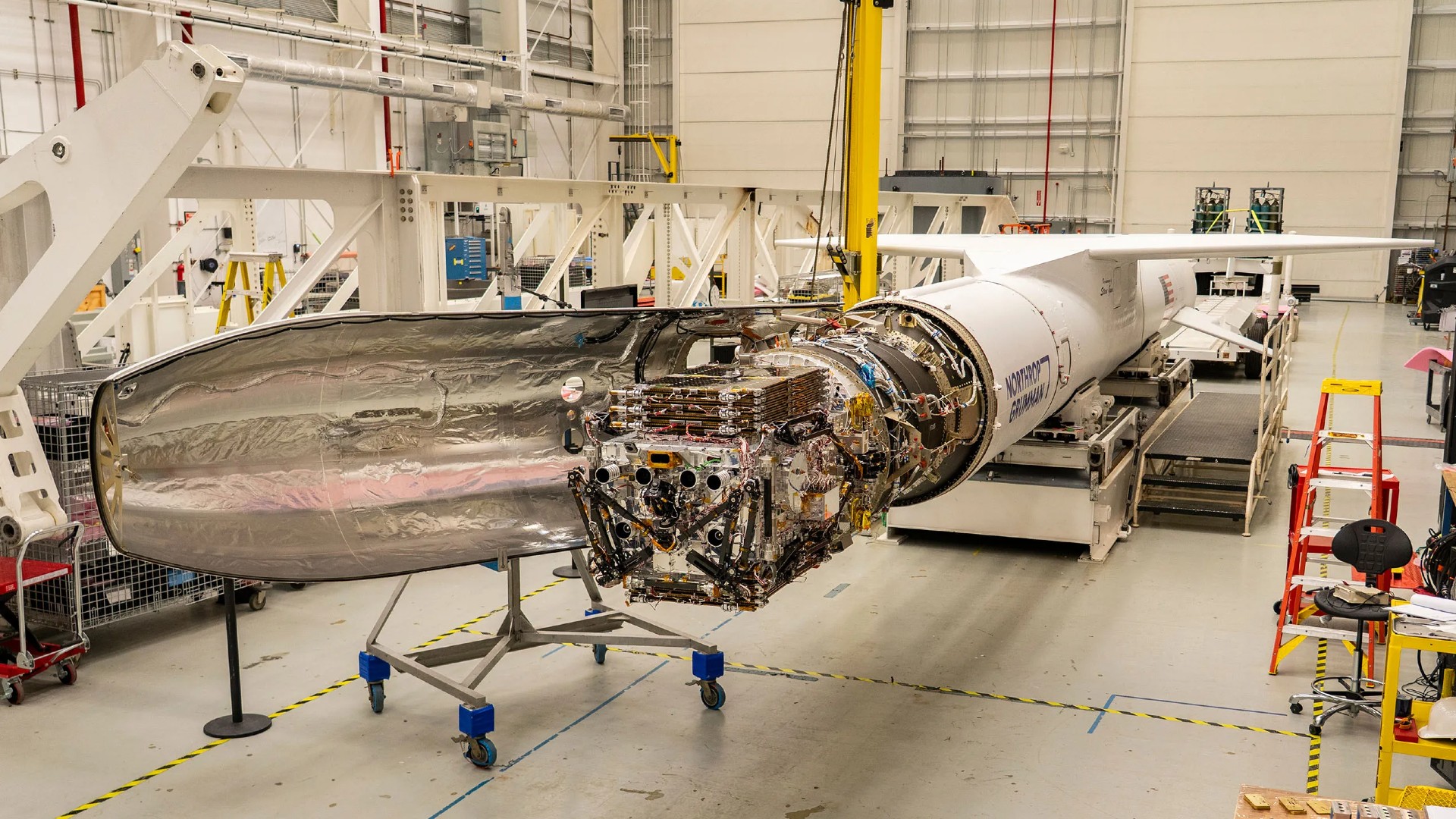
If all goes well, Katalyst's space tug (it's called Link) will lift the Swift observatory into a higher, safer orbit — one that will add years of life to the aging space telescope's mission. Liftoff is officially set for June 27, with Link launching on the last-ever Pegasus XL rocket, an air-launched booster built by Northrop Grumman.
"Frankly, I have to be honest: No one thought it was going to be possible," Shawn Domagal-Goldman, NASA's Astrophysics Division director, told reporters here on Wednesday (June 17). "No one thought we would get as far as we've already gotten today."
What stands out most is how quickly the mission came together.
NASA’s Neil Gehrels Swift Observatory, shown in this artist’s concept, orbits Earth as it studies the ever-changing universe. Launched in 2004, the space telescope's days are numbered as it is falling out of space. (Image credit: NASA’s Goddard Space Flight Center Conceptual Image Lab)
It was just in September 2025 that NASA picked Katalyst to build a spacecraft capable of boosting Swift on a budget of $30 million. That was nine months ago. And now, the finished Link spacecraft — with its three robotic arms, three main Hall thrusters and a suite of other instruments — is packed aboard its Pegasus XL rocket and tucked on the belly of its L-1011 Stargazer carrier plane for a trip to its launch site in the South Pacific's Kwajalein Atoll.
"In the last nine months, we have gone from a clean sheet to a spacecraft that is currently integrated on a rocket on an airplane, ready to go to Kwaj for launch," said Kieran Wilson, Link's principal investigator at Katalyst Space, on Wednesday. "This is an absolutely unprecedented development timeline for this program."
Yet that "swift" timeline, if you will, is essential if NASA is to rescue the Swift space observatory.
Katalyst Space's LINK robotic servicing satellite awaits encapsulation inside a Northrop Grumman Pegasus XL rocket on June 8, 2026, at NASA's Wallops Flight Facility in Virginia. (Image credit: NASA/Ron Beard)
NASA originally launched Swift (its full name is the Neil Gehrels Swift Observatory, after its late principal investigator) in 2004 on a $250 million mission to search the sky for gamma-ray bursts and other high-energy astrophysics phenomena in the cosmos. From its original orbit about 375 miles (600 kilometers) above Earth, Swift was a silent sentinel, ready to quickly pivot to new targets with unprecedented speed.
"Swift was designed to study gamma-ray bursts, short-lived flashes of high-energy light that release more energy in just a few seconds than the sun will in its entire lifetime," Swift principal investigator Brad Cenko told reporters Wednesday. "It's been extremely successful in this regard, detecting over 2,000 of these sources all the way out to the edge of the visible universe."
It was Swift that helped scientists confirm without a doubt that the heaviest elements we know of, including the shiny gold and platinum in the jewelry you're wearing right now, were forged by these explosive cosmic events, Cenko said. Swift was expected to last two years in orbit. It's well into its second decade now, and still in good health — well, except for that "falling out of space" part.
You see, Swift doesn't have thrusters, or a propulsion system of any kind. And over the years, an increase in solar activity — space weather from the sun — has puffed up Earth's atmosphere to create more drag on Swift than expected, pulling it down from its initial orbit.
Last year, the Swift mission team realized the space telescope was falling faster than expected. Without a rescue mission, Swift would crash to Earth by the end of this summer.
"It was okay for a generic spacecraft to come out of orbit," Domagal-Goldman said. "But this was not just any spacecraft. This is an observatory with unique capabilities for astrophysics … It is a swift observatory that can quickly pivot across the night sky to find things that go boom in the night."
"So we decided, yeah, we want to go save this one this time because of how special it is," he added.
Artist's illustration of Katalyst Space Technologies' Link servicing spacecraft approaching and capturing NASA's Swift space observatory on an orbit-boosting mission. (Image credit: Katalyst Space Technologies)
A lot has to go right for Katalyst's Link spacecraft to rescue Swift.
The 937-pound (425-kilogram) spacecraft will launch into an initial testing orbit on June 27 and perform a series of checkouts to ensure that its basic systems (three main engines, 16 reaction control thrusters, solar arrays, robotic arms) are all working properly.
"We'll have a commissioning period of a few weeks, after which we will begin maneuvers in order to approach Swift," Wilson said.
Once Link reaches Swift's orbit, it will perform a series of proximity operations, dock, and then raise the space observatory to its initial orbit over the period of a several months. If that goes to plan, Swift could be back to performing science by this fall, Cenko said. (The telescope has been in a low-power mode to preserve what orbit it can since February.)
If Link is successful, Swift could get another five or more years of life in space. Link, meanwhile, will detach and be intentionally deorbited (meaning it will fall to Earth on purpose) to end its mission.
"All this is challenging and risky," Wilson said. "There's a lot of spacecraft that have had far longer development cycles with far more funding behind them that have failed for mundane reasons."
A lot of simple things can go wrong.
For example, the solar arrays on Link might malfunction, Wilson said. Swift has been in orbit for so long, its protective insulation blankets may be as brittle as glass and break when Link's robotic arms grab on, he added.
Engineers from Katalyst stabilize their Link robotic servicing spacecraft as it moves into a vibration chamber at NASA's Goddard Space Flight Center on April 15, 2026. (Image credit: NASA/Scott Wiessinger)
And then there's the sun. It was increased solar activity that put Swift in its perilous situation. That activity is ongoing. In fact, Swift may be one big solar storm away from doom if the sun fires off a major storm before Katalyst's Link can reach it.
Swift is on track to fall below an altitude of 186 miles (300 km) by October. At that point, it may be too low for Link to reach the observatory. A surprise solar storm could accelerate that fall, but NASA remains hopeful.
"At the moment, we think we have several months where Swift will be at a sufficiently high altitude to give Katalyst folks a great chance to capture and boost us," Cenko said.
Katalyst is banking on the future need for spacecraft servicing and life extension in space. This week, the company raised $12 million in funding to develop an even more capable spacecraft called Nexus, which it plans to "expand satellite servicing to multi-orbit, multi-mission operations."
"Over the last decade or so, we've gotten very good at launching things into space," said Robert Lamontagne, Katalyst's vice president for strategic partnerships. "Katalyst is here really to kind of demark the end of that throwaway model, and the start of a new model."
The first test flight of a Nexus mission could launch in 2027. Its target: a U.S. Space Force satellite called Rooster in geostationary orbit22,236 miles (35,786 km) above Earth, much higher than the Swift observatory. That Nexus-1 mission will launch atop an Ariane 6 rocket next year.
One new mission is setting out to study menstruation in microgravity for the first time ever.
Forty-six years ago, NASA engineers asked Sally Ride if 100 tampons was the right amount to send with her for a six-day spaceflight. Though people laugh at that fact today, there has still never been any scientific study dedicated to studying menstruation in space. But a non-profit called Operation Period aims to change that. Led by Gen-Z researchers, this non-profit works to provide what its founder Manju Bangalore calls "menstrual freedom," which she says would mean everyone can have easy access to menstrual products. Meanwhile, the organization also aims to tackle the wider issues that leave people without such access in the first place. With its upcoming suborbital mission Operation Period-01 (OP-01), this ambitious team is taking their cause into microgravity. On OP-01, the mission's founder will launch to space to conduct the research themselves on a Virgin Galactic suborbital flight in 2027.
In conducting their work here on Earth, Operation Period found that "there were still some of those same gaps in spaceflight medicine," Manju Bangalore, the founder and executive director of Operation Period and research astronaut in training for OP-01, told Space.com. " I want all menstruators to be able to live life with their full dignity and reach their fullest potential, and that includes astronauts."
With a background in physics and astronomical engineering as well as with training in bioastronautics and having spent time working at NASA, Bangalore brings her love of space to this cause. She and Priya Abiram, the Director of Research at Operation Period's Redshift Lab, feel so strongly about their message, even 9 years since the pair founded their non-profit; in fact, with this mission, the two will become some of the youngest South Asian women to travel to space.
"On a personal level, I've always been fascinated by space and human space exploration. It's what's always excited me as a child, and I've kept that curiosity going," Bangalore said. "I didn't think those two missions would ever combine into this. It wasn't something I ever planned, but I'm very grateful to lead this historic mission to advance menstrual health in this way."
And just as this team is excited to bring their research into a suborbital environment, Virgin Galactic is excited to be expanding the range of microgravity science the non-profit supports. "This mission with Operation Period is a powerful example of how Virgin Galactic can continue to support real-time, in-flight scientific investigation into long-overlooked areas of human health, helping advance more inclusive and innovative exploration that delivers insight for both space and life on Earth," Virgin Galactic director of system analysis & research Amber Favaregh said in an emailed statement.
Recently, Operation Period expanded to include a research wing, and this mission will be conducted under that umbrella. The team was not yet able to share specific details on the exact protocol that will be conducted during the mission, information they said will be shared at a date closer to launch, but they did share the current issues that this research aims to begin to address.
Currently, astronauts typically choose to fully suppress their periods during their spaceflights, through hormonal IUDs or oral contraceptive pills. While that is a choice astronauts might continue to make in the future, without data to show the reality of dealing with a period in space, astronauts are left with fewer choices with their own bodies. Comprehensive data on menstruation in space will also be important if astronauts are to complete longer spaceflights or even extended stays on the moon. While the mission has not yet revealed its priorities and exactly what data it will collect, with such limited data on menstruation in space, there is a lot of knowledge to be gained.
While "the data that we have, although limited, says that it is generally safe to menstruate, in terms of long duration missions, we don't have quantitative data," Bangalore said. "We don't have enough data to continue to assist with patient resource allocation for mission planners."
Historic missteps like the "100 questions" moment with Sally Ride highlight an issue that could have big effects on future, longer-term missions. Sure, having a ridiculous number of backup products would ensure that there is no need unaddressed, mass considerations for spaceflight are extremely serious and future missions will need to have better data to know what will be needed in a microgravity environment.
And just like with other science in space, the research conducted in microgravity will also be used on Earth. The pair aim to collect menstruation data that will benefit astronauts as well as people back on our home planet. .
"I think on Earth, there's a lot of gaps right now in menstrual health research," Bangalore said. As just one example, she cited recent findings that menstrual product companies were reporting incorrect absorbency of their products because they were testing products with saline, which is very different from menstrual blood. "This was potentially leading to doctors to underdiagnosed heavy menstrual bleeding, which right now the stats say affects 20% of American menstruators," Bangalore said.
With this being the first mission of its kind, OP-01 will not answer every question that remains about menstruation and space, but it will bring data to a conversation decades in the making. "Our hope is to continue to iterate this research so that we can do future suborbital flights, as well as orbital flights, to continue to create larger data sets," Bangalore said. "I think the point of preliminary studies is to be able to know what questions to ask in the future, so we don't expect that this suborbital flight will solve everything or create all the data that we need, right, but we hope that this will be a good stepping stone."
Momentum for this research was actually sparked by many millions of views on a viral social media video in which Bangalore conducted an early version of a menstrual fluid dynamic experiment in a low-gravity environment aboard a parabolic flight.
This viral moment "ended up being a really cool kind of 'in' to continue talking about destigmatizing periods," she said. "Through that, I got to talk more about the gaps in spaceflight medicine, in terms of menstrual health."

 Login