
❌

Normal view

'A completely different story': 300 million-year-old fossils reveal the first vertebrate land dwellers weren't what we thought, researchers claim

19 June 2026 at 11:26

Never-before-seen fossils of newly hatched crocodile-like creatures are shining new light on how our aquatic ancestors conquered land.

Early four-limbed vertebrates (tetrapods), which would eventually give rise to humans, took their first steps on land in the Devonian period, some 419 million to 359 million years ago, marking one of the most important periods in the evolutionary history of animals.

Now, a new study published Thursday (June 18) in the journal Science has revealed that these early tetrapods were less like amphibians and more like us. Rather than having a tadpole phase in their development, as many amphibians do today, new evidence suggests that they were direct developers β€” growing from smaller to bigger versions of themselves, like their ancestors, humans and many other animals.

The study is an important contribution to our understanding of early tetrapods' reproductive developmental biology, said Tim Smithson, a visiting academic at the University of Cambridge who specializes in early tetrapods but was not involved in the study.

It suggests that the "earliest tetrapods that took those first steps on to land were able to rely on the successful reproductive and developmental strategies of their forebears," Smithson told Live Science in an email. "Direct development made life easier β€” one less thing to worry about!"

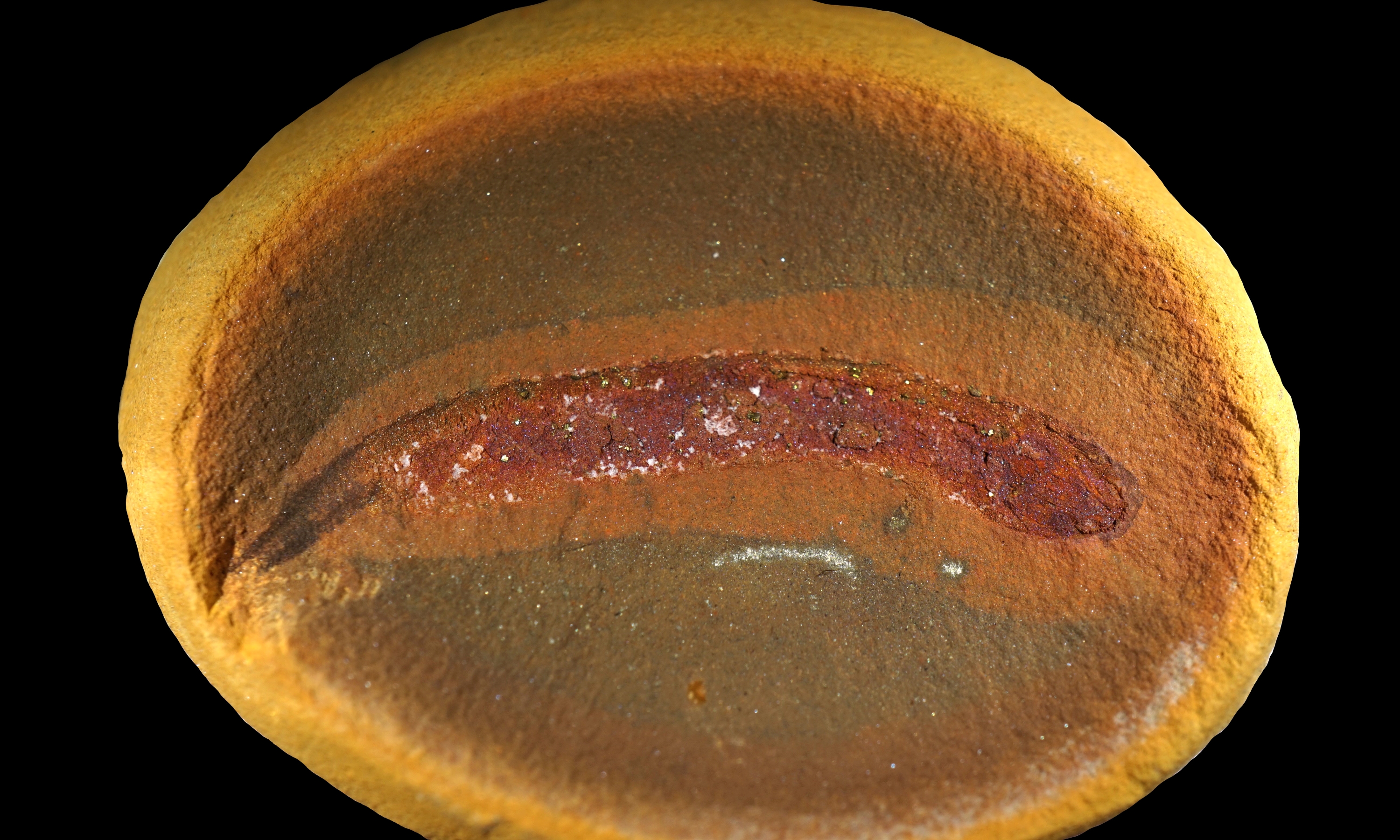
The new research was based partly on fossils from early land-dwelling predators called embolomeres. These animals looked like a cross between a crocodile and an eel and ruled river, lake and swamp habitats 350 million to 280 million years ago, during the Carboniferous and Permian periods. While these creatures could grow to more than 10 feet (3 meters) long as adults, the study unveils rare fossils from Mazon Creek, near Chicago, that preserved embolomeres as hatchlings that were days to a couple of weeks old.

"These are intimate details of the first moments of these animals' lives, and we've never seen that before for this entire part of the evolutionary tree," study co-author Jason Pardo, a postdoctoral fellow of evolutionary biology at Vilnius University in Lithuania and a research associate at the Field Museum in Chicago, told Live Science.

A photo of an embolomere fossil.

Researchers studied exceptionally well-preserved fossils from Mazon Creek, Illinois. (Image credit: Arjan Mann)

These fossils didn't show evidence of external gills and other tadpole-like features that the researchers would have expected from an early land dweller. The researchers then checked other fossils from before and during the "fin-to-limb transition" but found no evidence of an amphibian-like life cycle in those, either.

"For as long as we've understood evolution, we've assumed this story of how we made that transition from water to land," Pardo said. "We in fact have a completely different story."

Science upended?

A statement released by the Field Museum claimed that the study upends scientists' understanding of how animals conquered the land. However, the experts Live Science spoke to disagreed with this assertion.

"The Mazon Creek material is wonderful, the study is interesting and the interpretation of the fossils is sound, but I don't think the results are terribly surprising," Per Ahlberg, a professor of evolutionary organismal biology at Uppsala University in Sweden, told Live Science in an email.

Ahlberg, who was not involved in the new study, specializes in the early evolution of tetrapods. He noted that scientists knew some early tetrapods had a larval stage similar to that of modern salamanders β€ͺ—‬ namely, those belonging to the group Temnospondyli, which he described as the ancestral stock of modern amphibians. However, he contends that this didn't mean scientists assumed every early tetrapod was the same.

"Nobody has been arguing in recent years that ALL early tetrapods had such a larval stage or that this was essential for enabling the transition to land," Ahlberg said. "I mean, I have been working right at the core of this research field for 40 years and I have never given it any thought."

In response, Pardo agreed that specialists in the field recognized that the data didn't support that early tetrapods had an amphibian-like development. However, he argued that even among specialists, assumptions were still made about metamorphosis β€” a major developmental transition, like a tadpole transforming into a frog β€” and amphibian-like bodies.

Young embolomeres would grow up to become apex predators in rivers, lakes and swamps.

Young embolomeres, illustrated here, suggest that early tetrapods didn't undergo an amphibian-like metamorphosis. (Image credit: Berit Godring)

"Onto something big"

Study co-author Arjan Mann, an assistant curator of early tetrapods at the Field Museum, first saw the study's first baby embolomere fossil during a 2016 trip to the Field Museum while working on his doctorate. At the time, the fossil was a mystery.

Mann and Pardo mused over the fossil's identity for years before high-resolution scans with scanning electron microscopy at the Canadian Museum of Nature confirmed that the ancient creature was an embolomere, according to the museum's statement.

"I think Jason and I both knew we were onto something big, since fossils of this kind of animal and from this phase, and developmental state in early tetrapod evolution have never been found or studied before," Mann told Live Science in an email.

Along with the embolomeres, the researchers looked at megalichthyid fish from before the land transition and limbless, snake-like creatures known as aistopods from during the land transition. All showed signs of direct development, they said.

"I think the take home message of this study is that we should always challenge conventional wisdom in science, especially when these older ideas do not have substantial backing," Mann said.

This Species Was Long Thought Extinctβ€”Scientists Just Spotted One Alive and Well on a Caribbean Island

11 June 2026 at 14:35


The Cozumel dwarf fox, a rare species previously known only from secondhand reports and fossil records, has been discovered alive on Cozumel, a small Caribbean island off the eastern coast of the YucatΓ‘n Peninsula.

Researchers published the announcement in Neotropical Biology and Conservation, describing the rescue and identification of the rare dwarf fox before it was released back into the wild. They caution that this rare species, previously believed extinct, faces extreme danger from a host of threats.

The Cozumel Dwarf Fox

As one of the rarest canids on the planet, the species had never before been documented alive by scientists. The Cozumel dwarf fox (Urocyon sp.) is a close relative of the gray fox (Urocyon cinereoargenteus), which is found on the Mexican mainland. After several millennia of isolation on the islandβ€”possibly predating Maya settlementβ€”the Cozumel fox underwent insular dwarfism, evolving to only 60–80% the size of its mainland relatives.

Evidence for the animal has been remarkably scarce, and while subfossil remains provided conclusive proof that the species once existed, there had not even been a secondhand report since 2001, leading many researchers to assume it was extinct.

That changed on September 14, 2023, when members of the public reported a disoriented fox along a coastal highway near kilometer marker 29.

Responders from the FundaciΓ³n de Parques y Museos de Cozumel recovered the animal and cared for it for three days while monitoring its health. On September 17, 2023, the fox was released into the Laguna Columbia State Reserve, where it would be protected from traffic and other hazards.

The sighting marks the first time the Cozumel fox has been formally documented by scientists and recognized as taxonomically distinct.

Cozumel fox
The Cozumel dwarf fox, believed long extinct, was finally recorded by scientists. Credit: Rafael ChacΓ³n

Cozumel Fox Habitat

Although the sparse evidence of these creatures may not be enough to conclusively map their habitat, the researchers have some idea where the Cozumel fox typically resides.

β€œHistorical sightings have been concentrated around the community of El Cedral and near the entrance of Punta Sur Ecological Park, which is where this photographic record also took place,” lead author Travis Bayer of Pathos Wildlife told The Debrief. β€œNo sightings have ever been observed further north than El Cedral, which leads us to believe that may be the extent of their range on the island, which would also be very concerning due to the already limited space on an island.”

β€œIf their home ranges are restricted to the Southern end of the island, they may have home ranges around 100 km2,” Bayer continued. β€œIf they associate with only wetland/mangrove habitats, the size gets considerably smaller and more concerning for their conservation, as those habitats mainly only occur along the coastline and are at high risk for development for restaurants and resorts.”

Staying Hidden

Given that Cozumel is a popular tourist destination known for its beaches and resorts, it may seem surprising that an animal the size of a fox could remain undetected for so long. Bayer says part of the explanation lies in the island’s difficult terrain and the species’ elusive behavior.

β€œCozumel is home to many different terrestrial ecosystems, many of which are not easily accessible either,” Bayer explained. β€œHabitats like the mangrove forests and wetlands are almost impenetrable to us, but to a fox, easily traversable.”

dwarf gray fox
Image Credit: Rafael ChacΓ³n

β€œAlso, not that many people are out there looking for this animal, as the public awareness of it was extremely low, and the scientific investment was limited to one primary publication and a few brief mentions in others,” he added.

Additionally, the combination of grey foxes’ typical elusiveness, their nocturnal habits, and the highway cutting through their habitat being closed at night all combine to make the species easy to miss.

Preserving the Cozumel Fox

β€œIn collaboration with a team of local biologists, led by Rafael ChacΓ³n, we have begun developing an emergency conservation action plan for the Cozumel fox aimed at locating remaining individuals, estimating population size, identifying critical habitat, and determining immediate threats,” Bayer said.

Ensuring that the species does not disappear again is now a top priority. Researchers consider the fox critically endangered, with its limited habitat threatened by development, invasive species, and natural disasters.

Several introduced animals also pose significant risks. These include invasive boas released during a 1971 film production that have since spread across the island. Domestic dogs and cats may also threaten the fox through competition, predation, or disease transmission. In addition, predators such as ocelots and margays were introduced as exotic pets before eventually being released into the wild.

β€œUsing thermal drone surveys, large-scale camera trap networks, and other advanced monitoring technologies, we aim to rapidly generate the data needed to guide immediate conservation intervention,” Bayer said. β€œSimultaneously, we are collecting the evidence necessary to formally describe the animal as a new and distinct species deserving of critically endangered recognition and legal protections.”

β€œOne of the most important takeaways from this research is that species can quietly disappear without the world even realizing they are gone,” Bayer concluded.

β€œWe often think extinction is something dramatic and obvious, but in reality, it can happen gradually and silently, especially for rare species living in remote or understudied habitats.”

The paper, β€œFirst Photographic Evidence of an Insular Dwarf Fox (Urocyon sp.) on the Island of Cozumel, Mexico,” appeared in Neotropical Biology and Conservation on May 4, 2026.

Ryan Whalen covers science and technology for The Debrief. He holds an MA in History and a Master of Library and Information Science with a certificate in Data Science. He can be contacted at ryan@thedebrief.org, and follow him on Twitter @mdntwvlf.

A Very Lonely Caterpillar, Possibly the Last of Its Kind, Has Died

The Sacramento Mountains checkerspot butterfly hasn’t been seen in the wild since 2022. The caterpillar was the last individual in human care.

Β© Diana Cervantes for The New York Times

❌