On today’s Uncanny Valley, we dive into the dysfunction in Meta’s newly formed AI unit and why it’s been driving already-low employee morale even further into the ground.
On today’s Uncanny Valley, we dive into the dysfunction in Meta’s newly formed AI unit and why it’s been driving already-low employee morale even further into the ground.
For thousands of years, farmers have prepared their fields for planting by overturning the soil. It helps them the manage the moisture, nutrients and flow of air underfoot. But modern farming’s deep plowing and heavy machinery often do more harm than good, researchers report.
All that soil turnover disrupts the natural paths that water takes to percolate into the root zone. And this is not a problem just for growing crops. Breaking down the network of pores that water wants to move through also makes the soil less resilient to flooding and drought. So concludes a team of scientists in the April 16 Science.
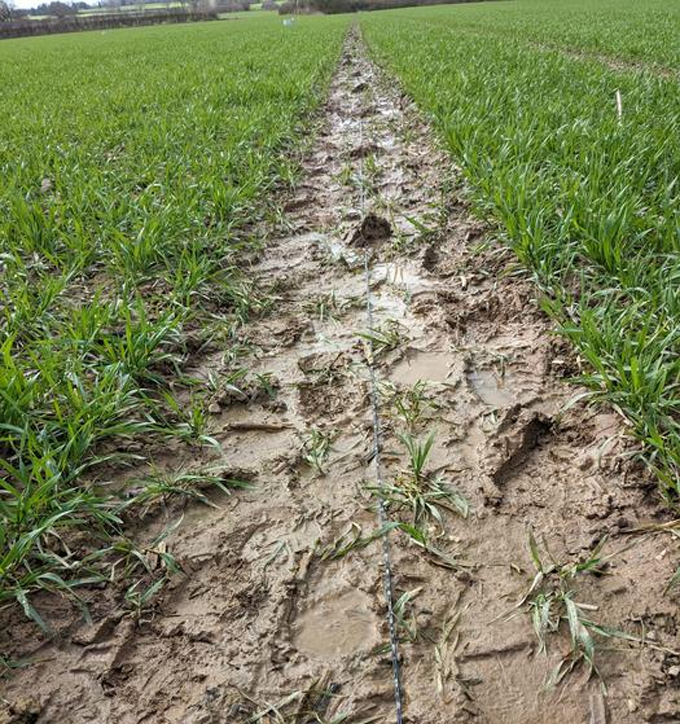
A fiber-optic cable, here laid along the relatively bare soil, was able to pick up tiny seismic signals. They’d been triggered by the movement of rainwater in the soil below.Marine Denolle
Qibin Shi is a geophysicist with the Chinese Academy of Sciences in Beijing. He was part of a team that fashioned a dense array of sensors out of fiber-optic cables. Such cables find use in more than just high-speed internet. They also can become powerful tools for seismology — and not just for earthquakes. They’re proving sensitive enough to detect even the tiny vibrations triggered as water moves through soil.
Shi’s group installed these cables along the edges of 27 plots of land at a university test farm in Newport, England. The plots were treated one of three ways. Nine went unplowed. Another nine were tilled to a depth of 10 centimeters (4 inches). The last nine were turned over to a depth of 25 centimeters (almost 10 inches). Within each group, plowing machinery of different weights were used. Why? The heavier they are, they more they can compact the soil.
For three days in March 2023, the team used its seismic-sensing system to track how the plots responded to rain. Rainwater didn’t seep down much on plots with the most compacted and deeply plowed soil. Instead, it tended to pool near the surface. Here, it could evaporate swiftly once the sun came out.
Water moved down and around more easily in the plots that were less compacted and less deeply plowed.
To understand what was happening, Shi’s team created a computer program that modeled the water’s movements. Rain, they found, moves through porous soil in a way that sort of mimics what happens to blood in capillaries — the body’s tiniest blood vessels. This process is known as capillary action.
Scientists used fiber-optic cables to study how turning over the soil in spring will affect rainwater’s ability to infiltrate the soil at this research site in Newport, England.Marine Denolle/University of Washington
Like our capillaries, the tiny, tunnel-like airways between specks of soil are very thin. Gravity does not drive water’s flow through these holes. Instead, as water tries to alternately adhere to soil particles and bind to other water molecules, it gets caught in a push-pull action. And that moves it. When those narrow pathways get disturbed or crushed, however, the suction forces strengthen, impairing the water’s flow.
Fiber-optic sensing could offer farmers a quick and inexpensive way to monitor soil moisture on a large scale, Shi’s team says. Such monitoring also could provide real-time warnings of natural hazards, such as flooding and soil liquefaction during an earthquake (when saturated ground can suddenly turn unstable due to shaking).
We're about six weeks out from the debut of Spider-Man: Brand New Day, the follow-up to 2021’s No Way Home. It's been five years since Spidey graced the big screen, so naturally, Sony Pictures has released a new trailer to build audience anticipation.
(Spoilers for No Way Home below.)
No Way Homeended on a pretty bleak note, with Peter Parker (Tom Holland) asking Doctor Strange (Benedict Cumberbatch) to erase him from everyone’s memory to protect the multiverse, including MJ (Zendaya).
From Amazon’s Off Campus to Netflix’s upcoming Icebreakers, the recent spate of hetero hockey romances shows Hollywood learned the wrong lessons from Heated Rivalry.
Terraxy, an innovative startup emerging from cutting-edge research at the King Abdullah University of Science and Technology (KAUST), has successfully secured $3 million in its Seed-2 funding round. This round was spearheaded by Wa’ed Ventures, the venture capital wing of Saudi Aramco, with additional support from KAUST itself. The investment aims to accelerate the scaling and commercialization of Terraxy’s groundbreaking soil regeneration and carbon storage technology, designed specifically to tackle the challenges posed by desert environments.
The capital injection follows a critical growth phase, facilitating Terraxy’s shift from pilot-scale initiatives toward full-scale industrial production. A flagship component of this expansion is the establishment of a 30,000-square-meter commercial facility located in Al Zulfi, Saudi Arabia. This state-of-the-art production hub symbolizes a major leap for the company in bringing its proprietary technology to market readiness, underpinning Wa’ed Ventures’ mission to translate locally developed, research-driven innovations into sustainable, practical solutions.
At the heart of Terraxy’s technology lies Carbosoil, a proprietary soil enhancer engineered to address the unique and challenging characteristics of sandy soils found across the Arabian Peninsula. Globally, soil degradation affects nearly a third of arable land, hindering agricultural productivity and ecosystem health. In Saudi Arabia, where sandy and nutrient-poor soils dominate, agricultural efforts are hampered by poor water retention and low nutrient availability. Carbosoil demonstrates a remarkable ability to improve these conditions, delivering up to a 70% increase in plant growth and yield using the same quantities of water and nutrients. This efficacy directly translates into enhanced resource-use efficiency, especially critical in arid regions where water scarcity is a major concern.
Integral to Terraxy’s success is the supportive regulatory landscape fostered by Saudi Arabia’s Ministry of Environment, Water and Agriculture (MEWA). Terraxy has benefited from MEWA’s Regulatory Sandbox, a pioneering initiative allowing emerging environmental technologies to be tested rigorously under real-world conditions. This framework not only accelerates the validation of novel technologies but also ensures alignment with stringent environmental standards and drives the responsible introduction of innovations to the market, supporting national sustainability targets.
The importance of soil health in the Kingdom cannot be overstated. It underpins food security, water efficiency, and land rehabilitation frameworks that are critical to Saudi Arabia’s ambitious environmental and economic agendas. Through collaboration between innovators, regulators, and investors, Terraxy exemplifies how multi-stakeholder engagement can foster the development of homegrown technologies that address both ecological and commercial imperatives.
Amidst escalating global efforts to combat land degradation and climate change, Terraxy’s dual-purpose technology stands out. It not only rehabilitates degraded soils but also captures and stores atmospheric carbon dioxide in a stable form that can endure for centuries. This long-term carbon sequestration capability complements regional and international commitments to emission reduction and climate resilience, providing a scalable solution adaptable to various arid and semi-arid environments.
Wa’ed Ventures CEO Anas Algahtani emphasized the strategic value of backing deep technology initiatives with tangible sustainability benefits. Highlighting Terraxy’s unique strength, he noted that the startup’s ability to transition from foundational science to deployable industrial applications underscores the potent role of science-led innovation. Such initiatives are vital to Saudi Arabia’s Vision 2030, which prioritizes sustainability, technological advancement, and economic diversification.
Aramco’s commitment to supporting solutions that address emissions from difficult-to-decarbonize sectors was also underlined by Ahmad O. Al-Khowaiter, Executive Vice President of Technology & Innovation at Aramco, and Chairman of Wa’ed Investment Committee. Terraxy’s technology fits squarely within this vision, exemplifying the kind of scalable, scientifically robust innovation required to achieve meaningful climate impact while fostering economic growth.
As a spinout from KAUST, Terraxy benefits from a robust ecosystem that bridges academia and industry. The National Transformation Institute (NTI) at KAUST has played a pivotal role in nurturing the company’s journey, offering infrastructure and translational support critical for scaling emerging technologies. Professor Himanshu Mishra, one of Terraxy’s co-founders and an associate professor at KAUST, highlighted how the broader ecosystem—rather than any singular breakthrough—was instrumental in Terraxy’s development.
Dr. Ian Campbell OBE, Senior Vice President at KAUST’s NTI, formally acknowledged the importance of NTI’s efforts in enabling Terraxy’s scale-up journey. He described Carbosoil as a cornerstone for soil enrichment initiatives and a tool that aligns with Saudi Arabia’s Green Initiative and expanding carbon credit market. Such alignment demonstrates how academia, government, and private sector investment can converge to yield innovations with direct and measurable impacts on national and global environmental priorities.
Substantial funding and institutional validation signal growing confidence in Terraxy’s technology. The company is poised to make a significant contribution to Saudi Arabia’s greening efforts, resource efficiency strategies, and carbon management policies. Its scalable commercial model offers a replicable path for other arid regions facing similar environmental challenges, positioning Terraxy as a potential global leader in sustainable soil regeneration and carbon sequestration.
The company’s trajectory also illustrates the power of university-driven innovation ecosystems in advancing high-tech environmental solutions. By translating fundamental research into market-ready products, Terraxy exemplifies how science and technology can be harnessed to create sustainable economic opportunities while addressing pressing environmental imperatives.
As Terraxy moves forward, its integrated approach to enhancing soil health and capturing carbon dioxide offers a compelling model for deep-tech interventions in the sustainability domain. With substantial backing and a proven technology platform, Terraxy’s advances could become a pivotal component in shaping sustainable land management and carbon reduction strategies, both within Saudi Arabia and internationally.
Le Parlement européen s'apprête à autoriser le 17 juin 2026 des nouvelles techniques génomiques (NGT) dans l'agriculture, qui peuvent rendre des plantations plus résistantes à la sécheresse ou aux maladies mais qui inquiètent des défenseurs de l'environnement et de petits exploitants.
SpaceX has agreed to acquire coding startup Cursor in a $60 billion all-stock deal, according to a filing with the U.S. Securities and Exchange Commission (SEC). The acquisition deepens the Elon Musk-led company’s push into artificial intelligence software and developer tools just days after its record-breaking Nasdaq debut.
The deal brings San Francisco-based Anysphere, the company behind Cursor, under the SpaceX umbrella as thje company looks to strengthen its position against rivals such as OpenAI and Anthropic in the fast-growing AI coding market.
SpaceX announced the massive deal in a post on X, saying: “SpaceX has exercised the option to acquire @cursor_ai in an all-stock transaction with the goal of building the world’s most useful AI models.”
SpaceX has exercised the option to acquire @cursor_ai in an all-stock transaction with the goal of building the world’s most useful AI models.
For the past few months, SpaceXAI has been jointly training a model with Cursor, which will be released in Cursor and Grok Build soon.… https://t.co/X5mepgXgjJ
The company added that it has been jointly training a model with Cursor over the past several months and plans to release it in both Cursor and Grok Build, xAI’s coding agent, in the near future.
Code meets compute
The acquisition comes after an agreement between the two companies in April that gave SpaceX the right to acquire Cursor at a predetermined valuation. According to SpaceX’s SEC filing, the companies also entered into a compute partnership under which SpaceX would provide GPU cluster capacity and collaborate on improving existing models, including Grok, while potentially developing new AI products together.
In the filing, SpaceX described software development as a strategically important AI use case because it generates structured, verifiable data and frequent user feedback. The company said Cursor’s coding workflows provide valuable developer interaction data, including coding prompts, iteration cycles and software architecture decisions that could help improve model training and inference.
Cursor has emerged as one of the fastest-growing AI software companies since its founding in 2022. Reports suggest that the company has reached roughly $2.6 billion in annualized business-to-business revenue and has recently been discussing a funding round that would have valued it at $50 billion.
The startup’s coding assistant is widely used by developers to generate, edit, and review software code. Cursor counts major companies such as Stripe, Adobe and Nvidia among its users, while Nvidia CEO Jensen Huang has described it as his “favourite enterprise AI service.”
Data powers expansion
SpaceX said the acquisition will help advance its broader AI strategy by integrating its models more directly into developer workflows and expanding distribution through high-engagement software products.
“We look forward to working closely with the Cursor team to advance our frontier AI capabilities,” SpaceX said in its announcement.
Cursor also welcomed the deal, posting on X: “We’re excited to join forces with @SpaceX to advance the frontier of useful AI. Expect significant improvements to Cursor soon.”
We're excited to join forces with @SpaceX to advance the frontier of useful AI. Expect significant improvements to Cursor soon. https://t.co/62IMr2sgEy
The acquisition follows SpaceX’s blockbuster stock market debut last week. Reuters reported that the company’s valuation climbed above $2 trillion after the listing. The company’s shares surged further Tuesday, briefly pushing SpaceX past Amazon by market value.
SpaceX expects the transaction to close during the third quarter of 2026, subject to regulatory approvals. Once completed, the deal would give the company direct control of one of the industry’s most prominent AI coding platforms while expanding access to developer data that it believes can strengthen future versions of Grok and other AI models.
An icon of Silicon Valley’s counterculture, Stewart Brand is confronting his final years in a home that embodies the self-sufficient, DIY ethos of his famous Whole Earth Catalog.
WIRED surveyed readers on their housing costs. The answers paint a stark portrait of unaffordability, climate adaptation, and the death of the homeowner dream.
The commercial was submitted by the Freedom of the Press Foundation to run during Donald Trump’s UFC event. It criticized the $111 billion merger as a threat to the First Amendment.
Dans le lagon de Mayotte, chaque battement d’aileron raconte une histoire ancienne. Tortues centenaires, dauphins résidents et coraux architectes y composent un écosystème d’une précision presque scientifique, mais d’une beauté profondément poétique. Ici, la vie sous-marine semble respirer au...
 Login