 Login
Cybersecurity Veterans Urge U.S. to Reverse Export Ban on Anthropic’s Fable and Mythos Models
16 June 2026 at 21:38
Experts Urge U.S. to Lift Export Ban on Anthropic’s Fable and Mythos Models Dozens of prominent cybersecurity practitioners


In a groundbreaking development that could revolutionize the field of artificial intelligence and neuromorphic computing, researchers have unveiled a novel algorithm–hardware co-design approach featuring neuromorphic networks supported by dual memory pathways. This innovative framework, recently published in Nature Machine Intelligence, promises to overcome longstanding challenges in efficiently mimicking brain-like processing in silicon hardware. The fusion of algorithmic design and hardware architecture epitomizes a synergistic leap forward for neuromorphic systems, which strive to emulate the efficiency and adaptability of biological neural networks.
Neuromorphic computing, inspired by the structure and function of the human brain, seeks to replicate neural dynamics through specialized hardware that inherently supports parallel and event-driven processing. Unlike traditional von Neumann architectures, which segregate memory and processing units, neuromorphic systems integrate these functions, drastically reducing latency and energy consumption. However, a persistent limitation in current neuromorphic implementations lies in their constrained memory capacity and difficulties in sustaining stable learning over time. The new co-design method directly confronts these issues by introducing a dual memory pathway mechanism akin to the human brain’s approach to memory storage and retrieval.
The dual memory pathways conceptualized by the research team separate short-term and long-term memory processing within the neuromorphic network. Short-term memory pathways facilitate rapid, flexible adaptation to incoming data, echoing the brain’s working memory functions. Concurrently, long-term memory pathways enable the consolidation and retention of learned information over extended periods. This bifurcation fosters an architectural efficiency that mitigates memory interference and catastrophic forgetting—two notorious hurdles in neuromorphic learning systems and artificial intelligence at large.
Fundamentally, the innovative algorithm tailors synaptic plasticity dynamics to the hardware substrate, leading to more stable, biologically plausible learning rules. The researchers employ spike-timing-dependent plasticity (STDP) paradigms adjusted dynamically by the dual pathways, allowing the system to adapt continuously yet retain core learned information without overwriting. This hybrid plasticity approach is supported by circuits that facilitate separate yet interactive memory stores, closely emulating the hippocampus-neocortex complementarity observed in mammalian brains.
Critically, the design is optimized to leverage emerging non-volatile memory technologies such as resistive RAM (ReRAM), which afford dense, low-power synaptic implementation. The team’s hardware prototype integrates these resistive elements into the dual memory architecture, striking a delicate balance between speed, retention, and energy efficiency. By co-optimizing the algorithmic parameters with hardware constraints, the design attains a level of performance and scalability previously unattainable in neuromorphic networks.
Extensive benchmarking on machine learning tasks highlights the superiority of this co-design approach. Tasks demanding continual learning and domain adaptation—traditionally challenging due to interference effects—exhibit enhanced stability and precision. Notably, the dual pathways enable the neuromorphic system to segregate novel information from prior knowledge efficiently, supporting lifelong learning scenarios critical for real-world AI applications such as robotics, autonomous systems, and adaptive sensory processing.
The implications of this breakthrough extend beyond traditional AI. By more faithfully replicating the brain’s memory consolidation processes, these neuromorphic networks could yield insights into neurological disorders characterized by memory dysfunction. Additionally, the modularity of the dual memory pathways invites future customization and specialization for domain-specific tasks, envisioning a new class of adaptive hardware that evolves alongside its operational environment.
Moreover, the research addresses the formidable challenge of hardware variability and noise—a persistent bottleneck in neuromorphic device deployment. The co-designed algorithm inherently compensates for device-level imperfections through adaptive learning thresholds and redundancy in memory representations. This robustness not only ensures reliable operation over extended periods but also enhances manufacturability and cost-effectiveness for large-scale silicium implementations.
This co-design paradigm exemplifies a pivotal shift in neuromorphic engineering, moving away from generic algorithm deployment on fixed hardware towards integrated development of systems where both hardware and software are mutually optimized. This approach reflects an emerging philosophy in AI hardware: embracing the interdependence of physical substrate and algorithmic function to unlock previously constrained capabilities.
Such a sophisticated neuromorphic platform provokes exciting questions regarding the future landscape of artificial intelligence. Could dual memory pathways represent a standard architectural motif underpinning all next-generation AI chips? Might this design accelerate the creation of truly autonomous systems capable of continuous, context-aware learning within dynamic environments? The potential scale and impact of these mechanisms suggest transformative ripples across industry sectors reliant on AI, from healthcare and finance to autonomous vehicles and beyond.
While promising, challenges remain. Scaling the dual memory network to extremely large, brain-scale systems presents engineering complexities necessitating further innovations in materials, circuit design, and integration techniques. Additionally, fine-tuning the balance between memory consolidation and plasticity, ensuring both adaptability and stability, demands deeper theoretical understanding informed by neuroscience. Continued collaboration between multidisciplinary teams of neuroscientists, material scientists, electrical engineers, and computer scientists will be pivotal to this endeavor.
Looking ahead, this work may catalyze the proliferation of neuromorphic devices poised to operate at unprecedented energy efficiencies while offering continuous learning capability. By taking inspiration from the brain’s memory architecture and rigorously co-designing compatible hardware, the research ushers in an era where artificial intelligence systems can remember, adapt, and grow with a natural fluidity previously attainable only in biological organisms.
The dual memory pathway design stands as a milestone demonstrating that bridging the algorithm–hardware gap is an indispensable strategy for advancing neuromorphic computing. Its capacity to resolve persistent issues such as catastrophic forgetting and memory interference attests to an elegant merging of biological principles with cutting-edge technology. As AI advances toward greater autonomy and contextual sophistication, innovations like these could form the foundational building blocks of truly intelligent machines.
In sum, the synergy achieved by this algorithm–hardware co-design exemplifies the future of neuromorphic architectures — dynamic, adaptive, and deeply integrated with the physical medium of computation. It heralds a pivotal moment where the dream of brain-inspired computing inches closer to reality, promising devices that do not merely process information, but learn and remember in a resilient and energy-efficient manner akin to the human mind.
Subject of Research: Algorithm–hardware co-design in neuromorphic networks incorporating dual memory pathways to enhance learning stability and efficiency.
Article Title: Algorithm–hardware co-design of neuromorphic networks with dual memory pathways.
Article References:
Sun, P., Su, Z., Achterberg, J. et al. Algorithm–hardware co-design of neuromorphic networks with dual memory pathways. Nat Mach Intell (2026). https://doi.org/10.1038/s42256-026-01255-3
Image Credits: AI Generated
In the rapidly evolving realm of artificial intelligence and deep learning, conventional electronic computing architectures are increasingly strained by the demands of large-scale data processing and intricate computational tasks. Optical computing has risen as a compelling alternative, leveraging the inherent physical phenomena of light—such as interference and diffraction—to execute computations fundamentally differently from traditional electronics. By harnessing these optical effects, optical computing systems (OCS) promise unparalleled advantages: notably superior processing speeds, heightened energy efficiency, and a natural aptitude for massive parallelism. These attributes make optical computing especially attractive for intensive applications like image processing, machine learning, and big data analytics, holding transformative potential across these domains.
Yet, despite these promising characteristics, contemporary optical computing platforms grapple with a significant bottleneck rooted in their hardware-centric development workflows. Conventionally, researchers must directly engage with physical OCS hardware to develop, tune, and validate computational tasks. This process entails sequential access to a limited number of costly and often heavily utilized devices. Users must physically occupy the system to load parameters, fine-tune configurations, and iteratively calibrate the hardware—an intrinsically tedious and time-consuming cycle. Each new user or task demands resetting the system state, leading to protracted queues, repetitive adjustments, and redundant calibrations. The resulting workflows impose long hours of equipment occupation and elevated trial-and-error expenses, stifling the possibility for concurrent task development and drastically curtailing research throughput and system agility.
To surmount these entrenched challenges, cutting-edge research has introduced the concept of the Digital Twin Optical Computing System (DT-OCS). This innovative approach establishes a high-fidelity digital replica—a “digital twin”—of the physical OCS that accurately models its input-output behavior under varying configuration parameters. Crucially, the digital twin allows researchers to perform extensive offline simulations, training, and optimization without the constraints of physical hardware availability. Analogous to a digital simulator software that mirrors a complex “real machine,” DT-OCS enables extensive task development and parameter tuning within a virtual environment, dramatically decoupling software development from hardware dependency. Consequently, optimized parameters validated digitally can be seamlessly transferred back to the physical system for deployment, bypassing numerous iterative hardware trials.
The implications of DT-OCS extend well beyond mere time savings. By effectively creating a “digital development toolkit” for optical computing, this framework revolutionizes the research ecosystem—transforming optical computing platforms from isolated, hardware-bound experiments to versatile, shareable research infrastructures. Researchers can now conduct task training, performance benchmarking, and method comparisons entirely within a unified digital realm, fostering collaborative innovation. Distinguished from legacy OCS paradigms, DT-OCS supports parallel task development workflows, allowing multiple computational problems to be advanced simultaneously without hardware conflicts. This capability markedly enhances flexibility, reduces development bottlenecks, and accelerates the maturation and practical adoption of optical computing technologies.
Envisioning the trajectory of optical computing, the integration of digital twin models with physical hardware appears indispensable. Contemporary transportation systems, for instance, benefit from the synergy between tangible road networks and dynamic digital mapping platforms. Similarly, next-generation optical computing platforms should embody dual representations: a robust physical computing infrastructure supplemented by perpetually updated digital twins. This paradigm champions accessibility, reproducibility, and scalability—cornerstones for fostering broad-scale collaboration. It paves the way for unified validation standards and equitable performance comparisons, catalyzing optical computing’s evolution into a general-purpose, widely deployable resource rather than a niche experimental setup.
The DT-OCS framework’s hallmark is its strategic decoupling of task development from hardware constraints. In traditional optical computing, task training and parameter fine-tuning necessitate iterative hardware engagements involving adjustments, diagnostics, and recalibrations. This approach encumbers the process with inefficiencies and precludes simultaneous multi-task development. DT-OCS obviates these impediments by faithfully modeling the physical system’s responses across parameter spectra, enabling exhaustive offline optimization. This digital-first workflow increases research agility, minimizes hardware occupancy, and substantially compresses the development timeline. Consequently, DT-OCS amplifies the throughput and adaptability of optical computing research endeavors.
The real-world efficacy of the DT-OCS framework has been experimentally validated using a cutting-edge high-speed optical computing system incorporating silicon photonic feature-computing chips. These empirical studies demonstrated DT-OCS applications in diverse computational domains, including image classification and sequential decision-making. Notably, configurations optimized within the digital twin translated flawlessly to the physical hardware, with observed task performance closely mirroring digital forecasts. This underscores not only the high fidelity of the DT-OCS model but also its robust transferability across practical scenarios. Moreover, by enabling parallel task development within the digital domain, DT-OCS expedites the overall research workflow, markedly elevating efficiency.
An illustrative application of the DT-OCS system involved offline training and deployment for the Fashion-MNIST image classification task—a benchmark dataset widely used in machine learning. This practical demonstration affirms DT-OCS’s capacity to bridge digital model development with real-world optical computing implementations. Beyond efficiency gains, DT-OCS signifies a conceptual shift toward disentangling computational task design from the idiosyncrasies of physical system constraints. Historically, optical computing research has been hamstrung by its dependence on specific hardware platforms and accessibility limitations, hindering reproducibility and cross-task comparisons. The introduction of an open-source digital twin framework surmounts these barriers by democratizing access and standardizing evaluation protocols.
By openly releasing the DT-OCS framework alongside associated task datasets, the research fosters a community-driven ecosystem where software-based task design, training, and validation can proceed independently of physical system constraints. This openness engenders scalability, reproducibility, and collaborative potential that traditional optical computing architectures cannot easily achieve. Researchers worldwide gain the freedom to explore broader task horizons, perform comprehensive benchmarking, and validate innovative approaches within a consistent computational substrate. Such a paradigm shift propels optical computing from isolated experimental configurations into accessible and extensible platforms, expediting technological advancements and practical deployments.
This pioneering work advocates a transformative application paradigm for optical computing platforms: the symbiotic coexistence of physical hardware and computationally equivalent open-source digital twin models. Only by embracing such dual-system architectures can the field transcend limitations imposed by experimental variability and hardware scarcity. The resultant platforms will be shareable, replicable, and adaptable to a diverse array of research challenges. As optical computing moves towards becoming a mainstream computational resource, the principles embodied by DT-OCS may well establish the foundational infrastructure that underpins scalable, collaborative innovation in photonic information processing.
Subject of Research: Not applicable
Article Title: Digital twin optical computing system
News Publication Date: 21-Apr-2026
Web References:
References:
DOI: 10.29026/oea.2026.250254
Image Credits: Dr. Tingzhao Fu from the National University of Defense Technology, China, and Dr. Hongwei Chen from Tsinghua University, China
Artificial intelligence, Computer science, Photonics, Engineering, Machine learning, Computer modeling, Computer processing, Semiconductors, Optics, Applied optics
While AI is proliferating across the workplace, it is introducing a new productivity paradox: While the technology makes work feel faster, it actually pushes more burden onto employees to provide context, perform quality checks, then rinse and repeat across numerous disparate tools.
This, according to a new survey of 6,000 full-time digital workers by Glean’s Work AI Institute, results in two emerging behaviors: “botsitting,” all the unrecognized work that goes into making AI actually usable; and “botshitting,” shipping AI-generated work that is unverified, not that well understood, or perhaps not even trustworthy. The survey report was co-authored by experts from Work AI Institute, Emory University, Stanford University, UC Berkeley, UC Santa Barbara, UNC Charlotte, University College London, and University of Notre Dame.
“It’s definitely in many ways a vicious cycle that feeds itself,” said Rebecca Hinds, head of Glean’s research center the Work AI Institute, a research collaborative of AI experts. Enterprises need to begin understanding and addressing the “massive, massive human labor that’s at the core of this.”
There’s no doubt that AI is quickly becoming a central teammate in the workplace. Glean’s Work AI Institute found that 87% of digital workers are using AI: It is already automating more than a quarter of their work and saving about 11 hours a week.
Still, only 13% say the use of AI has significantly improved their company’s performance, and their time savings are being eaten up by the same technology that is producing them. Employees lose about one-third of their work week (6.4 hours) botsitting: feeding AI context, supervising outputs, debugging errors, cleaning up AI-generated work, and switching between AI tools.
“We’re seeing high, high rates of multiple tool usage, and often those tools aren’t connected,” said Hinds.
In terms of context-feeding, large language models (LLMs) are trained on the vast corpus of the internet, but not always on enterprise-specific data. Thus, employees often have to provide additional information around their company’s products, customers, services, or other details.
“They’re often feeling frustrated when the tools don’t understand enough about day to day work to be useful,” said Hinds. Also, because employees are using multiple tools, they often have to repeat the same prompt over and over.
“It’s exhausting for workers to not only do this, but to have the work be unrecognized, often unrewarded and unacknowledged within the organization,” she said.
Similarly, workers are having to catch outputs that might look polished and finished on the surface, but could be wrong, incomplete, or missing important context. Debugging is the biggest driver of exhaustion, because it is often conducted by people who didn’t necessarily contribute to the initial output, Hinds noted, so they first have to dig up background information.
However, “not all botsitting is bad,” Hinds emphasized. “Certainly, we want workers to have some level of ownership and oversight.”
But when it is unnecessary, it can lead to botshitting, where users ship AI-generated work they haven’t verified because they’re overwhelmed or time-constrained. Sixty-nine percent of users admit to doing so, and 41% say they sometimes deliver work they could not explain if asked. Another 28% blame AI for mistakes they themselves caused.
“Botshitting is offloading your critical human thinking, judgment, and understanding,” Hinds explained. “You’re offloading that work that absolutely needs to remain with the human.”
Workers using multiple AI agents are significantly more likely to do this, she added, because agents are so scalable, and can spiral out of control if they don’t have the right controls or permissions built around them, causing overwhelmed users to give up on their verification efforts.
“You don’t often see the negative impacts until 3, 4, 5, steps down the line,” said Hinds. “Then it requires all of this cleanup work, detective work, to understand where did the agent go wrong.”
Interestingly, more than half of the workers surveyed said they get more day-to-day help from AI than they get from their managers, and consider it easier to collaborate with than humans.
Still, they seem to be facing a Goldilocks problem when it comes to sharing their use of AI. Among self-identified high AI achievers, 54% are using unapproved tools or using approved tools in noncompliant ways, and 36% are hiding how much AI helps them.
As Hinds explained, depending on the context and the level of psychological safety an organization has provided, it can be “differentially beneficial or harmful” to show you’re using AI, and, on the flip side, to conceal that you’re using it too much, because that might make you less valuable, or perceived as less valuable, she said.
It’s a complicated balance, because, she noted, “there’s massive pressure in so many organizations to demonstrate AI fluency, to demonstrate you’re a power user.”
In fact, the report said, “The companies pulling ahead are doing something different. They aren’t spending a greater share of their AI time using AI. They’re spending a greater share on the work around it: setting context, defining what ‘good’ looks like, building judgment, and deciding what should never have been handed to a model in the first place.”
The most transformative organizations are addressing AI challenges proactively: Providing training and support, treating AI as an opportunity to redesign work, and formally rewarding AI skills. In addition, it noted, the hardest skill to build is knowing when not to use AI.
It is “not just clicks of the tool, not just tokens used, but real skills, real learning,” said Hinds. In addition to investing in workers, these organizations are clearly stating AI strategy and clarifying the “why” behind it. Governance should also be “living and breathing,” with companies continuously re-evaluating policies.
And it needs to happen at every level, top execs included, said Hinds: “It’s being able to see the executives use the technology, sharing both the success stories and the failures.”
Successful companies are also actively using metrics anchored in existing key performance indicators (KPIs). They are measuring quality, efficiency, and employee engagement in different ways, and putting data in the hands of employees so they can assess their own adoption and success.
“It’s less about surveillance and more about feedback in terms of how we work collectively,” said Hinds.
What’s “fascinating but perhaps not surprising,” she said, is that workers are increasingly using AI itself as a teacher, and prefer it over other learning channels. This speaks to the importance of low-code, no-code tools, with low learning curves and organizational context, that are embedded directly into workflows.
“It is starkly different from what we’ve seen with previous technologies,” she said.
This article originally appeared on CIO.com.

The Event Horizon Telescope (EHT), the facility that delivered humanity’s first-ever picture of a black hole, can produce some of the sharpest images in all of astronomy. But turning the EHT’s raw data into images is a complex process involving messy statistics and powerful algorithms. Recent work presents a potential upgrade to that process: for the first time in long-baseline interferometry, it may be possible to model everything everywhere all at once.
The EHT has some of the sharpest eyes in all of astronomy. With its effective resolution of just 20 microarcseconds, in principle you could use it to read a newspaper in New York while sitting at a cafe in Paris. But this planet-spanning instrument (it relies on data from radio telescopes on four continents) doesn’t snap pictures like an ordinary camera. Instead, each pair of telescopes measures something called an “interferometric visibility,” which is related to a single Fourier component of the actual underlying image.

The first image of a black hole, constructed from Event Horizon Telescope data taken in 2017. [EHT Collaboration; CC BY 4.0]
Typically researchers break the problem down into several stages: first calibrate the data, then regularize and construct the best-fitting image, then analyze that image to constrain the actual physics you care about like the width of the ring surrounding a black hole. This is how the original EHT publications went about their groundbreaking work on the now-iconic glowing ring around the supermassive black hole in the galaxy Messier 87 (M87*).
Recent work led by Paul Tiede (Black Hole Initiative at Harvard University) suggests an alternative process. Instead of separating the stages of analysis as described above, the team demonstrated that one could fit everything simultaneously in a framework they call hierarchical interferometric Bayesian imaging, or HIBI.
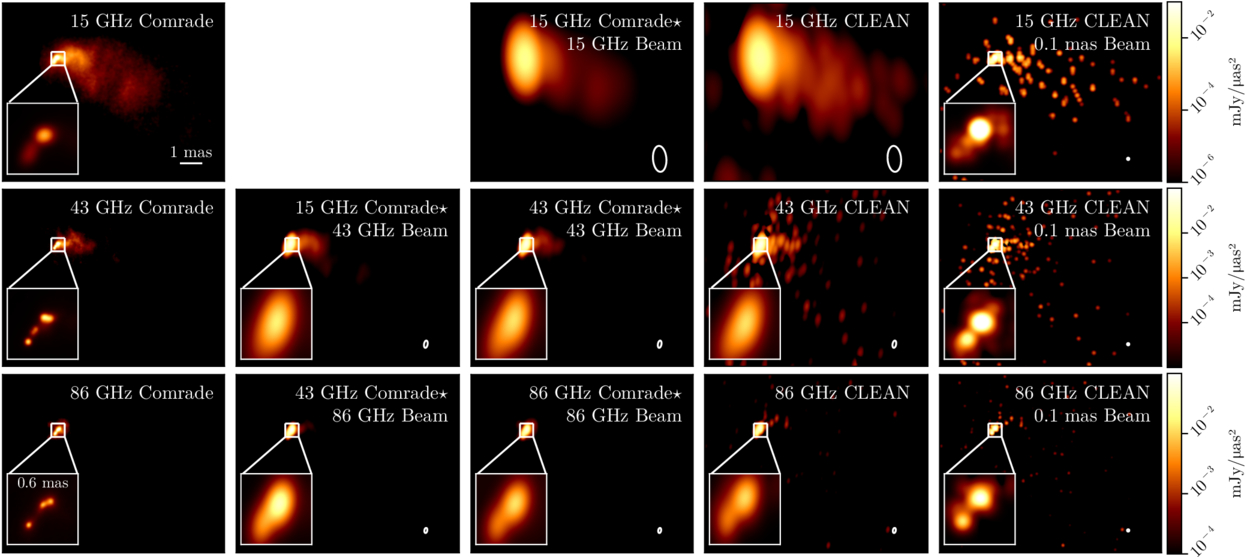
A comparison of the new HIBI technique (referred to as “Comrade” here) and a traditional algorithm called CLEAN. Click to enlarge. [Tiede et al. 2026]
Even more exciting, the team demonstrated that it’s possible to skip the image construction step altogether and go straight to the science. By fitting parameters describing the physics underlying a scene, the team was able to constrain the width of the ring around M87* without any reference to a picture. They predict that this technique could be crucial for extracting information when future instruments like the Next Generation Event Horizon Telescope observe more distant black holes that are only marginally resolved. Though we’ll likely have to wait years for these next-generation telescopes, work like this ensures that astronomers will be able to squeeze as much science from them as possible once these new facilities are ready.
“Hierarchical Interferometric Bayesian Imaging,” Paul Tiede et al 2026 ApJ 997 262. doi:10.3847/1538-4357/ae2749
The post Enhancing the Sharpest Images appeared first on AAS Nova.
