An international team of paleontologists from Romania, Hungary and Italy has identified a new genus and species of herbivorous, duck-billed dinosaur from an incomplete skeleton unearthed in the Hațeg Basin, a bowl-shaped depression in the Carpathians of present-day Romania.
In a significant milestone for the advancement of intelligent transport systems, representatives from fifteen partner institutions converged in the Swiss city of Winterthur for the General Assembly of the MOVEO project. Spanning two days in early June and hosted collaboratively by the Zurich University of Applied Sciences (ZHAW) alongside the City of Winterthur, this high-level meeting marked a pivotal moment to assess the multifaceted progress achieved in this ambitious European Union-backed initiative. The assembly provided a platform for experts specializing in transport infrastructure, digitalization, and inclusivity to engage in comprehensive dialogues surrounding the integration of cutting-edge technologies across diverse transport environments.
MOVEO stands at the intersection of innovation and real-world application, targeting critical challenges faced by modern transport systems. Over the course of the assembly, attendees delved deeply into advancements across the project’s core technical domains. One focal area involved the enhancement of inspection and monitoring systems designed to surveil transport infrastructure dynamically and track traffic flows in real time. By deploying sophisticated sensors and analytic devices, the project aims to generate actionable data streams that can preemptively identify structural stresses or anomalies, ultimately elevating maintenance efficiency and passenger safety.
Another crucial theme that permeated discussions was the development of intelligent door-to-door mobility solutions catering to both passenger transit and goods logistics. These smart mobility frameworks integrate multimodal transport options, leveraging data-driven route optimization and seamless transfer protocols to facilitate efficient, sustainable travel. The capacity of such systems to adapt dynamically to user needs and traffic conditions represents a paradigm shift from traditional static schedules to responsive, user-centric mobility networks.
In tandem with technological innovation, a significant portion of the dialogue addressed the pursuit of inclusivity and accessibility within transport services and infrastructure. Realizing transport environments that accommodate the full spectrum of user abilities demands rigorous design principles and thoughtful integration of assistive technologies. MOVEO’s commitment to these objectives manifests in both hardware adaptations and software interfaces, ensuring equitable access and enhancing user experience for disabled individuals, elderly passengers, and other traditionally underserved demographics.
Central to MOVEO’s methodology is the concept of a ‘digital twin’—a sophisticated virtual replica of physical assets and operational scenarios. This digital twin platform supports the project’s demonstration sites by enabling detailed simulation, predictive modeling, and real-time monitoring in a highly scalable and flexible manner. The ability to virtually recreate and experiment within these models accelerates technology validation cycles and informs better decision-making, reducing costs and mitigating risks associated with physical trial-and-error processes.
Highlighting the project’s real-world applicability, the partners provided updates on progress across five geographically and climatically diverse demonstration sites. Two are situated in eastern Switzerland, reflecting alpine and temperate conditions, while the others span the historic landscape of Ravenna, Italy; the complex hydrological system of France’s Seine basin; and the strategic maritime hub of Klaipėda port in Lithuania. Each site serves as a living laboratory where varying infrastructure types and life cycle stages are addressed, allowing the consortium to benchmark technologies against multifaceted operational contexts.
During the assembly, a notable field visit to the Leonie-Moser bridge in Winterthur offered tangible insight into the ongoing integration of MOVEO innovations. This upcoming bridge, slated for completion in September 2026, will link the districts of Oberwinterthur and Grüze, facilitating pedestrian and bus transit. Importantly, it forms a key node for sensor installations dedicated to monitoring passenger flows, particularly as commuters transfer between train and bus services. The instrumentation strategy exemplifies how real-time data acquisition enables nuanced understanding of multimodal transport interactions on critical infrastructure.
José Solís Hernández, project coordinator and an expert engineer from Spain’s CEMOSA, underscored the rapid progress being made in technological implementations. Reflecting on the trajectory thus far, Hernández emphasized the consortium’s focus on concluding key installation phases by the upcoming October deadline. This timeline aligns with preparatory activities for the next formal project review, during which minimum viable products (MVPs) must be finalized, demonstrating functional readiness and alignment with strategic objectives.
MOVEO’s expansive consortium harnesses expertise from nine European nations, uniting a comprehensive value chain that spans the entirety of transport and digitalization disciplines. The collective includes specialists in critical areas such as structural inspection, advanced monitoring techniques, logistics optimization, user mobility dynamics, and social inclusiveness. Engaging end-users alongside transport infrastructure managers ensures that developed solutions remain relevant, practical, and attuned to operational realities.
The innovative research underpinning MOVEO crystallizes around five core pillars. Firstly, infrastructure assessment and redesign leverages analytical tools to evaluate existing assets, proposing modifications that enhance resilience and adaptability. Secondly, inspection and monitoring integrate sensor networks and diagnostic technologies to maintain operational integrity. The third pillar, digitalized mobility, focuses on user-centered, data-driven solutions that redefine transit experiences. Smart logistics form the fourth pillar, addressing the efficient movement of goods with a sustainability lens. Finally, inclusiveness and accessibility aim to democratize mobility services, ensuring no user is left behind regardless of physical or cognitive barriers.
Backed by nearly five million euros in funding through the European Union’s Horizon Europe framework, MOVEO is positioned for a 42-month research phase culminating in October 2028. This substantial financial support reflects the high strategic importance assigned to the project, especially amidst rising pressures to modernize transport infrastructure in alignment with environmental, economic, and social objectives. The collaborative approach fosters cross-border innovation, ensuring outcomes deliver broad-reaching impacts for European mobility systems and beyond.
Ultimately, MOVEO exemplifies how integrative, interdisciplinary research can be effectively mobilized to tackle the complexities of future transport demand. By bridging digital technology with physical infrastructure and emphasizing user inclusivity, the project charts a course toward a smarter, safer, and more sustainable mobility ecosystem. As installations near completion and the demonstrator sites become fully operational, MOVEO’s innovations promise to inform policy, guide industry practices, and elevate standards across the entire European transportation landscape.
Subject of Research: Transport infrastructure monitoring, digitalized mobility, and inclusive transport solutions in Europe.
Article Title: (Not provided)
News Publication Date: (Not provided)
Web References: https://mediasvc.eurekalert.org/Api/v1/Multimedia/27a1c0f0-d8a7-487e-97b3-ebce96f60ef7/Rendition/low-res/Content/Public
References: (Not provided)
Image Credits: European Science Communication Institute gGmbH
Keywords: MOVEO project, transport infrastructure, digital twin, sensor monitoring, multimodal mobility, smart logistics, transport inclusiveness, European Union Horizon Europe, infrastructure assessment, pedestrian flow monitoring
MILAN — Switzerland’s decision not to participate in the European Union’s Copernicus Earth observation program during the 2028–2034 funding cycle has revived a broader debate over the value of contributing […]
NASA Webb, Hubble Reveal History of Relic of Milky Way’s Formation
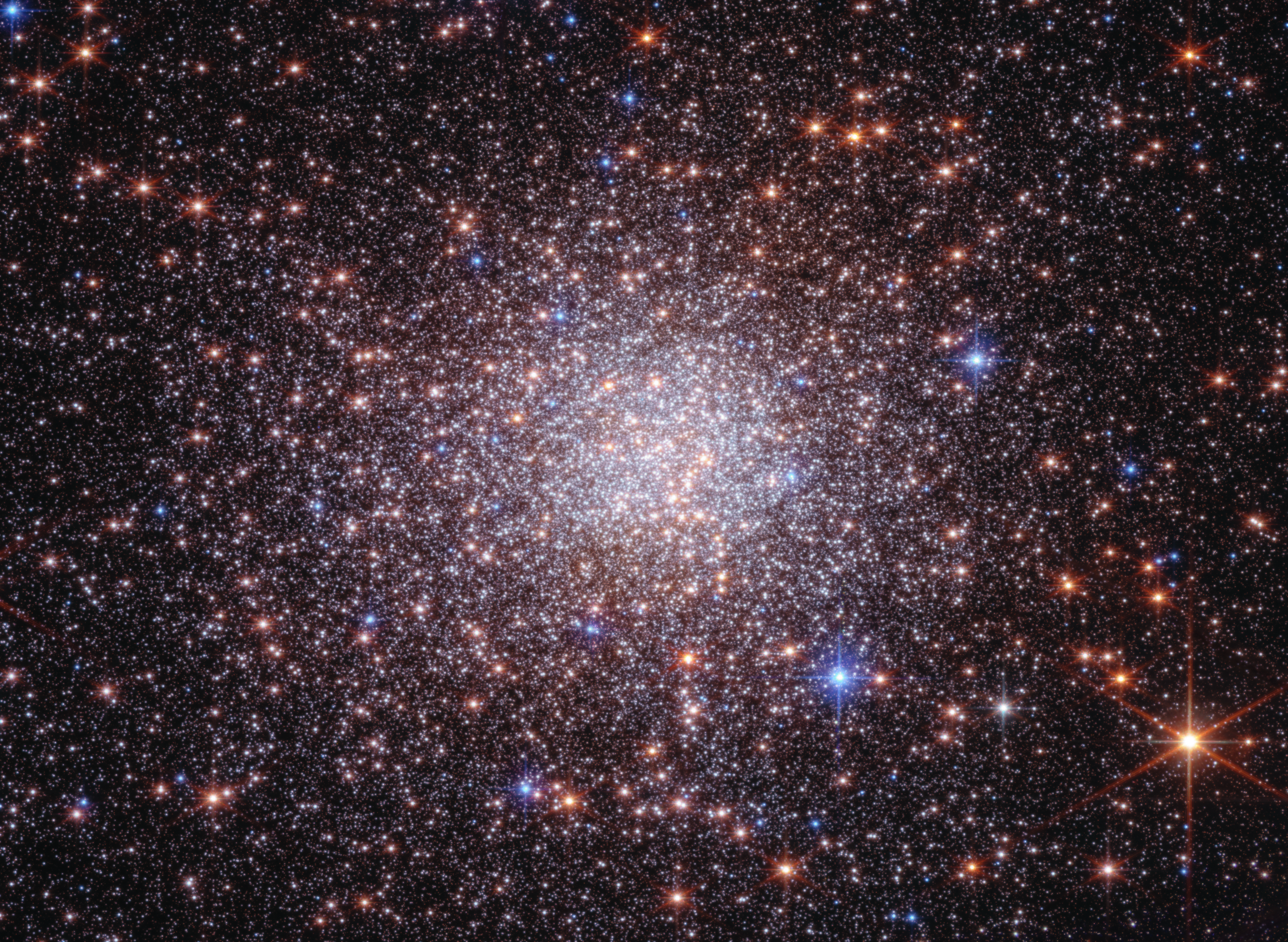
New observations from Webb combined with multiple observations from Hubble prove that Terzan 5 is a self-contained, self-enriching stellar system that contains up to four distinct star populations. It orbits within our Milky Way galaxy’s central bulge.
Credits: Image: NASA, ESA, CSA, STScI, Giorgia Zullo (University of Bologna), Francesco Ferraro (University of Bologna); Image Processing: Alyssa Pagan (STScI)
Researchers using two of humanity’s most powerful observatories — NASA’s James Webb and Hubble Space Telescopes — have definitively shown that Terzan 5 is not a globular star cluster as it was once classified, offering new insight into how galaxies like our own form and evolve over time. A globular star cluster typically has only one ancient star population. New data not only confirms the existence of two distinct populations of stars in Terzan 5, but also provides evidence for two more recent rounds of star formation. Although located within the crowded bulge of our Milky Way, our galaxy’s central, spherical region of older stars, Terzan 5 was massive enough to maintain its separate identity while lighter weight systems spread out and mixed to form the bulge billions of years ago. It’s like a lump in an otherwise well-mixed cake batter.
“Webb’s new near-infrared observations, cross-referenced with Hubble’s archival observations, have given us a much clearer picture of the history of Terzan 5,” said Giorgia Zullo, who led the research and is a PhD student at the University of Bologna in Italy.
These results were presented at a press conference Tuesday at the 248th meeting of the American Astronomical Society in Pasadena, and were published in Astronomy & Astrophysics.
Image: Bulge Fossil Fragment Terzan 5 (Webb and Hubble Image)
New observations from Webb combined with multiple observations from Hubble prove that Terzan 5 is a self-contained, self-enriching stellar system that contains up to four distinct star populations. It orbits within our Milky Way galaxy’s central bulge.
Image: NASA, ESA, CSA, STScI, Giorgia Zullo (University of Bologna), Francesco Ferraro (University of Bologna); Image Processing: Alyssa Pagan (STScI)
Four generations of stars
Discovered in 1968 by astronomer Azop Terzan, Terzan 5 resembles a globular cluster in many ways. However, in 2009 this system was discovered to harbor two distinct populations of stars. In 2016 Hubble provided the first estimate of their ages, showing that one formed roughly 12 billion years ago — as the Milky Way itself was assembling — and the other about 5 billion years ago, just before Earth started forming. This pointed to a more complex history than a typical globular cluster.
Studying Terzan 5 is complicated by its location in a region of our galaxy crowded with stars and heavily obscured by dust. This is where Webb stepped in. Its infrared view allowed the research team to peer through the dust and catalog many more stars, and fainter stars, than previous work. By measuring star colors and brightnesses, astronomers can classify them into populations of different ages and chemistries.
Webb was able to measure these key properties for every star within the field of view in the sky — both stars within Terzan 5 and unrelated foreground stars. To isolate the stars of Terzan 5, the team relied on the power and longevity of Hubble. The 12-year separation allowed the team to measure very small movements of individual stars, known as proper motions, to determine which stars belong to Terzan 5 and which are part of the Milky Way bulge.
By combining data from both Webb and Hubble, the researchers found strong evidence for two more stellar populations, one that formed 3.8 billion years ago and another only 2.5 billion years ago. They also were able to determine the ages of the previously known stellar populations with unprecedented precision, finding that they formed 12.5 billion and 4.7 billion years ago.
With the previously known two generations of stars, astronomers could not rule out the possibility that Terzan 5 interacted with another object, like a globular cluster or a giant molecular cloud, becoming enriched with new gas and dust that set off a second round of star formation. With four stellar generations, those explanations are ruled out.
Measurements of the stellar composition of Terzan 5 populations made at the W. M. Keck Observatory and European Southern Observatory’s Very Large Telescope also point toward very distinct populations. “Along with the ages of these populations, the cluster preserves a fossil record of progressive enrichment of heavy elements by supernovae,” said co-author R. Michael Rich, a research astronomer at the University of California, Los Angeles.
Terzan 5 formed multiple generations of stars because it was able to retain the necessary raw materials. There is evidence of powerful supernova explosions in Terzan 5 that forged heavier elements that were swept up by subsequent generations of stars. In lighter weight systems, the force of the explosions themselves could have ejected the resulting elements as well as sweeping out leftover gas and dust. The progenitor of Terzan 5 had enough mass to retain those stars’ ejections, allowing new generations of stars to form over billions of years.
‘Bulge fossil fragment’
The results show that Terzan 5 is most likely the remnant of a much more massive stellar system that initially formed 12.5 billion years ago. Terzan 5 is extraordinary because it survived — and never merged or fully “mixed in” with the Milky Way’s bulge. “For some reason, this peculiar clump of stars formed separately from the bulge and was not destroyed as the bulge itself formed,” said Francesco R. Ferraro, a professor at the University of Bologna and principal investigator of the Webb observations. “Terzan 5 is what we now call a bulge fossil fragment because it resembles the primordial clumps that contributed to the formation of the bulge.”
To date, there’s one other known cosmic object like Terzan 5. Liller 1 was the second to be reclassified from a globular star cluster to a bulge fossil fragment. It also contains multiple generations of stars. There may be more objects like it. Between 40 to 50 additional globular clusters that orbit within the bulge will be examined by Ferraro’s team to determine if their stellar populations are all the same, like globular clusters, or have several generations, like bulge fossil fragments.
Video: Zoom to See Terzan 5 Near Our Milky Way Galaxy’s Bulge
Zoom in to Terzan 5, a star cluster that lies within the crowded central region of our Milky Way galaxy known as the bulge. The scene starts with a ground-based image of our Milky Way bulge and zooms in on and circles Terzan 5, ending with the composite image of the star system from the James Webb and Hubble Space Telescopes.
Potential parallels for galaxy formation near, far
Ultimately, this research may improve what we know about how the central bulges of galaxies form over hundreds of millions of years. “Based on observations and in-depth simulations, we think that galaxies in the early universe had huge disks of gas that fragmented into clumps and formed stars. These clumps migrated to the center of the galaxies, and many merged to form their bulges,” said Barbara Lanzoni, a co-author and associate professor at the University of Bologna. For example, Webb has turned up several examples of “clumpy” galaxies that were actively forming when the universe was only a few hundred million years old, like the clumps in the Firefly Sparkle galaxy. “Terzan 5 may provide direct evidence that can help explain how bulges formed in galaxies throughout the universe,” Lanzoni said.
The James Webb Space Telescope is the world’s premier space science observatory. Webb is solving mysteries in our solar system, looking beyond to distant worlds around other stars, and probing the mysterious structures and origins of our universe and our place in it. Webb is an international program led by NASA with its partners, ESA (European Space Agency) and CSA (Canadian Space Agency).
The Hubble Space Telescope has been operating for over three decades and continues to make ground-breaking discoveries that shape our fundamental understanding of the universe. Hubble is a project of international cooperation between NASA and ESA (European Space Agency). NASA’s Goddard Space Flight Center in Greenbelt, Maryland, manages the telescope and mission operations. Lockheed Martin Space, based in Denver, also supports mission operations at Goddard. The Space Telescope Science Institute in Baltimore, which is operated by the Association of Universities for Research in Astronomy, conducts Hubble science operations for NASA.
The following sections contain links to download this article’s images and videos in all available resolutions followed by related information links, media contacts, and if available, research paper and Spanish translation links.
Related Images & Videos
Bulge Fossil Fragment Terzan 5 (Webb and Hubble Image)
New observations from Webb combined with multiple observations from Hubble prove that Terzan 5 is a self-contained, self-enriching stellar system that contains up to four distinct star populations. It orbits within our Milky Way galaxy’s central bulge.
Terzan 5 (Webb and Hubble Compass Image)
This image of bulge fossil fragment Terzan 5 was captured by the James Webb and Hubble space telescopes. Webb’s data are from its NIRCam (Near-Infrared Camera) and Hubble’s from its Advanced Camera for Surveys (ACS). The image shows a scale bar, compass arrows, and co…
Zoom to See Terzan 5 Near Our Milky Way Galaxy’s Bulge
Zoom in to Terzan 5, a star cluster that lies within the crowded central region of our Milky Way galaxy known as the bulge. The scene starts with a ground-based image of our Milky Way bulge and zooms in on and circles Terzan 5, ending with the composite image of the star system f…
Baidu’s Apollo Go has received a Level 4 autonomous driving permit in Switzerland for AmiGo, a robotaxi service it is running with Swiss Post’s PostBus, putting the Chinese tech giant ahead of Waymo and Tesla in deploying driverless vehicles into European public transport.
The Federal Roads Office (FEDRO) special permit covers an 80 km² service area across three eastern cantons, and Baidu says the project is on track to become the largest planned automated public transport operation of its kind in Europe.
For the first time, astronomers have distinguished between the morning and evening atmospheres of a single planet, revealing two remarkably different environments at its edges. WASP-121 b is a gas giant that orbits extremely close to its star, resulting in one hemisphere exposed to temperatures approaching 2,500 degrees Celsius while the opposite side remains in constant darkness.
WASP-121 b is part of a group of gas giants known as hot Jupiters. These massive planets orbit their stars in just a few days and eventually become locked in place by gravity. Tidal forces keep one side facing the star at all times, while the other side never sees daylight.
“WASP-121 b is particularly extreme,” said co-author Tom Evans-Soma of the University of Newcastle, Australia. “Average temperatures on the dayside hemisphere are around 2,770 Kelvin, while those on the nightside are closer to about 1,000 Kelvin.”
The difference in temperature between the two hemispheres, which is about 1,775 degrees Celsius, makes WASP-121 b one of the most thermally extreme exoplanets known. The regions at the boundary between day and night, called terminators, are where the planet experiences constant morning or evening conditions. Scientists expected these areas to have different atmospheric properties, but only with the precision of JWST could these differences be directly observed.
Mapping the Atmosphere
The researchers used a method based on the planet’s transit across its star to study these differences. As WASP-121 b passes in front of its star, it rotates by about 30 degrees, which means that different parts of its atmosphere can be observed during each transit. By tracking how infrared starlight filters through the atmosphere over time, the team reconstructed how temperature and chemical composition change across different longitudes.
“By measuring how starlight absorption changes as WASP-121 b rotates, we probe its atmosphere longitude by longitude,” said lead author Cyril Gapp of MPIA. The observations not only confirmed what models had predicted, but also showed that the differences between the two terminators are even greater than expected.
Two Different Skies
The evening side of the planet’s terminator absorbs more starlight than the morning side. Powerful eastward winds sweep heat from the scorching dayside toward the nightside, with the evening region getting the first blast of this warmth. This extra heat causes the atmosphere there to puff up, allowing it to absorb even more starlight, as the observations showed.
Chemical measurements backed up these findings. Carbon monoxide absorption increased as the hotter regions of the evening came into view near the end of the transit. Water showed a different pattern. Rather than simply decreasing with higher temperatures, the researchers interpret the result as evidence that water molecules in the upper atmosphere are breaking apart, likely due to the intense heat at the evening terminator. This points to a real chemical change, not just a shift in molecular location.
The Cloud Problem
The morning side shows a different environment. Although models predicted a difference between the two terminators, they did not fully explain why the morning side appears cooler and more opaque. The most likely explanation involves clouds that are unlike those on Earth.
At the morning terminator, air comes in from the cold nightside. Temperatures may be low enough for silicate and mineral compounds to turn into tiny particles, forming clouds that block infrared radiation from below. This makes the atmosphere appear cooler than it really is underneath.
When the team adjusted their models to account for these clouds, the results more closely aligned with their observations. Still, confirming exactly how these clouds form and behave will require more advanced modeling, as cloud formation and evaporation in such extreme environments remain a major puzzle in exoplanet science.
A Method Ready to Scale
WASP-121 b has been the subject of previous studies, but JWST now enables astronomers to examine its atmosphere in detail, section by section. This approach is now also available for use with other exoplanets.
The team has already found other ultra-hot gas giants with the right temperatures and orbits for similar analysis. Using this method on other planets will help astronomers compare atmospheric conditions and deepen our understanding of extreme planetary environments.
Austin Burgess is a writer and researcher with a background in sales, marketing, and data analytics. He holds an MBA, a Bachelor of Science in Business Administration, and a data analytics certification. His work focuses on breaking scientific developments, with an emphasis on emerging biology, cognitive neuroscience, and archaeological discoveries.
The French government outlined a major sovereign AI push, declaring its intelligence agency would stop working with US company Palantir in favour of a local alternative alongside a pledge to invest €655 million in the technology through to 2030.
Prime Minister Sebastien Lecornu announced the plans in a video on X as the country advances its sovereign technology ambitions and a desire to reduce dependence on US offerings.
The debate around sovereignty continues to heat up: the US recently hit the brakes on a couple of Anthropic models due to national security concerns.
Prime Minister Lecornu pointed to the issue in announcing the decision to cut ties with Palantir, stating “France must have its own tools”.
“We cannot rely on the goodwill of certain partners who, as we have seen in recent days, are capable of cutting off access to the Anthropic model.”
Intelligence agency DGSI is to replace Palantir’s data tools with an alternative made by privately-controlled French company ChapsVision.
Palantir had worked with the agency for around a decade and announced a three-year renewal in December 2025.
Concerns have been raised about Palantir due to ambitions in Europe to reduce the amount of sensitive data processed by US-based companies.
The company was co-founded by billionaire Peter Thiel, who has strong links to the US government.
Revolution The prime minister said the €655 million investment would go towards infrastructure, computing capacity, research, business and industrial sectors.
As part of the plans, the government aims to provide all civil servants with a conversational assistant from domestic company Mistral AI, in addition to a public health assistant by the end of the year.
“We can undergo this revolution. Or we can lead it. France has chosen. It will rise to the challenge of this revolution and intends to claim its full place in it,” Prime Minister Lecornu said.
James Webb has revealed that the sunrise and sunset sides of WASP-121 b have surprisingly different atmospheres. Astronomers using the James Webb Space Telescope (JWST) have discovered striking differences between the morning and evening sides of the atmosphere of WASP-121 b, an ultra-hot gas giant located far beyond our solar system. The findings provide the [...]
Thinktank says decoupling electricity from gas prices has also helped shield Spain from hikes caused by Iran war
Spanish households save €10 a month on electricity bills because of wind turbines and solar panels installed in the last five years, a report has found.
Typical energy bills would be 19% more expensive if electricity costs were still as tightly coupled to gas prices as in 2021, according to Ember, a climate thinktank. It found Spain’s “strategic” expansion of renewables since Russia invaded Ukraine in 2022 has shielded Spanish households from the latest rises in fossil fuel prices caused by the Iran war.
Deep inside a limestone cave in southern China, paleontologists have uncovered an assemblage of thirteen fossilized teeth belonging to Gigantopithecus blacki, the largest primate species ever known to have lived.
NASA’s Chandra Finds Unexpected Fireworks in Aftermath of Stellar Explosions
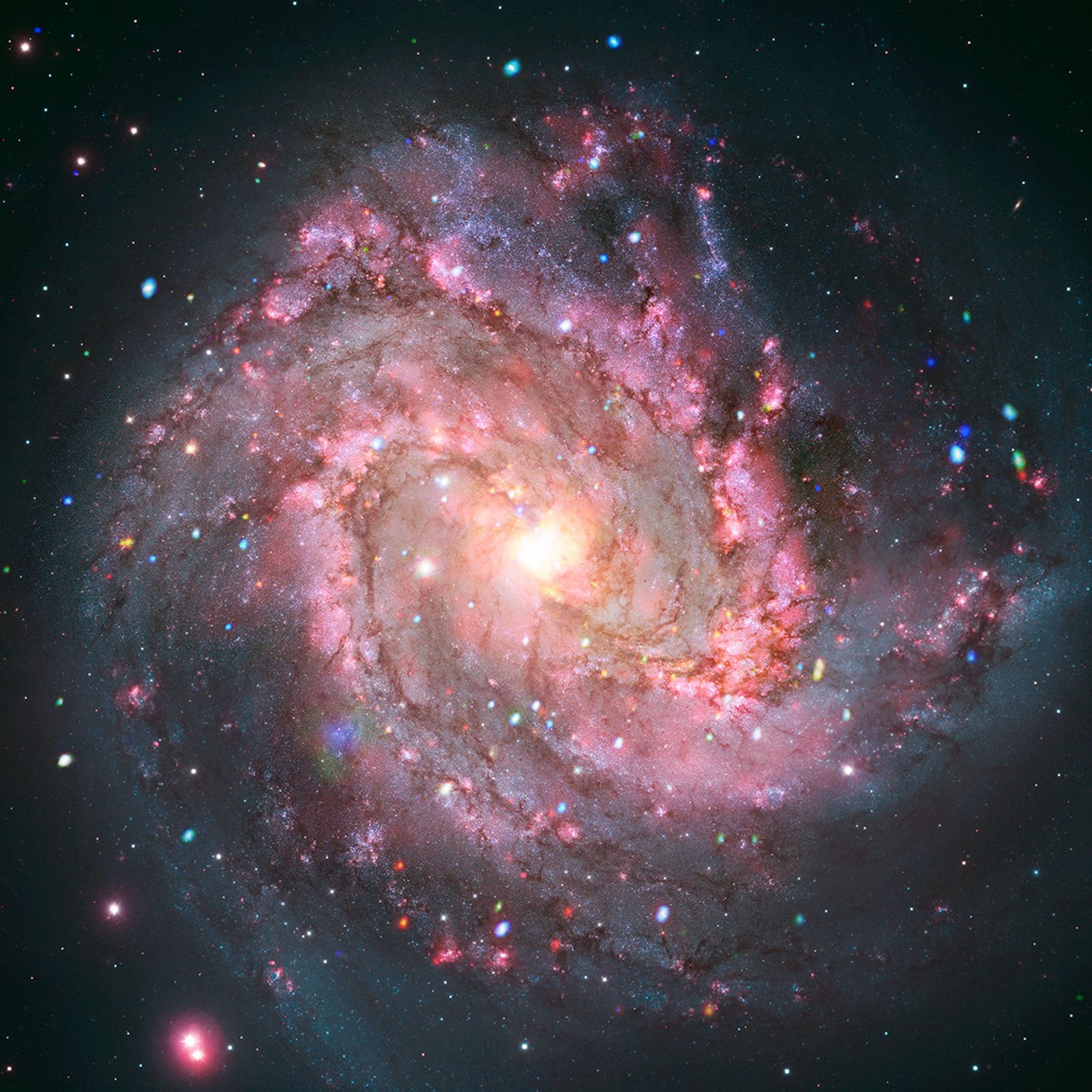
A composite image of the nearby galaxy Messier 83, and short timelapse videos of two curious supernova remnants hidden inside.
X-ray: NASA/CXC/SAO; Optical: NASA/ESA/AURA/STScI, Hubble Heritage Team, W. Blair (STScI/Johns Hopkins University) and R. O’Connell (University of Virginia); Image Processing: NASA/CXC/SAO/A. Jubett, L. Frattare and P. Edmonds
The aftermath of a supernova, a stellar explosion, is usually a slowly fading cloud of hot gas. So when astronomers pointed NASA’s Chandra X-ray Observatory at the nearby galaxy Messier 83 (M83), they did not expect to find a population of supernova remnants, or the debris from these explosions, showing dramatic changes in their brightness. The new results were presented at the American Astronomical Society meeting in Pasadena, California, and published in The Astrophysical Journal.
The galaxy M83, located about 15 million light-years from Earth, is forming stars at a high rate. Researchers analyzed 14 years of Chandra data of the galaxy, spanning 2000 to 2014.
Using this extensive set of data, the researchers caught surprising variations in the X-ray brightness of sources previously identified as supernova remnants. The researchers expected supernova remnants older than a century or so to fade gradually in X-rays, but not change dramatically in brightness.
The team found that roughly half of the 22 X-ray sources associated with supernova remnants in their sample showed changes in X-ray brightness over the 14-year span of observations — a result that was completely unexpected.
“We knew that individual X-ray sources could vary dramatically,” said Andrea Prestwich, of the Catholic University of America who led the study. “But finding that so many supernova remnants were behaving this way was a real surprise. Something unusual is going on in these objects. Pinpointing the cause remains a challenge, as M83’s distance limits the detail we can observe.”
One of the 22 variable supernova remnants has a straightforward explanation: SN 1957D, the debris from a supernova first observed nearly 70 years ago, is ramming into material surrounding the explosion site, producing the observed X-ray flares. But this cannot explain the rest of the sample. There is no evidence to suggest that all 22 remnants were formed within the last century. Something else must be driving the variability.
The most likely explanation is that the team has uncovered a population of stellar survivors stars that lived through their partner’s destruction in a supernova explosion. In this scenario, each variable X-ray source began as a pair of massive stars orbiting each other. The more massive star collapsed and exploded as a supernova, leaving behind a black hole or ultra-dense neutron star. Its companion survived.
Galaxy M83 in X-ray and Optical Light.
X-ray: NASA/CXC/SAO; Optical: NASA/ESA/AURA/STScI, Hubble Heritage Team, W. Blair (STScI/Johns Hopkins University) and R. O’Connell (University of Virginia); Image Processing: NASA/CXC/SAO/A. Jubett, L. Frattare and P. Edmonds
“It may be that this galaxy contains a collection of supernova remnants where one massive star survives the supernova and becomes locked into an orbit with a black hole or neutron star,” said co-author Michael McCollough of the Center for Astrophysics | Harvard & Smithsonian (CfA). “The neutron star or black hole can then start pulling material from the massive star’s surface.”
That infalling material is superheated by the intense gravitational pull, producing the X-rays Chandra detects. These types of systems, known as high-mass X-ray binaries (HMXBs), are among the most variable X-ray sources in the universe. Researchers say they may be the cause of the variations seen in M83’s supernova remnants.
Astronomers have known about HMXBs for decades, but the difference with this group in M83 is their connection to supernova remnants. Previously, only a handful of supernova remnants associated with HMXBs had been identified across observations of all galaxies. It is unprecedented to find more than 20 strong candidates in just one galaxy.
The authors found that the variable supernova remnants are in regions with higher concentrations of massive stars than in other parts of the galaxy, increasing the chances of a link between the remnants and HMXBs.
There is another possible explanation: Instead of pulling in material from a companion star, the black hole or neutron star may be recapturing some of the material blasted outward by the original explosion.
“This could be an example of cosmic recycling, where debris from the explosion falls back onto the very object the supernova created,” said co-author Roy Kilgard of Wesleyan University. “And it’s quite possible that both explanations are at play — different sources in our sample may have different origins.”
These results are not unique to M83. A follow-up study of the nearby star-forming galaxy M51 by Zoe Hoiland of Vassar College and Kilgard has uncovered a similar population of variable X-ray sources associated with supernova remnants, suggesting that such systems may be a feature of galaxies undergoing vigorous star formation.
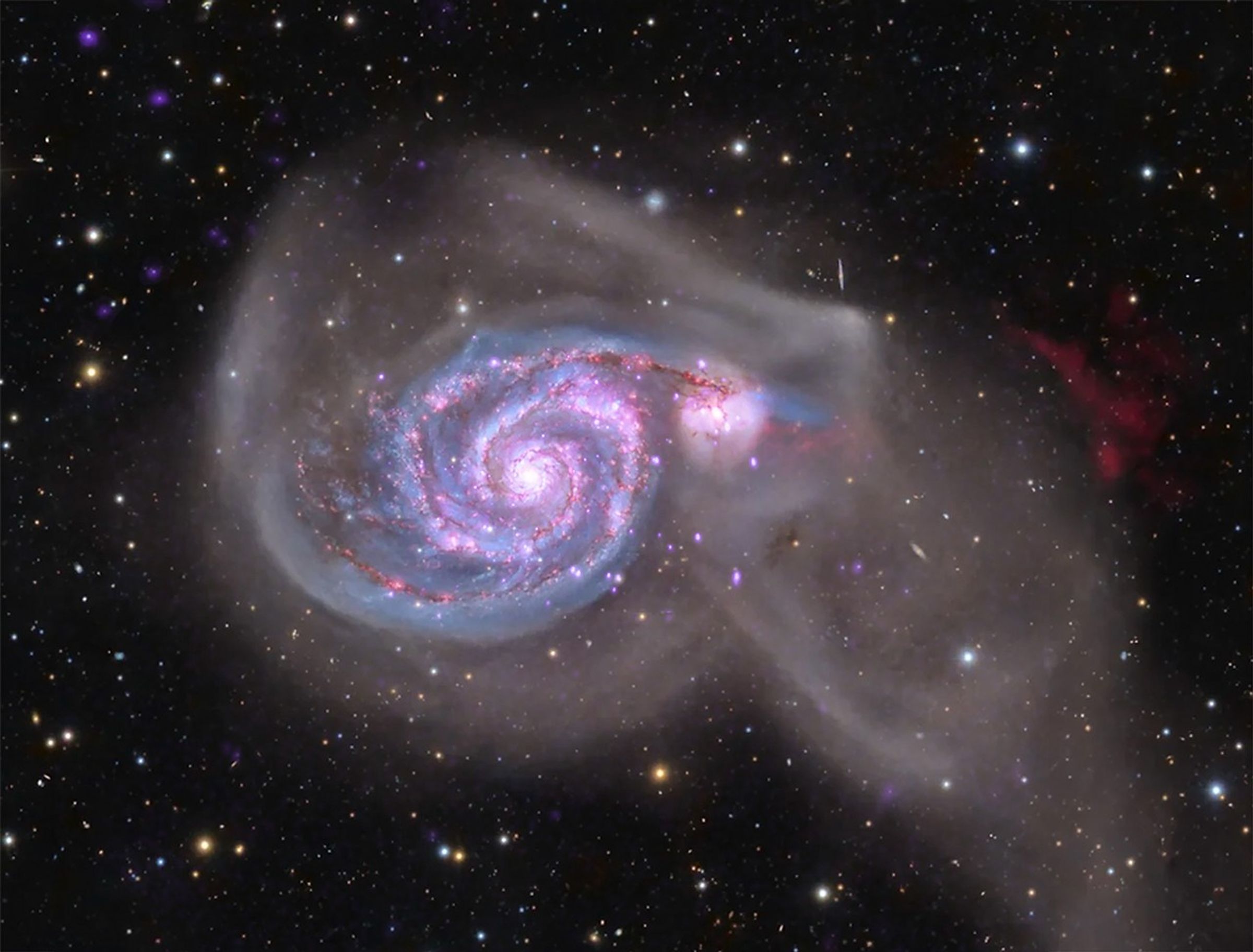
This is a composite image of the galaxy M51 combining data from NASA’s Chandra X-ray Observatory (purple) with optical data (red, green and blue) taken with ground-based telescopes by a team of astrophotographers. A surprisingly high number of X-ray sources associated with supernova remnants in M51 show large changes in brightness, similar to the behavior seen in M83.
Chandra X-ray Data: NASA/CXC/SAO; Astrobin/Optical Groundbased: C.Björk, T.Bähnck, S.Donoso, J.Gentillon, A. and D.Grelin, S.Guberski, R. Hall, T.Heuberger, J.Jacks, P.Kent, Br.Meyers, W.Ostling, N.Puig, T.Schaeffer, F.Schöfbänker, M.Vasilev
The Chandra data for M83 began with single observations in 2000 and 2001, followed by 10 observations from 2010 to 2011 and another observation in 2014.
NASA’s Marshall Space Flight Center in Huntsville, Alabama, manages the Chandra program. The Smithsonian Astrophysical Observatory’s Chandra X-ray Center controls science operations from Cambridge, Massachusetts, and flight operations from Burlington, Massachusetts.
Visual Description
This release features a composite image of the nearby galaxy Messier 83, and short timelapse videos of two curious supernova remnants hidden inside.
In the composite image, Messier 83, or M83, is shown to have a spiral structure, viewed straight on. At the center is a brilliant white and yellow pool of light. From that light, spiral arms of hot pink cloud corkscrew out in wide, sweeping arches. The galaxy is covered in a faint grey haze, and flecked with red, green, blue, white, and yellow dots.
In an annotated version of the composite image, two tiny dots to our lower right of center are highlighted by white circles. These are two of the supernova remnants being considered by researchers. Each is examined further in a separate timelapse video.
Over a 14-year period from 2000 to 2014, astronomers pointed NASA’s X-ray observatory at the M83 galaxy. They discovered that about half of the X-ray sources believed to be supernova remnants, the aftermath of stellar explosions, were exhibiting dramatic changes in brightness. This result was entirely unexpected.
Those changes in brightness are highlighted in the timelapse videos. In each video, a series of static images flashes by, focused on one of the two X-ray sources once believed to be supernova remnants. In the videos, the X-ray sources appear as bright blue blobs with glowing cores. But in each image, taken months or years apart, the shapes change, as does the intensity of the blue color, and the brightness of the core. By presenting the substantively different images of the same objects one after another in quick succession, short timelapse videos are created.
The most likely explanation for the changes in brightness is that the team has uncovered a population of stellar survivors, stars that lived through an orbiting partner’s destruction in a supernova explosion. Material is being pulled from the surviving star onto the black hole or neutron star that formed in the supernova, a process known to cause rapid changes in X-ray brightness.
NASA’s Chandra Finds Unexpected Fireworks in Aftermath of Stellar Explosions
A composite image of the nearby galaxy Messier 83, and short timelapse videos of two curious supernova remnants hidden inside.
X-ray: NASA/CXC/SAO; Optical: NASA/ESA/AURA/STScI, Hubble Heritage Team, W. Blair (STScI/Johns Hopkins University) and R. O'Connell (University of Virginia); Image Processing: NASA/CXC/SAO/A. Jubett, L. Frattare and P. Edmonds
The aftermath of a supernova, a stellar explosion, is usually a slowly fading cloud of hot gas. So when astronomers pointed NASA’s Chandra X-ray Observatory at the nearby galaxy Messier 83 (M83), they did not expect to find a population of supernova remnants, or the debris from these explosions, showing dramatic changes in their brightness. The new results were presented at the American Astronomical Society meeting in Pasadena, California, and published in The Astrophysical Journal.
The galaxy M83, located about 15 million light-years from Earth, is forming stars at a high rate. Researchers analyzed 14 years of Chandra data of the galaxy, spanning 2000 to 2014.
Using this extensive set of data, the researchers caught surprising variations in the X-ray brightness of sources previously identified as supernova remnants. The researchers expected supernova remnants older than a century or so to fade gradually in X-rays, but not change dramatically in brightness.
The team found that roughly half of the 22 X-ray sources associated with supernova remnants in their sample showed changes in X-ray brightness over the 14-year span of observations — a result that was completely unexpected.
“We knew that individual X-ray sources could vary dramatically,” said Andrea Prestwich, of the Catholic University of America who led the study. “But finding that so many supernova remnants were behaving this way was a real surprise. Something unusual is going on in these objects. Pinpointing the cause remains a challenge, as M83’s distance limits the detail we can observe.”
One of the 22 variable supernova remnants has a straightforward explanation: SN 1957D, the debris from a supernova first observed nearly 70 years ago, is ramming into material surrounding the explosion site, producing the observed X-ray flares. But this cannot explain the rest of the sample. There is no evidence to suggest that all 22 remnants were formed within the last century. Something else must be driving the variability.
The most likely explanation is that the team has uncovered a population of stellar survivors stars that lived through their partner’s destruction in a supernova explosion. In this scenario, each variable X-ray source began as a pair of massive stars orbiting each other. The more massive star collapsed and exploded as a supernova, leaving behind a black hole or ultra-dense neutron star. Its companion survived.
Galaxy M83 in X-ray and Optical Light.
X-ray: NASA/CXC/SAO; Optical: NASA/ESA/AURA/STScI, Hubble Heritage Team, W. Blair (STScI/Johns Hopkins University) and R. O’Connell (University of Virginia); Image Processing: NASA/CXC/SAO/A. Jubett, L. Frattare and P. Edmonds
“It may be that this galaxy contains a collection of supernova remnants where one massive star survives the supernova and becomes locked into an orbit with a black hole or neutron star,” said co-author Michael McCollough of the Center for Astrophysics | Harvard & Smithsonian (CfA). “The neutron star or black hole can then start pulling material from the massive star’s surface.”
That infalling material is superheated by the intense gravitational pull, producing the X-rays Chandra detects. These types of systems, known as high-mass X-ray binaries (HMXBs), are among the most variable X-ray sources in the universe. Researchers say they may be the cause of the variations seen in M83’s supernova remnants.
Astronomers have known about HMXBs for decades, but the difference with this group in M83 is their connection to supernova remnants. Previously, only a handful of supernova remnants associated with HMXBs had been identified across observations of all galaxies. It is unprecedented to find more than 20 strong candidates in just one galaxy.
The authors found that the variable supernova remnants are in regions with higher concentrations of massive stars than in other parts of the galaxy, increasing the chances of a link between the remnants and HMXBs.
There is another possible explanation: Instead of pulling in material from a companion star, the black hole or neutron star may be recapturing some of the material blasted outward by the original explosion.
“This could be an example of cosmic recycling, where debris from the explosion falls back onto the very object the supernova created,” said co-author Roy Kilgard of Wesleyan University. “And it’s quite possible that both explanations are at play — different sources in our sample may have different origins.”
These results are not unique to M83. A follow-up study of the nearby star-forming galaxy M51 by Zoe Hoiland of Vassar College and Kilgard has uncovered a similar population of variable X-ray sources associated with supernova remnants, suggesting that such systems may be a feature of galaxies undergoing vigorous star formation.
This is a composite image of the galaxy M51 combining data from NASA’s Chandra X-ray Observatory (purple) with optical data (red, green and blue) taken with ground-based telescopes by a team of astrophotographers. A surprisingly high number of X-ray sources associated with supernova remnants in M51 show large changes in brightness, similar to the behavior seen in M83.
Chandra X-ray Data: NASA/CXC/SAO; Astrobin/Optical Groundbased: C.Björk, T.Bähnck, S.Donoso, J.Gentillon, A. and D.Grelin, S.Guberski, R. Hall, T.Heuberger, J.Jacks, P.Kent, Br.Meyers, W.Ostling, N.Puig, T.Schaeffer, F.Schöfbänker, M.Vasilev
The Chandra data for M83 began with single observations in 2000 and 2001, followed by 10 observations from 2010 to 2011 and another observation in 2014.
NASA’s Marshall Space Flight Center in Huntsville, Alabama, manages the Chandra program. The Smithsonian Astrophysical Observatory’s Chandra X-ray Center controls science operations from Cambridge, Massachusetts, and flight operations from Burlington, Massachusetts.
Visual Description
This release features a composite image of the nearby galaxy Messier 83, and short timelapse videos of two curious supernova remnants hidden inside.
In the composite image, Messier 83, or M83, is shown to have a spiral structure, viewed straight on. At the center is a brilliant white and yellow pool of light. From that light, spiral arms of hot pink cloud corkscrew out in wide, sweeping arches. The galaxy is covered in a faint grey haze, and flecked with red, green, blue, white, and yellow dots.
In an annotated version of the composite image, two tiny dots to our lower right of center are highlighted by white circles. These are two of the supernova remnants being considered by researchers. Each is examined further in a separate timelapse video.
Over a 14-year period from 2000 to 2014, astronomers pointed NASA’s X-ray observatory at the M83 galaxy. They discovered that about half of the X-ray sources believed to be supernova remnants, the aftermath of stellar explosions, were exhibiting dramatic changes in brightness. This result was entirely unexpected.
Those changes in brightness are highlighted in the timelapse videos. In each video, a series of static images flashes by, focused on one of the two X-ray sources once believed to be supernova remnants. In the videos, the X-ray sources appear as bright blue blobs with glowing cores. But in each image, taken months or years apart, the shapes change, as does the intensity of the blue color, and the brightness of the core. By presenting the substantively different images of the same objects one after another in quick succession, short timelapse videos are created.
The most likely explanation for the changes in brightness is that the team has uncovered a population of stellar survivors, stars that lived through an orbiting partner’s destruction in a supernova explosion. Material is being pulled from the surviving star onto the black hole or neutron star that formed in the supernova, a process known to cause rapid changes in X-ray brightness.
Experience the Launch of NASA’s Roman Space Telescope
Are you ready for a new view of the universe? The Nancy Grace Roman Space Telescope will reveal distant worlds, dark energy, and the structure of the cosmos, and we want you to be a part of it!
Digital creators and social media users are invited to register to our NASA Social for the Nancy Grace Roman Space Telescope launch. Roman is NASA’s next flagship astrophysics mission, designed to explore everything from our outer solar system to the edge of the observable universe. This mission is scheduled to launch on Aug. 30, 2026, aboard a SpaceX Falcon Heavy rocket from Launch Complex 39A at NASA’s Kennedy Space Center in Florida.
Are you passionate about social media and communications? Do you love to create content for an audience? Are you a fan of new, unique experiences? If you said yes, this NASA Social event is for you! This is your opportunity to be on the front lines of this historic mission.
The NASA Social event will take place over two days, including the day of launch. A maximum of 50 digital creators will be selected to attend this two-day event and will be given access similar to news media.
NASA Social participants will have the opportunity to:
Tour NASA’s Kennedy Space Center
Learn directly from astrophysics subject matter experts
Meet fellow digital creators and social media users
Spend time with members of NASA’s social media team
View the launch of the Nancy Grace Roman Space Telescope
NASA Social events are intended for members of the public. Current or former NASA civil servants, NASA contractors, NASA interns, and individuals or organizations currently under contract to provide products or services to NASA are not eligible to apply or participate in NASA Social events.
NASA Social registration for the Roman launch opens on this page on Monday, June 15 and the deadline to apply is at 11:59 p.m. EDT on Sunday, June 28. All applications will be considered on a case-by-case basis.
Do I need to have a social media account to register?
Yes. This event is designed for people who:
Actively use multiple social networking platforms and tools to disseminate information to a unique audience.
Regularly produce new content that features multimedia elements.
Have the potential to reach a large number of people using digital platforms.
Reach a unique audience, separate and distinctive from traditional news media and/or NASA audiences.
Must have an established history of posting content on social media platforms.
Have previous postings that are highly visible, respected, and widely recognized.
Users are encouraged to follow @NASARoman for Roman updates on X, Facebook, and @NASAGoddard and @NASAUniverse on Instagram. Updates and information about the event will be shared on X via @NASA_Events
How do I register?
Registration for this event opens Monday, June 15 and closes at 11:59 p.m. EDT on Sunday, June 28. Registration is for one person only (you) and is non-transferable. Each individual wishing to attend must register separately. Each application will be considered on a case-by-case basis.
Can I register if I am not a U.S. citizen?
Yes, this event is open for all to apply.
When will I know if I am selected?
After registrations have been received and processed, an email with confirmation information and additional instructions will be sent to those selected. We expect to send the first notifications on July 17 and waitlist notifications on July 22.
What are NASA Social credentials?
All NASA social applications will be considered on a case-by-case basis. Those chosen must prove through the registration process they meet specific engagement criteria.
If you do not make the registration list for this NASA Social, you still can attend the launch off site and participate in the conversation online. Find out about ways to experience a launch at https://www.nasa.gov/kennedy/see-a-launch-up-close/.
What are the registration requirements?
Registration indicates your intent to travel to NASA Kennedy and attend the two-day event in person. You are responsible for your own expenses for travel, accommodation, food, and other amenities.
The schedule of events and special guest appearances are subject to change without notice. NASA is not responsible for loss or damage incurred as a result of attending. NASA, moreover, is not responsible for loss or damage incurred if the event is canceled with limited or no notice. Please plan accordingly.
Kennedy is a government facility. Those who are selected may need to complete additional steps to receive clearance to enter the secure areas.
IMPORTANT: Those without proper identification cannot be admitted.
For United States Citizens:
You will be required to present a REAL ID compliant identification or valid U.S. passport PLUS one of the following:
Acceptable documents to accompany federal or state identification:
Unexpired Employment Authorization Document issued by DHS that contains a photograph (Form I-688B)
Driver’s license or ID card issued by a state or outlying possession of the United States provided it contains a photograph or information such as name, date of birth, gender, height, eye color, and address
ID card issued by federal, state, or local government agencies or entities, provided it contains a photograph or information such as name, date of birth, gender, height, eye color, and address
School ID card with a photograph
Voter’s Registration Card
Military Dependent’s ID Card
U.S. Military card or draft record
U.S. Coast Guard Merchant Mariner Card
Native American Tribal Document
U.S. Social Security Card issued by the Social Security Administration (other than a card stating it is not valid for employment)
Original or Certified copy of birth certificate issued by a state, county, municipal authority, or outlying possessions of the United States bearing an official seal
U.S. Citizen ID Card (Form I-197)
ID Card for use of Resident Citizens of the United States (Form I-179)
Unexpired employment authorization document issued by DHS (other than those listed previously)
For Foreign Nationals:
Same items required of U.S. Citizens (SSN only when applicable)
Unexpired foreign passport, with I-551 stamp or attached Form I-94 indicating unexpired employment authorization
Passport number and registration date
Citizenship
Driver’s license issued by a Canadian Government authority
For Legal Resident Aliens:
Same items required of U.S. Citizens, and:
Permanent Resident Card or Alien Registration Receipt Card with photograph (Form I-551)
Unexpired Temporary Resident Card (Form I-688)
Certification of Birth Abroad issued by the Department of State (Form FS-545 or Form DS-1350)
The REAL ID Act was passed by Congress in 2005 to establish minimum security standards for state-issued driver’s licenses and identification cards.
All registrants must be at least 18 years old.
What if the launch date changes?
Hundreds of different factors can cause a scheduled launch date to change multiple times. The launch date will not be official until after the Flight Readiness Review. If the launch date changes prior to the review, NASA may adjust the date of the NASA Social accordingly to coincide with the new target launch date, and will notify registrants of any changes via email.
If the launch is postponed, attendees will be invited to attend a later launch date. If the launch is postponed beyond 72 hours, the NASA Social event may be canceled.
NASA Social attendees are responsible for any additional costs they incur related to any launch delay. We strongly encourage participants to make travel arrangements that are refundable and/or flexible.
What if I cannot come to the Kennedy Space Center?
If you cannot come to NASA Kennedy and attend in person, you should not register for the NASA Social. Join the conversation by following @NASARoman on X and Facebook, and @NASAGoddard and @NASAUniverse on Instagram. You can watch the launch at nasa.gov/live. NASA will provide regular launch and mission updates on @NASA.
If you cannot make this NASA Social, don’t worry; NASA is planning many other NASA Social events in the near future at various locations! Check for updates on NASA Socials.
Tesla presented self-published and inflated “Full Self-Driving” safety statistics directly to government regulators in Sweden and the Netherlands as it lobbied for European approval, according to correspondence obtained by Reuters through public records requests.
The data includes a claim that FSD could have “saved 32,000 lives” — a figure that independent researchers say is based on the absurd assumption that every vehicle in the U.S., including freight trucks and motorcycles, would be replaced by an FSD-enabled Tesla.
The UK government laid out plans to ban people under 16 years of age from social media and impose wider restrictions on gaming and live-streaming platforms in a landmark intervention to protect children online.
The measures would cover social media platforms including Snapchat, TikTok, Instagram, YouTube, Facebook and X, but exclude messaging services such as WhatsApp and Signal. UK Prime Minister Keir Starmer said the move would “give kids their childhood back”, adding it represents “a line in the sand” as “tech giants had their chance and failed”.
The government is also considering overnight curfews and breaks in infinite scrolling for under-18s. It explained restrictions on some functions would remain on by default even for 16 and 17-year-old users, to avoid a “cliff-edge at 16”.
In addition, the government is seeking restrictions on a wider range of online services viewed as higher risk for children, including live-streaming and communication with adult strangers through gaming websites. AI services designed to simulate intimate relationships with users would face a minimum age limit of 18, with similar functions also set to become age-restricted across wider AI chatbots.
The proposal will be brought to Parliament by the end of the year, with measures due to come into force in spring 2027.
The announcement follows a consultation earlier this year that drew more than 116,000 responses. Nine in 10 parents backed a social media ban for under-16s, while two-thirds of young people agreed children younger than 16 should be barred from using at least some platforms.
Technology secretary Liz Kendall said the government was “taking power away from the tech giants and putting it back in parents’ hands”.
Punitive measure The government explained it plans to use “the same model for a social media ban as Australia”, which became the first country in the world to outright ban platforms for under-16s last year. However, it added it will also “learn the lessons from Australia’s experience” by introducing strict age verification measures that will prove tougher to bypass. UK watchdog Ofcom will be tasked with researching effective age assurance measures, with Kendall adding the government would ensure the regulator has the funding needed to take on additional responsibility.
Megan Jenkins, research analyst at Assembly Research, said the speed of the UK’s decision makes it “highly questionable”, adding the government appeared to have chosen “what feels like a punitive measure for children” rather than making social media platforms “safer by design”.
Meanwhile, safety technology company Privately SA’s CEO Deepak Tewari warned that while stronger online protections are necessary, age checks must avoid creating “a surveillance infrastructure for children”.
“If age assurance is to become part of online safety policy, the industry must put its money where its mouth is: prove that age checks can be effective, proportionate and genuinely privacy-preserving,” he argued.
Senior figures from UK operators Virgin Media O2 and VodafoneThree voiced confidence premium network offerings based on standalone (SA) 5G could become a solid revenue source, during sessions at a circus-themed Ericsson event.
The vendor’s tech showcase was held in central London in a building which also houses the UK’s National Centre for Circus Arts, with performers appearing in the breaks of the main programme.
It brought together operators, enterprises, partners and representatives from UK authorities to discuss the benefits of cutting-edge 5G technology and progress of network rollouts. It acted as a follow-up to a music-themed event in 2025.
Juggling networks VodafoneThree CNO and network director Andrea Dona (pictured, below) highlighted early progress integrating assets previously held by the Vodafone and 3 UK brands following a merger just over a year ago.
Describing the deal as “a really important one for the country,” the network guru reiterated an argument frequently voiced while the deal was going through the approvals process: it would boost network investment by the combined entity and rivals.
Highlighting a “really fast start” in the process of merging the two networks and employing respective spectrum assets, he added recent benchmark statistics showed peers “have not stood still, they’ve also invested. Everyone feels the pressure to do more and give the UK a better network”.
“There’s still a lot of work to do but I think in some areas we are ahead [of target],” Dona added. “The scene is set for an amazing journey”.
VodafoneThree describes its ambition with SA 5G as to build the “UK’s first nationwide AI-ready network”.
Dona explained the connection to AI was due to SA 5G’s bandwidth and latency being able to support compatible applications, as well as the benefits the technology can bring to the network architecture itself including use in and on the RAN.
“The network we’re building is going to be an exceptional network,” he asserted, pointing to the benefits of slicing in stadia as an example.
“If you want a privileged lane to do your upload and you’re willing to pay,” then you can, he said, adding operators can monetise the network through “quality on demand” offers.
“We need to ensure in a situation with congestion, when a resource is not readily available, we can make it available if you pay for additional quality, additional performance and additional services”.
Selling premium versions of services “happens in every industry”, he said.
Singing in harmony During a separate session, Virgin Media O2 director of strategy, transformation and planning Anita Tadayon (pictured, below) said she also believes there is an appetite for services based on network slicing on SA 5G, but called for an industry-wide effort to get the message across on what the technology can do.
“Articulating the benefits of slicing for a customer is really important and collectively, as an industry, we have to do that together. We’ve got to sing from the same hymn sheet,” she noted, adding if there’s value “then the customer will pay”.
Speaking broadly on SA 5G, she highlighted a strong push on rolling out the technology at VMO2.
Its network now covers 700 towns and cities, and Tadayon explained the technology benefits all customers whether they have a compatible handset or not.
“I know we talk about monetisation, but look at what it also does for our customers.”
“Absolutely, there’s new innovation and use cases, but it also delivers all of our customers a benefit on coverage, capacity, speed, everything”.
Away from the latest iteration of 5G, she highlighted the operator’s work in providing direct-to-device satellite connectivity to users in remote areas through a deal with Starlink and a push to introduce greater autonomy in its network.

 Login