
❌

Normal view

Backyard Worlds: Binaries

16 June 2026 at 14:00

Backyard Worlds: Binaries

Most stars in our Milky Way galaxy exist in groups, including pairs or “binaries,” in which two stars orbit each other. Some binaries are stars paired with brown dwarfs, balls of gas more massive than planets without enough mass to sustain nuclear fusion. Finding brown dwarfs in pairs helps scientists deduce their ages and origin stories! Backyard Worlds: Binaries invites you to search images made by NASA’s Wide-field Infrared Survey Explorer (WISE) space telescope to find these vital brown dwarfs in binary systems. Your discoveries will teach us about brown dwarf formation and identify objects that resemble giant planets like Jupiter.

Go to Project Website about Backyard Worlds: Binaries

project task

Examining Images

division

Astrophysics

where

Online

launched

2026

Illustration showing a large, dark red gas‑giant–like world in orbit with a white dwarf shown as a bright white dot. The bright band of the Milky Way stretching across the star‑filled background.
Artist’s rendition of a brown dwarf orbiting a white dwarf (the bright white circle) with the Milky Way in the background.
 NOIRLab/NSF/AURA/P. Marenfeld

What you’ll do

  • Learn how to recognize binary systems and brown dwarfs in images made by NASA’s WISE space telescope. 
  • Click buttons to indicate whether or not they contain binaries. If you see a binary, click a button to indicate whether or not it includes a brown dwarf. Review as many image sets as you like, 
  • If you want to, you can discuss what you have found with other volunteers and scientists in the Talk forum.

Requirements

  • Time: 5-15 minutes to complete the tutorial
  • Equipment: Web-connected device.
  • Knowledge: None. In project tutorial provides all instruction needed.

Get started!

  1. Visit the project website.  
  2. Complete the in-project tutorial to learn how to spot binary systems in short animations of WISE data.
  3. Start identifying candidate binary systems containing a brown dwarf, using a Field Guide reference as necessary.

Learn More

The Backyard Worlds: Binaries Research page gives an overview of the research being pursued and its value towards expanding what we know about how star and planetary systems form. Links throughout this page take the reader to additional sources of information. The Frequently Asked Questions (FAQs) page has additional information relevant to the work of the project. 

You might also like to try Backyard Worlds: Cool Neighbors and Backyard Worlds: Planet 9!

A vibrant logo set against a starry space background. In the center is a colorful, striped planet featuring shades of blue, green, and pink, surrounded by a glowing orange-red ring. A white silhouette of a telescope on a tripod points up toward the planet. Arcing above the planet is the text "BACKYARD WORLDS:" in white, blue-outlined letters. Arcing below is the word "BINARIES" in large, stylized red bubble letters on a white, cloud-like background.

Looping side‑by‑side animation showing two sky images: the original WISE sky view on the left and processed images on the right. Pixelated points labeled as M‑dwarf stars shift position between frames, illustrating how subtracting sequential images reveals moving objects.
Animated images from the Backyard Worlds: Binaries project showing two distinct “dipoles” – single objects moving through space – that appear to be moving together. These dipoles “flip” together, indicating that they are moving in the same direction.
Backyard Worlds: Binaries WISE data.

Get to know the people of Backyard Worlds: Binaries!

Mei Lin

Intern, undergraduate student
Harvard University

Portrait photo of a man wearing a blue shirt and blazer

Aaron Meisner

Staff Astronomer
NSF’s NOIRLab and Harvard University

Zachary Hartman

NASA Postdoctoral Fellow
NASA Ames Research Center

Austin Rothermich

Graduate Student
City University of New York and American Museum of Natural History

Portrait photo of a woman with long curly hair

Jackie Faherty

Astrophysicist / Scientist at American Museum of Natural History

Adam Schneider

United States Naval Observatory

Portrait photo of a smiling man

J. Davy Kirkpatrick

Astronomer, Infrared Processing and Analysis Center (IPAC) at the California Institute of Technology 

Portrait photo of a bearded young man

Dan Caseldon

Citizen scientist and Research Associate, American Museum of Natural History

Arjun Dey

Astronomer, NSF’s NOIRLab 

John Gizis

Observational Astronomer, University of Delaware

The post Backyard Worlds: Binaries appeared first on NASA Science.
Hubble Sees Swarm of Galaxies

12 June 2026 at 12:34

2 min read

Hubble Sees Swarm of Galaxies

Numerous galaxies dot the scene and appear to cluster around the image center. The view includes large elliptical galaxies along with spiral and lenticular galaxies. Faint arcs of distant galaxies gravitationally lensed by the cluster appear in the upper-right quadrant of the image. A couple of foreground stars are also visible and easily distinguished by their diffraction spikes.
This NASA Hubble Space Telescope image features the galaxy cluster MACS0329-0211.
NASA, ESA, M. Postman (STScI); Image Processing: G. Kober (NASA/Catholic University of America)

Looking somewhat like a swarm of bees returning to their hive, this NASA Hubble Space Telescope image features the galaxy cluster MACS0329-0211. Galaxy clusters like MACS0329-0211 are important signposts in the story of how the structure of the universe evolved, and are the ultimate telescopic lenses, placing gravitationally lensed galaxies from the earliest stages of the universe into our view.

Zoom into this galaxy swarm and you will find large, oval-shaped elliptical galaxies, and thin spiral and lenticular galaxies viewed from the edge. We can also see the full, face-on view of spiral galaxies and their curving spiral arms. The image’s upper-right quadrant holds faint arcs of distant galaxies gravitationally lensed by the cluster’s massive gravity. The largest of these arcs appears above the bright oval shape of a giant elliptical galaxy. Closer inspection of the image’s center reveals several bright-white intersecting curves that appear as a distorted figure eight. This may be another distant galaxy whose light was magnified and distorted by this massive cluster’s gravity.

Hubble looked at MACS0329-0211 as part of an observing program of X-ray bright galaxy clusters. Researchers used Hubble’s two main cameras, the Advanced Camera for Surveys and its Wide Field Camera 3, to gather data visible and infrared light from the cluster. Hubble’s ability to see such a broad spectrum of light makes it a valuable tool in understanding the very nature of these galaxy clusters.

Media Contact:

Claire Andreoli
NASA’s Goddard Space Flight Center, Greenbelt, MD
claire.andreoli@nasa.gov

Hubble Sees Swarm of Galaxies

12 June 2026 at 12:34

2 min read

Hubble Sees Swarm of Galaxies

Numerous galaxies dot the scene and appear to cluster around the image center. The view includes large elliptical galaxies along with spiral and lenticular galaxies. Faint arcs of distant galaxies gravitationally lensed by the cluster appear in the upper-right quadrant of the image. A couple of foreground stars are also visible and easily distinguished by their diffraction spikes.
This NASA Hubble Space Telescope image features the galaxy cluster MACS0329-0211.
NASA, ESA, M. Postman (STScI); Image Processing: G. Kober (NASA/Catholic University of America)

Looking somewhat like a swarm of bees returning to their hive, this NASA Hubble Space Telescope image features the galaxy cluster MACS0329-0211. Galaxy clusters like MACS0329-0211 are important signposts in the story of how the structure of the universe evolved, and are the ultimate telescopic lenses, placing gravitationally lensed galaxies from the earliest stages of the universe into our view.

Zoom into this galaxy swarm and you will find large, oval-shaped elliptical galaxies, and thin spiral and lenticular galaxies viewed from the edge. We can also see the full, face-on view of spiral galaxies and their curving spiral arms. The image’s upper-right quadrant holds faint arcs of distant galaxies gravitationally lensed by the cluster’s massive gravity. The largest of these arcs appears above the bright oval shape of a giant elliptical galaxy. Closer inspection of the image’s center reveals several bright-white intersecting curves that appear as a distorted figure eight. This may be another distant galaxy whose light was magnified and distorted by this massive cluster’s gravity.

Hubble looked at MACS0329-0211 as part of an observing program of X-ray bright galaxy clusters. Researchers used Hubble’s two main cameras, the Advanced Camera for Surveys and its Wide Field Camera 3, to gather data visible and infrared light from the cluster. Hubble’s ability to see such a broad spectrum of light makes it a valuable tool in understanding the very nature of these galaxy clusters.

Media Contact:

Claire Andreoli
NASA’s Goddard Space Flight Center, Greenbelt, MD
claire.andreoli@nasa.gov

The post Hubble Sees Swarm of Galaxies appeared first on NASA Science.

NASA to Preview Katalyst Mission to Boost Swift Spacecraft’s Orbit

11 June 2026 at 14:58
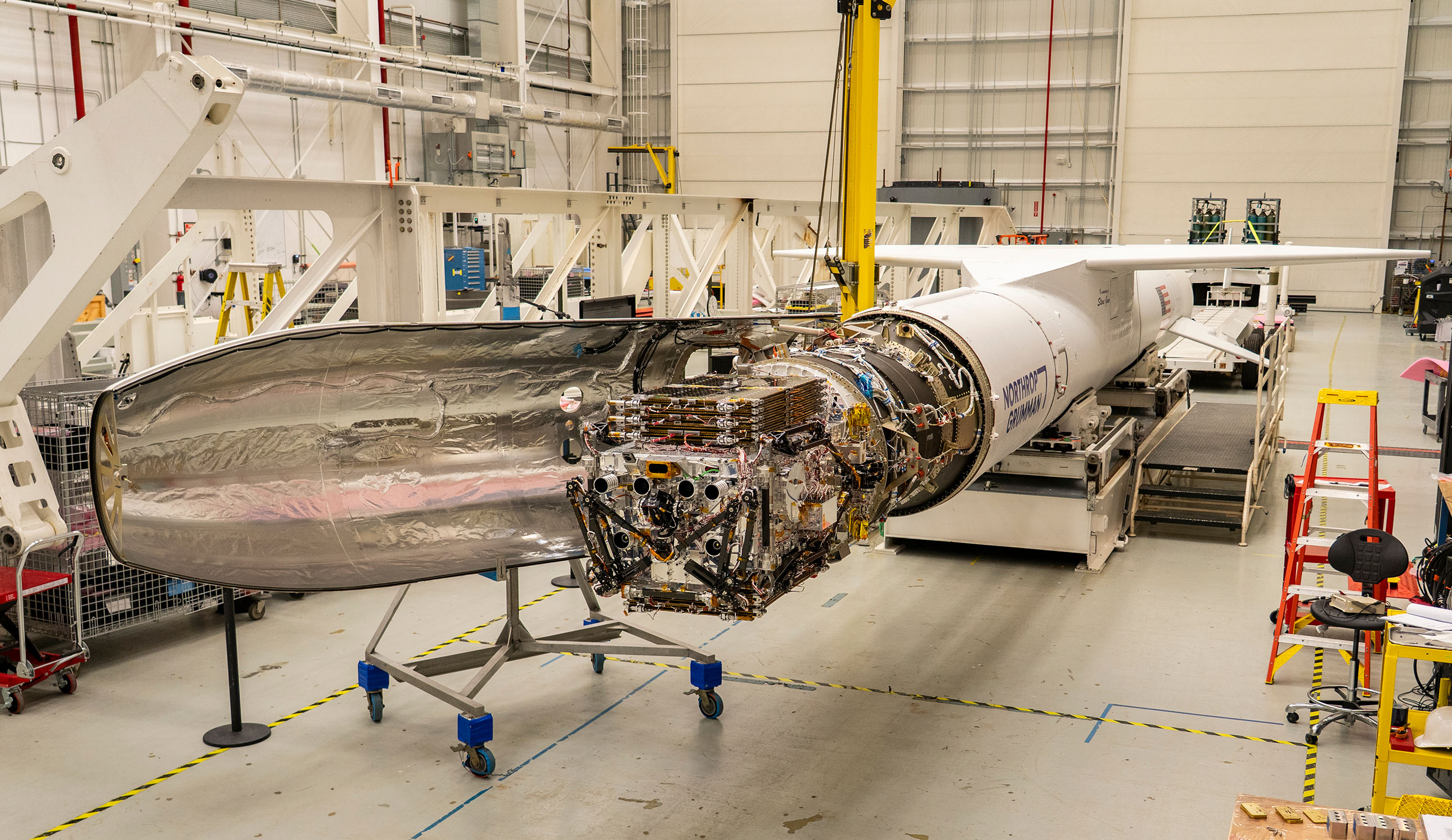
LINK attached to the front of the Pegasus XL
Katalyst Space’s LINK robotic servicing satellite awaits encapsulation inside a Northrop Grumman Pegasus XL on June 8, 2026, at NASA’s Wallops Flight Facility in Virginia. The rocket will carry LINK to space for an attempted orbital boost of NASA’s Neil Gehrels Swift Observatory.
Credit: NASA/Ron Beard

NASA will host an audio-only media teleconference at 11 a.m. EDT, Wednesday, June 17, to preview the Katalyst Space mission to boost the orbit of NASA’s Neil Gehrels Swift Observatory.

Katalyst’s robotic servicing spacecraft, called LINK, will attempt to rendezvous with Swift and raise its altitude, extending its science mission lifespan and advancing a key capability for the future of space exploration. The LINK spacecraft will launch on Northrop Grumman’s Pegasus XL rocket later this month from Kwajalein Atoll in the Marshall Islands.

Media interested in participating by phone must RSVP no later than two hours before the start of the call to Amy Barra at: amy.l.barra@nasa.gov. NASA’s media accreditation policy is available online.

Audio of the media teleconference will stream on the agency’s website at:

https://www.nasa.gov/live

Participants in the media teleconference include:

  • Shawn Domagal-Goldman, division director, Astrophysics, NASA Headquarters in Washington
  • Brad Cenko, principal investigator, Swift, NASA’s Goddard Space Flight Center in Greenbelt, Maryland
  • Kieran Wilson, principal investigator, LINK, Katalyst Space
  • Robert Lamontagne, vice president, strategic partnerships, Katalyst Space
  • Wes Collier, vice president, launch systems, Northrop Grumman

The Swift mission, which launched in 2004, leads NASA’s fleet of telescopes in studying changes in the high-energy universe, like gamma-ray bursts, which are the most powerful explosions in the cosmos. When a rapid, sudden event takes place in the sky, Swift serves as a “dispatcher,” providing critical information that allows other “first responder” missions to follow up to learn more about how the universe works.

After 21 years, Swift’s low Earth orbit has begun to rapidly decay because of increased solar activity. Rather than allowing the observatory to re-enter Earth’s atmosphere, as many missions do at the end of their lifetimes, NASA is using this opportunity to advance U.S. spacecraft servicing technology. In September 2025, NASA awarded a contract to Katalyst to mount a robotic servicing mission for Swift in less than a year. The mission will use LINK to rendezvous with Swift and boost it to a higher altitude, demonstrating a key capability for the future of space exploration. The mission is targeted for launch in June from Kwajalein Atoll, Marshall Islands.

Learn more about the mission to boost Swift’s orbit at:

https://science.nasa.gov/mission/swift/swift-boost-mission/

-end-

Karen Fox / Alise Fisher
Headquarters, Washington
202-385-1287 / 202-358-2546
karen.c.fox@nasa.gov / alise.m.fisher@nasa.gov

Amy Barra
Wallops Flight Facility, Wallops Island, Va.
757-824-1579
amy.l.barra@nasa.gov

The post NASA to Preview Katalyst Mission to Boost Swift Spacecraft’s Orbit appeared first on NASA Science.

NASA to Preview Katalyst Mission to Boost Swift Spacecraft’s Orbit

11 June 2026 at 14:58
LINK attached to the front of the Pegasus XL
Katalyst Space’s LINK robotic servicing satellite awaits encapsulation inside a Northrop Grumman Pegasus XL on June 8, 2026, at NASA’s Wallops Flight Facility in Virginia. The rocket will carry LINK to space for an attempted orbital boost of NASA’s Neil Gehrels Swift Observatory.
Credit: NASA/Ron Beard

NASA will host an audio-only media teleconference at 11 a.m. EDT, Wednesday, June 17, to preview the Katalyst Space mission to boost the orbit of NASA’s Neil Gehrels Swift Observatory.

Katalyst’s robotic servicing spacecraft, called LINK, will attempt to rendezvous with Swift and raise its altitude, extending its science mission lifespan and advancing a key capability for the future of space exploration. The LINK spacecraft will launch on Northrop Grumman’s Pegasus XL rocket later this month from Kwajalein Atoll in the Marshall Islands.

Media interested in participating by phone must RSVP no later than two hours before the start of the call to Amy Barra at: amy.l.barra@nasa.gov. NASA’s media accreditation policy is available online.

Audio of the media teleconference will stream on the agency’s website at:

https://www.nasa.gov/live

Participants in the media teleconference include:

  • Shawn Domagal-Goldman, division director, Astrophysics, NASA Headquarters in Washington
  • Brad Cenko, principal investigator, Swift, NASA’s Goddard Space Flight Center in Greenbelt, Maryland
  • Kieran Wilson, principal investigator, LINK, Katalyst Space
  • Robert Lamontagne, vice president, strategic partnerships, Katalyst Space
  • Wes Collier, vice president, launch systems, Northrop Grumman

The Swift mission, which launched in 2004, leads NASA’s fleet of telescopes in studying changes in the high-energy universe, like gamma-ray bursts, which are the most powerful explosions in the cosmos. When a rapid, sudden event takes place in the sky, Swift serves as a “dispatcher,” providing critical information that allows other “first responder” missions to follow up to learn more about how the universe works.

After 21 years, Swift’s low Earth orbit has begun to rapidly decay because of increased solar activity. Rather than allowing the observatory to re-enter Earth’s atmosphere, as many missions do at the end of their lifetimes, NASA is using this opportunity to advance U.S. spacecraft servicing technology. In September 2025, NASA awarded a contract to Katalyst to mount a robotic servicing mission for Swift in less than a year. The mission will use LINK to rendezvous with Swift and boost it to a higher altitude, demonstrating a key capability for the future of space exploration. The mission is targeted for launch in June from Kwajalein Atoll, Marshall Islands.

Learn more about the mission to boost Swift’s orbit at:

https://science.nasa.gov/mission/swift/swift-boost-mission/

-end-

Karen Fox / Alise Fisher
Headquarters, Washington
202-385-1287 / 202-358-2546
karen.c.fox@nasa.gov / alise.m.fisher@nasa.gov

Amy Barra
Wallops Flight Facility, Wallops Island, Va.
757-824-1579
amy.l.barra@nasa.gov

❌