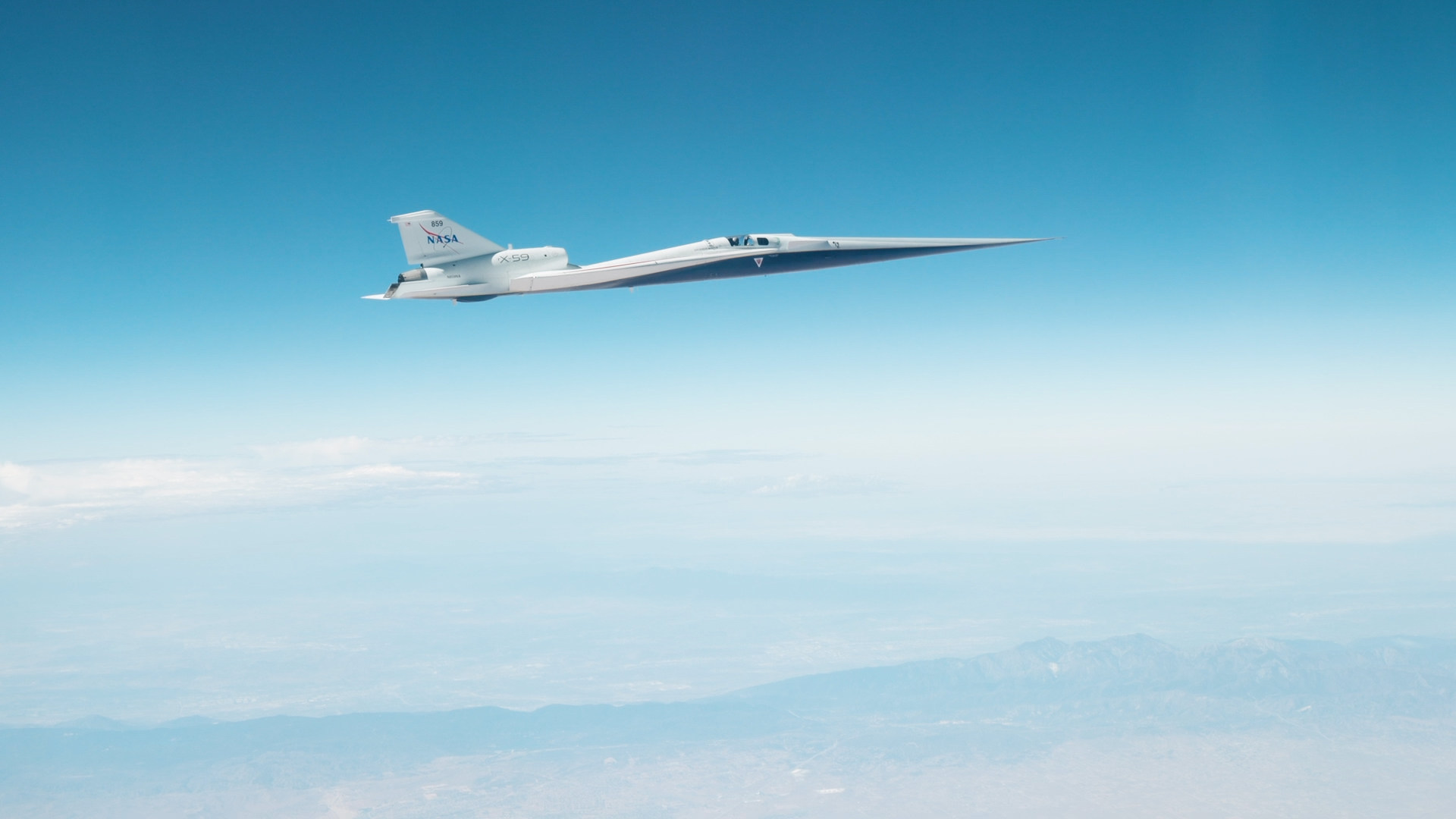
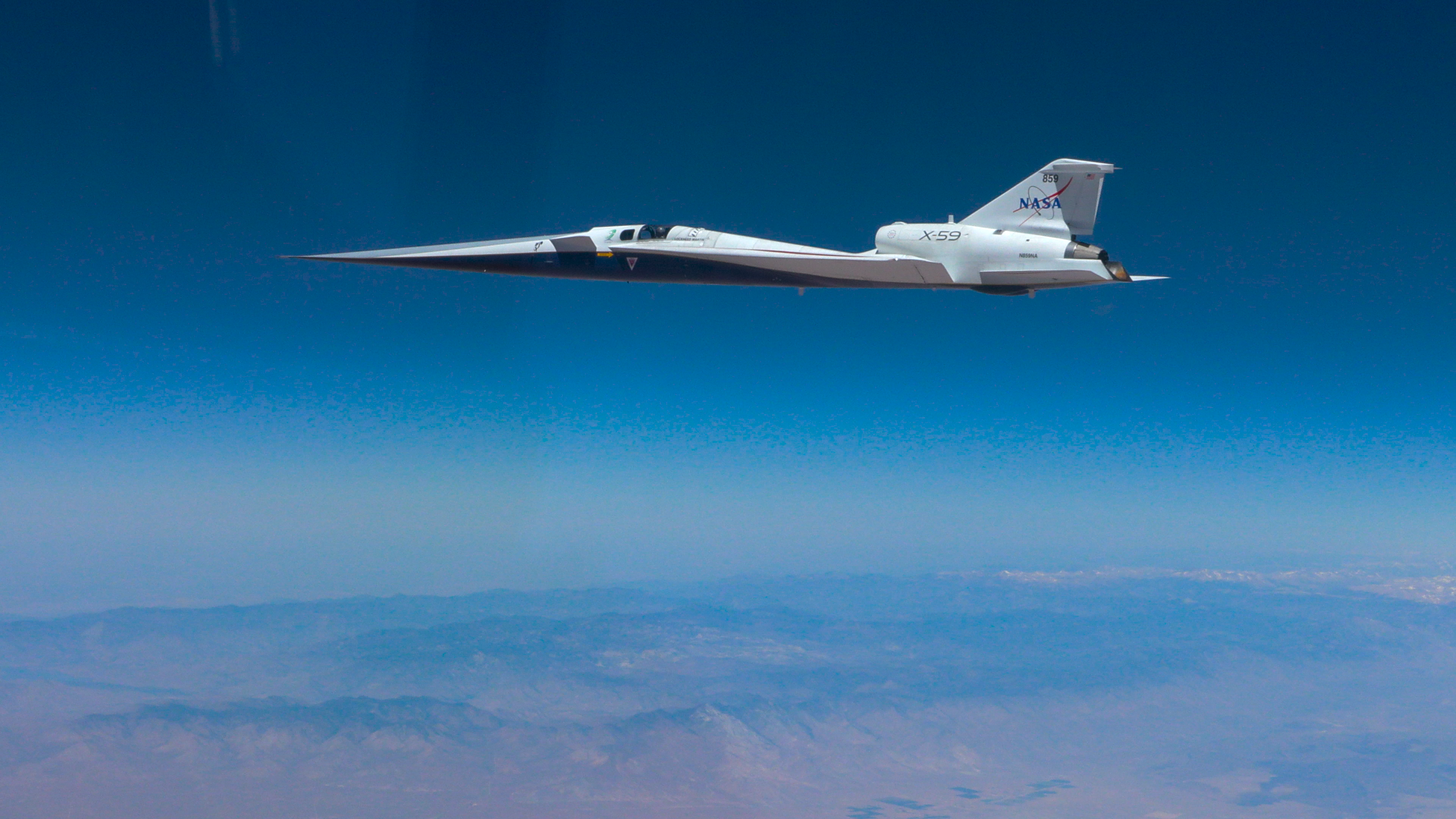
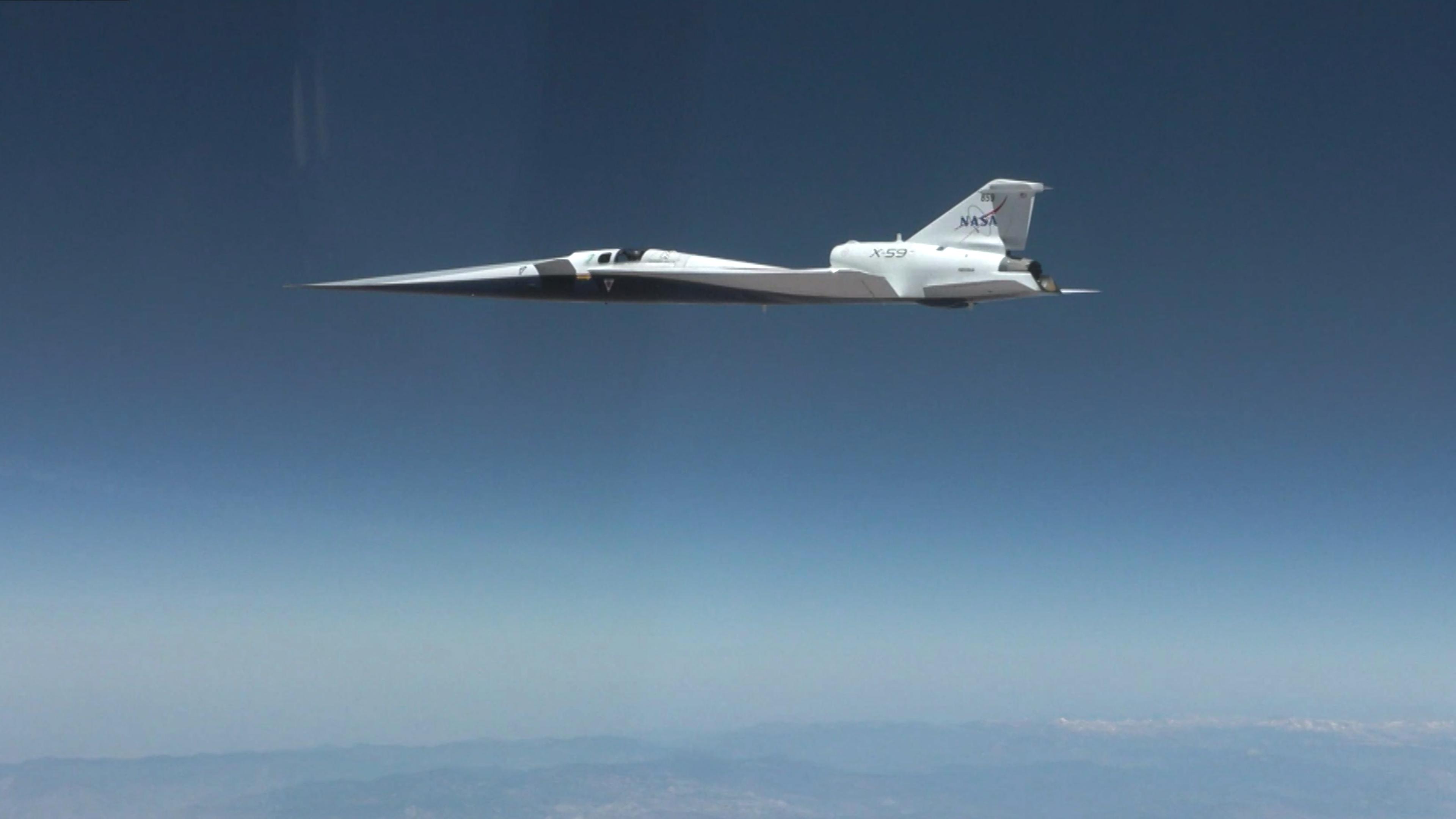
NASA’s X-59 quiet supersonic research aircraft reached its target speed and altitude for future community overflights for the first time during a flight on Friday, June 12, 2026. The milestone marked the first time the aircraft flew at Mach 1.4 and 55,000 feet — conditions it will fly when gathering community response data to its quiet sonic thump.
NASA/Lori Losey
NASA’s X-59 experimental aircraft reached a major milestone Friday, June 12, flying Mach 1.4 (about 924 mph) and an altitude of 55,000 feet, the conditions required for the aircraft to make future flights critical to its mission.
The X-59 still has months of performance testing ahead, but after those are complete, NASA’s Quesst mission will fly the aircraft over several U.S. communities to collect data on public perception of the quiet sonic thump it will make at supersonic speeds. Those community overflights will include flights at Mach 1.4 and 55,000 feet.
The milestone comes just days after the X-59’s first supersonic flight. That flight showed the aircraft performed as expected at Mach 1.1, but Friday’s mission conditions flight was an even more critical step for NASA.
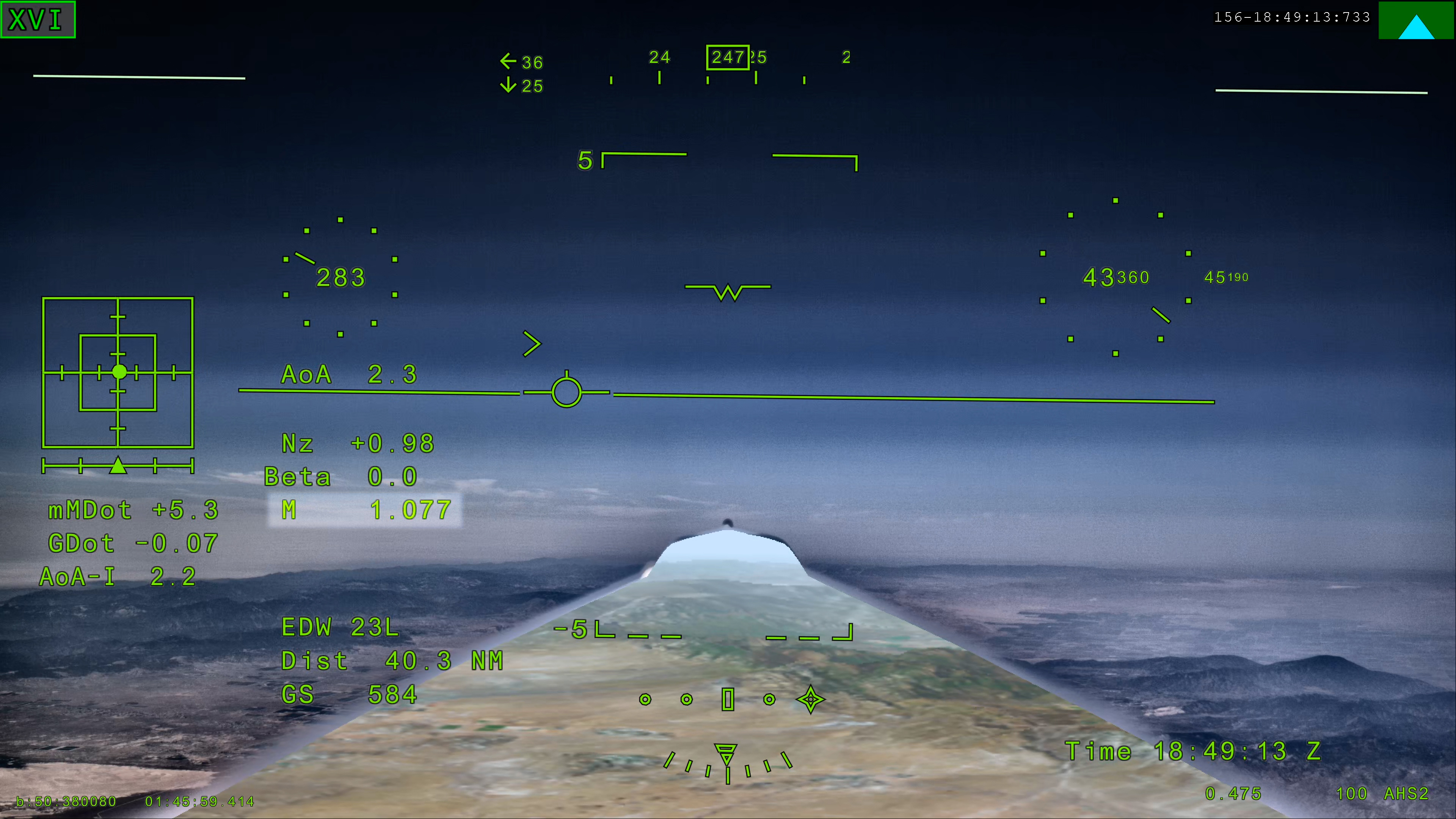
NASA’s X‑59 eXternal Vision System (XVS) shows Mach 1.4 at 55,030 feet on Friday, June 12, 2026 during the aircraft’s first mission conditions flight, the approximate conditions it will fly when gathering community response data to its quiet “sonic thump.” The milestone marks the first time the aircraft flew at its designed speed and altitude.
NASA/Lori Losey
The X-59 was designed to fly supersonic without causing a loud sonic boom. However, for these early supersonic flights it has been accompanied by a NASA F-15 research aircraft, a traditional supersonic jet that causes booms obscuring any noise the X-59 makes. During upcoming flights, a shock-sensing probe mounted to the F-15 will gather measurements of the X-59’s shock wave signature, an early measure of its supersonic performance.
After the team conducts more tests at a variety of altitudes and conditions to complete envelope expansion, the X-59 will enter the acoustic validation phase of Quesst. During this phase, researchers will thoroughly measure the aircraft’s supersonic acoustic signature — the quiet thump it’s designed to make — to confirm it is performing as intended.
Each flight brings NASA one step closer to flying the X-59 over communities and gathering feedback that could help shape the future of commercial supersonic flight over land.
Researchers from the private nuclear fusion energy company Commonwealth Fusion Systems have published a series of papers that they claim confirm that their flagship ARC reactor will produce more usable energy than it consumes if built as designed.
Although the company projects it will deliver the first commercial fusion plants by the early 2030s, other researchers say there are remaining challenges to overcome, and won’t declare the ARC reactor successful until an operational version is constructed to validate the research team’s theoretical predictions.
ARC Fusion Reactor ‘Will Work’ When Built
Scientists have long dreamed of capturing the nuclear fusion reaction that fuels our Sun and using it to generate clean, renewable power. Private fusion firms like CFS have received nearly $10 billion in funding over the last decade alone.
The first laboratory “net-energy” controlled fusion reaction, which fusion scientists call “ignition,” didn’t occur until 2022, when physicists at the US National Ignition Facility in Livermore, California, successfully produced more energy than was used to generate the reaction. Although brief, that moment has fueled speculation that practical fusion energy generation may be right around the corner.
Now, the Commonwealth team, which includes 58 researchers from the company and partner institutes, has published scientific papers outlining the physics of their ARC reactor, including new models that they say account for the “expected behavior” of the superhot plasma at the heart of the design.
Brandon Sorbom, the company’s chief science officer, said that the published works “confirm that when we build the ARC fusion power plant, it will work”.
Company Claims ARC Will Produce 400 Megawatts of Net Electricity
After nearly a decade of research, CFS, founded in 2018, is currently preparing its prototype for a 2027 demonstration it calls ‘SPARC.’ The company said they expect that trial run, which will demonstrate their technology’s ability to generate more energy than it needs to heat the plasma, will help them fine-tune ARC’s final design.
A peek inside the Commonwealth Fusion Systems magnet production facility. Image Credit: CFS.
According to the Commonwealth-led team, ARC will generate more energy than is required to operate the entire facility, including plasma heating, resulting in a true net-positive power-generation facility. This includes producing approximately 400 megawatts of net electricity, which the team noted is enough to power 280,000 average US homes. For comparison, recent census data indicates that Boston, Massachusetts, near the company’s headquarters in Cambridge, has around 271,000 U.S. homes.
Like SPARC, the ARC reactor uses high-temperature superconducting magnets to compress the plasma, which remains suspended by the magnetic fields, preventing it from damaging the chamber walls and terminating any potential fusion reaction. Under this extreme pressure, the nuclei of heavy hydrogen trapped inside the chamber fuse to form helium, the same reaction that takes place inside the Sun.
This fusion reaction results in the release of energy, primarily high-speed neutrons. At its hottest, the donut-shaped ring of plasma reaches seven times the temperature of the Sun.
Critics Applaud Publication While Highlighting Unproven Concepts and Systems
Tony Roulstone, a nuclear engineer at the University of Cambridge, UK, conceded that the CFS team and its collaborating authors are “some of the best in the fusion business” and noted the company’s ARC reactor concept is the result of “good work over many years.” However, Roulstone also warned of the pressure on researchers in privately funded companies to “claim things before the evidence is fully in place.”
David Hammer, a nuclear engineer at Cornell University in Ithaca, New York, said it is a good sign that the team is publishing at a high volume, but also warned that published papers will not guarantee that the built device will work as intended.
Their modeling “has to be proven correct by a fusion reactor that works as designed”, he adds. If the firm can get SPARC operating successfully next year, “it will be an important step forward”, he says.
Hamner also noted that several of the design’s subsystems require further development before it can be declared complete. This includes addressing how plasma will behave in the real world when it becomes unstable versus its modeled behavior, proving out the process for extracting usable energy from the generated heat, and demonstrating that the reactor is robust enough to operate for long periods.
The scientists also noted the challenges in sourcing tritium, the isotopic fuel the reactor requires to operate. Although CFS has outlined its tritium generation process, Hamner noted that the series of published papers neither details the process nor demonstrates its viability.
“There are candidate blanket materials and blanket designs, but there are many engineering person-years needed” to bring a functional ARC-style plant to fruition, he explained.
“We certainly have to build more on top of that foundation laid out in these papers,” a company spokesperson said, adding that they will “be able to produce tritium for operations and for future power plants.”
Editor’s Note: This article was updated to correct a previous version that described neutrinos, rather than fast-neutrons, in the context of the reporting, and to clarify that the first achievement of a “net-energy” controlled fusion reaction (ignition) occurred in 2022.
Christopher Plain is a Science Fiction and Fantasy novelist and Head Science Writer at The Debrief. Follow and connect with him on X, learn about his books at plainfiction.com, or email him directly at christopher@thedebrief.org.
(L-R) Sen. Mike Rounds, Pamela Brown, Chris Malachowsky, Kevin O'Leary, Gabriele Caccia, Tammy Haddad, Michele L. Jawando, Sen. Mark Warner, Michael Kelly and Major General Patrick Ellis attend the Second Annual AI Honors. | Getty Images for Washington AI N
Hello and welcome to Regulator, a newsletter for Verge subscribers about tech politics, tech influence, and tech shenanigans in Washington, DC. (If you're not a subscriber, you can get on board here.) We're back after a two-week hiatus, during most of which I was gallivanting in the Netherlands for a family wedding, and a trip to the Heineken Experience, which is, truly, an ~experience~.
Before I left, I asked everyone in Washington to please chill out while I was gone. This clearly did not happen, and I have returned to a political landscape that can be best described as that meme from Community where the room is on fire. Let's get into th …
The Tories have pledged to tear up the requirement in the Equality Act for public-sector bodies to promote equality and diversity following the murder of Henry Nowak.
The first thing a future anti-woke UK government should cut is the billions spent on useless Left-wing research, says Charlotte Gill. For starters, here are 10 studies funded by UKRI's Future Leaders Fellowships.
NASA’s X-59 quiet supersonic research aircraft completed its first supersonic flight Friday, June 5, 2026, marking the first time the aircraft exceeded the speed of sound in support of NASA’s Quesst mission. The milestone represents a major step in flight testing as the aircraft expands into the supersonic portion of its flight envelope.
The 81-minute flight achieved a speed of Mach 1.1 (approximately 713 mph) at an altitude of 43,400 feet, with the X-59 performing as expected. For NASA test pilot Jim “Clue” Less, the plane’s instruments were the only indication of flying supersonic — exactly what the team wanted.
“You know you are supersonic when gauges say you are supersonic. I didn’t feel anything,” Less said. “It went smoothly, and we easily got to Mach 1.1.”
The X-59 is designed to fly at supersonic speeds while creating only a quiet thump instead of a loud sonic boom. For this flight, a NASA F‑15 chase plane flew nearby to monitor the test. Its loud sonic booms obscured any sound made by the X-59. The X-59 will conduct flights focused on its sound profile during a later phase of testing.
Now that the X-59 has officially kicked off supersonic flight tests, the next big step is its first mission conditions flight. During this test, the X-59 will fly at the same speed and altitude planned for future tests, where the aircraft will fly over several U.S. communities to gather data from people on the ground about its noise levels: Mach 1.4 (925 mph) at 55,000 feet.
“The plane wants to go faster, and we are looking forward to that,” Less said.
The X-59 is the centerpiece of NASA’s Quesst mission, which aims to demonstrate quieter supersonic flight and to help enable commercial supersonic flight over land.
Découvert en Patagonie après trois saisons de fouilles, Joaquinraptor casali redistribue les cartes de la paléontologie. Ce prédateur d'une tonne aux bras démesurés faisait passer le T. rex pour un boxeur manchot. Et si la force brute n'était pas la meilleure arme de l'ère des dinosaures ?
NASA’s X-59 Aircraft Flies Supersonic for First Time
NASA’s X 59 eXternal Vision System shows Mach 1.077 on Friday, June 5, 2026, marking the aircraft’s first time reaching supersonic speed in support of NASA’s Quesst mission. The moment represents a milestone for the aircraft as it transitions to include test flights faster than the speed of sound.
NASA
NASA’s experimentalX-59 aircraft marked a major milestone Friday, June 5, when it flew faster than the speed of sound for the first time, setting the stage for demonstrating its quiet supersonic capabilities later this year.
NASA test pilot Jim “Clue” Less took off and landed at Edwards Air Force Base in California, reaching a top speed of approximately Mach 1.1 (713 mph) and altitude of 43,400 feet. The X-59’s flight began at 11:08 a.m. PDT and lasted 81 minutes, with the team focusing on flying qualities at both subsonic and then supersonic speeds.
In the coming days, we expect to take the next step and push to Mach 1.4
jared isaacman
NASA Administrator
”X-59 is getting ready for its quiet supersonic debut. Since the aircraft’s first flight on Oct. 28, 2025, the team has made tremendous progress, flying 16 times in the last 90 days and getting into a steady test rhythm. In the coming days, we expect to take the next step and push to Mach 1.4,” said NASA Administrator Jared Isaacman “I’m grateful to the NASA team and Lockheed Martin Skunk Works for their help getting us to this point, and I hope this is the first of many collaborations as we rebuild NASA’s X-plane portfolio.”
The X-59 is designed to fly at supersonic speeds while creating only a quiet thump instead of a loud sonic boom. For this flight, a NASA F‑15 chase plane flew nearby to monitor the X‑59. The loud sonic booms from the F-15 obscured any sound made by the X-59.
“The X-59’s first supersonic flight is a testament to America’s enduring leadership in science, engineering, and aerospace innovation,” said Michael Kratsios, Assistant to the President for Science and Technology and Director of the Office of Science and Technology Policy. “This achievement comes as the Trump Administration continues work to unleash supersonic flight and enable American ingenuity.”
This first supersonic flight is a significant milestone, but an event even more critical to the mission is upcoming. In just days, the aircraft is expected to make its first “mission conditions” flight, reaching a cruising speed of Mach 1.4 (925 mph) and altitude of approximately 55,000 feet. The X-59 also will be accompanied by a chase plane for this flight.
NASA’s X-59 quiet supersonic research aircraft completed its first supersonic flight Friday, June 5, 2026, marking the first time the aircraft exceeded the speed of sound in support of NASA’s Quesst mission. The milestone represents a major step in flight testing as the aircraft expands into the supersonic portion of its flight envelope.
NASA / Lori Losey
This speed and altitude are the base conditions for the X-59 when it will eventually fly over several U.S. communities enabling NASA to gather data about how people may perceive its quiet thump. NASA will share this data with U.S. and international regulators to help establish new data-driven noise standards to enable a future viable market for supersonic commercial flight over land.
For the last several months, the X-59 has been participating in an ongoing series of flights where the plane has been flying at a wide range of speeds and altitudes – a process known as envelope expansion. These tests are the first phase of the X-59’s flight testing. They are focused on performance and involve chase plane monitoring. When the aircraft completes this phase it will enter another, focused on its sound profile in order to verify its quiet thump capability.
The X-59 is the centerpiece of NASA’s Quesst mission, which aims to demonstrate quiet supersonic flight and help enable commercial supersonic flight over land worldwide. These advancements will help travelers reach their preferred destinations faster, spending less time in the air.
Through Quesst’s development of the X-59, NASA also will deliver design tools and technology for quiet supersonic airliners that will achieve the high speeds desired by commercial operators without disturbing people on the ground. NASA will validate design tools through ground and flight testing, providing U.S. aircraft manufacturers the ability to explore new quiet supersonic concepts, and provide them with confidence that their resulting designs will meet quiet flight requirements.
Preparations for Next Moonwalk Simulations Underway (and Underwater)
NASA’s X-59 eXternal Vision System shows Mach 1.077 on Friday, June 5, 2026, marking the aircraft’s first time reaching supersonic speed in support of NASA’s Quesst mission. The moment represents a milestone for the aircraft as it transitions to include test flights faster than the speed of sound.
NASA
NASA’s experimentalX-59 aircraft marked a major milestone Friday, June 5, when it flew faster than the speed of sound for the first time, setting the stage for demonstrating its quiet supersonic capabilities later this year.
NASA test pilot Jim “Clue” Less took off and landed at Edwards Air Force Base in California, reaching a top speed of approximately Mach 1.1 (713 mph) and altitude of 43,400 feet. The X-59’s flight began at 11:08 a.m. PDT and lasted 81 minutes, with the team focusing on flying qualities at both subsonic and then supersonic speeds.
In the coming days, we expect to take the next step and push to Mach 1.4
jared isaacman
NASA Administrator
”X-59 is getting ready for its quiet supersonic debut. Since the aircraft’s first flight on Oct. 28, 2025, the team has made tremendous progress, flying 16 times in the last 90 days and getting into a steady test rhythm. In the coming days, we expect to take the next step and push to Mach 1.4,” said NASA Administrator Jared Isaacman “I’m grateful to the NASA team and Lockheed Martin Skunk Works for their help getting us to this point, and I hope this is the first of many collaborations as we rebuild NASA’s X-plane portfolio.”
The X-59 is designed to fly at supersonic speeds while creating only a quiet thump instead of a loud sonic boom. For this flight, a NASA F‑15 chase plane flew nearby to monitor the X‑59. The loud sonic booms from the F-15 obscured any sound made by the X-59.
“The X-59’s first supersonic flight is a testament to America’s enduring leadership in science, engineering, and aerospace innovation,” said Michael Kratsios, Assistant to the President for Science and Technology and Director of the Office of Science and Technology Policy. “This achievement comes as the Trump Administration continues work to unleash supersonic flight and enable American ingenuity.”
This first supersonic flight is a significant milestone, but an event even more critical to the mission is upcoming. In just days, the aircraft is expected to make its first “mission conditions” flight, reaching a cruising speed of Mach 1.4 (925 mph) and altitude of approximately 55,000 feet. The X-59 also will be accompanied by a chase plane for this flight.
NASA’s X-59 quiet supersonic research aircraft completed its first supersonic flight Friday, June 5, 2026, marking the first time the aircraft exceeded the speed of sound in support of NASA’s Quesst mission. The milestone represents a major step in flight testing as the aircraft expands into the supersonic portion of its flight envelope.
NASA / Lori Losey
This speed and altitude are the base conditions for the X-59 when it will eventually fly over several U.S. communities enabling NASA to gather data about how people may perceive its quiet thump. NASA will share this data with U.S. and international regulators to help establish new data-driven noise standards to enable a future viable market for supersonic commercial flight over land.
For the last several months, the X-59 has been participating in an ongoing series of flights where the plane has been flying at a wide range of speeds and altitudes – a process known as envelope expansion. These tests are the first phase of the X-59’s flight testing. They are focused on performance and involve chase plane monitoring. When the aircraft completes this phase it will enter another, focused on its sound profile in order to verify its quiet thump capability.
The X-59 is the centerpiece of NASA’s Quesst mission, which aims to demonstrate quiet supersonic flight and help enable commercial supersonic flight over land worldwide. These advancements will help travelers reach their preferred destinations faster, spending less time in the air.
Through Quesst’s development of the X-59, NASA also will deliver design tools and technology for quiet supersonic airliners that will achieve the high speeds desired by commercial operators without disturbing people on the ground. NASA will validate design tools through ground and flight testing, providing U.S. aircraft manufacturers the ability to explore new quiet supersonic concepts, and provide them with confidence that their resulting designs will meet quiet flight requirements.
NASA’s X-59 quiet supersonic research aircraft completed its first supersonic flight Friday, June 5, 2026, marking the first time the aircraft exceeded the s...
Les raptors, dinosaures à plumes du Crétacé, ne pouvaient pas voler malgré leur lien étroit avec les oiseaux. Une nouvelle étude menée sur un site fossilifère en Chine révèle toutefois que certains d’entre eux auraient été capables de planer et de chasser les premiers oiseaux.
Com mais de 10 milhões de jogadores em todo o mundo, Airport Simulator: Plane City é um simulador de gestão de aeroportos do estúdio francês Playrion que mistura estratégia, personalização e a calma hipnótica de ver aviões a descolar e a aterrar.
I reflect on my educational journey, highlighting challenges such as family separation and multiple school changes. I excelled in science and mathematics yet was indoctrinated on Godless cosmology and rejected the Creator. Later Jesus Christ saved me from atheism and renewed my mind to His truth.
Satan's rebellion has led humanity to believe in false origins of life, such as abiogenesis and panspermia, instead of a divine Creator. I critique the scientific community's efforts to explain life without acknowledging supernatural creation, asserting the biblical viewpoint that true life and intelligence can only stem from God.
Human hands exhibit unparalleled complexity and dexterity, revealing the mastery of their Creator. Despite advancements in robotics, replicating the nuanced movements and strength of human hands remains a significant challenge. Companies like Proception are striving to develop robotic hands, yet authentic human hand functionality remains unmatched, highlighting the intricacies of divine design.
The ongoing competition to create artificial intelligence involves massive investments by major companies in developing supercomputers with extensive GPU capacities. However, true sentient intelligence cannot emerge merely from advanced technology, as intelligence is the product of divine creation, not a result of computational complexity alone.
John McCarthy, a significant figure in artificial intelligence, coined the term during the 1956 Dartmouth conference, aiming to develop machines that could simulate human intelligence. He proposed key aspects of AI, questioning its potential sentience. I argue that true sentience originates from a divine Creator, not from machines.

 Login