
❌

Normal view

Amendment 59: Several Updates to the ROSES-25 Summary of Solicitation

15 June 2026 at 19:55

Research Opportunities in Space and Earth Sciences (ROSES)-2025 is an ongoing “omnibus” or “umbrella” solicitation meaning that it includes many individual program elements each with its own topics and due dates. Refer to Table 3 of ROSES-25 for a list of those program elements. The ROSES-25 “Summary of Solicitation” is the front matter that sets the default backstop rules for each of the program elements in ROSES-25.

ROSES-25 Amendment 59 makes several additions, changes, and clarifications to the ROSES-25 Summary of Solicitation to conform with Agency and administration priorities, see Sections I, I(g), II(a), II(b), III(b), III(d), V(b)ii, VI(c) & VIII(b). New text is in bold.

Important and substantial revisions to 2 CFR 200, the government-wide guidance for grants and cooperative agreements are proposed to take effect October 1, 2026, see https://www.federalregister.gov/documents/2026/05/29/2026-10817/regulation-for-federal-financial-assistance#h-8. Many types of currently allowable costs, such as but not limited to publications, research or events outside the United States, and domestic conferences may be restricted, denied, or may be allowable by legal exception or special award conditions only. Public comments on the revisions to 2 CFR 200 may be submitted until July 13, 2026, at https://www.regulations.gov/commenton/OMB-2026-0034-0001

On or about June 15, 2026, this Amendment to the NASA Research Announcement “Research Opportunities in Space and Earth Sciences (ROSES) 2025” (NNH25ZDA001N) will be posted on the NASA research opportunity homepage at https://solicitation.nasaprs.com/ROSES2025 and will appear on SARA’s ROSES blog at: https://science.nasa.gov/researchers/solicitations/roses-2025/

Questions concerning this amendment to ROSES-25 may be directed to SARA@nasa.gov.

The post Amendment 59: Several Updates to the ROSES-25 Summary of Solicitation appeared first on NASA Science.
NASA to Preview Katalyst Mission to Boost Swift Spacecraft’s Orbit

11 June 2026 at 14:58
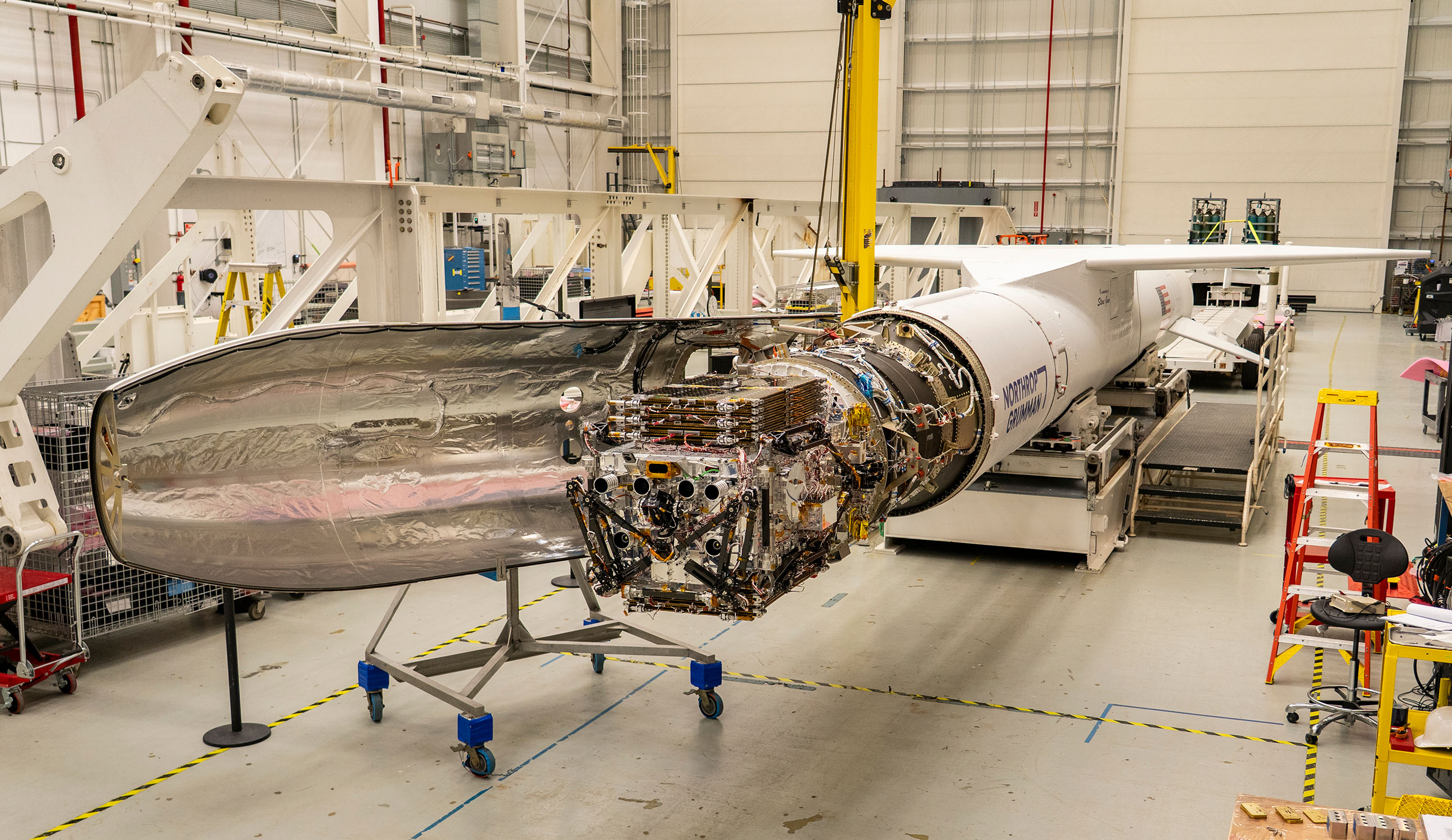
LINK attached to the front of the Pegasus XL
Katalyst Space’s LINK robotic servicing satellite awaits encapsulation inside a Northrop Grumman Pegasus XL on June 8, 2026, at NASA’s Wallops Flight Facility in Virginia. The rocket will carry LINK to space for an attempted orbital boost of NASA’s Neil Gehrels Swift Observatory.
Credit: NASA/Ron Beard

NASA will host an audio-only media teleconference at 11 a.m. EDT, Wednesday, June 17, to preview the Katalyst Space mission to boost the orbit of NASA’s Neil Gehrels Swift Observatory.

Katalyst’s robotic servicing spacecraft, called LINK, will attempt to rendezvous with Swift and raise its altitude, extending its science mission lifespan and advancing a key capability for the future of space exploration. The LINK spacecraft will launch on Northrop Grumman’s Pegasus XL rocket later this month from Kwajalein Atoll in the Marshall Islands.

Media interested in participating by phone must RSVP no later than two hours before the start of the call to Amy Barra at: amy.l.barra@nasa.gov. NASA’s media accreditation policy is available online.

Audio of the media teleconference will stream on the agency’s website at:

https://www.nasa.gov/live

Participants in the media teleconference include:

  • Shawn Domagal-Goldman, division director, Astrophysics, NASA Headquarters in Washington
  • Brad Cenko, principal investigator, Swift, NASA’s Goddard Space Flight Center in Greenbelt, Maryland
  • Kieran Wilson, principal investigator, LINK, Katalyst Space
  • Robert Lamontagne, vice president, strategic partnerships, Katalyst Space
  • Wes Collier, vice president, launch systems, Northrop Grumman

The Swift mission, which launched in 2004, leads NASA’s fleet of telescopes in studying changes in the high-energy universe, like gamma-ray bursts, which are the most powerful explosions in the cosmos. When a rapid, sudden event takes place in the sky, Swift serves as a “dispatcher,” providing critical information that allows other “first responder” missions to follow up to learn more about how the universe works.

After 21 years, Swift’s low Earth orbit has begun to rapidly decay because of increased solar activity. Rather than allowing the observatory to re-enter Earth’s atmosphere, as many missions do at the end of their lifetimes, NASA is using this opportunity to advance U.S. spacecraft servicing technology. In September 2025, NASA awarded a contract to Katalyst to mount a robotic servicing mission for Swift in less than a year. The mission will use LINK to rendezvous with Swift and boost it to a higher altitude, demonstrating a key capability for the future of space exploration. The mission is targeted for launch in June from Kwajalein Atoll, Marshall Islands.

Learn more about the mission to boost Swift’s orbit at:

https://science.nasa.gov/mission/swift/swift-boost-mission/

-end-

Karen Fox / Alise Fisher
Headquarters, Washington
202-385-1287 / 202-358-2546
karen.c.fox@nasa.gov / alise.m.fisher@nasa.gov

Amy Barra
Wallops Flight Facility, Wallops Island, Va.
757-824-1579
amy.l.barra@nasa.gov

The post NASA to Preview Katalyst Mission to Boost Swift Spacecraft’s Orbit appeared first on NASA Science.

NASA to Preview Katalyst Mission to Boost Swift Spacecraft’s Orbit

11 June 2026 at 14:58
LINK attached to the front of the Pegasus XL
Katalyst Space’s LINK robotic servicing satellite awaits encapsulation inside a Northrop Grumman Pegasus XL on June 8, 2026, at NASA’s Wallops Flight Facility in Virginia. The rocket will carry LINK to space for an attempted orbital boost of NASA’s Neil Gehrels Swift Observatory.
Credit: NASA/Ron Beard

NASA will host an audio-only media teleconference at 11 a.m. EDT, Wednesday, June 17, to preview the Katalyst Space mission to boost the orbit of NASA’s Neil Gehrels Swift Observatory.

Katalyst’s robotic servicing spacecraft, called LINK, will attempt to rendezvous with Swift and raise its altitude, extending its science mission lifespan and advancing a key capability for the future of space exploration. The LINK spacecraft will launch on Northrop Grumman’s Pegasus XL rocket later this month from Kwajalein Atoll in the Marshall Islands.

Media interested in participating by phone must RSVP no later than two hours before the start of the call to Amy Barra at: amy.l.barra@nasa.gov. NASA’s media accreditation policy is available online.

Audio of the media teleconference will stream on the agency’s website at:

https://www.nasa.gov/live

Participants in the media teleconference include:

  • Shawn Domagal-Goldman, division director, Astrophysics, NASA Headquarters in Washington
  • Brad Cenko, principal investigator, Swift, NASA’s Goddard Space Flight Center in Greenbelt, Maryland
  • Kieran Wilson, principal investigator, LINK, Katalyst Space
  • Robert Lamontagne, vice president, strategic partnerships, Katalyst Space
  • Wes Collier, vice president, launch systems, Northrop Grumman

The Swift mission, which launched in 2004, leads NASA’s fleet of telescopes in studying changes in the high-energy universe, like gamma-ray bursts, which are the most powerful explosions in the cosmos. When a rapid, sudden event takes place in the sky, Swift serves as a “dispatcher,” providing critical information that allows other “first responder” missions to follow up to learn more about how the universe works.

After 21 years, Swift’s low Earth orbit has begun to rapidly decay because of increased solar activity. Rather than allowing the observatory to re-enter Earth’s atmosphere, as many missions do at the end of their lifetimes, NASA is using this opportunity to advance U.S. spacecraft servicing technology. In September 2025, NASA awarded a contract to Katalyst to mount a robotic servicing mission for Swift in less than a year. The mission will use LINK to rendezvous with Swift and boost it to a higher altitude, demonstrating a key capability for the future of space exploration. The mission is targeted for launch in June from Kwajalein Atoll, Marshall Islands.

Learn more about the mission to boost Swift’s orbit at:

https://science.nasa.gov/mission/swift/swift-boost-mission/

-end-

Karen Fox / Alise Fisher
Headquarters, Washington
202-385-1287 / 202-358-2546
karen.c.fox@nasa.gov / alise.m.fisher@nasa.gov

Amy Barra
Wallops Flight Facility, Wallops Island, Va.
757-824-1579
amy.l.barra@nasa.gov

❌