A new passive technology could help future wireless networks reach places where signals struggle today. Dead zones are one of the most persistent problems in wireless communications. Whether it’s a basement office, a warehouse aisle, a tunnel, or a crowded indoor venue, signals often struggle to reach every corner. The challenge is expected to grow [...]
This record-breaking crystal can transform from mirror-like to glass-like, opening the door to tiny optical chips, AR displays, and smart contact lenses. Creating truly “invisible” wearable technology such as smart contact lenses and ultrathin augmented reality glasses will require a radical rethink of how optical devices are built. Instead of relying on conventional bulky components, [...]
A decades-old psychology test exposed a surprising weakness in AI’s ability to stay focused. A classic psychology test has revealed a surprising weakness in some of today’s most advanced artificial intelligence systems, suggesting that AI attention may work very differently from human attention. Researchers led by Suketu Patel investigated how large language models (LLMs), the [...]
The unveiling of the new garment by Prada and Axiom Space took place at Prada’s SoHo location in Manhattan just days before the announcement of the Artemis III crew, according to the New York Timesfashion desk. With black-clad waiters circulating champagne and healthy juices through the Rem Koolhaas-designed venue, the intersection of fashion and space exploration was once again on full display.
“The future of space exploration will not be built by any one entity alone, and our partnership with Prada is proof of that,” said Dr. Jonathan Cirtain, Axiom Space CEO and President, in a statement.
“By bringing together the best in both aerospace engineering as well as luxury craftmanship and advanced product development, we have developed a garment that neither company could have created independently, and that is exactly the kind of cross-industry thinking that will define the next era of human spaceflight,” Cirtain added.
Some might be surprised to learn this is not the first time NASA has collaborated with a fashion house. The first modern spacesuit was designed and crafted by a group of international designers at the Latex Corporation (ILC). In the 1960s, this company was best known for manufacturing bras and girdles.
Notably, a version of its A7L spacesuit was worn by Neil Armstrong during the Apollo 11 mission. Designers developed the A7L to protect astronauts from the harsh conditions of space and the lunar surface.
The suit was constructed using materials such as neoprene, Beta cloth—which helped protect astronauts from extreme temperatures—and aluminized Mylar. Overall, it was a highly complex, multilayered design.
The new LCVG collaboration draws on Prada’s expertise in knitting, craftsmanship, and advanced design. The resulting garment is a next-generation system developed using sophisticated 3D modeling techniques.
The suit is designed to maintain cooling and ventilation while remaining comfortable during spacewalks lasting up to eight hours. Thanks to its high-performance materials, it can also be worn repeatedly during long-duration missions.
“When we unveiled the AxEMU, we announced that the collaboration between Prada and Axiom Space would continue beyond that first milestone,” said Lorenzo Bertelli, Prada Group Chief Marketing Officer and Head of Sustainability, in a statement.
“Today, we are proud to present a new achievement born from the unique combination of Axiom Space’s pioneering expertise and Prada’s know-how in design, patternmaking, and advanced materials, ahead of humanity’s return to the lunar surface,” Bertelli added.
In 2024, Axiom Space and Prada unveiled the AxEMU’s outer layer, designed to withstand the harsh conditions of the lunar South Pole. Their latest collaboration on the Liquid Cooling and Ventilation Garment builds on that partnership, focusing on astronaut comfort, thermal regulation, and reliability inside the spacesuit.
“We look forward to continuing this collaboration with Axiom Space, pushing boundaries and exploring new frontiers together,” adds Bertelli.
The LCVG keeps astronauts cool during spacewalks by circulating chilled water through tubes woven into the garment, removing body heat and venting it through the spacesuit. It also delivers fresh oxygen and removes carbon dioxide, helping astronauts remain safe and comfortable in the harsh environment of space.
“Every minute astronauts spend outside their vehicle, the LCVG is working to keep them safe,” said Russell Ralston, Axiom Space Senior Vice President of Spacecraft Development.
“It manages their thermal environment, supports their breathing, and does it all while they’re pushing their bodies to the limit,” Ralson added. “The work we have done with Prada has taken that capability to a level we could not have achieved alone.”
Chrissy Newton is a PR professional and the founder of VOCAB Communications. She currently appears on The Discovery Channel and Max and hosts the Rebelliously Curious podcast, which can be found on YouTube and on all audio podcast streaming platforms. Follow her on X: @ChrissyNewton, Instagram: @BeingChrissyNewton, and chrissynewton.com. To contact Chrissy with a story, please email chrissy @ thedebrief.org.
Artificial Intelligence is beginning to improve itself. In today's video I have a summary of recent events. Are we ready for the intelligence explosion? I think not.
Across the stories today, a common thread emerges: the tension between revelation and rescue—moments when new understanding drives urgent action, even as time runs short.
Beneath our feet, scientists have mapped fungal networks stretching nearly a billion times the distance to the sun, revealing an underground web of connection that dwarfs anything visible above ground. It’s a reminder that the natural world operates on scales both microscopic and cosmic, with systems we’re only beginning to understand. This same spirit of discovery appears in unexpected places—from the ghostly earthshine illuminating the moon’s dark side to the arrival of a tropical western reef heron in Wales, likely pushed northward by changing climate patterns.
The day’s coverage points to growing momentum around what happens when scientific insight meets conservation urgency. In Mozambique, nine female white rhinos completed their journey to establish the country’s first viable breeding population in generations—a decade-long effort finally bearing fruit. Meanwhile, Australian researchers at PlantBank work like modern-day ark builders, preserving seeds before species disappear forever. On Palau’s Ulong Island, the simple act of removing invasive rats triggered rapid ecological recovery across both land and marine environments, challenging assumptions about how long nature needs to heal.
Yet revelations don’t always bring good news. China’s power sector emissions fell for the first time in a decade, a historic milestone, but a coal surge threatens to reverse that progress. Trees may store less carbon than scientists hoped, according to new research examining growth patterns across 137 forest sites. And Antarctica is missing sea ice equivalent to France’s size, with winter temperatures soaring 20°C above normal—numbers that feel abstract until you consider their global implications.
It’s a reminder that progress and pressure often arrive together. Lake Mead approaches the critical threshold that will slash Hoover Dam’s electricity production, while thousands of marine animals die in fishing nets annually through bycatch. For the 58-year-old Kenyan fisherman Mohamed Mwazigona, returning to shore with just 2 kilograms of fish, these aren’t statistics—they’re the reality of dwindling catches that threaten coastal livelihoods.
Behind the numbers are real communities adapting in real time. Eight volunteers used ropes and pulleys to rescue a 172-pound loggerhead turtle named Bowser from a Florida pier—the kind of hands-on conservation that makes the difference between survival and loss. In Albania, protesters dubbed the “Flamingo Revolution” emerged after bulldozers illegally destroyed protected wetlands for a luxury resort, showing how environmental destruction can galvanize public resistance.
The stories also reveal how legal frameworks struggle to keep pace with environmental challenges. A federal judge ruled the Trump administration’s cancellation of environmental justice grants illegal, while Australia’s climate chief outlined plans to transform the country from fossil fuel exporter to renewable energy leader. Meanwhile, environmental laws were waived to enable border wall construction through Big Bend National Park, illustrating how political priorities can override conservation concerns.
What emerges is a picture of a planet under pressure, but also of human ingenuity rising to meet unprecedented challenges. As commercial satellites threaten the night sky that has guided humanity for millennia, conservationists celebrate osprey chicks hatching in Wales and sengi pups born in captivity. Progress isn’t linear, and solutions often come from unexpected directions—underground fungal networks, community rescue efforts, and the patient work of seed preservation.
As the week unfolds, all eyes will be on how these parallel stories of discovery and rescue continue to intersect, shaping our understanding of what’s possible when knowledge meets action.
Extremely powerful large language models (LLMs) still operate as though they’re typing on a keyboard, processing workloads in a simple left-to-right fashion. But in locally-run, single-user scenarios, this sequential processing can leave graphics processing units (GPUs) and tensor processing units (TPUs) underutilized.
Google is betting that DiffusionGemma can get around this bottleneck. The new experimental open model generates text “exceptionally fast,” creating entire blocks of text simultaneously through diffusion techniques rather than through token-by-token processing. The company says this technique results in 4x faster inference compared to auto-regressive models that rely on sequential processing.
It can also save users money. Technology analyst Carmi Levy noted that existing pay-per-token monetization models “penalize the use of less than optimally efficient AI solutions.”
But DiffusionGemma “could herald a new generation of task-defined, efficient solutions that can enable expanded compute capacity without draining the operations budget,” he said.
A contrast to left-to-right processing
Built on Google’s Gemma 4 family and its Gemini Diffusion research, DiffusionGemma is a 26B mixture-of-experts (MoE) model designed to maximize text output generation.
It essentially shifts how models use hardware, giving processors a larger hunk of work each cycle so it can draft full 256-token paragraphs in sequence. This allows the model to generate text up to 4x faster on GPUs, Google claims. It activates only 3.8B parameters during inference, and, when quantized, can fit within 18GB VRAM on high-end consumer GPUs like Nvidia RTX 5090.
“It upgrades your model inference from a single, sequential typewriter to a massive printing press that stamps the entire block of text simultaneously,” Google research scientists Brendan O’Donoghue and Sebastian Flennerhag wrote in a blog post.
AI image generators begin with pure, random ‘visual noise’ and iteratively refine that into a finalized picture (what’s known as ‘diffusion’); DiffusionGemma applies this same process to text. It does not generate tokens in order, but begins with a “canvas of random placeholder tokens” that it processes in multiple passes, identifying the context tokens it feels are most relevant and using those to refine the rest.
The model has the ability to self-correct, using confidence scoring to re-evaluate tokens in the next pass. “The model iteratively refines its own output, allowing it to evaluate the entire text block at once to fix mistakes in real-time,” O’Donoghue and Flennerhag explained.
DiffusionGemma also has bidirectional attention, they wrote. “Generating 256 tokens in parallel with each forward pass allows every token to attend to all others.” This can be particularly helpful in domains that are non-linear in nature, such as mathematical graphs, code infilling, and in-line editing, they said.
DiffusionGemma is optimized across Nvidia’s hardware stack, making it compatible with consumer setups as well as with high-performance enterprise systems like Hopper and Blackwell.
Because it is released under the Apache 2.0 license, developers can freely use, modify, distribute, and commercialize the software using their preferred tools. It can be run on GPUs or in the cloud through Google Cloud Model Garden or Nvidia NIM, and is available on Hugging Face, GitHub, and vLLM, with support for the open-source library llama.cpp coming soon.
Key use cases
The model is particularly useful in local workflows that are “speed critical,” such as generation of non-linear text structures, and unlocks what Google calls “new patterns of model behavior” like multimodal understanding and generating and rendering code in near real-time.
Levy explained, “DiffusionGemma is particularly well suited for interactive coding and editing where its efficiency allows rapid processing and iterations,” noting that its ability to fit within 18GB of VRAM and its deployability on commonly available local GPUs can potentially benefit customer service-related workloads that lean heavily on real-time interaction and local processing.
“DiffusionGemma also incorporates a thinking mode that is especially adept at problem solving,” he said. For instance, the model was fine-tuned to play Sudoku, a typically challenging task for autoregressive models because each token depends on future tokens. This “rather handily” illustrates the model’s capability to solve more complex problems, Levy noted.
Limitations
Google freely admits that DiffusionGemma is geared to specific workflows, and there are “key trade-offs.”
The model is engineered for small batch size inferencing and low-latency, high-speed generation low-to-medium batch sizes on a “single capable accelerator.”
In high-QPS cloud serving environments, (where infrastructure is designed to handle tens or hundreds of thousands of requests per second with ultra-low latency), DiffusionGemma’s parallel coding “offers diminishing returns,” and can even result in higher serving costs, Google conceded. In addition, its overall output quality is lower than that of standard Gemma 4, which is built for apps demanding maximum quality.
However, Levy noted that while DiffusionGemma “can be less precise than other models in certain workloads,” subsequent refinement cycles could overcome this limitation.
While Google isn’t sharing runtime costs, it’s clear that this is an efficiency play, he added. “When deployed across the kinds of workloads that would optimally benefit from its architecture, DiffusionGemma seems to have the potential to reduce processing overhead and related costs,” he said.
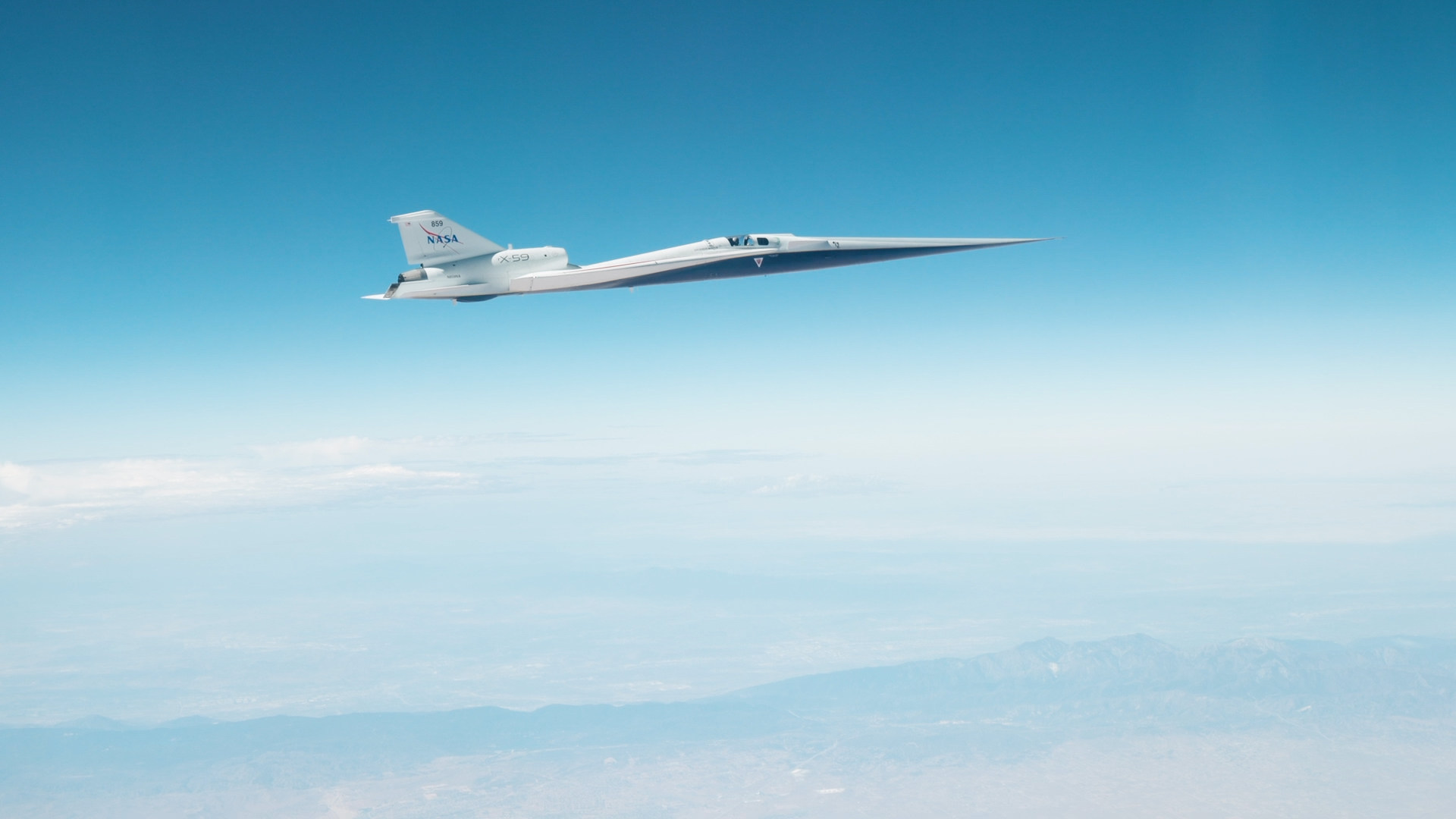
NASA’s X-59 quiet supersonic research aircraft reached its target speed and altitude for future community overflights for the first time during a flight on Friday, June 12, 2026. The milestone marked the first time the aircraft flew at Mach 1.4 and 55,000 feet — conditions it will fly when gathering community response data to its quiet sonic thump.
NASA/Lori Losey
NASA’s X-59 experimental aircraft reached a major milestone Friday, June 12, flying Mach 1.4 (about 924 mph) and an altitude of 55,000 feet, the conditions required for the aircraft to make future flights critical to its mission.
The X-59 still has months of performance testing ahead, but after those are complete, NASA’s Quesst mission will fly the aircraft over several U.S. communities to collect data on public perception of the quiet sonic thump it will make at supersonic speeds. Those community overflights will include flights at Mach 1.4 and 55,000 feet.
The milestone comes just days after the X-59’s first supersonic flight. That flight showed the aircraft performed as expected at Mach 1.1, but Friday’s mission conditions flight was an even more critical step for NASA.
NASA’s X‑59 eXternal Vision System (XVS) shows Mach 1.4 at 55,030 feet on Friday, June 12, 2026 during the aircraft’s first mission conditions flight, the approximate conditions it will fly when gathering community response data to its quiet “sonic thump.” The milestone marks the first time the aircraft flew at its designed speed and altitude.
NASA/Lori Losey
The X-59 was designed to fly supersonic without causing a loud sonic boom. However, for these early supersonic flights it has been accompanied by a NASA F-15 research aircraft, a traditional supersonic jet that causes booms obscuring any noise the X-59 makes. During upcoming flights, a shock-sensing probe mounted to the F-15 will gather measurements of the X-59’s shock wave signature, an early measure of its supersonic performance.
After the team conducts more tests at a variety of altitudes and conditions to complete envelope expansion, the X-59 will enter the acoustic validation phase of Quesst. During this phase, researchers will thoroughly measure the aircraft’s supersonic acoustic signature — the quiet thump it’s designed to make — to confirm it is performing as intended.
Each flight brings NASA one step closer to flying the X-59 over communities and gathering feedback that could help shape the future of commercial supersonic flight over land.
Several trends are now converging that threaten to pit tech companies against the general public.
Miniaturization has finally enabled companies to build AI glasses that look and function like normal glasses, but with microphones and cameras. People are increasingly talking to AI, rather than typing. And multimodal input, especially video, is on the rise.
Put all of these trends together and you get a nascent industry pushing toward all-day, everyday AI glasses with cameras — and a worried public already pushing back at the idea.
Let’s look at how we got here.
Meta started it with a surprise hit: its second-generation Ray-Ban Meta glasses, which later gained multimodal AI capability. Its Meta Ray-Ban Display glasses add one in-lens screen — but both versions of the glasses have cameras. (The company is working on a third generation that will probably ship next year.)
Google provides the AI and software platform through Android XR and Gemini, partnering with hardware makers to put its AI on other companies’ glasses. At Google I/O last month, Google unveiled frames from Gentle Monster and Warby Parker running Android XR with Gemini AI; they’re scheduled to launch this fall. Google is working on two types of AI glasses, one with screens and one that is audio-focused. Both types have cameras, though.
Samsung is working to launch AI-powered smart glasses, too, code-named “Jinju.” The company offered up details at Google I/O alongside Google. The glasses feature a 12-megapixel camera with autofocus; run on Android XR with Gemini AI; are co-designed with Gentle Monster and Warby Parker; and are slated to launch in July at the Samsung Unpacked event.
(As with Meta and Google, Samsung is working on AI glasses with and without screens, but both of its models have cameras.)
Tech giant Apple is also on the glasses train, based on reporting from anonymous insiders. Codenamed N50, the Apple glasses could have two cameras, one for pictures and videos, the other for multimodal AI input and hand-gesture control. (Apple is also working on a pendant and next-gen AirPods, both of which have cameras.)
There’s Amazon, which is reportedly developing a new line of consumer AI glasses with a camera after its earlier, camera-less Echo Frames and Carrera Smart Glasses lines failed. (My guess is the problem was Alexa, not the lack of cameras.) Although its Echo Frames have been effectively discontinued — displayed as sold out online — the company is already testing AI glasses with cameras for enterprise use on hundreds of US-based Amazon drivers.
Amazon Smart Delivery Glasses
Amazon
Huawei in April launched its AI Glasses for the Chinese market — the lightweight glasses sport a dual-engine AI architecture and integration with its HarmonyOS ecosystem. It’s joined there by Xiaomi’s AI Smart Glasses, which are powered by the company’s HyperOS ecosystem and have cameras for photos and videos and for for reading QR codes.
Beyond those well-known firms, other companies are making daily-wear AI glasses with cameras in them, including XREAL, Rokid, TCL, Solos, and Brilliant Labs.
A minority of other companies is focused on glasses without cameras, including Even Realities (G1 and G2); MIRA (MIRA glasses); Dymesty (Dymesty AI glasses); Lucyd (Lucyd Lyte); and Huawei (Eyewear 2).
Get the picture?
Clearly, by the end of the year, the market will be flooded with all manner of AI glasses designed for everywhere, everyday wear. They can use prescription lenses or serve as sunglasses — and most of them will have cameras built in for photos, videos and multimodal AI.
There’s just one problem: The public hates AI glasses with cameras.
Return of the ‘Glassholes’?
As we learned from Google Glass, a lot of people feel uncomfortable with a camera pointed at them while they’re talking to someone. And that backlash is back with the current generation of AI glasses.
Because Meta is the market leader in the US, its Ray-Ban Meta glasses have borne the brunt of early disaffection.
Texas Attorney General Ken Paxton recently launched a formal investigation into Meta’s AI glasses, calling them “a privacy nightmare for Texans,” claiming the devices “can easily invade personal privacy by collecting biometric data and recording Texans without their knowledge or consent.”
Paxton also claimed the LED light on the glasses, which is designed to alert others that the camera is taking pictures or videos, can be easily defeated. In fact, some modders-for-hire charge up to $100 to physically destroy the LED and TikTok videos describe how to disable or cover the light.
The pushback is happening elsewhere. Philadelphia courts banned smart Meta AI glasses with recording features from city courthouses and a petition is circulating to ban them from New York City bars and restaurants. MSC Cruise Line banned smart glasses in all public areas. And restaurants, gyms, and workplaces have begun banning smart glasses because of the camera.
Uncertainty drives some of the concern. People don’t know whether they’re being recorded, and if they are, they don’t know who will see the video. It turns out, those suspicions might be warranted.
The New York Timespublished an internal Meta memo in February describing plans to add facial recognition (“Name Tag”) to Ray-Ban Meta glasses. The memo said the “political tumult in the United States would distract critics from the feature’s release.”
Then earlier this month, WIRED discovered dormant facial-recognition code called “NameTag” hidden inside Meta’s AI companion app. The code would let Ray-Ban Meta glasses identify strangers by face, a feature Meta publicly claimed “does not exist.” Meta quietly erased the code with an update one day after the exposé was published.
A coalition of civil society organizations wrote Congress to demand that Meta abandon its Name Tag facial recognition plans, calling it a “creepy and unacceptable escalation of surveillance.” The letter warned the technology could be adopted by law enforcement to surveil immigrants, people of color, and nonviolent protesters.
On one hand, all the biggest consumer electronics companies are either shipping AI glasses with cameras in them or planning to do so — and many smaller companies are looking to do the same. The industry expects AI glasses with cameras to go totally mainstream.
On the other hand, a growing public, legal and legislative backlash has erupted in opposition to AI glasses with cameras in them.
One possible outcome is that the public disdain for the cameras will fade, overwhelmed by widespread enthusiasm for the benefits they offer. A new social norm might emerge that mirrors the broad acceptance of everybody having cameras in their phones and pointing them in random directions.
Another possibility is that companies will be forced by consumer disdain and legal action to abandon cameras in glasses and focus instead on AI glasses that can’t take pictures or use video for multimodal AI input.
Scientists have finally captured a hidden state of matter, revealing a long-predicted phase with intriguing quantum potential. Researchers from Brown University and the University of Michigan College of Engineering have succeeded in stabilizing a previously elusive state of matter that had existed only in theoretical models. Using carefully engineered nanoparticles as building blocks, the team [...]

 Login

 A new passive technology could help future wireless networks reach places where signals struggle today. Dead zones are one of the most persistent problems in wireless communications. Whether it’s a basement office, a warehouse aisle, a tunnel, or a crowded indoor venue, signals often struggle to reach every corner. The challenge is expected to grow [...]