Normal view
Ancient Meteorite Reveals a Forgotten Planet That Existed 4.5 Billion Years Ago
After nearly breaking, NASA's Deep Space Network "worked well" on Artemis II
NASA pushed its Deep Space Network beyond its limits during the Artemis I mission nearly four years ago. The global array of deep space communications antennas couldn't keep up with the routine demands of 40 robotic science missions and the extraordinary surge required by NASA's Orion space capsule as it flew around the Moon.
The experience in late 2022 reduced or delayed downlinks from several high-profile science missions, including the James Webb Space Telescope and Mars rovers, as the data-hungry Artemis I mission took priority on NASA's communications network. And that was before the first Artemis mission with astronauts onboard. When Artemis II launched April 1, NASA called upon the Deep Space Network (DSN) again to connect Mission Control to the Orion capsule as it soared more than a quarter of a million miles from Earth.
With a crew of four flying inside the spacecraft, the agency's appetite for data from Orion on Artemis II was even higher than it was on Artemis I. But at a little more than nine days, the Artemis II mission was shorter than the 25 days Artemis I spent in space, helping alleviate the communications overload. Artemis I also launched 10 small CubeSats into deep space, many of which required tracking and telecom services from the DSN. Artemis II carried fewer CubeSats.


Β© NASA/JPL-Caltech
Lunar Meteorite Preserves Evidence of Colossal Asteroid Strike
Planetary scientists analyzing a lunar meteorite known as Northwest Africa (NWA) 12593 have uncovered evidence of an asteroid impact that occurred 3.5 billion years ago on the Moon, helping to reconstruct a period of intense bombardment that left lasting marks across the inner Solar System.
The post Lunar Meteorite Preserves Evidence of Colossal Asteroid Strike appeared first on Sci.News: Breaking Science News.
Asteroid 2024 YR4 Wonβt Hit the Moon, New JWST Observations Show
![]()
Discovered in December 2024, the roughly 60-meter-wide asteroid 2024 YR4 was initially thought to have a slim chance of striking Earth in 2032. Further observations ruled out an Earth impact but left open the possibility of a Moon impact. New JWST observations show that 2024 YR4 will speed past both Earth and the Moon without a collision.
Another Update on 2024 YR4
In April 2025, we featured a Research Note that described March 2025 JWST observations of 2024 YR4 and characterized the asteroidβs size and albedo. At the close of that article, the authors suggested that further JWST observations in early 2026 could help to refine our understanding of the asteroidβs trajectory and determine whether it would strike the Moon.
On 18 and 26 February 2026, JWST carried out those critical observations. In this dataset, the asteroid is bright enough to be detected confidently, and the background is peppered with a sufficient number of reference stars β two factors necessary to determine the precise track of the asteroid as it zipped through space.
Trajectory Refinement
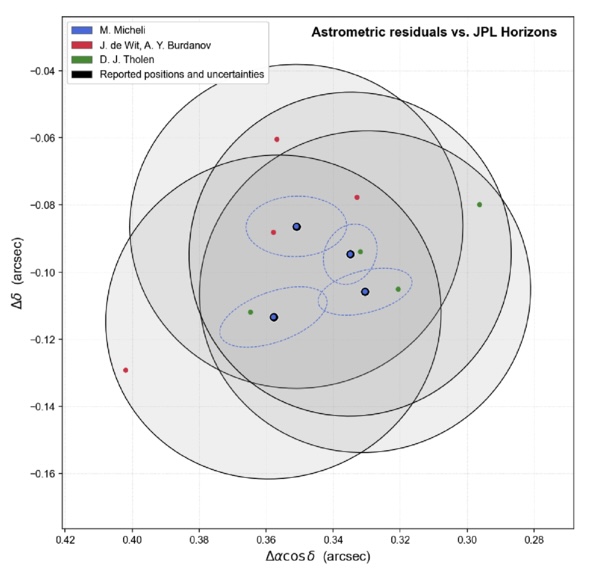
Difference between the position of 2024 YR4 determined in this work using three different reduction methods (red, blue, and green circles) and the position drawn from the existing orbit from the JPL Horizons database. The different analysis methods yielded consistent results. [Adapted from De Wit et al. 2026]
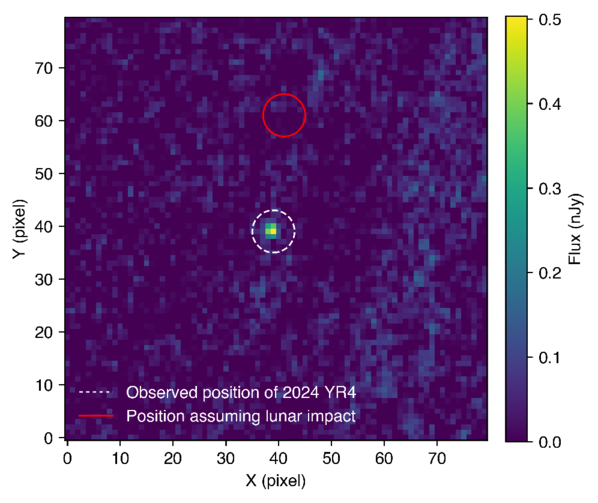
Combining the latest JWST observations with existing data stretching back to the asteroidβs discovery, de Wit and coauthors determined a new, highly precise orbit for the object β one that definitively shows that the asteroid will safely pass by the Moon at a distance of 22,900 Β± 800 km in 2032. In addition to ruling out the upcoming lunar impact, the team also ruled out any collisions with Earth in the next 100 years. Phew!
Position of 2024 YR4 as seen by JWST in February 2026 (white dashed circle) compared to the asteroidβs location estimated from existing data (red circle). [De Wit et al. 2026]
High-Impact Science
This work highlights JWSTβs potential as a tool for planetary defense. The February 2026 observations detailed here represent the faintest-ever detection of a near-Earth object, and JWST can detect objects far fainter than ground-based telescopes can. This ability allows JWST to observe potentially hazardous asteroids over a larger swath of their orbits, which translates to earlier trajectory estimation β JWST pinned down 2024 YR4βs orbit two years before the asteroid would have become bright enough for ground-based telescopes to do so.
JWSTβs role may be even more important for smaller objects that rapidly become undetectable after discovery. De Witβs team demonstrated this for a 10-meter-diameter 2024 YR4 clone on the same trajectory; for an object of this size, JWST would be able to rule out an Earth impact before the asteroid became undetectable, but ground-based telescopes could not. With surveys from facilities like Vera C. Rubin Observatory and Near-Earth Object Surveyor set to discover hundreds of thousands of new near-Earth objects, JWSTβs role as a hazard assessor will likely be in high demand.
Citation
βJWST Observations of Asteroid 2024 YR4 Rule Out a 2032 Lunar Impact and Demonstrate a New Regime for Planetary Defense Follow-Up,β Julien de Wit et al 2026 ApJL 1003 L21. doi:10.3847/2041-8213/ae6a95
The post Asteroid 2024 YR4 Wonβt Hit the Moon, New JWST Observations Show appeared first on AAS Nova.

Featured Image: Chasing Weywotβs Shadow
![]()
The outer solar system is inhabited by swarms of small objects that are challenging to observe and characterize. When one of these objects travels in front of a star, from our perspective, the passage provides a brief chance to study these distant, icy denizens of our solar system. In a recent article, Estela FernΓ‘ndez-Valenzuela (University of Central Florida) and coauthors described how they predicted and observed stellar crossings by Weywot, the largest moon of the dwarf planet Quaoar, which lies roughly 44 au from the Sun. In the image above, the black dashed lines indicate the areas where Weywot was predicted to briefly blot out the light from a star, and the blue lines show the updated regions based on Hubble Space Telescope observations. In each panel, the green squares and red circles show where the occultation was and was not detected, respectively. There were five successful detections of Weywotβs passage across a star, allowing the team to constrain Weywotβs diameter to 116β172 km. The team also found that Weywot is much darker than the body it orbits, which has important implications for how the system formed. To learn more about the planning process for and results of these observations, be sure to check out the full research article linked below.
Citation
βWeywot, an Unusually Low-Albedo Satellite in the Trans-Neptunian Region,β Estela FernΓ‘ndez-Valenzuela et al 2026 ApJL 1002 L37. doi:10.3847/2041-8213/ae6076
The post Featured Image: Chasing Weywotβs Shadow appeared first on AAS Nova.
Jupiter Accelerates Electrons to Near-Light Speed, Offering Clues to Cosmic Ray Origins
The giant planetβs bow shock isnβt just deflecting the solar wind, itβs acting as a powerful particle accelerator, firing electrons to relativistic energies of at least 1 MeV, according to a new analysis of data from NASAβs Juno spacecraft.
The post Jupiter Accelerates Electrons to Near-Light Speed, Offering Clues to Cosmic Ray Origins appeared first on Sci.News: Breaking Science News.
Researchers Measured Alien Planet Spins and Discovered a Surprising Pattern
After 11 years at Mars, NASA's MAVEN spacecraft went out with a whisper
NASA's MAVEN spacecraft was in excellent shape when it disappeared behind Mars on December 6 of last year. The routine passage, called an occultation, was supposed to last less than an hour, but ground teams didn't hear from the spacecraft when it was supposed to regain contact with Earth.
The loss of communication triggered contingency plans for engineers to try to restore a link with MAVEN, which orbits Mars more than 200 million miles from Earth. To no avail, they listened for faint signals and uplinked commands in the blind. Hopes of saving the mission faded over time, and NASA officials announced Wednesday that they're giving up on it.
"NASA has ceased efforts to search for the MAVEN spacecraft and are beginning activities to decommission the mission," said Mike Moreau, MAVEN's project manager at NASA's Goddard Space Flight Center in Maryland.Β


Β© NASA/University of Colorado/LASP
Meteorite Found in Africa Preserves Evidence of Long-Lost Massive Protoplanet
The Northwest Africa (NWA) 12774, an angrite meteorite discovered in the Sahara Desert, likely in Mauritania, appears to be a fragment of a vanished protoplanet, offering the strongest evidence yet that a large planetary body formed and was later destroyed during the Solar Systemβs chaotic infancy.
The post Meteorite Found in Africa Preserves Evidence of Long-Lost Massive Protoplanet appeared first on Sci.News: Breaking Science News.
Earth May Be Seeding Venus With Life, According to New Research
Europa may not vent water into space after all
JWST maps the weather on a hot gas giant 700 light-years away
WASP-94A b is a hot, tidally locked gas giant orbiting close to one of the stars in a binary system roughly 690 light-years away from Earth. In a new Science study, scientists led by Sagnick Mukherjee, an astrophysicist at Johns Hopkins University, used the James Webb Space Telescope to learn what the weather looks like out there.
Tidal locking means that you no longer have day- and night-side temperature differences sweeping across the planet. βWe wanted to understand the atmospheres of such planets,β Mukherjee says. βAre they static or dynamic? Do they have winds? Do they have clouds?β His team found that, on WASP-94A b, itβs cloudy in the morning, but the skies are clear in the evening. The fact that we didnβt know this already means we might have gotten the chemistry of this and many other exoplanets surprisingly wrong.
Averaged atmospheres
WASP-94A b has a mass slightly below half of Jupiter but has a diameter thatβs over 70 percent wider. βThis means the planet has low density, and its atmosphere extends further out into space, which makes it easier to observe,β Mukherjee explains. When astronomers study atmospheres like this, they usually rely on transmission spectroscopy. By analyzing the spectrum of light filtering through the planetβs atmosphere as it crosses in front of its star, they can figure out its chemical composition.


Β© NASA, ESA, and L. Hustak (STScI)
- Ars Technica - Science
- "I'll buy 10 of those"βNASA science chief yearns for mass-produced satellites
"I'll buy 10 of those"βNASA science chief yearns for mass-produced satellites
There are more opportunities to access space than ever, thanks to a bevy of commercial rockets, some with reusable boosters, led by SpaceX's workhorse Falcon 9. So why is NASA launching fewer telescopes and planetary science missions than it did a quarter-century ago?
The answer is complex. It is not necessarily the money. The space agency's science budget this year is $7.25 billion, roughly the same as it was in 2000, adjusted for inflation. This is despite attempts by the Trump administration to drastically reduce NASA science funding.
In the early months of his tenure, NASA Administrator Jared Isaacman's focus has been on human spaceflight and the Moon. This isn't terribly surprising given NASA's wildly successful Artemis II mission carrying four astronauts around the Moon last month. Since taking office in December, Isaacman has announced an overhaul of the Artemis program, canceling a space station to be built in orbit around the Moon in favor of construction of a base on the lunar surface.


Β© NASA/JPL-Caltech/Space Science Institute
JWST Is Tracking Down the Cosmic Origins of Earth's Water
New observations from the James Webb Space Telescope are exposing the pathways that water takes to reach terrestrial planets

Β© ALMA (ESO/NAOJ/NRAO), Andrews et al.; N. Lira. ( CC BY 4.0 )