
❌

Normal view

Enhancing the Sharpest Images

15 April 2026 at 17:00

The Submillimeter Array at the summit of Maunakea in Hawaiʻi.

The Event Horizon Telescope (EHT), the facility that delivered humanity’s first-ever picture of a black hole, can produce some of the sharpest images in all of astronomy. But turning the EHT’s raw data into images is a complex process involving messy statistics and powerful algorithms. Recent work presents a potential upgrade to that process: for the first time in long-baseline interferometry, it may be possible to model everything everywhere all at once.

The Hardest Eye Test

The EHT has some of the sharpest eyes in all of astronomy. With its effective resolution of just 20 microarcseconds, in principle you could use it to read a newspaper in New York while sitting at a cafe in Paris. But this planet-spanning instrument (it relies on data from radio telescopes on four continents) doesn’t snap pictures like an ordinary camera. Instead, each pair of telescopes measures something called an “interferometric visibility,” which is related to a single Fourier component of the actual underlying image.
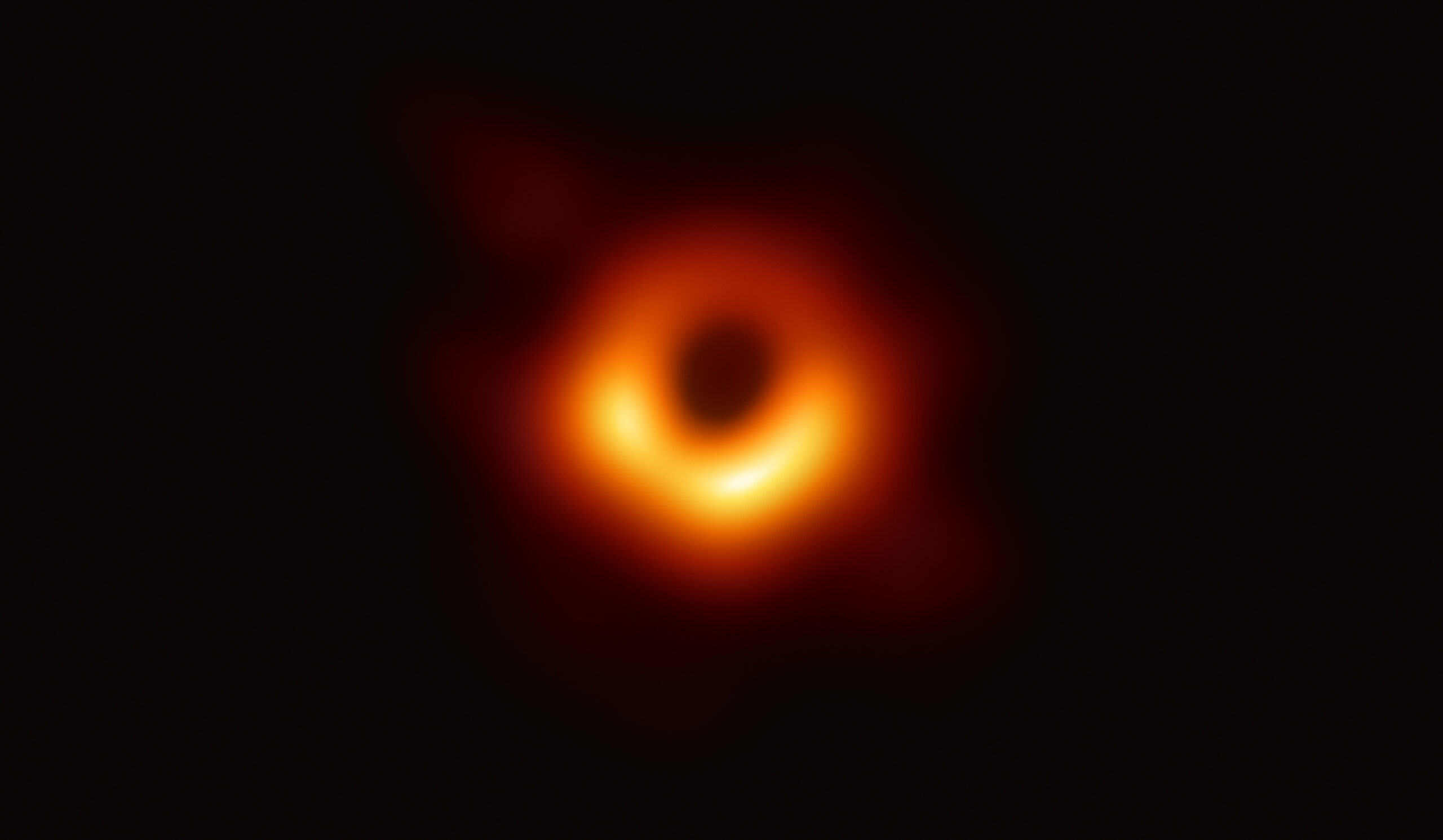
A photograph of an orange ring surrounding a dark center.

The first image of a black hole, constructed from Event Horizon Telescope data taken in 2017. [EHT Collaboration; CC BY 4.0]

Combining these components into an image is a process fraught with assumptions and modeling choices. Since the EHT doesn’t have an infinite number of telescopes, each measurement can be mapped to infinitely many images. This forces researchers to choose how to “regularize” this space of images to select one best picture. Making things harder, they also must contend with all the typical issues of real-world data collection. Each telescope has slight calibration errors, and every data point is affected by weather and temperature-dependent processes.

Typically researchers break the problem down into several stages: first calibrate the data, then regularize and construct the best-fitting image, then analyze that image to constrain the actual physics you care about like the width of the ring surrounding a black hole. This is how the original EHT publications went about their groundbreaking work on the now-iconic glowing ring around the supermassive black hole in the galaxy Messier 87 (M87*).

A New Approach

Recent work led by Paul Tiede (Black Hole Initiative at Harvard University) suggests an alternative process. Instead of separating the stages of analysis as described above, the team demonstrated that one could fit everything simultaneously in a framework they call hierarchical interferometric Bayesian imaging, or HIBI.
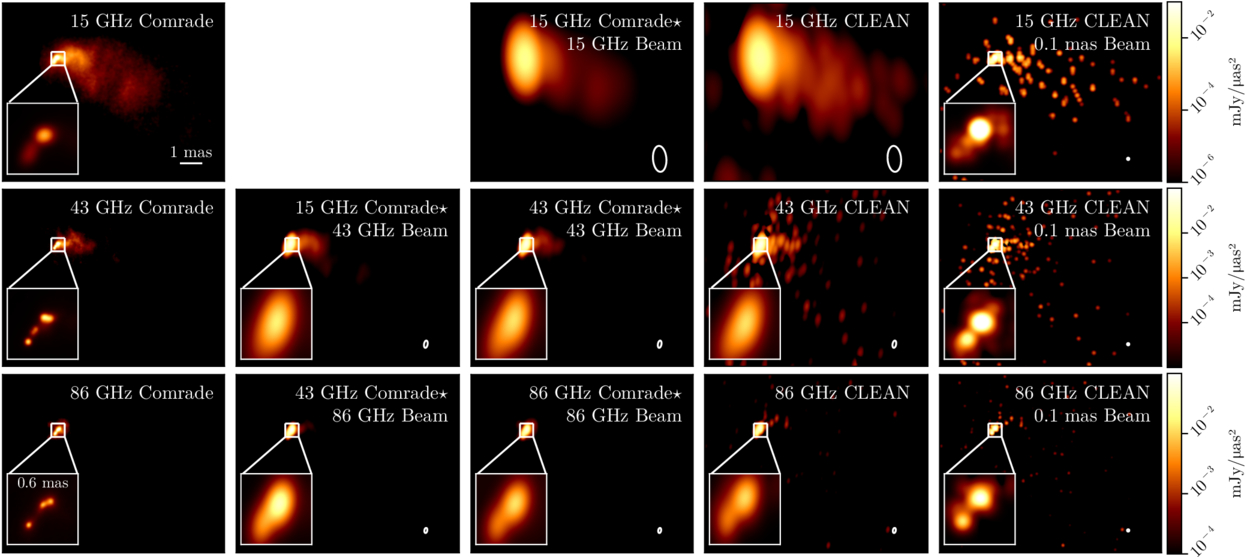
A multi-panel plot of images of an orange blob with a tail. All images are very similar.

A comparison of the new HIBI technique (referred to as “Comrade” here) and a traditional algorithm called CLEAN. Click to enlarge. [Tiede et al. 2026]

By fitting all parameters that go into an image together, the method doesn’t select one “best” image. Instead, by allowing the pixel-by-pixel intensities, calibration parameters, and underlying physics to inform one another during inference, HIBI explores the full range of images consistent with the data. This prevents the degeneracies that plague the traditional approach, where image and calibration estimates can trade off against each other in misleading ways. The team validated HIBI on synthetic data mimicking the EHT’s 2017 setup, showing that it reliably recovered a range of source shapes with well-calibrated uncertainty estimates.

Even more exciting, the team demonstrated that it’s possible to skip the image construction step altogether and go straight to the science. By fitting parameters describing the physics underlying a scene, the team was able to constrain the width of the ring around M87* without any reference to a picture. They predict that this technique could be crucial for extracting information when future instruments like the Next Generation Event Horizon Telescope observe more distant black holes that are only marginally resolved. Though we’ll likely have to wait years for these next-generation telescopes, work like this ensures that astronomers will be able to squeeze as much science from them as possible once these new facilities are ready.

Citation

“Hierarchical Interferometric Bayesian Imaging,” Paul Tiede et al 2026 ApJ 997 262. doi:10.3847/1538-4357/ae2749

The post Enhancing the Sharpest Images appeared first on AAS Nova.
Selections from 2025: A New Way to Combine Ground-Based Images

19 December 2025 at 17:00

side-by-side images of galaxies

Editor’s Note: For the remainder of 2025, we’ll be looking at a few selections that we haven’t yet discussed on AAS Nova from among the most-downloaded articles published in AAS journals this year. The usual posting schedule will resume January 2nd.

ImageMM: Joint Multi-Frame Image Restoration and Super-Resolution

Published September 2025

Main takeaway:

A team led by Yashil Sukurdeep (Johns Hopkins University) developed a new method for processing and combining ground-based astronomical images. The authors’ algorithm, called ImageMM because it leverages a method called majorization–minimization, yielded greater detail in bright sources and distinguished more faint sources from the background than existing methods.

Why it’s interesting:

As ground-based telescopes grow larger and their cameras grow more sensitive, they must still contend with one unfortunate fact: they are trapped beneath Earth’s atmosphere, which blurs fine details in astronomical images. To extract as much information as possible from beneath Earth’s blurry, ever-shifting atmosphere, researchers have developed numerous strategies for cleaning, combining, and sharpening astronomical images. From simple averaging of multiple exposures to complex statistical techniques, each of these methods has unique strengths and weaknesses. ImageMM succeeds in quieting background noise and sharpening images of both extended and point-like sources while avoiding many of the pitfalls of statistical methods.

How they tested the new method:

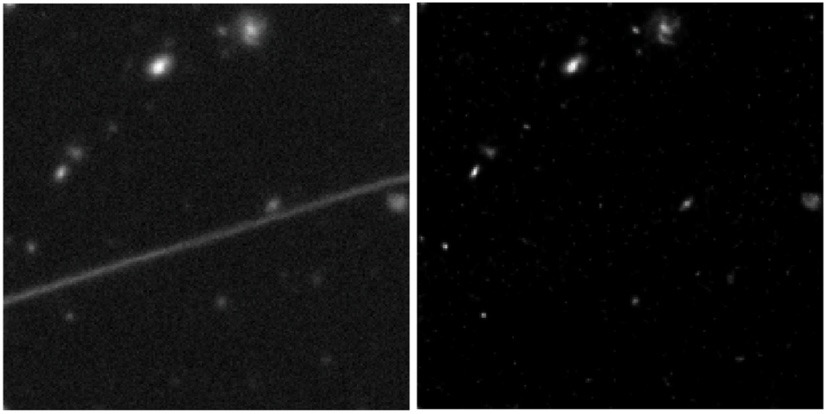
satellite-trail removal by ImageMM

An example of satellite-trail removal by ImageMM. Click to enlarge. [Adapted from Sukurdeep et al. 2025]

Sukurdeep and collaborators tested ImageMM on data from the Hyper Suprime-Cam on the 8.2-meter Subaru Telescope as well as on simulated images. These tests demonstrated not only that ImageMM can enhance the scientific value of noisy datasets, it can also handle interlopers like satellite trails and cosmic rays — and it processes data nearly in real time as it comes down the pipeline. This ability to rapidly and faithfully process high-resolution astronomical images will be critical for upcoming surveys, like the Vera C. Rubin Observatory’s 10-year Legacy Survey of Space and Time, which will generate immense amounts of data ready for processing.

Citation

Yashil Sukurdeep et al 2025 AJ 170 233. doi:10.3847/1538-3881/adfb72

The post Selections from 2025: A New Way to Combine Ground-Based Images appeared first on AAS Nova.

Featured Image: Following Photons Through Curved Spacetimes

16 June 2025 at 17:00

Today’s featured image is a beautiful representation of how simulated images of active black holes are made. In a recent research article, a team led by Aniket Sharma (Indian Institute of Science Education and Research Mohali) introduced Mahakala, a new ray-tracing algorithm that expertly tracks photons as they navigate the warped spacetimes surrounding black holes. Mahakala is named for the Egyptian deity who, as Sharma and collaborators describe, is “believed to be the depiction of absolute black, and the one who has the power to dissolve time and space into himself.” The image above shows a simulated accreting black hole at a wavelength of 1.3 millimeters, which is the same wavelength used by the Event Horizon Telescope to view the supermassive black holes at the center of the Milky Way and the galaxy Messier 87. The dotted lines streaming off to the right represent the paths that photons took on their way to the viewer as they curved around the black hole, which is visible among the forest of lines. In this representation, the color of each dot shows the synchrotron emission generated at that point in three-dimensional space. The team hopes that Mahakala, which can be run quickly and easily from a Python Jupyter notebook, helps make the complex world of general relativistic magnetohydrodynamics simulations more accessible. You can try it for yourself or learn more from the article linked below.

Citation

“Mahakala: A Python-Based Modular Ray-Tracing and Radiative Transfer Algorithm for Curved Spacetimes,” Aniket Sharma et al 2025 ApJ 985 40. doi:10.3847/1538-4357/adc104

The post Featured Image: Following Photons Through Curved Spacetimes appeared first on AAS Nova.

US scrambles to stop Internet users re-creating dead pilots’ voices

22 May 2026 at 20:39

Pilots’ voices from the last seconds of a fatal cargo plane crash have been re-created by Internet sleuths using software and AI tools. The spread of reconstructed audio recordings has prompted a US government agency to suspend all public access to its database of civil transportation accidents—because federal law prohibits investigators from publicly releasing audio from cockpit voice recorders.

The US National Transportation Safety Board (NTSB) usually shares factual reports and evidence gathered from investigations of aircraft crashes and other civil transportation incidents. But on May 21, the NTSB announced that the online docket system containing such information was “temporarily unavailable” as it reviewed the publicly available materials that had enabled people to re-create cockpit audio recordings from aircraft disasters.

“​​The NTSB is aware that advances in image recognition and computational methods have enabled individuals to reconstruct approximations of cockpit voice recorder audio from sound spectrum imagery released as part of NTSB investigations, including the ongoing investigation of the crash last year of UPS flight 2976 in Louisville, Kentucky,” according to an NTSB statement. “The NTSB does not release cockpit audio recordings.”

Read full article

Comments

© National Transportation Safety Board

❌