❌

Normal view

New SPHEREx Space Telescope Images Confirm a Major Problem That Many Astronomers Were Afraid Of

12 June 2026 at 15:52

Nearly three out of every four images obtained by NASA’s new SPHEREx space telescope revealed something many astronomers were afraid of: contamination by artificial objects humans are launching into space.

The findings were reported in a new preprint paper by researchers at NASA’s Ames Research Center, who say that 73.3% of all the images the telescope captured over four months last summer revealed evidence of at least one trail left by SpaceX satellites or other orbital spacecraft.

What may be worst of all is that astronomers aren’t surprised.

With its mission to map the night sky in near-infrared light, NSA’s Spectro-Photometer for the History of the Universe, Epoch of Reionization, and Ices Explorer (SPHEREx) relies on long-exposure imagery that enables it to map large regions of the sky with every viewing.

Unfortunately, long-exposure photography is also ideal for capturing the movement of satellites, an increasing number of which have been placed in orbit in recent years.

Equally troubling is the fact that SPHEREx, from its own position in Earth orbit, had been positioned at an altitude where it was hoped that the number of satellite streaks could be limited. Yet despite such efforts, the new paper featured at the arXiv preprint server reports that, on average, at least two satellite trails were detected in every exposure.

Satellites Mistaken for Cosmic Rays

Astronomers have been raising concerns about this problem already for some time, and presently, there doesn’t appear to be any near-term solution.

Even beyond image contamination, the preprint study also found that several satellites that enter SPHEREx’s field of view are bright enough that they are also triggering the space telescope’s automated system that protects its delicate components from stray cosmic rays.

Designed to shut down the telescope’s data collection when it detects what it suspects are cosmic rays, the new research reveals that some satellites reflect enough light to engage algorithms that control this defense system.

Even in instances where imagery is successfully obtained, albeit with contamination from satellites, the brightness of these orbital objects can effectively obscure objects behind the portions of the telescope’s images where the satellites appeared.

satellite trails
In the images above, several examples of satellite trails are shown in SPHEREx imagery collected during the summer months of 2025 Image Credit: NASA/Borlaff, et al/arXiv.org).

A Growing Concern

The new SphereX findings are only the latest indication that astronomers were right to be concerned about potential light pollution from satellites. In a past study by Sando Kruk and colleagues, Hubble Telescope images had shown an increase in the number of satellites crossing its field of view, rising from contamination shown in just 2.8% of its images, to 5.9% over a period of two decades.

Ideas about how to prevent the issue have focused on using anti-reflective coatings on satellites and other means of reducing their brightness once they reach orbit. However, many modern satellites are large enough that having darker exteriors doesn’t help to significantly mitigate the amount of light they can reflect.

Additionally, the study’s authors note that “Optical reflections are just a fraction of the problem, since satellites also emit and reflect [infrared],” meaning that optical darkening efforts “might even increase their temperature, making them brighter in the IR.”

Worse Before It Gets Better

According to the study’s authors, the problem is likely to worsen before astronomers see any improvements.

“Remarkably, some private operators have announced the intent of deploying 4000 purposely high reflective satellites,” the researchers write, which aim to provide “sunlight on demand.” Such artificial orbital systems, if successfully deployed, would reflect light as much as five times the brightness of the full Moon onto areas of the Earth roughly five kilometers in diameter.

This, the team argues, would potentially have “a catastrophic impact to the quality of the dark sky and the Earth’s inhabitants.”

Fundamentally, the authors hope that bringing additional attention to such issues with their recent study may help to mitigate future concerns about our ever-brightening night sky.

“The widespread contamination addressed in this paper affects multiple areas of astronomical research,” the team says, which they say includes “the study of transient phenomena, deep imaging surveys, spectroscopic studies, and the search for Near-Earth Objects (NEOs), thereby hindering our ability to understand the Universe and protect the Earth.”

The new paper by Alejandro S. Borlaff and colleagues, “SPHEREx confirms predictions for artificial satellite trail pollution in Low Earth Orbit,” appeared at the preprint arXiv server.

Micah Hanks is the Editor-in-Chief and Co-Founder of The Debrief. A longtime reporter on science, defense, and technology with a focus on space and astronomy, he can be reached at micah@thedebrief.org. Follow him on X @MicahHanks, and at micahhanks.com.

NASA and USAF-Backed Research Reveals the Breakthrough Propulsion Technology That Could Propell Future Satellite Swarms

12 June 2026 at 13:21


In a University of Kentucky laboratory, three small spacecraft stand-ins slid across low-friction air tracks, nudging and pulling one another without thrusters, propellant, or physical contact.

Instead, they used carefully timed magnetic fields, a technique that could one day help future satellite swarms hold precise formations in space without constantly burning fuel.

The NASA and Air Force-backed study, set to be published in the September 2026 edition of Aerospace Science and Technology,  marks a step toward what researchers call electromagnetic formation flying, a proposed method for controlling the relative positions of satellites using onboard coils rather than conventional propellant-based thrusters.

In the study, researchers demonstrated a decentralized, three-satellite control system that used alternating magnetic field forces to maintain formation with centimeter-level precision, offering a possible pathway for future space telescopes, interferometers, gravity-wave detectors, and other distributed spacecraft missions.

“Spacecraft formation flying can advance a variety of space technologies such as distributed-aperture telescopes, gravity-wave detectors, and interferometers,” researchers write. “One challenge for spacecraft formation flying is that traditional propellant thrusters eventually deplete, and they can contaminate sensitive spacecraft components.”

The study, authored by scientists from the University of Kentucky’s Department of Mechanical and Aerospace Engineering, focuses on a longstanding problem in spacecraft engineering.

Many future missions may not rely on a single large spacecraft, but instead on groups of smaller satellites flying in carefully arranged formations. If those satellites can maintain their spacing and orientation with extreme precision, they could function together like a much larger scientific instrument.

For example, a distributed-aperture telescope could use multiple spacecraft separated by carefully controlled distances to achieve observing capabilities that might be difficult or impossible with a single monolithic telescope.

Similar formation-flying concepts have been proposed for space-based interferometers and additional missions in which the relative positions of spacecraft are central to mission performance.

However, keeping multiple satellites in formation is not easy. Standard spacecraft rely on thrusters, which consume limited propellant. Over time, that fuel runs out, limiting mission duration and maneuverability. Thruster plumes can also contaminate sensitive instruments, a concern on spacecraft carrying delicate optical, scientific, or electromagnetic sensors.

However, electromagnetic formation flying, or EMFF, offers a different possibility. Each spacecraft carries electromagnetic coils. When electric current flows through those coils, they create magnetic fields. Those fields interact with magnetic fields created by nearby spacecraft, producing attractive or repulsive forces that can alter the satellites’ positions relative to one another.

Put simply, the satellites can push or pull on each other using magnetism.

The idea is not entirely new. Previous work has explored electromagnetic formation flying between two spacecraft, including experiments using direct-current-driven coils.

The problem becomes much harder when the formation includes three or more satellites. In that case, every satellite’s magnetic field can interact with the others, creating a web of coupled forces that becomes increasingly difficult to control as the formation grows.

The new study approaches that problem using alternating magnetic field forces, or AMFF. Rather than driving the coils with steady direct current, the researchers use sinusoidal currents at specific frequencies.

The key insight is that two satellites generate a nonzero time-averaged interaction force only when their magnetic moments alternate at the same frequency. If they do not share a frequency, the average force between them is negligible.

That frequency-matching approach effectively allows the system to pair satellites electromagnetically. One pair can interact at one frequency, while another pair interacts at a different frequency.

By adjusting the amplitude of each sinusoidal signal, the satellites can control the strength of the force between each pair without requiring a centralized controller to solve the entire formation’s motion at once.

“Only pairs with a common frequency can generate a nonzero time-averaged intersatellite force, and that force is determined solely by the amplitudes at the common frequency,” researchers write. “The method in this paper is decentralized, which means that each satellite has access to measurements of its position and velocity relative to only its local neighbor satellites.”

Centralized control can work in smaller systems, but it can turn computationally clumsy as satellite formations grow. A scalable system would need each spacecraft to make local decisions based on nearby neighbors, rather than requiring a single controller to calculate every force across the entire formation.

To test the idea, the researchers built a ground-based experimental platform using three custom electromagnetic actuation system units placed on linear air tracks.

The air tracks allowed the units to move with low friction, simulating one-dimensional relative motion between satellites. Each unit included an electromagnetic coil, batteries, power electronics, an Arduino Due microcontroller, wireless communication hardware, and laser range-finding sensors for measuring relative position.

In the three-satellite setup, the center unit was driven by a sum of two sinusoidal currents, while each outer unit was driven by one of those frequencies. This allowed the center unit to interact independently with each outer unit, demonstrating the central premise of frequency-multiplexed magnetic control.

In closed-loop experiments, the three-satellite system achieved formation in less than 30 seconds. The maximum steady-state formation error was less than plus or minus 0.01 meters, or about 0.4 inches. The mean steady-state formation error was less than plus or minus 0.001 meters, or about 0.04 inches.

Those numbers demonstrate that the method did more than produce a magnetic tug in a lab. It allowed multiple units to settle into a desired formation using local feedback and alternating magnetic fields, while avoiding the coupling problem that has limited electromagnetic control for larger formations.

The researchers also compared the experimental results with computer simulations. While the simulations generally matched the observed behavior, the team noted some differences caused by real-world hardware factors, including sensor interference, current saturation, possible misalignment, airflow disturbances along the air tracks, and unmodeled magnetic effects.

Those caveats are important. This was not a spaceflight demonstration, and the system was tested only in one dimension. Real spacecraft would operate in a far more complex environment, where microgravity, radiation, extreme temperature swings, atmospheric drag in low Earth orbit, gravitational forces, Earth’s magnetic field, and equipment restrictions would all matter.

Researchers also note that traditional thrusters may still be needed for orbit maintenance, orbit transfers, or controlling the overall center of mass of a satellite formation.

In essence, this is not a replacement for all spacecraft propulsion. It is better understood as a possible propellantless method for controlling the relative positions of satellites once they are already in orbit and operating as part of a formation.

Still, that limitation does not diminish the possible impact. If electromagnetic formation flying can be scaled and adapted for real spacecraft, it could reduce propellant demands for future distributed missions. That could extend mission lifetimes, reduce contamination hazards to sensitive instruments, and enable spacecraft formations more flexible than today’s architectures.

The research was supported in part by the National Aeronautics and Space Administration (NASA), the National Science Foundation, and the Air Force Office of Scientific Research.

The funding mix reflects the dual scientific and strategic interests in the work. NASA has clear reasons to explore precise formation flying for future space observatories and scientific missions. The Air Force, meanwhile, has an obvious interest in satellite coordination, maneuverability, and resilient distributed space systems.

The study’s most intriguing contribution may be its demonstration that magnetic-field-based satellite control can be both decentralized and scalable.

Rather than treating a multi-satellite formation in a single complicated system that must be controlled from the top down, AMFF allows each satellite to manage interactions with its neighbors using assigned frequencies. That could become increasingly valuable as space missions move toward constellations, swarms, and distributed architectures.

Researchers caution that additional work will be needed to move beyond one-dimensional air-track experiments and toward three-dimensional testing, more realistic sensing and control hardware, and, eventually, on-orbit validation.

Additional coils would be needed for three-dimensional position control, and relative attitude control could require additional actuation frequencies for each interacting satellite pair.

Nevertheless, the laboratory results show that the underlying concept works in a three-body system, which is exactly where the hard part begins.

Two satellites can pull or push on each other relatively easily. Three satellites introduce the coupling problem that makes electromagnetic formation flying difficult. By demonstrating three-satellite control with alternating magnetic fields, the study delivers experimental evidence that the frequency-based solution can work.

For forthcoming space missions, that could be a meaningful step. The next generation of telescopes and orbital instruments may not always be built as single enormous spacecraft. They may be assembled virtually, with multiple satellites flying together as one coordinated machine.

If so, keeping those satellites precisely arranged without wasting propellant could become one of the enabling technologies of future astronomy, Earth observation, and national security space systems.

“This article presented a 3-satellite experimental demonstration of decentralized EMFF using AMFF,” researchers conclude. “The settling time and steady-state formation error achieved in these experiments demonstrate that this approach is most likely capable of meeting requirements for satellite constellation reconfiguration and maintenance, thereby addressing the need for propellant-free formation flying.”

Tim McMillan is a retired law enforcement executive, investigative reporter and co-founder of The Debrief. His writing typically focuses on defense, national security, the Intelligence Community and topics related to psychology. You can follow Tim on Twitter: @LtTimMcMillan.  Tim can be reached by email: tim@thedebrief.org or through encrypted email: LtTimMcMillan@protonmail.com 

NASA Spots Giant Ocean Swell Signaling a Potential El Niño Comeback

Earth Experiencing Extreme High TemperaturesSentinel-6 satellite data shows strengthening warm-water waves in the Pacific, pointing to the likely arrival of El Niño and its global weather impacts later in 2026. Several months before an El Niño develops, large waves of warmer, elevated water travel eastward across the Pacific Ocean. Satellite observations in 2026 have detected several of these waves. [...]

Misteriosos “pequenos pontos vermelhos” podem esconder buracos negros gigantes

12 June 2026 at 11:27

Uma análise sem precedentes de um enigmático “pequeno ponto vermelho” detetado pelo telescópio James Webb reforça a teoria de que estes objetos são buracos negros supermassivos em crescimento, ajudando a resolver um dos maiores mistérios do Universo primitivo.

The post Misteriosos “pequenos pontos vermelhos” podem esconder buracos negros gigantes appeared first on Tek Notícias.

NASA Award Boosts Space Technology Research Capabilities

11 June 2026 at 22:14
2 Min Read

NASA Award Boosts Space Technology Research Capabilities

Space Technology Mission Directorate, Two mechanical engineers working on the calibration gas system

NASA is introducing a new funding opportunity to accelerate academic research and technology development. The Minority University Research and Education Project Space Technology Artemis Research (M‑STAR) application window opened Thursday and will remain open through 11:59 p.m. EDT on Tuesday, Aug. 11.

The research funded through this award supports the agency’s priorities for exploring the Moon, Mars, and deep space, while strengthening eligible institutions in the future of space exploration. Through M-STAR, institutions are encouraged to grow their scientific and engineering capabilities, enhance faculty and student engagement in aerospace research, and expand their ability to compete for future federal and commercial research awards.

Administered by NASA’s Office of STEM Engagement, this initiative contributes to NASA’s Space Technology Mission Directorate, and supports the agency’s broader mission to develop innovative technologies that improve space transportation, human exploration, robotic discovery, and the growing space economy.

NASA’s Office of STEM Engagement fosters an ecosystem across education, industry, and government to cultivate a well‑prepared talent pool, while the agency’s Space Technology Mission Directorate develops the transformative space technologies that enable future NASA missions and ensure U.S. leadership in aerospace. Together, they accelerate mission readiness by aligning cutting edge technological innovation with the workforce needed to carry it forward.

For complete eligibility information, help session registration, and to submit an M-STAR proposal, visit:

https://go.nasa.gov/4exkPiH

The post NASA Award Boosts Space Technology Research Capabilities appeared first on NASA Science.

NASA Award Boosts Space Technology Research Capabilities

11 June 2026 at 22:14
2 Min Read

NASA Award Boosts Space Technology Research Capabilities

Space Technology Mission Directorate, Two mechanical engineers working on the calibration gas system

NASA is introducing a new funding opportunity to accelerate academic research and technology development. The Minority University Research and Education Project Space Technology Artemis Research (M‑STAR) application window opened Thursday and will remain open through 11:59 p.m. EDT on Tuesday, Aug. 11.

The research funded through this award supports the agency’s priorities for exploring the Moon, Mars, and deep space, while strengthening eligible institutions in the future of space exploration. Through M-STAR, institutions are encouraged to grow their scientific and engineering capabilities, enhance faculty and student engagement in aerospace research, and expand their ability to compete for future federal and commercial research awards.

Administered by NASA’s Office of STEM Engagement, this initiative contributes to NASA’s Space Technology Mission Directorate, and supports the agency’s broader mission to develop innovative technologies that improve space transportation, human exploration, robotic discovery, and the growing space economy.

NASA’s Office of STEM Engagement fosters an ecosystem across education, industry, and government to cultivate a well‑prepared talent pool, while the agency’s Space Technology Mission Directorate develops the transformative space technologies that enable future NASA missions and ensure U.S. leadership in aerospace. Together, they accelerate mission readiness by aligning cutting edge technological innovation with the workforce needed to carry it forward.

For complete eligibility information, help session registration, and to submit an M-STAR proposal, visit:

https://go.nasa.gov/4exkPiH

Lane Painter

11 June 2026 at 20:38
A portrait of a smiling young man with light skin and reddish-blonde hair, wearing a dark blue blazer over a white button-down shirt with his arms folded. On his left wrist, a watch is visible. He stands indoors against a white wall. Prominently displayed on the wall to his left is a large, backlit 3D NASA insignia. To his right, the wall features a timeline or informational graphic containing text and silhouettes of aerospace technology, including the International Space Station, a satellite, a high-altitude balloon, and an airplane.

Lane Painter

Operations Specialist, Mars Exploration Program, NASA Headquarters

Operations Specialist, Mars Exploration Program, NASA Headquarters

Lane Painter is an Operations Specialist supporting the Mars Exploration Program at NASA Headquarters in Washington, D.C.

His work focuses on advancing innovative robotic mobility capabilities, next-generation commercial space models, and international engagement that support NASA’s robotic science exploration of Mars, with the goal of enabling greater science return and exploration capability at lower cost.

Painter is a co-lead for NASA’s Mars Exploration Program Science Transport and Robotic Innovation for Deployment and Exploration, or STRIDE, an activity focused on assessing and maturing emerging commercial mobility systems, including surface and aerial robotic systems, that could support future Mars exploration missions.

Painter also serves on the leadership team for the International Mars Exploration Working Group, or IMEWG, supporting NASA’s engagement with the multilateral forum of space agencies and government institutions focused on coordinating shared Mars exploration priorities. Through this work, he helps facilitate international dialogue on robotic Mars exploration, science priorities, technology development, mission planning, and long-term cooperation across the global Mars exploration community.

Prior to joining the Mars Exploration Program, Painter was part of the University of Chicago’s Human-Robot Interaction Lab, where he supported research at the intersection of robotics and human-machine teaming.

Painter earned a bachelor’s degree in economics from the University of Chicago and a master’s degree in Industrial Systems, Manufacture, and Management from the Department of Engineering at the University of Cambridge in the United Kingdom.

The post Lane Painter appeared first on NASA Science.

After nearly breaking, NASA's Deep Space Network "worked well" on Artemis II

11 June 2026 at 19:34

NASA pushed its Deep Space Network beyond its limits during the Artemis I mission nearly four years ago. The global array of deep space communications antennas couldn't keep up with the routine demands of 40 robotic science missions and the extraordinary surge required by NASA's Orion space capsule as it flew around the Moon.

The experience in late 2022 reduced or delayed downlinks from several high-profile science missions, including the James Webb Space Telescope and Mars rovers, as the data-hungry Artemis I mission took priority on NASA's communications network. And that was before the first Artemis mission with astronauts onboard. When Artemis II launched April 1, NASA called upon the Deep Space Network (DSN) again to connect Mission Control to the Orion capsule as it soared more than a quarter of a million miles from Earth.

With a crew of four flying inside the spacecraft, the agency's appetite for data from Orion on Artemis II was even higher than it was on Artemis I. But at a little more than nine days, the Artemis II mission was shorter than the 25 days Artemis I spent in space, helping alleviate the communications overload. Artemis I also launched 10 small CubeSats into deep space, many of which required tracking and telecom services from the DSN. Artemis II carried fewer CubeSats.

Read full article

Comments

© NASA/JPL-Caltech

ESA astronaut assignment on Artemis 3 part of negotiations on revised Artemis roles

11 June 2026 at 18:33
Parmitano

The assignment of an ESA astronaut to Artemis 3 is part of negotiations for revised roles in the overall effort, with a goal of getting its astronauts on the moon.

The post ESA astronaut assignment on Artemis 3 part of negotiations on revised Artemis roles appeared first on SpaceNews.

NASA’s Career Technical Education Day Highlights Technical Careers

11 June 2026 at 17:21

3 min read

NASA’s Career Technical Education Day Highlights Technical Careers

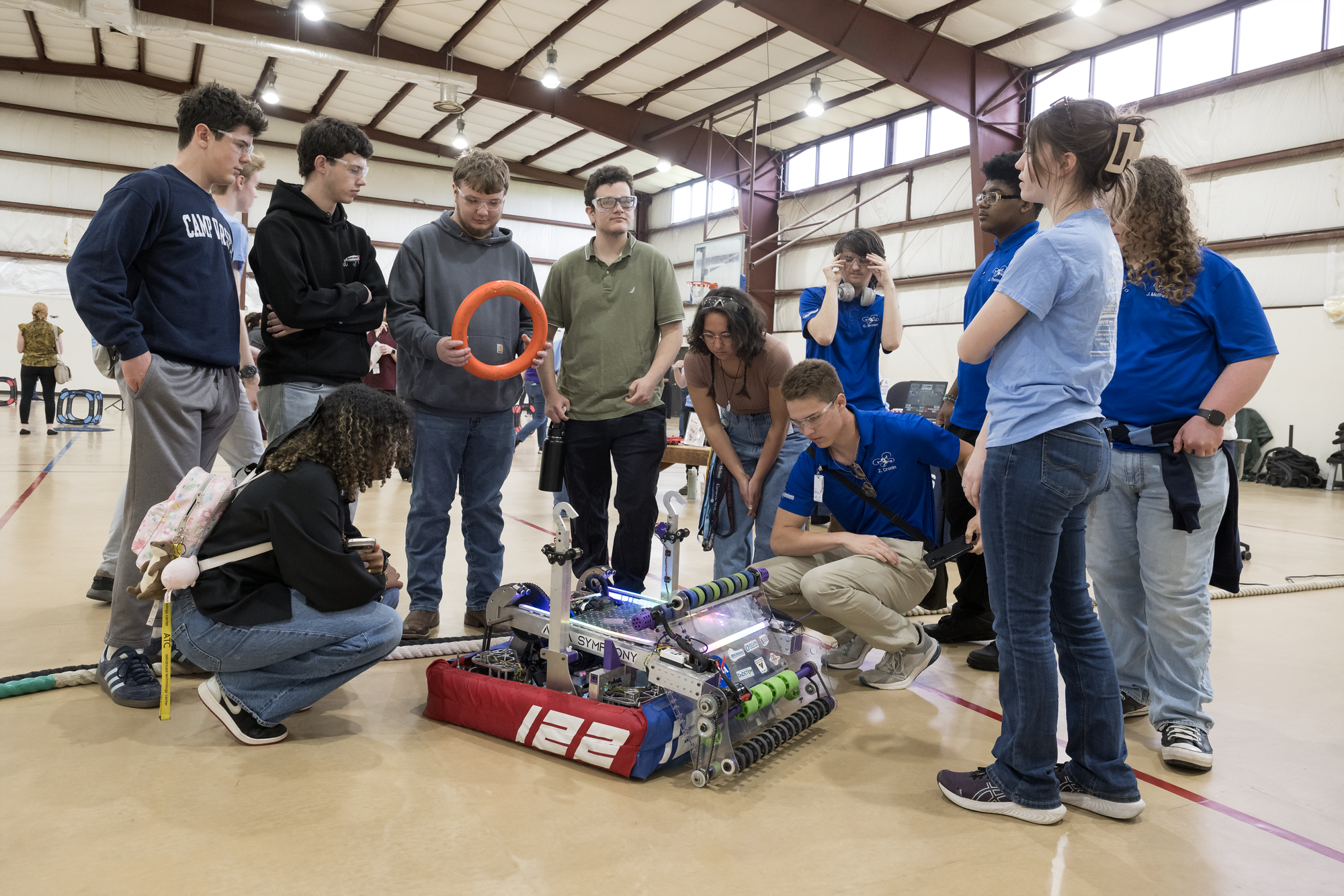
Students participate in a hands-on robotics demonstration during Career Technical Education Day at NASA’s Langley Research Center in Hampton, Virginia.
NASA/Mark Knopp

At NASA, remaining a global leader in exploration and innovation includes having a skilled
and dedicated workforce. Technicians play a critical role in advancing the agency’s
research and missions, applying hands-on expertise across engineering, fabrication,
electronics, and countless other technical fields.


To help cultivate the next generation of technical talent, NASA’s Office of STEM Engagement
hosted Career Technical Education Day recently at NASA’s Langley Research Center in
Hampton, Virginia. One hundred high school and community college students from Virginia
and North Carolina attended, eager to explore the technical career paths that help drive
NASA’s work.


“Many students picture NASA as only astronauts or engineers and therefore never consider
a career at NASA to be within their reach,” said Bonnie Murray, lead for the Office of STEM
Engagement at NASA Langley. “Bringing students from local career and technical
education programs to Langley allows them the opportunity to see technicians at work,
hear the pathways those technicians followed, and understand how the skills they are
developing in their related classes have a place in the NASA workforce.”


The event opened with remarks from NASA Langley’s Steve Gayle, who traced his path from
an engineering technician co-op in the center’s Fabrication Division and a graduate of
Langley’s Engineering Technician Apprentice Program to his current role as acting
associate director. Gayle encouraged students to embrace challenges, think critically, stay
curious, and create their own opportunities as they pursue their career goals.


“We need young, bright minds,” Gayle said. “At NASA, we rely on skilled hands-on
professionals — technicians who operate our wind tunnels, apply their skills in our
fabrication shops, and use their electronics knowledge to design, test, and build critical
systems.”

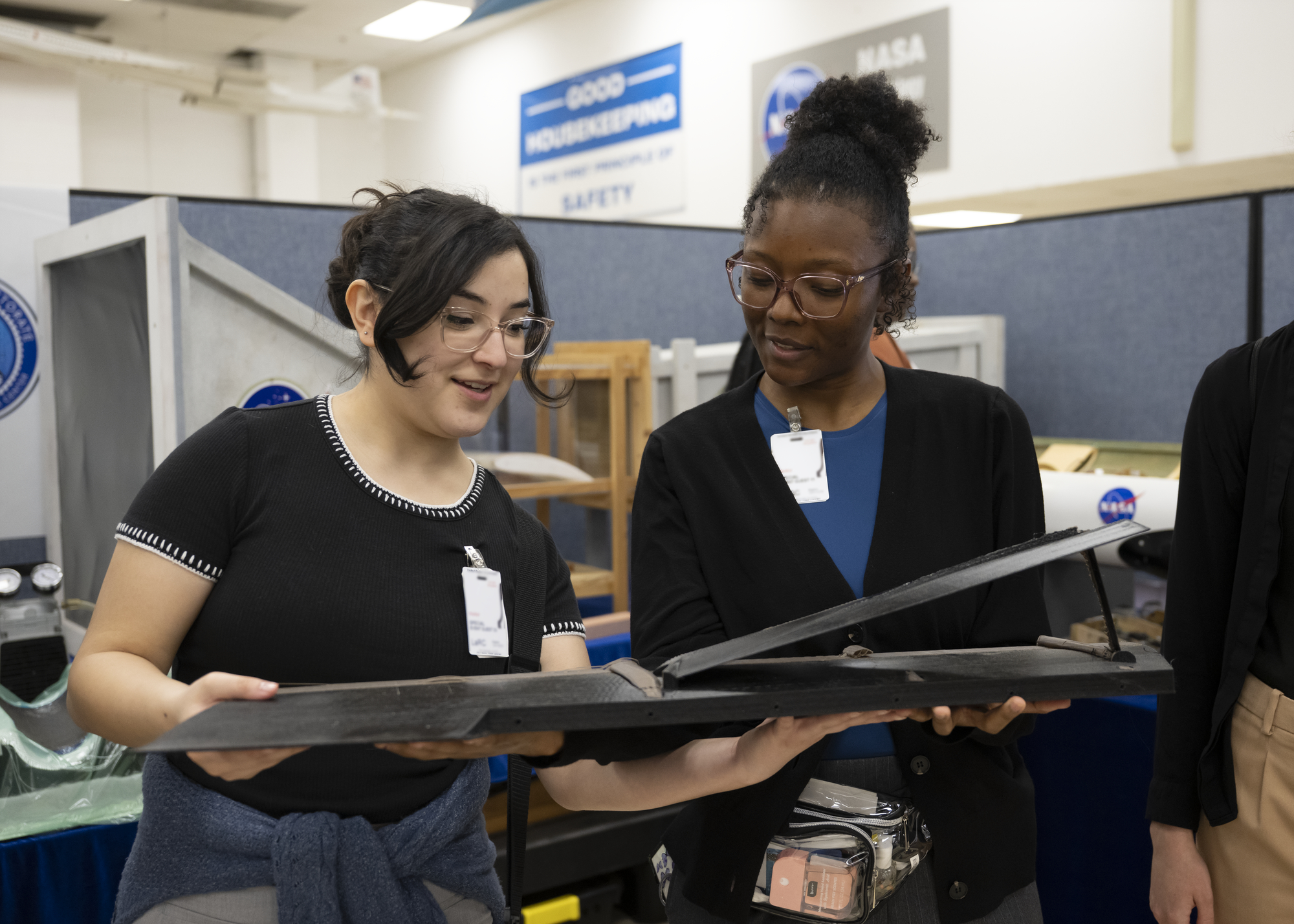
Students visit NASA Langley Research Center’s model shop during Career Technical Education Day to learn about the materials and techniques technicians use to build model aircraft and spacecraft.
NASA/Ryan Hill

Throughout the day, students toured several of Langley’s world-class facilities, including
the historic Landing and Impact Research Facility and one of the center’s wind tunnels. At
each stop, they received a behind-the-scenes look at the spaces where NASA technicians
build, test, and refine the tools and technologies that support the agency’s missions. The
technicians spoke with students about their work, their career paths, and the skills needed
to excel in technical roles.


Hands-on demonstrations and interactive activities lead by NASA technicians and
aerospace industry partners helped students connect their classroom experience with
real-world applications. Whether observing fabrication techniques, seeing instrumentation
up close, or engaging with engineering demonstrations, participants experienced how
STEM and technical skills directly translate into meaningful careers.


“Through events such as this, NASA seeks to prepare students for aerospace careers
through experiences and investments that strengthen research capacity, build technical
expertise, and expand reach in alignment with agency missions and needs,” Murray said.
The event ended with a career panel moderated by NASA astronaut Joe Acaba, associate
director of mission and strategy at NASA’s Johnson Space Center in Houston and former
math and science teacher. The panel featured four Langley technician apprentices who
shared insights into their roles and the value of strong foundational skills in technical
fields.

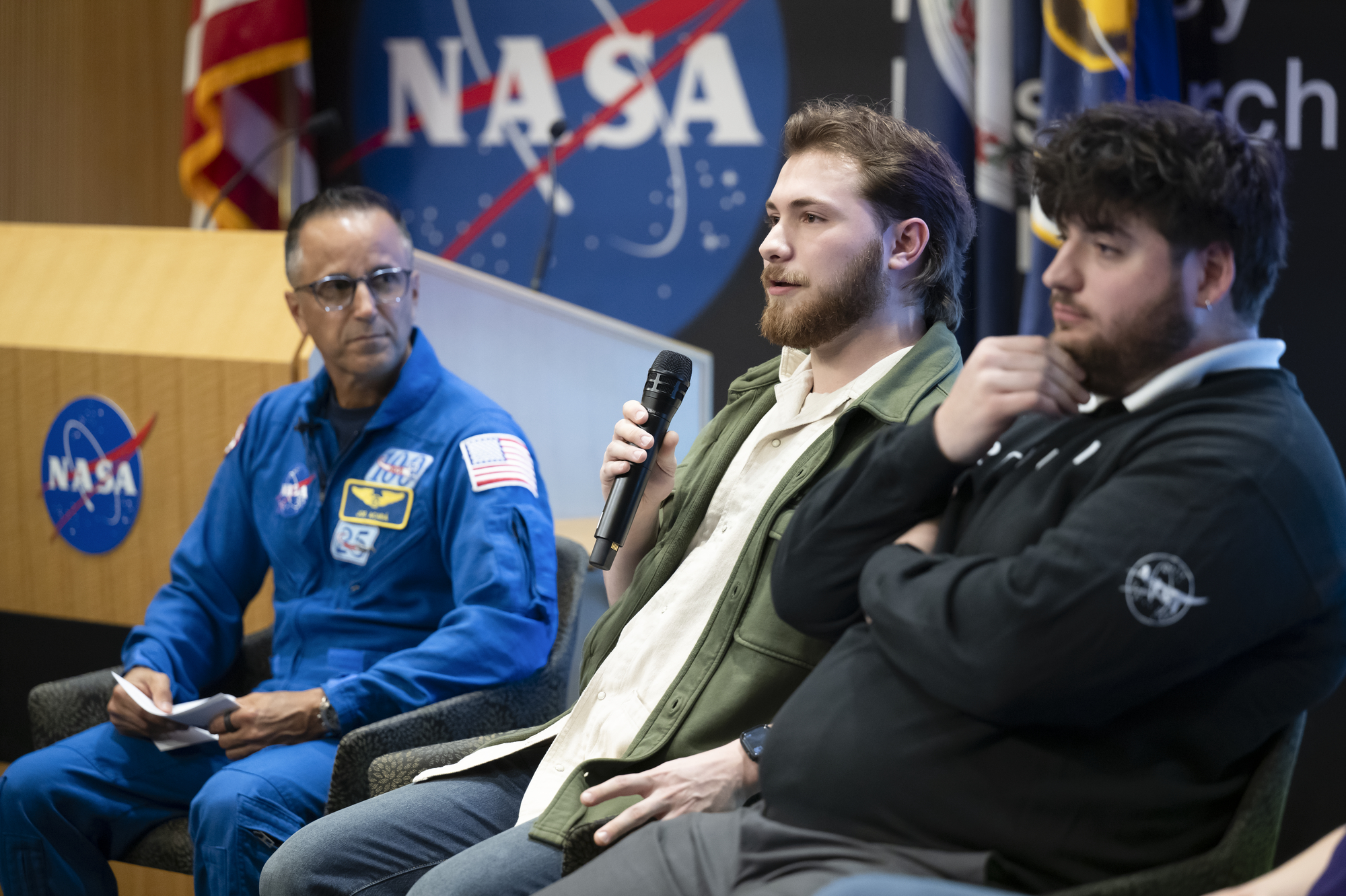
Wyatt Healy, mechanical engineering technician apprentice at NASA’s Langley Research Center, answers questions during a career panel featuring NASA Langley technician apprentices during Career Technical Education Day.
NASA/Ryan Hill

“A basic grasp of how software, systems, and even everyday items function goes a long way
as you progress in your technician journey,” said Wyatt Healy, mechanical engineering
technician apprentice at NASA Langley. “When you have those fundamentals down,
learning the more advanced concepts becomes much easier. It doesn’t happen overnigh
but with a strong foundation, the sky is the limit.”


By connecting students with NASA professionals, facilities, and hands-on experiences, the
event showcased a broad range of opportunities available in technical careers. It also
underscored NASA’s commitment to building a strong, skilled workforce equipped to
support the agency’s mission and tackle the challenges of tomorrow.


For more information about opportunities to connect students with NASA’s mission, work, and people, visit:

https://www.nasa.gov/learning-resources

Brittny McGraw
NASA Langley Research Center

The post NASA’s Career Technical Education Day Highlights Technical Careers appeared first on NASA Science.

NASA’s Career Technical Education Day Highlights Technical Careers

11 June 2026 at 17:21

3 min read

Preparations for Next Moonwalk Simulations Underway (and Underwater)

Students participate in a hands-on robotics demonstration during Career Technical Education Day at NASA’s Langley Research Center in Hampton, Virginia.
NASA/Mark Knopp

At NASA, remaining a global leader in exploration and innovation includes having a skilled
and dedicated workforce. Technicians play a critical role in advancing the agency’s
research and missions, applying hands-on expertise across engineering, fabrication,
electronics, and countless other technical fields.


To help cultivate the next generation of technical talent, NASA’s Office of STEM Engagement
hosted Career Technical Education Day recently at NASA’s Langley Research Center in
Hampton, Virginia. One hundred high school and community college students from Virginia
and North Carolina attended, eager to explore the technical career paths that help drive
NASA’s work.


“Many students picture NASA as only astronauts or engineers and therefore never consider
a career at NASA to be within their reach,” said Bonnie Murray, lead for the Office of STEM
Engagement at NASA Langley. “Bringing students from local career and technical
education programs to Langley allows them the opportunity to see technicians at work,
hear the pathways those technicians followed, and understand how the skills they are
developing in their related classes have a place in the NASA workforce.”


The event opened with remarks from NASA Langley’s Steve Gayle, who traced his path from
an engineering technician co-op in the center’s Fabrication Division and a graduate of
Langley’s Engineering Technician Apprentice Program to his current role as acting
associate director. Gayle encouraged students to embrace challenges, think critically, stay
curious, and create their own opportunities as they pursue their career goals.


“We need young, bright minds,” Gayle said. “At NASA, we rely on skilled hands-on
professionals — technicians who operate our wind tunnels, apply their skills in our
fabrication shops, and use their electronics knowledge to design, test, and build critical
systems.”

Students visit NASA Langley Research Center’s model shop during Career Technical Education Day to learn about the materials and techniques technicians use to build model aircraft and spacecraft.
NASA/Ryan Hill

Throughout the day, students toured several of Langley’s world-class facilities, including
the historic Landing and Impact Research Facility and one of the center’s wind tunnels. At
each stop, they received a behind-the-scenes look at the spaces where NASA technicians
build, test, and refine the tools and technologies that support the agency’s missions. The
technicians spoke with students about their work, their career paths, and the skills needed
to excel in technical roles.


Hands-on demonstrations and interactive activities lead by NASA technicians and
aerospace industry partners helped students connect their classroom experience with
real-world applications. Whether observing fabrication techniques, seeing instrumentation
up close, or engaging with engineering demonstrations, participants experienced how
STEM and technical skills directly translate into meaningful careers.


“Through events such as this, NASA seeks to prepare students for aerospace careers
through experiences and investments that strengthen research capacity, build technical
expertise, and expand reach in alignment with agency missions and needs,” Murray said.
The event ended with a career panel moderated by NASA astronaut Joe Acaba, associate
director of mission and strategy at NASA’s Johnson Space Center in Houston and former
math and science teacher. The panel featured four Langley technician apprentices who
shared insights into their roles and the value of strong foundational skills in technical
fields.

Wyatt Healy, mechanical engineering technician apprentice at NASA’s Langley Research Center, answers questions during a career panel featuring NASA Langley technician apprentices during Career Technical Education Day.
NASA/Ryan Hill

“A basic grasp of how software, systems, and even everyday items function goes a long way
as you progress in your technician journey,” said Wyatt Healy, mechanical engineering
technician apprentice at NASA Langley. “When you have those fundamentals down,
learning the more advanced concepts becomes much easier. It doesn’t happen overnight,
but with a strong foundation, the sky is the limit.”


By connecting students with NASA professionals, facilities, and hands-on experiences, the
event showcased a broad range of opportunities available in technical careers. It also
underscored NASA’s commitment to building a strong, skilled workforce equipped to
support the agency’s mission and tackle the challenges of tomorrow.


For more information about opportunities to connect students with NASA’s mission, work, and people, visit:

https://www.nasa.gov/learning-resources

Brittny McGraw
NASA Langley Research Center

Artemis 3 commander confident crew will be ready for 2027 mission

10 June 2026 at 23:22
Bresnik

The astronaut named commander of Artemis 3 is confident that his crew will be ready for what NASA has called one of its most complex missions in just a year.

The post Artemis 3 commander confident crew will be ready for 2027 mission appeared first on SpaceNews.

We managed to glean some interesting details about the Artemis III mission

10 June 2026 at 18:31

On Tuesday, NASA announced the crew for the Artemis III mission, which is scheduled to be flown no earlier than summer 2027. As part of the announcement, space agency officials also discussed plans for the crew to dock with both a Blue Origin lander and a SpaceX Starship lander during the spaceflight in low-Earth orbit.

The presentation, although informative, still left open key questions about the landers' readiness and what exactly they'll look like. After the crew announcement, Ars sat down with Jeremy Parsons, NASA's Artemis program manager, to answer some of these questions.

This interview, conducted at NASA's Johnson Space Center, has been lightly edited for clarity.

Read full article

Comments

© NASA/Aubrey Gemignani

NASA Selects Veteran Astronauts for Artemis III Mission

10 June 2026 at 14:46

Following the historic success of the Artemis II mission, NASA is preparing for the next step toward returning astronauts to the Moon. The agency has announced the four astronauts selected for the upcoming Artemis III mission. The crew will include three NASA astronauts – Andre Douglas, Frank Rubio, and Randy Bresnik. The fourth crew member […]

The post NASA Selects Veteran Astronauts for Artemis III Mission appeared first on AERONAUT.media.

La Nasa s’habille en Prada : la maison de luxe crée le sous-vêtement des futurs astronautes d'Artemis

10 June 2026 at 06:03
Après avoir habillé les podiums, Prada s’attaque désormais aux contraintes du vide spatial. La marque italienne a dévoilé un nouvel équipement destiné aux astronautes, fruit d’une collaboration avec l’industrie spatiale américaine.

❌