NASA Award Boosts Space Technology Research Capabilities
NASA is introducing a new funding opportunity to accelerate academic research and technology development. The Minority University Research and Education Project Space Technology Artemis Research (M‑STAR) application window opened Thursday and will remain open through 11:59 p.m. EDT on Tuesday, Aug. 11.
The research funded through this award supports the agency’s priorities for exploring the Moon, Mars, and deep space, while strengthening eligible institutions in the future of space exploration. Through M-STAR, institutions are encouraged to grow their scientific and engineering capabilities, enhance faculty and student engagement in aerospace research, and expand their ability to compete for future federal and commercial research awards.
Administered by NASA’s Office of STEM Engagement, this initiative contributes to NASA’s Space Technology Mission Directorate, and supports the agency’s broader mission to develop innovative technologies that improve space transportation, human exploration, robotic discovery, and the growing space economy.
NASA’s Office of STEM Engagement fosters an ecosystem across education, industry, and government to cultivate a well‑prepared talent pool, while the agency’s Space Technology Mission Directorate develops the transformative space technologies that enable future NASA missions and ensure U.S. leadership in aerospace. Together, they accelerate mission readiness by aligning cutting edge technological innovation with the workforce needed to carry it forward.
For complete eligibility information, help session registration, and to submit an M-STAR proposal, visit:
Operations Specialist, Mars Exploration Program, NASA Headquarters
Operations Specialist, Mars Exploration Program, NASA Headquarters
Lane Painter is an Operations Specialist supporting the Mars Exploration Program at NASA Headquarters in Washington, D.C.
His work focuses on advancing innovative robotic mobility capabilities, next-generation commercial space models, and international engagement that support NASA’s robotic science exploration of Mars, with the goal of enabling greater science return and exploration capability at lower cost.
Painter is a co-lead for NASA’s Mars Exploration Program Science Transport and Robotic Innovation for Deployment and Exploration, or STRIDE, an activity focused on assessing and maturing emerging commercial mobility systems, including surface and aerial robotic systems, that could support future Mars exploration missions.
Painter also serves on the leadership team for the International Mars Exploration Working Group, or IMEWG, supporting NASA’s engagement with the multilateral forum of space agencies and government institutions focused on coordinating shared Mars exploration priorities. Through this work, he helps facilitate international dialogue on robotic Mars exploration, science priorities, technology development, mission planning, and long-term cooperation across the global Mars exploration community.
Prior to joining the Mars Exploration Program, Painter was part of the University of Chicago’s Human-Robot Interaction Lab, where he supported research at the intersection of robotics and human-machine teaming.
Painter earned a bachelor’s degree in economics from the University of Chicago and a master’s degree in Industrial Systems, Manufacture, and Management from the Department of Engineering at the University of Cambridge in the United Kingdom.
NASA pushed its Deep Space Network beyond its limits during the Artemis I mission nearly four years ago. The global array of deep space communications antennas couldn't keep up with the routine demands of 40 robotic science missions and the extraordinary surge required by NASA's Orion space capsule as it flew around the Moon.
The experience in late 2022 reduced or delayed downlinks from several high-profile science missions, including the James Webb Space Telescope and Mars rovers, as the data-hungry Artemis I mission took priority on NASA's communications network. And that was before the first Artemis mission with astronauts onboard. When Artemis II launched April 1, NASA called upon the Deep Space Network (DSN) again to connect Mission Control to the Orion capsule as it soared more than a quarter of a million miles from Earth.
With a crew of four flying inside the spacecraft, the agency's appetite for data from Orion on Artemis II was even higher than it was on Artemis I. But at a little more than nine days, the Artemis II mission was shorter than the 25 days Artemis I spent in space, helping alleviate the communications overload. Artemis I also launched 10 small CubeSats into deep space, many of which required tracking and telecom services from the DSN. Artemis II carried fewer CubeSats.
The assignment of an ESA astronaut to Artemis 3 is part of negotiations for revised roles in the overall effort, with a goal of getting its astronauts on the moon.
NASA’s Career Technical Education Day Highlights Technical Careers
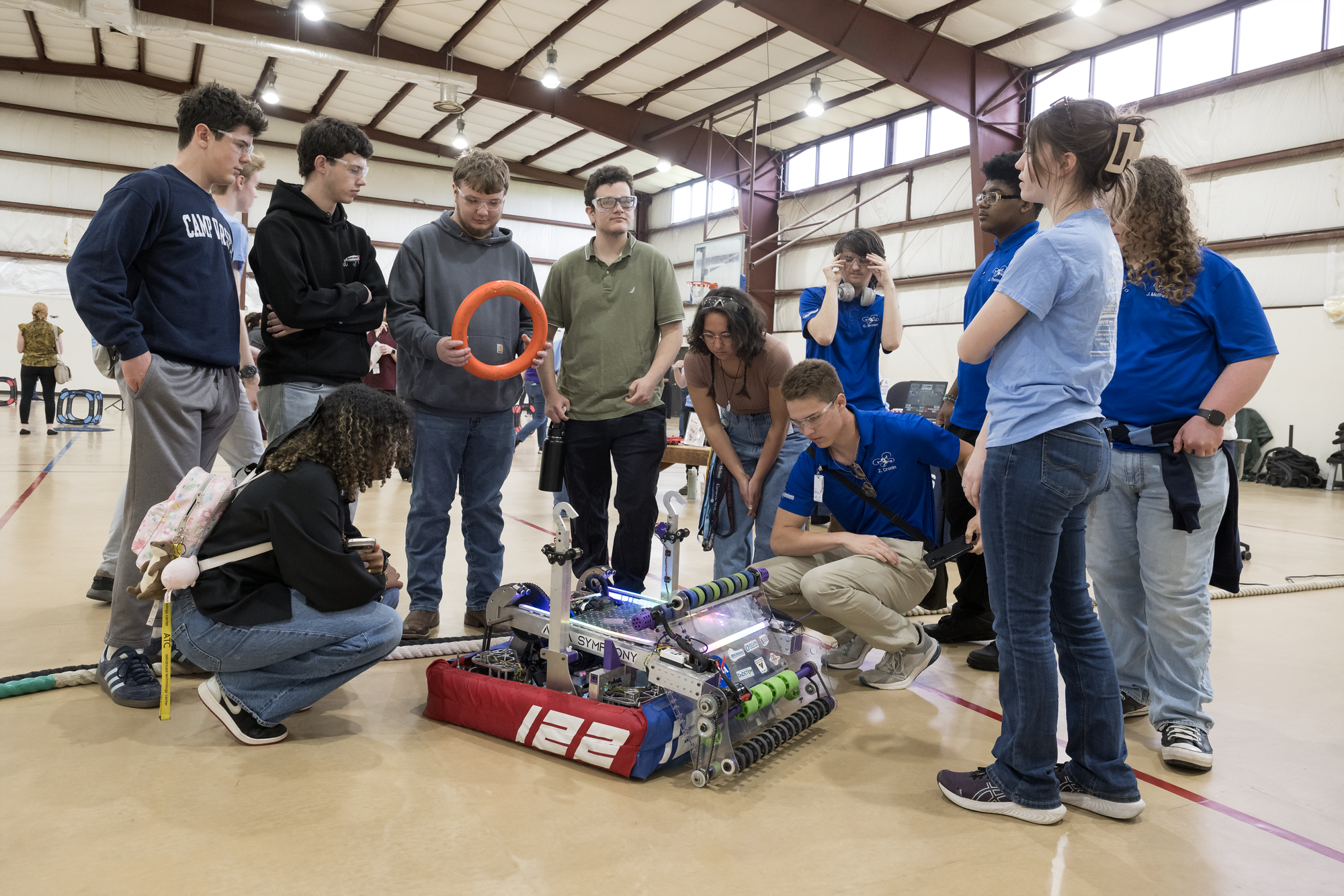
Students participate in a hands-on robotics demonstration during Career Technical Education Day at NASA’s Langley Research Center in Hampton, Virginia.
NASA/Mark Knopp
At NASA, remaining a global leader in exploration and innovation includes having a skilled and dedicated workforce. Technicians play a critical role in advancing the agency’s research and missions, applying hands-on expertise across engineering, fabrication, electronics, and countless other technical fields.
To help cultivate the next generation of technical talent, NASA’s Office of STEM Engagement hosted Career Technical Education Day recently at NASA’s Langley Research Center in Hampton, Virginia. One hundred high school and community college students from Virginia and North Carolina attended, eager to explore the technical career paths that help drive NASA’s work.
“Many students picture NASA as only astronauts or engineers and therefore never consider a career at NASA to be within their reach,” said Bonnie Murray, lead for the Office of STEM Engagement at NASA Langley. “Bringing students from local career and technical education programs to Langley allows them the opportunity to see technicians at work, hear the pathways those technicians followed, and understand how the skills they are developing in their related classes have a place in the NASA workforce.”
The event opened with remarks from NASA Langley’s Steve Gayle, who traced his path from an engineering technician co-op in the center’s Fabrication Division and a graduate of Langley’s Engineering Technician Apprentice Program to his current role as acting associate director. Gayle encouraged students to embrace challenges, think critically, stay curious, and create their own opportunities as they pursue their career goals.
“We need young, bright minds,” Gayle said. “At NASA, we rely on skilled hands-on professionals — technicians who operate our wind tunnels, apply their skills in our fabrication shops, and use their electronics knowledge to design, test, and build critical systems.”
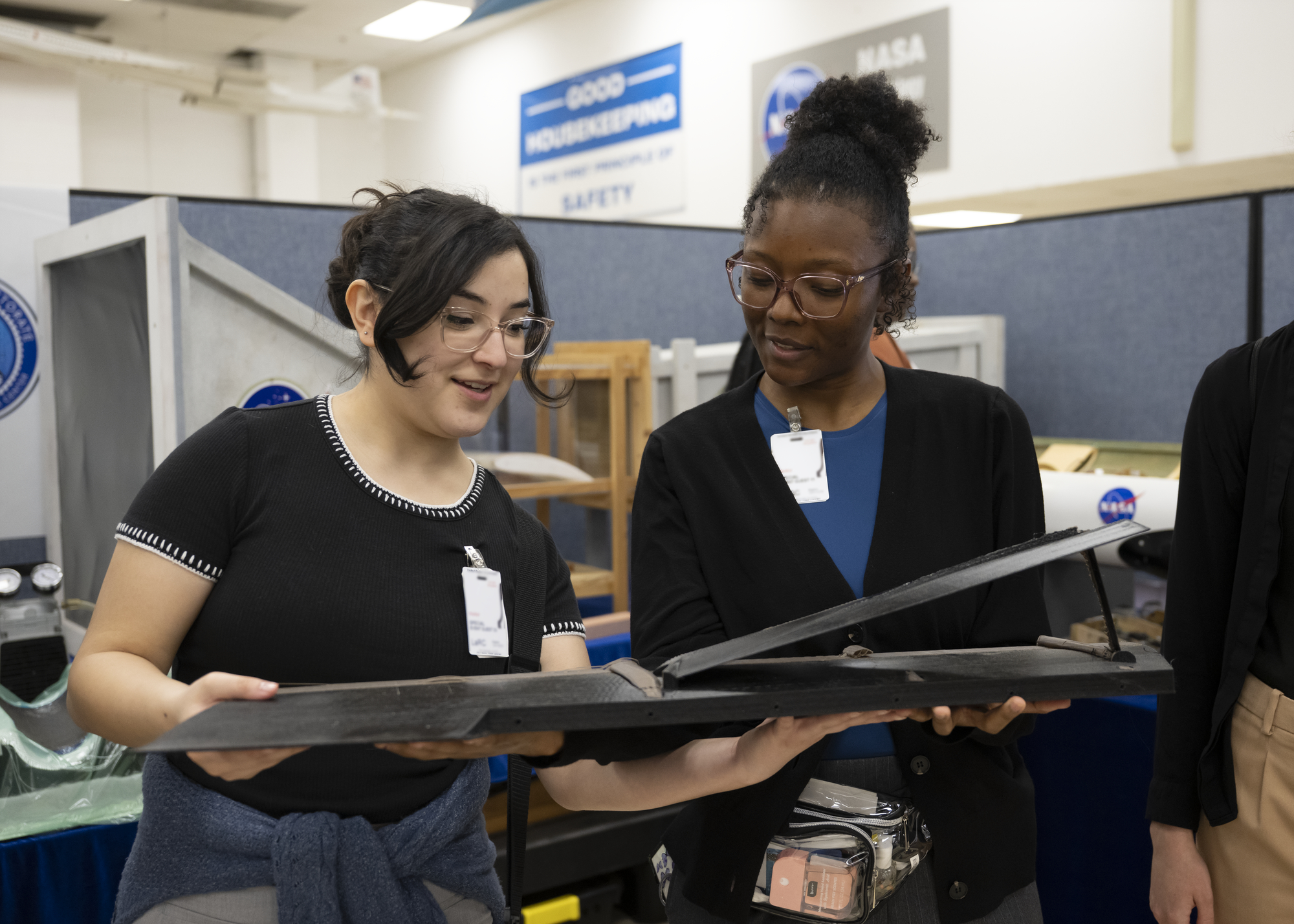
Students visit NASA Langley Research Center’s model shop during Career Technical Education Day to learn about the materials and techniques technicians use to build model aircraft and spacecraft.
NASA/Ryan Hill
Throughout the day, students toured several of Langley’s world-class facilities, including the historic Landing and Impact Research Facility and one of the center’s wind tunnels. At each stop, they received a behind-the-scenes look at the spaces where NASA technicians build, test, and refine the tools and technologies that support the agency’s missions. The technicians spoke with students about their work, their career paths, and the skills needed to excel in technical roles.
Hands-on demonstrations and interactive activities lead by NASA technicians and aerospace industry partners helped students connect their classroom experience with real-world applications. Whether observing fabrication techniques, seeing instrumentation up close, or engaging with engineering demonstrations, participants experienced how STEM and technical skills directly translate into meaningful careers.
“Through events such as this, NASA seeks to prepare students for aerospace careers through experiences and investments that strengthen research capacity, build technical expertise, and expand reach in alignment with agency missions and needs,” Murray said. The event ended with a career panel moderated by NASA astronaut Joe Acaba, associate director of mission and strategy at NASA’s Johnson Space Center in Houston and former math and science teacher. The panel featured four Langley technician apprentices who shared insights into their roles and the value of strong foundational skills in technical fields.
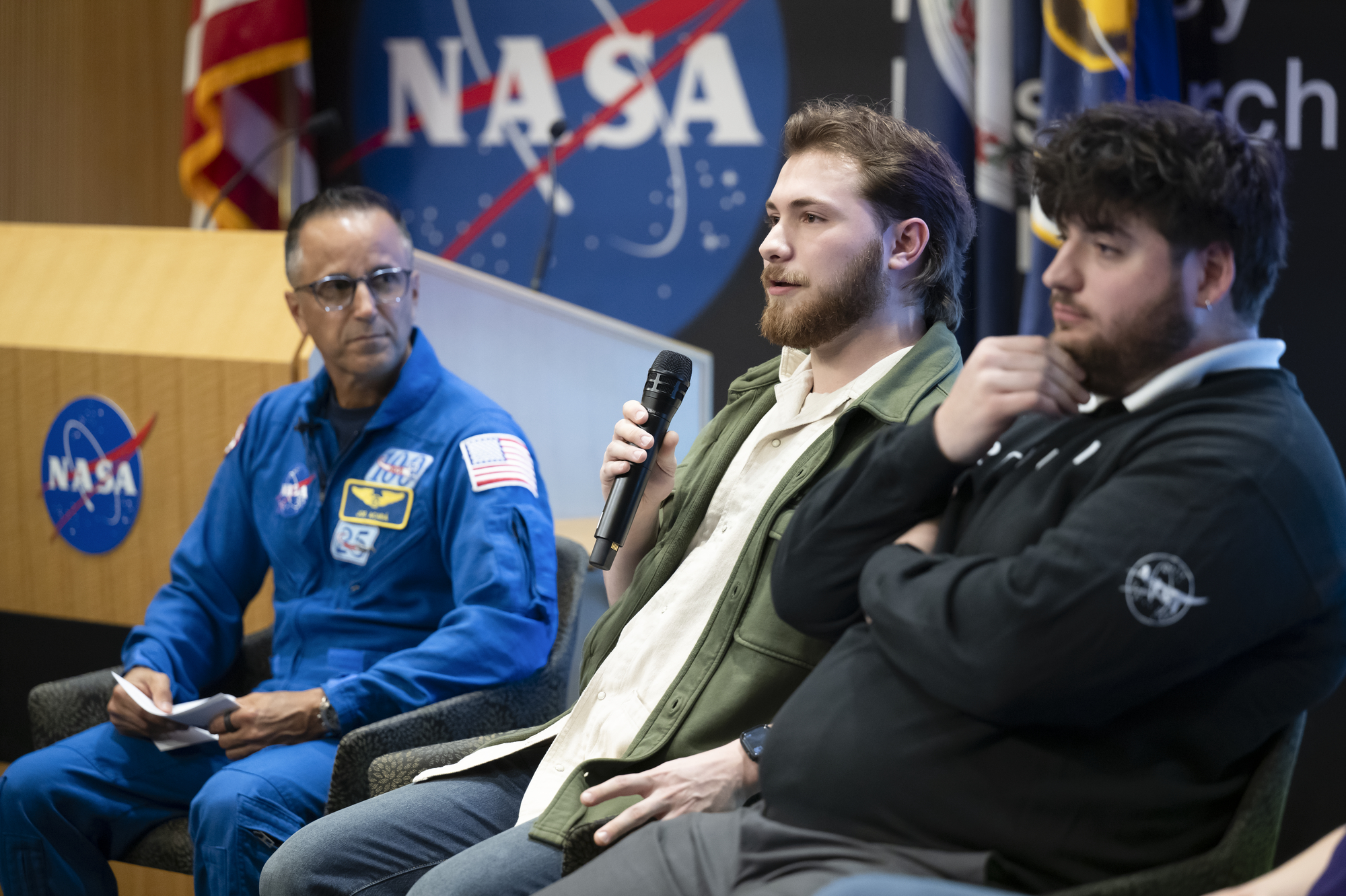
Wyatt Healy, mechanical engineering technician apprentice at NASA’s Langley Research Center, answers questions during a career panel featuring NASA Langley technician apprentices during Career Technical Education Day.
NASA/Ryan Hill
“A basic grasp of how software, systems, and even everyday items function goes a long way as you progress in your technician journey,” said Wyatt Healy, mechanical engineering technician apprentice at NASA Langley. “When you have those fundamentals down, learning the more advanced concepts becomes much easier. It doesn’t happen overnigh but with a strong foundation, the sky is the limit.”
By connecting students with NASA professionals, facilities, and hands-on experiences, the event showcased a broad range of opportunities available in technical careers. It also underscored NASA’s commitment to building a strong, skilled workforce equipped to support the agency’s mission and tackle the challenges of tomorrow.
For more information about opportunities to connect students with NASA’s mission, work, and people, visit:
Preparations for Next Moonwalk Simulations Underway (and Underwater)
Students participate in a hands-on robotics demonstration during Career Technical Education Day at NASA’s Langley Research Center in Hampton, Virginia.
NASA/Mark Knopp
At NASA, remaining a global leader in exploration and innovation includes having a skilled and dedicated workforce. Technicians play a critical role in advancing the agency’s research and missions, applying hands-on expertise across engineering, fabrication, electronics, and countless other technical fields.
To help cultivate the next generation of technical talent, NASA’s Office of STEM Engagement hosted Career Technical Education Day recently at NASA’s Langley Research Center in Hampton, Virginia. One hundred high school and community college students from Virginia and North Carolina attended, eager to explore the technical career paths that help drive NASA’s work.
“Many students picture NASA as only astronauts or engineers and therefore never consider a career at NASA to be within their reach,” said Bonnie Murray, lead for the Office of STEM Engagement at NASA Langley. “Bringing students from local career and technical education programs to Langley allows them the opportunity to see technicians at work, hear the pathways those technicians followed, and understand how the skills they are developing in their related classes have a place in the NASA workforce.”
The event opened with remarks from NASA Langley’s Steve Gayle, who traced his path from an engineering technician co-op in the center’s Fabrication Division and a graduate of Langley’s Engineering Technician Apprentice Program to his current role as acting associate director. Gayle encouraged students to embrace challenges, think critically, stay curious, and create their own opportunities as they pursue their career goals.
“We need young, bright minds,” Gayle said. “At NASA, we rely on skilled hands-on professionals — technicians who operate our wind tunnels, apply their skills in our fabrication shops, and use their electronics knowledge to design, test, and build critical systems.”
Students visit NASA Langley Research Center’s model shop during Career Technical Education Day to learn about the materials and techniques technicians use to build model aircraft and spacecraft.
NASA/Ryan Hill
Throughout the day, students toured several of Langley’s world-class facilities, including the historic Landing and Impact Research Facility and one of the center’s wind tunnels. At each stop, they received a behind-the-scenes look at the spaces where NASA technicians build, test, and refine the tools and technologies that support the agency’s missions. The technicians spoke with students about their work, their career paths, and the skills needed to excel in technical roles.
Hands-on demonstrations and interactive activities lead by NASA technicians and aerospace industry partners helped students connect their classroom experience with real-world applications. Whether observing fabrication techniques, seeing instrumentation up close, or engaging with engineering demonstrations, participants experienced how STEM and technical skills directly translate into meaningful careers.
“Through events such as this, NASA seeks to prepare students for aerospace careers through experiences and investments that strengthen research capacity, build technical expertise, and expand reach in alignment with agency missions and needs,” Murray said. The event ended with a career panel moderated by NASA astronaut Joe Acaba, associate director of mission and strategy at NASA’s Johnson Space Center in Houston and former math and science teacher. The panel featured four Langley technician apprentices who shared insights into their roles and the value of strong foundational skills in technical fields.
Wyatt Healy, mechanical engineering technician apprentice at NASA’s Langley Research Center, answers questions during a career panel featuring NASA Langley technician apprentices during Career Technical Education Day.
NASA/Ryan Hill
“A basic grasp of how software, systems, and even everyday items function goes a long way as you progress in your technician journey,” said Wyatt Healy, mechanical engineering technician apprentice at NASA Langley. “When you have those fundamentals down, learning the more advanced concepts becomes much easier. It doesn’t happen overnight, but with a strong foundation, the sky is the limit.”
By connecting students with NASA professionals, facilities, and hands-on experiences, the event showcased a broad range of opportunities available in technical careers. It also underscored NASA’s commitment to building a strong, skilled workforce equipped to support the agency’s mission and tackle the challenges of tomorrow.
For more information about opportunities to connect students with NASA’s mission, work, and people, visit:
Depuis leur découverte par le télescope James-Webb, les « petits points rouges » défient les astronomes. Une nouvelle observation, presque par hasard, pourrait enfin lever le voile sur leur véritable nature.
The astronaut named commander of Artemis 3 is confident that his crew will be ready for what NASA has called one of its most complex missions in just a year.
On Tuesday, NASA announced the crew for the Artemis III mission, which is scheduled to be flown no earlier than summer 2027. As part of the announcement, space agency officials also discussed plans for the crew to dock with both a Blue Origin lander and a SpaceX Starship lander during the spaceflight in low-Earth orbit.
The presentation, although informative, still left open key questions about the landers' readiness and what exactly they'll look like. After the crew announcement, Ars sat down with Jeremy Parsons, NASA's Artemis program manager, to answer some of these questions.
This interview, conducted at NASA's Johnson Space Center, has been lightly edited for clarity.
Following the historic success of the Artemis II mission, NASA is preparing for the next step toward returning astronauts to the Moon. The agency has announced the four astronauts selected for the upcoming Artemis III mission. The crew will include three NASA astronauts – Andre Douglas, Frank Rubio, and Randy Bresnik. The fourth crew member […]
La Nasa et l'ESA ont annoncé hier soir la composition de l'équipage d'Artemis III : l'astronaute italien Luca Parmitano en sera le pilote. Une première européenne saluée des deux côtés de l'Atlantique. Il y a ce que le communiqué dit… et ce qu'il tait. Notre analyse.
Après avoir habillé les podiums, Prada s’attaque désormais aux contraintes du vide spatial. La marque italienne a dévoilé un nouvel équipement destiné aux astronautes, fruit d’une collaboration avec l’industrie spatiale américaine.
When NASA added a low Earth orbit test flight to the Artemis program in February, pushing the lunar landing from Artemis 3 to Artemis 4, it left the details sparse. On Tuesday, the agency filled them in. At a press conference, NASA named the four-person crew for Artemis 3, a 2027 Earth-orbit test flight thatContinue reading "Meet the astronauts flying on Artemis 3"
Il telescopio spaziale James Webb sta offrendo una visione senza precedenti dell’universo primordiale grazie alla sua capacità di osservare la luce infrarossa proveniente da oggetti estremamente lontani. Tra le sue scoperte più sorprendenti figurano galassie molto luminose e apparentemente mature esistite poche centinaia di milioni di anni dopo il Big Bang. Queste osservazioni hanno acceso un intenso dibattito scientifico, poiché suggeriscono che la crescita delle prime strutture cosmiche potrebbe essere avvenuta più rapidamente del previsto. Sebbene analisi successive abbiano ridimensionato alcune delle stime iniziali, Webb continua a fornire dati che stanno portando gli astronomi a perfezionare le teorie sulla formazione delle galassie, dei buchi neri supermassicci e dell’universo delle origini.
NASA has named the astronauts who will fly the next Artemis mission, a test flight in low Earth orbit where Orion will attempt to dock with two lunar lander prototypes.
The US space agency unveiled the crew for its Artemis III mission on Tuesday during an enthusiastic event at Johnson Space Center in Houston.
For this spaceflight into low-Earth orbit, which will see the Orion spacecraft rendezvous and dock with lunar lander prototypes, NASA chose an experienced, all-male crew with military backgrounds. They were revealed inside a darkened Teague Auditorium where hundreds of friends, family members, and NASA employees cheered enthusiastically.
NASA officials have completed an investigation into an incident that caused damage to a 70-meter radio frequency antenna last year.
The incident, which occurred at the Goldstone Deep Space Communications Complex near Barstow, California, affected the space agency’s Deep Space Station 14 (DSS-14), a 70-meter radio-frequency antenna, which currently remains offline awaiting repairs and system upgrades.
Joel Montalbano, acting associate administrator for NASA’s Space Operations Mission Directorate, emphasized that the agency “takes safety and any departure from established procedures seriously,” adding that investigations into the incident at Goldstone “made clear that we must strengthen our processes. We are acting on the investigation’s findings.”
Incident at Goldstone
The damage was caused last September 16, 2025, when the antenna reportedly over-extended during rotation during tracking for NASA’s Juno mission. Stress on the antenna’s cabling and support infrastructure, as well as damage to its fire-suppression system, is expected to cost between $4.1 and $4.6 million in repairs.
Fortunately, no injuries were reported at the time of the incident, and a Mishap Investigation Board was convened to investigate the underlying causes. Following on-site inspections, interviews, and reviews of technical documentation from NASA’s three Deep Space Network facilities, the results of the investigation were included in a report submitted in April, which also made recommendations on how to prevent future incidents.
Software Issues
A primary factor behind the incident had been what the reports’ authors characterize as “software weaknesses, human error, and an undetected failure in the antenna’s hydraulic limit system,” according to a recent NASA statement.
“Investigators determined an electrical issue at the antenna the previous day caused the control system to misreport the antenna’s rotation state, an issue that went unnoticed and triggered multiple limit-stops during the Juno track,” the statement added.
Over-rotation of the antenna resulted after flooding in the antenna base was spotted by operators, following troubleshooting efforts that accidentally bypassed safeguards in the system’s hardware and software.
Investigators also determined that the antenna’s hydraulic limit system had already been rendered inoperable before the September 16 incident, following damage sustained “in an undocumented prior incident.”
Modernization for Future Missions
On June 5, Montalbano emphasized that NASA plans to follow the guidance in the review board’s report, with a focus on ensuring greater adherence to procedures to help limit the likelihood of future mishaps.
“We will update and improve procedures, rebuild core in-house capabilities, and reinforce operational discipline across the Deep Space Network,” Montalbano said.
“NASA remains focused on learning from this and modernizing systems, so DSS-14 and the broader network are ready to support our ambitious future missions,” he added.
Micah Hanks is the Editor-in-Chief and Co-Founder of The Debrief. A longtime reporter on science, defense, and technology with a focus on space and astronomy, he can be reached atmicah@thedebrief.org. Follow him on X @MicahHanks, and at micahhanks.com.
Andre Douglas, Frank Rubio, Randy Bresnik (NASA) e Luca Parmitano (ESA) são os nomes dos astronautas selecionados pela agência espacial norte-americana para participar na Artemis III, prevista para 2027. Desta vez não há nenhuma mulher na tripulação.

 Login