Elon Musk’s rocket company said it would sell more than 555 million shares at $135 each in its blockbuster initial public offering, which is set to begin trading on Friday.
Two Times tech reporters and their editor talk about assessing the sky-high valuation of the rocket and satellite maker, the potential economic impact of its public debut and the role of the world’s richest man in it all.
Elon Musk’s rocket company is spending big and losing money. That has raised questions about whether it can justify its valuation for its blockbuster initial public offering.
Born in 1888, artist and illustrator Chesley Bonestell became famous for his realistic paintings of space. His work spanned decades and many formats and publications; perhaps most influential was his collaboration with Wernher von Brain on the 1952–54 Collier’s series, “Man Will Conquer Space Soon!” By making the stuff of science fiction seem achievable, his artwork helpedContinue reading "June 11, 1986: Chesley Bonestell dies"
Investors who bought the automaker’s shares in its initial public offering became rich. As a result, many have a deep faith in Elon Musk, the chief executive of Tesla and SpaceX.
When NASA added a low Earth orbit test flight to the Artemis program in February, pushing the lunar landing from Artemis 3 to Artemis 4, it left the details sparse. On Tuesday, the agency filled them in. At a press conference, NASA named the four-person crew for Artemis 3, a 2027 Earth-orbit test flight thatContinue reading "Meet the astronauts flying on Artemis 3"
NASA’s Artemis program has little room for error if it is to land astronauts on the moon by the end of 2028, but Blue Origin could be out of commission for at least a year.
NASA astronaut Jessica Meir captured a breathtaking view of auroras on Earth from orbit while sheltering with her fellow astronauts in a SpaceX Dragon spacecraft.
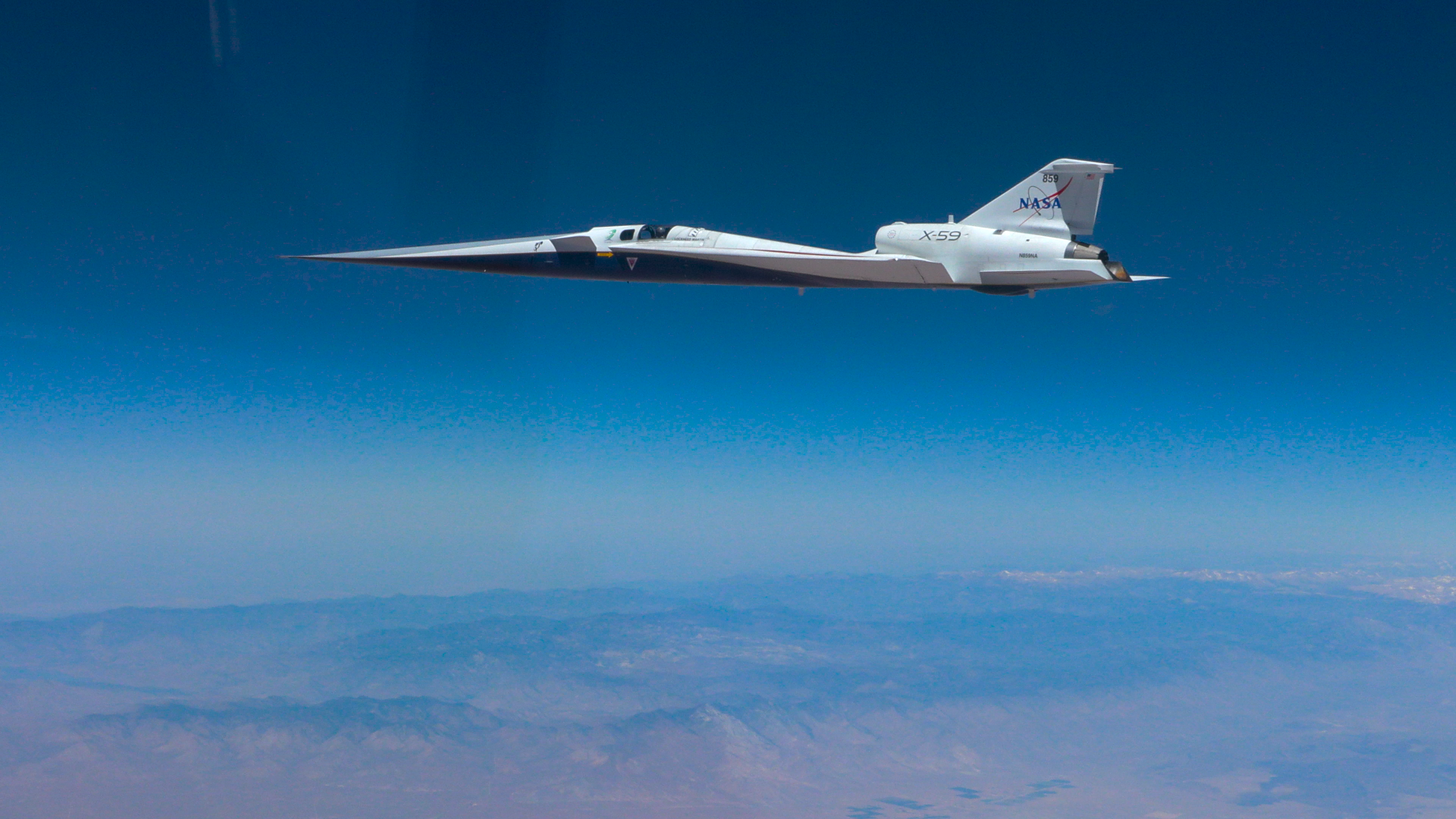
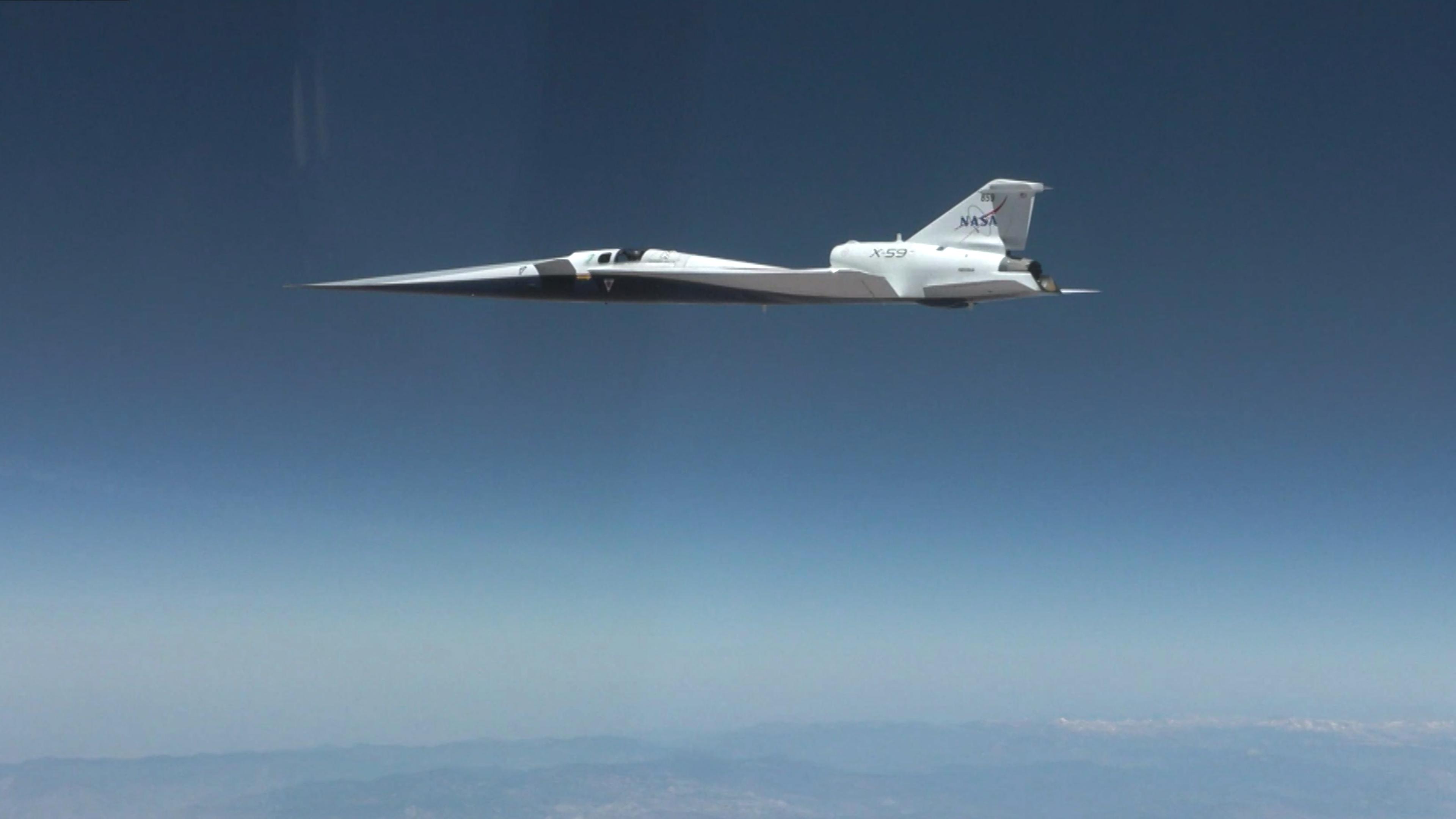
NASA’s X-59 quiet supersonic research aircraft completed its first supersonic flight Friday, June 5, 2026, marking the first time the aircraft exceeded the speed of sound in support of NASA’s Quesst mission. The milestone represents a major step in flight testing as the aircraft expands into the supersonic portion of its flight envelope.
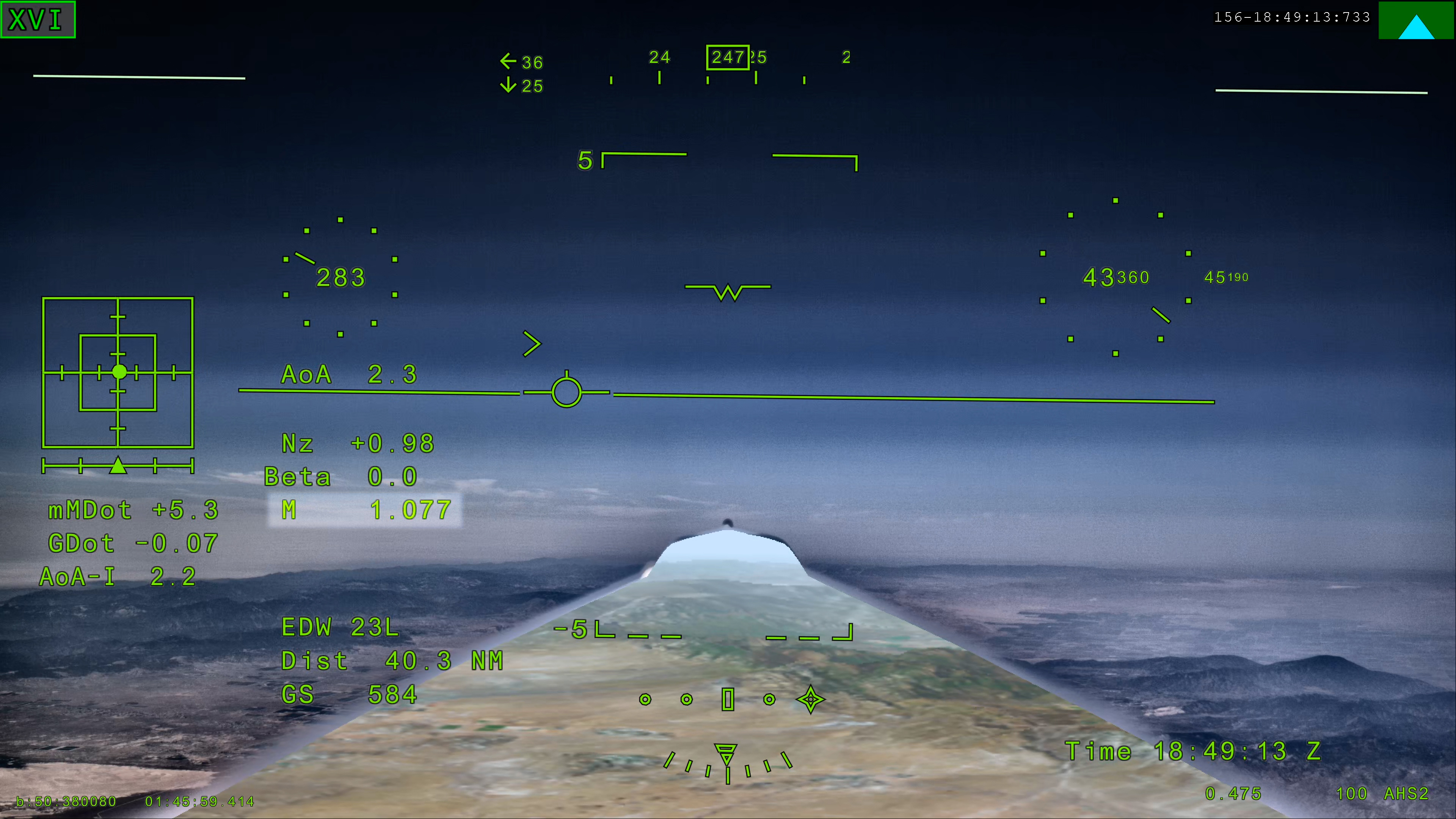
The 81-minute flight achieved a speed of Mach 1.1 (approximately 713 mph) at an altitude of 43,400 feet, with the X-59 performing as expected. For NASA test pilot Jim “Clue” Less, the plane’s instruments were the only indication of flying supersonic — exactly what the team wanted.
“You know you are supersonic when gauges say you are supersonic. I didn’t feel anything,” Less said. “It went smoothly, and we easily got to Mach 1.1.”
The X-59 is designed to fly at supersonic speeds while creating only a quiet thump instead of a loud sonic boom. For this flight, a NASA F‑15 chase plane flew nearby to monitor the test. Its loud sonic booms obscured any sound made by the X-59. The X-59 will conduct flights focused on its sound profile during a later phase of testing.
Now that the X-59 has officially kicked off supersonic flight tests, the next big step is its first mission conditions flight. During this test, the X-59 will fly at the same speed and altitude planned for future tests, where the aircraft will fly over several U.S. communities to gather data from people on the ground about its noise levels: Mach 1.4 (925 mph) at 55,000 feet.
“The plane wants to go faster, and we are looking forward to that,” Less said.
The X-59 is the centerpiece of NASA’s Quesst mission, which aims to demonstrate quieter supersonic flight and to help enable commercial supersonic flight over land.
Rocket launches this week According to tracking from Next SpaceFlight, Chinese aerospace firm Landspace’s ZhuQue-2E Block 2 is scheduled to lift off from the Jiuquan Satellite Launch Center in China at 4:20 a.m. EST on Tuesday, June 9. The ZhuQue-2E is a medium-lift rocket powered by liquid oxygen and methane — the first methane-fueled vehicleContinue reading "SpaceX and Rocket Lab set for liftoff this week"
"If a major meteor shower outburst or storm is forecast during a mission or crew activity, the mission would be delayed or the crew kept inside until the outburst or storm is over."
NASA’s X-59 Aircraft Flies Supersonic for First Time
NASA’s X 59 eXternal Vision System shows Mach 1.077 on Friday, June 5, 2026, marking the aircraft’s first time reaching supersonic speed in support of NASA’s Quesst mission. The moment represents a milestone for the aircraft as it transitions to include test flights faster than the speed of sound.
NASA
NASA’s experimentalX-59 aircraft marked a major milestone Friday, June 5, when it flew faster than the speed of sound for the first time, setting the stage for demonstrating its quiet supersonic capabilities later this year.
NASA test pilot Jim “Clue” Less took off and landed at Edwards Air Force Base in California, reaching a top speed of approximately Mach 1.1 (713 mph) and altitude of 43,400 feet. The X-59’s flight began at 11:08 a.m. PDT and lasted 81 minutes, with the team focusing on flying qualities at both subsonic and then supersonic speeds.
In the coming days, we expect to take the next step and push to Mach 1.4
jared isaacman
NASA Administrator
”X-59 is getting ready for its quiet supersonic debut. Since the aircraft’s first flight on Oct. 28, 2025, the team has made tremendous progress, flying 16 times in the last 90 days and getting into a steady test rhythm. In the coming days, we expect to take the next step and push to Mach 1.4,” said NASA Administrator Jared Isaacman “I’m grateful to the NASA team and Lockheed Martin Skunk Works for their help getting us to this point, and I hope this is the first of many collaborations as we rebuild NASA’s X-plane portfolio.”
The X-59 is designed to fly at supersonic speeds while creating only a quiet thump instead of a loud sonic boom. For this flight, a NASA F‑15 chase plane flew nearby to monitor the X‑59. The loud sonic booms from the F-15 obscured any sound made by the X-59.
“The X-59’s first supersonic flight is a testament to America’s enduring leadership in science, engineering, and aerospace innovation,” said Michael Kratsios, Assistant to the President for Science and Technology and Director of the Office of Science and Technology Policy. “This achievement comes as the Trump Administration continues work to unleash supersonic flight and enable American ingenuity.”
This first supersonic flight is a significant milestone, but an event even more critical to the mission is upcoming. In just days, the aircraft is expected to make its first “mission conditions” flight, reaching a cruising speed of Mach 1.4 (925 mph) and altitude of approximately 55,000 feet. The X-59 also will be accompanied by a chase plane for this flight.
NASA’s X-59 quiet supersonic research aircraft completed its first supersonic flight Friday, June 5, 2026, marking the first time the aircraft exceeded the speed of sound in support of NASA’s Quesst mission. The milestone represents a major step in flight testing as the aircraft expands into the supersonic portion of its flight envelope.
NASA / Lori Losey
This speed and altitude are the base conditions for the X-59 when it will eventually fly over several U.S. communities enabling NASA to gather data about how people may perceive its quiet thump. NASA will share this data with U.S. and international regulators to help establish new data-driven noise standards to enable a future viable market for supersonic commercial flight over land.
For the last several months, the X-59 has been participating in an ongoing series of flights where the plane has been flying at a wide range of speeds and altitudes – a process known as envelope expansion. These tests are the first phase of the X-59’s flight testing. They are focused on performance and involve chase plane monitoring. When the aircraft completes this phase it will enter another, focused on its sound profile in order to verify its quiet thump capability.
The X-59 is the centerpiece of NASA’s Quesst mission, which aims to demonstrate quiet supersonic flight and help enable commercial supersonic flight over land worldwide. These advancements will help travelers reach their preferred destinations faster, spending less time in the air.
Through Quesst’s development of the X-59, NASA also will deliver design tools and technology for quiet supersonic airliners that will achieve the high speeds desired by commercial operators without disturbing people on the ground. NASA will validate design tools through ground and flight testing, providing U.S. aircraft manufacturers the ability to explore new quiet supersonic concepts, and provide them with confidence that their resulting designs will meet quiet flight requirements.
Preparations for Next Moonwalk Simulations Underway (and Underwater)
NASA’s X-59 eXternal Vision System shows Mach 1.077 on Friday, June 5, 2026, marking the aircraft’s first time reaching supersonic speed in support of NASA’s Quesst mission. The moment represents a milestone for the aircraft as it transitions to include test flights faster than the speed of sound.
NASA
NASA’s experimentalX-59 aircraft marked a major milestone Friday, June 5, when it flew faster than the speed of sound for the first time, setting the stage for demonstrating its quiet supersonic capabilities later this year.
NASA test pilot Jim “Clue” Less took off and landed at Edwards Air Force Base in California, reaching a top speed of approximately Mach 1.1 (713 mph) and altitude of 43,400 feet. The X-59’s flight began at 11:08 a.m. PDT and lasted 81 minutes, with the team focusing on flying qualities at both subsonic and then supersonic speeds.
In the coming days, we expect to take the next step and push to Mach 1.4
jared isaacman
NASA Administrator
”X-59 is getting ready for its quiet supersonic debut. Since the aircraft’s first flight on Oct. 28, 2025, the team has made tremendous progress, flying 16 times in the last 90 days and getting into a steady test rhythm. In the coming days, we expect to take the next step and push to Mach 1.4,” said NASA Administrator Jared Isaacman “I’m grateful to the NASA team and Lockheed Martin Skunk Works for their help getting us to this point, and I hope this is the first of many collaborations as we rebuild NASA’s X-plane portfolio.”
The X-59 is designed to fly at supersonic speeds while creating only a quiet thump instead of a loud sonic boom. For this flight, a NASA F‑15 chase plane flew nearby to monitor the X‑59. The loud sonic booms from the F-15 obscured any sound made by the X-59.
“The X-59’s first supersonic flight is a testament to America’s enduring leadership in science, engineering, and aerospace innovation,” said Michael Kratsios, Assistant to the President for Science and Technology and Director of the Office of Science and Technology Policy. “This achievement comes as the Trump Administration continues work to unleash supersonic flight and enable American ingenuity.”
This first supersonic flight is a significant milestone, but an event even more critical to the mission is upcoming. In just days, the aircraft is expected to make its first “mission conditions” flight, reaching a cruising speed of Mach 1.4 (925 mph) and altitude of approximately 55,000 feet. The X-59 also will be accompanied by a chase plane for this flight.
NASA’s X-59 quiet supersonic research aircraft completed its first supersonic flight Friday, June 5, 2026, marking the first time the aircraft exceeded the speed of sound in support of NASA’s Quesst mission. The milestone represents a major step in flight testing as the aircraft expands into the supersonic portion of its flight envelope.
NASA / Lori Losey
This speed and altitude are the base conditions for the X-59 when it will eventually fly over several U.S. communities enabling NASA to gather data about how people may perceive its quiet thump. NASA will share this data with U.S. and international regulators to help establish new data-driven noise standards to enable a future viable market for supersonic commercial flight over land.
For the last several months, the X-59 has been participating in an ongoing series of flights where the plane has been flying at a wide range of speeds and altitudes – a process known as envelope expansion. These tests are the first phase of the X-59’s flight testing. They are focused on performance and involve chase plane monitoring. When the aircraft completes this phase it will enter another, focused on its sound profile in order to verify its quiet thump capability.
The X-59 is the centerpiece of NASA’s Quesst mission, which aims to demonstrate quiet supersonic flight and help enable commercial supersonic flight over land worldwide. These advancements will help travelers reach their preferred destinations faster, spending less time in the air.
Through Quesst’s development of the X-59, NASA also will deliver design tools and technology for quiet supersonic airliners that will achieve the high speeds desired by commercial operators without disturbing people on the ground. NASA will validate design tools through ground and flight testing, providing U.S. aircraft manufacturers the ability to explore new quiet supersonic concepts, and provide them with confidence that their resulting designs will meet quiet flight requirements.
NASA’s X-59 quiet supersonic research aircraft completed its first supersonic flight Friday, June 5, 2026, marking the first time the aircraft exceeded the s...
NASA has told crew aboard the International Space Station (ISS) to resume normal operations, ending a roughly two-hour period in which five astronauts sheltered inside a docked SpaceX capsule. The shelter order came Friday morning as a precautionary measure to protect crew while Russian cosmonauts attempted a fix on the Zvezda service module’s transfer tunnelContinue reading "ISS crew back to normal after emergency shelter order"

 Login